


Judges 17:1
Bible text: King James Version (1769 Blayney text) · Public domain
Bible text: Berean Standard Bible · Public domain
Bible text: American Standard Version (1901) · Public domain
Bible text: World English Bible, Messianic edition · Public domain
Bible text: Geneva Bible (1599) · Public domain
Bible text: Young's Literal Translation · Public domain
- וַיְהִיvay·hiand he wasH1961Conj-w ¦ V-Qal-ConsecImperf-3msVerb Qal Consecutive Imperfect 3rd Singular Masculineוַandיְהִיhe was
- אִישׁ'isha manH376N-msNoun Singular Masculine Absolute
- מֵהַרme·harfrom [the] hill country ofH2022Prep-m ¦ N-mscNoun Singular Masculine Constructמֵfromהַר[the] hill country of
- אֶפְרָיִם'ef·Ra·yimEphraimH669N-proper-mNoun Proper Masculine
- וּשְׁמוֹu·she·Moand his nameH8034Conj-w ¦ N-msc ¦ 3msNoun Singular Masculine Constructוּandשְׁמnameוֹhis
- מִיכָיְהוּmi·Kha·ye·hu[was] MicaiahH4321N-proper-mNoun Proper Masculine
English is a literal word-by-word gloss of the Hebrew, not the KJV's wording. Why?
This is the original text the KJV's translators worked from — each Hebrew word with its own literal English meaning in this verse, prepared by scholars at Tyndale House, Cambridge. The KJV translates whole sentences, not word by word, so its wording differs: one Hebrew word can become several English words, and the KJV may choose “the LORD” where the gloss reads “Yahweh”. Both are faithful — they answer different questions. For the KJV's own rendering, switch to the KJV text.
Details
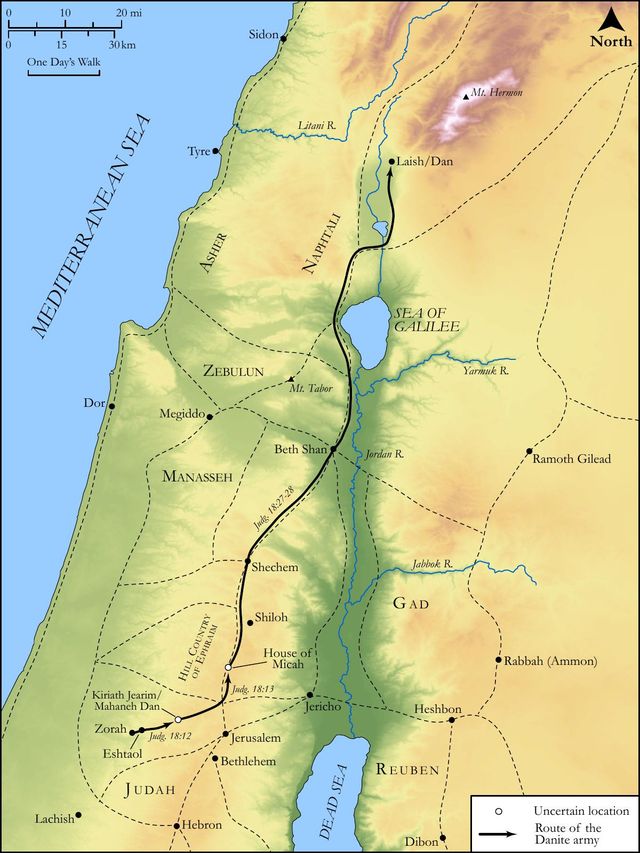
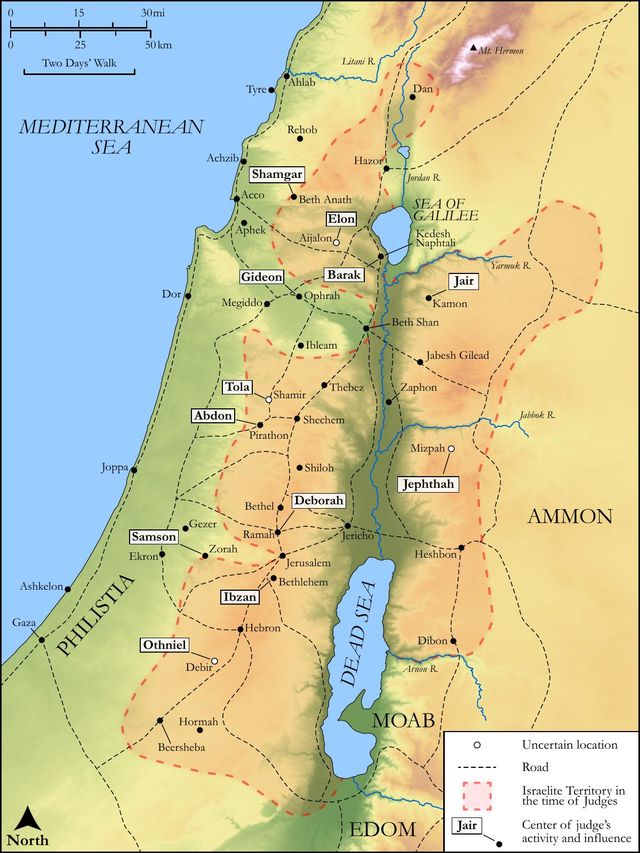
See on the biblical-era maps
Study this verse
Public-domain commentary
Matthew Henry
From his Commentary on the Whole Bible. Henry comments on passages, not single verses — this entry covers Judges 17:1–6. His four-level outline is real structure in the source text, so it is rendered as structure.
Here we have, I. Micah and his mother quarrelling. 1. The son robs the mother. The old woman had hoarded, with long scraping and saving, a great sum of money, 1100 pieces of silver. It is likely she intended, when she died, to leave it to her son: in the mean time it did her good to look upon it, and to count it over. The young man had a family of children grown up, for he had one of age to be a priest, Jdg 17:5. He knows where to find his mother's cash, thinks he has more need of it than she has, cannot stay till she dies, and so takes it away privately for his own use. Though it is a fault in parents to withhold from their children that which is meet, and lead them into temptation to wish them in their graves, yet even this will by no means excuse the wickedness of those children that steal from their parents, and think all their own that they can get from them, though by the most indirect methods. 2. The mother curses the son, or whoever had taken her money. It should seem she suspected her son; for, when she cursed, she spoke in his cars so loud, and with so much passion and vehemence, as made both his ears to tingle. See what mischief the love of money makes, how it destroys the duty and comfort of every relation. It was the love of money that made Micah so undutiful to his mother as to rob her, and made her so unkind and void of natural affection to her son as to curse him if he had it and concealed it. Outward losses drive good people to their prayers, but bad people to their curses. This woman's silver was her god before it was made thither into a graven or a molten image, else the loss of it would not have put her into such a passion as caused her quite to forget and break through all the laws of decency and piety. It is a very foolish thing for those that are provoked to throw their curses about as a madman that casteth fire-brands, arrows, and death, since they know not but they may light upon those that are most dear to them.
II.Micah and his mother reconciled.
1.The son was so terrified with his mother's curses that he restored the money. Though he had so little grace as to take it, he had so much left as not to dare to keep it when his mother had sent a curse after it. He cannot believe his mother's money will do him any good without his mother's blessing, nor dares he deny the theft when he is charged with it, nor retain the money when it is demanded by the right owner. It is best not to do evil, but it is next best, when it is done, to undo it again by repentance, confession, and restitution. Let children be afraid of having the prayers of their parents against them; for, though the curse causeless shall not come, yet that which is justly deserved may be justly feared, even though it was passionately and indecently uttered.
2.The mother was so pleased with her son's repentance that she recalled her curses, and turned them into prayers for her son's welfare: Blessed be thou of the Lord, my son. When those that have been guilty of a fault appear to be free and ingenuous in owning it they ought to be commended for their repentance, rather than still be condemned and upbraided for their fault.
III.Micah and his mother agreeing to turn their money into a god, and set up idolatry in their family; and this seems to have been the first instance of the revolt of any Israelite from God and his instituted worship after the death of Joshua and the elders that out-lived him, and is therefore thus particularly related. And though this was only the worship of the true God by an image, against the second commandment, yet this opened the door to the worship of other gods, Baalim and the groves, against the first and great commandment. Observe,
1.The mother's contrivance of this matter. When the silver was restored she pretended she had dedicated it to the Lord (Jdg 17:3), either before it was stolen, and then she would have this thought to be the reason why she was so much grieved at the loss of it and imprecated evil on him that had taken it, because it was a dedicated and therefore an accursed thing, or after it was stolen she had made a vow that, if she could retrieve it, she would dedicate it to God, and then she would have the providence that had so far favoured her as to bring it back to her hands to be an owning of her vow. "Come," said she to her son, "the money is mine, but thou hast a mind to it; let it be neither mine nor thine, but let us both agree to make it into an image for a religious use." Had she put it to a use that was indeed for the service and honour of God, this would have been a good way of accommodating the matter between them; but, as it was, the project was wicked. Probably this old woman was one of those that came out of Egypt, and would have such images made as she had seen there; now that she began to dote she called to remembrance the follies of her youth, and perhaps told her son that this way of worshipping God by images was, to her knowledge, the old religion.
2.The son's compliance with her. It should seem, when she first proposed the thing he stumbled at it, knowing what the second commandment was; for, when she said (Jdg 17:3) she designed it for her son to make an image of, yet he restored it to his mother (being loth to have a hand in making the image), and she gave it to the founder and had the thing done, blaming him perhaps for scrupling at it, Jdg 17:4. But, when the images were made, Micah, by his mother's persuasion, was not only well reconciled to them, but greatly pleased and in love with them; so strangely bewitching was idolatry, and so much supported by traditions received from their parents, Pe1 1:18; Jer 44:17. But observe how the old woman's covetousness prevailed, in part, above her superstition. She had wholly dedicated the silver to make the graven and molten images (Jdg 17:3), all the 1100 pieces; but, when it came to be done, she made less than a fifth part serve, even 200 shekels, Jdg 17:4. She thought that enough, and indeed it was too much to give for an image that is a teacher of lies. Had it been devoted truly to the honour of God, he would not thus have been put off with part of the price, but would have signified his resentment of the affront, as he did in the case of Ananias and Sapphira. Now observe,
(1.)What was the corruption here introduced, Jdg 17:5. The man Micah had a house of gods, a house of God, so the Septuagint, for so he thought it, as good as that at Shiloh, and better, because his own, of his own inventing and at his own disposal; for people love to have their religion under their girdle, to manage it as they please. A house of error, so the Chaldee, for really it was so, a deviation from the way of truth and an inlet to all deceit. Idolatry is a great cheat, and one of the worst of errors. That which he aimed at in the progress of his idolatry, whether he designed it at first or no, was to mimic and rival both God's oracles and his ordinances.
[1.]His oracles; for he made teraphim, little images which he might advise with as there was occasion, and receive informations, directions, and predictions from. What the urim and thummim were to the prince and people these teraphim should be to his family; yet he could not think that the true God would own them, or give answers by them, and therefore depended upon such demons as the heathen worshipped to inspire them and make them serviceable to him. Thus, while the honour of Jehovah was pretended (Jdg 17:3), yet, his institution being relinquished, these Israelites unavoidably lapsed into downright idolatry and demon-worship.
[2.]His ordinances. Some room or apartment in the house of Micah was appointed for the temple or house of God; an ephod, or holy garment, was provided for his priest to officiate in, in imitation of those used at the tabernacle of God, and one of his sons he consecrated, probably the eldest, to be his priest. And, when he had set up a graven or molten image to represent the object of his worship, no marvel if a priest of his own getting and his own making served to be the manager of it. Here is no mention of any altar, sacrifice, or incense, in honour of these silver gods, but, having a priest, it is probable he had all these, unless we suppose that, at first, his gods were intended only to be advised with, not to be adored, like Laban's teraphim; but the beginning of idolatry, as of other sins, is like the letting forth of water: break the dam, and you bring a deluge. Here idolatry began, and it spread like a fretting leprosy. Dr. Lightfoot would have us observe that as 1100 pieces of silver were here devoted to the making of an idol, which ruined religion, especially in the tribe of Dan (as we shall presently find), which was Samson's tribe, so 1100 pieces of silver were given by each Philistine lord for the ruin of Samson.
(2.)What was the cause of this corruption (Jdg 17:6): There was no king in Israel, no judge or sovereign prince to take cognizance of the setting up of these images (which, doubtless, the country about soon resorted to), and to give orders for the destroying of them, none to convince Micah of his error and to restrain and punish him, to take this disease in time, by which the spreading of the infection might have been happily prevented. Every man did that which was right in his own eyes, and then they soon did that which was evil in the sight of the Lord. When they were without a king to keep good order among them, God's house was forsaken, his priests were neglected, and all went to ruin among them. See what a mercy government is, and what reason there is that not only prayers and intercessions, but giving of thanks, should be made for kings and all in authority, Ti1 2:1, Ti1 2:2. Nothing contributes more, under God, to the support of religion in the world, than the due administration of those two great ordinances, magistracy and ministry.
Continue studying Judges 17:1 across the web’s major study libraries — every link below opens this exact verse, chapter, or book on the destination site.
Read & Compare
 BibleGatewayThis verse in more than 200 translations and 70 languages.
 Bible.comThe YouVersion reader — hundreds of translations, reading plans, and highlights.
 ESV.orgCrossway's official English Standard Version reader.
 NET BibleThe NET translation with 60,000+ translators' notes on every rendering decision.
 STEP BibleTyndale House's free study tool — original text, vocabulary, and scholarly resources.
 BibliaLogos Bible Software's free web reader.
 USCCBThe New American Bible (Revised Edition) with the U.S. bishops' study notes.
Commentaries
 BibleHub CommentariesDozens of classic commentaries on this verse, gathered on one page.
 StudyLightMore than 100 commentary sets — the largest collection on the web.
 BibleRefPlain-English commentary on what this verse means, verse by verse.
 Enduring WordDavid Guzik's free commentary on this chapter, widely used by Bible teachers.
 Bible Study ToolsVerse commentary alongside Greek and Hebrew study aids.
Original Language & Research
- BibleHub InterlinearThe verse word by word — original language, transliteration, and English.
- BibleHub LexiconEvery word's original-language definition and Strong's entry.
 Blue Letter BibleDeep-study tools — Strong's numbers, concordance, and word studies.
 SefariaThe Hebrew text with Rashi and centuries of Jewish commentary.
Sermons, Hymns & Audio


TrulyRandomVerse is not affiliated with these sites and doesn’t control their content. They’re linked because they’re genuinely useful.
Summary
Judges 17:1 introduces Micah, a man residing in the central highlands of Ephraim, whose personal narrative initiates the deeply unsettling appendix of the book of Judges (chapters 17-21). This concise opening verse immediately sets the stage for a period of profound spiritual and moral decline within Israel, vividly illustrating the societal anarchy and the absence of central religious and political authority, a time when "every man did that which was right in his own eyes." Micah's descent into syncretistic worship and self-made religion serves as a powerful microcosm of the nation's broader spiritual compromise and societal disintegration, foreshadowing the chaos that will unfold.
Context
ShowHideLiterary Context
Judges 17:1 marks a distinct shift in the book's narrative, initiating what is often referred to as the "appendix" (chapters 17-21). Unlike the preceding cyclical accounts of apostasy, foreign oppression, and divine deliverance through judges (chapters 3-16), this final section focuses entirely on internal moral and spiritual decay within Israelite society itself. It comprises two interconnected stories: Micah's idolatry and the migration of the Danites (chapters 17-18), followed by the egregious account of the Levite's concubine and the ensuing tribal war against Benjamin (chapters 19-21). These narratives are not about external threats but about the profound breakdown of covenant fidelity and societal order, repeatedly punctuated by the chilling refrain, "in those days there was no king in Israel and every man did what was right in his own eyes." This opening verse immediately grounds the reader in a specific individual's story that exemplifies the prevailing national chaos.
Historical & Cultural Context
The period of the Judges, following the death of Joshua and the generation that knew the Lord (Judges 2:10), was characterized by a decentralized tribal confederacy. Without a unified monarchy or a strong, consistent central religious authority, Israel frequently struggled to maintain its covenant obligations to Yahweh. This era witnessed a significant decline in adherence to Mosaic law, leading to widespread syncretism—the dangerous blending of Yahweh worship with the idolatrous practices of the surrounding Canaanite cultures. The geographical setting of "mount Ephraim" is highly significant; Ephraim was a powerful and centrally located tribe, indicating that this spiritual malaise was not confined to peripheral or less influential areas but had deeply permeated the heartland of Israel. The absence of a king meant there was no single figure to enforce justice, uphold God's law, or provide unified leadership, leaving individuals and tribes to act autonomously, often according to their own flawed understanding of right and wrong, as warned in Deuteronomy 12:8.
Key Themes
ShowHideJudges 17:1, despite its brevity, immediately introduces several critical themes that will be extensively developed throughout the subsequent chapters. Firstly, it highlights the peril of individual apostasy and syncretism. Micah's personal choice to establish a private religious system, complete with idols and a self-appointed priesthood, serves as a vivid illustration of the pervasive spiritual compromise of the era. Secondly, the verse subtly points to the absence of central authority and the resulting societal chaos. The recurrent refrain, "every man did what was right in his own eyes" (first stated in Judges 17:6), encapsulates the overarching theme of this appendix, and Micah's story is its initial and compelling illustration. Thirdly, the geographical setting on "mount Ephraim" underscores that this moral and spiritual decay was not an isolated phenomenon but was deeply entrenched even in prominent tribal territories, signaling a widespread national problem. Finally, the verse functions as a foreshadowing of deeper disorder, setting the narrative stage for a series of escalating moral failures, including theft, idolatry, a mercenary Levite, and ultimately, devastating inter-tribal warfare, all stemming from a catastrophic failure to adhere to God's covenant.
Exposition and Analysis
ShowHideKey Word Analysis
ShowHideThis term (H376) refers to a male person, an individual. The use of this simple, almost generic term to introduce Micah emphasizes his role as a representative figure. He is not a judge, a prophet, or a leader of national significance in the traditional sense, but an ordinary Israelite whose personal choices reflect and contribute to the broader moral and spiritual decline of the nation. His individuality underscores that the pervasive issues of the Judges era stemmed from the cumulative actions of countless individuals "doing what was right in their own eyes."
This name (H669) means "double fruit" and refers to a son of Joseph, the tribe descended from him, and its territory. As one of the most powerful and influential tribes, Ephraim's territory, particularly its central highlands ("mount Ephraim"), was a significant and strategic region within Israel. The fact that Micah, a purveyor of idolatry and self-made religion, hails from this prominent tribe is highly significant. It indicates that the spiritual malaise and covenant infidelity were not confined to the fringes of Israelite society but had deeply infiltrated its very heartland, affecting even those areas expected to uphold God's law and provide leadership.
This name (H4321) is a shortened form of Micaiah, meaning "Who is like Yahweh?" or "Who is like the Lord?". The profound irony of Micah's name is central to understanding the narrative that follows. Despite bearing a name that implicitly celebrates Yahweh's incomparable uniqueness and supremacy, Micah's subsequent actions—creating idols, establishing a private shrine, and hiring a Levite to serve his personal religious system—demonstrate a severe misunderstanding or blatant disregard for the very God his name extols. His life becomes a tragic, practical answer to the question his name poses: no one is truly like Yahweh, yet Micah attempts to make Yahweh conform to his own desires or to the practices of surrounding pagan deities.
Verse Breakdown
ShowHide"And there was a man"
This opening phrase, "וַיְהִי אִישׁ" (vayhi 'ish), is a common biblical narrative device used to introduce a new character or set a scene. Here, its simplicity belies the profound implications of the story that will unfold. It immediately focuses the reader's attention on an individual whose actions will serve as a stark example of the prevailing spiritual and moral conditions within Israel during the period of the Judges, highlighting the personal dimension of the national decline.
"of mount Ephraim"
This clause provides the crucial geographical and tribal context for the individual. By situating Micah in "mount Ephraim," the text grounds the story in a specific, important region of Israel. This detail is not incidental; it powerfully emphasizes that the issues of syncretism, lawlessness, and spiritual compromise were not isolated to the fringes of Israelite society but were deeply embedded even in its central and influential tribal territories, underscoring the widespread and pervasive nature of the spiritual decay.
"whose name [was] Micah"
This final clause identifies the central figure by name. As explored in the Key Word Analysis, the name "Micah" itself carries a powerful, ironic theological statement. The immediate introduction of his name here creates a profound tension between his identity (implied by the meaning of his name) and his subsequent actions, which will starkly contradict the very question "Who is like Yahweh?" thereby setting the stage for a narrative steeped in tragic irony.
Literary Devices
ShowHideJudges 17:1, though seemingly simple, masterfully employs several subtle literary devices to set the tone and theme for the subsequent narrative. The most prominent is Irony, particularly evident in the naming of Micah. His name, meaning "Who is like Yahweh?", stands in profound contrast to his subsequent actions of creating idols and establishing a self-made religious system, which profoundly diminishes Yahweh's unique nature and authority. This immediate juxtaposition creates a sense of tragic irony that pervades the entire narrative of chapters 17-18. The verse also functions as Foreshadowing. Its straightforward introduction of a man from a specific location subtly hints at the complex, chaotic, and morally compromised events that will unfold, signaling that this individual's story will be highly significant and representative. Furthermore, Micah's personal narrative serves as a powerful Microcosm for the larger national condition described by the recurring phrase, "every man did what was right in his own eyes." His individual choices reflect and exemplify the widespread spiritual and moral disintegration of the entire nation. Finally, the specific Setting on "mount Ephraim" is a deliberate choice, highlighting that the spiritual decay was not marginal but central, affecting even prominent tribal territories.
Theological and Thematic Connections
ShowHideJudges 17:1 serves as the crucial entry point to a narrative that powerfully illustrates the dire consequences of Israel's failure to maintain covenant fidelity and adhere to God's prescribed worship. The theological implication is stark: when divine authority is disregarded and individuals or communities determine truth and worship based on their own subjective standards, spiritual anarchy, moral relativism, and societal decay inevitably ensue. Micah's story vividly highlights the inherent danger of syncretism, where the worship of the true God is diluted or corrupted by human innovations and pagan practices. This self-made religion, driven by personal convenience and perceived benefit rather than divine command, ultimately leads to a fractured society that has lost its moral compass, its distinct identity as God's chosen people, and its ability to discern right from wrong in God's eyes.
Reflection and Application
ShowHideJudges 17:1, despite its brevity, offers a sobering entry point into a narrative that holds profound contemporary relevance. Micah's story is a stark warning against the dangers of unchecked spiritual individualism and syncretism. In an age where personal truth, subjective experience, and self-expression are often elevated above objective, revealed truth, we are particularly prone to "doing what is right in our own eyes," much like the Israelites in the period of the Judges. This can manifest in various ways: cherry-picking biblical commands, constructing a personalized spirituality that lacks accountability to Scripture or community, or subtly blending Christian faith with secular ideologies or practices that fundamentally contradict God's word. The narrative of Micah reminds us that true worship and faithful living are not about convenience, personal preference, or what feels right to us, but about humble submission to God's revealed will and unwavering obedience to His commands. Our spiritual health, both individually and corporately, depends on our steadfast commitment to God's authoritative word as expressed in Scripture, and our willingness to be led by His Spirit through His established means of grace, rather than forging our own paths.
Questions for Reflection
ShowHideFAQ
ShowHideWhy is Judges 17-21 often called an "appendix" to the book of Judges?
ShowHideJudges 17-21 is considered an appendix because it fundamentally breaks from the cyclical narrative pattern (apostasy, oppression, cry for deliverance, judge, peace) that characterizes the main body of the book (chapters 3-16). Instead of recounting foreign oppression and God raising a deliverer, these final chapters vividly illustrate the internal moral and spiritual decay within Israel itself. They serve as a powerful and disturbing demonstration of the consequences of the period's defining characteristic: "in those days there was no king in Israel, and every man did what was right in his own eyes." These stories, including Micah's, highlight the profound need for righteous leadership and faithful adherence to God's law, thereby setting the crucial historical and theological stage for the later establishment of the monarchy.
What is the significance of Micah being from "mount Ephraim"?
ShowHideThe fact that Micah is from "mount Ephraim" is highly significant, carrying both geographical and theological weight. Ephraim was one of the most prominent and powerful tribes in Israel, often playing a leading role in the nation's affairs (e.g., Joshua was from Ephraim, and Shiloh, the central sanctuary, was in Ephraim). By placing the story of Micah's idolatry and self-made religion in such a central, influential, and historically significant tribal territory, the author underscores that the spiritual and moral decline was not confined to remote or less significant areas. It demonstrates that the pervasive issues of syncretism, lawlessness, and the abandonment of God's covenant had deeply infiltrated even the heartland of Israel, indicating a widespread national problem rather than isolated incidents. This highlights the depth of the spiritual corruption that afflicted the entire nation.
Christ-Centered Fulfillment
ShowHideThe chaotic and morally bankrupt era depicted in Judges, powerfully introduced by the individual story of Micah in Judges 17:1, profoundly underscores humanity's desperate need for a true and righteous King. The repeated refrain, "in those days there was no king in Israel," vividly portrays the spiritual vacuum and the disastrous consequences of individuals "doing what was right in their own eyes." This period of self-rule and spiritual anarchy ultimately points forward to the coming of Jesus Christ, the ultimate King who perfectly fulfills the role Israel so desperately lacked. Unlike Micah, who attempted to create a god in his own image, Jesus is the image of the invisible God, the one who truly is like Yahweh, embodying divine perfection, authority, and grace. He is not merely a temporary deliverer but the eternal King who brings true order, justice, and spiritual restoration. In Christ, we find not a self-made religion based on human preference, but a salvation freely given through His atoning sacrifice (Ephesians 2:8-9), and a Good Shepherd who leads His sheep in paths of righteousness (John 10:11), unlike the aimless wandering and moral compromise of the Judges era. He is the one who establishes a new covenant, writing God's law not on stone tablets but on our hearts (Jeremiah 31:33), ensuring that we no longer live by our own flawed standards but by His perfect, life-giving will.