


Judges 10:1
Bible text: King James Version (1769 Blayney text) · Public domain
Bible text: King James Version with Strong's numbers · Public domain
Bible text: Berean Standard Bible · Public domain
Bible text: American Standard Version (1901) · Public domain
Bible text: World English Bible, Messianic edition · Public domain
Bible text: Geneva Bible (1599) · Public domain
Bible text: Young's Literal Translation · Public domain
- וַיָּקָםvai·ya·Kamand he aroseH6965Conj-w ¦ V-Qal-ConsecImperf-3msVerb Qal Consecutive Imperfect 3rd Singular Masculineוַandיָּקָםhe arose
- אַחֲרֵי'a·cha·ReiafterH310Adj-mpcAdjective Numerical Plural Masculine Construct
- אֲבִימֶלֶךְ'a·vi·Me·lekhAbimelechH40N-proper-mNoun Proper Masculine
- לְהוֹשִׁיעַle·ho·Shi·a'to deliverH3467Prep-l ¦ V-Hiphil-InfVerb Hiphil Infinitive Constructלְtoהוֹשִׁיעַdeliver
- אֶת'et<obj.>H853DirObjMParticle Object Indicator
- יִשְׂרָאֵלYis·ra·'ElIsraelH3478N-properNoun Proper Location
- תּוֹלָעto·La'TolaH8439N-proper-mNoun Proper Masculine
- בֶּןben[the] son ofH1121N-mscNoun Singular Masculine Construct
- פּוּאָהpu·'AhPuahH6312N-proper-mNoun Proper Masculine
- בֶּןben[the] son ofH1121N-mscNoun Singular Masculine Construct
- דּוֹדוֹdo·DoDodoH1734N-proper-mNoun Proper Masculine
- אִישׁ'ish<the> man ofH376N-mscNoun Singular Masculine Construct
- יִשָּׂשכָרyi·so·sh·KharIssacharH3485N-proper-mNoun Proper Masculine
- וְהוּאve·hu'and heH1931Conj-w ¦ Pro-3msPronoun Personal 3rd Singular Masculineוְandהוּאhe
- יֹשֵׁבyo·Shev[was] dwellingH3427V-Qal-Prtcpl-msVerb Qal Participle Singular Masculine Absolute
- בְּשָׁמִירbe·sha·Mirin ShamirH8069Prep-b ¦ N-properNoun Proper LocationבְּinשָׁמִירShamir
- בְּהַרbe·Harin [the] hill country ofH2022Prep-b ¦ N-mscNoun Singular Masculine Constructבְּinהַר[the] hill country of
- אֶפְרָיִם'ef·Ra·yimEphraimH669N-proper-mNoun Proper Masculine
English is a literal word-by-word gloss of the Hebrew, not the KJV's wording. Why?
This is the original text the KJV's translators worked from — each Hebrew word with its own literal English meaning in this verse, prepared by scholars at Tyndale House, Cambridge. The KJV translates whole sentences, not word by word, so its wording differs: one Hebrew word can become several English words, and the KJV may choose “the LORD” where the gloss reads “Yahweh”. Both are faithful — they answer different questions. For the KJV's own rendering, switch to the KJV text.
Details
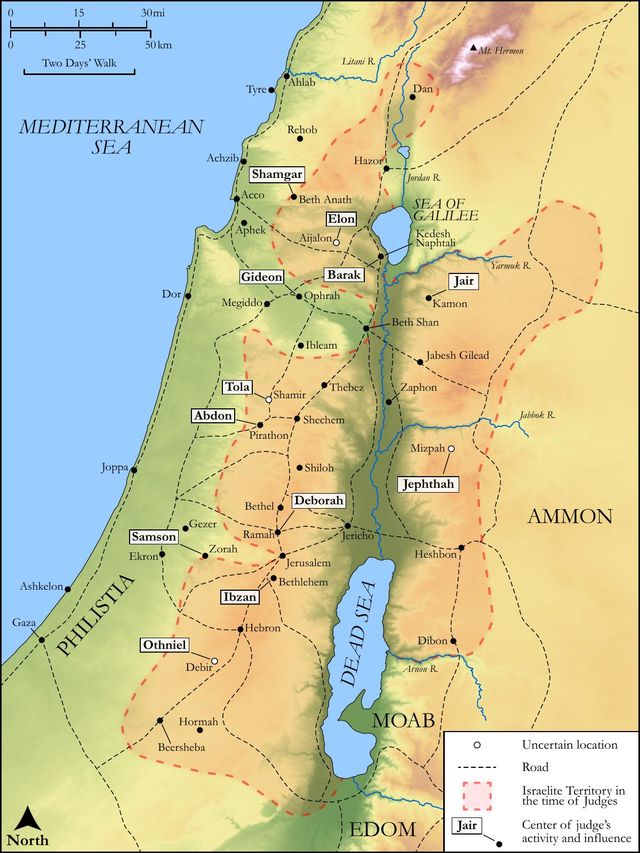
See on the biblical-era maps
Study this verse
Public-domain commentary
Matthew Henry
From his Commentary on the Whole Bible. Henry comments on passages, not single verses — this entry covers Judges 10:1–5.
Quiet and peaceable reigns, though the best to live in, are the worst to write of, as yielding least variety of matter for the historian to entertain his reader with; such were the reigns of these two judges, Tola and Jair, who make but a small figure and take up but a very little room in this history. But no doubt they were both raised up of God to serve their country in the quality of judges, not pretending, as Abimelech had done, to the grandeur of kings, nor, like him, taking the honour they had to themselves, but being called of God to it. 1. Concerning Tola it is said that he arose after Abimelech to defend Israel, Jdg 10:1. After Abimelech had debauched Israel by his wickedness, disquieted and disturbed them by his restless ambition, and, by the mischiefs he brought on them, exposed them to enemies from abroad, God animated this good man to appear for the reforming of abuses, the putting down of idolatry, the appeasing of tumults, and the healing of the wounds given to the state by Abimelech's usurpation. Thus he saved them from themselves, and guarded them against their enemies. He was of the tribe of Issachar, a tribe disposed to serve, for he bowed his shoulder to bear (Gen 49:14, Gen 49:15), yet one of that tribe is here raised up to rule; for those that humble themselves shall be exalted. He bore the name of him that was ancestor to the first family of that tribe; of the sons of Issachar Tola was the first, Gen 46:13; Num 26:23. It signifies a worm, yet, being the name of his ancestor, he was not ashamed of it. Though he was of Issachar, yet, when he was raised up to the government, he came and dwelt in Mount Ephraim, which was more in the heart of the country, that the people might the more conveniently resort to him for judgment. He judged Israel twenty-three years (Jdg 10:2), kept things in good order, but did not any thing very memorable. 2. Jair was a Gileadite, so was his next successor Jephthah, both of that half tribe of the tribe of Manasseh which lay on the other side Jordan; though they seemed separated from their brethren, yet God took care, while the honour of the government was shifted from tribe to tribe and before it settled in Judah, that those who lay remote should sometimes share in it, putting more abundant honour on that part which lacked. Jair bore the name of a very famous man of the same tribe who in Moses's time was very active in reducing this country, Num 32:41; Jos 13:30. That which is chiefly remarkable concerning this Jair is the increase and honour of his family: He had thirty sons, Jdg 10:4. And, (1.) They had good preferments, for they rode on thirty ass colts; that is, they were judges itinerant, who, as deputies to their father, rode from place to place in their several circuits to administer justice. We find afterwards that Samuel made his sons judges, though he could not make them good ones, Sa1 8:1-3. (2.) They had good possessions, every one a city, out of those that were called, from their ancestor of the same name with their father, Havoth-jair - the villages of Jair; yet they are called cities, either because those young gentlemen to whom they were assigned enlarged and fortified them, and so improved them into cities, or because they were as well pleased with their lot in those country towns as if they had been cities compact together and fenced with gates and bars. Villages are cities to a contented mind.
Historical interpretation
Historical reception
1 surviving comment on this verse from the historical church.
Uncle of Abimelech: i. e., half brother to Gedeon, as being born of the same mother, but by a different father, and of a different tribe.
Continue studying Judges 10:1 across the web’s major study libraries — every link below opens this exact verse, chapter, or book on the destination site.
Read & Compare
 BibleGatewayThis verse in more than 200 translations and 70 languages.
 Bible.comThe YouVersion reader — hundreds of translations, reading plans, and highlights.
 ESV.orgCrossway's official English Standard Version reader.
 NET BibleThe NET translation with 60,000+ translators' notes on every rendering decision.
 STEP BibleTyndale House's free study tool — original text, vocabulary, and scholarly resources.
 BibliaLogos Bible Software's free web reader.
 USCCBThe New American Bible (Revised Edition) with the U.S. bishops' study notes.
Commentaries
 BibleHub CommentariesDozens of classic commentaries on this verse, gathered on one page.
 StudyLightMore than 100 commentary sets — the largest collection on the web.
 BibleRefPlain-English commentary on what this verse means, verse by verse.
 Enduring WordDavid Guzik's free commentary on this chapter, widely used by Bible teachers.
 Bible Study ToolsVerse commentary alongside Greek and Hebrew study aids.
Original Language & Research
- BibleHub InterlinearThe verse word by word — original language, transliteration, and English.
- BibleHub LexiconEvery word's original-language definition and Strong's entry.
 Blue Letter BibleDeep-study tools — Strong's numbers, concordance, and word studies.
 SefariaThe Hebrew text with Rashi and centuries of Jewish commentary.
Sermons, Hymns & Audio


TrulyRandomVerse is not affiliated with these sites and doesn’t control their content. They’re linked because they’re genuinely useful.
Summary
Judges 10:1 introduces Tola, the son of Puah, from the tribe of Issachar, who arose to "defend" Israel for twenty-three years after the tumultuous and violent reign of Abimelech. This brief but significant verse marks a transition from chaos to a period of relative stability, quietly highlighting God's unwavering faithfulness and continuous provision of leadership for His people, even amidst their spiritual decline and the absence of a central authority.
Context
ShowHideLiterary Context
Judges 10:1 immediately follows the dark and chaotic narrative of Abimelech's self-appointed rule, which concluded with his ignominious death. Abimelech, unlike the divinely appointed judges, seized power through murder and deceit, embodying the moral decay of the period. Tola's appearance signifies a shift from human ambition and violence back to God's providential care. The Book of Judges is structured around a cyclical pattern: Israel's apostasy, divine judgment through oppression, their cry for help, God raising a deliverer (judge), and a subsequent period of rest. This pattern is explicitly stated in Judges 2:16, and Tola's quiet emergence fits within this divine response to Israel's need, even if his specific acts of deliverance are not detailed. He represents God's consistent intervention despite the nation's repeated failures.
Historical & Cultural Context
The period of the Judges (roughly 1200-1050 BC) was characterized by a decentralized tribal confederacy in Canaan, lacking a central government or king. This era was marked by frequent internal strife, external oppression from surrounding peoples, and a pervasive spiritual apostasy where "every man did that which was right in his own eyes" (Judges 21:25). Tola's lineage from the tribe of Issachar is notable; this tribe was later praised for its "understanding of the times" (1 Chronicles 12:32) and its strategic location in the fertile Jezreel Valley. His dwelling in "Shamir in mount Ephraim" places him in a central, geographically significant region, suggesting a strategic position for national leadership and defense, even if his specific actions are not recorded. This context underscores the dire need for leaders like Tola, who could bring order and stability to a fragmented nation.
Key Themes
ShowHideThis verse contributes to several overarching themes in Judges. Firstly, Divine Provision is paramount: despite Israel's spiritual failings and the recent chaos under Abimelech, God continues to provide leaders and deliverers, underscoring His unwavering commitment to His covenant people. Secondly, the Role of a Judge is highlighted; Tola "arose to defend Israel," embodying the primary function of these early leaders, which was to deliver the nation from internal or external threats and provide a period of peace and justice. This contrasts sharply with Abimelech's self-serving rule. Thirdly, the theme of Obscure Leadership is evident. Tola's brief mention, with no specific acts of deliverance or battles recorded, highlights that not all significant service is celebrated with grand narratives. God uses individuals in various capacities, and their quiet faithfulness and behind-the-scenes work are equally valued and vital to His overarching plan, providing stability and preserving the nation until the next major crisis or deliverer.
Exposition and Analysis
ShowHideKey Word Analysis
ShowHideThe Hebrew verb יָשַׁע (yâshaʻ) is a deeply significant term in the Old Testament, meaning "to save," "to deliver," "to liberate," or "to bring salvation." It implies active intervention to rescue from distress, danger, or oppression. While translated "defend" here, it carries a stronger connotation of active deliverance and restoration of order, not merely passive protection. This word is frequently used to describe God's saving acts for His people, indicating that Tola's role was divinely empowered and aimed at bringing about a period of peace and well-being for Israel.
The verb קָם (qûwm), "to arise" or "to stand up," when used in the context of a judge, often implies a divine initiative or appointment. Unlike Abimelech, who "made himself king" through violent means, Tola "arose," suggesting he was raised up by God for this specific purpose. This subtle linguistic distinction underscores his legitimacy and divine sanction, contrasting with the previous, illegitimate ruler.
This tribal designation for Tola is significant. While not explicitly stated in Judges, the tribe of Issachar is later described as having "men who understood the times and knew what Israel should do" (1 Chronicles 12:32). This detail, though from a later book, suggests a tribal characteristic of wisdom and discernment, which would have been invaluable for a judge tasked with bringing order and "defending" Israel in a chaotic era.
Verse Breakdown
ShowHide"And after Abimelech"
This opening phrase immediately establishes a chronological and thematic transition. It signals the end of the violent, self-serving, and illegitimate "kingship" of Abimelech (detailed in Judges 9), and the beginning of a new period under a divinely appointed leader. It highlights the cyclical nature of the Book of Judges, moving from a period of chaos and oppression to one of potential restoration.
"there arose to defend Israel Tola the son of Puah, the son of Dodo"
This clause introduces the new judge, Tola, emphasizing his divine appointment ("arose") and his primary mission ("to defend Israel," meaning to deliver and save them). His lineage is provided, a common biblical practice to establish identity and legitimacy. The lack of detailed heroic deeds for Tola suggests that his "defense" may have been more about maintaining peace and order through wise governance rather than military conquest, or that his story is simply condensed.
"a man of Issachar; and he dwelt in Shamir in mount Ephraim"
This final part of the verse provides Tola's tribal affiliation and geographical residence. Being from Issachar and dwelling in Shamir, located in the central territory of Mount Ephraim, suggests a strategic and central position within Israel. This location would have facilitated his ability to administer justice and provide leadership across the tribal confederacy, underscoring his role in bringing stability to a fragmented nation.
Literary Devices
ShowHideJudges 10:1 employs several literary devices to convey its meaning efficiently. Transition is paramount, clearly marking the shift from the destructive reign of Abimelech to the emergence of Tola, signaling a new, more stable phase in Israel's history. This is reinforced by Contrast, as Tola's quiet, divinely appointed rise stands in stark opposition to Abimelech's violent usurpation and self-aggrandizement. The inclusion of Tola's Genealogy ("the son of Puah, the son of Dodo") serves to legitimize his leadership, rooting him within the tribal structure of Israel, unlike Abimelech who was defined by his illegitimate ambition. Finally, the specific Geographical Detail ("Shamir in mount Ephraim") grounds the narrative, making Tola's presence tangible and suggesting his strategic importance in the central highlands, vital for unifying a decentralized nation.
Theological and Thematic Connections
ShowHideJudges 10:1, though brief, is rich in theological significance. It powerfully illustrates God's unceasing faithfulness to His covenant people, even when they are unfaithful. Despite Israel's spiritual decline and the recent chaos under Abimelech, God does not abandon them. Instead, He sovereignly raises up a deliverer, Tola, demonstrating His ongoing commitment to provide leadership and stability. This verse underscores the divine initiative in salvation and deliverance, showing that God's grace precedes and responds to human need. It also subtly highlights the diverse ways God uses individuals; not all "judges" are celebrated for grand military victories, but all are instruments of His purpose, bringing periods of peace and order. This quiet provision speaks volumes about God's patience and persistent love for His people, always working to restore and redeem.
Reflection and Application
ShowHideJudges 10:1 offers a profound lesson about God's unwavering faithfulness and His methods of working in the world. In the aftermath of great turmoil and human failure, God quietly and consistently raises up individuals to fulfill His purposes. This reminds us that even when circumstances seem chaotic or leadership is lacking, God remains sovereignly in control, providing what is needed for His people's well-being. Tola's obscure yet significant role encourages us to value faithfulness in all callings, recognizing that God uses both the prominent and the seemingly "minor" figures to advance His kingdom. It challenges us to trust in God's ongoing provision, even when His hand is not overtly dramatic, and to be open to how He might use ordinary individuals—including ourselves—for extraordinary purposes, often in ways that are not widely publicized but are deeply impactful for His glory and the good of others. This quiet narrative offers a powerful message of hope: even in periods of moral and political decline, God's redemptive plan continues to unfold through His chosen instruments.
Questions for Reflection
ShowHideFAQ
ShowHideWhy is Tola considered a "minor" judge, and what is the significance of his brief mention?
ShowHideTola is classified as a "minor" judge primarily because the biblical text dedicates only two verses to his leadership, recording no specific acts of military deliverance, battles, or dramatic narratives like those associated with major judges such as Gideon or Samson. His mention is brief, focusing on his lineage, tribe, dwelling place, and the duration of his judgeship (23 years). The significance of this brevity lies in its theological message: God's work is not limited to grand, celebrated acts. Tola's quiet, consistent leadership, providing a period of stability and "defending" Israel, was just as vital in God's plan. It suggests that God uses individuals in various capacities, and faithfulness in maintaining peace and order, even without fanfare, is highly valued in His eyes. It also highlights that not every divinely appointed leader will have their full story recorded, yet their contribution is integral to the unfolding narrative of God's interaction with His people.
What is the significance of Tola being from the tribe of Issachar and dwelling in Mount Ephraim?
ShowHideTola's tribal affiliation with Issachar is significant because this tribe was later noted for its wisdom and discernment, described as "men who understood the times and knew what Israel should do" (1 Chronicles 12:32). While this characteristic isn't explicitly mentioned for Tola, it suggests a potential for sagacious leadership. His dwelling in Shamir in Mount Ephraim also holds importance. Ephraim was a central and influential tribe, and Mount Ephraim was a strategically vital region in the heartland of Israel. This central location would have allowed Tola to effectively administer justice and provide leadership across the tribal territories, contributing to national stability and defense in a decentralized era. It underscores that even a "minor" judge was placed in a position of strategic importance by divine providence.
How does Tola's story, despite its brevity, contribute to the overall message and theological themes of the Book of Judges?
ShowHideTola's brief account significantly reinforces the overarching message of the Book of Judges: God's unwavering faithfulness despite Israel's cyclical unfaithfulness. His emergence "after Abimelech" (Judges 10:1) demonstrates God's continuous provision of deliverers, even after periods of extreme moral decay and human failure. Tola represents a quiet, yet essential, phase in the Judges cycle—a period of rest and stability provided by God's grace. He embodies the concept that God's salvation (from the Hebrew yâshaʻ, "to defend" or "to save") is ever-present, even when not accompanied by dramatic military campaigns. His story reminds readers that God's redemptive plan is always at work, often through humble and less celebrated instruments, ensuring the continuity of His covenant with Israel and setting the stage for future acts of deliverance.
Christ-Centered Fulfillment
ShowHideJudges 10:1, in its quiet introduction of Tola, subtly foreshadows the ultimate divine provision of a Deliverer in Jesus Christ. Just as Tola "arose to defend Israel" (using the Hebrew yâshaʻ, meaning "to save" or "to deliver") after a period of chaos and self-rule, so too did Christ "arise" into a world steeped in sin and spiritual disarray, not through human ambition but by divine appointment. While Tola provided temporary relief and stability for a nation, Jesus is the definitive Lamb of God, who takes away the sin of the world!, offering eternal salvation and true peace. His name, Jesus (Yeshua), means "the Lord saves," directly fulfilling the essence of the word yâshaʻ that describes Tola's role. Christ's coming, though initially humble and uncelebrated by many, was the ultimate act of God's faithfulness to His covenant, delivering humanity from the ultimate oppression of sin and death (Colossians 1:13). He is the true Judge who brings perfect order and justice, and the ultimate Savior in whom "there is salvation in no one else, for there is no other name under heaven given among men by which we must be saved" (Acts 4:12). Like Tola, who brought a period of quiet stability, Jesus brings a peace that surpasses all understanding, establishing an eternal kingdom that will never end.