


1 Chronicles 12:32
Bible text: King James Version (1769 Blayney text) · Public domain
Bible text: King James Version with Strong's numbers · Public domain
Bible text: Berean Standard Bible · Public domain
Bible text: American Standard Version (1901) · Public domain
Bible text: World English Bible, Messianic edition · Public domain
Bible text: Geneva Bible (1599) · Public domain
Bible text: Young's Literal Translation · Public domain
- וּמִבְּנֵיu·mi·be·Neiand of [the] descendants ofH1121Conj-w ¦ Prep-m ¦ N-mpcNoun Plural Masculine Constructוּandמִofבְּנֵי[the] descendants of
- יִשָּׂשכָרyi·so·sh·KharIssacharH3485N-proper-mNoun Proper Masculine
- יוֹדְעֵיyod·'Ei[those who] knewH3045V-Qal-Prtcpl-mpVerb Qal Participle Plural Masculine Construct
- בִינָהvi·Nah<of> understandingH998N-fsNoun Singular Feminine Absolute
- לַעִתִּיםla·'i·Timof the timesH6256Prep-l ¦ N-cpNoun Plural common gender Absoluteלַof theעִתִּיםtimes
- לָדַעַתla·Da·'atto knowH3045Prep-l ¦ V-Qal-InfVerb Qal Infinitive Constructלָtoדַעַתknow
- מַהmahwhat?H4100InterrogPronoun Interrogative
- יַּעֲשֶׂהya·'a·Sehwill it doH6213V-Qal-Imperf-3msVerb Qal Imperfect 3rd Singular Masculine
- יִשְׂרָאֵלYis·ra·'ElIsraelH3478N-properNoun Proper Location
- רָאשֵׁיהֶםra·shei·Hemtheir chiefsH7218N-mpc ¦ 3mpNoun Plural Masculine Constructרָאשֵׁיchiefsהֶםtheir
- מָאתַיִםma·Ta·yimtwo hundredH3967N-fdNoun Dual Feminine Absolute
- וְכָלve·kholand allH3605Conj-w ¦ N-mscNoun Singular Masculine Constructוְandכָלall
- אֲחֵיהֶם'a·chei·Hemtheir relativesH251N-mpc ¦ 3mpNoun Plural Masculine Constructאֲחֵיrelativesהֶםtheir
- עַל'al[were] onH5921PrepPreposition
- פִּיהֶםpi·Hemtheir mouthH6310N-msc ¦ 3mpNoun Singular Masculine Constructפִּיmouthהֶםtheir
English is a literal word-by-word gloss of the Hebrew, not the KJV's wording. Why?
This is the original text the KJV's translators worked from — each Hebrew word with its own literal English meaning in this verse, prepared by scholars at Tyndale House, Cambridge. The KJV translates whole sentences, not word by word, so its wording differs: one Hebrew word can become several English words, and the KJV may choose “the LORD” where the gloss reads “Yahweh”. Both are faithful — they answer different questions. For the KJV's own rendering, switch to the KJV text.
Details
See on the biblical-era maps
Study this verse
Public-domain commentary
Matthew Henry
From his Commentary on the Whole Bible. Henry comments on passages, not single verses — this entry covers 1 Chronicles 12:23–40.
We have here an account of those who were active in perfecting the settlement of David upon the throne, after the death of Ishbosheth. We read (Ch1 11:1, and before Sa2 5:1) that all the tribes of Israel came, either themselves or by their representatives, to Hebron, to make David king; now here we have an account of the quota which every tribe brought in ready armed to the war, in case there should be any opposition, Ch1 12:23. We may observe here,
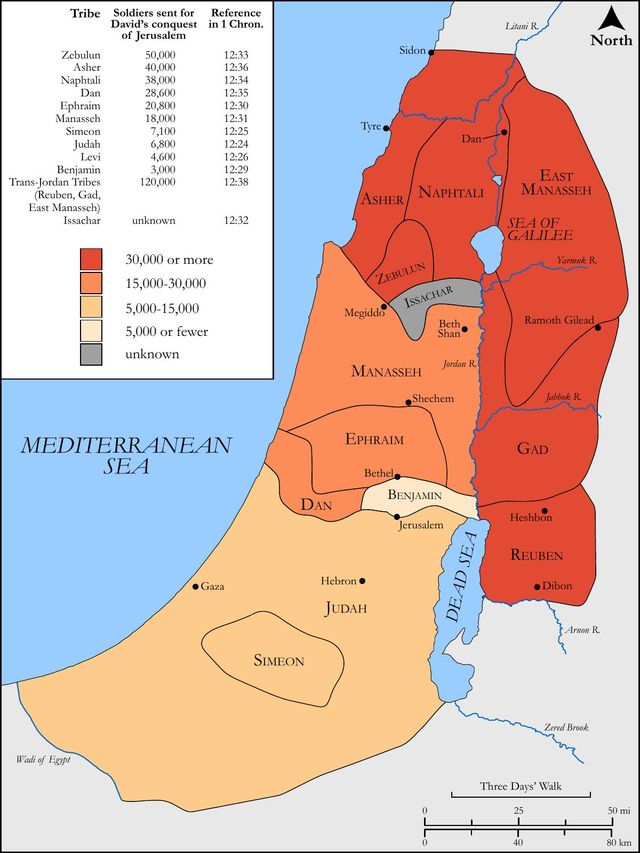
I.That those tribes that lived nearest brought the fewest - Judah but 6800 (Ch1 12:24), Simeon but 7100 (Ch1 12:25); whereas Zebulun, that lay remote, brought 50,000, Asher 40,000, and the two tribes and a half on the other side Jordan 120,000. Not as if the next adjacent tribes were cold in the cause; but they showed as much of their prudence in bringing few, since all the rest lay so near within call, as the others did of their zeal in bringing so many. The men of Judah had enough to do to entertain those that came from afar.
II.The Levites themselves, and the priests (called here the Aaronites), appeared very hearty in this cause, and were ready, if there were occasion, to fight for David, as well as pray for him, because they knew he was called of God to the government, Ch1 12:26-28.
III.Even some of the kindred of Saul came over to David (Ch1 12:29), not so many as of the other tribes, because a foolish affection for their own tribe, and a jealousy for the honour of it, kept many of them long in the sinking interest of Saul's family. Kindred should never over-rule conscience. Call no man Father to this extent, but God only.
IV.It is said of most of these that they were mighty men of valour (Ch1 12:25, Ch1 12:28, Ch1 12:30), of others that they were expert in war (Ch1 12:35, Ch1 12:36), and of them all that they could keep rank, Ch1 12:38. They had a great deal of martial fire, and yet were governable and subject to the rules of order - warm hearts but cool heads.
V.Some were so considerate as to bring with them arms, and all instruments for war (Ch1 12:24, Ch1 12:33, Ch1 12:37), for how could they think that David should be able to furnish them?
VI.The men of Issachar were the fewest af all, only 200, and yet as serviceable to David's interest as those that brought in the greatest numbers, these few being in effect the whole tribe. For, 1. They were men of great skill above any of their neighbours, men that had understanding of the times, to know what Israel ought to do. They understood the natural times, could discern the face of the sky, were weather-wise, could advise their neighbours in the proper times for ploughing, sowing reaping, etc. Or the ceremonial times, the times appointed for the solemn feasts; therefore they are said to call the people to the mountain (Deu 33:19), for almanacs were not then so common as now. Or, rather, the political times; they understood public affairs, the temper of the nation, and the tendencies of the present events. It is the periphrasis of statesmen that they know the times, Esth. 1. 13. Those of that tribe were greatly intent on public affairs, had good intelligence from abroad and made a good use of it. They knew what Israel ought to do: from their observation and experience they learned both their own and others' duty and interest. In this critical juncture they knew Israel ought to make David king. It was not only expedient, but necessary; the present posture of affairs called for it. The men of Issachar dealt mostly in country business, and did not much intermeddle in public affairs, which gave them an opportunity of observing others and conversing with themselves. A stander-by sees sometimes more than a gamester. 2. They were men of great interests; for all their brethren were at their commandment. The commonality of that tribe having bowed their shoulder to bear (Gen 49:15), the great men had them at their beck. Hence we read of the princes of Issachar, Jdg 5:15. They knew how to rule, and the rest knew how to obey. It is happy indeed when those that should lead are intelligent and judicious, and those who are to follow are modest and obsequious.
VII.It is said of them all that they engaged in this enterprise with a perfect heart (Ch1 12:38), and particularly of the men of Zebulun that they were not of double heart, Ch1 12:33. They were, in this matter, Israelites indeed, in whom was no guile. And this was their perfection, that they were of one heart, Ch1 12:38. None had any separate interests, but all for the public good.
VIII.The men of Judah, and others of the adjacent tribes, prepared for the victualling of their respective camps when they came to Hebron, Ch1 12:39, Ch1 12:40. Those that were at the least pains in travelling to this convention, or congress of states, thought themselves obliged to be at so much the more charge in entertaining the rest, that there might be something of an equality. A noble feast was made (was made for laughter, Ecc 10:19) upon this occasion, for there was joy in Israel, Ch1 12:40. And good reason; for when the righteous bear rule the city rejoices. Thus, when the throne of Christ is set up in a soul, there is, or ought to be, great joy in that soul: and provision is made for the feasting of it, not as here for two or three days, but for the whole life, nay, for eternity.
Continue studying 1 Chronicles 12:32 across the web’s major study libraries — every link below opens this exact verse, chapter, or book on the destination site.
Read & Compare
 BibleGatewayThis verse in more than 200 translations and 70 languages.
 Bible.comThe YouVersion reader — hundreds of translations, reading plans, and highlights.
 ESV.orgCrossway's official English Standard Version reader.
 NET BibleThe NET translation with 60,000+ translators' notes on every rendering decision.
 STEP BibleTyndale House's free study tool — original text, vocabulary, and scholarly resources.
 BibliaLogos Bible Software's free web reader.
 USCCBThe New American Bible (Revised Edition) with the U.S. bishops' study notes.
Commentaries
 BibleHub CommentariesDozens of classic commentaries on this verse, gathered on one page.
 StudyLightMore than 100 commentary sets — the largest collection on the web.
 BibleRefPlain-English commentary on what this verse means, verse by verse.
 Enduring WordDavid Guzik's free commentary on this chapter, widely used by Bible teachers.
 Bible Study ToolsVerse commentary alongside Greek and Hebrew study aids.
Original Language & Research
- BibleHub InterlinearThe verse word by word — original language, transliteration, and English.
- BibleHub LexiconEvery word's original-language definition and Strong's entry.
 Blue Letter BibleDeep-study tools — Strong's numbers, concordance, and word studies.
 SefariaThe Hebrew text with Rashi and centuries of Jewish commentary.
Sermons, Hymns & Audio


TrulyRandomVerse is not affiliated with these sites and doesn’t control their content. They’re linked because they’re genuinely useful.
Summary
1 Chronicles 12:32 powerfully describes the unique and invaluable contribution of the tribe of Issachar to David's burgeoning kingdom. Unlike other tribes lauded for their military might, the men of Issachar were distinguished by their profound spiritual and practical discernment, possessing a keen "understanding of the times" that enabled them to accurately interpret the prevailing circumstances and discern God's will for Israel. This insightful wisdom allowed them to provide strategic and actionable counsel, guiding the nation in "what Israel ought to do," and their leaders' authority was so respected that their brethren readily submitted to their commandment, underscoring their crucial role in establishing and unifying David's reign.
Context
ShowHideLiterary Context
First Chronicles 12 meticulously catalogues the diverse tribal contingents who converged upon Hebron to affirm their allegiance to David and crown him king over all Israel. The chapter primarily details the military prowess of these groups—skilled warriors, archers, slingers, and mighty men of valor, each bringing their specific martial strength to consolidate David's power. Amidst this extensive roll call of physical and strategic might, the mention of Issachar in verse 32 stands out as a significant and deliberate departure. Their distinguishing contribution is not one of physical strength or combat skill, but rather of intellectual and spiritual discernment. This unique emphasis highlights a crucial theological point: the foundation of a stable, God-honoring kingdom requires more than just military might; it demands wisdom, foresight, and unity born from divine insight. This verse thus complements the broader narrative of David's anointing and the consolidation of his power, emphasizing the diverse array of gifts necessary for effective leadership and national flourishing, as detailed in 1 Chronicles 11.
Historical & Cultural Context
The historical backdrop of 1 Chronicles 12 is a pivotal and tumultuous period in Israelite history. It immediately follows the death of King Saul and the protracted civil war between David's supporters and the remnants of Saul's house. David had already reigned in Hebron over Judah for seven and a half years, but this gathering marks the crucial moment when all twelve tribes formally recognized and crowned him as their unified king. In such a volatile and transformative era, characterized by shifting loyalties, the lingering divisions of civil war, and the immense task of forging a cohesive nation, the ability to discern God's will and provide strategic direction was not merely beneficial but absolutely paramount. Tribal identity and loyalty were central to Israelite society, and the voluntary rallying of these diverse groups to David demonstrated a powerful move towards national unity. The wisdom of Issachar, therefore, was not an abstract quality but a concrete, indispensable asset for navigating the complex political, social, and spiritual challenges inherent in establishing a unified monarchy under God's chosen leader.
Key Themes
ShowHideThe primary theme illuminated by 1 Chronicles 12:32 is discernment and practical wisdom. The Issacharites' "understanding of the times" speaks to a profound ability to interpret the prevailing circumstances—be they political, social, or spiritual—through the lens of God's overarching plan for Israel. This was not mere intellectual knowledge but an applied wisdom, enabling them "to know what Israel ought to do," transforming insight into actionable counsel. This theme of wisdom is foundational throughout biblical literature, consistently presented as more valuable than riches or strength, as powerfully articulated in Proverbs 4:7. Closely related is the theme of strategic leadership, where spiritual insight translates directly into practical, actionable guidance that shapes national direction and promotes cohesion. The fact that "all their brethren were at their commandment" further underscores their influence and authority, demonstrating that true leadership, particularly in a transitional period, is often rooted in respected wisdom and the capacity to foster unity. This unity was critical for David's new kingdom, as the Chronicler consistently emphasizes the importance of a unified Israel under God's chosen king, a theme also evident in 1 Chronicles 13.
Exposition and Analysis
ShowHideKey Word Analysis
ShowHideThis term (H998) denotes deep insight, discernment, and the mental capacity to distinguish between different things. It signifies not just factual knowledge but the profound ability to grasp the underlying meaning, implications, and intricate connections of events, situations, or divine pronouncements. In a biblical context, bîynâh' often refers to a spiritual perception—the Spirit-empowered ability to discern God's will, purposes, and timing amidst the complexities of human history and personal circumstances. It is a practical wisdom that leads to appropriate and righteous action.
More than merely chronological periods (H6256), 'êth' refers to opportune moments, divinely appointed seasons, or significant junctures marked by specific providential activity. It suggests an awareness of the kairos—God's appointed, qualitative time—rather than simply the chronos (linear, quantitative time). The Issacharites' understanding was thus dynamic and perceptive, enabling them to perceive the specific spiritual and historical significance of the current moment and to recognize God's hand at work within it, guiding their counsel.
This primitive root (H3045) signifies to know, properly to ascertain by seeing, but encompasses a vast array of meanings including observation, care, recognition, and causatively, instruction or designation. In this context, it emphasizes the practical and prescriptive nature of their wisdom. Their understanding was not abstract or theoretical; it was directly applied to guiding the nation. It implies the ability to formulate strategic counsel, make sound judgments, and articulate a clear, divinely aligned path forward for the entire community, ensuring national actions were in harmony with divine purposes.
Verse Breakdown
ShowHide"And of the children of Issachar, [which were men] that had understanding of the times"
This opening clause immediately distinguishes the Issacharites from the other tribes listed in the chapter, whose contributions are primarily military. Their defining characteristic is a unique intellectual and spiritual capacity—the profound ability to discern the significance of the historical moment and the divine providences at play. This highlights the supreme value of spiritual insight and foresight in leadership, particularly during periods of national transition.
"to know what Israel ought to do"
This phrase specifies the practical and actionable outcome of their profound understanding. Their discernment was not for personal gain, abstract contemplation, or mere intellectual exercise, but was directly applied for the benefit and guidance of the entire nation. It implies a capacity for strategic thinking, the formulation of wise counsel, and the articulation of a clear, divinely-informed path forward for Israel during a crucial period of consolidation under David's reign.
"the heads of them [were] two hundred; and all their brethren [were] at their commandment"
This final clause powerfully emphasizes the widespread influence, respected authority, and remarkable unity within the tribe of Issachar. The mention of "two hundred heads" indicates a significant number of leaders within the tribe who possessed this rare and valuable wisdom. The fact that "all their brethren were at their commandment" signifies deep trust, willing obedience, and a cohesive tribal structure, all of which were invaluable assets for the stability and effective governance of David's newly unified kingdom.
Literary Devices
ShowHideThe verse employs several potent literary devices to underscore the unique and vital quality of the Issacharites. Emphasis is achieved by singling out this tribe for a non-military attribute—wisdom and discernment—within a chapter predominantly dedicated to cataloging warriors and their martial skills. This deliberate placement highlights the supreme value of intellectual and spiritual insight as a foundation for national strength, placing it on par with, if not above, physical prowess. There is an implicit contrast drawn between the physical strength and battle readiness of other tribes and the intellectual and spiritual discernment of Issachar, suggesting that diverse gifts are equally, and perhaps even more, vital for national well-being and stability. Furthermore, the phrase "all their brethren were at their commandment" serves as a form of hyperbole or a strong declaration, powerfully conveying the absolute unity, deep respect, and undisputed authority that these leaders commanded within their tribe, rather than implying literal, constant obedience from every single individual. This strong assertion effectively communicates the tribe's cohesion and the leaders' profound influence, demonstrating the unifying and directing power of wisdom.
Theological and Thematic Connections
ShowHideThe distinctive characteristic of the children of Issachar—their ability to understand the times and discern God's will for Israel—underscores a timeless and profound theological principle: the indispensable value of spiritual discernment in the life of God's people. This is not merely about intellectual acumen but about a Spirit-empowered insight into God's purposes, allowing believers to navigate complex situations with divine wisdom. In every age, there is an urgent need for individuals and communities to understand the spiritual climate, cultural trends, and historical moments from a biblical perspective, enabling them to act in alignment with God's sovereign will. This discernment is crucial for effective leadership, wise decision-making, and purposeful living, ensuring that the church and individual believers are not merely reactive but proactively engaged in advancing God's kingdom and living out His truth in a dynamic world.
Reflection and Application
ShowHideThe exemplary conduct of the children of Issachar provides a compelling and enduring model for contemporary believers. In a world characterized by unprecedented rates of change, ideological confusion, and profound spiritual challenges, the call to "understand the times" is more urgent and vital than ever before. This involves cultivating a deep, prayerful, and consistent engagement with God's inspired Word, allowing the Holy Spirit to illuminate current events, cultural narratives, and global trends through the unchanging lens of biblical truth. Such profound discernment empowers us to move beyond superficial analyses and grasp the deeper spiritual dynamics at play, enabling us to "know what we ought to do" in our personal lives, our families, our churches, and our broader communities. Whether we occupy formal leadership roles or simply engage in our daily interactions, our ability to offer wise counsel, make biblically informed decisions, and discern opportune moments for action can provide invaluable guidance, foster unity, and ensure that our efforts align with God's eternal purposes, making us effective agents of His kingdom in every season and circumstance.
Questions for Reflection
ShowHideFAQ
ShowHideWhat does "understanding of the times" mean in a practical sense for believers today?
ShowHideFor believers today, "understanding of the times" means much more than simply being aware of current events or news headlines. It involves a Spirit-empowered ability to interpret these events through a biblical worldview, recognizing the spiritual forces at work, discerning God's purposes, and identifying opportune moments for action. Practically, it means:
Why was this quality so important for David's kingdom, and why is it still relevant?
ShowHideThis quality was supremely important for David's kingdom because he was establishing a unified nation after a protracted period of civil strife and tribal division. Military strength alone could not forge a cohesive and righteous kingdom; it required wise counsel to navigate political intricacies, establish just laws, and align national direction with God's will. The Issacharites provided the strategic foresight and spiritual insight necessary to ensure that David's actions were not merely expedient but divinely guided, fostering unity and stability. This quality remains profoundly relevant today because the church, as God's chosen people, also needs to navigate a complex, rapidly changing, and often hostile world. We need leaders and individuals who can discern God's will for our communities, respond wisely to cultural shifts, and guide the body of Christ in fulfilling its mission effectively. Just as Israel needed to know "what Israel ought to do," the church needs to know "what the church ought to do" in every generation, requiring the same kind of spiritual wisdom and practical discernment to be effective witnesses for Christ in our present age.
Christ-Centered Fulfillment
ShowHideWhile the children of Issachar provided invaluable discernment for David's earthly kingdom, their unique gift serves as a profound foreshadowing of the ultimate wisdom and perfect understanding embodied in Jesus Christ. He is the one who perfectly "understood the times" and knew precisely "what Israel ought to do," not merely for a nation, but for the redemption and restoration of all humanity. Jesus consistently demonstrated perfect discernment of God's timing and purpose, declaring, "My time has not yet come" (John 2:4, John 7:6) until the appointed hour for His ultimate sacrifice on the cross. He flawlessly executed the Father's will, knowing the path of redemption and the way to eternal life for all who believe. Furthermore, Christ, as "the wisdom of God" (1 Corinthians 1:24), empowers His followers with the Holy Spirit to possess this very discernment. Through the Spirit, believers are given "a spirit of wisdom and of revelation in the knowledge of him" (Ephesians 1:17), enabling them to "understand what the will of the Lord is" (Ephesians 5:17) and to discern the "spiritual things" (1 Corinthians 2:14-16). Thus, the wisdom of Issachar finds its ultimate source and perfect fulfillment in Christ, who not only perfectly understood God's timing and purpose but also enables His church to walk in that same divine wisdom for the advancement of His eternal kingdom until His glorious return.