


1 Chronicles 12:33
Bible text: King James Version (1769 Blayney text) · Public domain
Bible text: King James Version with Strong's numbers · Public domain
Bible text: Berean Standard Bible · Public domain
Bible text: American Standard Version (1901) · Public domain
Bible text: World English Bible, Messianic edition · Public domain
Bible text: Geneva Bible (1599) · Public domain
Bible text: Young's Literal Translation · Public domain
- מִזְּבֻלוּןmi·ze·vu·Lunfrom ZebulunH2074Prep-m ¦ N-proper-mNoun Proper MasculineמִfromזְּבֻלוּןZebulun
- יוֹצְאֵיyotz·'Ei[those who] go forth ofH3318V-Qal-Prtcpl-mpVerb Qal Participle Plural Masculine Construct
- צָבָאtza·Va'warH6635N-msNoun Singular Masculine Absolute
- עֹרְכֵי'o·re·Khei[those who] prepare ofH6186V-Qal-Prtcpl-mpVerb Qal Participle Plural Masculine Construct
- מִלְחָמָהmil·cha·MahbattleH4421N-fsNoun Singular Feminine Absolute
- בְּכָלbe·kholwith allH3605Prep-b ¦ N-mscNoun Singular Masculine Constructבְּwithכָלall
- כְּלֵיke·Leiweapons ofH3627N-mpcNoun Plural Masculine Construct
- מִלְחָמָהmil·cha·MahwarH4421N-fsNoun Singular Feminine Absolute
- חֲמִשִּׁיםcha·mi·ShimfiftyH2572N-mpNoun Plural Masculine Absolute
- אָלֶף'A·lefthousandH505N-csNoun Singular common gender Absolute
- וְלַעֲדֹרve·la·'a·Dorand to helpH5737Conj-w ¦ Prep-l ¦ V-Qal-InfVerb Qal Infinitive Constructוְandלַtoעֲדֹרhelp
- בְּלֹאbe·lo'with notH3808Prep-b ¦ NegParticle Negativeבְּwithלֹאnot
- לֵבleva heartH3820N-msNoun Singular Masculine Absolute
- וָלֵבva·Levand a heartH3820Conj-w ¦ N-msNoun Singular Masculine Absoluteוָandלֵבa heart
English is a literal word-by-word gloss of the Hebrew, not the KJV's wording. Why?
This is the original text the KJV's translators worked from — each Hebrew word with its own literal English meaning in this verse, prepared by scholars at Tyndale House, Cambridge. The KJV translates whole sentences, not word by word, so its wording differs: one Hebrew word can become several English words, and the KJV may choose “the LORD” where the gloss reads “Yahweh”. Both are faithful — they answer different questions. For the KJV's own rendering, switch to the KJV text.
Details
See on the biblical-era maps
Study this verse
Public-domain commentary
Matthew Henry
From his Commentary on the Whole Bible. Henry comments on passages, not single verses — this entry covers 1 Chronicles 12:23–40.
We have here an account of those who were active in perfecting the settlement of David upon the throne, after the death of Ishbosheth. We read (Ch1 11:1, and before Sa2 5:1) that all the tribes of Israel came, either themselves or by their representatives, to Hebron, to make David king; now here we have an account of the quota which every tribe brought in ready armed to the war, in case there should be any opposition, Ch1 12:23. We may observe here,
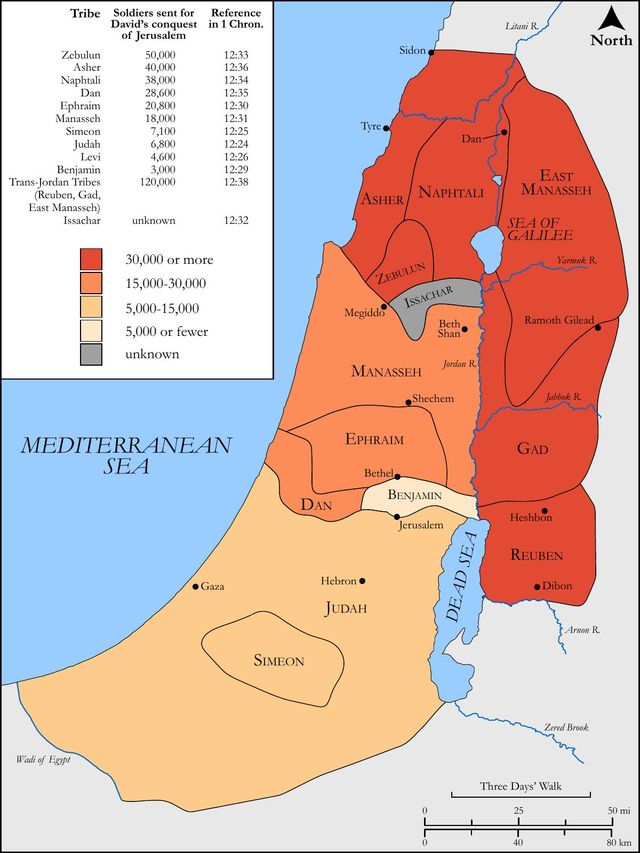
I.That those tribes that lived nearest brought the fewest - Judah but 6800 (Ch1 12:24), Simeon but 7100 (Ch1 12:25); whereas Zebulun, that lay remote, brought 50,000, Asher 40,000, and the two tribes and a half on the other side Jordan 120,000. Not as if the next adjacent tribes were cold in the cause; but they showed as much of their prudence in bringing few, since all the rest lay so near within call, as the others did of their zeal in bringing so many. The men of Judah had enough to do to entertain those that came from afar.
II.The Levites themselves, and the priests (called here the Aaronites), appeared very hearty in this cause, and were ready, if there were occasion, to fight for David, as well as pray for him, because they knew he was called of God to the government, Ch1 12:26-28.
III.Even some of the kindred of Saul came over to David (Ch1 12:29), not so many as of the other tribes, because a foolish affection for their own tribe, and a jealousy for the honour of it, kept many of them long in the sinking interest of Saul's family. Kindred should never over-rule conscience. Call no man Father to this extent, but God only.
IV.It is said of most of these that they were mighty men of valour (Ch1 12:25, Ch1 12:28, Ch1 12:30), of others that they were expert in war (Ch1 12:35, Ch1 12:36), and of them all that they could keep rank, Ch1 12:38. They had a great deal of martial fire, and yet were governable and subject to the rules of order - warm hearts but cool heads.
V.Some were so considerate as to bring with them arms, and all instruments for war (Ch1 12:24, Ch1 12:33, Ch1 12:37), for how could they think that David should be able to furnish them?
VI.The men of Issachar were the fewest af all, only 200, and yet as serviceable to David's interest as those that brought in the greatest numbers, these few being in effect the whole tribe. For, 1. They were men of great skill above any of their neighbours, men that had understanding of the times, to know what Israel ought to do. They understood the natural times, could discern the face of the sky, were weather-wise, could advise their neighbours in the proper times for ploughing, sowing reaping, etc. Or the ceremonial times, the times appointed for the solemn feasts; therefore they are said to call the people to the mountain (Deu 33:19), for almanacs were not then so common as now. Or, rather, the political times; they understood public affairs, the temper of the nation, and the tendencies of the present events. It is the periphrasis of statesmen that they know the times, Esth. 1. 13. Those of that tribe were greatly intent on public affairs, had good intelligence from abroad and made a good use of it. They knew what Israel ought to do: from their observation and experience they learned both their own and others' duty and interest. In this critical juncture they knew Israel ought to make David king. It was not only expedient, but necessary; the present posture of affairs called for it. The men of Issachar dealt mostly in country business, and did not much intermeddle in public affairs, which gave them an opportunity of observing others and conversing with themselves. A stander-by sees sometimes more than a gamester. 2. They were men of great interests; for all their brethren were at their commandment. The commonality of that tribe having bowed their shoulder to bear (Gen 49:15), the great men had them at their beck. Hence we read of the princes of Issachar, Jdg 5:15. They knew how to rule, and the rest knew how to obey. It is happy indeed when those that should lead are intelligent and judicious, and those who are to follow are modest and obsequious.
VII.It is said of them all that they engaged in this enterprise with a perfect heart (Ch1 12:38), and particularly of the men of Zebulun that they were not of double heart, Ch1 12:33. They were, in this matter, Israelites indeed, in whom was no guile. And this was their perfection, that they were of one heart, Ch1 12:38. None had any separate interests, but all for the public good.
VIII.The men of Judah, and others of the adjacent tribes, prepared for the victualling of their respective camps when they came to Hebron, Ch1 12:39, Ch1 12:40. Those that were at the least pains in travelling to this convention, or congress of states, thought themselves obliged to be at so much the more charge in entertaining the rest, that there might be something of an equality. A noble feast was made (was made for laughter, Ecc 10:19) upon this occasion, for there was joy in Israel, Ch1 12:40. And good reason; for when the righteous bear rule the city rejoices. Thus, when the throne of Christ is set up in a soul, there is, or ought to be, great joy in that soul: and provision is made for the feasting of it, not as here for two or three days, but for the whole life, nay, for eternity.
Continue studying 1 Chronicles 12:33 across the web’s major study libraries — every link below opens this exact verse, chapter, or book on the destination site.
Read & Compare
 BibleGatewayThis verse in more than 200 translations and 70 languages.
 Bible.comThe YouVersion reader — hundreds of translations, reading plans, and highlights.
 ESV.orgCrossway's official English Standard Version reader.
 NET BibleThe NET translation with 60,000+ translators' notes on every rendering decision.
 STEP BibleTyndale House's free study tool — original text, vocabulary, and scholarly resources.
 BibliaLogos Bible Software's free web reader.
 USCCBThe New American Bible (Revised Edition) with the U.S. bishops' study notes.
Commentaries
 BibleHub CommentariesDozens of classic commentaries on this verse, gathered on one page.
 StudyLightMore than 100 commentary sets — the largest collection on the web.
 BibleRefPlain-English commentary on what this verse means, verse by verse.
 Enduring WordDavid Guzik's free commentary on this chapter, widely used by Bible teachers.
 Bible Study ToolsVerse commentary alongside Greek and Hebrew study aids.
Original Language & Research
- BibleHub InterlinearThe verse word by word — original language, transliteration, and English.
- BibleHub LexiconEvery word's original-language definition and Strong's entry.
 Blue Letter BibleDeep-study tools — Strong's numbers, concordance, and word studies.
 SefariaThe Hebrew text with Rashi and centuries of Jewish commentary.
Sermons, Hymns & Audio


TrulyRandomVerse is not affiliated with these sites and doesn’t control their content. They’re linked because they’re genuinely useful.
Summary
1 Chronicles 12:33 offers a vivid portrait of the tribe of Zebulun's significant contribution to King David's forces as he consolidated his reign in Hebron. This verse highlights their exceptional military prowess, disciplined conduct on the battlefield, and, most notably, their profound and unwavering loyalty, characterized by a singular, undivided heart. Their inclusion underscores the diverse yet unified support David received, laying a crucial foundation for his emerging kingdom.
Context
ShowHideLiterary Context
Chapter 12 of 1 Chronicles meticulously enumerates the various contingents of warriors and leaders who rallied to David at Hebron, where he was to be anointed king over all Israel, a pivotal moment also recorded in 2 Samuel 5:1-3. Following detailed lists of mighty men from Benjamin, Judah, Gad, and Manasseh, the Chronicler shifts focus to the northern tribes, emphasizing their voluntary and wholehearted commitment. This verse, specifically detailing Zebulun's contribution, is part of a larger catalog (1 Chronicles 12:23-40) that showcases the breadth of support David garnered from across Israel, demonstrating the divine mandate and national consensus behind his kingship. The descriptions of each tribal group consistently highlight their unique strengths and shared dedication, painting a picture of a unified nation assembling under God's chosen leader.
Historical & Cultural Context
The period described is a pivotal moment in Israelite history: the transition from Saul's fragmented reign to David's unified monarchy. After Saul's death, David was initially king only over Judah in Hebron, while Ish-Bosheth, Saul's son, reigned over the northern tribes. The gathering at Hebron signifies the culmination of a seven-year civil war and the national recognition of David as God's anointed king for all Israel. Tribes like Zebulun, located in the northern Galilee region, were often exposed to foreign incursions, fostering a strong martial tradition. Their journey to Hebron, a significant distance, underscores their commitment. The emphasis on "keeping rank" and being "not of double heart" reflects the military and political necessities of the time: a unified, disciplined, and loyal force was essential for establishing stability and securing the kingdom against internal dissent and external threats.
Key Themes
ShowHideThis verse powerfully contributes to several overarching themes within 1 Chronicles. Firstly, it highlights Unity and National Consensus, demonstrating how disparate tribes came together under David, fulfilling God's promise of a united kingdom as envisioned in Psalm 122:3-4. Secondly, it underscores Divine Sovereignty and Davidic Kingship, as the Chronicler consistently portrays David's rise as divinely ordained, with God orchestrating the hearts of these warriors to support His chosen leader. Thirdly, and most profoundly, it emphasizes Wholehearted Devotion and Integrity. The phrase "not of double heart" is a key theological concept, signifying complete sincerity and loyalty. This contrasts sharply with those who might be indecisive or insincere, as seen in the warning against being double-minded in James 1:8 or attempting to serve two masters in Matthew 6:24. The Zebulunites' undivided loyalty was not merely a military asset but a spiritual virtue, reflecting a singular focus on the task and the king.
Exposition and Analysis
ShowHideKey Word Analysis
ShowHideThis word, foundational to the idiom "double heart," refers to the inner core of a person—the seat of feelings, will, intellect, and moral character. In biblical thought, the heart is the center of one's being, where decisions are made and intentions are formed. To have an undivided heart signifies complete sincerity and loyalty, as opposed to being indecisive, wavering, or hypocritical.
A primitive root meaning "to set in a row" or "arrange," this word is translated as "expert" in the context of war, indicating skill, preparation, and the ability to organize for battle. It denotes professional competence and strategic readiness, highlighting that the Zebulunites were not merely numerous but highly trained and capable soldiers.
This primitive root means "to arrange as a battle" or "to muster." In this context, it signifies the ability to maintain formation, order, and discipline in military maneuvers. It implies a well-drilled army capable of coordinated action, crucial for effectiveness in ancient warfare and reflecting a broader sense of cohesion.
Verse Breakdown
ShowHide"Of Zebulun, such as went forth to battle"
This identifies the tribe and their primary function within David's burgeoning army. Zebulun was known for its martial spirit and readiness to engage in conflict, often highlighted in prophetic blessings (e.g., Judges 5:18). Their presence among David's forces signifies their active participation and commitment to the military effort.
"expert in war, with all instruments of war"
This clause emphasizes their professional competence and preparedness. They were not merely numerous but highly trained and well-equipped soldiers. The phrase "expert in war" suggests seasoned veterans, while "with all instruments of war" indicates they brought their full arsenal, ready for any engagement.
"fifty thousand"
This large number underscores the significant contribution of Zebulun, highlighting their numerical strength and the sheer scale of the support David commanded. While some numbers in Chronicles can be debated for their exact literalness, they consistently convey the immense power and widespread allegiance David enjoyed.
"which could keep rank"
This speaks to their discipline, order, and ability to maintain formation in battle. Military discipline was crucial for coordinated warfare and reflects a broader sense of cohesion and strategic effectiveness within a united force. It implies they were not a disorganized mob but a well-drilled army capable of executing complex maneuvers.
"[they were] not of double heart"
This is the culminating and most significant descriptor. It speaks to their moral and spiritual character. Their loyalty was absolute, without wavering, hidden agendas, or internal division. This quality was invaluable for building trust and unity in David's emerging kingdom, distinguishing them as truly reliable and sincere allies.
Literary Devices
ShowHideThe Chronicler employs Emphasis through specific qualitative descriptors, particularly in the concluding phrase "not of double heart." While the preceding phrases detail their military strength and discipline, the final statement elevates their moral and spiritual integrity as their most crucial attribute. This creates a climactic effect, suggesting that character and loyalty are paramount. Furthermore, the phrase "not of double heart" functions as a powerful Idiom, conveying a complex concept of single-mindedness and sincerity in a concise and memorable way, drawing on a common understanding of the heart as the seat of will and intention. The repetition of "heart" (Hebrew: lev v'lev) within the idiom itself subtly reinforces the idea of internal division, which the Zebulunites lacked.
Theological and Thematic Connections
ShowHideThe Zebulunites' characteristics in 1 Chronicles 12:33 offer profound theological insights into the nature of true commitment, both to earthly leaders and, by extension, to God. Their military readiness and disciplined unity serve as a powerful metaphor for the spiritual battle believers are called to wage, requiring both skill in God's word and unwavering cohesion within the body of Christ. Most significantly, their "undivided heart" speaks to the core biblical demand for wholehearted devotion, a sincerity of purpose that rejects duplicity and embraces complete loyalty to a singular object of allegiance, whether it be a king or, ultimately, the King of Kings.
Reflection and Application
ShowHideThe example of the Zebulun warriors provides a powerful blueprint for believers today. Just as these men were fully committed to David's cause, we are called to exhibit an undivided heart towards God, loving Him with all our being and pursuing His kingdom with singular focus. Their ability to "keep rank" highlights the vital importance of unity and cohesion within the body of Christ; when believers work together with a singular purpose, maintaining spiritual discipline and order, they become a more effective force in spiritual warfare and ministry. Furthermore, being "not of double heart" challenges us to live lives of sincerity and integrity, where our words, actions, and inner convictions are aligned, reflecting a genuine and authentic faith that is not swayed by competing loyalties or hidden agendas. This verse serves as a timeless reminder of the value of wholehearted devotion, disciplined action, and unwavering unity in our personal spiritual walk and our collective service to God.
Questions for Reflection
ShowHideFAQ
ShowHideWhat does "not of double heart" truly mean in the context of ancient Israelite warfare and loyalty?
ShowHideIn the context of ancient Israelite warfare and loyalty, "not of double heart" (Hebrew: לֹא בְלֵב וָלֵב, lo' v'lev v'lev) signifies absolute, unwavering loyalty and singular purpose. It means these warriors were entirely committed to David's cause, without any hidden agendas, divided loyalties, or internal indecision. They were not wavering between supporting David and another potential king, nor were they serving David for personal gain while harboring other intentions. This quality was paramount for military effectiveness and political stability in a time when tribal allegiances could be fluid. It implies integrity, sincerity, and a complete devotion that ensured their reliability on the battlefield and in the consolidation of David's kingdom. Such wholeheartedness was a highly valued virtue, contrasting with the instability of a double-minded person.
Christ-Centered Fulfillment
ShowHideWhile 1 Chronicles 12:33 describes the earthly loyalty of warriors to King David, it powerfully foreshadows the ultimate call to an undivided heart in the kingdom of God, centered on Christ. The Zebulunites' single-minded devotion to David, their readiness for battle, and their disciplined unity point to the spiritual characteristics required of those who follow the true King. Jesus Himself spoke of the impossibility of serving two masters, demanding a singular allegiance that transcends earthly concerns. Believers are called to be "expert in war" not against flesh and blood, but against spiritual forces, equipped with the full armor of God and engaging in spiritual warfare. The "keeping rank" of the Zebulunites finds its fulfillment in the unity of the body of Christ, where believers are called to grow into one faith and knowledge of the Son of God, functioning as a cohesive unit under Christ, the Head (1 Corinthians 12:12-27). Ultimately, the unwavering loyalty of Zebulun to David prefigures the complete and unreserved devotion required of those who follow Jesus, the Lamb of God who is also the conquering Warrior King, whose kingdom, though not of this world (John 18:36), demands an undivided heart from His disciples.