


1 Chronicles 12:23
- וְאֵלֶּהVe·'e·lehand theseH428Conj-w ¦ PrtParticle Demonstrativeוְandאֵלֶּהthese
- מִסְפְּרֵיmis·pe·Rei[are] [the] numbers ofH4557N-mpcNoun Plural Masculine Construct
- רָאשֵׁיra·Shei[the] chiefs ofH7218N-mpcNoun Plural Masculine Construct
- הֶחָלוּץhe·cha·Lutzthe [man] equippedH2502Art ¦ V-Qal-PassPrtcpl-msVerb Qal Participle Passive Singular Masculine Absoluteהֶtheחָלוּץ[man] equipped
- לַצָּבָאla·tza·Va'for <the> warH6635Prep-l ¦ N-msNoun Singular Masculine Absoluteלַfor <the>צָּבָאwar
- בָּאוּBa·'u[who] they cameH935V-Qal-Perf-3cpVerb Qal Perfect 3rd Plural common gender
- עַל'altoH5921PrepPreposition
- דָּוִידda·VidDavidH1732N-proper-mNoun Proper Masculine
- חֶבְרוֹנָהchev·Ro·nahHebron towardsH2275N-proper ¦ SfxNoun Proper LocationחֶבְרוֹנָHebronהtowards
- לְהָסֵבle·ha·Sevto turn overH5437Prep-l ¦ V-Hiphil-InfVerb Hiphil Infinitive Constructלְtoהָסֵבturn over
- מַלְכוּתmal·Khut[the] kingdom ofH4438N-fscNoun Singular Feminine Construct
- שָׁאוּלsha·'UlSaulH7586N-proper-mNoun Proper Masculine
- אֵלָיו'e·Lavto himH413Prep ¦ 3msPrepositionאֵלָיtoוhim
- כְּפִיke·Fiaccording to [the] mouth ofH6310Prep-k ¦ N-mscNoun Singular Masculine Constructכְּaccording toפִי[the] mouth of
- יְהוָהYah·wehYahwehH3068N-properNoun Proper Title
English is a literal word-by-word gloss of the Hebrew, not the KJV's wording. Why?
This is the original text the KJV's translators worked from — each Hebrew word with its own literal English meaning in this verse, prepared by scholars at Tyndale House, Cambridge. The KJV translates whole sentences, not word by word, so its wording differs: one Hebrew word can become several English words, and the KJV may choose “the LORD” where the gloss reads “Yahweh”. Both are faithful — they answer different questions. For the KJV's own rendering, switch to the KJV text.
Details
See on the biblical-era maps
Study this verse
Public-domain commentary
Matthew Henry
From his Commentary on the Whole Bible. Henry comments on passages, not single verses — this entry covers 1 Chronicles 12:23–40.
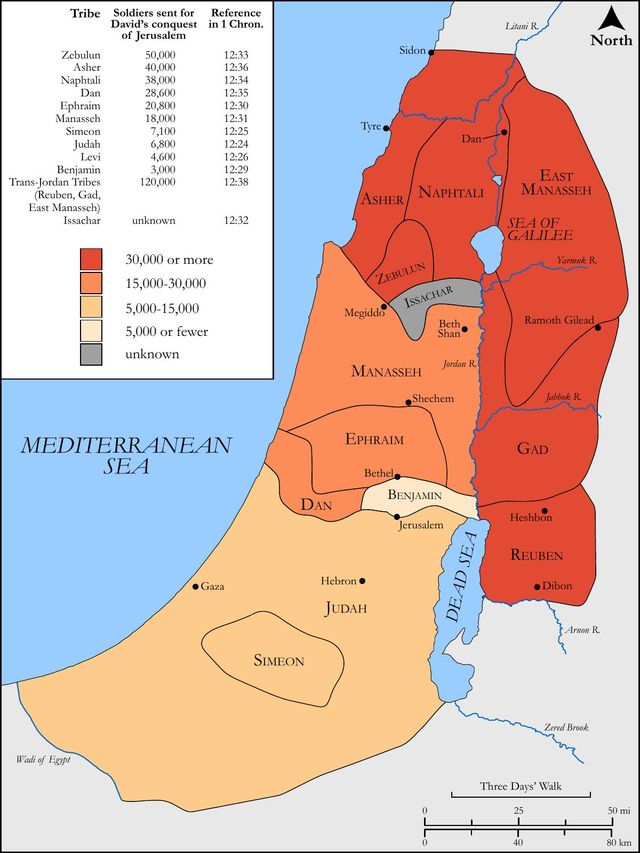
We have here an account of those who were active in perfecting the settlement of David upon the throne, after the death of Ishbosheth. We read (Ch1 11:1, and before Sa2 5:1) that all the tribes of Israel came, either themselves or by their representatives, to Hebron, to make David king; now here we have an account of the quota which every tribe brought in ready armed to the war, in case there should be any opposition, Ch1 12:23. We may observe here,
I.That those tribes that lived nearest brought the fewest - Judah but 6800 (Ch1 12:24), Simeon but 7100 (Ch1 12:25); whereas Zebulun, that lay remote, brought 50,000, Asher 40,000, and the two tribes and a half on the other side Jordan 120,000. Not as if the next adjacent tribes were cold in the cause; but they showed as much of their prudence in bringing few, since all the rest lay so near within call, as the others did of their zeal in bringing so many. The men of Judah had enough to do to entertain those that came from afar.
II.The Levites themselves, and the priests (called here the Aaronites), appeared very hearty in this cause, and were ready, if there were occasion, to fight for David, as well as pray for him, because they knew he was called of God to the government, Ch1 12:26-28.
III.Even some of the kindred of Saul came over to David (Ch1 12:29), not so many as of the other tribes, because a foolish affection for their own tribe, and a jealousy for the honour of it, kept many of them long in the sinking interest of Saul's family. Kindred should never over-rule conscience. Call no man Father to this extent, but God only.
IV.It is said of most of these that they were mighty men of valour (Ch1 12:25, Ch1 12:28, Ch1 12:30), of others that they were expert in war (Ch1 12:35, Ch1 12:36), and of them all that they could keep rank, Ch1 12:38. They had a great deal of martial fire, and yet were governable and subject to the rules of order - warm hearts but cool heads.
V.Some were so considerate as to bring with them arms, and all instruments for war (Ch1 12:24, Ch1 12:33, Ch1 12:37), for how could they think that David should be able to furnish them?
VI.The men of Issachar were the fewest af all, only 200, and yet as serviceable to David's interest as those that brought in the greatest numbers, these few being in effect the whole tribe. For, 1. They were men of great skill above any of their neighbours, men that had understanding of the times, to know what Israel ought to do. They understood the natural times, could discern the face of the sky, were weather-wise, could advise their neighbours in the proper times for ploughing, sowing reaping, etc. Or the ceremonial times, the times appointed for the solemn feasts; therefore they are said to call the people to the mountain (Deu 33:19), for almanacs were not then so common as now. Or, rather, the political times; they understood public affairs, the temper of the nation, and the tendencies of the present events. It is the periphrasis of statesmen that they know the times, Esth. 1. 13. Those of that tribe were greatly intent on public affairs, had good intelligence from abroad and made a good use of it. They knew what Israel ought to do: from their observation and experience they learned both their own and others' duty and interest. In this critical juncture they knew Israel ought to make David king. It was not only expedient, but necessary; the present posture of affairs called for it. The men of Issachar dealt mostly in country business, and did not much intermeddle in public affairs, which gave them an opportunity of observing others and conversing with themselves. A stander-by sees sometimes more than a gamester. 2. They were men of great interests; for all their brethren were at their commandment. The commonality of that tribe having bowed their shoulder to bear (Gen 49:15), the great men had them at their beck. Hence we read of the princes of Issachar, Jdg 5:15. They knew how to rule, and the rest knew how to obey. It is happy indeed when those that should lead are intelligent and judicious, and those who are to follow are modest and obsequious.
VII.It is said of them all that they engaged in this enterprise with a perfect heart (Ch1 12:38), and particularly of the men of Zebulun that they were not of double heart, Ch1 12:33. They were, in this matter, Israelites indeed, in whom was no guile. And this was their perfection, that they were of one heart, Ch1 12:38. None had any separate interests, but all for the public good.
VIII.The men of Judah, and others of the adjacent tribes, prepared for the victualling of their respective camps when they came to Hebron, Ch1 12:39, Ch1 12:40. Those that were at the least pains in travelling to this convention, or congress of states, thought themselves obliged to be at so much the more charge in entertaining the rest, that there might be something of an equality. A noble feast was made (was made for laughter, Ecc 10:19) upon this occasion, for there was joy in Israel, Ch1 12:40. And good reason; for when the righteous bear rule the city rejoices. Thus, when the throne of Christ is set up in a soul, there is, or ought to be, great joy in that soul: and provision is made for the feasting of it, not as here for two or three days, but for the whole life, nay, for eternity.
Continue studying 1 Chronicles 12:23 across the web’s major study libraries — every link below opens this exact verse, chapter, or book on the destination site.
Read & Compare
 BibleGatewayThis verse in more than 200 translations and 70 languages.
 Bible.comThe YouVersion reader — hundreds of translations, reading plans, and highlights.
 ESV.orgCrossway's official English Standard Version reader.
 NET BibleThe NET translation with 60,000+ translators' notes on every rendering decision.
 STEP BibleTyndale House's free study tool — original text, vocabulary, and scholarly resources.
 BibliaLogos Bible Software's free web reader.
 USCCBThe New American Bible (Revised Edition) with the U.S. bishops' study notes.
Commentaries
 BibleHub CommentariesDozens of classic commentaries on this verse, gathered on one page.
 StudyLightMore than 100 commentary sets — the largest collection on the web.
 BibleRefPlain-English commentary on what this verse means, verse by verse.
 Enduring WordDavid Guzik's free commentary on this chapter, widely used by Bible teachers.
 Bible Study ToolsVerse commentary alongside Greek and Hebrew study aids.
Original Language & Research
- BibleHub InterlinearThe verse word by word — original language, transliteration, and English.
- BibleHub LexiconEvery word's original-language definition and Strong's entry.
 Blue Letter BibleDeep-study tools — Strong's numbers, concordance, and word studies.
 SefariaThe Hebrew text with Rashi and centuries of Jewish commentary.
Sermons, Hymns & Audio


TrulyRandomVerse is not affiliated with these sites and doesn’t control their content. They’re linked because they’re genuinely useful.
Summary
1 Chronicles 12:23 introduces the pivotal assembly of formidable warriors from across the Israelite tribes who converged upon David at Hebron. This momentous gathering was not merely a strategic military or political maneuver, but a divinely orchestrated event, explicitly affirmed as being "according to the word of the LORD." It signifies the critical and legitimate transition of the kingdom from Saul's lineage to David, establishing his divinely appointed kingship and consolidating national unity under God's chosen leader, thereby fulfilling long-standing divine promises for Israel's future.
Context
ShowHideLiterary Context
This verse functions as a crucial introductory statement, serving as the heading for the detailed enumeration of the diverse military contingents that pledged allegiance to David. Chapter 12 of 1 Chronicles meticulously lists various groups—including skilled Benjamites, powerful Gadites, and loyal Manassites—highlighting their exceptional readiness, military prowess, and unwavering commitment to David. The preceding chapter (1 Chronicles 11) recounts David's anointing as king over all Israel and his capture of Jerusalem, setting the immediate stage for the consolidation of his reign. Thus, 1 Chronicles 12:23, followed by the extensive roster of supporters, powerfully testifies to the widespread and divinely sanctioned support David garnered, underscoring the legitimacy and divine mandate behind his ascent to the throne, a mandate explicitly stated in our focal verse. The Chronicler emphasizes the unity, strength, and divine orchestration that converged around God's chosen king.
Historical & Cultural Context
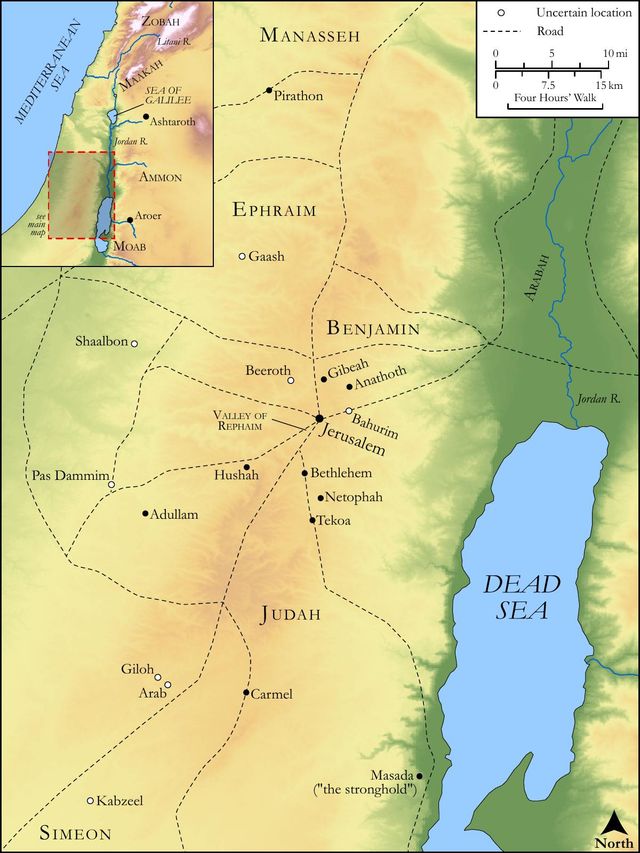
Following the tragic death of King Saul at Mount Gilboa (as recounted in 1 Samuel 31), Israel entered a complex period of transition marked by civil strife. While David was anointed king over Judah in Hebron (as detailed in 2 Samuel 2:4), Saul's son, Ish-bosheth, was established as king over the northern tribes by Abner, Saul's commander (see 2 Samuel 2:8-10). This created a deeply divided kingdom. Hebron, an ancient and highly significant city nestled in the Judean hills, held immense strategic, historical, and religious importance. It served as David's capital for seven and a half years before he captured Jerusalem. As a traditional burial site for the patriarchs and a place of covenant significance, Hebron was the ideal location for the gathering of these "bands" or military units from across Israel. This convergence signified a decisive shift in tribal loyalties, a widespread recognition of David's divine appointment, and a crucial step towards national unification under a single, divinely sanctioned monarchy, thereby fulfilling prophecies concerning David's kingship.
Key Themes
ShowHideThe overarching and paramount theme in 1 Chronicles 12:23 is the divine sovereignty over human affairs, particularly evident in the establishment of leadership and the fulfillment of God's promises. The phrase "according to the word of the LORD" is the theological linchpin, asserting that David's accession to the throne was not a mere political coup or a result of human machinations, but the direct and certain fulfillment of God's declared will, as first revealed through Samuel's anointing of David in 1 Samuel 16:12-13. This underscores God's active and faithful involvement in Israel's history and His unwavering commitment to His covenant promises. Another crucial theme is unity and loyalty, as warriors from various tribes, including those who had previously aligned with Saul, came together to support David. Their "ready armed" status highlights their commitment to God's chosen leader and their immediate readiness to participate in the divine plan. This convergence at Hebron also solidifies the legitimacy of David's kingship, demonstrating widespread acceptance and validating his role as the rightful successor to Saul and the divinely appointed shepherd of Israel, a role further cemented when all tribes formally anointed him king in 2 Samuel 5:3.
Exposition and Analysis
ShowHideKey Word Analysis
ShowHideThis primitive root (H2502) means "to pull off," and by implication, "to deliver" or "equip (for fight)." In the context of "ready armed," it conveys a sense of being stripped for action, prepared, and equipped for military service. It suggests not just the presence of weapons, but a state of readiness, professionalism, and immediate preparedness for combat. The warriors were not merely present; they were actively prepared and dedicated to the task of establishing David's kingdom, indicating their active and committed participation in God's unfolding plan.
Derived from the root meaning "to rule," this noun (H4438) refers to "a rule" or, concretely, "a dominion" or "kingdom." Its use here in "to turn the kingdom of Saul to him" emphasizes the transfer of legitimate royal authority and the entire sphere of governance. It highlights that the objective was not merely to gain personal power, but to effect a divinely ordained change in the established monarchy, moving the entire realm from Saul's house to David's, thereby fulfilling God's sovereign decree concerning the kingship of Israel.
This is the sacred, personal name of God (H3068), often translated as "the LORD." It signifies "the self-Existent or Eternal One," emphasizing God's covenant faithfulness, His active presence, and His unchanging nature. The phrase "according to the word of the LORD" (using H6310 for "word") is profoundly significant, asserting that the entire process—the gathering, the readiness for war, the coming to Hebron, and the transfer of the kingdom—was not a human political maneuver but the direct fulfillment of the sovereign, powerful, and certain declaration of the covenant God, YHWH. Its inclusion elevates the historical narrative to a profound theological statement about divine sovereignty and faithfulness to His promises.
Verse Breakdown
ShowHide"And these [are] the numbers of the bands [that were] ready armed to the war"
This opening clause introduces the subject of the verse: a precise accounting or census of the military units. The emphasis on "ready armed" immediately establishes the formidable and professional nature of these forces, indicating their preparedness and professional capacity for conflict. This sets the stage for the detailed list that follows in the chapter, showcasing the significant strength, discipline, and caliber of David's supporters who were prepared for immediate action.
"[and] came to David to Hebron"
This specifies both the destination and the purpose of these armed bands. Their convergence on Hebron, David's initial capital in Judah, signifies a deliberate and unified act of allegiance and recognition of his divinely appointed authority. It marks a physical and political gathering point for the consolidation of his power, indicating a decisive shift in national loyalty towards the king chosen by God. This was a strategic move to solidify his base before expanding his reign.
"to turn the kingdom of Saul to him"
This clause explicitly states the ultimate objective of their gathering: to facilitate the complete and legitimate transfer of royal authority from the house of Saul to David. It acknowledges the existing political reality of Saul's lingering reign (through Ish-bosheth) and highlights the deliberate, active effort required to effect the divinely ordained transition. This was a direct challenge to the political status quo, undertaken by those who recognized and submitted to God's sovereign will for the kingship of Israel.
"according to the word of the LORD"
This concluding phrase is the theological linchpin and interpretive key of the entire verse. It provides the ultimate justification, divine mandate, and driving force behind all the human actions described. It asserts that the entire process—the gathering of warriors, their readiness for war, their coming to Hebron, and the transfer of the kingdom—was not a mere human power struggle or a fortunate political alignment, but the direct and certain fulfillment of God's prior pronouncements, promises, and sovereign will. This elevates the historical narrative to a profound statement about divine sovereignty, faithfulness, and the efficacy of God's spoken word.
Literary Devices
ShowHideThe Chronicler masterfully employs several significant literary devices in 1 Chronicles 12:23 to convey its profound theological message. The most prominent is Divine Commentary, where the narrator explicitly interjects with the phrase "according to the word of the LORD." This functions as an authoritative interpretive lens, immediately informing the reader that the human actions described are not random or merely politically motivated, but are directly aligned with and driven by God's sovereign will. This device ensures that the audience understands the divine mandate behind David's kingship from the outset, highlighting God's active involvement in human affairs. There is also a strong element of Emphasis achieved through the meticulous detail and enumeration found throughout the broader chapter. By listing the various tribes and their specific military capabilities, the Chronicler emphasizes the broad, deep, and formidable support David received, underscoring the legitimacy, strength, and divine favor of his burgeoning kingdom. Furthermore, the verse contains clear Foreshadowing, as this gathering at Hebron "to turn the kingdom of Saul to him" explicitly anticipates the eventual and complete unification of all Israel under David's undisputed rule, a reality that is fully realized in subsequent narratives in 2 Samuel and 1 Chronicles.
Theological and Thematic Connections
ShowHide1 Chronicles 12:23 profoundly illustrates the foundational biblical truth of God's active and meticulous sovereignty in human history, particularly concerning the establishment of leadership and the unfailing fulfillment of His divine promises. The convergence of these formidable warriors to David was not a random political alignment or a mere act of human will, but a direct and obedient response to "the word of the LORD," demonstrating that God orchestrates events and uses human agents to bring about His divine purposes. This verse emphasizes that true authority and legitimate power derive fundamentally from God's appointment, not merely from human strength, popular acclaim, or military might. It highlights the profound principle that when God speaks, His word is inherently effective, powerful, and will inevitably accomplish precisely what He intends, even if it requires significant human cooperation, strategic action, and the overturning of established norms. The unity of diverse tribes under David also powerfully foreshadows a greater spiritual unity that God desires for His people under His ultimate King.
Reflection and Application
ShowHideThe convergence of warriors to David at Hebron, driven by the profound understanding that it was "according to the word of the LORD," offers a powerful and enduring lesson for believers today. It serves as a potent reminder that God's sovereign plans are unstoppable and will be brought to fruition, and He often uses the willing obedience and active participation of His people to accomplish them. Just as these warriors recognized God's divine hand in David's call and aligned themselves with His purpose, we too are called to diligently discern God's will in our lives, our communities, and the broader world, and to respond with readiness, unity, and unwavering commitment. This passage profoundly encourages us to trust implicitly in God's overarching sovereignty, even amidst uncertainty, perceived chaos, or challenging transitions, knowing that He is faithfully working behind the scenes to accomplish His eternal purposes. Our readiness to serve, to unite under the supreme leadership of Christ, and to act in accordance with His revealed word is absolutely crucial for the advancement of His kingdom in the world. It challenges us to deeply examine if our actions, allegiances, and life choices are truly "according to the word of the LORD."
Questions for Reflection
ShowHideFAQ
ShowHideWhat was the significance of Hebron in David's rise to kingship?
ShowHideHebron held immense strategic, historical, and religious significance during David's rise to power. After Saul's death, David was first anointed king over the tribe of Judah in Hebron (2 Samuel 2:4), and it served as his capital for seven and a half years. Its choice as the gathering point for the diverse tribes in 1 Chronicles 12:23 underscores its importance as a place of legitimate authority, a traditional city of the patriarchs, and a powerful symbol of the growing unity around David. It was a pivotal location for the consolidation of his reign and the initial fulfillment of God's promise concerning his kingship before he captured Jerusalem and established it as his permanent capital for all Israel.
Christ-Centered Fulfillment
ShowHideThe transfer of the kingdom to David "according to the word of the LORD" in 1 Chronicles 12:23 finds its ultimate, perfect, and eternal fulfillment in the person and redemptive work of Jesus Christ. David's kingship, established by divine decree and marked by the gathering of loyal followers, powerfully foreshadows the eternal, universal reign of Jesus, the true Son of David. Just as formidable warriors assembled to turn the earthly kingdom to David, so too do believers from every tribe, tongue, and nation gather under the banner of Christ, who is proclaimed as the King of kings and Lord of lords. The "word of the LORD" that established David's earthly throne points forward to the divine decree that Jesus, after His resurrection and ascension, has been given all authority in heaven and on earth. His kingdom is not merely a political entity but a spiritual reality that will have no end. The unity of the diverse Israelite tribes under David anticipates the Church, the body of Christ, composed of believers from every background, all united under their one Head, Jesus Christ, who came into the world to seek and to save the lost and to establish an everlasting kingdom of righteousness and peace, a spiritual reality that transcends all earthly reigns.