


1 Chronicles 12:24
- בְּנֵיbe·Nei[the] descendants ofH1121N-mpcNoun Plural Masculine Construct
- יְהוּדָהye·hu·DahJudahH3063N-proper-mNoun Proper Masculine
- נֹשְׂאֵיno·se·'Eibearers ofH5375V-Qal-Prtcpl-mpVerb Qal Participle Plural Masculine Construct
- צִנָּהtzi·NahshieldH6793N-fsNoun Singular Feminine Absolute
- וָרֹמַחva·Ro·machand spearH7420Conj-w ¦ N-msNoun Singular Masculine Absoluteוָandרֹמַחspear
- שֵׁשֶׁתShe·shetsixH8337N-cscNoun Singular common gender Construct
- אֲלָפִים'a·la·Fimthousand<s>H505N-cpNoun Plural common gender Absolute
- וּשְׁמוֹנֶהu·she·mo·Nehand eightH8083Conj-w ¦ N-csNoun Singular common gender Absoluteוּandשְׁמוֹנֶהeight
- מֵאוֹתme·'othundred<s>H3967N-fpNoun Plural Feminine Absolute
- חֲלוּצֵיcha·lu·Tzei[men] equipped ofH2502V-Qal-PassPrtcpl-mpVerb Qal Participle Passive Plural Masculine Construct
- צָבָאtza·Va'warH6635N-msNoun Singular Masculine Absolute
English is a literal word-by-word gloss of the Hebrew, not the KJV's wording. Why?
This is the original text the KJV's translators worked from — each Hebrew word with its own literal English meaning in this verse, prepared by scholars at Tyndale House, Cambridge. The KJV translates whole sentences, not word by word, so its wording differs: one Hebrew word can become several English words, and the KJV may choose “the LORD” where the gloss reads “Yahweh”. Both are faithful — they answer different questions. For the KJV's own rendering, switch to the KJV text.
Details
See on the biblical-era maps
Study this verse
Public-domain commentary
Matthew Henry
From his Commentary on the Whole Bible. Henry comments on passages, not single verses — this entry covers 1 Chronicles 12:23–40.
We have here an account of those who were active in perfecting the settlement of David upon the throne, after the death of Ishbosheth. We read (Ch1 11:1, and before Sa2 5:1) that all the tribes of Israel came, either themselves or by their representatives, to Hebron, to make David king; now here we have an account of the quota which every tribe brought in ready armed to the war, in case there should be any opposition, Ch1 12:23. We may observe here,
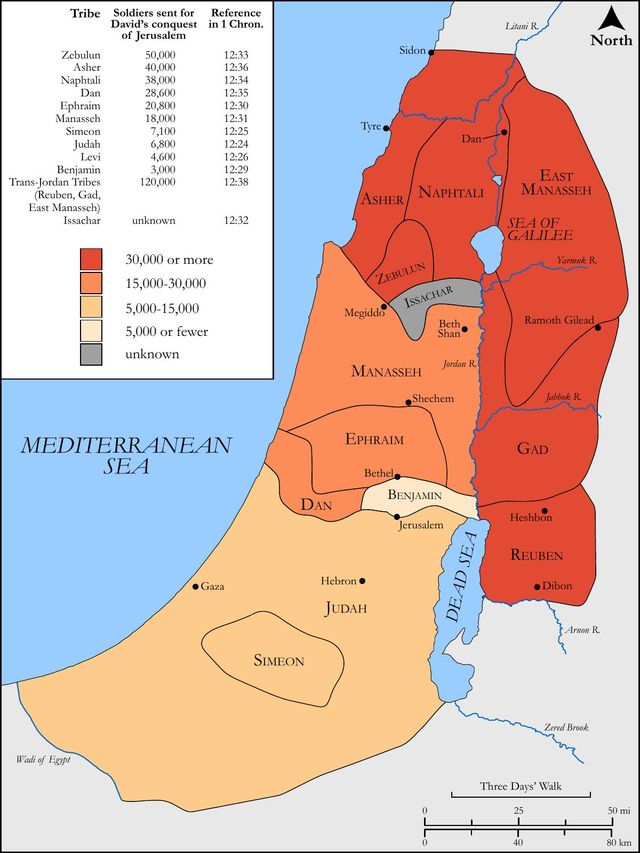
I.That those tribes that lived nearest brought the fewest - Judah but 6800 (Ch1 12:24), Simeon but 7100 (Ch1 12:25); whereas Zebulun, that lay remote, brought 50,000, Asher 40,000, and the two tribes and a half on the other side Jordan 120,000. Not as if the next adjacent tribes were cold in the cause; but they showed as much of their prudence in bringing few, since all the rest lay so near within call, as the others did of their zeal in bringing so many. The men of Judah had enough to do to entertain those that came from afar.
II.The Levites themselves, and the priests (called here the Aaronites), appeared very hearty in this cause, and were ready, if there were occasion, to fight for David, as well as pray for him, because they knew he was called of God to the government, Ch1 12:26-28.
III.Even some of the kindred of Saul came over to David (Ch1 12:29), not so many as of the other tribes, because a foolish affection for their own tribe, and a jealousy for the honour of it, kept many of them long in the sinking interest of Saul's family. Kindred should never over-rule conscience. Call no man Father to this extent, but God only.
IV.It is said of most of these that they were mighty men of valour (Ch1 12:25, Ch1 12:28, Ch1 12:30), of others that they were expert in war (Ch1 12:35, Ch1 12:36), and of them all that they could keep rank, Ch1 12:38. They had a great deal of martial fire, and yet were governable and subject to the rules of order - warm hearts but cool heads.
V.Some were so considerate as to bring with them arms, and all instruments for war (Ch1 12:24, Ch1 12:33, Ch1 12:37), for how could they think that David should be able to furnish them?
VI.The men of Issachar were the fewest af all, only 200, and yet as serviceable to David's interest as those that brought in the greatest numbers, these few being in effect the whole tribe. For, 1. They were men of great skill above any of their neighbours, men that had understanding of the times, to know what Israel ought to do. They understood the natural times, could discern the face of the sky, were weather-wise, could advise their neighbours in the proper times for ploughing, sowing reaping, etc. Or the ceremonial times, the times appointed for the solemn feasts; therefore they are said to call the people to the mountain (Deu 33:19), for almanacs were not then so common as now. Or, rather, the political times; they understood public affairs, the temper of the nation, and the tendencies of the present events. It is the periphrasis of statesmen that they know the times, Esth. 1. 13. Those of that tribe were greatly intent on public affairs, had good intelligence from abroad and made a good use of it. They knew what Israel ought to do: from their observation and experience they learned both their own and others' duty and interest. In this critical juncture they knew Israel ought to make David king. It was not only expedient, but necessary; the present posture of affairs called for it. The men of Issachar dealt mostly in country business, and did not much intermeddle in public affairs, which gave them an opportunity of observing others and conversing with themselves. A stander-by sees sometimes more than a gamester. 2. They were men of great interests; for all their brethren were at their commandment. The commonality of that tribe having bowed their shoulder to bear (Gen 49:15), the great men had them at their beck. Hence we read of the princes of Issachar, Jdg 5:15. They knew how to rule, and the rest knew how to obey. It is happy indeed when those that should lead are intelligent and judicious, and those who are to follow are modest and obsequious.
VII.It is said of them all that they engaged in this enterprise with a perfect heart (Ch1 12:38), and particularly of the men of Zebulun that they were not of double heart, Ch1 12:33. They were, in this matter, Israelites indeed, in whom was no guile. And this was their perfection, that they were of one heart, Ch1 12:38. None had any separate interests, but all for the public good.
VIII.The men of Judah, and others of the adjacent tribes, prepared for the victualling of their respective camps when they came to Hebron, Ch1 12:39, Ch1 12:40. Those that were at the least pains in travelling to this convention, or congress of states, thought themselves obliged to be at so much the more charge in entertaining the rest, that there might be something of an equality. A noble feast was made (was made for laughter, Ecc 10:19) upon this occasion, for there was joy in Israel, Ch1 12:40. And good reason; for when the righteous bear rule the city rejoices. Thus, when the throne of Christ is set up in a soul, there is, or ought to be, great joy in that soul: and provision is made for the feasting of it, not as here for two or three days, but for the whole life, nay, for eternity.
Continue studying 1 Chronicles 12:24 across the web’s major study libraries — every link below opens this exact verse, chapter, or book on the destination site.
Read & Compare
 BibleGatewayThis verse in more than 200 translations and 70 languages.
 Bible.comThe YouVersion reader — hundreds of translations, reading plans, and highlights.
 ESV.orgCrossway's official English Standard Version reader.
 NET BibleThe NET translation with 60,000+ translators' notes on every rendering decision.
 STEP BibleTyndale House's free study tool — original text, vocabulary, and scholarly resources.
 BibliaLogos Bible Software's free web reader.
 USCCBThe New American Bible (Revised Edition) with the U.S. bishops' study notes.
Commentaries
 BibleHub CommentariesDozens of classic commentaries on this verse, gathered on one page.
 StudyLightMore than 100 commentary sets — the largest collection on the web.
 BibleRefPlain-English commentary on what this verse means, verse by verse.
 Enduring WordDavid Guzik's free commentary on this chapter, widely used by Bible teachers.
 Bible Study ToolsVerse commentary alongside Greek and Hebrew study aids.
Original Language & Research
- BibleHub InterlinearThe verse word by word — original language, transliteration, and English.
- BibleHub LexiconEvery word's original-language definition and Strong's entry.
 Blue Letter BibleDeep-study tools — Strong's numbers, concordance, and word studies.
 SefariaThe Hebrew text with Rashi and centuries of Jewish commentary.
Sermons, Hymns & Audio


TrulyRandomVerse is not affiliated with these sites and doesn’t control their content. They’re linked because they’re genuinely useful.
Summary
1 Chronicles 12:24 precisely details the contingent from the tribe of Judah who joined David, specifying their number as six thousand eight hundred, equipped with shield and spear, and fully prepared for war. This verse is an integral part of a broader enumeration of the mighty warriors and leaders from various tribes who rallied around David, first during his time in exile at Ziklag and later at Hebron, where he was anointed king over all Israel. It fundamentally underscores the foundational military support David received from his own tribe, highlighting their unwavering loyalty, formidable strength, and disciplined readiness as crucial elements in the establishment and security of his divinely ordained kingdom.
Context
ShowHideLiterary Context
1 Chronicles 12 meticulously enumerates the diverse and formidable warriors who joined David, serving to demonstrate the growing support and divine favor upon him. The chapter naturally divides into two main sections: those who came to David at Ziklag while he was still a fugitive from Saul (1 Chronicles 12:1-22), emphasizing their unique skills and unwavering loyalty, and those who subsequently came to him at Hebron to make him king (1 Chronicles 12:23-40). Verse 24 falls squarely within this second, climactic section, specifically detailing the tribal contingents that assembled at Hebron. The Chronicler's meticulous accounting of numbers, weaponry, and readiness for each tribal group underscores the legitimacy and formidable strength of David's burgeoning kingdom, culminating in the joyous celebration of his anointing as king over all Israel (1 Chronicles 12:38-40). This verse, therefore, is a vital piece of the Chronicler's larger narrative, emphasizing David's divinely ordained rise to power and the essential unity of Israel under his righteous rule.
Historical & Cultural Context
The period described in 1 Chronicles 12 marks a pivotal transition in Israelite history, moving from the fragmented and declining reign of Saul to the unified and ascendant monarchy of David. David had been divinely anointed by Samuel years prior, but Saul's persistent jealousy and persecution forced David into a prolonged period of exile. The gathering at Hebron, which served as David's initial capital, was a crucial step in fulfilling God's covenantal promises to David. Culturally, loyalty to one's tribe and clan was paramount, yet this chapter powerfully showcases a broader, transcendent loyalty to David as God's chosen king, effectively bridging and uniting tribal divisions. The mention of "shield and spear" reflects the standard weaponry of the time, indicating well-equipped and professionally trained infantry. The phrase "ready armed to the war" (עֲרוּכֵי מִלְחָמָה, arukhei milchamah) signifies a professional military posture, indicating not merely a collection of armed individuals, but disciplined soldiers prepared for immediate and organized combat. This level of organization and readiness was absolutely essential for establishing and maintaining control in a region frequently marked by conflict and the constant need for defense against both internal and external threats.
Key Themes
ShowHideThis verse, situated within its broader chapter, significantly contributes to several profound theological and narrative themes. Firstly, it powerfully illustrates Divine Orchestration and Favor, demonstrating how God was actively gathering support for David, thereby fulfilling the promise of a lasting dynasty, a theme echoed in God's covenant with David in 2 Samuel 7:16. Secondly, it underscores the theme of Unity and Loyalty, as various tribes, including Judah, willingly set aside past divisions or allegiances to Saul and united under David's leadership, recognizing his divine appointment. The specific mention of Judah, David's own tribe, highlights their foundational and unwavering support, symbolizing the core of his strength. Thirdly, the detailed enumeration of warriors and their explicit readiness points to Military Strength and Preparedness, which was vital for securing the nascent kingdom and establishing a period of relative peace and stability. This readiness was not merely physical but also a reflection of their deep commitment to David's cause. Finally, the chapter, including this verse, contributes significantly to the theme of the Legitimacy of David's Kingship, demonstrating that his rule was not seized by mere force, but was widely affirmed and supported by the people, undergirded by divine will. The Chronicler's emphasis on such meticulous details serves to reinforce the glorious and divinely sanctioned nature of David's reign, which would later serve as a prophetic blueprint for the Messiah's eternal kingdom.
Exposition and Analysis
ShowHideKey Word Analysis
ShowHideFrom יָדָה; celebrated; Jehudah (or Judah), the name of five Israelites; also of the tribe descended from the first, and of its territory; Judah. The prominence of Judah, David's own tribe, is emphasized here. This tribe was destined for leadership and from which the Messiah would ultimately descend (Genesis 49:10). Their substantial contingent underscores their pivotal role in establishing David's kingdom and their unwavering loyalty to their tribal leader.
Feminine of צֵן; a hook (as pointed); also a (large) shield (as if guarding by prickliness); also cold (as piercing); buckler, cold, hook, shield, target. This refers to a large, full-body shield, often covering the entire person, primarily used for heavy defense in battle formations. Its mention signifies that these were well-equipped, heavily armed warriors, capable of sustained defensive action, implying professional soldiers rather than irregulars.
A primitive root; to pull off; hence (intensively) to strip, (reflex.) to depart; by implication, to deliver, equip (for fight); present, strengthen; arm (self), (go, ready) armed ([idiom] man, soldier), deliver, draw out, make fat, loose, (ready) prepared, put off, take away, withdraw self. This term conveys a state of complete preparedness, disciplined formation, and mental readiness for combat. It suggests that these men were not just equipped, but organized and poised for immediate engagement. The root implies being "stripped" or "equipped" for action, signifying a professional and ready military posture.
Verse Breakdown
ShowHide"The children of Judah"
This phrase identifies the specific tribal contingent from Judah, David's own lineage and the tribe from which he hailed. Their presence and substantial numbers are profoundly significant, as they represent the core, unwavering support for David's kingship, providing a strong and loyal base from which he could effectively consolidate power over all Israel. Their loyalty was paramount to his success.
"that bare shield and spear"
This clause describes the specific weaponry and, by extension, the military role of these warriors. The "shield" (צִנָּה, tsinnâh) refers to a large defensive piece, while the "spear" (רֹמַח, rômach) was a primary offensive weapon, suitable for both close-quarters combat and throwing. This indicates that these were trained infantrymen, fully equipped for battle, capable of both robust defense and aggressive offense, signifying their professional military status.
"[were] six thousand and eight hundred"
The precise numerical detail here highlights the Chronicler's meticulous emphasis on the substantial and verifiable strength of David's forces. This large number from a single, foundational tribe demonstrates the significant military power that rallied behind David, underscoring the formidable nature of his army and the widespread, tangible acceptance of his leadership across Israel.
"ready armed to the war"
This powerful phrase emphasizes their state of complete preparedness and professional military bearing. It conveys that they were not merely equipped, but also organized, disciplined, and mentally poised for immediate and decisive combat. This profound readiness was absolutely crucial for the stability and security of the nascent kingdom, signaling their deep commitment and robust capability to defend David's throne and advance his divinely appointed cause.
Literary Devices
ShowHideThe Chronicler employs several impactful literary devices in 1 Chronicles 12:24 to convey its message with precision and emphasis. Enumeration is prominently used throughout the entire chapter, and specifically here, with the precise number "six thousand and eight hundred," lending an air of historical accuracy and powerfully emphasizing the tangible strength and widespread support for David. The mention of "shield and spear" functions as a form of Synecdoche, where these specific implements represent the entire warrior, signifying their complete armament and unwavering readiness for battle as a unified fighting force. Furthermore, the phrase "ready armed to the war" serves as a powerful Emphasis, highlighting the disciplined, professional, and fully prepared nature of Judah's contingent. This repeated emphasis on readiness and comprehensive equipment across the chapter underscores the formidable and divinely sanctioned nature of David's army, reinforcing the Chronicler's overarching theological theme of God's sovereign hand in establishing David's legitimate and powerful reign.
Theological and Thematic Connections
ShowHideThe assembly of warriors from Judah, explicitly described as "ready armed to the war," speaks profoundly to the theological truth that God often works through human means and diligent preparation to accomplish His divine purposes. While David's kingship was undeniably divinely appointed and sovereignly ordained, its establishment and consolidation required the active participation, unwavering loyalty, and military readiness of his people. This verse powerfully illustrates the principle of divine sovereignty working in synergistic concert with human responsibility and diligent effort. It also foreshadows the enduring importance of a unified and prepared people for God's kingdom work, whether in establishing an earthly monarchy or in the spiritual battles of the Church. The meticulous detail provided by the Chronicler reflects God's attention to the specifics of His grand plan, even down to the numbers and equipment of those who faithfully serve His chosen leader.
Reflection and Application
ShowHideThe detailed account of Judah's warriors, their impressive numbers, and their explicit readiness for war offers profound and enduring lessons for believers today. Just as these men were physically prepared and deeply committed to David's earthly kingdom, we are called to be spiritually prepared and wholeheartedly committed to the eternal kingdom of God. Our "shield and spear" are not carnal weapons, but rather the spiritual armor and the living truth of God's Word, enabling us to stand firm and immovable in the face of spiritual challenges and temptations. The exemplary unity and unwavering loyalty displayed by Judah's contingent powerfully remind us of the immense strength found in collective purpose and steadfast support for God-appointed leadership within the church and our broader communities. Our readiness should be characterized by an active and diligent pursuit of holiness, a deep and transformative knowledge of Scripture, and a fervent, consistent prayer life, ensuring we are always "ready armed" for the spiritual battles that inevitably arise in our daily walk of faith. This passage profoundly encourages us to assess our own state of preparedness and commitment to Christ's glorious cause, urging us to be active, loyal, and ready participants in His ongoing work of redemption and transformation in the world.
Questions for Reflection
ShowHideFAQ
ShowHideWhy is the specific number of Judah's warriors, 6,800, mentioned with such precision?
ShowHideThe Chronicler's meticulous enumeration, including the precise number of 6,800 for Judah's contingent, serves several crucial purposes. Firstly, it lends historical credibility and powerfully demonstrates the sheer scale of support David commanded, underscoring the undeniable legitimacy of his kingship. Secondly, it highlights the formidable military strength that rallied behind David, indicating that his ascent to the throne was not merely a political maneuver but a significant and divinely-backed mobilization of forces. Thirdly, for the post-exilic audience of Chronicles, such precise details would have powerfully reinforced the past glory and divine favor upon the Davidic line, offering tangible hope for future restoration and a renewed sense of identity. It emphasizes that God's plan for David was robustly supported by a prepared and numerous people, signifying both profound divine blessing and unwavering human commitment.
What does "ready armed to the war" imply for David's kingdom and its future?
ShowHideThe phrase "ready armed to the war" (עֲרוּכֵי מִלְחָמָה, arukhei milchamah) is profoundly significant. It implies that these were not just individuals with weapons, but a disciplined, organized, and thoroughly prepared fighting force, poised for immediate action. For David's nascent kingdom, this meant immediate military capability to secure his reign, defend against external enemies, and strategically expand his territory. It signaled an era of stability and strength, absolutely crucial for establishing a unified monarchy after years of fragmentation and internal strife under Saul. This state of readiness was foundational for the peace and prosperity that would characterize much of David's reign, allowing him to consolidate power and eventually bring the ark of the covenant to Jerusalem, establishing it as the spiritual and political capital, as meticulously detailed in 2 Samuel 6.
How does this verse contribute to the larger narrative of David's rise to power in 1 Chronicles?
ShowHide1 Chronicles 12:24 is a crucial and integral piece in the Chronicler's overarching narrative of David's divinely ordained rise to power. The entire chapter is dedicated to showcasing the powerful and diverse forces that willingly joined David, thereby legitimizing his kingship in the eyes of all Israel. This specific verse, by meticulously detailing the strength of Judah, David's own ancestral tribe, powerfully emphasizes the foundational and unwavering support he received from his kin. It underscores the profound theological theme that David's rule was not a usurpation but a widespread, divinely-backed movement, affirmed by the people. The Chronicler's consistent emphasis on such meticulous details throughout the chapter, culminating in the joyous and unanimous anointing of David as king over all Israel (1 Chronicles 12:38-40), serves to reinforce the glory and divine sanction of the Davidic line, which is absolutely central to the book's theological message and its profound focus on the temple and the eternal covenant.
Christ-Centered Fulfillment
ShowHideWhile 1 Chronicles 12:24 vividly describes the earthly warriors who valiantly rallied around David, the earthly king, it ultimately points to the far greater spiritual reality of Christ's eternal kingdom and His spiritual army. David, as the anointed king, serves as a profound type and foreshadowing of Jesus Christ, the true Son of David and King of kings, to whom all authority in heaven and on earth has been sovereignly given (Matthew 28:18). Just as David's warriors were "ready armed to the war" to establish his earthly kingdom, believers in Christ are called to be spiritually "armed" and perpetually prepared for the spiritual warfare of God's kingdom (Ephesians 6:10-18). We are, in a profound spiritual sense, Christ's "children of Judah," His chosen people, not by earthly bloodline but by saving faith, who bear the "shield of faith" and wield the "sword of the Spirit, which is the word of God" (Ephesians 6:16-17). Our ultimate loyalty is to Him, the conquering Lamb of God who takes away the sin of the world (John 1:29), and whose reign is eternal, truly universal, and perfectly just (Revelation 11:15). The unity, discipline, and readiness of David's men prefigure the Church, the unified body of Christ, called to stand united and prepared to advance His glorious gospel and demonstrate His transformative love in a world still awaiting His full and final triumph.