


Judges 10:4
- וַיְהִיvay·hiand it belongedH1961Conj-w ¦ V-Qal-ConsecImperf-3msVerb Qal Consecutive Imperfect 3rd Singular Masculineוַandיְהִיit belonged
- לוֹloto <the> himPrep-l ¦ 3msSuffix Personal 3rd Singular Masculineלto <the>וֹhim
- שְׁלֹשִׁיםshe·lo·ShimthirtyH7970N-mpNoun Plural Masculine Absolute
- בָּנִיםba·NimsonsH1121N-mpNoun Plural Masculine Absolute
- רֹכְבִיםro·khe·Vim[who] rodeH7392V-Qal-Prtcpl-mpVerb Qal Participle Plural Masculine Absolute
- עַל'alonH5921PrepPreposition
- שְׁלֹשִׁיםshe·lo·ShimthirtyH7970N-mpNoun Plural Masculine Absolute
- עֲיָרִים'a·ya·RimdonkeysH5895N-mpNoun Plural Masculine Absolute
- וּשְׁלֹשִׁיםu·she·lo·Shimand thirtyH7970Conj-w ¦ N-mpNoun Plural Masculine Absoluteוּandשְׁלֹשִׁיםthirty
- עֲיָרִים'a·ya·RimcitiesH5892N-mpNoun Plural Masculine Absolute
- לָהֶםla·Hem[belonged] to <the> themPrep-l ¦ 3mpSuffix Personal 3rd Plural Masculineלָ[belonged] to <the>הֶםthem
- לָהֶםla·Hem<to> <the> themPrep-l ¦ 3mpSuffix Personal 3rd Plural Masculineלָ<to> <the>הֶםthem
- יִקְרְאוּyik·re·'Upeople callH7121V-Qal-Imperf-3mpVerb Qal Imperfect 3rd Plural Masculine
- חַוֹּתcha·VotHavvothH2334N-fpcNoun Plural Feminine Construct
- יָאִירya·'IrJairH2334N-properNoun Proper Location
- עַד'aduntilH5704PrepPreposition
- הַיּוֹםhai·Yomthe dayH3117Art ¦ N-msNoun Singular Masculine Absoluteהַtheיּוֹםday
- הַזֶּהha·Zeh<the> thisH2088Art ¦ PrtParticle Demonstrativeהַ<the>זֶּהthis
- אֲשֶׁר'a·SherwhichH834RelParticle Relative
- בְּאֶרֶץbe·'E·retz[are] in [the] land ofH776Prep-b ¦ N-fscNoun Singular Feminine Constructבְּ[are] inאֶרֶץ[the] land of
- הַגִּלְעָדha·gil·'Ad<the> GileadH1568Art ¦ N-properNoun Proper Locationהַ<the>גִּלְעָדGilead
English is a literal word-by-word gloss of the Hebrew, not the KJV's wording. Why?
This is the original text the KJV's translators worked from — each Hebrew word with its own literal English meaning in this verse, prepared by scholars at Tyndale House, Cambridge. The KJV translates whole sentences, not word by word, so its wording differs: one Hebrew word can become several English words, and the KJV may choose “the LORD” where the gloss reads “Yahweh”. Both are faithful — they answer different questions. For the KJV's own rendering, switch to the KJV text.
Details
See on the biblical-era maps

Study this verse
Public-domain commentary
Matthew Henry
From his Commentary on the Whole Bible. Henry comments on passages, not single verses — this entry covers Judges 10:1–5.
Quiet and peaceable reigns, though the best to live in, are the worst to write of, as yielding least variety of matter for the historian to entertain his reader with; such were the reigns of these two judges, Tola and Jair, who make but a small figure and take up but a very little room in this history. But no doubt they were both raised up of God to serve their country in the quality of judges, not pretending, as Abimelech had done, to the grandeur of kings, nor, like him, taking the honour they had to themselves, but being called of God to it. 1. Concerning Tola it is said that he arose after Abimelech to defend Israel, Jdg 10:1. After Abimelech had debauched Israel by his wickedness, disquieted and disturbed them by his restless ambition, and, by the mischiefs he brought on them, exposed them to enemies from abroad, God animated this good man to appear for the reforming of abuses, the putting down of idolatry, the appeasing of tumults, and the healing of the wounds given to the state by Abimelech's usurpation. Thus he saved them from themselves, and guarded them against their enemies. He was of the tribe of Issachar, a tribe disposed to serve, for he bowed his shoulder to bear (Gen 49:14, Gen 49:15), yet one of that tribe is here raised up to rule; for those that humble themselves shall be exalted. He bore the name of him that was ancestor to the first family of that tribe; of the sons of Issachar Tola was the first, Gen 46:13; Num 26:23. It signifies a worm, yet, being the name of his ancestor, he was not ashamed of it. Though he was of Issachar, yet, when he was raised up to the government, he came and dwelt in Mount Ephraim, which was more in the heart of the country, that the people might the more conveniently resort to him for judgment. He judged Israel twenty-three years (Jdg 10:2), kept things in good order, but did not any thing very memorable. 2. Jair was a Gileadite, so was his next successor Jephthah, both of that half tribe of the tribe of Manasseh which lay on the other side Jordan; though they seemed separated from their brethren, yet God took care, while the honour of the government was shifted from tribe to tribe and before it settled in Judah, that those who lay remote should sometimes share in it, putting more abundant honour on that part which lacked. Jair bore the name of a very famous man of the same tribe who in Moses's time was very active in reducing this country, Num 32:41; Jos 13:30. That which is chiefly remarkable concerning this Jair is the increase and honour of his family: He had thirty sons, Jdg 10:4. And, (1.) They had good preferments, for they rode on thirty ass colts; that is, they were judges itinerant, who, as deputies to their father, rode from place to place in their several circuits to administer justice. We find afterwards that Samuel made his sons judges, though he could not make them good ones, Sa1 8:1-3. (2.) They had good possessions, every one a city, out of those that were called, from their ancestor of the same name with their father, Havoth-jair - the villages of Jair; yet they are called cities, either because those young gentlemen to whom they were assigned enlarged and fortified them, and so improved them into cities, or because they were as well pleased with their lot in those country towns as if they had been cities compact together and fenced with gates and bars. Villages are cities to a contented mind.
Historical interpretation
Historical reception
1 surviving comment on this verse from the historical church.
Havoth Jair: This name was now confirmed to these towns, which they had formerly received from another Jair. Num. 32. 41.
Continue studying Judges 10:4 across the web’s major study libraries — every link below opens this exact verse, chapter, or book on the destination site.
Read & Compare
 BibleGatewayThis verse in more than 200 translations and 70 languages.
 Bible.comThe YouVersion reader — hundreds of translations, reading plans, and highlights.
 ESV.orgCrossway's official English Standard Version reader.
 NET BibleThe NET translation with 60,000+ translators' notes on every rendering decision.
 STEP BibleTyndale House's free study tool — original text, vocabulary, and scholarly resources.
 BibliaLogos Bible Software's free web reader.
 USCCBThe New American Bible (Revised Edition) with the U.S. bishops' study notes.
Commentaries
 BibleHub CommentariesDozens of classic commentaries on this verse, gathered on one page.
 StudyLightMore than 100 commentary sets — the largest collection on the web.
 BibleRefPlain-English commentary on what this verse means, verse by verse.
 Enduring WordDavid Guzik's free commentary on this chapter, widely used by Bible teachers.
 Bible Study ToolsVerse commentary alongside Greek and Hebrew study aids.
Original Language & Research
- BibleHub InterlinearThe verse word by word — original language, transliteration, and English.
- BibleHub LexiconEvery word's original-language definition and Strong's entry.
 Blue Letter BibleDeep-study tools — Strong's numbers, concordance, and word studies.
 SefariaThe Hebrew text with Rashi and centuries of Jewish commentary.
Sermons, Hymns & Audio


TrulyRandomVerse is not affiliated with these sites and doesn’t control their content. They’re linked because they’re genuinely useful.
Summary
Judges 10:4 provides a succinct yet impactful portrait of Jair, one of Israel's "minor judges," highlighting his significant prosperity and extensive regional influence. The verse details his thirty sons, each riding an ass colt, and their association with thirty cities known as Havothjair, located in the land of Gilead. This snapshot reveals a period of relative stability and established leadership during the often-turbulent era of the Judges, underscoring a leader whose legacy was substantial enough to lend his name to geographical locations that persisted "unto this day."
Context
ShowHideLiterary Context
Judges 10:4 is situated within the latter half of the Book of Judges, a narrative that chronicles Israel's recurring cycle of apostasy, divine judgment, oppression by foreign powers, and subsequent deliverance through divinely appointed judges. Jair's brief account immediately follows the equally concise judgeship of Tola of Issachar, serving as another example of a leader who brought a measure of peace and stability to Israel. His inclusion acts as a transitional interlude, providing a short respite before the more extensive and turbulent narrative of Jephthah and the subsequent Ammonite oppression begins in Judges 10:6. This brevity, rather than diminishing his importance, underscores the intermittent nature of God's grace and provision of leadership, even amidst Israel's spiritual decline, offering a temporary reprieve before the next major cycle of disobedience and judgment.
Historical & Cultural Context
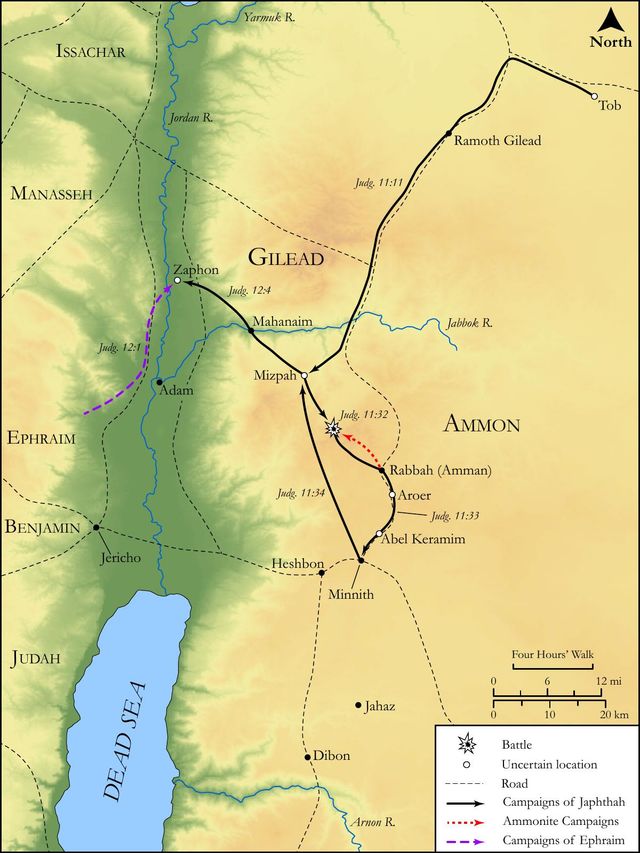
The period of the Judges, famously characterized by the refrain "every man did that which was right in his own eyes" (Judges 21:25), was marked by a lack of central monarchy and consequently, decentralized tribal governance. Within this socio-political landscape, regional leaders like Jair emerged to provide order and direction. The specific details in Judges 10:4 vividly reflect the patriarchal and tribal structures prevalent in ancient Israel, where family size, wealth, and control over territory were direct indicators of power, status, and stability. The mention of "ass colts" is particularly noteworthy, as riding donkeys, especially young, strong ones, was a distinct mark of high social standing and authority, often associated with civic or judicial leaders, distinguishing them from military figures who would typically ride horses. Jair's influence extended across Gilead, a strategically important region east of the Jordan River, demonstrating his substantial reach and the regional nature of the judges' authority.
Key Themes
ShowHideThis verse profoundly contributes to several key themes within the Book of Judges and the broader biblical narrative. Firstly, it highlights Prosperity and Influence, as the "thirty sons that rode on thirty ass colts" and "thirty cities" unequivocally signify Jair's considerable wealth, social standing, and widespread administrative reach. This imagery portrays a powerful and respected leader whose authority was extended and solidified through his numerous family members. Secondly, it speaks to Regional Governance, indicating that Jair's family, through his sons, exercised significant administrative control or influence over a cluster of towns in Gilead, a typical form of decentralized authority during this era, where individual judges often held sway over specific tribal territories rather than the entire nation. Lastly, the phrase "unto this day" emphasizes Legacy and Continuity, a common biblical idiom that underscores the lasting impact or historical verification of an event or place. It signifies that the "villages of Jair" (Havothjair) retained their name long after Jair's time, serving as a testament to his enduring historical footprint in the land of Gilead.
Exposition and Analysis
ShowHideKey Word Analysis
ShowHideFrom the root meaning "to build," this term refers to a son, but in a wider sense, it encompasses descendants, subjects, or those who build up a family name. In Judges 10:4, the "thirty sons" of Jair signify not only his numerous offspring but also the extension of his influence and authority through his family. Their existence and activities (riding ass colts, associated with cities) underscore Jair's prominence and the perpetuation of his legacy through his lineage, as sons were crucial for maintaining and expanding a family's power and standing in ancient Israelite society.
This term specifically denotes a young, strong ass, often one just broken to carry a burden. In Israel, riding such an animal was a powerful symbol of peace, dignity, and high social status, frequently associated with royalty, judges, or important officials, distinguishing them from military figures. The fact that Jair's thirty sons each possessed and rode one underscores their elevated position, wealth, and the considerable influence of Jair's family, indicating their role as men of authority and standing in the community.
This word refers to a city in its widest sense, encompassing anything from a guarded place to a mere encampment or post. In the context of Judges 10:4, the "thirty cities" associated with Jair's sons indicate a significant sphere of administrative or economic control. This suggests that Jair, through his family, exercised judicial or governing authority over a considerable number of settlements, highlighting the extent of his regional power and the stability he brought to these areas in the absence of a centralized monarchy.
Verse Breakdown
ShowHide"And he had thirty sons that rode on thirty ass colts"
This initial clause immediately establishes Jair's considerable wealth, high social status, and the extensive reach of his family's influence. The number "thirty" is often used in the Bible as a round number signifying a substantial and impressive quantity, suggesting a large, powerful family. The "ass colts" are not merely animals but symbols of dignity and authority, indicating that Jair's sons were men of rank, likely traveling throughout their controlled territory to administer justice, manage affairs, or represent their father's authority.
"and they had thirty cities, which are called Havothjair unto this day"
This part of the verse reveals the administrative and territorial scope of Jair's and his sons' influence. The "thirty cities" directly correspond to the thirty sons, strongly implying that each son might have overseen one city or a cluster of villages, thereby extending Jair's governance. The naming of these cities "Havothjair" (literally, "villages of Jair") and the phrase "unto this day" emphasize the lasting impact of Jair's rule and his enduring legacy, suggesting that these places retained their name long after his time, serving as a historical marker of his significant and lasting influence.
"which [are] in the land of Gilead"
This final phrase precisely locates Jair's sphere of influence. Gilead, a distinct and strategically important region east of the Jordan River, was part of the inheritance of the tribes of Reuben, Gad, and the half-tribe of Manasseh. This geographical detail grounds Jair's story, showing that his authority, though substantial, was regional, typical of the judges who often operated within specific tribal or inter-tribal areas rather than over all of Israel, providing localized order and stability.
Literary Devices
ShowHideJudges 10:4 effectively employs several Literary Devices to convey Jair's status and the impact of his judgeship. Symbolism is prominently featured in the "thirty ass colts," which are not merely animals but potent symbols of wealth, dignity, and the authority of a leader or official, distinguishing Jair's sons as men of high rank and influence. The repetition of the number "thirty" for both sons and cities can be interpreted as a form of Merism or Hyperbole, indicating a vast and comprehensive extent of influence and control, rather than a precise literal count, thereby emphasizing the magnitude of Jair's power. Toponymy is central to the verse, as the naming of the cities "Havothjair" directly links the geographical landscape to the historical figure, solidifying his enduring legacy. Finally, the phrase "unto this day" functions as a common biblical Idiom or Historical Marker, serving to authenticate the historical claim and underscore the lasting nature of Jair's impact and the memory of his rule in the region.
Theological and Thematic Connections
ShowHideJudges 10:4, though brief, offers a profound glimpse into God's continued faithfulness in raising up leaders for Israel, even during periods of profound spiritual decline and decentralization. Jair's prosperity and extensive influence can be seen as a tangible sign of God's blessing and the measure of stability He grants when His people are under a form of leadership, even if imperfect. It highlights the diverse ways God uses individuals, some with extensive narratives and others with concise accounts, to fulfill His overarching purposes of deliverance and order for His people. The verse subtly contrasts the peace and administrative order under Jair's leadership with the cycles of oppression that typically plagued Israel dues to their disobedience, underscoring the societal value of effective, if not explicitly righteous, rule.
Reflection and Application
ShowHideJair's story, though concise, invites us to deeply consider the nature of influence, legacy, and stewardship in our own lives. His prosperity and the extensive reach of his family's control over thirty cities suggest a leader who managed to bring a significant measure of order and stability to his region, leaving a lasting mark on the landscape and its inhabitants. This narrative reminds us that God works through diverse individuals, some whose contributions are widely celebrated and extensively detailed, and others whose impact is quietly but effectively felt within their specific sphere of influence. We are called to steward whatever resources, positions, or relationships God has entrusted to us, not primarily for personal gain or fleeting glory, but for the genuine well-being of those around us and the advancement of God's redemptive purposes in the world. Our true legacy is not merely what we accumulate or the breadth of our earthly control, but rather how faithfully we use our influence to serve others, administer justice, and honor God, knowing that even seemingly "minor" contributions can have an enduring and eternal impact.
Questions for Reflection
ShowHideFAQ
ShowHideWhy is so little said about Jair compared to other judges like Gideon or Samson?
ShowHideThe Book of Judges presents a diverse array of leaders, some with extensive narratives detailing their exploits, spiritual struggles, and moral failings (e.g., Gideon, Samson, Deborah), and others, like Jair and Tola, whose accounts are remarkably brief. This brevity does not necessarily diminish their importance but rather reflects the literary and theological purpose of the book. The primary focus of Judges is often on the cyclical pattern of Israel's disobedience and God's consistent deliverance, rather than providing exhaustive biographies of every judge. Jair's concise entry highlights his administrative success and the stability he brought to his region, serving as a transitional figure between more prominent judges and illustrating that God's provision of leadership was consistent, even if some judges' stories were less dramatic or detailed. His account emphasizes the lasting impact of his rule through the naming of cities, rather than focusing on military victories or profound spiritual awakenings.
What is the significance of the "thirty ass colts" and "thirty cities"?
ShowHideThe specific mention of "thirty sons that rode on thirty ass colts" and "thirty cities" is highly significant, conveying Jair's immense wealth, status, and administrative reach. Firstly, "thirty" is a round number that likely signifies a substantial and impressive quantity, indicating Jair's considerable prosperity and the large size of his influential family. In ancient Israel, riding an "ass colt" (a young, strong donkey) was a distinct mark of high status and dignity, often associated with officials, judges, or even royalty (Judges 5:10 and Zechariah 9:9). This detail underscores the elevated social and political standing of Jair's sons as extensions of his authority. Secondly, the "thirty cities" directly linked to the sons suggest a well-established system of regional governance, where each son might have administered one or more towns. This demonstrates the extensive reach of Jair's authority and his family's influence over a considerable territory in Gilead, indicating a period of organized administration and stability.
What does the phrase "unto this day" signify regarding Havothjair?
ShowHideThe phrase "unto this day" (Hebrew: עַד הַיּוֹם הַזֶּה, 'ad hayyom hazzeh') is a common biblical idiom used by the narrator to emphasize the lasting impact, historical verification, or continued existence of an event, custom, or place from the time of the narrative up to the time of the writing or compilation of the text. In the case of "Havothjair" (meaning "villages of Jair"), it signifies that these thirty cities or settlements retained their name, associated with Judge Jair, long after his death. This serves as a testament to his enduring legacy and the significant historical footprint he left in the land of Gilead. It acts as a historical marker, assuring the reader of the verifiability and lasting memory of Jair's influence and the places connected to him, suggesting that his impact was not fleeting but had a tangible, enduring presence in the landscape.
Christ-Centered Fulfillment
ShowHideJair, as a "minor judge" who brought a measure of stability and order to a specific region of Israel, serves as a subtle, yet significant, foreshadowing of the ultimate and perfect Judge and King, Jesus Christ. While Jair's influence was limited to his lifetime and a particular geographical area, and his legacy primarily tied to earthly prosperity and administrative control, Christ's reign is eternal, universal, and spiritual. The imagery of Jair's sons riding on ass colts, symbols of dignity and authority, subtly points to Jesus' humble yet regal entry into Jerusalem, fulfilling the prophecy of a King coming "lowly, and riding upon an ass, and upon a colt the foal of an ass" (Matthew 21:5, quoting Zechariah 9:9). Unlike Jair, whose rule brought temporary peace and regional order, Christ establishes an everlasting kingdom of righteousness and peace (Isaiah 9:6-7). His authority is not merely over thirty cities but over all creation, and His "sons" are all who believe in Him, inheriting eternal life and a spiritual kingdom that transcends earthly boundaries. Jesus is the true Judge who brings ultimate deliverance from sin and death, and His legacy is not merely a name on a map but the salvation of humanity, reigning eternally as King of kings and Lord of lords.