


Judges 10:17
Bible text: King James Version (1769 Blayney text) · Public domain
Bible text: King James Version with Strong's numbers · Public domain
Bible text: Berean Standard Bible · Public domain
Bible text: American Standard Version (1901) · Public domain
Bible text: World English Bible, Messianic edition · Public domain
Bible text: Geneva Bible (1599) · Public domain
Bible text: Young's Literal Translation · Public domain
- וַיִּצָּעֲקוּvai·yi·tza·'a·Kuand they were summonedH6817Conj-w ¦ V-Niphal-ConsecImperf-3mpVerb Niphal Consecutive Imperfect 3rd Plural Masculineוַandיִּצָּעֲקוּthey were summoned
- בְּנֵיbe·Nei[the] people ofH1121N-mpcNoun Plural Masculine Construct
- עַמּוֹןa·MonAmmonH5983N-proper-mNoun Proper Masculine
- וַיַּחֲנוּvai·ya·cha·Nuand they encampedH2583Conj-w ¦ V-Qal-ConsecImperf-3mpVerb Qal Consecutive Imperfect 3rd Plural Masculineוַandיַּחֲנוּthey encamped
- בַּגִּלְעָדba·gil·'Adin <the> GileadH1568Prep-b ¦ N-properNoun Proper Locationבַּin <the>גִּלְעָדGilead
- וַיֵּאָסְפוּvai·ye·'a·se·Fuand they gatheredH622Conj-w ¦ V-Niphal-ConsecImperf-3mpVerb Niphal Consecutive Imperfect 3rd Plural Masculineוַandיֵּאָסְפוּthey gathered
- בְּנֵיbe·Nei[the] people ofH1121N-mpcNoun Plural Masculine Construct
- יִשְׂרָאֵלYis·ra·'ElIsraelH3478N-properNoun Proper Location
- וַיַּחֲנוּvai·ya·cha·Nuand they encampedH2583Conj-w ¦ V-Qal-ConsecImperf-3mpVerb Qal Consecutive Imperfect 3rd Plural Masculineוַandיַּחֲנוּthey encamped
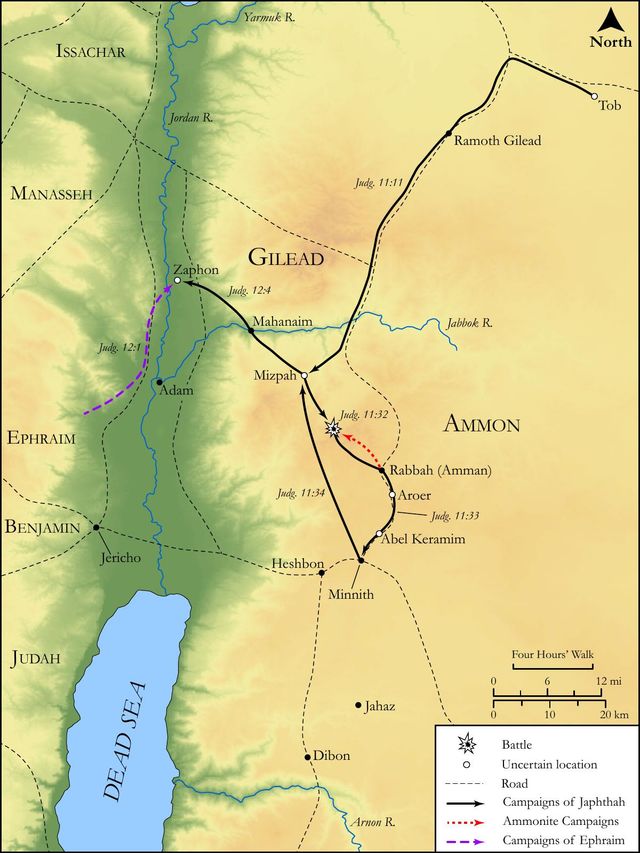
- בַּמִּצְפָּהba·mitz·Pahat <the> MizpahH4709Prep-b ¦ N-properNoun Proper Locationבַּat <the>מִּצְפָּהMizpah
English is a literal word-by-word gloss of the Hebrew, not the KJV's wording. Why?
This is the original text the KJV's translators worked from — each Hebrew word with its own literal English meaning in this verse, prepared by scholars at Tyndale House, Cambridge. The KJV translates whole sentences, not word by word, so its wording differs: one Hebrew word can become several English words, and the KJV may choose “the LORD” where the gloss reads “Yahweh”. Both are faithful — they answer different questions. For the KJV's own rendering, switch to the KJV text.
Details
See on the biblical-era maps

Study this verse
Public-domain commentary
Matthew Henry
From his Commentary on the Whole Bible. Henry comments on passages, not single verses — this entry covers Judges 10:10–18. His three-level outline is real structure in the source text, so it is rendered as structure.
Here is, I. A humble confession which Israel make to God in their distress, Jdg 10:10. Now they own themselves guilty, like a malefactor upon the rack, and promise reformation, like a child under the rod. They not only complain of the distress, but acknowledge it is their own sin that has brought them into the distress; therefore God is righteous, and they have no reason to repine. They confess their omissions, for in them their sin began - "We have forsaken our God," and their commissions - "We have served Baalim, and herein have done foolishly, treacherously, and very wickedly."
II.A humbling message which God thereupon sends to Israel, whether by an angel (as Jdg 2:1) or by a prophet (as Jdg 6:8) is not certain.
It was kind that God took notice of their cry, and did not turn a deaf ear to it and send them no answer at all; it was kind likewise that when they began to repent he sent them such a message as was proper to increase their repentance, that they might be qualified and prepared for deliverance. Now in this message,
1.He upbraids them with their great ingratitude, reminds them of the great things he had done for them, delivering them from such and such enemies, the Egyptians first, out of whose land they were rescued, the Amorites whom they conquered and into whose land they entered, and since their settlement there, when the Ammonites had joined with the Moabites to oppress them (Jdg 3:13), when the Philistines were vexatious in the days of Shamgar, and afterwards other enemies had given them trouble, upon their petition God had wrought many a great salvation for them, Jdg 10:11, Jdg 10:12. Of their being oppressed by the Zidonians and the Maonites we read not elsewhere. God had in justice corrected them, and in mercy delivered them, and therefore might reasonably expect that either through fear or through love they would adhere to him and his service. Well therefore might the word cut them to the heart (Jdg 10:13), "Yet you have forsaken me that have brought you out of your troubles and served other gods that brought you into your troubles." Thus did they forsake their own mercies for their own delusions.
2.He shows them how justly he might now abandon them to ruin, by abandoning them to the gods that they had served. To awaken them to a thorough repentance and reformation, he lets them see,
(1.)Their folly in serving Baalim. They had been at a vast expense to obtain the favour of such gods as could not help them when they had most need of their help: "Go, and cry unto the gods which you have chosen (Jdg 10:14), try what they can do for you now. You have worshipped them as gods - try if they have now either a divine power or a divine goodness to be employed for you. You paid your homage to them as your kings and lords - try if they will now protect you. You brought your sacrifices of praise to their altars as your benefactors, imagining that they gave you your corn, and wine, and oil, but a friend indeed will be a friend in need; what stead will their favour stand you in now?" Note, It is necessary, in true repentance, that there be a full conviction of the utter insufficiency of all those things to help us and do us any kindness which we have idolized and set upon the throne in our hearts in competition with God. We must be convinced that the pleasures of sense on which we have doted cannot be our satisfaction, nor the wealth of the world which we have coveted be our portion, that we cannot be happy or easy any where but in God.
(2.)Their misery and danger in forsaking God. "See what a pass you have brought yourselves to; now you can expect no other than that I should say, I will deliver you no more, and what will become of you then?" Jdg 10:13. This he tells them, not only as what he might do, but as what he would do if they rested in a confession of what they had done amiss, and did not put away their idols and amend for the future.
III.A humble submission which Israel hereupon made to God's justice, with a humble application to his mercy, Jdg 10:15.
The children of Israel met together, probably in a solemn assembly at the door of the tabernacle, received the impressions of the message God had sent them, were not driven by it to despair, though it was very threatening, but resolve to lie at God's feet, and, if they perish, they will perish there. They not only repeat their confession, We have sinned, but,
1.They surrender themselves to God's justice: Do thou unto us whatsoever seemeth good unto thee. Hereby they own that they deserved the severest tokens of God's displeasure and were sure he could do them no wrong, whatever he laid upon them; they humbled themselves under his mighty and heavy hand, and accepted of the punishment of their iniquity, which Moses had made the condition of God's return in mercy to them, Lev 26:41. Note, True penitents dare and will refer themselves to God to correct them as he thinks fit, knowing that their sin is highly malignant in its deserts, and that God is not rigorous or extreme in his demands.
2.They supplicate for God's mercy: Deliver us only, we pray thee, this day, from this enemy. They acknowledge what they deserved, yet pray to God not to deal with them according to their deserts. Note, We must submit to God's justice with a hope in his mercy.
IV.A blessed reformation set on foot hereupon.
They brought forth fruits meet for repentance (Jdg 10:16): They put away the gods of strangers (as the word is), strange gods, and worshipped by those nations that were strangers to the commonwealth of Israel and to the covenants of promise, and they served the Lord. Need drove them to him. They knew it was to no purpose to go to the gods whom they had served, and therefore returned to the God whom they had slighted. This is true repentance not only for sin, but from sin.
V.God's gracious return in mercy to them, which is expressed here very tenderly (Jdg 10:16):
His soul was grieved for the misery of Israel. Not that there is any grief in God (he has infinite joy and happiness in himself, which cannot be broken in upon by either the sins or the miseries of his creatures), nor that there is any change in God: he is in one mind, and who can turn him? But his goodness is his glory. By it he proclaims his name, and magnifies it above all names; and, as he is pleased to put himself into the relation of a father to his people that are in covenant with him, so he is pleased to represent his goodness to them by the compassions of a father towards his children; for, as he is the Father of lights, so he is the Father of mercies. As the disobedience and misery of a child are a grief to a tender father, and make him feel very sensibly from his natural affection, so the provocations of God's people are a grief to him (Psa 95:10), he is broken with their whorish heart (Eze 6:9); their troubles also are a grief to him; so he is pleased to speak when he is pleased to appear for the deliverance of his people, changing his way and method of proceeding, as tender parents when they begin to relent towards their children with whom they have been displeased. Such are the tender mercies of our God, and so far is he from having any pleasure in the death of sinners.
VI.Things are now working towards their deliverance from the Ammonites' oppression, Jdg 10:17, Jdg 10:18.
God had said, "I will deliver you no more;" but now they are not what they were, they are other men, they are new men, and now he will deliver them. That threatening was denounced to convince and humble them, and, now that it had taken its desired effect, it is revoked in order to their deliverance.
1.The Ammonites are hardened to their own ruin. They gathered together in one body, that they might be destroyed at one blow, Rev 16:16.
2.The Israelites are animated to their own rescue. They assembled likewise, Jdg 10:17. During their eighteen years' oppression, as in their former servitudes, they were run down by their enemies, because they would not incorporate; each family, city, or tribe, would stand by itself, and act independently, and so they all became an easy prey to the oppressors, for want of a due sense of a common interest to cement them: but, whenever they got together, they did well; so they did here. When God's Israel become as one man to advance a common good and oppose a common enemy what difficulty can stand before them? The people and princes of Gilead, having met, consult first about a general that should command in chief against the Ammonites. Hitherto most of the deliverers of Israel had an extraordinary call to the office, as Ehud, Barak, Gideon; but the next is to be called in a more common way, by a convention of the states, who enquired out a fit man to command their army, found out one admirably well qualified for the purpose, and God owned their choice by putting his Spirit upon him (Jdg 11:29); so that this instance is of use for direction and encouragement in after-ages, when extraordinary calls are no longer to be expected. Let such be impartially chosen to public trust and power as God has qualified, and then God will graciously own those who are thus chosen.
Continue studying Judges 10:17 across the web’s major study libraries — every link below opens this exact verse, chapter, or book on the destination site.
Read & Compare
 BibleGatewayThis verse in more than 200 translations and 70 languages.
 Bible.comThe YouVersion reader — hundreds of translations, reading plans, and highlights.
 ESV.orgCrossway's official English Standard Version reader.
 NET BibleThe NET translation with 60,000+ translators' notes on every rendering decision.
 STEP BibleTyndale House's free study tool — original text, vocabulary, and scholarly resources.
 BibliaLogos Bible Software's free web reader.
 USCCBThe New American Bible (Revised Edition) with the U.S. bishops' study notes.
Commentaries
 BibleHub CommentariesDozens of classic commentaries on this verse, gathered on one page.
 StudyLightMore than 100 commentary sets — the largest collection on the web.
 BibleRefPlain-English commentary on what this verse means, verse by verse.
 Enduring WordDavid Guzik's free commentary on this chapter, widely used by Bible teachers.
 Bible Study ToolsVerse commentary alongside Greek and Hebrew study aids.
Original Language & Research
- BibleHub InterlinearThe verse word by word — original language, transliteration, and English.
- BibleHub LexiconEvery word's original-language definition and Strong's entry.
 Blue Letter BibleDeep-study tools — Strong's numbers, concordance, and word studies.
 SefariaThe Hebrew text with Rashi and centuries of Jewish commentary.
Sermons, Hymns & Audio


TrulyRandomVerse is not affiliated with these sites and doesn’t control their content. They’re linked because they’re genuinely useful.
Summary
Judges 10:17 marks a pivotal moment in Israel's narrative of apostasy and restoration, illustrating the immediate and tangible consequence of their national repentance. After eighteen years of severe Ammonite oppression and Israel's heartfelt confession and abandonment of idolatry, this verse depicts the rapid mobilization of both the oppressor and the oppressed. The Ammonites consolidate their forces in Gilead, signifying their continued aggression and territorial claim, while the newly unified and repentant Israelites assemble at Mizpeh, setting the stage for the climactic confrontation and the anticipated divine deliverance.
Context
ShowHideLiterary Context
Judges 10:17 is strategically positioned within the latter half of Judges 10, a chapter that vividly portrays Israel's profound spiritual decline and their subsequent, albeit desperate, plea for divine intervention. The preceding verses Judges 10:6-9 meticulously detail Israel's pervasive idolatry, serving the gods of various surrounding nations, which directly resulted in severe oppression by the Philistines and Ammonites for eighteen years, particularly afflicting the tribes situated east of the Jordan River. The narrative then undergoes a dramatic shift in Judges 10:10-16, where Israel finally confesses their sin, acknowledges God's past deliverances, and, most crucially, actively puts away their foreign gods, choosing instead to serve the Lord. This demonstration of genuine repentance profoundly moves the Lord, for "his soul was grieved for the misery of Israel" (Judges 10:16). Therefore, verse 17 is not merely a logistical update on military movements but the direct, practical outcome of this spiritual turning point, signaling the imminent commencement of the deliverance process, which will culminate with the raising of Jephthah as a deliverer in Judges 11.
Historical & Cultural Context
The era of the Judges was characterized by a decentralized tribal confederacy in Israel, a period marked by the absence of a central monarchy or a standing army. This inherent lack of centralized authority often rendered Israel vulnerable to internal strife and persistent external threats. The Ammonites, descendants of Lot and a perennial adversary of Israel, frequently contested control over the fertile lands of Gilead, located east of the Jordan. Their strategic gathering in Gilead, as described in the verse, underscores their ongoing aggression and established control over this vital region. Mizpeh, a place name meaning "watchtower" or "outlook," held significant importance as a traditional gathering place for the Israelite tribes. It frequently served as a site for national assembly, deliberation, and covenant-making, as evidenced in other pivotal biblical accounts such as the assembly preceding the civil war against Benjamin (Judges 20:1) or Samuel's convocation of Israel for repentance and battle against the Philistines (1 Samuel 7:5-6). The fact that Israel assembled at Mizpeh of Gilead suggests a unified, national response, despite the typical tribal fragmentation of the era, indicating the profound depth of their distress and the sincerity of their repentance.
Key Themes
ShowHideJudges 10:17 powerfully contributes to several overarching themes foundational to the book of Judges and broader biblical theology. Firstly, it serves as a vivid illustration of the cycle of apostasy, oppression, repentance, and deliverance that forms the structural backbone of Judges. Israel's genuine repentance in Judges 10:10-16 directly precedes the military mobilization described in this verse, unequivocally setting the stage for the "deliverance" phase of the cycle. Secondly, the verse highlights divine compassion and responsiveness; despite Israel's repeated unfaithfulness and idolatry, God's "soul was grieved" (Judges 10:16), prompting Him to immediately initiate action upon their genuine turning back to Him. Thirdly, Judges 10:17 underscores the crucial theme of preparation for conflict, demonstrating that spiritual renewal—specifically, the putting away of foreign gods—often precedes or accompanies the practical, physical readiness required to confront challenges. Finally, it subtly introduces the profound theme of national unity in crisis, as the disparate tribes of Israel, under the immense pressure of the Ammonite threat and spurred by a renewed commitment to God, gather as one cohesive body at Mizpeh, foreshadowing the urgent need for a unified leader like Jephthah.
Exposition and Analysis
ShowHideKey Word Analysis
ShowHideMeaning "a son (as a builder of the family name), in the widest sense (of literal and figurative relationship, including grandson, subject, nation, quality or condition, etc.)." In this verse, "children of Ammon" and "children of Israel" refer to the respective nations or peoples, emphasizing their collective identity and lineage. For Ammon, it highlights their tribal, inbred nature and their historical continuity as an adversarial nation. For Israel, it underscores their identity as the descendants of Jacob, God's covenant people, now acting as a unified entity.
A primitive root meaning "properly, to incline; by implication, to decline (of the slanting rays of evening); specifically, to pitch a tent; gen. to encamp (for abode or siege)." This word describes the military action of both the Ammonites and the Israelites. For the Ammonites, it signifies their aggressive posture and establishment of a military base for continued occupation or assault. For the Israelites, it denotes their strategic positioning for defense and readiness for battle, indicating a deliberate and organized preparation for confrontation.
A primitive root meaning "to gather for any purpose; hence, to receive, take away, i.e. remove (destroy, leave behind, put up, restore, etc.)." While the Ammonites were "gathered together" (from H6817, tsâʻaq, implying a shriek or call to assembly), the Israelites "assembled themselves together" using ʼâçaph, which suggests a more deliberate, organized, and purposeful gathering. This distinction highlights Israel's intentional and unified response, driven by their repentance and readiness to engage in the impending conflict.
Verse Breakdown
ShowHide"Then the children of Ammon were gathered together, and encamped in Gilead."
This initial clause describes the aggressive posture of Israel's long-standing oppressor. The Ammonites, having inflicted eighteen years of severe oppression, now consolidate their military forces, signaling a renewed or sustained intent to dominate and exploit. Their strategic encampment in Gilead, a region east of the Jordan historically settled by Israelite tribes, signifies their direct territorial claim and established military presence, setting the immediate geographical and military stage for the impending conflict.
"And the children of Israel assembled themselves together, and encamped in Mizpeh."
This second clause presents the crucial Israelite counter-mobilization, a direct and unified response to the Ammonite threat. Significantly, this assembly immediately follows their national repentance and the decisive act of putting away their foreign gods (Judges 10:10-16). Their encampment at Mizpeh, a strategic and symbolically significant location within Gilead, powerfully demonstrates their newfound unity, collective resolve, and readiness to confront the Ammonite threat. This action marks a profound shift from passive suffering to active, divinely-empowered resistance.
Literary Devices
ShowHideJudges 10:17 masterfully employs several potent literary devices to convey its message. Juxtaposition is prominently featured, setting the consolidated forces of the Ammonites against the newly assembled Israelites. This creates a stark visual and thematic contrast between the oppressor and the oppressed, powerfully highlighting the impending military confrontation. This contrast is further reinforced by the use of parallelism in the grammatical structure of the two clauses: "Then X were gathered together, and encamped in Y. And Z assembled themselves together, and encamped in W." This parallel construction emphasizes the symmetrical nature of the military preparations on both sides, while subtle linguistic differences (e.g., "gathered together" vs. "assembled themselves together") hint at the distinct motivations and nature of each gathering. Furthermore, the verse utilizes foreshadowing, as this immediate military mobilization directly anticipates the raising of a divinely appointed deliverer, Jephthah, and the ensuing decisive battle for Israel's freedom. The specific choice of Mizpeh as the Israelite gathering point also carries profound symbolism, as it was historically a significant site for national assembly, covenant renewal, and strategic watchfulness, suggesting that Israel's physical readiness is deeply intertwined with their spiritual re-commitment to God.
Theological and Thematic Connections
ShowHideJudges 10:17 stands as a powerful theological statement regarding the dynamic interplay between divine action and human response within the covenant relationship. It profoundly demonstrates that while God's compassion and willingness to deliver His people are boundless, genuine repentance and a turning away from idolatry on the part of His people often serve as the crucial catalyst for His active intervention in their dire circumstances. The immediate military mobilization on both sides, occurring directly after Israel's turning from their foreign gods, vividly illustrates that God's promised deliverance does not negate the necessity of human participation and readiness. Instead, it underscores a divine-human partnership where spiritual alignment and obedience empower practical action. This verse powerfully encapsulates the principle that when God's people genuinely put away their idols and sincerely seek Him, He is moved by their plight to act on His behalf, initiating the process of rescue and restoration, even if it means preparing them for a difficult and necessary confrontation.
Reflection and Application
ShowHideJudges 10:17 offers profound and enduring lessons for contemporary believers, illuminating the vital connection between spiritual state and practical readiness. It powerfully reminds us that true spiritual renewal is not merely an internal sentiment or a fleeting confession, but often manifests in tangible actions, a decisive turning from sin, and a courageous readiness to confront life's challenges. Just as Israel's national repentance directly preceded their mobilization for battle, our turning from sin and a renewed, wholehearted commitment to God positions us to effectively face and overcome the spiritual and practical struggles in our lives. This verse highlights that God's immense compassion is powerfully activated by genuine repentance; He is never indifferent to our suffering, and when we truly return to Him, He initiates the process of rescue and restoration. However, divine intervention does not absolve us of personal responsibility; we are actively called to participate in our deliverance, to "assemble ourselves" and prepare for the "battle" that spiritual alignment often entails. It is a compelling call to both profound spiritual integrity and practical readiness, fostering a deep trust that God will faithfully lead us through the confrontations that inevitably arise when we choose to follow Him wholeheartedly.
Questions for Reflection
ShowHideFAQ
ShowHideWhy is the location of Mizpeh significant in this verse?
ShowHideMizpeh (meaning "watchtower" or "outlook") is profoundly significant in Judges 10:17 for several compelling reasons. Historically, it was a recognized and symbolically important gathering place for the tribes of Israel, particularly those in Gilead. Its mention here signifies a national, unified response from the Israelites, a crucial development given the typical tribal fragmentation and disunity prevalent during the period of the Judges. This newfound unity is paramount, especially after a prolonged period of severe oppression and spiritual decline. The choice of Mizpeh also carries deep symbolic weight: it implies a strategic vantage point, a place from which to "watch" the enemy and meticulously prepare for confrontation. Furthermore, Mizpeh was often associated with solemn covenant renewal and critical national decision-making, as vividly seen in Judges 20:1 (the assembly before the civil war) and 1 Samuel 7:5-6 (Samuel's gathering for repentance and battle). Thus, Israel's assembly at Mizpeh in this verse underscores not merely a military gathering, but a renewed national commitment and a unified readiness to face their oppressors under the guiding hand of God.
Christ-Centered Fulfillment
ShowHideJudges 10:17, though depicting a military mobilization in the Old Testament, finds profound Christ-centered fulfillment in the ultimate spiritual battle and deliverance accomplished through Jesus Christ. The oppressive dominion of the Ammonites foreshadows the far more pervasive and destructive human bondage to sin and death, which holds all humanity captive. Israel's repentance and decisive turning from idols, which necessarily preceded their physical readiness for battle, powerfully mirrors the foundational call to repentance that is central to the gospel message proclaimed by Jesus (Mark 1:15). Just as God's "soul was grieved for the misery of Israel" (Judges 10:16), so too did His immense, redemptive compassion lead Him to send His Son, Jesus, to deliver humanity from the dominion of darkness and transfer us into the kingdom of His beloved Son (Colossians 1:13-14). Christ is the ultimate "deliverer" (or Judge) who, unlike Jephthah or any earthly judge, perfectly fulfills God's will, conquering sin and death not through physical warfare but through His perfect, atoning sacrifice on the cross (Hebrews 2:14-15). The assembly of Israel at Mizpeh, a place of unity and readiness for battle, can be seen as a powerful type of the Church, the body of Christ, which is called to be united and spiritually prepared for warfare against the true enemies of our souls, not "flesh and blood, but against principalities, against powers, against the rulers of the darkness of this world, against spiritual wickedness in high places" (Ephesians 6:10-18). In Christ, our victory over sin, death, and the devil is assured, and our true "encampment" is not in a physical Mizpeh, but securely in Him, our impregnable refuge and the victorious Captain of our salvation (Hebrews 2:10).