


Judges 10:18
Bible text: King James Version (1769 Blayney text) · Public domain
Bible text: King James Version with Strong's numbers · Public domain
Bible text: Berean Standard Bible · Public domain
Bible text: American Standard Version (1901) · Public domain
Bible text: World English Bible, Messianic edition · Public domain
Bible text: Geneva Bible (1599) · Public domain
Bible text: Young's Literal Translation · Public domain
- וַיֹּאמְרוּvai·yo·me·Ruand they saidH559Conj-w ¦ V-Qal-ConsecImperf-3mpVerb Qal Consecutive Imperfect 3rd Plural Masculineוַandיֹּאמְרוּthey said
- הָעָםha·'Amthe peopleH5971Art ¦ N-msNoun Singular Masculine Absoluteהָtheעָםpeople
- שָׂרֵיsa·Rei[the] leaders ofH8269N-mpcNoun Plural Masculine Construct
- גִלְעָדgil·'AdGileadH1568N-properNoun Proper Location
- אִישׁ'isheachH376N-msNoun Singular Masculine Absolute
- אֶל'eltoH413PrepPreposition
- רֵעֵהוּre·'E·huhis neighborH7453N-msc ¦ 3msNoun Singular Masculine Constructרֵעֵneighborהוּhis
- מִיmiwho?H4310InterrogPronoun Interrogative
- הָאִישׁha·'Ish[is] the manH376Art ¦ N-msNoun Singular Masculine Absoluteהָ[is] theאִישׁman
- אֲשֶׁר'a·SherwhoH834RelParticle Relative
- יָחֵלya·Chelhe will beginH2490V-Hiphil-Imperf-3msVerb Hiphil Imperfect 3rd Singular Masculine
- לְהִלָּחֵםle·hi·la·Chemto fightH3898Prep-l ¦ V-Niphal-InfVerb Niphal Infinitive Constructלְtoהִלָּחֵםfight
- בִּבְנֵיbiv·Neiagainst [the] people ofH1121Prep-b ¦ N-mpcNoun Plural Masculine Constructבִּagainstבְנֵי[the] people of
- עַמּוֹןa·MonAmmonH5983N-proper-mNoun Proper Masculine
- יִהְיֶהyih·Yehhe will becomeH1961V-Qal-Imperf-3msVerb Qal Imperfect 3rd Singular Masculine
- לְרֹאשׁle·Rosh<into> chiefH7218Prep-l ¦ N-msNoun Singular Masculine Absoluteלְ<into>רֹאשׁchief
- לְכֹלle·Kholof allH3605Prep-l ¦ N-mscNoun Singular Masculine Constructלְofכֹלall
- יֹשְׁבֵיyo·she·Vei[the] inhabitants ofH3427V-Qal-Prtcpl-mpVerb Qal Participle Plural Masculine Construct
- גִלְעָדgil·'AdGileadH1568N-properNoun Proper Location
English is a literal word-by-word gloss of the Hebrew, not the KJV's wording. Why?
This is the original text the KJV's translators worked from — each Hebrew word with its own literal English meaning in this verse, prepared by scholars at Tyndale House, Cambridge. The KJV translates whole sentences, not word by word, so its wording differs: one Hebrew word can become several English words, and the KJV may choose “the LORD” where the gloss reads “Yahweh”. Both are faithful — they answer different questions. For the KJV's own rendering, switch to the KJV text.
Details
See on the biblical-era maps
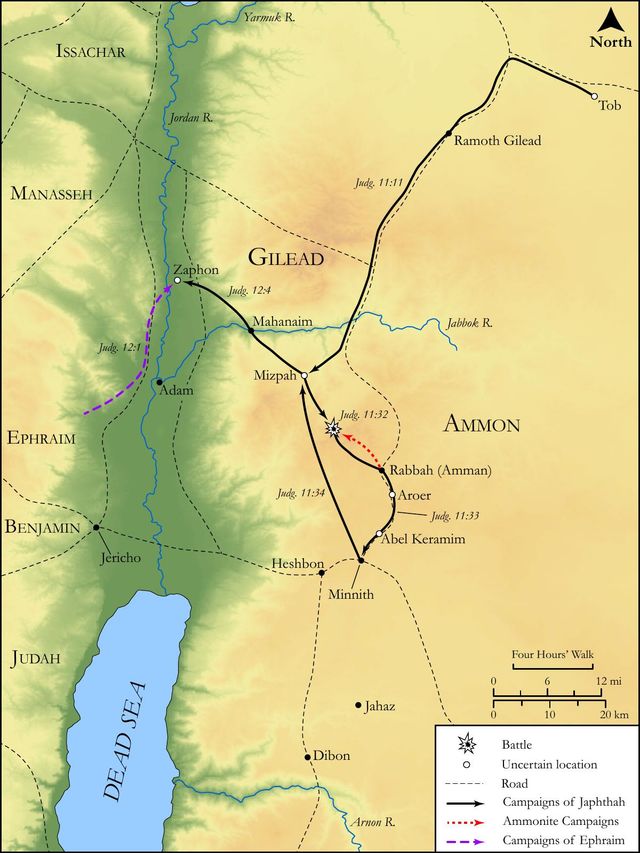
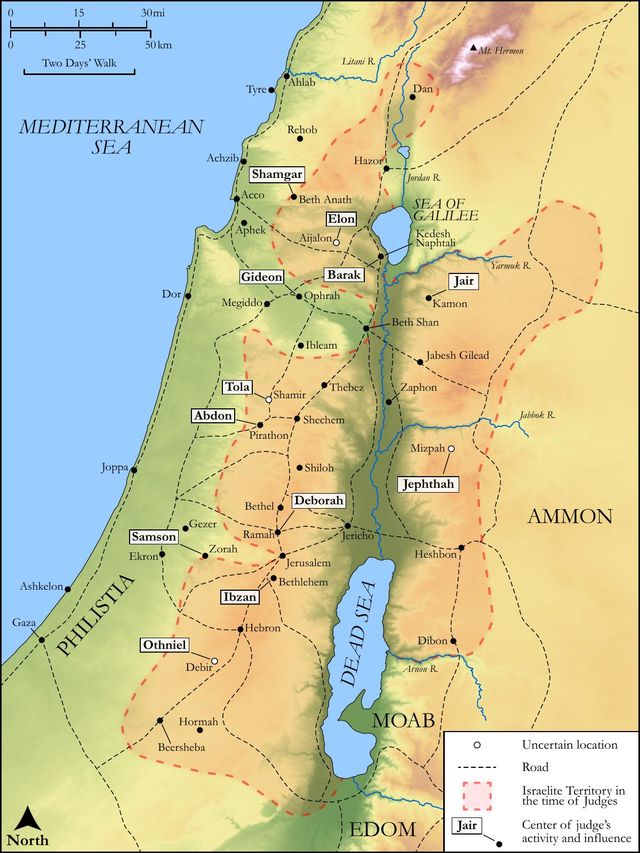
Study this verse
Public-domain commentary
Matthew Henry
From his Commentary on the Whole Bible. Henry comments on passages, not single verses — this entry covers Judges 10:10–18. His three-level outline is real structure in the source text, so it is rendered as structure.
Here is, I. A humble confession which Israel make to God in their distress, Jdg 10:10. Now they own themselves guilty, like a malefactor upon the rack, and promise reformation, like a child under the rod. They not only complain of the distress, but acknowledge it is their own sin that has brought them into the distress; therefore God is righteous, and they have no reason to repine. They confess their omissions, for in them their sin began - "We have forsaken our God," and their commissions - "We have served Baalim, and herein have done foolishly, treacherously, and very wickedly."
II.A humbling message which God thereupon sends to Israel, whether by an angel (as Jdg 2:1) or by a prophet (as Jdg 6:8) is not certain.
It was kind that God took notice of their cry, and did not turn a deaf ear to it and send them no answer at all; it was kind likewise that when they began to repent he sent them such a message as was proper to increase their repentance, that they might be qualified and prepared for deliverance. Now in this message,
1.He upbraids them with their great ingratitude, reminds them of the great things he had done for them, delivering them from such and such enemies, the Egyptians first, out of whose land they were rescued, the Amorites whom they conquered and into whose land they entered, and since their settlement there, when the Ammonites had joined with the Moabites to oppress them (Jdg 3:13), when the Philistines were vexatious in the days of Shamgar, and afterwards other enemies had given them trouble, upon their petition God had wrought many a great salvation for them, Jdg 10:11, Jdg 10:12. Of their being oppressed by the Zidonians and the Maonites we read not elsewhere. God had in justice corrected them, and in mercy delivered them, and therefore might reasonably expect that either through fear or through love they would adhere to him and his service. Well therefore might the word cut them to the heart (Jdg 10:13), "Yet you have forsaken me that have brought you out of your troubles and served other gods that brought you into your troubles." Thus did they forsake their own mercies for their own delusions.
2.He shows them how justly he might now abandon them to ruin, by abandoning them to the gods that they had served. To awaken them to a thorough repentance and reformation, he lets them see,
(1.)Their folly in serving Baalim. They had been at a vast expense to obtain the favour of such gods as could not help them when they had most need of their help: "Go, and cry unto the gods which you have chosen (Jdg 10:14), try what they can do for you now. You have worshipped them as gods - try if they have now either a divine power or a divine goodness to be employed for you. You paid your homage to them as your kings and lords - try if they will now protect you. You brought your sacrifices of praise to their altars as your benefactors, imagining that they gave you your corn, and wine, and oil, but a friend indeed will be a friend in need; what stead will their favour stand you in now?" Note, It is necessary, in true repentance, that there be a full conviction of the utter insufficiency of all those things to help us and do us any kindness which we have idolized and set upon the throne in our hearts in competition with God. We must be convinced that the pleasures of sense on which we have doted cannot be our satisfaction, nor the wealth of the world which we have coveted be our portion, that we cannot be happy or easy any where but in God.
(2.)Their misery and danger in forsaking God. "See what a pass you have brought yourselves to; now you can expect no other than that I should say, I will deliver you no more, and what will become of you then?" Jdg 10:13. This he tells them, not only as what he might do, but as what he would do if they rested in a confession of what they had done amiss, and did not put away their idols and amend for the future.
III.A humble submission which Israel hereupon made to God's justice, with a humble application to his mercy, Jdg 10:15.
The children of Israel met together, probably in a solemn assembly at the door of the tabernacle, received the impressions of the message God had sent them, were not driven by it to despair, though it was very threatening, but resolve to lie at God's feet, and, if they perish, they will perish there. They not only repeat their confession, We have sinned, but,
1.They surrender themselves to God's justice: Do thou unto us whatsoever seemeth good unto thee. Hereby they own that they deserved the severest tokens of God's displeasure and were sure he could do them no wrong, whatever he laid upon them; they humbled themselves under his mighty and heavy hand, and accepted of the punishment of their iniquity, which Moses had made the condition of God's return in mercy to them, Lev 26:41. Note, True penitents dare and will refer themselves to God to correct them as he thinks fit, knowing that their sin is highly malignant in its deserts, and that God is not rigorous or extreme in his demands.
2.They supplicate for God's mercy: Deliver us only, we pray thee, this day, from this enemy. They acknowledge what they deserved, yet pray to God not to deal with them according to their deserts. Note, We must submit to God's justice with a hope in his mercy.
IV.A blessed reformation set on foot hereupon.
They brought forth fruits meet for repentance (Jdg 10:16): They put away the gods of strangers (as the word is), strange gods, and worshipped by those nations that were strangers to the commonwealth of Israel and to the covenants of promise, and they served the Lord. Need drove them to him. They knew it was to no purpose to go to the gods whom they had served, and therefore returned to the God whom they had slighted. This is true repentance not only for sin, but from sin.
V.God's gracious return in mercy to them, which is expressed here very tenderly (Jdg 10:16):
His soul was grieved for the misery of Israel. Not that there is any grief in God (he has infinite joy and happiness in himself, which cannot be broken in upon by either the sins or the miseries of his creatures), nor that there is any change in God: he is in one mind, and who can turn him? But his goodness is his glory. By it he proclaims his name, and magnifies it above all names; and, as he is pleased to put himself into the relation of a father to his people that are in covenant with him, so he is pleased to represent his goodness to them by the compassions of a father towards his children; for, as he is the Father of lights, so he is the Father of mercies. As the disobedience and misery of a child are a grief to a tender father, and make him feel very sensibly from his natural affection, so the provocations of God's people are a grief to him (Psa 95:10), he is broken with their whorish heart (Eze 6:9); their troubles also are a grief to him; so he is pleased to speak when he is pleased to appear for the deliverance of his people, changing his way and method of proceeding, as tender parents when they begin to relent towards their children with whom they have been displeased. Such are the tender mercies of our God, and so far is he from having any pleasure in the death of sinners.
VI.Things are now working towards their deliverance from the Ammonites' oppression, Jdg 10:17, Jdg 10:18.
God had said, "I will deliver you no more;" but now they are not what they were, they are other men, they are new men, and now he will deliver them. That threatening was denounced to convince and humble them, and, now that it had taken its desired effect, it is revoked in order to their deliverance.
1.The Ammonites are hardened to their own ruin. They gathered together in one body, that they might be destroyed at one blow, Rev 16:16.
2.The Israelites are animated to their own rescue. They assembled likewise, Jdg 10:17. During their eighteen years' oppression, as in their former servitudes, they were run down by their enemies, because they would not incorporate; each family, city, or tribe, would stand by itself, and act independently, and so they all became an easy prey to the oppressors, for want of a due sense of a common interest to cement them: but, whenever they got together, they did well; so they did here. When God's Israel become as one man to advance a common good and oppose a common enemy what difficulty can stand before them? The people and princes of Gilead, having met, consult first about a general that should command in chief against the Ammonites. Hitherto most of the deliverers of Israel had an extraordinary call to the office, as Ehud, Barak, Gideon; but the next is to be called in a more common way, by a convention of the states, who enquired out a fit man to command their army, found out one admirably well qualified for the purpose, and God owned their choice by putting his Spirit upon him (Jdg 11:29); so that this instance is of use for direction and encouragement in after-ages, when extraordinary calls are no longer to be expected. Let such be impartially chosen to public trust and power as God has qualified, and then God will graciously own those who are thus chosen.
Continue studying Judges 10:18 across the web’s major study libraries — every link below opens this exact verse, chapter, or book on the destination site.
Read & Compare
 BibleGatewayThis verse in more than 200 translations and 70 languages.
 Bible.comThe YouVersion reader — hundreds of translations, reading plans, and highlights.
 ESV.orgCrossway's official English Standard Version reader.
 NET BibleThe NET translation with 60,000+ translators' notes on every rendering decision.
 STEP BibleTyndale House's free study tool — original text, vocabulary, and scholarly resources.
 BibliaLogos Bible Software's free web reader.
 USCCBThe New American Bible (Revised Edition) with the U.S. bishops' study notes.
Commentaries
 BibleHub CommentariesDozens of classic commentaries on this verse, gathered on one page.
 StudyLightMore than 100 commentary sets — the largest collection on the web.
 BibleRefPlain-English commentary on what this verse means, verse by verse.
 Enduring WordDavid Guzik's free commentary on this chapter, widely used by Bible teachers.
 Bible Study ToolsVerse commentary alongside Greek and Hebrew study aids.
Original Language & Research
- BibleHub InterlinearThe verse word by word — original language, transliteration, and English.
- BibleHub LexiconEvery word's original-language definition and Strong's entry.
 Blue Letter BibleDeep-study tools — Strong's numbers, concordance, and word studies.
 SefariaThe Hebrew text with Rashi and centuries of Jewish commentary.
Sermons, Hymns & Audio


TrulyRandomVerse is not affiliated with these sites and doesn’t control their content. They’re linked because they’re genuinely useful.
Summary
Judges 10:18 vividly portrays the profound desperation and strategic urgency gripping the Israelite community in Gilead. Suffering under eighteen years of severe Ammonite oppression, the people and their leaders collectively seek a deliverer, offering the highest position of authority—"head over all the inhabitants of Gilead"—to any courageous individual willing to initiate military action against their formidable enemy. This pivotal moment not only highlights a community in crisis but also sets the immediate narrative stage for the dramatic introduction and eventual leadership of Jephthah, underscoring the human search for salvation in the face of overwhelming adversity.
Context
ShowHideLiterary Context
Judges 10:18 is situated at a critical juncture within the cyclical narrative of apostasy, oppression, repentance, and deliverance that defines the book of Judges. Prior to this verse, Israel has once again "done evil in the sight of the Lord" by serving foreign gods (Judges 10:6), leading to severe oppression by the Philistines and, more intensely, the Ammonites for eighteen years. In their profound distress, the Israelites finally cry out to God, confessing their sin and putting away their foreign deities (Judges 10:10-16). Despite God's initial rebuke of their repeated unfaithfulness, His compassion is stirred, setting the stage for a deliverer. This verse, therefore, marks the transition from Israel's repentance and God's renewed pity to the human search for a leader, immediately preceding the narrative of Jephthah's call and his eventual anointing as "head and captain" over Gilead (Judges 11:1-11). It underscores the human initiative in seeking a solution, even as it aligns with God's sovereign plan to raise up a deliverer.
Historical & Cultural Context
The events of Judges 10 unfold during a tumultuous period in Israel's history, characterized by decentralized tribal governance and frequent foreign oppression due to their covenant infidelity. The Ammonites, a Transjordanian people descended from Lot (Genesis 19:38), were perennial adversaries of Israel, often contesting control over the fertile lands east of the Jordan River, particularly Gilead. This region was strategically vital but geographically vulnerable, lying exposed to incursions from the desert. The "people and princes of Gilead" refers to the tribal elders and leading citizens of the Transjordanian tribes (Reuben, Gad, and the half-tribe of Manasseh), who, lacking a centralized government or standing army, would convene to address existential threats. Their desperate plea for a military leader reflects the dire consequences of Ammonite domination, which likely included forced labor, tribute, and widespread destruction, making the offer of "head over all the inhabitants of Gilead" an unprecedented and urgent measure in a society without a king.
Key Themes
ShowHideThis verse powerfully encapsulates several key themes prevalent in the book of Judges and broader biblical theology. Firstly, it underscores the Desperation for Leadership in times of national crisis, revealing a profound vacuum where divine guidance and human initiative intersect. The question, "What man is he that will begin to fight...?" is a desperate cry for someone to step into a perilous breach, highlighting the paralysis of the people and their urgent need for a champion. Secondly, it illustrates Conditional Leadership, where the offer of authority is not based on lineage or traditional appointment but on a pragmatic, performance-based promise: whoever delivers them will be their ruler. This pragmatic approach highlights the severity of their situation and their willingness to empower an unconventional leader, a pattern seen throughout Judges where God raises up unlikely figures, such as Gideon (Judges 6:12-16) or Samson (Judges 13:24-25). Lastly, the verse subtly points to Divine Providence at work, even amidst human desperation. While the people are seeking a leader on human terms, their search ultimately aligns with God's plan to raise up Jephthah, demonstrating that God often uses human means and initiatives to accomplish His sovereign purposes, even when those means are born of desperation.
Exposition and Analysis
ShowHideKey Word Analysis
ShowHideThis term (H5971) refers to a "people as a congregated unit," specifically a tribe (like those of Israel), or collectively, troops or attendants. In this context, it signifies the general populace of Gilead, emphasizing that the cry for a deliverer was not merely from the leaders but from the entire community suffering under Ammonite oppression. It highlights the widespread nature of the distress and the collective desire for liberation.
This primitive root (H2490) primarily means "to bore" or "to wound," but figuratively, it can mean "to profane," "to break," or, as in this context, "to begin" (as if by an 'opening wedge'). The emphasis here is on initiating action, taking the first, decisive, and dangerous step. The Gileadites were paralyzed by fear and lacked a leader willing to break the stalemate, making the call for someone to "begin" the fight a desperate plea for a catalyst to action against their formidable enemy.
This term (H7218) is far more significant than merely "military commander." Derived from a root meaning "to shake" (as the most easily shaken part of the body), ro'sh encompasses a broader meaning of chief, leader, ruler, or even the "top" or "foremost" part. In this context, it signifies a position of supreme authority, implying both military command and civil governance over all the inhabitants of Gilead. The offer of this title indicates the Gileadites' willingness to grant extensive power and respect to their deliverer, reflecting the gravity of their situation and their readiness to centralize authority in a way uncommon during the period of the Judges. It was an offer approaching a localized, conditional kingship.
Verse Breakdown
ShowHide"And the people [and] princes of Gilead said one to another"
This clause reveals a collective deliberation among the Gileadite community. "The people" indicates the general populace, while "princes" refers to the tribal elders, heads of families, or local leaders (H8269, sar). Their joint consultation underscores the gravity of the situation and the communal nature of the decision-making process. It suggests a desperate council, seeking a unified solution to their existential threat, highlighting the widespread nature of the crisis.
"What man [is he] that will begin to fight against the children of Ammon?"
This is a rhetorical question born of profound desperation and a crippling leadership vacuum. It highlights the absence of a clear, willing, or capable military leader among them. The emphasis on "begin to fight" (H2490, châlal and H3898, lâcham) points to the paralysis of fear and the urgent need for someone to take the initiative against the formidable Ammonite aggressors who had oppressed them for eighteen years. It is a desperate cry for a champion, a deliverer, to break the stalemate.
"he shall be head over all the inhabitants of Gilead."
This clause presents the immense, conditional reward for stepping forward. The offer of "head" (H7218, ro'sh) signifies not just military command but supreme civil authority over the entire region of Gilead (H1568, Gilʻâd). This pragmatic offer, made out of dire necessity, indicates the Gileadites' willingness to concede significant power to secure their deliverance, reflecting the high stakes and their desperate hope for salvation from their oppressors. It sets the stage for Jephthah's subsequent negotiation and elevation to this very position.
Literary Devices
ShowHideJudges 10:18 effectively employs several literary devices to convey its message of desperation and urgency. The primary device is a Rhetorical Question, "What man [is he] that will begin to fight against the children of Ammon?" This question is not posed to elicit information but to express the profound desperation, fear, and leadership vacuum within Gilead. It underscores the community's paralysis and their urgent need for a deliverer. Coupled with this is a clear Conditional Promise, "he shall be head over all the inhabitants of Gilead." This promise, contingent upon someone stepping forward, highlights the pragmatic and desperate nature of their offer, emphasizing the high stakes involved and their willingness to empower an unconventional leader. Finally, the verse serves as powerful Foreshadowing. It immediately precedes the introduction of Jephthah in the subsequent chapter, subtly hinting at the unlikely leader God will raise up in response to this very question and the promise of leadership. The verse thus builds suspense and anticipation for the coming narrative of deliverance.
Theological and Thematic Connections
ShowHideJudges 10:18 powerfully illustrates the recurring biblical theme of human inadequacy and the divine response to it. In their deepest distress, the people and princes of Gilead, having exhausted their own resources and leadership, turn to a pragmatic solution: offering the highest position to anyone brave enough to act. This human initiative, born of desperation, paradoxically aligns with God's sovereign plan. While Israel had repeatedly strayed and faced divine judgment, God's compassion was stirred by their repentance. This verse shows humanity's desperate search for a deliverer, a search that ultimately points to the need for a divinely appointed leader. It reminds us that even when humanity seeks solutions on its own terms, God can work through those very circumstances to raise up His chosen instruments, whether flawed human judges or, ultimately, the perfect Deliverer. The willingness to empower an unlikely figure also echoes God's frequent choice of the weak or overlooked to accomplish His mighty purposes, demonstrating His sovereignty over human affairs.
Reflection and Application
ShowHideJudges 10:18 offers profound insights into leadership, community, and the human response to crisis. It reminds us that in moments of overwhelming challenge, there is a desperate need for courageous individuals to step forward and initiate action. The Gileadites' willingness to offer supreme authority to "any man" who would fight highlights the critical value of initiative and the profound impact one person's courage can have on a paralyzed community. This verse challenges us to consider our own roles when facing collective challenges, whether in our families, churches, or broader society. Are we waiting for someone else to act, or are we willing to consider what bold, perhaps unconventional, steps we might take? It also speaks to the nature of true leadership: it often emerges not from pre-ordained positions but from a willingness to serve, to sacrifice, and to bear the burden of a people in need. The community's empowerment of a potential leader also underscores the importance of communal support and the recognition of gifts, even in unexpected places, reminding us that God often uses the unlikely to accomplish His purposes.
Questions for Reflection
ShowHideFAQ
ShowHideWho were the Ammonites, and what was their relationship with Israel?
ShowHideThe Ammonites were a Semitic people, descendants of Ben-Ammi, the son of Lot by his younger daughter (Genesis 19:38). They inhabited the region east of the Jordan River, primarily modern-day central Jordan, with their capital at Rabbah (modern Amman). Throughout Israelite history, the Ammonites were frequently hostile, often clashing over territorial claims, particularly in the fertile lands of Gilead. Their oppression, as described in Judges 10, involved eighteen years of severe subjugation, crossing the Jordan to afflict Judah, Benjamin, and Ephraim, indicating a widespread and brutal campaign aimed at dominating Israelite territory and resources. This long-standing animosity is also evident in later biblical accounts, such as their opposition to Nehemiah's rebuilding efforts (Nehemiah 4:7-8).
How does this verse directly lead to the introduction of Jephthah?
ShowHideJudges 10:18 serves as the immediate narrative setup for Jephthah's emergence as a deliverer. The desperate question, "What man [is he] that will begin to fight against the children of Ammon?" and the accompanying promise, "he shall be head over all the inhabitants of Gilead," directly articulate the specific need that Jephthah will fulfill. In the very next chapter, Jephthah, a mighty man of valor but an outcast, is sought out by the elders of Gilead because of this very crisis. They appeal to him, reminding him of their desperate need, and explicitly offer him the position of "head" if he will lead them against the Ammonites (Judges 11:4-8). Thus, Judges 10:18 creates the precise conditions and the specific job description that Jephthah will step into, making him the answer to Gilead's desperate plea and demonstrating God's sovereign hand in raising up an unlikely deliverer.
What does "head over all the inhabitants of Gilead" imply about the nature of leadership in this period?
ShowHideThe phrase "head over all the inhabitants of Gilead" signifies a position of supreme authority, encompassing both military command and civil governance. In the decentralized tribal system of the Judges period, there was no standing king or national leader. Leadership was typically localized and often charismatic, emerging in response to specific crises. The offer of "head" (ro'sh) in Judges 10:18 is a pragmatic, almost contractual, arrangement born of extreme necessity. It implies that the chosen individual would wield significant power, uniting the disparate clans and tribes of Gilead under a single authority for the purpose of war and, implicitly, for subsequent governance. It reflects a desperate willingness to centralize power in an individual, even if unconventional, to ensure survival. This foreshadows the later Israelite desire for a king, as seen in 1 Samuel, where the people seek a leader "like all the nations" (1 Samuel 8:5), indicating a shift towards a more centralized form of leadership in response to ongoing threats.
Christ-Centered Fulfillment
ShowHideThe desperate cry of the people and princes of Gilead in Judges 10:18, seeking a human leader to deliver them from oppression, profoundly foreshadows humanity's ultimate need for a divine Deliverer. While Jephthah, the answer to their plea, was a flawed and temporary savior, his emergence points to the greater and perfect "Head" who would come. The Gileadites sought someone to "begin to fight" against a physical enemy, offering a conditional earthly crown. Yet, humanity's deepest need is for a leader who can fight against the spiritual enemies of sin, death, and the devil. Jesus Christ is this ultimate "Head," not chosen by human desperation or conditional promises, but divinely appointed as the head of the church (Ephesians 1:22) and the head over all things (Colossians 1:18). He is the true "pioneer of salvation" (Hebrews 2:10), who not only began the fight but decisively won it through His sacrificial death and resurrection. Unlike Jephthah, whose leadership was limited and whose victory came with a tragic cost, Christ's victory is complete and eternal, offering true freedom and life to all who follow Him, the Good Shepherd who lays down His life for His sheep (John 10:11). The longing for a deliverer in Judges 10:18 finds its ultimate and perfect fulfillment in the person and work of Jesus Christ, the promised King of kings and Lord of lords.