


Judges 11:5
Bible text: King James Version (1769 Blayney text) · Public domain
Bible text: Berean Standard Bible · Public domain
Bible text: American Standard Version (1901) · Public domain
Bible text: World English Bible, Messianic edition · Public domain
Bible text: Geneva Bible (1599) · Public domain
Bible text: Young's Literal Translation · Public domain
- וַיְהִיvay·Hiand it wasH1961Conj-w ¦ V-Qal-ConsecImperf-3msVerb Qal Consecutive Imperfect 3rd Singular Masculineוַandיְהִיit was
- כַּאֲשֶׁרka·'a·Sherjust whenH834Prep-k ¦ RelParticle Relativeכַּjustאֲשֶׁרwhen
- נִלְחֲמוּnil·cha·Muthey foughtH3898V-Niphal-Perf-3cpVerb Niphal Perfect 3rd Plural common gender
- בְנֵיve·nei[the] people ofH1121N-mpcNoun Plural Masculine Construct
- עַמּוֹןa·MonAmmonH5983N-proper-mNoun Proper Masculine
- עִם'imwithH5973PrepPreposition
- יִשְׂרָאֵלYis·ra·'ElIsraelH3478N-properNoun Proper Location
- וַיֵּלְכוּvai·ye·le·Khuand they wentH1980Conj-w ¦ V-Qal-ConsecImperf-3mpVerb Qal Consecutive Imperfect 3rd Plural Masculineוַandיֵּלְכוּthey went
- זִקְנֵיzik·Nei[the] elders ofH2205Adj-mpcAdjective Plural Masculine Construct
- גִלְעָדgil·'AdGileadH1568N-properNoun Proper Location
- לָקַחַתla·Ka·chatto fetchH3947Prep-l ¦ V-Qal-InfVerb Qal Infinitive Constructלָtoקַחַתfetch
- אֶת'et<obj.>H853DirObjMParticle Object Indicator
- יִפְתָּחyif·TachJephthahH3316N-proper-mNoun Proper Masculine
- מֵאֶרֶץme·'E·retzfrom [the] land ofH776Prep-m ¦ N-fscNoun Singular Feminine Constructמֵfromאֶרֶץ[the] land of
- טוֹבTovTobH2897N-properNoun Proper Location
English is a literal word-by-word gloss of the Hebrew, not the KJV's wording. Why?
This is the original text the KJV's translators worked from — each Hebrew word with its own literal English meaning in this verse, prepared by scholars at Tyndale House, Cambridge. The KJV translates whole sentences, not word by word, so its wording differs: one Hebrew word can become several English words, and the KJV may choose “the LORD” where the gloss reads “Yahweh”. Both are faithful — they answer different questions. For the KJV's own rendering, switch to the KJV text.
Details
See on the biblical-era maps
Study this verse
Public-domain commentary
Matthew Henry
From his Commentary on the Whole Bible. Henry comments on passages, not single verses — this entry covers Judges 11:4–11. His two-level outline is real structure in the source text, so it is rendered as structure.
Here is, I. The distress which the children of Israel were in upon the Ammonites' invasion of their country, Jdg 11:4. Probably this was the same invasion with that mentioned, Jdg 10:17, when the children of Ammon were gathered together and encamped in or against Gilead. And those words, in process of time, refer to what goes immediately before of the expulsion of Jephthah; many days after he had been thus thrust out in disgrace was he fetched back again with honour.
II.The court which the elders made to Jephthah hereupon to come and help them.
They did not write or send a messenger to him, but went themselves to fetch him, resolving to have no denial, and the exigence of the case was such as would admit no delay. Their errand to him was, Come, and be our captain, Jdg 11:6. They knew none among themselves that was able to undertake that great trust, but in effect confessed themselves unfit for it; they know him to be a bold man, and inured to the sword, and therefore he must be the man. See how God prepared men for the service he designs them for, and makes their troubles work for their advancement. If Jephthah had not been put to his shifts by his brethren's unkindness, he would not have had such occasion as this gave him to exercise and improve his martial genius, and so to signalize himself and become famous. Out of the eater comes forth meat. The children of Israel were assembled and encamped, Jdg 10:17. But an army without a general is like a body without a head; therefore Come, say they, and be our captain, that we may fight. See the necessity of government; though they were hearty enough in the cause, yet they owned they could not fight without a captain to command them. So necessary is it to all societies that there be a pars imperans and a pars subdita, some to rule and others to obey, that any community would humbly beg the favour of being commanded rather than that every man should be his own master. Blessed be God for government, for a good government.
III.The objections Jephthah makes against accepting their offer:
Did you not hate me, and expel me? Jdg 11:7. It should seem that his brethren were some of these elders, or these elders by suffering his brethren to abuse him, and not righting him as they ought to have done (for their business is to defend the poor and fatherless, Psa 82:3, Psa 82:4), had made themselves guilty of his expulsion, and he might justly charge them with it. Magistrates, that have power to protect those that are injured, if they neglect to redress their grievances are really guilty of inflicting them. "You hated me and expelled me, and therefore how can I believe that you are sincere in this proposal, and how can you expect that I should do you any service?" Not but that Jephthah was very willing to serve his country, but he thought fit to give them a hint of their former unkindness to him, that they might repent of their sin in using him so ill, and might for the future be the more sensible of their obligations. Thus Joseph humbled his brethren before he made himself known to them. The particular case between the Gileadites and Jephthah was a resemblance of the general state of the case between Israel and God at this time. They had thrust God out by their idolatries, yet in their distress begged his help; he told them how justly he might have rejected them, and yet graciously delivered them. So did Jephthah. Many slight God and good men till they come to be in distress, and then they are desirous of God's mercy and good men's prayers.
IV.Their urgency with him to accept the government they offer him, Jdg 11:8.
"Therefore because we formerly did thee that wrong, and to show thee that we repent of it and would gladly atone for it, we turn again to thee now, to put such an honour upon thee as shall balance that indignity." Let this instance be,
1.A caution to us not to despise or trample upon any because they are mean, nor to be injurious to any that we have advantage against, because, whatever we think of them now, the time may come when we may have need of them, and may be glad to be beholden to them. It is our wisdom to make no man our enemy, because we know not how soon our distresses may be such as that we may be highly concerned to make him our friend.
2.An encouragement to men of worth that are slighted or ill-treated. Let them bear it with meekness and cheerfulness, and leave it to God to make their light shine out of obscurity. Fuller's remark on this story, in his "Pisgah Sight," is this: "Virtue once in an age will work her own advancement, and, when such as hate it chance to need it, they will be forced to prefer it," and then the honour will appear the brighter.
V.The bargain he makes with them.
He had mentioned the injuries they had formerly done him, but, perceiving their repentance, his spirit was too great and generous to mention them any more. God had forgiven Israel the affronts they had put upon him (Jdg 10:16), and therefore Jephthah will forgive. Only he thinks it prudent to make his bargain wisely for the future, since he deals with men that he had reason to distrust. 1. He puts to them a fair question, Jdg 11:9. He speaks not with too much confidence of his success, knowing how justly God might suffer the Ammonites to prevail for the further punishment of Israel; but puts an if upon it. Nor does he speak with any confidence at all in himself; if he do succeed, it is the Lord that delivers them into his hand, intending hereby to remind his countrymen to look up to God, as arbitrator of the controversy and the giver of victory, for so he did. "Now if, by the blessing of God, I come home a conqueror, tell me plainly shall I be your head? If I deliver you, under God, shall I, under him, reform you?" The same question is put to those who desire salvation by Christ. "If he save you, will you be willing that he shall rule you? for on no other terms will he save you. If he make you happy, shall he make you holy? If he be your helper, shall he be your head?" 2. They immediately give him a positive answer (Jdg 11:10): "We will do according to thy words; command us in war, and thou shalt command us in peace." They do not take time to consider of it. The case was too plain to need a debate, and the necessity too pressing to admit a delay. They knew they had power to conclude a treaty for those whom they represented, and therefore bound it with an oath, The Lord be witness between us. They appeal to God's omniscience as the judge of their present sincerity, and to his justice as an avenger if afterwards they should prove false. The Lord be a hearer, so the word is. Whatever we speak, it concerns us to remember that God is a hearer, and to speak accordingly. Thus was the original contract ratified between Jephthah and the Gileadites, which all Israel, it should seem, agreed to afterwards, for it is said (Jdg 12:7), he judged Israel. He hereupon went with them (Jdg 11:11) to the place where they were all assembled (Jdg 10:17), and there by common consent they made him head and captain, and so ratified the bargain their representatives had made with him, that he should be not only captain now, but head for life. Jephthah, to obtain this little honour, was willing to expose his life for them (Jdg 12:3), and shall we be discouraged in our Christian warfare by any of the difficulties we may meet with in it, when Christ himself has promised a crown of life to him that overcometh?
VI.Jephthah's pious acknowledgment of God in this great affair (Jdg 11:11):
He uttered all his words before the Lord in Mizpeh, that is, upon his elevation, he immediately retired to his devotions, and in prayer spread the whole matter before God, both his choice to the office and his execution of the office, as one that had his eye ever towards the Lord, and would do nothing without him, that leaned not to his own understanding or courage, but depended on God and his favour. He utters before God all his thoughts and cares in this matter; for God gives us leave to be free with him. 1. "Lord, the people have made me their head; wilt thou confirm the choice, and own me as thy people's head under thee and for thee?" God justly complains of Israel (Hos 8:4), they have set up kings, but not by me. "Lord," said Jephthah, "I will be no head of their making without thee. I will not accept the government unless thou give me leave." Had Abimelech done this, he might have prospered. 2. "Lord, they have made me their captain, to go before them in this war with the Ammonites; shall I have thy presence? Wilt thou go before me? If not, carry me not up hence. Lord, satisfy me in the justice of the cause. Assure me of success in the enterprise." This is a rare example, to be imitated by all, particularly by great ones; in all our ways let us acknowledge God, seek his favour, ask counsel at his mouth, and take him along with us; so shall we make our way prosperous. Thus Jephthah opened the campaign with prayer. That was likely to end gloriously which began thus piously.
Continue studying Judges 11:5 across the web’s major study libraries — every link below opens this exact verse, chapter, or book on the destination site.
Read & Compare
 BibleGatewayThis verse in more than 200 translations and 70 languages.
 Bible.comThe YouVersion reader — hundreds of translations, reading plans, and highlights.
 ESV.orgCrossway's official English Standard Version reader.
 NET BibleThe NET translation with 60,000+ translators' notes on every rendering decision.
 STEP BibleTyndale House's free study tool — original text, vocabulary, and scholarly resources.
 BibliaLogos Bible Software's free web reader.
 USCCBThe New American Bible (Revised Edition) with the U.S. bishops' study notes.
Commentaries
 BibleHub CommentariesDozens of classic commentaries on this verse, gathered on one page.
 StudyLightMore than 100 commentary sets — the largest collection on the web.
 BibleRefPlain-English commentary on what this verse means, verse by verse.
 Enduring WordDavid Guzik's free commentary on this chapter, widely used by Bible teachers.
 Bible Study ToolsVerse commentary alongside Greek and Hebrew study aids.
Original Language & Research
- BibleHub InterlinearThe verse word by word — original language, transliteration, and English.
- BibleHub LexiconEvery word's original-language definition and Strong's entry.
 Blue Letter BibleDeep-study tools — Strong's numbers, concordance, and word studies.
 SefariaThe Hebrew text with Rashi and centuries of Jewish commentary.
Sermons, Hymns & Audio


TrulyRandomVerse is not affiliated with these sites and doesn’t control their content. They’re linked because they’re genuinely useful.
Summary
Judges 11:5 serves as a critical juncture in the narrative of Jephthah, vividly portraying Israel's desperate plight under severe Ammonite oppression and the extraordinary lengths to which the elders of Gilead were driven. This verse encapsulates the profound irony and urgent necessity that compelled these leaders, who had previously ostracized Jephthah due to his illegitimate birth, to now humbly seek out this exiled warrior from the distant land of Tob, thereby setting the stage for his improbable ascension as a deliverer and judge over Israel.
Context
ShowHideLiterary Context
Judges 11:5 is deeply embedded within the recurring cyclical pattern of the Book of Judges: apostasy, divine judgment through oppression, the cry for deliverance, and God raising a judge. The preceding chapter, Judges 10, meticulously details Israel's profound spiritual decline, particularly their repeated abandonment of Yahweh for the gods of surrounding nations, including the Ammonites and Philistines (Judges 10:6). This idolatry provoked divine wrath, leading God to "sell them into the hand of the Philistines and into the hand of the Ammonites" (Judges 10:7), who then "crushed and oppressed the people of Israel" for eighteen years, especially those in Gilead east of the Jordan (Judges 10:8-9). After a period of intense suffering, the people finally cried out to the Lord (Judges 10:10), receiving an initial rebuke for their persistent unfaithfulness (Judges 10:11-14). Despite this, Israel repented, put away their foreign gods, and committed themselves to serving the Lord (Judges 10:15-16). It is against this backdrop of escalating military threat—with the Ammonites gathering for war and Israel assembling in Mizpah (Judges 10:17)—and the desperate need for a military leader that the elders of Gilead, having previously rejected Jephthah (Judges 11:1-3), are now compelled to seek him out.
Historical & Cultural Context
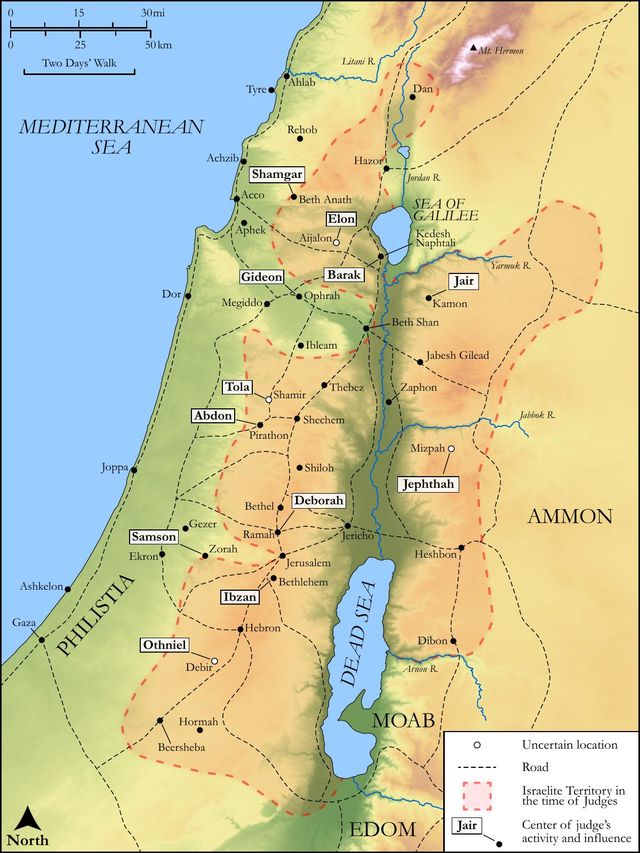
The period of the Judges (approximately 1375-1050 BC) was characterized by a decentralized tribal confederacy in Israel, marked by the absence of a central monarchy and cohesive national leadership. This fragmentation meant that "everyone did what was right in his own eyes" (Judges 21:25), leaving individual tribes vulnerable to incursions from surrounding peoples. The Ammonites, descendants of Lot through his younger daughter (Genesis 19:38), were a consistently hostile neighbor to the Transjordanian tribes of Israel (Reuben, Gad, and the half-tribe of Manasseh, which constituted Gilead). Their territorial claims, as later articulated in Judges 11:13, indicate a long-standing dispute. In this tumultuous era, military prowess was paramount, and a "judge" often emerged as a charismatic, divinely appointed military deliverer. The elders, recognized as the established, respected leaders of the community, held significant authority in tribal decision-making, especially during crises. Their journey to "fetch" Jephthah underscores the extreme severity of their situation and the critical absence of any other viable military commander within their own ranks.
Key Themes
ShowHideJudges 11:5 powerfully contributes to several overarching themes within the Book of Judges and the broader biblical narrative. Firstly, it vividly illustrates the desperation and pragmatism of human leadership when confronted with an overwhelming crisis. The elders, representing the collective community, are forced to set aside their pride, past prejudices, and the social stigma attached to Jephthah to seek help from the very individual they had wronged. This highlights how extreme circumstances can compel individuals and communities to re-evaluate their biases and seek unconventional solutions. Secondly, the verse reinforces the profound theme of God's sovereign use of the outcast and overlooked to achieve His divine purposes. Jephthah, a man of humble, ostracized origins, rejected by his family and living in exile, becomes the unlikely instrument of Israel's deliverance. This narrative motif consistently appears throughout Scripture, where God chooses the weak, the despised, and the overlooked to confound the strong and wise, thereby demonstrating His absolute sovereignty and power (1 Corinthians 1:27-29). Finally, the verse underscores Israel's constant and profound need for a deliverer in a period marked by profound spiritual and political chaos. Without a righteous, central king, the people were adrift, and their very survival depended on God raising up champions like Jephthah to rescue them from their enemies, ultimately pointing to the eschatological need for a perfect King and Savior.
Exposition and Analysis
ShowHideKey Word Analysis
ShowHideVerse Breakdown
ShowHide"And it was so, that when the children of Ammon made war against Israel"
This initial clause immediately establishes the critical catalyst for the events that unfold. The Ammonites, having previously subjected Israel to eighteen years of severe oppression (Judges 10:8), have now escalated their aggression into full-scale, active military conflict. This signifies a profound turning point, moving beyond mere subjugation to open warfare, which necessitated an immediate and decisive response from Israel. The Hebrew phrase "made war" (נִלְחֲמוּ, nilḥamu) emphatically conveys an aggressive, offensive military campaign.
"the elders of Gilead went to fetch Jephthah"
This is the desperate yet pivotal action undertaken by the recognized leaders of the region most afflicted by the Ammonite threat. Their deliberate act of "going to fetch" (וַיֵּלְכוּ לָקַחַת, vayyel'khu laqaḥat) Jephthah underscores the profound urgency of the situation and their humbling recognition that no other leader within their community possessed the necessary military acumen, courage, or reputation to confront the enemy. It represents a significant reversal of their previous rejection of Jephthah, highlighting their self-acknowledged inadequacy.
"out of the land of Tob"
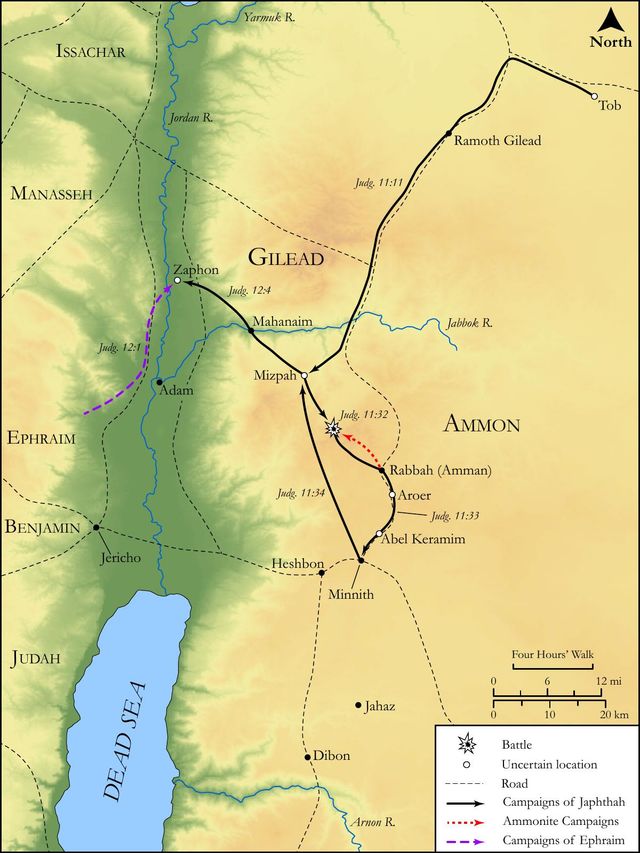
This concluding phrase precisely specifies Jephthah's location, powerfully emphasizing his status as an outsider, an exile living beyond the immediate borders of Israelite territory. His presence in "the land of Tob" serves as a poignant reminder of his past rejection and banishment due to his illegitimate birth (Judges 11:1-3). The elders' arduous journey to this distant, foreign land vividly illustrates the extreme depth of their desperation and the profound unlikelihood of the individual they were now compelled to seek as their deliverer.
Literary Devices
ShowHideJudges 11:5 masterfully employs several potent literary devices to convey its multifaceted meaning. Most notably, Irony pervades the verse, as the very "elders of Gilead" who had previously expelled Jephthah from their community are now, by dire necessity, forced to humble themselves and earnestly seek his assistance. This dramatic reversal of their earlier stance powerfully underscores the desperation of their situation and implicitly highlights Jephthah's unique and indispensable qualities as a warrior. The verse also utilizes Foreshadowing, subtly hinting at Jephthah's eventual, improbable rise to leadership despite his outcast status. This aligns with a broader, recurring biblical motif where God frequently chooses the humble, the lowly, and the rejected to accomplish His divine will, thereby challenging conventional human notions of power, authority, and suitability for leadership. Furthermore, Judges 11:5 serves as a crucial inflection point within the overarching Narrative Arc of the Book of Judges. It marks the pivotal transition from Israel's repentance and desperate cry for help to God's raising up of a specific deliverer. The escalating conflict with Ammon provides the necessary dramatic tension that propels the narrative forward, meticulously setting the stage for Jephthah's subsequent negotiations with the elders and his eventual military campaign.
Theological and Thematic Connections
ShowHideJudges 11:5 stands as a profound illustration of divine providence operating through the crucible of human desperation and often through flawed instruments. It reveals a consistent theological truth: even when God's people are in a state of profound spiritual decline and face severe consequences for their unfaithfulness, God, in His boundless mercy and unwavering covenant faithfulness, provides a means of deliverance. The elders' desperate plea to Jephthah, a man they had previously scorned and banished, reflects humanity's inherent tendency to exhaust all conventional, self-reliant options before being compelled to turn to unconventional, often divinely appointed, solutions. This narrative powerfully underscores that God's choices for leadership frequently defy human expectations and societal norms, demonstrating His absolute sovereignty in raising up unlikely figures—even those with significant personal flaws—to fulfill His redemptive purposes and deliver His people.
Reflection and Application
ShowHideJudges 11:5 offers profound and enduring lessons for contemporary believers, challenging us to critically examine our own prejudices, biases, and preconceived notions, particularly in discerning potential and leadership in unexpected places. Just as the elders of Gilead were forced to confront and reverse their past rejection of Jephthah due to their overwhelming and desperate need, we too may be called to set aside pride, social conventions, or ingrained biases to embrace solutions or leaders that do not conform to our preconceived notions of suitability. The verse serves as a powerful reminder that true capability, God-given anointing, and divine favor can reside in individuals whom society, or even segments of the church, may have despised, overlooked, or deemed unqualified. Furthermore, this passage speaks eloquently to the humbling power of desperate circumstances, which can strip away our self-sufficiency and force us to acknowledge our profound need for help, whether from others or, ultimately, from God Himself. In moments of severe crisis, we are often compelled to seek assistance from sources we might otherwise avoid, thereby revealing the true depth of our dependence and the limits of our own resources.
Questions for Reflection
ShowHideFAQ
ShowHideWho were the "elders of Gilead" and why did they go to Jephthah?
ShowHideThe "elders of Gilead" were the respected, authoritative, and experienced leaders of the Israelite tribes (primarily Gad and Reuben, and the half-tribe of Manasseh) residing in the Transjordanian region of Gilead. They constituted the collective leadership and decision-making body of the community. They went to Jephthah because their people were suffering under severe oppression and open warfare from the Ammonites (Judges 10:7-9), and they desperately lacked a capable military leader to deliver them. Despite having previously rejected Jephthah due to his illegitimate birth and driving him into exile (Judges 11:1-3), his reputation as a mighty warrior and leader of a band of "worthless fellows" (Judges 11:3) was evidently well-known and unmatched. Their act of "fetching" him highlights their extreme desperation, their humbling recognition of their own inadequacy, and the critical absence of any other viable option for military leadership within their own ranks.
What was the "land of Tob" and why is its mention significant?
ShowHideThe "land of Tob" (Hebrew: אֶרֶץ טוֹב, 'eretz Ṭôwb) was a geographical region likely situated northeast of Gilead, possibly in modern-day southern Syria or northern Jordan. Its precise location is debated, but it was definitively outside the immediate Israelite tribal territories. Its mention is highly significant because it was the place where Jephthah had taken refuge after being driven out by his half-brothers, who refused to share their inheritance with him because he was the son of a prostitute (Judges 11:1-3). Thus, "the land of Tob" symbolizes Jephthah's status as an outcast, an exile, and an overlooked figure. The fact that the elders had to travel to this distant, foreign land to retrieve him underscores the profound depth of their crisis and the extent of their humility in seeking help from someone they had previously wronged and banished. It powerfully illustrates that God often raises up deliverers from unexpected places and circumstances, often from the margins of society.
Christ-Centered Fulfillment
ShowHideJudges 11:5, while detailing the desperate call for an imperfect human deliverer, beautifully foreshadows the ultimate, perfect Deliverer, Jesus Christ. Just as Jephthah was an outcast, rejected by his own people and living in exile in the "land of Tob" (Judges 11:1-3), so too was Jesus "despised and rejected by men, a man of sorrows and acquainted with grief" (Isaiah 53:3). He came to His own, and His own people "did not receive Him" (John 1:11), ultimately casting Him out of the city to be crucified (Hebrews 13:12). Yet, in humanity's deepest spiritual crisis—enslaved by sin and facing the righteous wrath of God (Romans 3:23; Romans 6:23)—there was no one else who could deliver. Humanity, like the elders of Gilead, was utterly helpless and without hope. It was God Himself who "fetched" His Son from heaven, sending Him into the world not to condemn it, but to save it (John 3:17). Jesus, the true Lamb of God, took away the sin of the world (John 1:29), becoming the perfect Judge and Deliverer, not through military might or human negotiation, but through His self-sacrificial love on the cross and His resurrection power, offering eternal salvation and true freedom to all who believe, regardless of their past or perceived status (Romans 10:9-10).