


Judges 11:3
Bible text: King James Version (1769 Blayney text) · Public domain
Bible text: Berean Standard Bible · Public domain
Bible text: American Standard Version (1901) · Public domain
Bible text: World English Bible, Messianic edition · Public domain
Bible text: Geneva Bible (1599) · Public domain
Bible text: Young's Literal Translation · Public domain
- וַיִּבְרַחvai·yiv·Rachand he fledH1272Conj-w ¦ V-Qal-ConsecImperf-3msVerb Qal Consecutive Imperfect 3rd Singular Masculineוַandיִּבְרַחhe fled
- יִפְתָּחyif·TachJephthahH3316N-proper-mNoun Proper Masculine
- מִפְּנֵיmi·pe·Nei[away] from beforeH6440Prep-m ¦ N-mpcNoun Plural Masculine Constructמִ[away] fromפְּנֵיbefore
- אֶחָיו'e·Chavhis brothersH251N-mpc ¦ 3msNoun Plural Masculine Constructאֶחָיbrothersוhis
- וַיֵּשֶׁבvai·Ye·shevand he dweltH3427Conj-w ¦ V-Qal-ConsecImperf-3msVerb Qal Consecutive Imperfect 3rd Singular Masculineוַandיֵּשֶׁבhe dwelt
- בְּאֶרֶץbe·'E·retzin [the] land ofH776Prep-b ¦ N-fscNoun Singular Feminine Constructבְּinאֶרֶץ[the] land of
- טוֹבTovTobH2897N-properNoun Proper Location
- וַיִּתְלַקְּטוּvai·yit·la·ke·Tuand they joined themselvesH3950Conj-w ¦ V-Hithpael-ConsecImperf-3mpVerb Hithpael Consecutive Imperfect 3rd Plural Masculineוַandיִּתְלַקְּטוּthey joined themselves
- אֶל'eltoH413PrepPreposition
- יִפְתָּחyif·TachJephthahH3316N-proper-mNoun Proper Masculine
- אֲנָשִׁים'a·na·ShimmenH582N-mpNoun Plural Masculine Absolute
- רֵיקִיםrei·KimunprincipledH7386Adj-mpAdjective Plural Masculine Absolute
- וַיֵּצְאוּvai·ye·tze·'Uand they went outH3318Conj-w ¦ V-Qal-ConsecImperf-3mpVerb Qal Consecutive Imperfect 3rd Plural Masculineוַandיֵּצְאוּthey went out
- עִמּוֹi·Mowith himH5973Prep ¦ 3msPreposition Definiteעִמּwithוֹhim
English is a literal word-by-word gloss of the Hebrew, not the KJV's wording. Why?
This is the original text the KJV's translators worked from — each Hebrew word with its own literal English meaning in this verse, prepared by scholars at Tyndale House, Cambridge. The KJV translates whole sentences, not word by word, so its wording differs: one Hebrew word can become several English words, and the KJV may choose “the LORD” where the gloss reads “Yahweh”. Both are faithful — they answer different questions. For the KJV's own rendering, switch to the KJV text.
Details
See on the biblical-era maps

Study this verse
Public-domain commentary
Matthew Henry
From his Commentary on the Whole Bible. Henry comments on passages, not single verses — this entry covers Judges 11:1–3.
The princes and people of Gilead we left, in the close of the foregoing chapter, consulting about the choice of a general, having come to this resolve, that whoever would undertake to lead their forces against the children of Ammon should by common consent be head over all the inhabitants of Gilead. The enterprise was difficult, and it was fit that so great an encouragement as this should be proposed to him that would undertake it. Now all agreed that Jephthah, the Gileadite, was a mighty man of valour, and very fit for that purpose, none so fit as he, but he lay under three disadvantages: - 1. He was the son of a harlot (Jdg 11:1), of a strange woman (Jdg 11:2), one that was neither a wife nor a concubine; some think his mother was a Gentile; so Josephus, who calls him a stranger by the mother's side. An Ishmaelite, say the Jews. If his mother was a harlot, that was not his fault, however it was his disgrace. Men ought not to be reproached with any of the infelicities of their parentage or extraction, so long as they are endeavouring by their personal merits to roll away the reproach. The son of a harlot, if born again, born from above, shall be accepted of God, and be as welcome as any other to the glorious liberties of his children. Jephthah could not read in the law the brand there put on the Ammonites, the enemies he was to grapple with, that they should not enter into the congregation of the Lord, but in the same paragraph he met with that which looked black upon himself, that a bastard should be in like manner excluded, Deu 23:2, Deu 23:3. But if that law means, as most probably it does, only those that are born of incest, not of fornication, he was not within the reach of it. 2. He had been driven from his country by his brethren. His father's legitimate children, insisting upon the rigour of the law, thrust him out from having any inheritance with them, without any consideration of his extraordinary qualifications, which merited a dispensation, and would have made him a mighty strength and ornament of their family, if they had overlooked his being illegitimate and admitted him to a child's part, Jdg 11:2. One would not have thought this abandoned youth was intended to be Israel's deliverer and judge, but God often humbles those whom he designs to exalt, and makes that stone the head of the corner which the builders refused; so Joseph, Moses, and David, the three most eminent of the shepherds of Israel, were all thrust out by men, before they were called of God to their great offices. 3. He had, in his exile, headed a rabble, Jdg 11:3. Being driven out by his brethren, his great soul would not suffer him either to dig or beg, but by his sword he must live; and, being soon noted for his bravery, those that were reduced to such straits, and animated by such a spirit, enlisted themselves under him. Vain men they are here called, that is, men that had run through their estates and had to seek for a livelihood. These went out with him, not to rob or plunder, but to hunt wild beasts, and perhaps to make incursions upon those countries which Israel was entitled to, but had not as yet come to the possession of, or were some way or other injured by. This is the man that must save Israel. That people had by their idolatry made themselves children of whoredoms, and aliens from God and his covenant, and therefore, though God upon their repentance will deliver them, yet, to mortify them and remind them of their sin, he chooses to do it by a bastard and an exile.
Continue studying Judges 11:3 across the web’s major study libraries — every link below opens this exact verse, chapter, or book on the destination site.
Read & Compare
 BibleGatewayThis verse in more than 200 translations and 70 languages.
 Bible.comThe YouVersion reader — hundreds of translations, reading plans, and highlights.
 ESV.orgCrossway's official English Standard Version reader.
 NET BibleThe NET translation with 60,000+ translators' notes on every rendering decision.
 STEP BibleTyndale House's free study tool — original text, vocabulary, and scholarly resources.
 BibliaLogos Bible Software's free web reader.
 USCCBThe New American Bible (Revised Edition) with the U.S. bishops' study notes.
Commentaries
 BibleHub CommentariesDozens of classic commentaries on this verse, gathered on one page.
 StudyLightMore than 100 commentary sets — the largest collection on the web.
 BibleRefPlain-English commentary on what this verse means, verse by verse.
 Enduring WordDavid Guzik's free commentary on this chapter, widely used by Bible teachers.
 Bible Study ToolsVerse commentary alongside Greek and Hebrew study aids.
Original Language & Research
- BibleHub InterlinearThe verse word by word — original language, transliteration, and English.
- BibleHub LexiconEvery word's original-language definition and Strong's entry.
 Blue Letter BibleDeep-study tools — Strong's numbers, concordance, and word studies.
 SefariaThe Hebrew text with Rashi and centuries of Jewish commentary.
Sermons, Hymns & Audio


TrulyRandomVerse is not affiliated with these sites and doesn’t control their content. They’re linked because they’re genuinely useful.
Summary
Judges 11:3 details the immediate aftermath of Jephthah's expulsion by his half-brothers due to his illegitimate birth. Forced into exile, he established himself in the frontier region of Tob, where he quickly attracted a following of overlooked and dispossessed men, often described as "vain" or "worthless." This verse is foundational, setting the stage for Jephthah's unlikely ascent from outcast to a formidable leader, demonstrating how his initial circumstances forged his character and prepared him for the crucial role he would later play in delivering Israel from the Ammonites.
Context
ShowHideLiterary Context
Judges 11:3 flows directly from the preceding verses that establish Jephthah's challenging origins. Judges 11:1-2 introduces him as the son of Gilead by a prostitute, leading to his rejection and expulsion by his half-brothers who sought to deny him any inheritance. This familial ostracization is the direct catalyst for his flight, making verse 3 the immediate consequence of that injustice. The narrative then progresses to describe his activities in Tob, which ultimately lead to the elders of Gilead seeking him out for leadership against the Ammonites in Judges 11:4-6. Thus, this verse is crucial for understanding the formation of Jephthah's character, his social standing, and his eventual emergence as a military and national leader.
Historical & Cultural Context
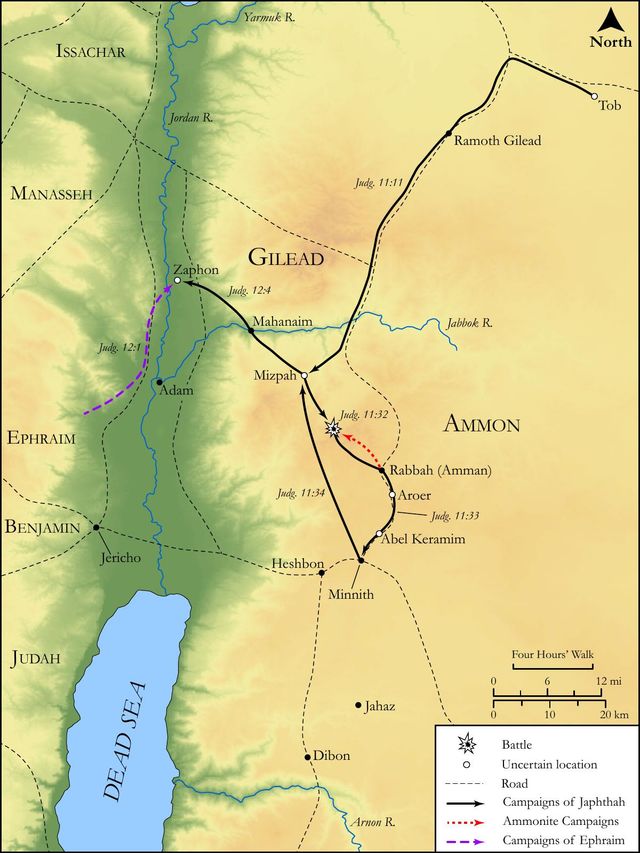
The period of the Judges (roughly 12th-11th centuries BC) was marked by a fragmented Israelite society, frequent external threats, and internal moral decline, encapsulated by the recurring phrase, "everyone did what was right in his own eyes" (Judges 17:6 and Judges 21:25). In this turbulent era, social standing, tribal affiliation, and inheritance rights were paramount. Jephthah's illegitimate birth was a significant cultural stigma that, in the eyes of his brothers, justified his expulsion and disinheritance. The "land of Tob" was likely a region east of the Jordan River, on the fringes of Israelite territory, serving as a common refuge for outcasts, fugitives, or those seeking to live outside established societal norms. Such frontier areas often attracted individuals who were dispossessed, indebted, or seeking adventure, forming loosely organized bands for survival, raiding, or mercenary work.
Key Themes
ShowHideThis verse introduces several pivotal themes that resonate throughout the book of Judges and the broader biblical narrative. Firstly, it powerfully illustrates the theme of rejection and neglect, showing how an individual cast out by his own community can nevertheless be raised up by God for a significant purpose. Secondly, it highlights the emergence of unlikely leadership, as Jephthah, despite his humble and ostracized beginnings, demonstrates the ability to attract and organize a following. This foreshadows the divine pattern of choosing the weak or overlooked to accomplish mighty deeds, a theme echoed in the story of David gathering his men at Adullam. Finally, the gathering of "vain men" underscores the theme of divine providence working through unconventional means, suggesting that God can use even those considered "worthless" or "empty" by society to fulfill His redemptive plans, demonstrating His power through human weakness.
Exposition and Analysis
ShowHideKey Word Analysis
ShowHideThis primitive root (H1272) signifies a sudden, hurried departure, often due to danger, persecution, or, as in Jephthah's case, forced expulsion. It emphasizes that Jephthah's relocation was not voluntary but a direct consequence of his brothers' hostile and unjust actions. His flight underscores his vulnerability and the severity of his rejection, portraying him as a man dispossessed and without a conventional home or social standing.
This proper noun (H2897) refers to a geographical region, likely in Transjordan, northeast of Gilead. While the name itself means "good," its significance in this context lies in its frontier status. It served as a place of refuge and a base for those living outside the established social and political structures of Israel. For Jephthah, it was a strategic location where he could establish himself independently, away from the direct influence and judgment of his family and the Gileadite elders, and where he could gather a following.
This term (H7386), used here in its plural form, literally means "empty ones" or "worthless ones." In various biblical contexts, it can denote idleness, dissoluteness, or a lack of moral substance. Here, it describes men who were likely dispossessed, unemployed, or outcasts themselves—perhaps debtors, adventurers, or those with no social standing or property. They were "empty" of conventional societal value but full of potential for action under a strong leader. This group formed Jephthah's initial fighting force, suggesting he engaged in raiding or skirmishes to sustain them, thereby honing the military skills that would later be vital for Israel's deliverance.
Verse Breakdown
ShowHide"Then Jephthah fled from his brethren"
This clause directly states Jephthah's forced departure, establishing the immediate consequence of his brothers' rejection as detailed in Judges 11:2. It highlights his profound social ostracization and the injustice he faced, setting him on a path outside conventional Israelite society and foreshadowing his unconventional rise.
"and dwelt in the land of Tob"
This identifies Jephthah's new abode, a frontier region that served as a haven for outcasts and those living among the outcasts. His "dwelling" there implies a period of establishment and consolidation, where he built a new life and reputation away from his ancestral home, indicating a period of growth and preparation.
"and there were gathered vain men to Jephthah"
This signifies the beginning of Jephthah's leadership and the formation of his band. The "vain men" (as analyzed above) were drawn to him, indicating his charisma, strength, or perhaps simply his willingness to lead those whom society had discarded. This gathering is pivotal, forming the core of his future military capability and demonstrating his ability to attract followers.
"and went out with him"
This final phrase implies the activities of Jephthah and his newly formed group. "Going out" with Jephthah suggests they engaged in raiding, skirmishes, or mercenary work, which would have been common for such bands in the turbulent period of the Judges. It shows Jephthah not as a passive exile, but as an active leader building a reputation and a fighting force through practical, often dangerous, experience.
Literary Devices
ShowHideThe verse employs several significant literary devices. Foreshadowing is prominent, as Jephthah's gathering of "vain men" and "going out with him" hints at his future role as a mighty warrior and deliverer, despite his inauspicious beginnings. This initial band of outcasts foreshadows the larger force he will command for Israel. There is also a strong element of Irony: the very rejection by his family, intended to diminish him and deny him inheritance, inadvertently propels him to a position where he hones the skills and gathers the followers necessary to become the very deliverer his family and people will desperately need. The "land of Tob" functions as a Symbol of refuge and a crucible for transformation, a place where an outcast can forge a new identity and purpose. The "vain men" themselves can be seen as Symbolic of the raw, unrefined material that God often uses, demonstrating His ability to work through the unexpected and the lowly.
Theological and Thematic Connections
ShowHideJudges 11:3 powerfully illustrates God's sovereign hand in raising up leaders from unexpected places and through unconventional means. Despite Jephthah's profound rejection and the ignominy of his birth, God's plan for Israel's deliverance was already at work, using his exile and the formation of his band of "vain men" as a preparatory stage for his future leadership. This serves as a profound theological statement that human rejection or societal norms do not limit God's ability to choose and equip individuals for His purposes. It underscores the theme that God often works through the lowly and the overlooked, demonstrating His power not in spite of, but often through, human weakness and societal disdain, to accomplish His divine will.
Reflection and Application
ShowHideJephthah's story, beginning with his rejection and flight in Judges 11:3, offers profound lessons for contemporary believers. It reminds us that our past circumstances, including experiences of rejection, injustice, or unconventional beginnings, do not disqualify us from God's divine purpose. Just as Jephthah was prepared for leadership in the crucible of exile among "vain men," God often uses our wilderness experiences and the "unlikely" people around us to shape our character and equip us for His calling. This verse challenges us to look beyond superficial appearances and societal labels, both in ourselves and in others, recognizing that God can raise up instruments of His will from the most unexpected places. It encourages resilience in the face of adversity and faith that God can redeem even the most painful rejections for His glory and our good, transforming them into opportunities for growth and divine service.
Questions for Reflection
ShowHideFAQ
ShowHideWho were the "vain men" who gathered to Jephthah, and what does this say about his leadership?
ShowHideThe "vain men" (Hebrew: rêyq or reqim) were likely individuals who were dispossessed, idle, or without social standing—perhaps debtors, outcasts, or those seeking adventure and plunder. The term implies they were "empty" of conventional societal value or moral compass. Their gathering to Jephthah indicates his strong leadership qualities, even in exile. He attracted those who had nothing to lose and were willing to follow a strong figure into potentially dangerous ventures. This highlights that Jephthah's leadership emerged from the margins of society, demonstrating his ability to organize and lead a formidable force from unconventional beginnings, much like David gathered the distressed and discontented at the cave of Adullam.
Why was Jephthah rejected by his brothers, and how did this impact his life?
ShowHideJephthah was rejected by his half-brothers because he was the son of their father, Gilead, by a prostitute, making him illegitimate in their eyes (Judges 11:1-2). They drove him away to prevent him from inheriting any portion of the family estate. This rejection was a profound act of social and familial ostracization, forcing him into exile. It profoundly impacted his life by pushing him out of his ancestral home and into the frontier region of Tob, where he had to forge a new path and establish himself through his own strength and leadership, ultimately preparing him for his pivotal role as a deliverer of Israel.
Christ-Centered Fulfillment
ShowHideJephthah's story, beginning with his rejection and flight, serves as a powerful Old Testament foreshadowing of Christ. Like Jephthah, Jesus was born into humble circumstances and was ultimately "despised and rejected by mankind" (Isaiah 53:3). Though the legitimate Son of God, He was cast out by His own people, as "He came to His own, and His own people did not receive Him" (John 1:11). Just as Jephthah gathered "vain men"—outcasts and those considered worthless by society—Jesus called and gathered disciples who were often overlooked, like fishermen and a tax collector (Matthew 4:18-22, Matthew 9:9). These were not the esteemed religious leaders or the powerful, but those who were "poor in spirit" and "mourn" (Matthew 5:3-4). Jesus, the ultimate rejected stone who became the cornerstone (Psalm 118:22, Acts 4:11), establishes a kingdom not of this world, attracting those who are "empty" of worldly status but "full" of spiritual hunger and a desire for true righteousness. His leadership, like Jephthah's, emerges from the margins of human expectation, demonstrating God's consistent pattern of using the humble and the rejected to accomplish His greatest redemptive work.