


Judges 11:2
Bible text: King James Version (1769 Blayney text) · Public domain
Bible text: King James Version with Strong's numbers · Public domain
Bible text: Berean Standard Bible · Public domain
Bible text: American Standard Version (1901) · Public domain
Bible text: World English Bible, Messianic edition · Public domain
Bible text: Geneva Bible (1599) · Public domain
Bible text: Young's Literal Translation · Public domain
- וַתֵּלֶדva·Te·ledand she boreH3205Conj-w ¦ V-Qal-ConsecImperf-3fsVerb Qal Consecutive Imperfect 3rd Singular Feminineוַandתֵּלֶדshe bore
- אֵשֶׁת'e·shet[the] wife ofH802N-fscNoun Singular Feminine Construct
- גִּלְעָדgil·'AdGileadH1568N-proper-mNoun Proper Masculine
- לוֹloto <the> himPrep-l ¦ 3msSuffix Personal 3rd Singular Masculineלto <the>וֹhim
- בָּנִיםba·NimsonsH1121N-mpNoun Plural Masculine Absolute
- וַיִּגְדְּלוּvai·yig·de·Luand they grew upH1431Conj-w ¦ V-Qal-ConsecImperf-3mpVerb Qal Consecutive Imperfect 3rd Plural Masculineוַandיִּגְדְּלוּthey grew up
- בְנֵיve·nei[the] sons ofH1121N-mpcNoun Plural Masculine Construct
- הָאִשָּׁהha·'i·Shahthe wifeH802Art ¦ N-fsNoun Singular Feminine Absoluteהָtheאִשָּׁהwife
- וַיְגָרְשׁוּvay·ga·re·Shuand they drove outH1644Conj-w ¦ V-Piel-ConsecImperf-3mpVerb Piel Consecutive Imperfect 3rd Plural Masculineוַandיְגָרְשׁוּthey drove out
- אֶת'et<obj.>H853DirObjMParticle Object Indicator
- יִפְתָּחyif·TachJephthahH3316N-proper-mNoun Proper Masculine
- וַיֹּאמְרוּvai·Yo·me·ruand they saidH559Conj-w ¦ V-Qal-ConsecImperf-3mpVerb Qal Consecutive Imperfect 3rd Plural Masculineוַandיֹּאמְרוּthey said
- לוֹloto <the> himPrep-l ¦ 3msSuffix Personal 3rd Singular Masculineלto <the>וֹhim
- לֹאlo'notH3808NegParticle Negative
- תִנְחַלtin·Chalyou will have an inheritanceH5157V-Qal-Imperf-2msVerb Qal Imperfect 2nd Singular Masculine
- בְּבֵיתbe·veitin [the] house ofH1004Prep-b ¦ N-mscNoun Singular Masculine Constructבְּinבֵית[the] house of
- אָבִינוּ'a·Vi·nuour fatherH1N-msc ¦ 1cpNoun Singular Masculine Constructאָבִיfatherנוּour
- כִּיkiforH3588PrtParticle Conditional
- בֶּןben[are] [the] son ofH1121N-mscNoun Singular Masculine Construct
- אִשָּׁה'i·Shaha womanH802N-fsNoun Singular Feminine Absolute
- אַחֶרֶת'a·Che·retanotherH312Adj-fsAdjective Singular Feminine Absolute
- אָתָּה'A·tahyouH859Pro-2msPronoun Personal 2nd Singular Masculine
English is a literal word-by-word gloss of the Hebrew, not the KJV's wording. Why?
This is the original text the KJV's translators worked from — each Hebrew word with its own literal English meaning in this verse, prepared by scholars at Tyndale House, Cambridge. The KJV translates whole sentences, not word by word, so its wording differs: one Hebrew word can become several English words, and the KJV may choose “the LORD” where the gloss reads “Yahweh”. Both are faithful — they answer different questions. For the KJV's own rendering, switch to the KJV text.
Details
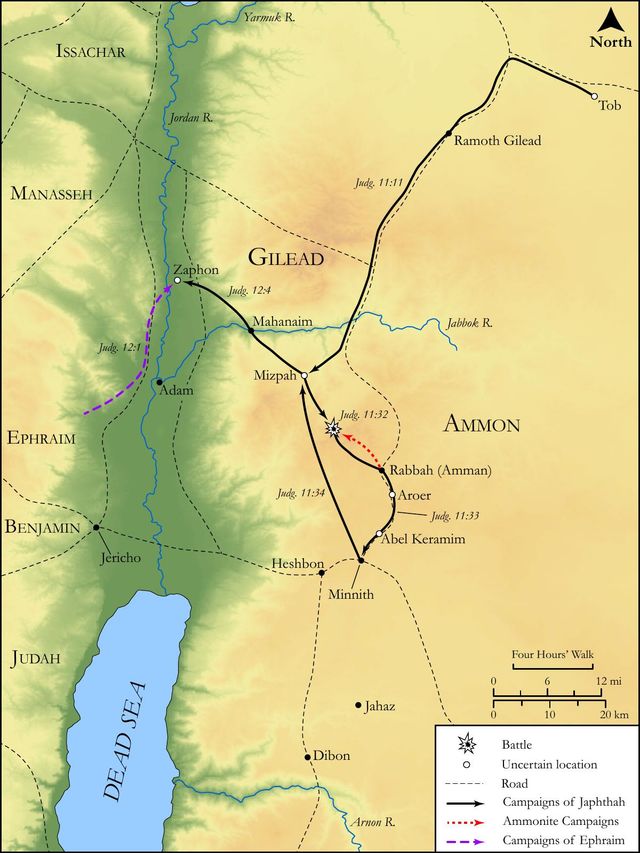
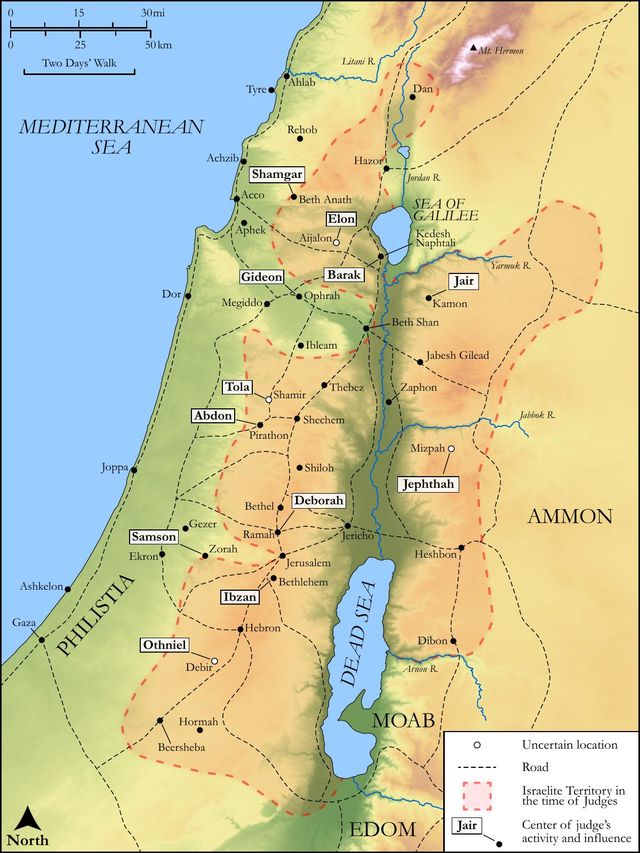
See on the biblical-era maps
Study this verse
Public-domain commentary
Matthew Henry
From his Commentary on the Whole Bible. Henry comments on passages, not single verses — this entry covers Judges 11:1–3.
The princes and people of Gilead we left, in the close of the foregoing chapter, consulting about the choice of a general, having come to this resolve, that whoever would undertake to lead their forces against the children of Ammon should by common consent be head over all the inhabitants of Gilead. The enterprise was difficult, and it was fit that so great an encouragement as this should be proposed to him that would undertake it. Now all agreed that Jephthah, the Gileadite, was a mighty man of valour, and very fit for that purpose, none so fit as he, but he lay under three disadvantages: - 1. He was the son of a harlot (Jdg 11:1), of a strange woman (Jdg 11:2), one that was neither a wife nor a concubine; some think his mother was a Gentile; so Josephus, who calls him a stranger by the mother's side. An Ishmaelite, say the Jews. If his mother was a harlot, that was not his fault, however it was his disgrace. Men ought not to be reproached with any of the infelicities of their parentage or extraction, so long as they are endeavouring by their personal merits to roll away the reproach. The son of a harlot, if born again, born from above, shall be accepted of God, and be as welcome as any other to the glorious liberties of his children. Jephthah could not read in the law the brand there put on the Ammonites, the enemies he was to grapple with, that they should not enter into the congregation of the Lord, but in the same paragraph he met with that which looked black upon himself, that a bastard should be in like manner excluded, Deu 23:2, Deu 23:3. But if that law means, as most probably it does, only those that are born of incest, not of fornication, he was not within the reach of it. 2. He had been driven from his country by his brethren. His father's legitimate children, insisting upon the rigour of the law, thrust him out from having any inheritance with them, without any consideration of his extraordinary qualifications, which merited a dispensation, and would have made him a mighty strength and ornament of their family, if they had overlooked his being illegitimate and admitted him to a child's part, Jdg 11:2. One would not have thought this abandoned youth was intended to be Israel's deliverer and judge, but God often humbles those whom he designs to exalt, and makes that stone the head of the corner which the builders refused; so Joseph, Moses, and David, the three most eminent of the shepherds of Israel, were all thrust out by men, before they were called of God to their great offices. 3. He had, in his exile, headed a rabble, Jdg 11:3. Being driven out by his brethren, his great soul would not suffer him either to dig or beg, but by his sword he must live; and, being soon noted for his bravery, those that were reduced to such straits, and animated by such a spirit, enlisted themselves under him. Vain men they are here called, that is, men that had run through their estates and had to seek for a livelihood. These went out with him, not to rob or plunder, but to hunt wild beasts, and perhaps to make incursions upon those countries which Israel was entitled to, but had not as yet come to the possession of, or were some way or other injured by. This is the man that must save Israel. That people had by their idolatry made themselves children of whoredoms, and aliens from God and his covenant, and therefore, though God upon their repentance will deliver them, yet, to mortify them and remind them of their sin, he chooses to do it by a bastard and an exile.
Continue studying Judges 11:2 across the web’s major study libraries — every link below opens this exact verse, chapter, or book on the destination site.
Read & Compare
 BibleGatewayThis verse in more than 200 translations and 70 languages.
 Bible.comThe YouVersion reader — hundreds of translations, reading plans, and highlights.
 ESV.orgCrossway's official English Standard Version reader.
 NET BibleThe NET translation with 60,000+ translators' notes on every rendering decision.
 STEP BibleTyndale House's free study tool — original text, vocabulary, and scholarly resources.
 BibliaLogos Bible Software's free web reader.
 USCCBThe New American Bible (Revised Edition) with the U.S. bishops' study notes.
Commentaries
 BibleHub CommentariesDozens of classic commentaries on this verse, gathered on one page.
 StudyLightMore than 100 commentary sets — the largest collection on the web.
 BibleRefPlain-English commentary on what this verse means, verse by verse.
 Enduring WordDavid Guzik's free commentary on this chapter, widely used by Bible teachers.
 Bible Study ToolsVerse commentary alongside Greek and Hebrew study aids.
Original Language & Research
- BibleHub InterlinearThe verse word by word — original language, transliteration, and English.
- BibleHub LexiconEvery word's original-language definition and Strong's entry.
 Blue Letter BibleDeep-study tools — Strong's numbers, concordance, and word studies.
 SefariaThe Hebrew text with Rashi and centuries of Jewish commentary.
Sermons, Hymns & Audio


TrulyRandomVerse is not affiliated with these sites and doesn’t control their content. They’re linked because they’re genuinely useful.
Summary
Judges 11:2 vividly portrays the painful rejection and disinheritance of Jephthah by his half-brothers, the legitimate sons of Gilead. Born to a woman described as "strange" or illicit, Jephthah is forcibly expelled from his father's household and denied any share in the family inheritance. This act of familial cruelty not only highlights the severe social stigma associated with his birth but also establishes the initial circumstances that force Jephthah into exile, setting the stage for his later, unexpected rise as a deliverer for Israel.
Context
ShowHideLiterary Context
This verse immediately follows the introduction of Jephthah in Judges 11:1, which succinctly establishes his identity as "a mighty man of valour" and "the son of a harlot." Judges 11:2 serves as the direct consequence and elaboration of this initial description, detailing the specific act of disinheritance and expulsion by his half-brothers. It explains why Jephthah becomes an outcast, thus providing the narrative bridge to Judges 11:3, where he flees to the land of Tob and gathers a band of "vain men." The verse is crucial for understanding Jephthah's character development and the societal forces that shaped his early life, setting up the dramatic irony of his later call to leadership.
Historical & Cultural Context
In ancient Israelite society, inheritance was paramount, inextricably linked to one's identity, social status, economic security, and tribal affiliation. Land, in particular, was considered a divine gift and a perpetual inheritance within the family, as seen in the instructions regarding daughters' inheritance rights in Numbers 27:7-11. A patrilineal system meant sons inherited from their father, and exclusion from this inheritance was a severe form of social and economic death. The phrase "strange woman" (אִשָּׁה אַחֶרֶת, ʼishshâh ʼachêr) or "harlot" (זוֹנָה, zonah, from Judges 11:1) signifies a woman who was not a legitimate, primary wife, or possibly a foreign woman, rendering her offspring socially disadvantaged, if not entirely illegitimate, in terms of inheritance rights. This context underscores the profound injustice Jephthah faced, rooted in the rigid social structures and legal norms of the time.
Key Themes
ShowHideJudges 11:2 introduces and develops several significant themes. Firstly, family conflict and jealousy are prominent, as the legitimate sons of Gilead actively conspire to remove Jephthah, driven by a perceived threat to their inheritance and status. This echoes broader biblical narratives of sibling rivalry, such as that between Jacob and Esau or Joseph and his brothers. Secondly, the verse highlights social stigma and discrimination, demonstrating how Jephthah's birth circumstances led to his neglect and denial of fundamental rights. This theme of the "outcast" is a recurring motif in the Bible, where God often chooses those rejected by society or family for His purposes, as seen in the call of David, the youngest son, or the ultimate example of Christ Himself. Finally, the verse subtly introduces the theme of divine sovereignty over human injustice, as this act of rejection, though unjust, ultimately positions Jephthah for God's later call to deliver Israel.
Exposition and Analysis
ShowHideKey Word Analysis
ShowHideThis verb (H1644) denotes a forceful, decisive expulsion, often implying divorce, banishment, or driving out from a possession. It is a strong term, indicating that Jephthah's removal was not a gentle request but a coercive act of banishment, effectively severing his ties to his family and home. This word emphasizes the violent and definitive nature of his disinheritance, leaving him with no recourse within the family structure.
The verb (H5157) signifies to take possession, to receive as a heritage or portion, or to come into an inheritance. In ancient Israel, inheritance was not merely about material wealth but about identity, belonging, and the continuation of the family line and its connection to the tribal land. By denying Jephthah the right to "inherit in our father's house," his brothers were stripping him of his social standing, economic security, and most profoundly, his familial identity and future within the clan.
This phrase (combining H802 for "woman" and H312 for "strange" or "other") literally means "another woman" or "a different woman." While Judges 11:1 specifies his mother as a זוֹנָה (zonah), a "harlot," the use of "strange woman" here by his brothers might be a euphemism or a broader term implying a woman outside the legitimate marital structure, perhaps a concubine, a foreign woman, or indeed, a harlot. Regardless of the exact nuance, the phrase functions as a derogatory label, highlighting her non-legitimate status and, by extension, Jephthah's perceived illegitimacy, which served as the justification for his disinheritance.
Verse Breakdown
ShowHide"And Gilead's wife bare him sons; and his wife's sons grew up"
This opening clause establishes the presence of legitimate heirs to Gilead, born from his legal wife. The phrase "grew up" implies that these sons reached an age of maturity and legal standing, enabling them to assert their rights and make decisions regarding the family's future and inheritance. It sets up a clear contrast between these legitimate sons and Jephthah, whose mother's status was ambiguous or illicit.
"and they thrust out Jephthah"
This is the pivotal action of the verse. The legitimate sons, acting in concert, forcibly expelled Jephthah. This "thrusting out" (גָּרַשׁ, gârash) was a violent and definitive act of banishment, severing his connection to the family home and its resources. It underscores the severity of the rejection and the power dynamics within the family.
"and said unto him, Thou shalt not inherit in our father's house;"
This direct declaration reveals the explicit reason for Jephthah's expulsion: the denial of his inheritance. In a society where inheritance was foundational to identity and survival, this statement was a profound curse, effectively stripping him of his birthright and any future claim to family property or status. It highlights the brothers' greed and their desire to consolidate all inheritance for themselves.
"for thou [art] the son of a strange woman."
This final clause provides the justification for their actions, rooted in the social stigma of Jephthah's birth. His mother's status as a "strange woman" (אִשָּׁה אַחֶרֶת, ʼishshâh ʼachêr) or harlot (זוֹנָה, zonah) was deemed sufficient grounds to invalidate his claim to inheritance. This reveals the harsh reality of social prejudice and the devastating impact of illegitimacy in ancient Israelite society, where lineage and marital legitimacy were paramount.
Literary Devices
ShowHideThe narrative in Judges 11:2 employs several literary devices to deepen its impact. Conflict is immediately evident, not only between Jephthah and his half-brothers but also within the very structure of the family unit, driven by greed and social prejudice. There is a strong element of Irony, as the very act of rejection and expulsion, intended to diminish Jephthah, ultimately sets the stage for his rise as a leader chosen by God, a common biblical motif where the lowly become instrumental in divine plans. The brothers' declaration also functions as Foreshadowing, as their rejection of Jephthah as an heir ironically foreshadows the later desperate plea from the elders of Gilead for Jephthah to return and lead them, acknowledging his "might" despite his "illegitimacy." The phrase "son of a strange woman" serves as a Labeling device, defining Jephthah by his birth rather than his character or potential, a form of social ostracization.
Theological and Thematic Connections
ShowHideJudges 11:2 powerfully illustrates the pervasive nature of human sin—jealousy, greed, and prejudice—and its devastating consequences within families and society. Yet, it also subtly introduces a profound theological truth: God's ability to work through and even redeem circumstances born of human injustice. Jephthah's rejection by his family, though deeply painful and unjust, becomes the crucible through which he is shaped for a unique divine purpose. This narrative foreshadows a consistent biblical pattern where God often chooses the overlooked, the rejected, or the seemingly unqualified to accomplish His will, demonstrating that His power is not limited by human social constructs or injustices. It underscores that while humans may cast out, God can call in and elevate for His glory.
Reflection and Application
ShowHideJephthah's story, beginning with this painful rejection, resonates deeply with the human experience of being overlooked, misunderstood, or unfairly treated. It reminds us that injustice, prejudice, and family strife are not new phenomena, and that the pain of exclusion can be profound. This verse challenges us to cultivate empathy for those who are "thrust out" by society, family, or circumstances beyond their control. It also offers a powerful message of hope and resilience: even when human systems fail and personal circumstances seem bleak, God's purposes can transcend and even utilize such difficulties. We are called to consider how we respond to rejection—whether it leads to bitterness and destructive choices, or if, through faith, it can become a pathway for God to display His power and grace in our lives. Our identity is not ultimately defined by human labels or rejections, but by God's unchanging view of us.
Questions for Reflection
ShowHideFAQ
ShowHideWhat does "strange woman" mean in this context, and why was it so significant?
ShowHideIn Judges 11:2, "strange woman" (אִשָּׁה אַחֶרֶת, ʼishshâh ʼachêr) refers to a woman who was not Gilead's primary, legitimate wife. Judges 11:1 clarifies that Jephthah's mother was a זוֹנָה (zonah), meaning "harlot." This status was profoundly significant in ancient Israelite society because lineage and marital legitimacy were crucial for inheritance rights, social standing, and tribal identity. Being born of a "strange woman" or harlot meant Jephthah lacked the full legal and social standing of his half-brothers, who were born to Gilead's legitimate wife. This perceived illegitimacy was the explicit justification his brothers used to deny him his inheritance and expel him from the "father's house," a severe social and economic blow.
Why was inheritance so crucial in ancient Israelite society, and what did it mean to be denied it?
ShowHideInheritance was foundational to life in ancient Israel. It primarily involved the transfer of land, which was considered a divine gift and the basis of a family's economic security, social status, and place within the tribal structure. To be denied inheritance, as Jephthah was, meant being stripped of one's rightful share of family property, particularly land, which was the primary source of livelihood. It also implied a loss of social standing, a severing of ties to the ancestral home, and a profound sense of dishonor and exclusion. This act effectively rendered Jephthah an outcast, forcing him to seek his fortune outside the established social and familial norms, as described in Judges 11:3.
How does Jephthah's expulsion in this verse set the stage for the rest of his story?
ShowHideJephthah's expulsion in Judges 11:2 is the foundational event that shapes his entire narrative. It forces him into exile, transforming him from a disinherited family member into an independent, albeit overlooked, leader of a band of "vain men" in the land of Tob (Judges 11:3). This period of exile and leadership outside the traditional societal structure hones his skills as a "mighty man of valour" (Judges 11:1). Paradoxically, it is this very experience as an outcast that prepares him to be the only one capable of delivering Israel from the Ammonites, leading the elders of Gilead to desperately seek his return and leadership in Judges 11:4-8. His rejection thus becomes the unlikely catalyst for his eventual elevation.
Christ-Centered Fulfillment
ShowHideThe painful rejection of Jephthah by his own family, based on his perceived illegitimate birth and social stigma, serves as a poignant foreshadowing of the ultimate rejection experienced by Jesus Christ. Though Jephthah was "the son of a strange woman," Jesus, the perfectly legitimate and divine Son of God, was similarly "despised and rejected by men" (Isaiah 53:3). He "came to his own, and his own people did not receive him" (John 1:11), just as Jephthah was "thrust out" from his father's house. Christ, though rightful heir to all things, emptied himself, taking the form of a servant (Philippians 2:7), and was treated as an outcast, even suffering outside the city gate (Hebrews 13:12). His identification with humanity in its fallen state, including experiencing rejection and injustice, means that He is a High Priest who can truly sympathize with our weaknesses (Hebrews 4:15). Ultimately, the "stone that the builders rejected" became the "cornerstone" (Psalm 118:22), and through His rejection, we who were once "strangers and aliens" are now "fellow citizens with the saints and members of the household of God" (Ephesians 2:19). Jephthah's story, therefore, points to the greater redemptive narrative of Christ, whose rejection secures our eternal inclusion.