


1 Samuel 16:11
Bible text: King James Version (1769 Blayney text) · Public domain
Bible text: King James Version with Strong's numbers · Public domain
Bible text: Berean Standard Bible · Public domain
Bible text: American Standard Version (1901) · Public domain
Bible text: World English Bible, Messianic edition · Public domain
Bible text: Geneva Bible (1599) · Public domain
Bible text: Young's Literal Translation · Public domain
- וַיֹּאמֶרvai·Yo·merand he saidH559Conj-w ¦ V-Qal-ConsecImperf-3msVerb Qal Consecutive Imperfect 3rd Singular Masculineוַandיֹּאמֶרhe said
- שְׁמוּאֵלshe·mu·'ElSamuelH8050N-proper-mNoun Proper Masculine
- אֶל'eltoH413PrepPreposition
- יִשַׁיyi·ShaiJesseH3448N-proper-mNoun Proper Masculine
- הֲתַמּוּha·Ta·mu¿ are they finishedH8552Interrog ¦ V-Qal-Perf-3cpVerb Qal Perfect 3rd Plural common genderהֲ¿תַמּוּare they finished
- הַנְּעָרִיםha·ne·'a·Rimthe young menH5288Art ¦ N-mpNoun Plural Masculine Absoluteהַtheנְּעָרִיםyoung men
- וַיֹּאמֶרvai·Yo·merand he saidH559Conj-w ¦ V-Qal-ConsecImperf-3msVerb Qal Consecutive Imperfect 3rd Singular Masculineוַandיֹּאמֶרhe said
- עוֹדodstillH5750Adj-msAdjective Numerical Singular Masculine Absolute
- שָׁאַרsha·'Arhe remainsH7604V-Qal-Perf-3msVerb Qal Perfect 3rd Singular Masculine
- הַקָּטָןha·ka·Tanthe young [one]H6996Art ¦ Adj-msAdjective Singular Masculine Absoluteהַtheקָּטָןyoung [one]
- וְהִנֵּהve·hi·Nehand there!H2009Conj-w ¦ PrtParticle Interjectionוְandהִנֵּהthere!
- רֹעֶהro·'Eh[he is] shepherdingH7462V-Qal-Prtcpl-msVerb Qal Participle Singular Masculine Absolute
- בַּצֹּאןba·Tzon<in> the flockH6629Prep-b ¦ N-csNoun Singular common gender Absoluteבַּ<in> theצֹּאןflock
- וַיֹּאמֶרvai·Yo·merand he saidH559Conj-w ¦ V-Qal-ConsecImperf-3msVerb Qal Consecutive Imperfect 3rd Singular Masculineוַandיֹּאמֶרhe said
- שְׁמוּאֵלshe·mu·'ElSamuelH8050N-proper-mNoun Proper Masculine
- אֶל'eltoH413PrepPreposition
- יִשַׁיyi·ShaiJesseH3448N-proper-mNoun Proper Masculine
- שִׁלְחָהshil·Chahsend !H7971V-Qal-Imp-2ms ¦ SfxVerb Qal Imperative 2nd Singular Masculineשִׁלְחָsendה!
- וְקָחֶנּוּve·ka·Che·nuand bring himH3947Conj-w ¦ V-Qal-Imp-2ms ¦ 3msVerb Qal Imperative 2nd Singular Masculineוְandקָחֶbringנּוּhim
- כִּיkiforH3588PrtParticle Conditional
- לֹאlo'notH3808NegParticle Negative
- נָסֹבna·Sowe will turn roundH5437V-Qal-Imperf-1cpVerb Qal Imperfect 1st Plural common gender
- עַד'aduntilH5704PrepPreposition
- בֹּאוֹbo·'Ohe comesH935V-Qal-Inf ¦ 3msVerb Qal Infinitive Constructבֹּאcomesוֹhe
- פֹהFohhereH6311AdvAdverb
English is a literal word-by-word gloss of the Hebrew, not the KJV's wording. Why?
This is the original text the KJV's translators worked from — each Hebrew word with its own literal English meaning in this verse, prepared by scholars at Tyndale House, Cambridge. The KJV translates whole sentences, not word by word, so its wording differs: one Hebrew word can become several English words, and the KJV may choose “the LORD” where the gloss reads “Yahweh”. Both are faithful — they answer different questions. For the KJV's own rendering, switch to the KJV text.
Details
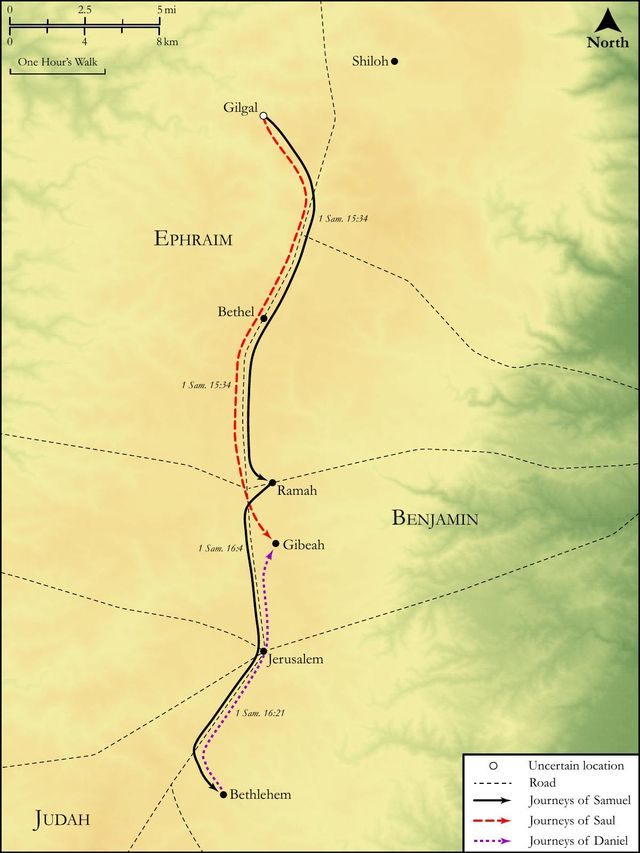
See on the biblical-era map
Study this verse
Public-domain commentary
Matthew Henry
From his Commentary on the Whole Bible. Henry comments on passages, not single verses — this entry covers 1 Samuel 16:6–13. His three-level outline is real structure in the source text, so it is rendered as structure.
If the sons of Jesse were told that God would provide himself a king among them (as he had said, Sa1 16:1), we may well suppose they all made the best appearance they could, and each hoped he should be the man; but here we are told,
I.How all the elder sons, who stood fairest for the preferment, were passed by.
1.Eliab, the eldest, was privately presented first to Samuel, probably none being present but Jesse only, and Samuel thought he must needs be the man: Surely this is the Lord's anointed, Sa1 16:6. The prophets themselves, when they spoke from under the divine direction, were as liable to mistake as other men; as Nathan, Sa2 7:3. But God rectified the prophet's mistake by a secret whisper to his mind: Look not on his countenance, Sa1 16:7. It was strange that Samuel, who had been so wretchedly disappointed in Saul, whose countenance and stature recommended him as much as any man's could, should be so forward to judge of a man by that rule. When God would please the people with a king he chose a comely man; but, when he would have one after his own heart, he should not be chosen by the outside. Men judge by the sight of the eyes, but God does not, Isa 11:3. The Lord looks on the heart, that is,
(1.)He knows it. We can tell how men look, but he can tell what they are. Man looks on the eyes (so the original word is), and is pleased with the liveliness and sprightliness that appear in them; but God looks on the heart, and sees the thoughts and intents of that.
(2.)He judges of men by it. The good disposition of the heart, the holiness or goodness of that, recommends us to God, and is in his sight of great price (Pe1 3:4), not the majesty of the look, or the strength and stature of the body. Let us reckon that to be true beauty which is within, and judge of men, as far as we are capable, by their minds, not their mien.
2.When Eliab was set aside, Abinadab and Shammah, and, after them, four more of the sons of Jesse, seven in all, were presented to Samuel, as likely for his purpose; but Samuel, who not attended more carefully than he did at first to the divine direction, rejected them all: The Lord has not chosen these, Sa1 16:8, Sa1 16:10. Men dispose of their honours and estates to their sons according to their seniority of age and priority of birth, but God does not. The elder shall serve the younger. Had it been left to Samuel, or Jesse, to make the choice, one of these would certainly have been chosen; but God will magnify his sovereignty in passing by some that were most promising as well as in fastening on others that were less so.
II.How David at length was pitched upon.
He was the youngest of all the sons of Jesse; his name signifies beloved, for he was a type of the beloved Son. Observe,
1.How he was in the fields, keeping the sheep (Sa1 16:11), and was left there, though there was a sacrifice and a feast at his father's house. The youngest are commonly the fondlings of the family, but, it should seem, David was least set by of all the sons of Jesse; either they did not discern or did not duly value the excellent spirit he was of. Many a great genius lies buried in obscurity and contempt; and God often exalts those whom men despise and gives abundant honour to that part which lacked. The Son of David was he whom men despised, the stone which the builders refused, and yet he has a name above every name. David was taken from following ewes to feed Jacob (Psa 78:71), as Moses from keeping the flock of Jethro, an instance of his humility and industry, both which God delights to put honour upon. We should think a military life, but God saw a pastoral life (which gives advantage for contemplation and communion with heaven), the best preparative for kingly power, at least for those graces of the Spirit which are necessary to the due discharge of that trust which attends it. David was keeping sheep, though it was a time of sacrifice; for there is mercy that takes precedence of sacrifice.
2.How earnest Samuel was to have him sent for: "We will not sit down to meat" (perhaps it was not the feast upon the sacrifice, but a common meal) "till he come hither; for, if all the rest be rejected, this must be he." He that designed not to sit at table at all is now waited for as the principal guest. If God will exalt those of low degree, who can hinder?
3.What appearance he made when he did come. No notice is taken of his clothing. No doubt that was according to his employment, mean and coarse, as shepherds' coats commonly are, and he did not change his clothes as Joseph did (Gen 41:14), but he had a very honest look, not stately, as Saul's, but sweet and lovely: He was ruddy, of a beautiful countenance, and goodly to look to (Sa1 16:12), that is, he had a clear complexion, a good eye, and a lovely face; the features were extraordinary, and there was something in his looks that was very charming. Though he was so far from using any art to help his beauty that his employment exposed it to the sun and wind, yet nature kept its own, and, by the sweetness of his aspect, gave manifest indications of an amiable temper and disposition of mind. Perhaps his modest blush, when he was brought before Samuel, and received by him with surprising respect, made him look much the handsomer.
4.The anointing of him. The Lord told Samuel in his ear (as he had done, Sa1 9:15) that this was he whom he must anoint, Sa1 16:12. Samuel objects not the meanness of his education, his youth, or the little respect he had in his own family, but, in obedience to the divine command, took his horn of oil and anointed him (Sa1 16:13), signifying thereby,
(1.)A divine designation to the government, after the death of Saul, of which hereby he gave him a full assurance. Not that he was at present invested with the royal power, but it was entailed upon him, to come to him in due time.
(2.)A divine communication of gifts and graces, to fit him for the government, and make him a type of him who was to be the Messiah, the anointed One, who received the Spirit, not by measure, but without measure. He is said to be anointed in the midst of his brethren, who yet, possibly, did not understand it as a designation to the government, and therefore did not envy David (as Joseph's brethren did him), because they saw no further marks of dignity put upon him, no, not so much as a coat of divers colours. But bishop Patrick reads it, He anointed him from the midst of his brethren, that is, he singled him out from the rest, and privately anointed him, but with a charge to keep his own counsel, and not to let his own brethren know it, as by what we find (Sa1 17:28), it should seem, Eliab did not. It is computed that David now was about twenty years old; if so, his troubles by Saul lasted ten years, for he was thirty years old when Saul died. Dr. Lightfoot reckons that he was about twenty-five, and that his troubles lasted but five years.
5.The happy effects of this anointing: The Spirit of the Lord came upon David from that day forward, Sa1 16:13. The anointing of him was not an empty ceremony, but a divine power went along with that instituted sign, and he found himself inwardly advanced in wisdom, and courage, and concern for the public, with all the qualifications of a prince, though not at all advanced in his outward circumstances. This would abundantly satisfy him that his election was of God. The best evidence of our being predestinated to the kingdom of glory is our being sealed with the Spirit of promise, and our experience of a work of grace in our own hearts. Some think that his courage, by which he slew the lion and the bear, and his extraordinary skill in music, were the effects and evidences of the Spirit's coming upon him. However, this made him the sweet psalmist of Israel, Sa2 23:1. Samuel, having done this, went to Ramah in safety, and we never read of him again but once (Sa1 19:18), till we read of his death; now he retired to die in peace, since his eyes had seen the salvation, even the sceptre brought into the tribe of Judah.
Historical interpretation
Historical reception
3 surviving comments on this verse. Each one is dated, so this reads as a timeline rather than a list.
And Samuel said to Jesse: Are all the children finished? etc. After the teachers of the law, the herald of prophecy, the sweetness of psalmody, and the long devotion of the people had been sent forth into the world, with the people instructed in divine services by the law of Moses, prophets, and psalmists, the incarnation of Christ was still to come in the fullness of time. Of which it is rightly understood what Jesse said: There is yet the least one, and he tends the sheep. For a child is born to us; a son is given to us (Isaiah IX). He who speaks in the Gospel: I am the good shepherd, and I know mine, and mine know me (John X). Nor without a certain reason of mystery is the same little one said to have tended the sheep before being anointed by the prophet; because that good Shepherd, who came that they might have life and have it more abundantly, tended ninety-nine sheep in heaven before he sought and found the hundredth on earth. He completed the number eight; for he gave us both the hope of our resurrection and his own example. Indeed, the day on which the Lord rose, from the day of his passion was the third, but from the day of the first creation, it is the eighth. Thus also after the six ages of this world, and the seventh, which is now being conducted in this life, the Sabbath of souls, as it were, the eighth age of our resurrection is hoped to come.
So he sent, and brought him, etc. The old man Simeon desired, as did the other saints of that time, for the Lord to come in the flesh, and He came. However, he was red from the blood of the Passion; because the good shepherd lays down his life for the sheep (John 10). He was also fairer in form than the sons of men; because He committed no sin, nor was deceit found in His mouth (Psalm 44; 1 Peter 2). This is similar to what the bride speaks in his praise: My beloved is white and ruddy (Song of Solomon 5); white in action, ruddy in blood. And what follows there, Chosen from thousands; this is what is signified here as David, rejected by his brothers, is anointed alone.
And Samuel said to Jesse: Send and bring him, etc. The prophets of that time said to the holy ones: Send the devoted intention of your mind, and with prayers frequently offered to God, obtain the advent of Christ, saying: Show us, O Lord, your mercy, and grant us your salvation (Psalm 34); and other such things. For indeed, we cannot recline with Abraham, Isaac, and Jacob in the kingdom of heaven, until the Son of God, humble and poor, comes and, having broken the snare of death, grandly opens for us the gates of life. For He himself in the Gospel testifies that we cannot recline, that is, rest in the kingdom, by our own means but by His grace: Amen, I say to you, that He will gird Himself, and make them recline, and will come and serve them (Luke 12).
Continue studying 1 Samuel 16:11 across the web’s major study libraries — every link below opens this exact verse, chapter, or book on the destination site.
Read & Compare
 BibleGatewayThis verse in more than 200 translations and 70 languages.
 Bible.comThe YouVersion reader — hundreds of translations, reading plans, and highlights.
 ESV.orgCrossway's official English Standard Version reader.
 NET BibleThe NET translation with 60,000+ translators' notes on every rendering decision.
 STEP BibleTyndale House's free study tool — original text, vocabulary, and scholarly resources.
 BibliaLogos Bible Software's free web reader.
 USCCBThe New American Bible (Revised Edition) with the U.S. bishops' study notes.
Commentaries
 BibleHub CommentariesDozens of classic commentaries on this verse, gathered on one page.
 StudyLightMore than 100 commentary sets — the largest collection on the web.
 BibleRefPlain-English commentary on what this verse means, verse by verse.
 Enduring WordDavid Guzik's free commentary on this chapter, widely used by Bible teachers.
 Bible Study ToolsVerse commentary alongside Greek and Hebrew study aids.
Original Language & Research
- BibleHub InterlinearThe verse word by word — original language, transliteration, and English.
- BibleHub LexiconEvery word's original-language definition and Strong's entry.
 Blue Letter BibleDeep-study tools — Strong's numbers, concordance, and word studies.
 SefariaThe Hebrew text with Rashi and centuries of Jewish commentary.
Sermons, Hymns & Audio


TrulyRandomVerse is not affiliated with these sites and doesn’t control their content. They’re linked because they’re genuinely useful.
Summary
1 Samuel 16:11 marks the pivotal moment in God's sovereign selection of David as Israel's next king, following the divine rejection of Saul. After Samuel had meticulously reviewed all of Jesse's elder sons, each deemed unsuitable by God's decree, the prophet's persistent, divinely-guided inquiry reveals the youngest and most overlooked son, David, diligently tending the family's sheep. This verse powerfully underscores God's surprising choice, demonstrating His unique criteria for leadership—looking beyond outward appearance to the heart—and Samuel's unwavering commitment to fulfilling the precise divine mandate.
Context
ShowHideLiterary Context
This verse is strategically positioned at a critical juncture in the book of 1 Samuel, immediately following God's definitive rejection of King Saul due to his persistent disobedience. The narrative expertly shifts focus from Saul's tragic decline to the divinely orchestrated emergence of God's chosen successor. 1 Samuel 16:1 opens with God instructing Samuel to anoint a new king from Jesse's sons in Bethlehem, a mission fraught with danger given Saul's continued reign. Samuel's initial assessment of Eliab, Jesse's eldest and most outwardly impressive son, is met with God's profound and corrective declaration in 1 Samuel 16:7, emphasizing that "man looketh on the outward appearance, but the Lord looketh on the heart." The subsequent rejection of all seven of Jesse's presented sons masterfully builds narrative tension, setting the stage for Samuel's insistent question in 1 Samuel 16:11 that finally brings David, the overlooked youngest, into the divine spotlight. This scene directly precedes David's anointing by Samuel in 1 Samuel 16:13.
Historical & Cultural Context
In ancient Israelite society, primogeniture was the deeply ingrained custom, bestowing upon the eldest son preeminence, a double portion of inheritance, and the natural mantle of leadership within the family. The very idea of the youngest son, especially one engaged in the humble and often solitary work of shepherding, being chosen over his older, more outwardly impressive, and socially recognized brothers was profoundly counter-cultural and astonishing. Shepherds, while essential for the agrarian economy, were typically viewed as being at the lower end of the social hierarchy, their work often keeping them distant from settled communities and public life. Bethlehem, though historically significant as the ancestral home of David's family and later the birthplace of Jesus, was a relatively small and unremarkable town at this time. The anointing of a king was a profoundly significant public and religious act, typically involving a prominent prophet and a recognized leader. The clandestine and private nature of this anointing, necessitated by Saul's continued reign and the potential for his violent reprisal, powerfully highlights the tension and inherent danger in Samuel's divinely appointed mission.
Key Themes
ShowHide1 Samuel 16:11 powerfully illustrates several core themes woven throughout 1 Samuel and the broader Old Testament narrative. Firstly, it exemplifies Divine Selection Over Human Expectation, a recurring motif where God deliberately chooses the unlikely, the weak, or the overlooked to accomplish His sovereign purposes, as seen in figures like Gideon, Joseph, or even Moses. This divine principle directly contrasts with human tendencies to judge by outward appearance, a profound lesson explicitly articulated in 1 Samuel 16:7. Secondly, the verse highlights the theme of Humility and Faithfulness in Obscurity. David's diligent and responsible work as a shepherd, though seemingly insignificant in the eyes of his family and society, served as a crucial training ground for his future role as king, cultivating qualities of care, protection, courage, and leadership over a flock, preparing him to "shepherd" God's people. This underscores the timeless biblical principle that faithfulness in small, unseen tasks often precedes greater responsibilities. Finally, Samuel's resolute declaration, "we will not sit down till he come hither," emphasizes God's Unwavering Purpose and Sovereignty. Once God has chosen, His plan will not be delayed or thwarted by human oversight or social custom; His chosen instrument must be brought forth, demonstrating His active involvement in human history and His unwavering commitment to His covenant purposes, which eventually lead to the establishment of the enduring Davidic dynasty, as detailed in 2 Samuel 7.
Exposition and Analysis
ShowHideKey Word Analysis
ShowHideThis term (H6996) literally translates to "the small one," "the least," or "the youngest." Its use here is profoundly significant, emphasizing David's perceived insignificance within his family structure and the prevailing societal hierarchy. In a culture that highly valued primogeniture, the youngest son typically held the least status and was often tasked with the most menial or isolated duties, such as shepherding. God's deliberate choice of "the small one" radically subverts human expectations and highlights His divine criteria for leadership, which consistently elevates the humble and overlooked, demonstrating His power to use the weak things of the world to shame the strong, as seen in 1 Corinthians 1:27.
This verb (H7462), often translated as "to tend a flock," "to pasture," or "to shepherd," describes David's humble yet formative occupation. The participle form used here (roʿeh) indicates an ongoing action. This seemingly mundane task was, in fact, a profound preparation for kingship. A shepherd's duties inherently included leading, feeding, protecting, and caring for the flock, often at considerable personal risk from predators or thieves. This role cultivated essential qualities of courage, compassion, vigilance, and leadership—all indispensable for a king who would be called to "shepherd" God's people. The imagery of a shepherd-king becomes a powerful and recurring motif throughout the Old Testament, culminating in the ultimate Good Shepherd.
Verse Breakdown
ShowHide"And Samuel said unto Jesse, Are here all [thy] children?"
This opening clause reveals Samuel's persistent and divinely-guided inquiry. Having witnessed all seven of Jesse's older sons presented and unequivocally rejected by God, Samuel understands with spiritual discernment that God's chosen one is still missing. His question is not merely a polite formality but a deeply spiritual one, driven by the conviction that God's plan has not yet been fulfilled, indicating a divine imperative at play.
"And he said, There remaineth yet the youngest, and, behold, he keepeth the sheep."
Jesse's response confirms Samuel's suspicion, yet the casual, almost dismissive mention of "the youngest" (David) and his humble occupation ("he keepeth the sheep") underscores how thoroughly he was overlooked and underestimated by his own family. The phrase "behold, he keepeth the sheep" serves to highlight David's obscurity and the seemingly unremarkable nature of his current role, standing in stark contrast to the immense destiny awaiting him.
"And Samuel said unto Jesse, Send and fetch him: for we will not sit down till he come hither."
Samuel's firm, authoritative, and non-negotiable command demonstrates the profound urgency and divine necessity of David's presence. His refusal to "sit down" (a posture signifying rest, completion, or even the commencement of a feast) until David arrives powerfully signifies that the divine mission is incomplete and cannot proceed without him. This resolute declaration emphasizes the absolute sovereignty of God's choice and Samuel's unwavering commitment to fulfilling God's will, signaling that no human preference, social custom, or familial oversight will deter the unfolding of the divine plan.
Literary Devices
ShowHideThe passage employs several potent literary devices that enrich its meaning and impact. Irony is profoundly prominent, as the outwardly least impressive son, the "youngest" and the humble "shepherd," is the one divinely chosen, radically subverting the cultural expectation of primogeniture and the initial human judgment of both Samuel and Jesse. This highlights the stark contrast between fallible human perception and infallible divine insight, a central theological theme of the entire chapter. Foreshadowing is also skillfully woven into the narrative, as David's diligent role as a shepherd of literal sheep subtly yet powerfully foreshadows his future and greater role as the "shepherd" of Israel, a king who would lead, protect, and care for God's people. Samuel's insistent and uncompromising demand, "we will not sit down till he come hither," utilizes hyperbole to emphasize the absolute necessity and divine urgency of David's immediate arrival, underscoring the unwavering and irresistible nature of God's sovereign plan.
Theological and Thematic Connections
ShowHide1 Samuel 16:11 is a profound illustration of God's sovereign election and His distinctive, counter-cultural criteria for leadership. It teaches a timeless truth: God does not choose based on superficial human standards of appearance, age, social status, or worldly accomplishments, but rather looks upon the heart and values faithfulness in seemingly insignificant roles. This divine principle of choosing the humble, the overlooked, and the weak to accomplish His mighty purposes is a recurring theme throughout biblical history, demonstrating God's power to work through unexpected vessels and confound human wisdom. The passage sets the stage for the establishment of the Davidic covenant, a foundational promise in Israel's history that points forward to the ultimate King and Messiah.
Reflection and Application
ShowHideThis verse offers a powerful and enduring message for believers today: God's ways are truly not our ways, and His perspective transcends all human limitations, biases, and conventional wisdom. It challenges us to look beyond superficial appearances in ourselves and others, recognizing that God often places extraordinary potential, divine calling, and profound purpose in the most unexpected and seemingly ordinary individuals. David's faithfulness and diligence in the humble task of shepherding teach us the profound value of integrity, commitment, and excellence in our current responsibilities, no matter how small, unseen, or mundane they may seem. God is consistently preparing us in the present for future callings, and our faithfulness in the "little things" is never wasted in His economy. Furthermore, Samuel's unwavering commitment to fulfilling God's command reminds us of the paramount importance of trusting God's timing and process, even when they defy our logic, expectations, or societal norms. Our sacred role is to obey His voice and patiently wait for God to reveal and unfold His chosen path, knowing with absolute certainty that His plans are perfect, sovereign, and will ultimately prevail for His glory.
Questions for Reflection
ShowHideFAQ
ShowHideWhy was David out keeping the sheep, and why was he not present with his brothers during Samuel's initial review?
ShowHideIn ancient Israelite families, the youngest son often held the least esteemed position and was typically assigned the most menial, solitary, or physically demanding tasks. Shepherding was a common and essential occupation, but it was frequently given to the younger, less experienced, or less socially prominent members of the family, as it required long hours of isolation, vigilance, and often exposure to danger. David's absence from the family gathering during Samuel's initial review was likely due to this traditional division of labor, where his primary responsibility was the welfare and protection of the flock. His family, including Jesse, probably did not consider him a viable or even conceivable candidate for such a significant and public role as king, which further underscores the divine irony and God's unconventional choice. This highlights God's ability to see beyond human assumptions, societal norms, and familial oversight, finding and elevating His chosen one in the most unexpected places, as powerfully emphasized in 1 Samuel 16:7.
Christ-Centered Fulfillment
ShowHide1 Samuel 16:11, with its profound depiction of God choosing the humble shepherd David, serves as a powerful and multi-faceted foreshadowing of the coming of Jesus Christ, the ultimate Shepherd-King. David, called from tending literal sheep to shepherd God's people Israel, stands as a clear type of the Messiah. Just as David was overlooked and seemingly insignificant in human eyes, yet divinely chosen and anointed, so too did Jesus come not as an earthly king in worldly splendor, but in profound humility, born in Bethlehem, the very city of David, and often associating with the lowly and forgotten. Jesus explicitly identifies Himself as the Good Shepherd who willingly lays down His life for the sheep, echoing and supremely fulfilling David's protective care for his flock. Furthermore, like David, who was God's chosen king and the ancestor of a royal line, Jesus is the Son of David, the true and eternal King whose kingdom is not of this world but is everlasting. The divine choice of David, based on the integrity of his heart rather than outward appearance, finds its ultimate and perfect fulfillment in Christ, who perfectly embodies the heart of God and flawlessly fulfills the role of the Shepherd-King, leading His flock into eternal life and salvation, as promised in John 10:27-28.