


1 Samuel 16:10
Bible text: King James Version (1769 Blayney text) · Public domain
Bible text: Berean Standard Bible · Public domain
Bible text: American Standard Version (1901) · Public domain
Bible text: World English Bible, Messianic edition · Public domain
Bible text: Geneva Bible (1599) · Public domain
Bible text: Young's Literal Translation · Public domain
- וַיַּעֲבֵרvai·ya·'a·Verand he made pass byH5674Conj-w ¦ V-Hiphil-ConsecImperf-3msVerb Hiphil Consecutive Imperfect 3rd Singular Masculineוַandיַּעֲבֵרhe made pass by
- יִשַׁיyi·ShaiJesseH3448N-proper-mNoun Proper Masculine
- שִׁבְעַתshiv·'Atseven ofH7651N-cscNoun Singular common gender Construct
- בָּנָיוba·Navhis sonsH1121N-mpc ¦ 3msNoun Plural Masculine Constructבָּנָיsonsוhis
- לִפְנֵיlif·Nei<to> beforeH6440Prep-l ¦ N-mpcNoun Plural Masculine Constructלִ<to>פְנֵיbefore
- שְׁמוּאֵלshe·mu·'ElSamuelH8050N-proper-mNoun Proper Masculine
- וַיֹּאמֶרvai·Yo·merand he saidH559Conj-w ¦ V-Qal-ConsecImperf-3msVerb Qal Consecutive Imperfect 3rd Singular Masculineוַandיֹּאמֶרhe said
- שְׁמוּאֵלshe·mu·'ElSamuelH8050N-proper-mNoun Proper Masculine
- אֶל'eltoH413PrepPreposition
- יִשַׁיyi·ShaiJesseH3448N-proper-mNoun Proper Masculine
- לֹאlo'notH3808NegParticle Negative
- בָחַרva·Charhe has chosenH977V-Qal-Perf-3msVerb Qal Perfect 3rd Singular Masculine
- יְהוָהYah·wehYahwehH3068N-properNoun Proper Title
- בָּאֵלֶּהba·'E·leh<in> theseH428Prep-b ¦ PrtParticle Demonstrativeבָּ<in>אֵלֶּהthese
English is a literal word-by-word gloss of the Hebrew, not the KJV's wording. Why?
This is the original text the KJV's translators worked from — each Hebrew word with its own literal English meaning in this verse, prepared by scholars at Tyndale House, Cambridge. The KJV translates whole sentences, not word by word, so its wording differs: one Hebrew word can become several English words, and the KJV may choose “the LORD” where the gloss reads “Yahweh”. Both are faithful — they answer different questions. For the KJV's own rendering, switch to the KJV text.
Details
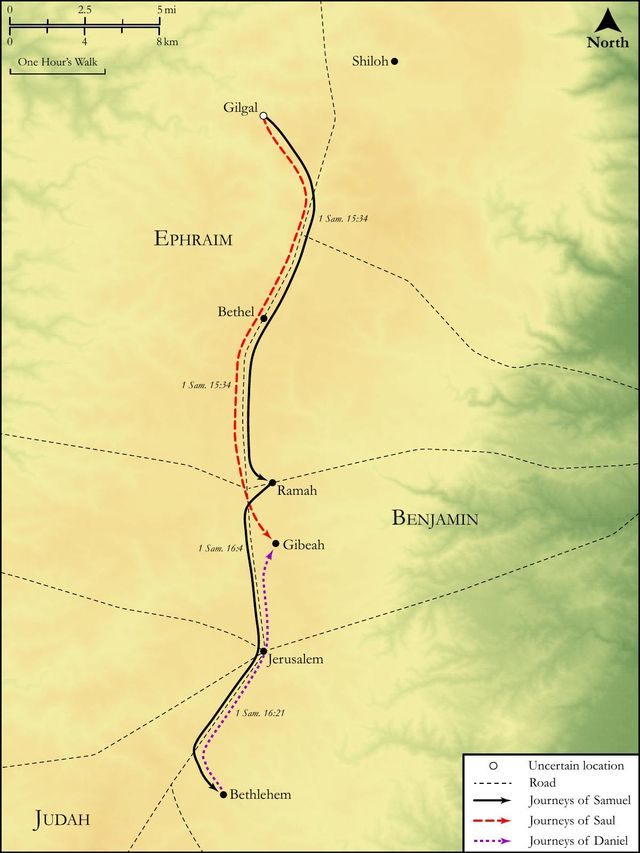
See on the biblical-era map
Study this verse
Public-domain commentary
Matthew Henry
From his Commentary on the Whole Bible. Henry comments on passages, not single verses — this entry covers 1 Samuel 16:6–13. His three-level outline is real structure in the source text, so it is rendered as structure.
If the sons of Jesse were told that God would provide himself a king among them (as he had said, Sa1 16:1), we may well suppose they all made the best appearance they could, and each hoped he should be the man; but here we are told,
I.How all the elder sons, who stood fairest for the preferment, were passed by.
1.Eliab, the eldest, was privately presented first to Samuel, probably none being present but Jesse only, and Samuel thought he must needs be the man: Surely this is the Lord's anointed, Sa1 16:6. The prophets themselves, when they spoke from under the divine direction, were as liable to mistake as other men; as Nathan, Sa2 7:3. But God rectified the prophet's mistake by a secret whisper to his mind: Look not on his countenance, Sa1 16:7. It was strange that Samuel, who had been so wretchedly disappointed in Saul, whose countenance and stature recommended him as much as any man's could, should be so forward to judge of a man by that rule. When God would please the people with a king he chose a comely man; but, when he would have one after his own heart, he should not be chosen by the outside. Men judge by the sight of the eyes, but God does not, Isa 11:3. The Lord looks on the heart, that is,
(1.)He knows it. We can tell how men look, but he can tell what they are. Man looks on the eyes (so the original word is), and is pleased with the liveliness and sprightliness that appear in them; but God looks on the heart, and sees the thoughts and intents of that.
(2.)He judges of men by it. The good disposition of the heart, the holiness or goodness of that, recommends us to God, and is in his sight of great price (Pe1 3:4), not the majesty of the look, or the strength and stature of the body. Let us reckon that to be true beauty which is within, and judge of men, as far as we are capable, by their minds, not their mien.
2.When Eliab was set aside, Abinadab and Shammah, and, after them, four more of the sons of Jesse, seven in all, were presented to Samuel, as likely for his purpose; but Samuel, who not attended more carefully than he did at first to the divine direction, rejected them all: The Lord has not chosen these, Sa1 16:8, Sa1 16:10. Men dispose of their honours and estates to their sons according to their seniority of age and priority of birth, but God does not. The elder shall serve the younger. Had it been left to Samuel, or Jesse, to make the choice, one of these would certainly have been chosen; but God will magnify his sovereignty in passing by some that were most promising as well as in fastening on others that were less so.
II.How David at length was pitched upon.
He was the youngest of all the sons of Jesse; his name signifies beloved, for he was a type of the beloved Son. Observe,
1.How he was in the fields, keeping the sheep (Sa1 16:11), and was left there, though there was a sacrifice and a feast at his father's house. The youngest are commonly the fondlings of the family, but, it should seem, David was least set by of all the sons of Jesse; either they did not discern or did not duly value the excellent spirit he was of. Many a great genius lies buried in obscurity and contempt; and God often exalts those whom men despise and gives abundant honour to that part which lacked. The Son of David was he whom men despised, the stone which the builders refused, and yet he has a name above every name. David was taken from following ewes to feed Jacob (Psa 78:71), as Moses from keeping the flock of Jethro, an instance of his humility and industry, both which God delights to put honour upon. We should think a military life, but God saw a pastoral life (which gives advantage for contemplation and communion with heaven), the best preparative for kingly power, at least for those graces of the Spirit which are necessary to the due discharge of that trust which attends it. David was keeping sheep, though it was a time of sacrifice; for there is mercy that takes precedence of sacrifice.
2.How earnest Samuel was to have him sent for: "We will not sit down to meat" (perhaps it was not the feast upon the sacrifice, but a common meal) "till he come hither; for, if all the rest be rejected, this must be he." He that designed not to sit at table at all is now waited for as the principal guest. If God will exalt those of low degree, who can hinder?
3.What appearance he made when he did come. No notice is taken of his clothing. No doubt that was according to his employment, mean and coarse, as shepherds' coats commonly are, and he did not change his clothes as Joseph did (Gen 41:14), but he had a very honest look, not stately, as Saul's, but sweet and lovely: He was ruddy, of a beautiful countenance, and goodly to look to (Sa1 16:12), that is, he had a clear complexion, a good eye, and a lovely face; the features were extraordinary, and there was something in his looks that was very charming. Though he was so far from using any art to help his beauty that his employment exposed it to the sun and wind, yet nature kept its own, and, by the sweetness of his aspect, gave manifest indications of an amiable temper and disposition of mind. Perhaps his modest blush, when he was brought before Samuel, and received by him with surprising respect, made him look much the handsomer.
4.The anointing of him. The Lord told Samuel in his ear (as he had done, Sa1 9:15) that this was he whom he must anoint, Sa1 16:12. Samuel objects not the meanness of his education, his youth, or the little respect he had in his own family, but, in obedience to the divine command, took his horn of oil and anointed him (Sa1 16:13), signifying thereby,
(1.)A divine designation to the government, after the death of Saul, of which hereby he gave him a full assurance. Not that he was at present invested with the royal power, but it was entailed upon him, to come to him in due time.
(2.)A divine communication of gifts and graces, to fit him for the government, and make him a type of him who was to be the Messiah, the anointed One, who received the Spirit, not by measure, but without measure. He is said to be anointed in the midst of his brethren, who yet, possibly, did not understand it as a designation to the government, and therefore did not envy David (as Joseph's brethren did him), because they saw no further marks of dignity put upon him, no, not so much as a coat of divers colours. But bishop Patrick reads it, He anointed him from the midst of his brethren, that is, he singled him out from the rest, and privately anointed him, but with a charge to keep his own counsel, and not to let his own brethren know it, as by what we find (Sa1 17:28), it should seem, Eliab did not. It is computed that David now was about twenty years old; if so, his troubles by Saul lasted ten years, for he was thirty years old when Saul died. Dr. Lightfoot reckons that he was about twenty-five, and that his troubles lasted but five years.
5.The happy effects of this anointing: The Spirit of the Lord came upon David from that day forward, Sa1 16:13. The anointing of him was not an empty ceremony, but a divine power went along with that instituted sign, and he found himself inwardly advanced in wisdom, and courage, and concern for the public, with all the qualifications of a prince, though not at all advanced in his outward circumstances. This would abundantly satisfy him that his election was of God. The best evidence of our being predestinated to the kingdom of glory is our being sealed with the Spirit of promise, and our experience of a work of grace in our own hearts. Some think that his courage, by which he slew the lion and the bear, and his extraordinary skill in music, were the effects and evidences of the Spirit's coming upon him. However, this made him the sweet psalmist of Israel, Sa2 23:1. Samuel, having done this, went to Ramah in safety, and we never read of him again but once (Sa1 19:18), till we read of his death; now he retired to die in peace, since his eyes had seen the salvation, even the sceptre brought into the tribe of Judah.
Historical interpretation
Historical reception
1 surviving comment on this verse from the historical church.
Therefore Jesse brought seven of his sons before Samuel, etc. The number seven is fitting to the law because of the sabbath, just as the number eight is fitting to the Gospel because of the mystery of the resurrection. Therefore, none of those who are perfect according to the law, hoping for the sabbath either of the body in the present or even of the Spirit in the future age, preach, perceive, even though being high in merits and strong in virtues, can suffice to save the world.
Continue studying 1 Samuel 16:10 across the web’s major study libraries — every link below opens this exact verse, chapter, or book on the destination site.
Read & Compare
 BibleGatewayThis verse in more than 200 translations and 70 languages.
 Bible.comThe YouVersion reader — hundreds of translations, reading plans, and highlights.
 ESV.orgCrossway's official English Standard Version reader.
 NET BibleThe NET translation with 60,000+ translators' notes on every rendering decision.
 STEP BibleTyndale House's free study tool — original text, vocabulary, and scholarly resources.
 BibliaLogos Bible Software's free web reader.
 USCCBThe New American Bible (Revised Edition) with the U.S. bishops' study notes.
Commentaries
 BibleHub CommentariesDozens of classic commentaries on this verse, gathered on one page.
 StudyLightMore than 100 commentary sets — the largest collection on the web.
 BibleRefPlain-English commentary on what this verse means, verse by verse.
 Enduring WordDavid Guzik's free commentary on this chapter, widely used by Bible teachers.
 Bible Study ToolsVerse commentary alongside Greek and Hebrew study aids.
Original Language & Research
- BibleHub InterlinearThe verse word by word — original language, transliteration, and English.
- BibleHub LexiconEvery word's original-language definition and Strong's entry.
 Blue Letter BibleDeep-study tools — Strong's numbers, concordance, and word studies.
 SefariaThe Hebrew text with Rashi and centuries of Jewish commentary.
Sermons, Hymns & Audio


TrulyRandomVerse is not affiliated with these sites and doesn’t control their content. They’re linked because they’re genuinely useful.
Summary
1 Samuel 16:10 records a pivotal moment in God's sovereign selection of Israel's next king, following King Saul's rejection. It details the methodical presentation of seven of Jesse's sons to the prophet Samuel, all of whom are definitively declared by divine counsel as not chosen by the LORD. This repeated rejection powerfully underscores God's unique criteria for leadership, which prioritizes the heart over outward appearance, and highlights His absolute sovereignty in electing His chosen instruments, setting the stage for the unexpected revelation of David.
Context
ShowHideLiterary Context
This verse is deeply embedded within the narrative of God's rejection of King Saul due to his persistent disobedience, particularly highlighted in 1 Samuel 15:23. Following this divine judgment, the LORD commands Samuel to go to Bethlehem to anoint a new king from among the sons of Jesse (1 Samuel 16:1). Upon Samuel's arrival and initial impression of Jesse's eldest son, Eliab, who possesses the physical stature typically associated with kingship, Samuel's human perspective is corrected by God's profound declaration in 1 Samuel 16:7: "for the LORD seeth not as man seeth; for man looketh on the outward appearance, but the LORD looketh on the heart." Verse 16:10 details the continuation of this rigorous selection process, where six more of Jesse's sons are presented and, like Eliab, are explicitly rejected by divine counsel. This methodical elimination builds suspense and prepares the reader for the surprising revelation of God's true choice, emphasizing that God's choice remains elusive to human perception and anticipation.
Historical & Cultural Context
In Israelite society, and indeed among the nations round about, physical appearance, imposing stature, and the order of birth (primogeniture) were highly significant factors in determining leadership and social standing. Kings were often expected to be formidable figures, embodying strength and authority. Saul, for instance, was initially chosen partly because he "was taller than any of the people" (1 Samuel 9:2). The process of anointing a king involved a prophet acting as God's representative, signifying divine approval and legitimacy. Jesse's family resided in Bethlehem, a relatively small town in Judah, which would later gain immense significance as the birthplace of King David and, centuries later, the Messiah. The repeated presentation of sons, particularly the number seven, reflects a cultural thoroughness in presenting all available candidates, yet it simultaneously highlights the profound counter-cultural nature of God's selection process, which consistently defies human expectations and societal norms.
Key Themes
ShowHideThe persistent rejection of Jesse's sons in 1 Samuel 16:10 powerfully reinforces several overarching themes found throughout 1 Samuel and the broader biblical narrative. Firstly, it underscores Divine Election and Sovereign Choice, demonstrating that God's selection for leadership is not based on human criteria such as physical appearance, age, or perceived strength, but on His own inscrutable wisdom and purpose. Secondly, it reiterates the crucial distinction between God's Perspective vs. Man's Perspective, a central message of 1 Samuel 16:7. Human judgment is limited and often flawed, focusing on superficial qualities, whereas God discerns the true character and heart of an individual. Thirdly, this systematic elimination builds suspense and sets the stage for the eventual, surprising choice of David, the youngest and seemingly least likely candidate (1 Samuel 16:11). This exemplifies the theme of Humility and the Unexpected Choice, illustrating God's consistent tendency to choose the humble, the overlooked, and the weak to accomplish His mighty purposes, thereby ensuring that glory redounds to Him alone. Finally, Samuel's persistence in waiting for God's clear direction, even after seven candidates are presented, highlights the importance of Patience and Trust in God's Process, demonstrating complete reliance on divine guidance in critical decisions.
Exposition and Analysis
ShowHideKey Word Analysis
ShowHideFrom its root meaning as a "builder of the family name," H1121 (bên) refers to a son in its widest sense. In this context, it emphasizes the male offspring of Jesse, who would traditionally be considered heirs and potential leaders. The repeated presentation of these "sons" highlights the human expectation that leadership would pass through the established lineage and conventional succession, underscoring the divine subversion of these norms.
H5674 (ʻâbar) means "to cross over; used very widely of any transition." Here, it describes the action of Jesse making his sons "pass before" Samuel, implying a formal presentation or review. Each son is brought forward, one by one, for Samuel's inspection and, more importantly, for divine scrutiny. This emphasizes the methodical and deliberate nature of the selection process, where each candidate is given an opportunity to be considered by God through His prophet.
This is the sacred covenant name of God, H3068 (Yᵉhôvâh), often translated as "the self-Existent or Eternal." Its use here emphasizes that the decision regarding the next king is not merely a human assessment but a direct, authoritative pronouncement from the sovereign God of Israel, who is intimately involved in the affairs of His people and is faithful to His covenant promises. It underscores the divine authority behind Samuel's declaration, confirming that the rejection of Jesse's sons is a definitive act of divine will.
H977 (bâchar) is a primitive root meaning "to try, i.e. (by implication) select; acceptable, appoint, choose." Samuel's declaration, "The LORD hath not chosen these," signifies an active and deliberate non-selection by God. It's not a passive oversight but a purposeful divine decision to pass over these individuals, indicating that God's specific, sovereign will for the kingship lies elsewhere. This word highlights God's prerogative to select His instruments according to His own perfect criteria, independent of human judgment or preference.
Verse Breakdown
ShowHide"Again, Jesse made seven of his sons to pass before Samuel."
This clause highlights the methodical and thorough nature of Jesse's presentation, prompted by Samuel's divine instruction. The word "Again" signifies the continuation of a process that began with Eliab. The number "seven" is significant; it often symbolizes completeness or perfection in biblical numerology. Here, it signifies that all the "obvious" or "expected" candidates (from a human perspective, including those who might have seemed promising) have been presented and exhausted. Jesse is dutifully bringing forth all his sons who are present and seemingly eligible, demonstrating his obedience to Samuel's request and his desire to fulfill God's will.
"And Samuel said unto Jesse, The LORD hath not chosen these."
This is the definitive pronouncement from Samuel, acting as God's mouthpiece. The directness and finality of "The LORD hath not chosen these" leave no room for ambiguity. It reiterates the core message of 1 Samuel 16:7—that God's criteria for selection are fundamentally different from human ones. This statement signifies that the search for God's anointed king must continue, as the divine choice has not yet been revealed among these seven. It underscores the prophet's reliance on divine revelation rather than human intuition or outward appearance.
Literary Devices
ShowHideThe passage employs several potent literary devices to convey its profound theological message. Repetition is central, as the phrase "The LORD hath not chosen these" (or its equivalent) is implied for each of the seven sons, culminating in this summary statement. This repetition emphasizes the consistent pattern of divine rejection, building suspense and highlighting the elusive nature of God's choice. Foreshadowing is also evident; the systematic elimination of all the seemingly "fit" candidates subtly prepares the reader for the unexpected and humble choice of David, who is not even present among his brothers. This creates Irony, as human expectations (based on appearance, age, and presence) are repeatedly subverted by divine wisdom. The narrative also builds considerable Suspense, leaving both Samuel and the reader wondering who God's chosen one could possibly be, thereby magnifying the significance of David's eventual anointing. This interplay of devices powerfully communicates that God's ways are higher than human ways, and His selection is entirely sovereign.
Theological and Thematic Connections
ShowHide1 Samuel 16:10 profoundly illustrates God's sovereign election and His unique criteria for leadership, which stand in stark contrast to human standards. It is a powerful testament to the truth that God "looks at the heart" rather than outward appearance, a principle that reverberates throughout Scripture. This passage teaches us that true strength, wisdom, and suitability for divine service are not found in human might, stature, or worldly qualifications, but in a heart attuned to God's will and marked by humility. God's choice of the overlooked and the seemingly insignificant is a recurring motif, designed to ensure that His glory is magnified and that no human can boast in their own strength or wisdom. This divine pattern challenges our human tendencies to judge superficially and calls us to trust in God's unconventional, yet perfect, methods of working in the world and through His people.
Reflection and Application
ShowHide1 Samuel 16:10 offers timeless lessons for our lives today, challenging our deeply ingrained human tendencies to judge by outward appearances and to rely on conventional wisdom. In a world that often prioritizes external metrics—be it physical attractiveness, social status, wealth, or professional accolades—this verse serves as a profound corrective. It calls us to cultivate a divine perspective, to look beyond the superficial and seek to discern the true character and heart, both in ourselves and in others. For those in positions of leadership or influence, it is a humbling reminder that God's anointing is not based on human qualifications but on His sovereign choice and the condition of one's heart. For individuals seeking God's will, the passage encourages patient perseverance, reminding us that God's "yes" may come after many "no's," often in unexpected ways and through surprising candidates (perhaps even ourselves, if we feel overlooked). It fosters humility, reminding us that true value and usefulness in God's kingdom are determined by His standards, not the world's. Ultimately, it invites us to trust God's unconventional methods, knowing that His plans are always perfect, even when they defy our logic or expectations.
Questions for Reflection
ShowHideFAQ
ShowHideWhy did God reject all seven sons presented first by Jesse?
ShowHideGod rejected all seven sons presented by Jesse not because they were inherently bad or unworthy individuals, but because none of them met God's specific criteria for the kingship at that time. As 1 Samuel 16:7 explicitly states, "the LORD seeth not as man seeth; for man looketh on the outward appearance, but the LORD looketh on the heart." Each of these sons, while perhaps outwardly impressive or conforming to human expectations of a king (like Eliab, the eldest), did not possess the particular heart God was seeking for this crucial role. The systematic rejection of all seven also served a profound theological purpose: it powerfully underscored God's absolute sovereignty in election, demonstrating that His choice was entirely independent of human wisdom, expectation, or physical attributes, thereby setting the stage for the surprising and humble choice of David. It ensured that the focus remained on God's divine prerogative rather than human merit.
What is the significance of the number seven in this verse?
ShowHideThe number seven often carries symbolic weight in the Bible, representing completeness, perfection, or divine fullness. In 1 Samuel 16:10, Jesse presents "seven of his sons." This number signifies a comprehensive presentation—Jesse has brought forth all his available sons who were present and seemingly eligible for the kingship. The fact that all seven are rejected by God emphasizes the thoroughness of the human effort to find a king, which nonetheless falls short of God's perfect and unconventional choice. It highlights that even a complete human effort, guided by conventional wisdom, cannot discern or fulfill God's specific, divinely ordained purpose. The rejection of the "full set" of expected candidates magnifies the unexpected nature of David's eventual selection, underscoring that God's ways are truly beyond human comprehension.
Christ-Centered Fulfillment
ShowHide1 Samuel 16:10, with its profound emphasis on God's sovereign choice and His preference for the humble heart over outward appearance, finds its ultimate and most glorious fulfillment in Jesus Christ. Just as David, the overlooked shepherd boy from Bethlehem, was God's chosen king, so too was Jesus, the Son of David, born in the same humble town (Luke 2:4-7). From a human perspective, Jesus was not what many expected of a Messiah—He did not come as a conquering political king, but as a humble servant (Philippians 2:7-8). He was "despised and rejected by mankind" (Isaiah 53:3), yet He was God's "chosen one" (Luke 9:35). Like Samuel's declaration that God looks at the heart, Jesus consistently challenged the outward piety of the Pharisees, exposing their hypocrisy and emphasizing the need for inner transformation (Matthew 23:27-28). He is the true Lamb of God, who takes away the sin of the world (John 1:29), the ultimate Shepherd-King who perfectly embodies the heart after God's own heart. In His life, death, and resurrection, Jesus demonstrates that God's kingdom is built not on human strength or worldly wisdom, but on divine humility, sacrifice, and sovereign election, perfectly fulfilling the pattern established in David's anointing.