


1 Samuel 22:2
Bible text: King James Version (1769 Blayney text) · Public domain
Bible text: King James Version with Strong's numbers · Public domain
Bible text: Berean Standard Bible · Public domain
Bible text: American Standard Version (1901) · Public domain
Bible text: World English Bible, Messianic edition · Public domain
Bible text: Geneva Bible (1599) · Public domain
Bible text: Young's Literal Translation · Public domain
- וַיִּתְקַבְּצוּvai·yit·ka·be·Tzuand they gathered togetherH6908Conj-w ¦ V-Hithpael-ConsecImperf-3mpVerb Hithpael Consecutive Imperfect 3rd Plural Masculineוַandיִּתְקַבְּצוּthey gathered together
- אֵלָיו'E·lavto himH413Prep ¦ 3msPreposition Definiteאֵלָיtoוhim
- כָּלkoleveryH3605N-mscNoun Singular Masculine Construct
- אִישׁ'ishman ofH376N-mscNoun Singular Masculine Construct
- מָצוֹקma·TzokdistressH4689N-msNoun Singular Masculine Absolute
- וְכָלve·kholand everyH3605Conj-w ¦ N-mscNoun Singular Masculine Constructוְandכָלevery
- אִישׁ'ishmanH376N-msNoun Singular Masculine Absolute
- אֲשֶׁר'a·SherwhomH834RelParticle Relative
- לוֹlo[belonged] to <the> himPrep-l ¦ 3msSuffix Personal 3rd Singular Masculineל[belonged] to <the>וֹhim
- נֹשֶׁאno·She'a creditorH5378V-Qal-Prtcpl-msVerb Qal Participle Singular Masculine Absolute
- וְכָלve·kholand everyH3605Conj-w ¦ N-mscNoun Singular Masculine Constructוְandכָלevery
- אִישׁ'ishmanH376N-msNoun Singular Masculine Absolute
- מַרmarbitter ofH4751Adj-mscAdjective Singular Masculine Construct
- נֶפֶשׁNe·feshsoulH5315N-fsNoun Singular Feminine Absolute
- וַיְהִיvay·Hiand he becameH1961Conj-w ¦ V-Qal-ConsecImperf-3msVerb Qal Consecutive Imperfect 3rd Singular Masculineוַandיְהִיhe became
- עֲלֵיהֶם'a·lei·Hemover themH5921Prep ¦ 3mpPreposition Definiteעֲלֵיoverהֶםthem
- לְשָׂרle·Sar<into> a commanderH8269Prep-l ¦ N-msNoun Singular Masculine Absoluteלְ<into>שָׂרa commander
- וַיִּהְיוּvai·yih·Yuand they wereH1961Conj-w ¦ V-Qal-ConsecImperf-3mpVerb Qal Consecutive Imperfect 3rd Plural Masculineוַandיִּהְיוּthey were
- עִמּוֹi·Mowith himH5973Prep ¦ 3msPreposition Definiteעִמּwithוֹhim
- כְּאַרְבַּעke·'ar·Ba'about fourH702Prep-k ¦ N-csNoun Singular common gender Absoluteכְּaboutאַרְבַּעfour
- מֵאוֹתme·'othundred<s>H3967N-fpNoun Plural Feminine Absolute
- אִישׁ'IshmanH376N-msNoun Singular Masculine Absolute
English is a literal word-by-word gloss of the Hebrew, not the KJV's wording. Why?
This is the original text the KJV's translators worked from — each Hebrew word with its own literal English meaning in this verse, prepared by scholars at Tyndale House, Cambridge. The KJV translates whole sentences, not word by word, so its wording differs: one Hebrew word can become several English words, and the KJV may choose “the LORD” where the gloss reads “Yahweh”. Both are faithful — they answer different questions. For the KJV's own rendering, switch to the KJV text.
Details
See on the biblical-era map
Study this verse
Public-domain commentary
Matthew Henry
From his Commentary on the Whole Bible. Henry comments on passages, not single verses — this entry covers 1 Samuel 22:1–5. His two-level outline is real structure in the source text, so it is rendered as structure.
Here, I. David shelters himself in the cave of Adullam, Sa1 22:1. Whether it was a natural or artificial fastness does not appear; it is probable that the access to it was so difficult that David thought himself able, with Goliath's sword, to keep it against all the forces of Saul, and therefore buried himself alive in it, while he was waiting to see (and he says here, Sa1 22:3) what God would do with him. The promise of the kingdom implied a promise of preservation to it, and yet David used proper means for his own safety, otherwise he would have tempted God. He did not do any thing that aimed to destroy Saul, but only to secure himself. He that might have done great service to his country as a judge or general is here shut up in a cave, and thrown by as a vessel in which there was no pleasure. We must not think it strange if sometimes shining lights be thus eclipsed and hidden under a bushel. Perhaps the apostle refers to this instance of David, among others, when he speaks of some of the Old Testament worthies that wandered in deserts, in dens and caves of the earth, Heb 11:38. It was at this time that David penned Psa 142:1-7, which is entitled, A prayer when David was in the cave; and there he complains that no man would know him and that refuge failed him, but hopes that shortly the righteous would compass him about.
II.Thither his relations flocked to him, his brethren and all his father's house, to be protected by him, to give assistance to him, and to take their lot with him. A brother is born for adversity. Now, Joab, and Abishai, and the rest of his relations, came to him, to suffer and venture with him, in hopes shortly to be advanced with him; and they were so. The first three of his worthies were those that first owed him when he was in the cave, Ch1 11:15, etc.
III.Here he began to raise forces in his own defence, Sa1 22:2.
He found by the late experiments he had made that he could not save himself by flight, and therefore was necessitated to do it by force, wherein he never acted offensively, never offered any violence to his prince nor gave any disturbance to the peace of the kingdom, but only used his forces as a guard to his own person. But, whatever defence his soldiers were to him, they did him no great credit, for the regiment he had was made up not of great men, nor rich men, nor stout men, no, nor good men, but men in distress, in debt, and discontented, men of broken fortunes and restless spirits, that were put to their shifts, and knew not well what to do with themselves. When David had fixed his headquarters in the cave of Adullam, they came and enlisted themselves under him to the number of about 400. See what weak instruments God sometimes makes use of, by which to bring about his own purposes. The Son of David is ready to receive distressed souls, that will appoint him their captain and be commanded by him.
IV.He took care to settle his parents in a place of safety.
No such place could he find in all the land of Israel while Saul was so bitterly enraged against him and all that belonged to him for his sake; he therefore goes with them to the king of Moab, and puts them under his protection, Sa1 22:3, Sa1 22:4. Observe here,
1.With what a tender concern he provided for his aged parents. It was not fit they should be exposed either to the frights or to the fatigues which he must expect during his struggle with Saul (their age would by no means bear such exposure); therefore the first thing he does is to find them a quiet habitation, whatever became of himself. Let children learn from this to show pity at home and requite their parents (Ti1 5:4), in every thing consulting their ease and satisfaction. Though ever so highly preferred, and ever so much employed, let them not forget their aged parents.
2.With what a humble faith he expects the issue of his present distresses: Till I know what God will do for me. He expresses his hopes very modestly, as one that had entirely cast himself upon God and committed his way to him, expecting a good issue, not from his own arts, or arms, or merits, but from what the wisdom, power, and goodness of God would do for him. Now David's father and mother forsook him, but God did not, Psa 27:10.
V.He had the advice and assistance of the prophet Gad, who probably was one of the sons of the prophets that were brought up under Samuel, and was by him recommended to David for his chaplain or spiritual guide. Being a prophet, he would pray for him and instruct him in the mind of God; and David, though he was himself a prophet, was glad of his assistance. He advised him to go into the land of Judah (Sa1 22:5), as one that was confident of his own innocency, and was well assured of the divine protection, and was desirous, even in his present hard circumstances, to do some service to his tribe and country. Let him not be ashamed to own his own cause nor decline the succours that would be offered him. Animated by this word, there he determined to appear publicly. Thus are the steps of a good man ordered by the Lord.
Historical interpretation
Four Centuries of Reception
3 surviving comments on this verse. Each one is dated, so this reads as a timeline rather than a list.
Select a marker to jump to its quote. Markers stagger vertically where authors wrote within a few decades of each other.
For if it is a bad thing to flee, it is much worse to persecute. The one party hides himself to escape death, the other persecutes with a desire to kill. It is written in the Scriptures that we ought to flee; but he that seeks to destroy transgresses the law and also is himself the occasion of the other’s flight. If then they [the Arians] reproach me with my flight, let them be more ashamed of their own persecution. Let them cease to conspire, and those who flee will immediately cease to do so. But they, instead of giving up their wickedness, are employing every means to obtain possession of my person, not perceiving that the flight of those who are persecuted is a strong argument against those who persecute. For no one flees from the gentle and the humane, but from the cruel and the evil-minded.“Every one that was in distress and every one that was in debt” fled from Saul and took refuge with David. But this is the reason why these men [those persecuting Athanasius] desire to cut off those who are in concealment, that there may be no evidence forthcoming of their own wickedness. But in this their minds seem to be blinded with their usual error. For the more the flight of their enemies becomes known, so much the more notorious will be the destruction or the banishment which their treachery has brought upon them. So whether they kill them outright, their death will be the more loudly noised abroad against them, or whether they drive them into banishment, they will but be sending forth everywhere monuments of their own iniquity.
For the just engage in many struggles. Does an athlete contend only once? How often, after he has won many victor’s crowns, is he overcome in another contest! How often it happens that one who has frequently gained the victory sometimes hesitates and is held fast in uncertainty! And it frequently comes to pass that a brave man is contending with brave men and greater struggles arise, where proofs of strength are greater. Thus, when David sought to flee to avoid the adversary, he also did not find his wings. He was driven here and there in an uncertain struggle.… But David is still in the cave—that is, in the flesh—in the cavern of his body, as it were, as he fights with King Saul, the son of hardness, and with the power of that spiritual prince who is not visible but is comprehensible.
And there were with him about four hundred men. Those who remain firm in faith, acting manfully and strengthened in heart by the doctrine of the Gospel, which is marked by the most beautiful unity of the four books, are called to hope for, seek, and obtain the heavenly kingdoms. For the number one hundred, which, after so many numbers running on the left, first seeks the right hand, as has been often said, reveals the entrance of the higher kingdom once the lower labors are completed. It should be noted that the events that took place in the cave of Adullam, which we have explained to our ability, can be referred to the primitive church and also appropriately applied to the state of the whole Church. For what follows specifically pertains to our Church, that is, the Church of the Gentiles.
Continue studying 1 Samuel 22:2 across the web’s major study libraries — every link below opens this exact verse, chapter, or book on the destination site.
Read & Compare
 BibleGatewayThis verse in more than 200 translations and 70 languages.
 Bible.comThe YouVersion reader — hundreds of translations, reading plans, and highlights.
 ESV.orgCrossway's official English Standard Version reader.
 NET BibleThe NET translation with 60,000+ translators' notes on every rendering decision.
 STEP BibleTyndale House's free study tool — original text, vocabulary, and scholarly resources.
 BibliaLogos Bible Software's free web reader.
 USCCBThe New American Bible (Revised Edition) with the U.S. bishops' study notes.
Commentaries
 BibleHub CommentariesDozens of classic commentaries on this verse, gathered on one page.
 StudyLightMore than 100 commentary sets — the largest collection on the web.
 BibleRefPlain-English commentary on what this verse means, verse by verse.
 Enduring WordDavid Guzik's free commentary on this chapter, widely used by Bible teachers.
 Bible Study ToolsVerse commentary alongside Greek and Hebrew study aids.
Original Language & Research
- BibleHub InterlinearThe verse word by word — original language, transliteration, and English.
- BibleHub LexiconEvery word's original-language definition and Strong's entry.
 Blue Letter BibleDeep-study tools — Strong's numbers, concordance, and word studies.
 SefariaThe Hebrew text with Rashi and centuries of Jewish commentary.
Sermons, Hymns & Audio


TrulyRandomVerse is not affiliated with these sites and doesn’t control their content. They’re linked because they’re genuinely useful.
Summary
1 Samuel 22:2 vividly portrays the humble and unconventional beginnings of David's loyal following. After fleeing King Saul and seeking refuge in the cave of Adullam, David, himself a fugitive in distress, became a magnet for those overlooked by society—individuals burdened by debt, embittered by their circumstances, or suffering from various forms of anguish. This verse marks the formation of David's initial band of approximately four hundred men, who, despite their disparate and desperate backgrounds, would form the nucleus of his future army and the foundation of his kingdom.
Context
ShowHideLiterary Context
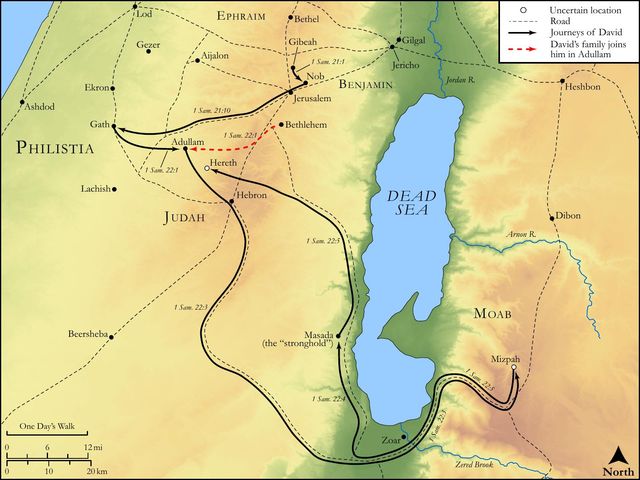
This verse immediately follows David's desperate flight from King Saul, who relentlessly sought his life out of jealousy and paranoia. Having narrowly escaped Gath by feigning madness, David retreats to the cave of Adullam, a natural fortress in the Judean wilderness. This period marks David's lowest point as a fugitive, isolated from his family and the established structures of Israel. Yet, it is precisely in this vulnerable state that God begins to assemble around him an unlikely army, transforming David from a solitary outcast into a leader of men, preparing him for the kingship that God had promised him in 1 Samuel 16.
Historical & Cultural Context
In ancient Israel, "distress," "debt," and "discontent" were not merely personal hardships but often carried significant social and economic consequences. Debt could lead to indentured servitude or the loss of ancestral land, effectively stripping individuals of their social standing and security. "Discontent" (literally "bitter of soul") reflected a deep sense of injustice or hopelessness, often stemming from oppressive societal structures or corrupt leadership, such as that under King Saul. For such individuals, joining a charismatic leader like David, even one who was a fugitive, offered a radical alternative to their current plight—a chance for protection, provision, and perhaps, a new purpose. The number "four hundred men" represents a significant, though still relatively small, fighting force for the time, indicating a nascent but growing movement.
Key Themes
ShowHideThis verse powerfully illustrates several key themes central to the book of 1 Samuel and the broader biblical narrative. It highlights Leadership in Adversity, demonstrating David's innate ability to attract and unite people, not through power or prestige, but through shared suffering and the promise of a better future, even while he himself was a fugitive. It underscores God's Providence and Unconventional Methods, revealing how God often works through the lowly and seemingly insignificant to accomplish His grand designs. What appears to be a motley crew of outcasts is, in God's sovereign plan, the seed of David's future kingdom and the foundation for his legendary "mighty men" (as later described in 2 Samuel 23:8-39). Furthermore, the gathering of these individuals speaks to the theme of Restoration and New Community, offering hope and belonging to those who were previously without it, foreshadowing the inclusive nature of God's redemptive work.
Exposition and Analysis
ShowHideKey Word Analysis
ShowHideThis term (H4689) denotes a narrow place, confinement, or severe restriction, extending to abstract and figurative senses like anguish, distress, or straitness. It conveys a deep sense of being "hemmed in" or trapped by circumstances, whether physical, emotional, or spiritual. For those who gathered to David, their "distress" was an overwhelming burden, a feeling of being cornered with no apparent escape.
This word (H5378) refers to lending on interest or, by implication, demanding payment for a debt. In ancient Israelite society, debt was a pervasive issue that could lead to severe social and economic consequences, including indentured servitude, loss of land, or social disgrace. Those "in debt" were often vulnerable, exploited, and desperate for relief from their financial bondage and the accompanying shame.
This term (H4751) means "bitter" and, when combined with nephesh (H5315, "soul" or "spirit"), forms the idiom "bitter of soul" or "bitter in spirit." It signifies deep dissatisfaction, resentment, or despair arising from a profound sense of injustice, unfulfilled expectations, or a general weariness with life. These individuals felt profoundly wronged or disillusioned, particularly with the prevailing leadership and societal conditions under Saul.
Verse Breakdown
ShowHide"And every one [that was] in distress"
This clause identifies the first category of individuals drawn to David—those experiencing profound anguish, trouble, or oppression. They felt "hemmed in" by their circumstances, whether from external pressures, internal turmoil, or the oppressive rule of Saul. This highlights a universal human longing for relief and freedom from suffering.
"and every one that [was] in debt"
This second group consisted of those burdened by financial obligations they could not meet. In a society where debt could lead to servitude or the loss of ancestral land and social standing, these individuals were often desperate, overlooked, and seeking a new beginning or protection from their creditors.
"and every one [that was] discontented"
The third category encompasses those who were "bitter of soul" or deeply dissatisfied with their lives, the current political climate under Saul, or their social standing. They were not necessarily in physical distress or financial debt, but rather carried a deep sense of injustice, disillusionment, or resentment, often stemming from the perceived failings of leadership.
"gathered themselves unto him"
This phrase emphasizes the voluntary nature of their allegiance. They were drawn to David, not conscripted, indicating his emerging charisma and the hope he represented as an alternative to the oppressive status quo, even in his fugitive state. This highlights a proactive choice by the individuals to seek refuge and new purpose under David.
"and he became a captain over them"
Despite his own precarious situation as a fugitive, David immediately assumed a leadership role. The term "captain" (Hebrew, sar) implies a military or administrative leader, indicating that David began to organize and direct this diverse group, providing them with structure, purpose, and protection, laying the groundwork for his future kingdom.
"and there were with him about four hundred men"
This final clause provides a numerical estimate of David's initial following. The number signifies a substantial group, large enough to be a viable fighting force and a clear challenge to Saul's authority, yet small enough to be mobile and adaptable in the wilderness. It marks the humble but significant beginnings of David's future kingdom and his legendary "mighty men."
Literary Devices
ShowHideThe passage employs several potent literary devices to convey its meaning. Contrast is prominent, juxtaposing David, the anointed future king, with his initial followers who are the distressed, indebted, and discontented—the very antithesis of a royal retinue. This highlights God's unconventional methods and the surprising nature of His kingdom-building. There is also a strong element of Foreshadowing, as this motley crew, gathered in desperation, will eventually transform into David's elite "mighty men," demonstrating God's ability to forge strength from weakness and purpose from despair. The situation also carries a degree of Irony, as the true king, chosen by God, is a fugitive leading outcasts, while the reigning king, Saul, is consumed by paranoia and surrounded by loyalists who often act unjustly. Finally, the verse functions as a powerful Symbolism of God's kingdom, which often begins with the lowly and rejected, offering them refuge and a new identity under a righteous leader.
Theological and Thematic Connections
ShowHide1 Samuel 22:2 offers profound theological insights into God's methods and the nature of His kingdom. It demonstrates God's consistent pattern of working through the weak, the outcast, and the unlikely to accomplish His purposes, rather than through the powerful or the privileged. This challenges human notions of strength and success, revealing that God's power is often made perfect in weakness. David, as a leader of the distressed, foreshadows a compassionate kingship that cares for the vulnerable, contrasting sharply with Saul's self-serving rule. This gathering of the lowly also speaks to the theme of God's covenant faithfulness, as He continues to build His kingdom through a chosen vessel, even when circumstances seem dire. It is a testament to the transformative power of divine leadership, offering hope and purpose to those who are broken.
Reflection and Application
ShowHide1 Samuel 22:2 offers a powerful and enduring message for contemporary life. It reminds us that true leadership, particularly in a spiritual context, often emerges not from positions of power or comfort, but from shared vulnerability and a deep empathy for the suffering of others. David, himself a fugitive, became a beacon of hope for those who were distressed, indebted, and discontented, demonstrating that even in our own brokenness, we can be used by God to bring healing and community to others. This passage encourages us to look beyond superficial measures of worth and recognize the inherent dignity and potential in every individual, especially those among the outcasts. It challenges us to consider how we, as individuals and communities of faith, can create spaces of refuge and restoration for those who feel lost, burdened, or bitter, just as David did in the cave of Adullam. Ultimately, it reinforces the profound truth that God delights in using the weak things of the world to shame the strong, building His kingdom from the most unexpected foundations.
Questions for Reflection
ShowHideFAQ
ShowHideWhy did these specific types of people gather around David, and what does it signify?
ShowHideThe text specifies "every one that was in distress, and every one that was in debt, and every one that was discontented." These categories represent the lowly, the oppressed, and the dispossessed of Israelite society under King Saul's increasingly tyrannical and unstable rule. Those in distress were likely suffering from various forms of anguish, perhaps due to Saul's erratic behavior or general societal breakdown. The indebted were often vulnerable to exploitation and social ostracization in Israel, potentially facing servitude or loss of land. The "discontented" (literally "bitter of soul") were likely those who felt wronged, disillusioned with the current leadership, or simply without hope for their future. Their gathering around David signifies several things: First, it highlights David's emerging charisma and reputation as a righteous alternative to Saul, even in his fugitive state. Second, it underscores God's providential hand, as He was assembling a diverse group of individuals who had nothing to lose and everything to gain by aligning with His anointed king. Third, it foreshadows the nature of God's kingdom, which often embraces the outcasts and gives them a new identity and purpose, rather than relying on the powerful or the elite. This motley crew would eventually become the loyal core of David's army, demonstrating God's ability to build strength from weakness, much like the early church would later be formed from a diverse group of believers (see 1 Corinthians 1:26-29).
Christ-Centered Fulfillment
ShowHideThe gathering of the distressed, indebted, and discontented around David in the cave of Adullam serves as a profound Old Testament type and shadow of the ultimate Christ-centered fulfillment. Just as David became a refuge and captain for those cast out by society, Jesus Christ, the greater Son of David, came not for the righteous but for sinners, for the sick, and for those who are burdened and heavy-laden. His invitation in Matthew 11:28—"Come unto me, all ye that labour and are heavy laden, and I will give you rest"—directly echoes David's role as a haven for the weary. The "distressed" find ultimate comfort in Christ, who bore our sorrows and infirmities (Isaiah 53:4). The "indebted" find their spiritual debt of sin fully paid through His atoning sacrifice on the cross (Colossians 2:14). And the "discontented," those bitter of soul due to sin and a fallen world, find true peace, joy, and purpose in His kingdom, where their deepest longings are satisfied (John 10:10). Christ, like David, did not gather an army of the powerful or privileged, but rather called fishermen, tax collectors, and overlooked women to be the foundation of His church, demonstrating that God's kingdom is built on grace, compassion, and the transformation of the humble and broken, making them "more than conquerors" through Him (Romans 8:37).