


1 Samuel 25:13
Bible text: King James Version (1769 Blayney text) · Public domain
Bible text: King James Version with Strong's numbers · Public domain
Bible text: Berean Standard Bible · Public domain
Bible text: American Standard Version (1901) · Public domain
Bible text: World English Bible, Messianic edition · Public domain
Bible text: Geneva Bible (1599) · Public domain
Bible text: Young's Literal Translation · Public domain
- וַיֹּאמֶרvai·yo·Merand he saidH559Conj-w ¦ V-Qal-ConsecImperf-3msVerb Qal Consecutive Imperfect 3rd Singular Masculineוַandיֹּאמֶרhe said
- דָּוִדda·VidDavidH1732N-proper-mNoun Proper Masculine
- לַאֲנָשָׁיוla·'a·na·Shavto his menH582Prep-l ¦ N-mpc ¦ 3msNoun Plural Masculine Constructלַtoאֲנָשָׁיmenוhis
- חִגְרוּchig·Rugird onH2296V-Qal-Imp-2mpVerb Qal Imperative 2nd Plural Masculine
- אִישׁ'isheveryoneH376N-msNoun Singular Masculine Absolute
- אֶת'et<obj.>H853DirObjMParticle Object Indicator
- חַרְבּוֹchar·Bohis swordH2719N-fsc ¦ 3msNoun Singular Feminine Constructחַרְבּswordוֹhis
- וַיַּחְגְּרוּvai·yach·ge·Ruand they girded onH2296Conj-w ¦ V-Qal-ConsecImperf-3mpVerb Qal Consecutive Imperfect 3rd Plural Masculineוַandיַּחְגְּרוּthey girded on
- אִישׁ'isheveryoneH376N-msNoun Singular Masculine Absolute
- אֶת'et<obj.>H853DirObjMParticle Object Indicator
- חַרְבּוֹchar·Bohis swordH2719N-fsc ¦ 3msNoun Singular Feminine Constructחַרְבּswordוֹhis
- וַיַּחְגֹּרvai·yach·Gorand he girded onH2296Conj-w ¦ V-Qal-ConsecImperf-3msVerb Qal Consecutive Imperfect 3rd Singular Masculineוַandיַּחְגֹּרhe girded on
- גַּםgamalsoH1571AdvAdverb
- דָּוִדda·VidDavidH1732N-proper-mNoun Proper Masculine
- אֶת'et<obj.>H853DirObjMParticle Object Indicator
- חַרְבּוֹchar·Bohis swordH2719N-fsc ¦ 3msNoun Singular Feminine Constructחַרְבּswordוֹhis
- וַיַּעֲלוּvai·ya·'a·Luand they went upH5927Conj-w ¦ V-Qal-ConsecImperf-3mpVerb Qal Consecutive Imperfect 3rd Plural Masculineוַandיַּעֲלוּthey went up
- אַחֲרֵי'a·cha·ReiafterH310Adj-mpcAdjective Numerical Plural Masculine Construct
- דָוִדda·VidDavidH1732N-proper-mNoun Proper Masculine
- כְּאַרְבַּעke·'ar·Ba'about fourH702Prep-k ¦ N-csNoun Singular common gender Absoluteכְּaboutאַרְבַּעfour
- מֵאוֹתme·'Othundred<s>H3967N-fpNoun Plural Feminine Absolute
- אִישׁ'IshmanH376N-msNoun Singular Masculine Absolute
- וּמָאתַיִםu·ma·Ta·yimand two hundredH3967Conj-w ¦ N-fdNoun Dual Feminine Absoluteוּandמָאתַיִםtwo hundred
- יָשְׁבוּya·she·Vuthey remainedH3427V-Qal-Perf-3cpVerb Qal Perfect 3rd Plural common gender
- עַל'alwithH5921PrepPreposition
- הַכֵּלִיםha·ke·Limthe baggage<s>H3627Art ¦ N-mpNoun Plural Masculine Absoluteהַtheכֵּלִיםbaggage<s>
English is a literal word-by-word gloss of the Hebrew, not the KJV's wording. Why?
This is the original text the KJV's translators worked from — each Hebrew word with its own literal English meaning in this verse, prepared by scholars at Tyndale House, Cambridge. The KJV translates whole sentences, not word by word, so its wording differs: one Hebrew word can become several English words, and the KJV may choose “the LORD” where the gloss reads “Yahweh”. Both are faithful — they answer different questions. For the KJV's own rendering, switch to the KJV text.
Details
See on the biblical-era map
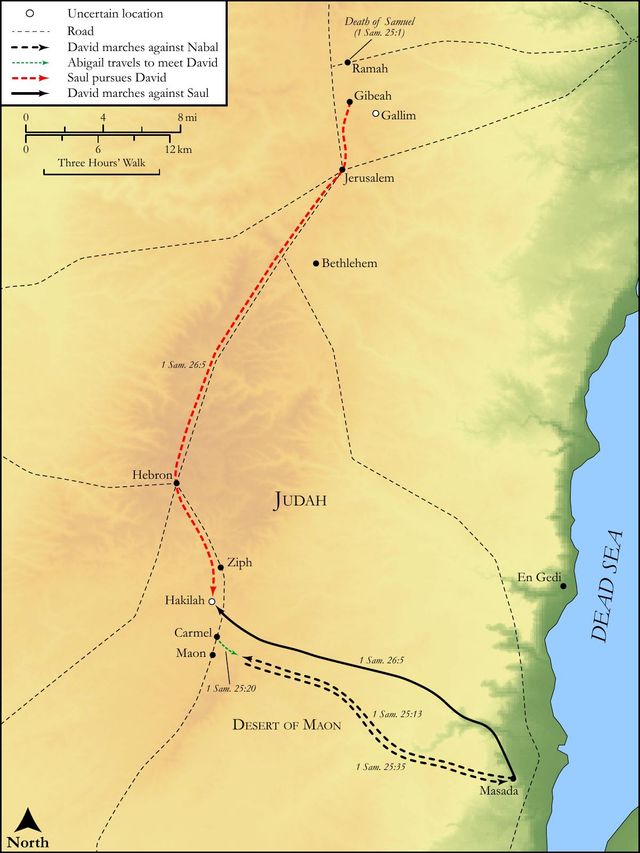
Study this verse
Public-domain commentary
Matthew Henry
From his Commentary on the Whole Bible. Henry comments on passages, not single verses — this entry covers 1 Samuel 25:12–17. His two-level outline is real structure in the source text, so it is rendered as structure.
Here is, I. The report made to David of the abuse Nabal had given to his messengers (Sa1 25:12): They turned their way. They showed their displeasure, as became them to do, by breaking off abruptly from such a churl, but prudently governed themselves so well as not to render railing for railing, not to call him as he deserved, much less to take by force what ought of right to have been given them, but came and told David that he might do as he thought fit. Christ's servants, when they are thus abused, must leave it to him to plead his own cause and wait till he appear in it. The servant showed his lord what affronts he had received, but did not return them, Luk 14:21.
II.David's hasty resolution hereupon.
He girded on his sword, and ordered his men to do so too, to the number of 400, Sa1 25:13. And what he said we are told, Sa1 25:21, Sa1 25:22.
1.He repented of the kindness he had done to Nabal, and looked upon it as thrown away upon him. He said, "surely in vain have I kept all that this fellow hath in the wilderness. I thought to oblige him and make him my friend, but I see it is to no purpose. He has no sense of gratitude, nor is he capable of receiving the impressions of a good turn, else he could not have used me thus. He hath requited me evil for good." But, when we are thus requited, we should not repent of the good we have done, nor be backward to do good another time. God is kind to the evil and unthankful, and why may not we?
2.He determined to destroy Nabal and all that belonged to him, Sa1 25:22. Here David did not act like himself. His resolution was bloody, to cut off all the males of Nabal's house, and spare none, man nor man-child. The ratification of his resolution was passionate: So, and more also do to God (he was going to say to me, but that would better become Saul's mouth, Sa1 14:44, than David's, and therefore he decently turns it off) to the enemies of David. Is this thy voice, O David? Can the man after God's own heart speak thus unadvisedly with his lips? Has he been so long in the school of affliction, where he should have learned patience, and yet so passionate? Is this he who used to be dumb and deaf when he was reproached (Psa 38:13), who but the other day spared him who sought his life, and yet now will not spare any thing that belongs to him who has only put an affront upon his messengers? He who at other times used to be calm and considerate is now put into such a heat by a few hard words that nothing will atone for them but the blood of a whole family. Lord, what is man! What are the best of men, when God leaves them to themselves, to try them, that they may know what is in their hearts? From Saul David expected injuries, and against those he was prepared and stood upon his guard, and so kept his temper; but from Nabal he expected kindness, and therefore the affront he gave him was a surprise to him, found him off his guard, and, by a sudden and unexpected attack, put him for the present into disorder. What need have we to pray, Lord, lead us not into temptation!
III.The account given of this matter to Abigail by one of the servants, who was more considerate than the rest, Sa1 25:14.
Had this servant spoken to Nabal, and shown him the danger he had exposed himself to by his own rudeness, he would have said, "Servants are now-a-days so saucy, and so apt to prescribe, that there is no enduring them," and, it may be, would have turned him out of doors. But Abigail, being a woman of good understanding, took cognizance of the matter, even from her servant, who,
1.Did David justice in commending him and his men for their civility to Nabal's shepherds, Sa1 25:15, Sa1 25:16. "The men were very good to us, and, though they were themselves exposed, yet they protected us and were a wall unto us." Those who do that which is good shall, one way or other, have the praise of the same. Nabal's own servant will be a witness for David that he is a man of honour and conscience, whatever Nabal himself says of him. And,
2.He did Nabal no wrong in condemning him for his rudeness to David's messengers: He railed on them (Sa1 25:14), he flew upon them (so the word is) with an intolerable rage; "for," say they, "it is his usual practice, Sa1 25:17. He is such a son of Belial, so very morose and intractable, that a man cannot speak to him but he flies into a passion immediately." Abigail knew it too well herself.
3.He did Abigail and the whole family a kindness in making her sensible what was likely to be the consequence. He knew David so well that he had reason to think he would highly resent the affront, and perhaps had had information of David's orders to his men to march that way; for he is very positive evil is determined against our master, and all his household, himself among the rest, would be involved in it. Therefore he desires his mistress to consider what was to be done for their common safety. they could not resist the force David would bring down upon them, nor had they time to send to Saul to protect them; something therefore must be done to pacify David.
Historical interpretation
Historical reception
2 surviving comments on this verse. Each one is dated, so this reads as a timeline rather than a list.
And about four hundred men followed David, etc. Whoever could be found perfect in prudence, fortitude, temperance, and justice followed the Lord to the office of preaching. Moreover, others, content with the twin perfection of charity, preferred to live quietly with those they had won for Christ, rather than gird themselves for spiritual battles to win others.
Then David said to his men, Let each one gird on his sword, etc. The sword of the Spirit, which is the word of God, can indeed be understood; with which the Mediator between God and men, the man Christ Jesus (Ephes. VI), was girded to vanquish the unbelievers, whenever he revealed the word of the Father to the world through his Gospel. And his disciples were girded when they preached the same. But because it is read in the following: David, being prohibited from striking the wicked, thanks to Abigail's intercession. The Church never prays, however, that Christ might not inflict the saving wound of his word upon the unbelievers. It is better understood in this place that the sword signifies the vengeance of destruction, which threatened the Jews after the Lord's passion; with which sword, indeed, the Lord himself, and his ministers of the same word, were girded, not by inflicting punishment on sinners, but by predicting this punishment as future to the sinners, unless they repented. Due to the fear of this sword, the Church, interceding with the Lord, suspended its blow for more than LX years.
Continue studying 1 Samuel 25:13 across the web’s major study libraries — every link below opens this exact verse, chapter, or book on the destination site.
Read & Compare
 BibleGatewayThis verse in more than 200 translations and 70 languages.
 Bible.comThe YouVersion reader — hundreds of translations, reading plans, and highlights.
 ESV.orgCrossway's official English Standard Version reader.
 NET BibleThe NET translation with 60,000+ translators' notes on every rendering decision.
 STEP BibleTyndale House's free study tool — original text, vocabulary, and scholarly resources.
 BibliaLogos Bible Software's free web reader.
 USCCBThe New American Bible (Revised Edition) with the U.S. bishops' study notes.
Commentaries
 BibleHub CommentariesDozens of classic commentaries on this verse, gathered on one page.
 StudyLightMore than 100 commentary sets — the largest collection on the web.
 BibleRefPlain-English commentary on what this verse means, verse by verse.
 Enduring WordDavid Guzik's free commentary on this chapter, widely used by Bible teachers.
 Bible Study ToolsVerse commentary alongside Greek and Hebrew study aids.
Original Language & Research
- BibleHub InterlinearThe verse word by word — original language, transliteration, and English.
- BibleHub LexiconEvery word's original-language definition and Strong's entry.
 Blue Letter BibleDeep-study tools — Strong's numbers, concordance, and word studies.
 SefariaThe Hebrew text with Rashi and centuries of Jewish commentary.
Sermons, Hymns & Audio


TrulyRandomVerse is not affiliated with these sites and doesn’t control their content. They’re linked because they’re genuinely useful.
Summary
1 Samuel 25:13 vividly portrays a critical juncture in David's wilderness journey, revealing his immediate and intensely personal reaction to Nabal's profound disrespect and ingratitude. This verse acts as the flashpoint for a potential, bloody confrontation, showcasing David's resolve to avenge the slight and the unwavering loyalty of his men as they prepare for battle, thereby setting the stage for crucial divine intervention through Abigail.
Context
ShowHideLiterary Context
This verse is situated within a crucial narrative arc in David's life, following his anointing as king and his subsequent flight from King Saul. David, leading a band of loyal but often desperate men, has been operating in the wilderness, providing protection for the flocks of wealthy landowners like Nabal in exchange for provisions. Immediately preceding this verse, David had sent ten young men to Nabal, requesting food and acknowledging the protection his men had offered Nabal's shepherds. Nabal, described as "harsh and evil in his deeds" in 1 Samuel 25:3, not only refused David's request but also insulted him, questioning his identity and legitimacy. David's command to "Gird ye on every man his sword" is a direct, visceral response to this public humiliation, signaling his intent to take matters into his own hands and exact swift retribution, thereby setting the stage for Abigail's crucial intervention to prevent bloodshed, as seen in 1 Samuel 25:23-31.
Historical & Cultural Context
In Israel and among the nations round about, hospitality was a sacred duty, and its denial, especially when protection had been provided, was a grave insult. Nabal's refusal was not merely stinginess but a public act of contempt, challenging David's authority and honor. David's response, though seemingly extreme to modern readers, was consistent with the "honor-shame" culture of the time, where a leader's reputation and the loyalty of his men depended on his ability to respond decisively to challenges. David's band, composed of men "in distress or in debt or discontented" as described in 1 Samuel 22:2, relied on such provisions for survival and viewed Nabal's insult as a threat to their very existence and their leader's standing. The act of "girding on a sword" was a universally understood sign of preparing for immediate, often violent, action, indicating a shift from negotiation to confrontation. The division of forces—400 going and 200 staying "by the stuff"—reflects practical military organization, ensuring supplies and non-combatants were protected while the main fighting force engaged.
Key Themes
ShowHideThis verse powerfully illustrates several key themes. Firstly, it highlights David's human fallibility and the dangers of unchecked anger. Despite being "a man after God's own heart," David was susceptible to personal offense and the temptation for immediate vengeance, a stark contrast to his earlier display of restraint when he spared King Saul's life. Secondly, it underscores the theme of leadership and loyalty; David's men immediately obey his command, demonstrating their unwavering commitment to him, even in a potentially morally ambiguous endeavor. Thirdly, it sets up the overarching theme of divine providence and intervention, as God, through Abigail, prevents David from committing a rash act that would have stained his future kingship. This incident serves as a crucial test of David's character, revealing his capacity for both intense wrath and, ultimately, for receiving wise counsel and submitting to God's guiding hand, aligning with the broader narrative of God shaping David into the king He desires, as seen throughout the book of 1 Samuel.
Exposition and Analysis
ShowHideKey Word Analysis
ShowHideThis verb, from H2296, literally means "to bind," "to fasten," or "to put on," specifically referring to the act of securing a sword or weapon belt around one's waist. In a military context, it signifies immediate preparation for battle or a serious confrontation. It conveys a sense of urgency, readiness for action, and a decisive shift from a state of peace to one of armed engagement. The repetition of this verb emphasizes the unanimous and swift response of David and his men.
This term refers to a cutting instrument, such as a knife or sword, known for its destructive effect. Beyond its literal meaning as a weapon, the sword here symbolizes the intent for violence, retribution, and the administration of justice (or perceived justice) by force. In this context, it represents David's immediate and carnal response to Nabal's insult, indicating a desire to exact personal vengeance rather than waiting for divine justice.
This term refers to something prepared, such as any apparatus, implement, utensil, or weapon. In a military context, it denotes the equipment, baggage, supplies, provisions, and non-combatants (or those assigned to guard duties) that accompany a mobile fighting force. The decision to leave two hundred men "by the stuff" demonstrates practical military strategy, ensuring the security of their base and resources while the main contingent proceeds to confront Nabal.
Verse Breakdown
ShowHide"And David said unto his men, Gird ye on every man his sword."
This opening clause captures David's immediate, authoritative, and emotionally charged command. The imperative "Gird ye on" conveys the urgency and seriousness of the situation, reflecting David's intense anger and his decision to retaliate against Nabal's insult. It signifies a decisive shift from a posture of request to one of aggressive intent, highlighting David's resolve to address the affront directly and forcefully.
"And they girded on every man his sword; and David also girded on his sword:"
This part highlights the immediate and unified obedience of David's men, underscoring their loyalty and readiness to follow their leader into conflict without hesitation. The specific mention that "David also girded on his sword" emphasizes his personal commitment to the impending action and his leading by example, indicating that this was not merely a command from a distance but a personal engagement in the planned retribution.
"and there went up after David about four hundred men;"
This clause specifies the size of the contingent David personally led into battle. Four hundred men represent a formidable force, demonstrating David's significant military strength and the seriousness of his intent to overwhelm Nabal and his household. The phrase "went up" suggests a movement towards Nabal's location, likely implying an ascent to a settlement or a strategic position, indicating the initiation of their punitive expedition.
"and two hundred abode by the stuff."
This final clause reveals David's practical military leadership, even amidst his anger. By leaving a portion of his men to guard their "stuff" (supplies, weapons, and perhaps non-combatants), David ensured the security of their base and resources. This strategic division of forces indicates a calculated approach to the confrontation, balancing the need for offensive action with the necessity of maintaining logistical support and a secure rear guard.
Literary Devices
ShowHideThe verse employs several effective literary devices. Repetition is prominent with the phrase "girded on every man his sword," which appears twice. This repetition emphasizes the immediate, unified, and decisive response of David and his men, highlighting their collective readiness for battle and the widespread nature of David's command. The scene also utilizes Military Imagery, vividly portraying the preparation for conflict through the act of arming and the strategic division of forces (400 going, 200 staying). This imagery underscores the gravity of David's intent and the disciplined nature of his outlaw band. Furthermore, the verse serves as a powerful instance of Foreshadowing. The dramatic arming of David and his men sets the stage for an impending, violent confrontation, creating suspense and anticipating the need for divine intervention, which ultimately comes through Abigail to prevent David from shedding innocent blood. The narrative also presents a subtle Contrast between David's previous acts of restraint (e.g., sparing Saul's life) and his current impulse for vengeance, highlighting the complexity of his character and the constant spiritual battle against human impulses.
Theological and Thematic Connections
ShowHideThis passage serves as a stark reminder of the destructive power of uncontrolled anger and the human temptation to seek immediate, personal vengeance when wronged. Even a man "after God's own heart" like David was not immune to such impulses, demonstrating that spiritual maturity does not negate human fallibility. The narrative implicitly raises questions about the nature of justice: is it a right to be seized by the offended, or a prerogative belonging to God? David's initial response, while culturally understandable, falls short of the higher call to trust God for vindication. God's intervention through Abigail, preventing David from carrying out his rash plan, underscores His sovereignty over human actions and His desire to preserve His chosen instruments from sin. This event teaches that true strength lies not in the ability to retaliate, but in the wisdom to exercise self-control and allow God to work out His purposes.
Reflection and Application
ShowHide1 Samuel 25:13 offers a profound lesson on the dangers of unchecked anger and the human tendency to seek immediate retribution. David, a man chosen by God and destined for kingship, momentarily succumbs to a visceral desire for vengeance, demonstrating that even the most spiritually attuned individuals are susceptible to powerful human emotions. This passage challenges us to examine our own responses when we feel insulted, disrespected, or wronged. Do we, like David, instinctively "gird on our swords" – whether literally or metaphorically – preparing for a counter-attack, or do we pause, pray, and seek divine guidance? The narrative beautifully foreshadows the critical role of wise counsel and divine intervention in averting tragic consequences. It reminds us that God often places "Abigails" in our lives – whether people, circumstances, or the quiet conviction of the Holy Spirit – to prevent us from acting rashly and to guide us toward a path of righteousness and peace. Cultivating self-control, humility, and a deep trust in God's ultimate justice are crucial for navigating life's provocations without succumbing to destructive impulses.
Questions for Reflection
ShowHideFAQ
ShowHideWhy did David react so strongly to Nabal's insult?
ShowHideDavid's strong reaction was rooted in a complex interplay of cultural norms, personal honor, and practical necessity. In Israel, hospitality was a sacred duty, and Nabal's refusal was not just stinginess but a profound public insult, a direct challenge to David's honor and legitimacy. David and his men had provided protection for Nabal's shepherds and flocks in the wilderness, a valuable service for which they expected reciprocal provision. Nabal's contemptuous dismissal, questioning David's identity ("Who is David? Who is the son of Jesse?" - 1 Samuel 25:10), was a direct affront to David's leadership and the very survival of his band, who relied on such provisions. David, as a leader, felt compelled to respond decisively to maintain his authority and the loyalty of his men, as failure to do so would have been perceived as weakness and could have undermined his entire enterprise. His anger was a natural, albeit dangerous, human response to such a grave and public disrespect.
What is the significance of the 400 men going and 200 staying?
ShowHideThe division of David's forces (400 going, 200 staying "by the stuff") demonstrates practical military strategy and leadership. The 400 men constituted the main strike force, a formidable number intended to overwhelm Nabal's household and exact retribution. The 200 men who "abode by the stuff" were assigned to guard the camp, supplies, and any non-combatants. This ensured the security of their provisions, weapons, and a safe base for retreat if necessary. It reflects David's understanding of military logistics, even in his anger, ensuring that his entire operation was not left vulnerable while he pursued his immediate objective. This strategic decision highlights David's competence as a military leader, even when his personal emotions were driving his actions.
Christ-Centered Fulfillment
ShowHideThe narrative of David's near-vengeance against Nabal, averted by Abigail's wise intervention, powerfully foreshadows the perfect character and mission of Jesus Christ. David, though a man after God's own heart, was still prone to human anger and the desire for personal retribution, an impulse that would have led to bloodshed and sin. In stark contrast, Jesus, the true Son of David, faced infinitely greater insults, rejection, and injustice, yet He never "girded on a sword" for vengeance. Instead, He commanded Peter to "Put your sword back into its place" in Matthew 26:52, choosing the path of self-sacrifice over retaliation. While David sought to avenge an insult, Christ willingly endured the ultimate insult of the cross, not for His own honor, but to secure redemption for humanity. He is the suffering Servant who "did not open his mouth" as prophesied in Isaiah 53:7 and "when he was reviled, he did not revile in return; when he suffered, he did not threaten" according to 1 Peter 2:23. Where David's anger nearly led to sin, Christ's perfect love led to salvation, demonstrating that true justice and ultimate victory come not through human vengeance but through divine self-giving love, a love that was poured out for us "while we were still sinners" as declared in Romans 5:8.