


1 Samuel 23:13
Bible text: King James Version (1769 Blayney text) · Public domain
Bible text: King James Version with Strong's numbers · Public domain
Bible text: Berean Standard Bible · Public domain
Bible text: American Standard Version (1901) · Public domain
Bible text: World English Bible, Messianic edition · Public domain
Bible text: Geneva Bible (1599) · Public domain
Bible text: Young's Literal Translation · Public domain
- וַיָּקָםvai·ya·Kamand he aroseH6965Conj-w ¦ V-Qal-ConsecImperf-3msVerb Qal Consecutive Imperfect 3rd Singular Masculineוַandיָּקָםhe arose
- דָּוִדda·VidDavidH1732N-proper-mNoun Proper Masculine
- וַאֲנָשָׁיוva·'a·na·Shavand his menH582Conj-w ¦ N-mpc ¦ 3msNoun Plural Masculine Constructוַandאֲנָשָׁיmenוhis
- כְּשֵׁשׁke·sheshabout sixH8337Prep-k ¦ N-csNoun Singular common gender Absoluteכְּaboutשֵׁשׁsix
- מֵאוֹתme·'othundred<s>H3967N-fpNoun Plural Feminine Absolute
- אִישׁ'IshmanH376N-msNoun Singular Masculine Absolute
- וַיֵּצְאוּvai·ye·tze·'Uand they went outH3318Conj-w ¦ V-Qal-ConsecImperf-3mpVerb Qal Consecutive Imperfect 3rd Plural Masculineוַandיֵּצְאוּthey went out
- מִקְּעִלָהmi·ke·'i·Lahfrom KeilahH7084Prep-m ¦ N-properNoun Proper LocationמִfromקְּעִלָהKeilah
- וַיִּתְהַלְּכוּvai·yit·ha·le·Khuand they went aboutH1980Conj-w ¦ V-Hithpael-ConsecImperf-3mpVerb Hithpael Consecutive Imperfect 3rd Plural Masculineוַandיִּתְהַלְּכוּthey went about
- בַּאֲשֶׁרba·'a·Sherat whereH834Prep-b ¦ RelParticle Relativeבַּatאֲשֶׁרwhere
- יִתְהַלָּכוּyit·ha·La·khuthey went aboutH1980V-Hithpael-Imperf-3mpVerb Hithpael Imperfect 3rd Plural Masculine
- וּלְשָׁאוּלu·le·sha·'Uland to SaulH7586Conj-w ¦ Prep-l ¦ N-proper-mNoun Proper MasculineוּandלְtoשָׁאוּלSaul
- הֻגַּדhu·Gadit was toldH5046V-Hophal-Perf-3msVerb Hophal Perfect 3rd Singular Masculine
- כִּיkithatH3588PrtParticle Conditional
- נִמְלַטnim·Lathe had escapedH4422V-Niphal-Perf-3msVerb Niphal Perfect 3rd Singular Masculine
- דָּוִדda·VidDavidH1732N-proper-mNoun Proper Masculine
- מִקְּעִילָהmi·ke·'i·Lahfrom KeilahH7084Prep-m ¦ N-properNoun Proper LocationמִfromקְּעִילָהKeilah
- וַיֶּחְדַּלvai·yech·Daland he ceasedH2308Conj-w ¦ V-Qal-ConsecImperf-3msVerb Qal Consecutive Imperfect 3rd Singular Masculineוַandיֶּחְדַּלhe ceased
- לָצֵאתla·Tzetto go forthH3318Prep-l ¦ V-Qal-InfVerb Qal Infinitive Constructלָtoצֵאתgo forth
English is a literal word-by-word gloss of the Hebrew, not the KJV's wording. Why?
This is the original text the KJV's translators worked from — each Hebrew word with its own literal English meaning in this verse, prepared by scholars at Tyndale House, Cambridge. The KJV translates whole sentences, not word by word, so its wording differs: one Hebrew word can become several English words, and the KJV may choose “the LORD” where the gloss reads “Yahweh”. Both are faithful — they answer different questions. For the KJV's own rendering, switch to the KJV text.
Details
See on the biblical-era map
Study this verse
Public-domain commentary
Matthew Henry
From his Commentary on the Whole Bible. Henry comments on passages, not single verses — this entry covers 1 Samuel 23:7–13. His four-level outline is real structure in the source text, so it is rendered as structure.
Here is, I. Saul contriving within himself the destruction of David (Sa1 23:7, Sa1 23:8): He heard that he had come to Keilah; and did he not hear what brought him thither? Was it not told him that he had bravely relieved Keilah and delivered it out of the hands of the Philistines? This, one would think, should have put Saul upon considering what honour and dignity should be done to David for this. But, instead of that, he catches at it as an opportunity of doing David a mischief. An ungrateful wretch he was, and for ever unworthy to have any service or kindness done him. Well might David complain of his enemies that they rewarded him evil for good, and that for his love they ere his adversaries, Psa 35:12; Psa 109:4. Christ was used thus basely, Joh 10:32. Now observe, 1. How Saul abused the God of Israel, in making his providence to patronise and give countenance to his malicious designs, and thence promising himself success in them: God hath delivered him into my hand; as if he who was rejected of God were in this instance owned and favoured by him, and David infatuated. He vainly triumphs before the victory, forgetting how often he had had fairer advantages against David than he had now and had yet missed his aim. He impiously connects God with his cause, because he thought he had gained one point. Therefore David prays (Psa 140:8), Grant not, O Lord! the desires of the wicked; further not his wicked device, lest they exalt themselves. We must not think that one smiling providence either justifies an unrighteous cause or secures its success. 2. How Saul abused the Israel of God, in making them the servants of his malice against David. He called all the people together to war, and they must with all speed march to Keilah, pretending to oppose the Philistines, but intending to besiege David and his men, though concealing that design; for it is said (Sa1 23:9) that he secretly practised mischief against him. Miserable is that people whose prince is a tyrant, for, while some are sufferers by his tyranny, others (which is worse) are made servants to it and instruments of it.
II.David consulting with God concerning his own preservation.
He knew by the information bought him that Saul was plotting his ruin (Sa1 23:9) and therefore applied to his great protector for direction. No sooner is the ephod brought to him than he makes use of it: Bring hither the ephod. We have the scriptures, those lively oracles, in our hands; let us take advice from them in doubtful cases. "Bring hither the Bible."
1.David's address to God upon this occasion is,
(1.)Very solemn and reverent. Twice he calls God the Lord God of Israel, and thrice calls himself his servant, Sa1 23:10, Sa1 23:11. Those that address God must know their distance, and who they are speaking to.
(2.)Very particular and express. His representation of the case is so (Sa1 23:10): "Thy servant has certainly heard on good authority" (for he would not call for the ephod upon every idle rumour) "that Saul has a design upon Keilah;" he does not say, "to destroy me," but, "to destroy the city" (as he had lately done the city of Nob) "for my sake." He seems more solicitous for their safety than for his own, and will expose himself any where rather than they shall be brought into trouble by his being among them. Generous souls are thus minded. His queries upon the case are likewise very particular. God allows us to be so in our addresses to him: "Lord, direct me in this matter, about which I am now at a loss." He does indeed invert the due order of his queries, but God in his answer puts him into method. That question should have been put first, and was first answered, "Will Saul come down, as thy servant has heard?" "Yea," says the oracle, "he will come down; he has resolved it, is preparing for it, and will do it, unless he hear that thou hast quitted the town." "Well, but if he do come down will the men of Keilah stand by me in holding the city against him, or will they open to him the gates, and deliver me into his hand?" If he had asked the men (the magistrates or elders) of Keilah themselves what they would do in that case, they could not have told him, not knowing their own minds, nor what they should do when it came to the trial, much less which way the superior vote of their council would carry it; or they might have told him they would protect him, and yet afterwards have betrayed him; but God could tell him infallibly: "When Saul besieges their city, and demands of them that they surrender thee into his hands, how fond soever they now seem of thee, as their saviour, they will deliver thee up rather than stand the shock of Saul's fury." Note,
[1.]God knows all men better than they know themselves, knows their length, their strength, what is in them, and what they will do if they come into such and such circumstances.
[2.]He therefore knows not only what will be, but what would be if it were not prevented; and therefore knows how to deliver the godly out of temptation, and how to render to every man according to his works.
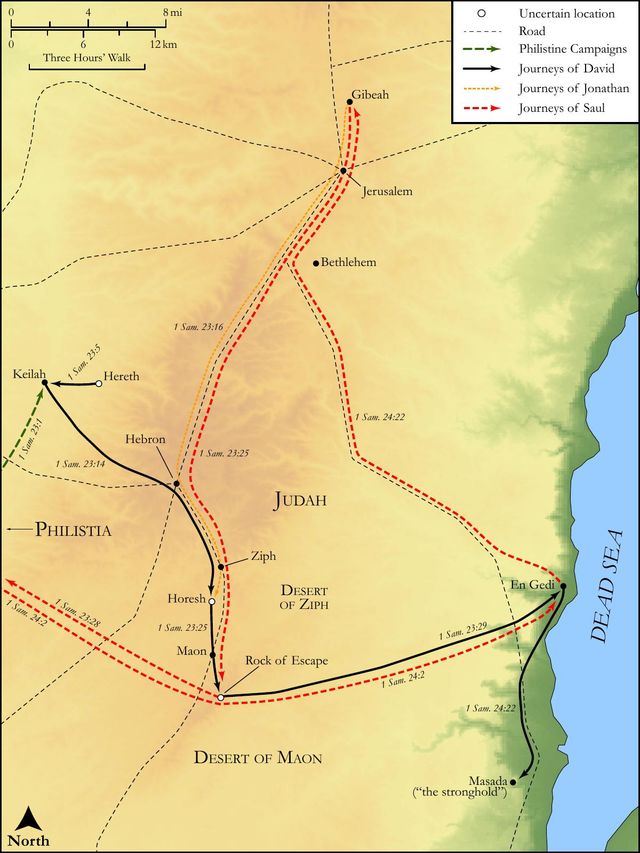
2.David, having thus far notice given him of his danger, quitted Keilah, Sa1 23:13. His followers had now increased in number to 600; with these he went out, not knowing whither he went, but resolving to follow Providence and put himself under its protection. This broke Saul's measures. He thought God had delivered David into his hand, but it proved that God delivered him out of his hand, as a bird out of the snare of the fowler. When Saul heard that David had escaped from Keilah, he forbore to go forth with the body of the army, as he intended (Sa1 23:8), and resolved to take only his own guards, and go in quest of his people's enemies and turn their counsels head-long.
Historical interpretation
Historical reception
2 surviving comments on this verse. Each one is dated, so this reads as a timeline rather than a list.
David therefore arose, etc. Woe, however, to that soul, woe to the city, which the word of God, leaving behind, wanders here and there, uncertain where, in whose heart to settle and find rest. "Foxes," he says, "have dens, and birds of the air have nests; but the Son of Man has nowhere to lay his head" (Matthew VIII); and this is what he says elsewhere: "Nevertheless, when the Son of Man comes, will he find faith on the earth?" (Luke XVIII). It is certainly to be noted that these things, generally, refer to all times of the Church, to which false brethren are never lacking, but especially to the last times, during which they will abound more, and can be typically referred, whose levity and perfidy even the name of Ceila fits. For it is said of a sling, cast forth, or stirring up, or lifting itself. And indeed why the soul of a false Christian, unstable and certainly wandering, is called cast to a sling, the wise woman explains, who in the type of the Church speaks with a strong and desirable hand saying, "But the soul of your enemies shall be whirled about in the impetus and circle of a sling" (1 Samuel XXV). But why a believer with infidelity, stirring it up, doubtlessly rightly calls it persecution, is proved by that traitor, who, from the number of Christ's disciples, added to the number of persecutors, thus far in the Church does not cease to have heirs of his depravity. Moreover, why it is called lifting itself, those manifest who usurp the knowledge of the faith for themselves specially, and do not fear to separate from the Catholic unity.
It was announced to Saul that David had fled from Ceila, etc. The enemies of the faith pretend to burden those with persecutions whom they see willingly abandoning the faith. But the adversary himself of old tires out with the more severe lashes of temptations those whom he sees strong in faith and action, or whom he sees either inert in faith, or utterly faithless or apostates, he possesses as his own quite contentedly and subject in all things, often with no, or certainly very few, temptations of wrath, pride, fornication, and envy, and other such passions.
Continue studying 1 Samuel 23:13 across the web’s major study libraries — every link below opens this exact verse, chapter, or book on the destination site.
Read & Compare
 BibleGatewayThis verse in more than 200 translations and 70 languages.
 Bible.comThe YouVersion reader — hundreds of translations, reading plans, and highlights.
 ESV.orgCrossway's official English Standard Version reader.
 NET BibleThe NET translation with 60,000+ translators' notes on every rendering decision.
 STEP BibleTyndale House's free study tool — original text, vocabulary, and scholarly resources.
 BibliaLogos Bible Software's free web reader.
 USCCBThe New American Bible (Revised Edition) with the U.S. bishops' study notes.
Commentaries
 BibleHub CommentariesDozens of classic commentaries on this verse, gathered on one page.
 StudyLightMore than 100 commentary sets — the largest collection on the web.
 BibleRefPlain-English commentary on what this verse means, verse by verse.
 Enduring WordDavid Guzik's free commentary on this chapter, widely used by Bible teachers.
 Bible Study ToolsVerse commentary alongside Greek and Hebrew study aids.
Original Language & Research
- BibleHub InterlinearThe verse word by word — original language, transliteration, and English.
- BibleHub LexiconEvery word's original-language definition and Strong's entry.
 Blue Letter BibleDeep-study tools — Strong's numbers, concordance, and word studies.
 SefariaThe Hebrew text with Rashi and centuries of Jewish commentary.
Sermons, Hymns & Audio


TrulyRandomVerse is not affiliated with these sites and doesn’t control their content. They’re linked because they’re genuinely useful.
Summary
1 Samuel 23:13 captures a critical juncture in David's life as a fugitive, powerfully illustrating his swift and obedient response to divine revelation, and God's active, protective hand amidst King Saul's relentless pursuit. Having just delivered the city of Keilah from Philistine aggression, David, upon receiving a direct warning from the Lord about the city's impending betrayal, immediately departed with his now six hundred men, abandoning a temporary haven for an uncertain journey into the wilderness. This verse underscores David's prudent leadership, the significant growth of his loyal following, and the divine frustration of Saul's determined efforts to capture God's anointed, thereby highlighting the ultimate futility of human schemes against God's sovereign will.
Context
ShowHideLiterary Context
This verse serves as the immediate consequence of David's inquiry and God's specific warning in the preceding narrative. David, despite being an outlaw hunted by King Saul, demonstrated remarkable fidelity to Israel by inquiring of the Lord and valiantly delivering the Judean city of Keilah from a Philistine raid, as detailed in 1 Samuel 23:1-5. However, David, ever reliant on divine counsel, again sought the Lord's guidance, asking if the citizens of Keilah would betray him to Saul, who was sure to come. The Lord's emphatic and specific warning in 1 Samuel 23:12—that they would indeed hand him over if he remained—directly precipitates David's immediate and decisive departure in verse 13. This rapid transition from a celebrated deliverer to a desperate fugitive underscores the constant peril of David's situation and the unyielding threat posed by Saul, setting the stage for David's continued wilderness wanderings and further divine interventions detailed throughout 1 Samuel 23.
Historical & Cultural Context
David's existence as a fugitive was a harsh reality for those who incurred the wrath of a reigning monarch in that day. The wilderness of Judah, with its rugged mountains, numerous caves, and scarce resources, offered natural concealment but demanded extreme resilience and constant reliance on divine provision. While fortified cities like Keilah provided temporary security, their inhabitants' loyalty was often conditional, driven by self-preservation and fear of the king. The cultural norm was absolute allegiance to the reigning monarch, making David's paradoxical status as God's anointed, yet Saul's enemy, profoundly dangerous. The increase of David's men from an initial four hundred (1 Samuel 22:2) to six hundred by this point is highly significant, indicating his growing influence and the formation of a substantial, albeit unconventional, fighting force composed of those disaffected by Saul's erratic reign or drawn to David's righteous leadership.
Key Themes
ShowHideThis verse powerfully contributes to several overarching themes in the book of Samuel. Firstly, Divine Guidance and Protection is paramount. God's direct communication and specific warning to David are the sole reasons for his timely escape, demonstrating God's active involvement in preserving His anointed. Secondly, David's Prudent Leadership is highlighted; he consistently seeks God's will and then takes decisive, strategic action to protect his growing band of followers. His immediate departure from Keilah, despite having just saved it, showcases his wisdom and responsibility. Thirdly, the theme of Human Fickleness vs. God's Faithfulness is starkly contrasted: the potential betrayal by the people of Keilah, whom David had just rescued, underscores the unreliable nature of human loyalty when compared to God's unwavering commitment to David's destiny. Finally, Saul's Frustration and the Futility of Fighting Against God's Will are vividly portrayed. Despite his vast resources and determination, Saul's plans are continually thwarted by God's providential care for David, as seen in Saul's "forbearance" to pursue David further, indicating a divine restraint on his actions. This theme is echoed throughout Saul's reign, particularly in his inability to capture David, despite numerous attempts, as seen in passages like 1 Samuel 23:25-29.
Exposition and Analysis
ShowHideKey Word Analysis
ShowHideThis verb (H3318) signifies "to go out," "to come forth," or "to escape." In this context, it emphasizes David's swift and decisive action in leaving Keilah. It conveys the urgency and necessity of his departure, directly in response to God's warning, highlighting his obedience and the precariousness of his position. The same root is used later in the verse for Saul's "forbear to go forth," creating a subtle contrast between David's divinely prompted movement and Saul's divinely restrained inaction.
This versatile verb (H1980) means "to walk," "to go," or "to journey." Here, it describes David and his men's subsequent movement after leaving Keilah: "went whithersoever they could go." It paints a picture of their nomadic, uncertain existence, emphasizing their lack of a fixed destination and their complete dependence on God's moment-by-moment guidance for their next refuge. It underscores their fugitive status and the constant search for safety in the wilderness.
This verb (H2308) means "to cease," "to desist," or "to restrain oneself." Applied to Saul, it indicates that he halted his immediate pursuit of David upon hearing of his escape from Keilah. This cessation is not attributed to Saul's strategic decision or weariness but is implicitly presented as a divinely imposed restraint. It highlights God's sovereign control over Saul's actions, thwarting his plans and ensuring David's safety, thereby demonstrating God's active protection of His anointed.
Verse Breakdown
ShowHide"Then David and his men, [which were] about six hundred, arose and departed out of Keilah,"
This clause immediately establishes David's prompt and obedient response to God's warning. The phrase "arose and departed" conveys a sense of urgency and decisive action. The specific mention of "six hundred" men highlights the significant size of David's company, indicating his growing influence and the logistical challenge of moving such a large group from a fortified city. Their departure from Keilah, a city David had just heroically saved, underscores the precariousness of his situation and the absolute necessity of trusting God's word over any perceived human gratitude or temporary security.
"and went whithersoever they could go."
This phrase vividly portrays the nomadic, uncertain, and vulnerable existence of David and his men. It signifies that they had no predetermined destination or secure refuge; their movements were dictated by the immediate need for safety and the search for any possible hiding place in the vast, rugged wilderness. This emphasizes their complete dependence on God's moment-by-moment guidance and provision, highlighting their status as divinely protected fugitives.
"And it was told Saul that David was escaped from Keilah;"
This clause confirms the efficiency of Saul's intelligence network, indicating that he was swiftly informed of David's movements. It sets up the expectation of continued, relentless pursuit, demonstrating Saul's unwavering obsession with capturing David. The word "escaped" implies David's successful evasion of Saul's trap, reinforcing the idea of divine intervention in his favor.
"and he forbare to go forth."
This final, crucial clause reveals a divine thwarting of Saul's plans. Despite Saul's determination and the immediate intelligence, he "forbore," or ceased, his pursuit. This cessation is implicitly attributed not to Saul's strategic thinking or weariness, but to God's sovereign hand. It signifies a supernatural restraint on Saul's will, preventing him from cornering David in Keilah and ensuring David's continued safety as part of God's larger plan for his life.
Literary Devices
ShowHideThe passage employs several potent literary devices to convey its profound message. Irony is prominent, as David, the deliverer of Keilah, is compelled to flee from the very people he saved, highlighting the fickle and unreliable nature of human loyalty. This contrasts sharply with the Divine Intervention and Providence demonstrated through God's direct warning to David and His subsequent restraint on Saul's pursuit, showcasing God's unwavering faithfulness. The phrase "went whithersoever they could go" functions as a powerful Metaphor for David's life as a hunted fugitive, emphasizing his rootless existence and complete dependence on God for direction and sustenance. Furthermore, the growth of David's company to "six hundred" men acts as Foreshadowing, hinting at the future strength and loyalty of the army that would eventually help establish David's kingdom, despite his current state of exile and vulnerability.
Theological and Thematic Connections
ShowHide1 Samuel 23:13 profoundly illustrates the theological truth of God's active sovereignty and meticulous providence in the lives of His chosen, even amidst profound adversity and human treachery. David's immediate obedience to God's warning, despite the inconvenience and uncertainty it entailed, underscores the principle that divine guidance often requires radical trust and swift action, even when it means abandoning perceived security. This passage also highlights the stark contrast between human fickleness and God's unwavering faithfulness; while the people of Keilah might have betrayed David, God's commitment to His anointed remained steadfast, actively protecting him from Saul's relentless and divinely thwarted pursuit. It serves as a powerful testament to the fact that God's plans for His people cannot be ultimately frustrated by human opposition or circumstances, affirming that His purposes will prevail.
Reflection and Application
ShowHideDavid's escape from Keilah offers timeless lessons for believers navigating the complexities of life, particularly when facing uncertainty, potential betrayal, or direct opposition. His unwavering commitment to seeking God's counsel, even immediately after a heroic act of deliverance, reminds us that our reliance on divine wisdom should be constant and pervasive, not just reserved for moments of desperation. When God reveals a threat or directs a change, David's swift and obedient departure teaches us the critical importance of immediate action, even if it means leaving behind a comfortable or seemingly secure situation for an unknown path. Furthermore, this narrative powerfully reassures us of God's active protection and faithfulness. Just as God supernaturally restrained Saul's pursuit, He is capable of thwarting the plans of our adversaries and guiding us safely through our own "wilderness experiences." David's leadership, prioritizing the safety and well-being of his men based on divine insight, challenges us to lead with wisdom, courage, and a deep dependence on God's guidance in all our spheres of influence, trusting that His provision will meet our needs in every circumstance.
Questions for Reflection
ShowHideFAQ
ShowHideWhy did David inquire of the Lord about Keilah's loyalty after saving them?
ShowHideDavid's decision to inquire of the Lord about Keilah's loyalty, even after he had just delivered them from the Philistines, demonstrates his profound spiritual maturity and consistent reliance on divine counsel. He understood the unpredictable nature of human gratitude and the intense pressure Saul could exert. David was not naive; he knew that the people of Keilah, though grateful for their deliverance, might prioritize their own safety over protecting a fugitive, especially if it meant incurring the wrath of King Saul. This inquiry highlights David's prudence and his unwavering commitment to seeking God's will in every significant decision, rather than relying on human sentiment or his own strategic assumptions, a practice seen throughout his life, such as in his initial inquiry before going to Keilah in 1 Samuel 23:2.
What is the significance of David's company growing to six hundred men?
ShowHideThe growth of David's company from an initial four hundred men (1 Samuel 22:2) to six hundred by the time of his escape from Keilah is highly significant. It indicates David's increasing influence and legitimacy, despite his status as a fugitive. This growing band, composed of those distressed, in debt, or discontented with Saul's reign, represented a nascent army and a loyal following. It demonstrated David's exceptional leadership qualities, his ability to inspire loyalty, and his capacity to organize and lead a substantial fighting force. This development foreshadows his future as king, showing that even in exile, God was building around him the core of his future kingdom and military strength, preparing him for the throne.
How does Saul's "forbearance" demonstrate God's protection?
ShowHideSaul's decision to "forbear to go forth" and pursue David immediately after hearing of his escape from Keilah is a clear demonstration of God's providential protection over David. Saul was relentlessly obsessed with capturing and killing David, and his resources were vast. For him to suddenly cease his pursuit, when David was seemingly cornered, suggests a divine intervention. The text implies that God, having warned David and orchestrated his escape, also supernaturally restrained Saul's will or ability to continue the chase. This highlights God's sovereign control over even the hearts of kings (Proverbs 21:1), ensuring that His anointed servant was preserved according to His divine plan, despite overwhelming human opposition. It underscores that God's purposes for David could not be thwarted by human malice.
Christ-Centered Fulfillment
ShowHideDavid's experience in 1 Samuel 23:13 serves as a profound type and shadow of Jesus Christ, the ultimate Anointed One. Like David, who was God's chosen king yet rejected by the reigning monarch and forced into a life of a hunted fugitive, Jesus, the true King of Israel, came to His own people, but "his own people did not receive him" (John 1:11). David's reliance on divine guidance and his immediate obedience to God's warning, leading to his escape from Keilah, mirrors Christ's perfect obedience to the Father's will, even to the point of fleeing danger, as seen in the flight to Egypt as an infant (Matthew 2:13-15). The growth of David's company to six hundred men, gathering those who were distressed or discontented, powerfully foreshadows Christ's gathering of His disciples and, ultimately, His church—a company of those who find refuge and purpose in Him, often having been alienated or burdened by the world, as He invites the weary and burdened to find rest in Him (Matthew 11:28). Just as God supernaturally restrained Saul's pursuit of David, so too did divine providence protect Jesus until His appointed time, and ultimately, no human or demonic power could thwart God's plan for His crucifixion, resurrection, and ascension. Christ's ultimate "escape" from the grave and His ascension to the right hand of the Father signifies the complete triumph over all His adversaries, assuring His followers that "no one will snatch them out of my hand" (John 10:28). David's wilderness journey, marked by uncertainty and dependence on God, prefigures Christ's own temptations and sufferings, demonstrating that our High Priest can sympathize with our weaknesses, for He "has been tempted in every way, just as we are—yet he did not sin" (Hebrews 4:15).