


1 Samuel 23:8
Bible text: King James Version (1769 Blayney text) · Public domain
Bible text: Berean Standard Bible · Public domain
Bible text: American Standard Version (1901) · Public domain
Bible text: World English Bible, Messianic edition · Public domain
Bible text: Geneva Bible (1599) · Public domain
Bible text: Young's Literal Translation · Public domain
- וַיְשַׁמַּעvay·sha·Ma'and he summonedH8085Conj-w ¦ V-Piel-ConsecImperf-3msVerb Piel Consecutive Imperfect 3rd Singular Masculineוַandיְשַׁמַּעhe summoned
- שָׁאוּלsha·'UlSaulH7586N-proper-mNoun Proper Masculine
- אֶת'et<obj.>H853DirObjMParticle Object Indicator
- כָּלkolallH3605N-mscNoun Singular Masculine Construct
- הָעָםha·'Amthe peopleH5971Art ¦ N-msNoun Singular Masculine Absoluteהָtheעָםpeople
- לַמִּלְחָמָהla·mil·cha·Mahfor <the> battleH4421Prep-l ¦ N-fsNoun Singular Feminine Absoluteלַfor <the>מִּלְחָמָהbattle
- לָרֶדֶתla·Re·detto go downH3381Prep-l ¦ V-Qal-InfVerb Qal Infinitive Constructלָtoרֶדֶתgo down
- קְעִילָהke·'i·LahKeilahH7084N-properNoun Proper Location
- לָצוּרla·Tzurto lay siegeH6696Prep-l ¦ V-Qal-InfVerb Qal Infinitive Constructלָtoצוּרlay siege
- אֶל'elagainstH413PrepPreposition
- דָּוִדda·VidDavidH1732N-proper-mNoun Proper Masculine
- וְאֶלve·'eland againstH413Conj-w ¦ PrepPrepositionוְandאֶלagainst
- אֲנָשָׁיו'a·na·Shavhis menH582N-mpc ¦ 3msNoun Plural Masculine Constructאֲנָשָׁיmenוhis
English is a literal word-by-word gloss of the Hebrew, not the KJV's wording. Why?
This is the original text the KJV's translators worked from — each Hebrew word with its own literal English meaning in this verse, prepared by scholars at Tyndale House, Cambridge. The KJV translates whole sentences, not word by word, so its wording differs: one Hebrew word can become several English words, and the KJV may choose “the LORD” where the gloss reads “Yahweh”. Both are faithful — they answer different questions. For the KJV's own rendering, switch to the KJV text.
Details
See on the biblical-era map
Study this verse
Public-domain commentary
Matthew Henry
From his Commentary on the Whole Bible. Henry comments on passages, not single verses — this entry covers 1 Samuel 23:7–13. His four-level outline is real structure in the source text, so it is rendered as structure.
Here is, I. Saul contriving within himself the destruction of David (Sa1 23:7, Sa1 23:8): He heard that he had come to Keilah; and did he not hear what brought him thither? Was it not told him that he had bravely relieved Keilah and delivered it out of the hands of the Philistines? This, one would think, should have put Saul upon considering what honour and dignity should be done to David for this. But, instead of that, he catches at it as an opportunity of doing David a mischief. An ungrateful wretch he was, and for ever unworthy to have any service or kindness done him. Well might David complain of his enemies that they rewarded him evil for good, and that for his love they ere his adversaries, Psa 35:12; Psa 109:4. Christ was used thus basely, Joh 10:32. Now observe, 1. How Saul abused the God of Israel, in making his providence to patronise and give countenance to his malicious designs, and thence promising himself success in them: God hath delivered him into my hand; as if he who was rejected of God were in this instance owned and favoured by him, and David infatuated. He vainly triumphs before the victory, forgetting how often he had had fairer advantages against David than he had now and had yet missed his aim. He impiously connects God with his cause, because he thought he had gained one point. Therefore David prays (Psa 140:8), Grant not, O Lord! the desires of the wicked; further not his wicked device, lest they exalt themselves. We must not think that one smiling providence either justifies an unrighteous cause or secures its success. 2. How Saul abused the Israel of God, in making them the servants of his malice against David. He called all the people together to war, and they must with all speed march to Keilah, pretending to oppose the Philistines, but intending to besiege David and his men, though concealing that design; for it is said (Sa1 23:9) that he secretly practised mischief against him. Miserable is that people whose prince is a tyrant, for, while some are sufferers by his tyranny, others (which is worse) are made servants to it and instruments of it.
II.David consulting with God concerning his own preservation.
He knew by the information bought him that Saul was plotting his ruin (Sa1 23:9) and therefore applied to his great protector for direction. No sooner is the ephod brought to him than he makes use of it: Bring hither the ephod. We have the scriptures, those lively oracles, in our hands; let us take advice from them in doubtful cases. "Bring hither the Bible."
1.David's address to God upon this occasion is,
(1.)Very solemn and reverent. Twice he calls God the Lord God of Israel, and thrice calls himself his servant, Sa1 23:10, Sa1 23:11. Those that address God must know their distance, and who they are speaking to.
(2.)Very particular and express. His representation of the case is so (Sa1 23:10): "Thy servant has certainly heard on good authority" (for he would not call for the ephod upon every idle rumour) "that Saul has a design upon Keilah;" he does not say, "to destroy me," but, "to destroy the city" (as he had lately done the city of Nob) "for my sake." He seems more solicitous for their safety than for his own, and will expose himself any where rather than they shall be brought into trouble by his being among them. Generous souls are thus minded. His queries upon the case are likewise very particular. God allows us to be so in our addresses to him: "Lord, direct me in this matter, about which I am now at a loss." He does indeed invert the due order of his queries, but God in his answer puts him into method. That question should have been put first, and was first answered, "Will Saul come down, as thy servant has heard?" "Yea," says the oracle, "he will come down; he has resolved it, is preparing for it, and will do it, unless he hear that thou hast quitted the town." "Well, but if he do come down will the men of Keilah stand by me in holding the city against him, or will they open to him the gates, and deliver me into his hand?" If he had asked the men (the magistrates or elders) of Keilah themselves what they would do in that case, they could not have told him, not knowing their own minds, nor what they should do when it came to the trial, much less which way the superior vote of their council would carry it; or they might have told him they would protect him, and yet afterwards have betrayed him; but God could tell him infallibly: "When Saul besieges their city, and demands of them that they surrender thee into his hands, how fond soever they now seem of thee, as their saviour, they will deliver thee up rather than stand the shock of Saul's fury." Note,
[1.]God knows all men better than they know themselves, knows their length, their strength, what is in them, and what they will do if they come into such and such circumstances.
[2.]He therefore knows not only what will be, but what would be if it were not prevented; and therefore knows how to deliver the godly out of temptation, and how to render to every man according to his works.
2.David, having thus far notice given him of his danger, quitted Keilah, Sa1 23:13. His followers had now increased in number to 600; with these he went out, not knowing whither he went, but resolving to follow Providence and put himself under its protection. This broke Saul's measures. He thought God had delivered David into his hand, but it proved that God delivered him out of his hand, as a bird out of the snare of the fowler. When Saul heard that David had escaped from Keilah, he forbore to go forth with the body of the army, as he intended (Sa1 23:8), and resolved to take only his own guards, and go in quest of his people's enemies and turn their counsels head-long.
Continue studying 1 Samuel 23:8 across the web’s major study libraries — every link below opens this exact verse, chapter, or book on the destination site.
Read & Compare
 BibleGatewayThis verse in more than 200 translations and 70 languages.
 Bible.comThe YouVersion reader — hundreds of translations, reading plans, and highlights.
 ESV.orgCrossway's official English Standard Version reader.
 NET BibleThe NET translation with 60,000+ translators' notes on every rendering decision.
 STEP BibleTyndale House's free study tool — original text, vocabulary, and scholarly resources.
 BibliaLogos Bible Software's free web reader.
 USCCBThe New American Bible (Revised Edition) with the U.S. bishops' study notes.
Commentaries
 BibleHub CommentariesDozens of classic commentaries on this verse, gathered on one page.
 StudyLightMore than 100 commentary sets — the largest collection on the web.
 BibleRefPlain-English commentary on what this verse means, verse by verse.
 Enduring WordDavid Guzik's free commentary on this chapter, widely used by Bible teachers.
 Bible Study ToolsVerse commentary alongside Greek and Hebrew study aids.
Original Language & Research
- BibleHub InterlinearThe verse word by word — original language, transliteration, and English.
- BibleHub LexiconEvery word's original-language definition and Strong's entry.
 Blue Letter BibleDeep-study tools — Strong's numbers, concordance, and word studies.
 SefariaThe Hebrew text with Rashi and centuries of Jewish commentary.
Sermons, Hymns & Audio


TrulyRandomVerse is not affiliated with these sites and doesn’t control their content. They’re linked because they’re genuinely useful.
Summary
1 Samuel 23:8 captures a pivotal and tragic moment in King Saul's reign, revealing the depth of his relentless paranoia and spiritual decline. Despite David's recent heroic act of delivering the city of Keilah from Philistine oppression, Saul perceives David's presence in this fortified location not as a blessing, but as a strategic opportunity to finally trap his rival. This verse vividly details Saul's decision to mobilize the entire national levy for war, signaling a massive military campaign aimed solely at besieging David and his small band of loyal followers, thereby underscoring the king's profound obsession and the tragic misdirection of Israel's national resources.
Context
ShowHideLiterary Context
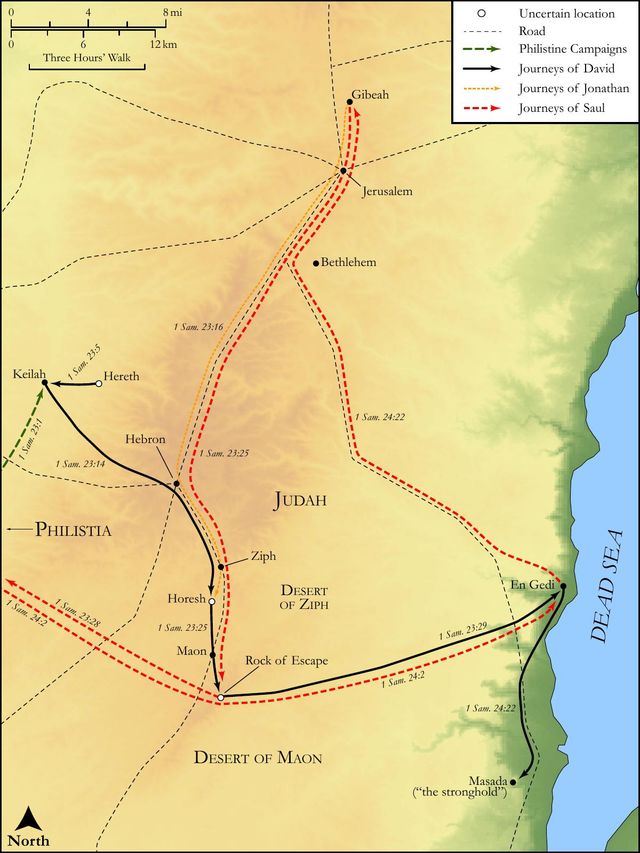
This verse is situated immediately after David's courageous and divinely-guided intervention to rescue the Philistine-besieged city of Keilah, an act that saved its inhabitants and their livestock, as detailed in 1 Samuel 23:1-5. David, still a fugitive from Saul, meticulously sought the Lord's counsel twice before engaging the Philistines, demonstrating his unwavering reliance on divine guidance. However, David's victory inadvertently exposed his location to Saul, setting the stage for the king's immediate and vengeful response recorded in verse 8. This action, in turn, precipitates David's subsequent inquiry of the Lord regarding Keilah's loyalty and his necessary flight from the city, as narrated in 1 Samuel 23:9-13. The broader narrative consistently highlights David's extreme vulnerability and God's protective hand amidst Saul's escalating and irrational hostility, emphasizing the precariousness of David's existence as God's anointed in waiting.
Historical & Cultural Context
The period of Saul's monarchy was characterized by persistent external conflicts, primarily with the Philistines, who posed a significant threat to Israel's territorial integrity and national identity. Internally, Saul's reign was marked by his struggle to consolidate power and his increasing instability. Kings in ancient Israel, like Saul, possessed the authority to summon a national levy (often referred to as "all the people" in a military context) for war, a common practice for national defense. The act of "besieging" a city was a devastating military tactic, involving surrounding the target, cutting off supplies, and often employing siege engines to breach its walls. Keilah itself was a strategically important fortified city located in the Shephelah, a transitional region between the Philistine plain and the Judean hills. Saul's decision to mobilize such a significant portion of the national army against an internal target—an innocent man and his loyal followers—was an extraordinary and costly undertaking, reflecting the deep personal vendetta that had consumed him and tragically diverted national resources from genuine external threats.
Key Themes
ShowHideThis verse powerfully contributes to several overarching themes within the book of 1 Samuel. Firstly, it dramatically amplifies the theme of Saul's escalating paranoia and his rejection by God, illustrating how his irrational fear of David usurping his throne has completely eclipsed his duties as king. His actions here are driven by personal vengeance rather than national defense, a stark and tragic contrast to his earlier, more righteous leadership, such as his decisive victory at Jabesh-Gilead described in 1 Samuel 11:6-11. Secondly, the verse underscores David's precarious position and God's consistent protection. Despite David's righteous actions and his divine anointing, he remains a hunted fugitive, relying entirely on divine guidance for survival, as evidenced by his repeated inquiries of the Lord, like the one in 1 Samuel 23:2. Thirdly, the passage vividly highlights the clash between human kingship and divine sovereignty. Saul, the king chosen by man and now rejected by God, abuses his earthly power to persecute God's chosen one, David, who must navigate this perilous landscape by continually trusting in God's ultimate control and miraculous deliverance.
Exposition and Analysis
ShowHideKey Word Analysis
ShowHideFrom the root H8085, this verb primarily signifies "to hear intelligently," but in its causative form, as used here, it means "to cause to hear," or "to call (gather) together." In this context, it emphasizes Saul's exercise of his royal prerogative to formally summon and mobilize the nation for war. It is not a casual gathering but a deliberate, authoritative call to arms, highlighting the king's absolute power and the gravity of his intent to capture David. The urgency implied by this word underscores the immediacy of Saul's vengeful response.
This term denotes a battle, conflict, or military campaign. Its use here underscores the hostile, aggressive, and full-scale military nature of Saul's objective. It was not merely an arrest or a skirmish but a declaration of a major military operation, indicating the extreme lengths Saul was willing to go to eliminate David, treating him as a national enemy rather than a loyal subject. This term highlights the disproportionate and misdirected use of national resources.
This primitive root means "to cramp," or "to confine," and in a military context, "to lay siege to a city." It implies surrounding the target to cut off escape routes and supplies, forcing surrender or capture. This word vividly conveys the dire predicament David and his men would face if trapped in Keilah, emphasizing Saul's strategic, ruthless, and comprehensive determination to corner them without any possibility of escape.
Verse Breakdown
ShowHide"And Saul called all the people together to war"
This clause reveals Saul's immediate and decisive action upon learning of David's location. The phrase "all the people" (or "all the army/nation") signifies a widespread national mobilization, demonstrating the immense resources and collective effort Saul was willing to expend on his personal vendetta against David. It highlights the king's absolute authority and the tragic misdirection of national power, turning it inward against an innocent man rather than outward against Israel's true enemies.
"to go down to Keilah"
This specifies the precise target of Saul's military campaign. Keilah, recently delivered by David from the Philistines, was a fortified city, making it a strategic location for both defense and entrapment. Saul's intent to "go down" (a common directional verb often indicating movement from a central location or higher ground to a specific target) indicates a planned descent and direct, aggressive confrontation.
"to besiege David and his men"
This final clause explicitly states the ultimate and singular objective of Saul's massive mobilization. His goal was not to defend Israel, nor to commend David's heroism, but solely to trap and capture David, whom he irrationally perceived as the greatest threat to his throne. The term "besiege" underscores the comprehensive and inescapable nature of Saul's plan, aiming to cut off all avenues of escape for David and his loyal followers, demonstrating a malevolent and obsessive focus.
Literary Devices
ShowHideThe verse employs several powerful literary devices that deepen its theological and narrative impact. Irony is profoundly evident, as Saul, the divinely appointed king of Israel, mobilizes the national army not against the Philistines (the true external enemy whom David just heroically defeated), but against David, his own anointed successor and a loyal servant. This stark contrast highlights Saul's distorted priorities and his tragic descent into irrational paranoia. The narrative also employs foreshadowing, as Saul's relentless and irrational pursuit here sets the tone for the many subsequent chapters detailing David's life as a hunted fugitive, constantly on the run from the king. This foreshadows both David's ongoing trials and God's consistent, miraculous deliverance. Furthermore, there is a clear contrast between David's selfless act of deliverance for the people of Keilah and Saul's self-serving, vengeful intent to use those same people and their city as a trap. This juxtaposition underscores the moral and spiritual chasm between the two leaders, one acting in selfless obedience to God, the other consumed by self-preservation and envy.
Theological and Thematic Connections
ShowHide1 Samuel 23:8 serves as a profound theological statement on the destructive power of unchecked envy and the unwavering nature of divine protection. Saul's actions exemplify how a heart consumed by jealousy, fear, and a refusal to acknowledge God's sovereign plan can lead to a tragic abuse of power, turning national resources against an innocent individual rather than against genuine external enemies. This narrative underscores the spiritual battle between human will, driven by sin and self-preservation, and God's sovereign purpose. Despite Saul's overwhelming military might and malicious intent, God's providence is strikingly evident in David's subsequent escape, demonstrating that no human force, however powerful, can ultimately thwart the divine purpose for His chosen one. The verse highlights the recurring biblical theme of the persecution of the righteous, yet it simultaneously affirms God's faithfulness to those who trust in Him amidst adversity, assuring them of His ultimate deliverance.
Reflection and Application
ShowHideThis verse offers both a stark warning and a profound encouragement for believers today. Saul's descent into paranoia and his willingness to use national power for a personal vendetta serves as a cautionary tale about the corrosive effects of unchecked envy, insecurity, and a refusal to submit to God's will. It reminds us that our internal battles—our fears, jealousies, and pride—can be far more destructive than any external threats if not surrendered to God's transforming power. For those who feel unjustly pursued, targeted, or overwhelmed by opposition, much like David, this passage offers profound solace. David's immediate response to Saul's overwhelming threat (as seen in the subsequent verses) was to inquire of the Lord, demonstrating an unwavering reliance on divine guidance and protection. This teaches us the critical importance of seeking God's counsel and trusting in His protective hand, even when circumstances seem overwhelmingly bleak and human strength is utterly insufficient. Our faithfulness in doing good may sometimes expose us to greater opposition, but it is precisely in these moments that God's power to deliver and His faithfulness to His promises are most clearly demonstrated.
Questions for Reflection
ShowHideFAQ
ShowHideWhy was Saul so obsessed with David, even after David had served him faithfully and continued to demonstrate loyalty?
ShowHideSaul's profound obsession with David stemmed primarily from a potent combination of intense jealousy, deep-seated insecurity, and his tragic rejection by God as king. After David's miraculous victory over Goliath and his subsequent military successes, the people's adoration shifted dramatically from Saul to David, famously encapsulated in the song, "Saul has slain his thousands, and David his ten thousands" (1 Samuel 18:7). This public acclaim fueled Saul's paranoia that David would usurp his throne, a fear exacerbated by the knowledge that the Spirit of the Lord had departed from him and was now powerfully with David (1 Samuel 16:14). His fear was not merely political but deeply spiritual, leading him to view David as a direct, divinely-backed threat to his divinely-appointed position, despite David's repeated demonstrations of loyalty and refusal to harm the king. Saul's internal turmoil and spiritual decline manifested as an irrational, consuming vendetta.
Christ-Centered Fulfillment
ShowHide1 Samuel 23:8, with its depiction of an innocent deliverer being relentlessly pursued and "besieged" by the established, yet corrupt, authority, powerfully foreshadows the experience of Jesus Christ. Just as David, having delivered Keilah from external enemies, found himself the immediate target of Saul's full military might, so too did Jesus, the ultimate Deliverer, face the relentless opposition and attempts to "besiege" Him by the religious and political powers of His day. The authorities sought to trap Jesus in His words (Matthew 22:15) and ultimately mobilized against Him, leading to His unjust arrest and crucifixion. Saul's personal vendetta against David, though rooted in human sin, was a distorted reflection of the spiritual warfare waged against God's anointed. Jesus, the true King, was not pursued for a perceived earthly throne, but because His kingdom was not of this world, exposing the very foundations of human sin (John 18:36). While David fled from his persecutor, Jesus willingly submitted to the "siege" of humanity's sin and death on the cross, becoming the ultimate Lamb of God who takes away the sin of the world (John 1:29). His victory was not in escaping a city, but in conquering sin, death, and the powers of darkness, thereby delivering His people from a far greater enemy than any earthly Philistine or king (Colossians 2:15), establishing an eternal kingdom of peace and righteousness.