


1 Samuel 23:7
Bible text: King James Version (1769 Blayney text) · Public domain
Bible text: King James Version with Strong's numbers · Public domain
Bible text: Berean Standard Bible · Public domain
Bible text: American Standard Version (1901) · Public domain
Bible text: World English Bible, Messianic edition · Public domain
Bible text: Geneva Bible (1599) · Public domain
Bible text: Young's Literal Translation · Public domain
- וַיֻּגַּדvai·yu·Gadand it was toldH5046Conj-w ¦ V-Hophal-ConsecImperf-3msVerb Hophal Consecutive Imperfect 3rd Singular Masculineוַandיֻּגַּדit was told
- לְשָׁאוּלle·sha·'Ulto SaulH7586Prep-l ¦ N-proper-mNoun Proper MasculineלְtoשָׁאוּלSaul
- כִּיkithatH3588PrtParticle Conditional
- בָאva'he had goneH935V-Qal-Perf-3msVerb Qal Perfect 3rd Singular Masculine
- דָוִדda·VidDavidH1732N-proper-mNoun Proper Masculine
- קְעִילָהke·'i·LahKeilahH7084N-properNoun Proper Location
- וַיֹּאמֶרvai·Yo·merand he saidH559Conj-w ¦ V-Qal-ConsecImperf-3msVerb Qal Consecutive Imperfect 3rd Singular Masculineוַandיֹּאמֶרhe said
- שָׁאוּלsha·'UlSaulH7586N-proper-mNoun Proper Masculine
- נִכַּרni·Karhe has alienatedH5234V-Piel-Perf-3msVerb Piel Perfect 3rd Singular Masculine
- אֹתוֹ'o·To<obj.> himH853DirObjM ¦ 3msParticle Object Indicatorאֹת<obj.>וֹhim
- אֱלֹהִים'E·lo·HimGodH430N-mpNoun Plural Masculine Absolute
- בְּיָדִיbe·ya·Diin my handH3027Prep-b ¦ N-csc ¦ 1csNoun Singular common gender Constructבְּinיָדִhandיmy
- כִּיkiforH3588PrtParticle Conditional
- נִסְגַּרnis·Garhe has shut himself upH5462V-Niphal-Perf-3msVerb Niphal Perfect 3rd Singular Masculine
- לָבוֹאla·Vo'by goingH935Prep-l ¦ V-Qal-InfVerb Qal Infinitive Constructלָbyבוֹאgoing
- בְּעִירbe·'Irin a city ofH5892Prep-b ¦ N-fscNoun Singular Feminine Constructבְּinעִירa city of
- דְּלָתַיִםde·la·Ta·yimdoorsH1817N-fdNoun Dual Feminine Absolute
- וּבְרִיחַu·ve·Ri·achand bar[s]H1280Conj-w ¦ N-msNoun Singular Masculine Absoluteוּandבְרִיחַbar[s]
English is a literal word-by-word gloss of the Hebrew, not the KJV's wording. Why?
This is the original text the KJV's translators worked from — each Hebrew word with its own literal English meaning in this verse, prepared by scholars at Tyndale House, Cambridge. The KJV translates whole sentences, not word by word, so its wording differs: one Hebrew word can become several English words, and the KJV may choose “the LORD” where the gloss reads “Yahweh”. Both are faithful — they answer different questions. For the KJV's own rendering, switch to the KJV text.
Details
See on the biblical-era map
Study this verse
Public-domain commentary
Matthew Henry
From his Commentary on the Whole Bible. Henry comments on passages, not single verses — this entry covers 1 Samuel 23:7–13. His four-level outline is real structure in the source text, so it is rendered as structure.
Here is, I. Saul contriving within himself the destruction of David (Sa1 23:7, Sa1 23:8): He heard that he had come to Keilah; and did he not hear what brought him thither? Was it not told him that he had bravely relieved Keilah and delivered it out of the hands of the Philistines? This, one would think, should have put Saul upon considering what honour and dignity should be done to David for this. But, instead of that, he catches at it as an opportunity of doing David a mischief. An ungrateful wretch he was, and for ever unworthy to have any service or kindness done him. Well might David complain of his enemies that they rewarded him evil for good, and that for his love they ere his adversaries, Psa 35:12; Psa 109:4. Christ was used thus basely, Joh 10:32. Now observe, 1. How Saul abused the God of Israel, in making his providence to patronise and give countenance to his malicious designs, and thence promising himself success in them: God hath delivered him into my hand; as if he who was rejected of God were in this instance owned and favoured by him, and David infatuated. He vainly triumphs before the victory, forgetting how often he had had fairer advantages against David than he had now and had yet missed his aim. He impiously connects God with his cause, because he thought he had gained one point. Therefore David prays (Psa 140:8), Grant not, O Lord! the desires of the wicked; further not his wicked device, lest they exalt themselves. We must not think that one smiling providence either justifies an unrighteous cause or secures its success. 2. How Saul abused the Israel of God, in making them the servants of his malice against David. He called all the people together to war, and they must with all speed march to Keilah, pretending to oppose the Philistines, but intending to besiege David and his men, though concealing that design; for it is said (Sa1 23:9) that he secretly practised mischief against him. Miserable is that people whose prince is a tyrant, for, while some are sufferers by his tyranny, others (which is worse) are made servants to it and instruments of it.
II.David consulting with God concerning his own preservation.
He knew by the information bought him that Saul was plotting his ruin (Sa1 23:9) and therefore applied to his great protector for direction. No sooner is the ephod brought to him than he makes use of it: Bring hither the ephod. We have the scriptures, those lively oracles, in our hands; let us take advice from them in doubtful cases. "Bring hither the Bible."
1.David's address to God upon this occasion is,
(1.)Very solemn and reverent. Twice he calls God the Lord God of Israel, and thrice calls himself his servant, Sa1 23:10, Sa1 23:11. Those that address God must know their distance, and who they are speaking to.
(2.)Very particular and express. His representation of the case is so (Sa1 23:10): "Thy servant has certainly heard on good authority" (for he would not call for the ephod upon every idle rumour) "that Saul has a design upon Keilah;" he does not say, "to destroy me," but, "to destroy the city" (as he had lately done the city of Nob) "for my sake." He seems more solicitous for their safety than for his own, and will expose himself any where rather than they shall be brought into trouble by his being among them. Generous souls are thus minded. His queries upon the case are likewise very particular. God allows us to be so in our addresses to him: "Lord, direct me in this matter, about which I am now at a loss." He does indeed invert the due order of his queries, but God in his answer puts him into method. That question should have been put first, and was first answered, "Will Saul come down, as thy servant has heard?" "Yea," says the oracle, "he will come down; he has resolved it, is preparing for it, and will do it, unless he hear that thou hast quitted the town." "Well, but if he do come down will the men of Keilah stand by me in holding the city against him, or will they open to him the gates, and deliver me into his hand?" If he had asked the men (the magistrates or elders) of Keilah themselves what they would do in that case, they could not have told him, not knowing their own minds, nor what they should do when it came to the trial, much less which way the superior vote of their council would carry it; or they might have told him they would protect him, and yet afterwards have betrayed him; but God could tell him infallibly: "When Saul besieges their city, and demands of them that they surrender thee into his hands, how fond soever they now seem of thee, as their saviour, they will deliver thee up rather than stand the shock of Saul's fury." Note,
[1.]God knows all men better than they know themselves, knows their length, their strength, what is in them, and what they will do if they come into such and such circumstances.
[2.]He therefore knows not only what will be, but what would be if it were not prevented; and therefore knows how to deliver the godly out of temptation, and how to render to every man according to his works.
2.David, having thus far notice given him of his danger, quitted Keilah, Sa1 23:13. His followers had now increased in number to 600; with these he went out, not knowing whither he went, but resolving to follow Providence and put himself under its protection. This broke Saul's measures. He thought God had delivered David into his hand, but it proved that God delivered him out of his hand, as a bird out of the snare of the fowler. When Saul heard that David had escaped from Keilah, he forbore to go forth with the body of the army, as he intended (Sa1 23:8), and resolved to take only his own guards, and go in quest of his people's enemies and turn their counsels head-long.
Historical interpretation
Historical reception
1 surviving comment on this verse from the historical church.
And Saul commanded all the people, etc. For as the state of the Church increased, there were not lacking at various times adversaries, who, with the Lord permitting, would test its patience and wisdom by attacking it with the gravest trials, seeking to capture both the Lord Himself in it and His men, that is, all the strong defenders of His Gospel, with impious siege, and to remove them from the midst, yet never reaching the treacherous desires of their wickedness.
Continue studying 1 Samuel 23:7 across the web’s major study libraries — every link below opens this exact verse, chapter, or book on the destination site.
Read & Compare
 BibleGatewayThis verse in more than 200 translations and 70 languages.
 Bible.comThe YouVersion reader — hundreds of translations, reading plans, and highlights.
 ESV.orgCrossway's official English Standard Version reader.
 NET BibleThe NET translation with 60,000+ translators' notes on every rendering decision.
 STEP BibleTyndale House's free study tool — original text, vocabulary, and scholarly resources.
 BibliaLogos Bible Software's free web reader.
 USCCBThe New American Bible (Revised Edition) with the U.S. bishops' study notes.
Commentaries
 BibleHub CommentariesDozens of classic commentaries on this verse, gathered on one page.
 StudyLightMore than 100 commentary sets — the largest collection on the web.
 BibleRefPlain-English commentary on what this verse means, verse by verse.
 Enduring WordDavid Guzik's free commentary on this chapter, widely used by Bible teachers.
 Bible Study ToolsVerse commentary alongside Greek and Hebrew study aids.
Original Language & Research
- BibleHub InterlinearThe verse word by word — original language, transliteration, and English.
- BibleHub LexiconEvery word's original-language definition and Strong's entry.
 Blue Letter BibleDeep-study tools — Strong's numbers, concordance, and word studies.
 SefariaThe Hebrew text with Rashi and centuries of Jewish commentary.
Sermons, Hymns & Audio


TrulyRandomVerse is not affiliated with these sites and doesn’t control their content. They’re linked because they’re genuinely useful.
Summary
1 Samuel 23:7 marks a pivotal moment in King Saul's relentless pursuit of David, vividly illustrating Saul's profound spiritual delusion and desperate obsession. Upon receiving intelligence that David had entered Keilah, a fortified city, Saul immediately interprets this strategic development as a direct act of divine intervention, believing God has "delivered" David into his grasp. This verse powerfully reveals Saul's tragically warped perception of God's will, setting the stage for a dramatic display of divine providence that will ultimately frustrate his malevolent intentions.
Context
ShowHideLiterary Context
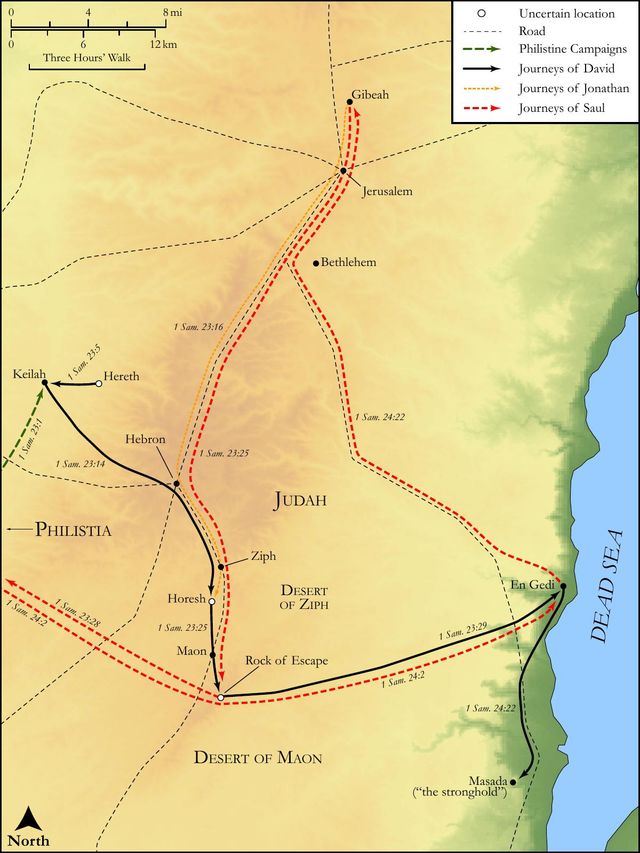
This verse immediately follows David's selfless and divinely guided rescue of Keilah's inhabitants from a Philistine attack. David undertook this perilous mission only after twice seeking and receiving confirmation from the Lord through the ephod, as recorded in 1 Samuel 23:2 and 1 Samuel 23:4. David's consistent reliance on divine counsel and his compassionate actions stand in stark contrast to Saul's increasingly self-serving agenda and his tragic disregard for God's revealed will. The narrative then proceeds to highlight David's continued dependence on God's guidance as he discerns the impending treachery of the men of Keilah (1 Samuel 23:10-12), which ultimately leads to his miraculous escape from the very trap Saul believed was divinely set. This sequence powerfully underscores the overarching theme of God's unwavering protection and faithfulness toward His anointed.
Historical & Cultural Context
The period of Saul's reign and David's subsequent flight was characterized by significant political instability, internal strife, and persistent external threats, particularly from the Philistines. Fortified cities like Keilah, with their robust "gates and bars," were strategically vital strongholds, serving as essential defensive refuges for populations and military outposts against invaders. For David, a military leader, to enter such a city, especially after having just defended it, seemed a logical and prudent tactical move. However, from Saul's perspective, David's entry into a walled city was a grave tactical error, as it presented an opportunity for siege warfare, where a fortified city could become an inescapable death trap if surrounded and cut off. Saul's belief that David was "shut in" reflects the common ancient military strategy of containment and siege, highlighting the harsh realities of warfare and the critical importance of secure locations, which Saul sought to exploit for his personal vendetta against David.
Key Themes
ShowHideThe verse profoundly contributes to several central themes within the book of 1 Samuel. Foremost is Saul's deepening spiritual delusion and his rejection by God. His declaration, "God hath delivered him into mine hand," is a chilling misinterpretation of divine will, revealing the extent of his spiritual decline and how far he has fallen from God's favor since his initial anointing (1 Samuel 10:1). This stands in stark contrast to God's unwavering providence and protection over David, His chosen king, despite the seemingly insurmountable odds and Saul's relentless human schemes. Saul's human calculations and military advantages are consistently thwarted by divine intervention, illustrating that God's sovereign plan for David's ascension to the throne cannot be frustrated by any human opposition. Furthermore, the verse highlights the nature of unjust persecution, as Saul's obsessive and irrational hatred drives him to extreme measures, even twisting spiritual language and divine attribution to justify his malicious intentions against the innocent and God-fearing David, who consistently seeks the Lord's will, as seen throughout 1 Samuel 23.
Exposition and Analysis
ShowHideKey Word Analysis
ShowHideThe Hebrew verb נָכַר (nâkar) primarily means "to scrutinize," "to look intently at," and by implication, "to acknowledge," "to discern," or conversely, "to disregard," "to ignore," or "to be strange toward." Saul's immediate declaration, "God hath delivered him into mine hand," is a profound misapplication of this term. While the KJV translates it as "delivered," Saul's use here reflects his perception that God has recognized and handed over David to him. This reveals Saul's spiritual blindness; he believes God is actively discerning and acting on his behalf, when in reality, Saul is failing to discern God's true will for David. His interpretation is a tragic projection of his own desires onto divine action, indicative of his deep spiritual estrangement from God.
The Hebrew noun יָד (yâd) refers literally to the "hand" but is used with immense latitude to signify power, authority, means, control, or possession. When Saul says, "God hath delivered him into mine hand," he is expressing his conviction that David is now completely within his sphere of influence, under his control, and at his mercy. This word underscores Saul's perception of his own power and authority, which he believes has been divinely affirmed. It highlights his focus on human means and control, contrasting sharply with God's ultimate sovereignty which operates beyond human "hands."
The Hebrew verb סָגַר (çâgar) means "to shut up," "to close," "to imprison," or figuratively, "to surrender." Saul's assessment that David is "shut in" emphasizes the perceived impregnability of Keilah's defenses, which he believes now work against David, effectively trapping him. From a military standpoint, David, having entered a walled city, is confined within its boundaries, making escape difficult if besieged. This word highlights Saul's strategic thinking and his reliance on physical barriers, but also his failure to account for God's ability to open what man has shut, or to provide an escape where human logic sees none.
Verse Breakdown
ShowHide"¶ And it was told Saul that David was come to Keilah."
This opening clause establishes the immediate context, highlighting the efficiency of Saul's intelligence network. Saul's obsessive pursuit of David meant that any reliable information about David's whereabouts was swiftly conveyed to him. The news of David's presence in a specific, known, and fortified location like Keilah was highly significant, as David had previously been constantly on the move in the wilderness, making him difficult to track. This intelligence confirms David's location, shifting the dynamic from a fluid chase to a potential siege.
"And Saul said, God hath delivered him into mine hand;"
This is the pivotal declaration of the verse, revealing the depth of Saul's spiritual delusion and his interpretive framework. He immediately attributes David's presence in Keilah to divine action, believing God has actively "given" David over to him. This statement is laden with profound dramatic irony, as Saul's interpretation is entirely contrary to God's actual will and plan for David. It showcases Saul's spiritual arrogance, his self-serving theology, and his tragic tendency to project his own malicious desires onto God's supposed actions, a hallmark of his apostasy and a clear sign of his rejection by God.
"for he is shut in, by entering into a town that hath gates and bars."
This clause provides the rationale for Saul's conviction, rooted in military strategy and human logic. He views David's entry into a fortified city as a tactical blunder that has effectively trapped him. The description "a town that hath gates and bars" emphasizes its defensive strength and the perceived impossibility of escape, which Saul believes now serves as an inescapable prison for David. This highlights Saul's reliance on physical barriers and human calculations, failing to consider the divine intervention that has consistently protected David and will continue to do so, demonstrating that God's power transcends any human fortification.
Literary Devices
ShowHideThe primary literary device at play in 1 Samuel 23:7 is Dramatic Irony. Saul declares with absolute conviction, "God hath delivered him into mine hand," believing divine providence is unequivocally on his side. However, the reader possesses superior knowledge, having been informed in previous chapters (e.g., 1 Samuel 15 and 1 Samuel 16) that God has decisively rejected Saul as king and has already anointed David as his successor. Thus, Saul's statement is tragically ironic, as God is actively protecting David from Saul, not delivering David to Saul. This irony powerfully underscores Saul's profound spiritual blindness and the vast chasm between his distorted perception of God's will and the divine reality. Furthermore, there is a clear element of Foreshadowing, as Saul's confident assertion that David is "shut in" sets the narrative stage for David's subsequent miraculous escape, demonstrating unequivocally that God's protective hand cannot be thwarted by human fortifications or schemes. The verse also employs a stark Contrast between Saul's human, flawed, and self-serving understanding of events and God's true, sovereign, and righteous plan.
Theological and Thematic Connections
ShowHide1 Samuel 23:7 stands as a powerful testament to the fundamental clash between human schemes and divine sovereignty. Saul's declaration, "God hath delivered him into mine hand," is a chilling and tragic example of how a person, particularly one in a position of power, can profoundly misinterpret circumstances and attribute their own malicious desires or self-serving agendas to God's will. This spiritual blindness stems directly from his persistent rebellion against God's word and his rejection of divine counsel, leading him to believe that God would actively aid his vendetta against His own anointed. Yet, the broader narrative of 1 Samuel consistently demonstrates God's unwavering protection of David, proving that no human fortification, strategic advantage, or malevolent intent can ultimately thwart the divine plan. This verse serves as a crucial theological reminder that God's ways are infinitely higher than our ways, and His sovereign purposes will prevail despite the most formidable human opposition or cleverest human calculations.
Reflection and Application
ShowHideSaul's profound misinterpretation of God's will in 1 Samuel 23:7 offers a sobering and timeless lesson for believers today. It serves as a powerful caution against the human propensity to project our own desires, biases, fears, or even our personal vendettas onto God's actions or perceived circumstances. True spiritual discernment requires profound humility, a deep and consistent immersion in God's revealed Word, and a willingness to submit our will entirely to His, rather than seeking divine validation for our own preconceived agendas. Just as Saul believed David was "shut in" by physical barriers and human strategy, we too can often feel trapped by life's overwhelming circumstances, whether they be financial hardship, relational conflict, professional setbacks, or personal struggles that seem to have no exit. This verse powerfully reminds us that even when human logic dictates a hopeless or inescapable situation, God's sovereign hand is actively at work, often orchestrating deliverance in ways we cannot foresee or comprehend. Our ultimate trust should not be in the absence of barriers or the strength of our own plans, but in the unfailing presence and power of an all-knowing, all-powerful God who faithfully protects His own and perfectly fulfills His divine purposes.
Questions for Reflection
ShowHideFAQ
ShowHideWhy did Saul believe God had delivered David into his hand?
ShowHideSaul believed God had delivered David into his hand because David had entered Keilah, a fortified city with strong "gates and bars." From Saul's perspective, this was a significant tactical blunder by David, effectively trapping him within the city walls and making his capture seem inevitable. Saul, in his profound spiritual delusion, interpreted this seemingly advantageous situation as a direct act of divine favor, aligning God with his personal vendetta against David. This reveals Saul's self-serving theology and his tragic inability to discern God's true will, which was to protect David and establish him as king, not to assist Saul in his relentless and unrighteous pursuit. Saul's belief system had become so distorted that he saw God as a tool for his own destructive desires, rather than as the sovereign Lord who had already rejected him and chosen David.
Christ-Centered Fulfillment
ShowHide1 Samuel 23:7, with its stark contrast between Saul's misguided perception of divine deliverance and God's true protective hand over David, powerfully foreshadows the ultimate deliverance and sovereignty found in Jesus Christ. Saul, the failed king, believed he had trapped God's anointed, much like the religious and political powers of Jesus' day thought they had "shut in" the true King of Israel on the cross. Yet, just as God miraculously delivered David from the "gates and bars" of Keilah, He raised Jesus from the dead, demonstrating that no human scheme, no "gates and bars" of death or the grave, could hold the ultimate Anointed One (Acts 2:24). Saul's twisted view of God's will is a sobering reminder of humanity's propensity to oppose God's true King, while David's protection points to Christ, who truly delivers His people from their ultimate enemies—sin and death—not by trapping them, but by setting them gloriously free through His sacrificial death and triumphant resurrection (Colossians 1:13-14). Ultimately, the true "deliverance" is not the capture of an earthly enemy, but the eternal salvation offered by the Lamb of God, who takes away the sin of the world, a deliverance that transcends any earthly fortress or human trap, proving that even the gates of Hades cannot prevail against His church.