


1 Samuel 26:8
- וַיֹּאמֶרvai·Yo·merand he saidH559Conj-w ¦ V-Qal-ConsecImperf-3msVerb Qal Consecutive Imperfect 3rd Singular Masculineוַandיֹּאמֶרhe said
- אֲבִישַׁי'a·vi·ShaiAbishaiH52N-proper-mNoun Proper Masculine
- אֶל'eltoH413PrepPreposition
- דָּוִדda·VidDavidH1732N-proper-mNoun Proper Masculine
- סִגַּרsi·Garhe has delivered upH5462V-Piel-Perf-3msVerb Piel Perfect 3rd Singular Masculine
- אֱלֹהִים'E·lo·HimGodH430N-mpNoun Plural Masculine Absolute
- הַיּוֹםhai·Yomthis dayH3117Art ¦ N-msNoun Singular Masculine Absoluteהַthisיּוֹםday
- אֶת'et<obj.>H853DirObjMParticle Object Indicator
- אוֹיִבְךָ'o·yiv·Khayour enemyH341V-Qal-Prtcpl-ms ¦ 2msVerb Qal Participle Singular Masculine Constructאוֹיִבְenemyךָyour
- בְּיָדֶךָbe·ya·De·khain your handH3027Prep-b ¦ N-csc ¦ 2msNoun Singular common gender Constructבְּinיָדֶhandךָyour
- וְעַתָּהve·'a·Tahand thereforeH6258Conj-w ¦ AdvAdverbוְandעַתָּהtherefore
- אַכֶּנּוּ'ak·Ke·nulet me strike himH5221V-Hiphil-Imperf-1cs ¦ 3msVerb Hiphil Imperfect 1st Singular common genderאַכֶּlet me strikeנּוּhim
- נָאna'pleaseH4994PrtParticle Interjection
- בַּחֲנִיתba·cha·Nitwith the spearH2595Prep-b ¦ N-fsNoun Singular Feminine Absoluteבַּwith theחֲנִיתspear
- וּבָאָרֶץu·va·'A·retzand in the groundH776Conj-w ¦ Prep-b ¦ N-fsNoun Singular Feminine Absoluteוּandבָin theאָרֶץground
- פַּעַםPa·'ama timeH6471N-fscNoun Singular Feminine Construct
- אַחַת'a·ChatoneH259N-fsNoun Singular Feminine Absolute
- וְלֹאve·Lo'and notH3808Conj-w ¦ NegParticle Negativeוְandלֹאnot
- אֶשְׁנֶה'esh·NehI will repeatH8138V-Qal-Imperf-1csVerb Qal Imperfect 1st Singular common gender
- לוֹloto <the> himPrep-l ¦ 3msSuffix Personal 3rd Singular Masculineלto <the>וֹhim
English is a literal word-by-word gloss of the Hebrew, not the KJV's wording. Why?
This is the original text the KJV's translators worked from — each Hebrew word with its own literal English meaning in this verse, prepared by scholars at Tyndale House, Cambridge. The KJV translates whole sentences, not word by word, so its wording differs: one Hebrew word can become several English words, and the KJV may choose “the LORD” where the gloss reads “Yahweh”. Both are faithful — they answer different questions. For the KJV's own rendering, switch to the KJV text.
Details
See on the biblical-era map
Study this verse
Public-domain commentary
Matthew Henry
From his Commentary on the Whole Bible. Henry comments on passages, not single verses — this entry covers 1 Samuel 26:6–12.
Here is, I. David's bold adventure into Saul's camp in the night, accompanied only by his kinsman Abishai, the son of Zeruiah. He proposed it to him and to another of his confidants (Sa1 26:6), but the other either declined it as too dangerous an enterprise, or at least was content that Abishai, who was forward to it, should run the risk of it rather than himself. Whether David was prompted to do this by his own courage, or by an extraordinary impression upon his spirits, or by the oracle, does not appear; but, like Gideon, he ventured through the guards, with a special assurance of the divine protection.
II.The posture he found the camp in Saul lay sleeping in the trench, or, as some read it, in his chariot, and in the midst of his carriages, with his spear stuck in the ground by him, to be ready if his quarters should by beaten up (Sa1 26:7); and all the soldiers, even those that were appointed to stand sentinel, were fast asleep, Sa1 26:12. Thus were their eyes closed and their hands bound, for a deep sleep from the Lord had fallen upon them; something extraordinary there was in it that they should all be asleep together, and so fast asleep that David and Abishai walked and talked among them, and yet none of them stirred. Sleep, when God gives it to his beloved, is their rest and refreshment; but he can, when he pleases, make it to his enemies their imprisonment. Thus are the stout-hearted spoiled; they have slept their sleep, and none of the men of might have found their hands, at thy rebuke, O God of Jacob! Psa 76:5, Psa 76:6. It was a deep sleep from the Lord, who has the command of the powers of nature, and makes them to serve his purposes as he pleases. Whom God will disable, or destroy, he binds up with a spirit of slumber, Rom 11:8. How helpless do Saul and all his forces lie, all, in effect, disarmed and chained! and yet nothing is done to them; they are only rocked asleep. How easily can God weaken the strongest, befool the wisest, and baffle the most watchful! Let all his friends therefore trust him and all his enemies fear him.
III.Abishai's request to David for a commission to dispatch Saul with the spear that stuck at his bolster, which (now that he lay so fair) he undertook to do at one blow, Sa1 26:8. He would not urge David to kill him himself, because he had declined doing this before when he had a similar opportunity; but he begged earnestly that David would give him leave to do it, pleading that he was his enemy, not only cruel and implacable, but false and perfidious, whom no reason would rule nor kindness work upon, and that God had now delivered him into his hand, and did in effect bid him strike. The last advantage he had of this kind was indeed but accidental, when Saul happened to be in the cave with him at the same time. But in this there was something extraordinary; the deep sleep that had fallen on Saul and all his guards was manifestly from the Lord, so that it was a special providence which gave him this opportunity; he ought not therefore to let it slip.
IV.David's generous refusal to suffer any harm to be done to Saul, and in it a resolute adherence to his principles of loyalty, Sa1 26:9.
David charged Abishai not to destroy him, would not only not do it himself, but not permit another to do it. And he gave two reasons for it: - 1. It would be a sinful affront to God's ordinance. Saul was the Lord's anointed, king of Israel by the special appointment and nomination of the God of Israel, the power that was, and to resist him was to resist the ordinance of God, Rom 13:2. No man could do it and be guiltless. The thing he feared was guilt and his concern respected his innocence more than his safety. 2. It would be a sinful anticipation of God's providence. God had sufficiently shown him, in Nabal's case, that, if he left it to him to avenge him, he would do it in due time. Encouraged therefore by his experience in that instance, he resolves to wait till God shall think fit to avenge him on Saul, and he will by no means avenge himself (Sa1 26:10): "The Lord shall smite him, as he did Nabal, with some sudden stroke, or he shall die in battle (as it proved he did soon after), or, if not, his day shall come to die a natural death, and I will contentedly wait till then, rather than force my way to the promised crown by any indirect methods." The temptation indeed was very strong; but, if he should yield, he would sin against God, and therefore he will resist the temptation with the utmost resolution (Sa1 26:11): "The Lord forbid that I should stretch forth my hand against the Lord's anointed; no, I will never do it, nor suffer it to be done." Thus bravely does he prefer his conscience to his interest and trusts God with the issue.
V.The improvement he made of this opportunity for the further evidence of his own integrity.
He and Abishai carried away the spear and cruse of water which Saul had by his bed-side (Sa1 26:12), and, which was very strange, none of all the guards were aware of it. If a physician had given them the strongest opiate or stupifying dose, they could not have been faster locked up with sleep. Saul's spear which he had by him for defence, and his cup of water which he had for his refreshment, were both stolen from him while he slept. Thus do we lose our strength and our comfort when we are careless, and secure, and off our watch.
Historical interpretation
Five Centuries of Reception
5 surviving comments on this verse. Each one is dated, so this reads as a timeline rather than a list.
Select a marker to jump to its quote. Markers stagger vertically where authors wrote within a few decades of each other.
But what great and wonderful and Christian patience is to be found in David from whom Christ descended according to the flesh! David often had the opportunity to kill King Saul, his persecutor, who was eager to destroy him. Yet when Saul was subject to him and in his power, David preferred to save his life and did not retaliate on his enemy but, on the contrary, even avenged him when he was killed. In short, many prophets have been killed, many martyrs have been honored with glorious deaths, and all have attained their heavenly crowns through the merit of patience, for a crown for sorrow and suffering cannot be obtained unless patience in sorrow and suffering precede.
For the truth is not preached with swords or with darts, nor by means of soldiers, but by persuasion and counsel. But what persuasion is there where fear of the emperor prevails? Or what counsel is there, when he who withstands them receives at last banishment and death? Even David, although he was a king and had his enemy in his power, did not prevent the soldiers by an exercise of authority when they wished to kill his enemy, but, as the Scripture says, David persuaded his men by arguments, and did not allow them to rise up and put Saul to death. But [the devil], being without arguments of reason, forces all men by his power, that it may be shown to all that their wisdom is not according to God but merely human, and that they who favor the Arian doctrines have indeed no king but Caesar; for by his means it is that these enemies of Christ accomplish whatsoever they wish to do.
After that, the opportunity to kill the enemy presented itself to him twice. Once in the cave Saul fell into David’s hands unawares, and again in the tent when he was relaxed in sleep. David stood over him when he was asleep, and when he could have satisfied all his anger by murdering the one who pursued him, he did not lay a hand on him himself, and he said to the one eager for the kill, “Do not destroy.” The voice which prevents destruction in the case of this man is obviously the voice of God.For this reason, just as those who produce the more notable inscriptions on stones cut the characters deeply by frequently applying the chisel with blows to the carving of the letters, so the Holy Spirit contrives, by means of continuous repetition, that this great saying may become more distinct and quite clear on the stela of our memory, so that this inscription, having been carved in us distinctly and without confusion, might be known well in the time of misfortunes. For, in my opinion, the goal of the economy of the Holy Spirit is to set forth the previous accomplishments of holy ones for guidance for the life after these accomplishments, the representation leading us forward to good which is equal and similar. For whenever the soul swells with revenge against someone who is provoking it, and the blood around the heart boils with anger against the one who has grieved the soul, then, when one has looked up at this stela which the Holy Spirit set up for David, and has read the word on it which David uttered on behalf of him who was eager for his own blood, he will not fail to calm the troubled thoughts in his soul and appease his passion by his desire to imitate the same things.
But this is marvelous not only for the fact that he grants life to the one who is doing everything against his life, but because David, although he had been anointed to the office of king and knew that he would not otherwise partake of that position unless Saul were out of the way, judged it better to suffer ill patiently in his private low estate than to enter upon the kingship by satisfying his anger against the one who had caused him grief.
And Abisai said to David: God has delivered your enemy into your hand today, etc. The disciples, now endowed with spiritual faith, understood that all things were given into the hands of the Savior by the Father; but still hindered by carnal ignorance, they thought that the proud and despisers of his word should be sought to be devoured by fire sent from heaven. Whom he immediately recalling from this intention, determined that rather patience was to be had, saying: For the Son of Man did not come to destroy souls, but to save them (Luke IX). Certainly, what David adds:
Continue studying 1 Samuel 26:8 across the web’s major study libraries — every link below opens this exact verse, chapter, or book on the destination site.
Read & Compare
 BibleGatewayThis verse in more than 200 translations and 70 languages.
 Bible.comThe YouVersion reader — hundreds of translations, reading plans, and highlights.
 ESV.orgCrossway's official English Standard Version reader.
 NET BibleThe NET translation with 60,000+ translators' notes on every rendering decision.
 STEP BibleTyndale House's free study tool — original text, vocabulary, and scholarly resources.
 BibliaLogos Bible Software's free web reader.
 USCCBThe New American Bible (Revised Edition) with the U.S. bishops' study notes.
Commentaries
 BibleHub CommentariesDozens of classic commentaries on this verse, gathered on one page.
 StudyLightMore than 100 commentary sets — the largest collection on the web.
 BibleRefPlain-English commentary on what this verse means, verse by verse.
 Enduring WordDavid Guzik's free commentary on this chapter, widely used by Bible teachers.
 Bible Study ToolsVerse commentary alongside Greek and Hebrew study aids.
Original Language & Research
- BibleHub InterlinearThe verse word by word — original language, transliteration, and English.
- BibleHub LexiconEvery word's original-language definition and Strong's entry.
 Blue Letter BibleDeep-study tools — Strong's numbers, concordance, and word studies.
 SefariaThe Hebrew text with Rashi and centuries of Jewish commentary.
Sermons, Hymns & Audio


TrulyRandomVerse is not affiliated with these sites and doesn’t control their content. They’re linked because they’re genuinely useful.
Summary
1 Samuel 26:8 vividly portrays a pivotal moment in the wilderness of Ziph, where David's loyal kinsman, Abishai, urges David to seize a providential opportunity to eliminate King Saul. Abishai interprets Saul's vulnerable state—deeply asleep and within David's reach—as a clear sign of divine intervention, believing God has delivered David's relentless persecutor into his hands. Abishai's passionate and immediate plea to strike a single, fatal blow with a spear highlights the human inclination towards swift retribution and the desire to exploit what appears to be a divinely sanctioned moment for personal advantage, thereby setting a dramatic stage for David's profound demonstration of faith, patience, and unwavering respect for God's anointing.
Context
ShowHideLiterary Context
This verse is strategically placed within a prolonged and perilous period of David's life, characterized by King Saul's relentless, paranoid pursuit to kill him. It marks the second distinct instance, following the encounter in the cave of Engedi, where David is presented with a clear, unimpeded opportunity to end Saul's life and, by extension, his own suffering. The narrative of 1 Samuel 26 intentionally mirrors the earlier account, serving to underscore and reinforce the recurring theme of David's exceptional character and his unwavering commitment to God's timing and sovereignty. Abishai's urgent proposal in 1 Samuel 26:8 functions as a dramatic foil to David's subsequent, principled refusal to harm "the Lord's anointed" in 1 Samuel 26:9, thereby amplifying the deep moral and theological dilemma David faced. The immediate preceding verses describe David and Abishai infiltrating Saul's camp undetected, finding Saul asleep with his spear firmly planted at his head and his water jug nearby, thus meticulously setting the scene for Abishai's bold and decisive suggestion.
Historical & Cultural Context
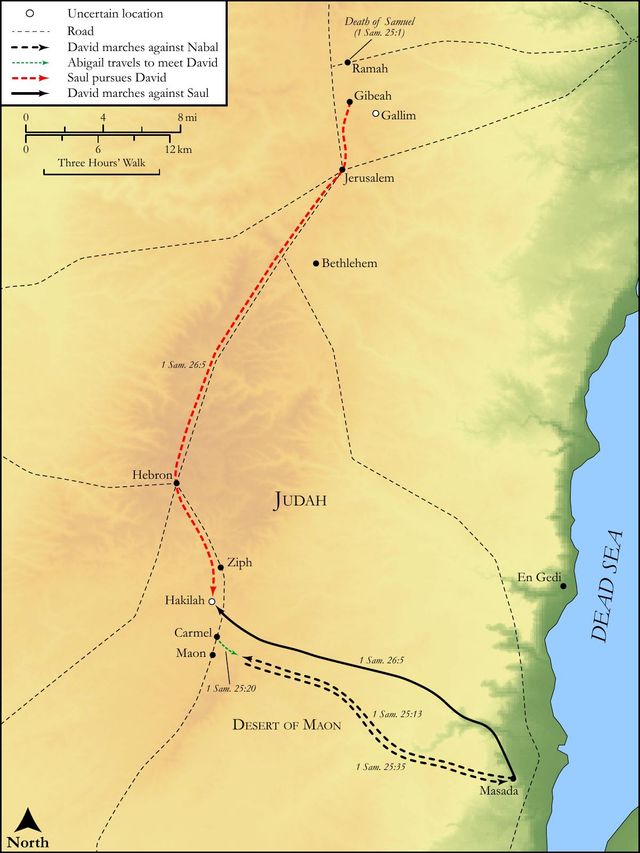
In ancient Israel and the broader Near East, a king's authority was often perceived as divinely ordained and sacrosanct. To "touch the Lord's anointed" (a phrase David himself employs in 1 Samuel 26:9) was considered an extremely grave offense, tantamount to defying God Himself. The concept of "divine delivery" (as Abishai states, "God hath delivered thine enemy into thine hand") was a prevalent understanding of providential intervention in warfare or personal conflict, where an enemy's unexpected vulnerability or defeat was interpreted as God's active hand in granting victory or opportunity. Spears were fundamental weapons of war, and a single, decisive thrust was a common and effective method of execution or battlefield kill. The fierce loyalty of a military retainer like Abishai, willing to carry out such a deed for his leader, was also a cultural norm, reflecting the hierarchical and often brutal realities of the time. The wilderness of Ziph, a rugged, desolate, and remote region within Judah, provided ideal terrain for hiding, evasion, and guerrilla warfare, accurately reflecting the desperate and precarious circumstances of David's exile.
Key Themes
ShowHideThis verse powerfully contributes to several overarching and profound themes woven throughout the book of 1 Samuel. Foremost among these is the theme of Divine Sovereignty versus Human Action. Abishai's immediate interpretation of the situation as a "God-given" opportunity for swift, decisive action stands in sharp contrast to David's patient reliance on God's perfect timing for his ascension to the throne—a theme consistently echoed throughout David's life, as seen in God's covenant with him in 2 Samuel 7. The scene also profoundly highlights the theme of Respect for God's Anointed, even when that anointed leader is actively and unjustly persecuting. David's steadfast refusal to harm Saul, despite Saul's unrighteousness and persistent attempts on David's life, underscores a deep theological principle about leaving judgment and consequences solely to God. Furthermore, the verse introduces the compelling theme of Temptation and Restraint, as David is presented with a clear, seemingly easy path to end his suffering and secure his future, yet he chooses a more difficult, faith-filled, and morally upright route. This moment, where his character shines brightly, implicitly foreshadows David's later struggles with temptation, but in this instance, his integrity is unblemished.
Exposition and Analysis
ShowHideKey Word Analysis
ShowHideDerived from the Hebrew root (סָגַר), meaning "to shut up" or "to surrender," this word in Abishai's declaration, "God hath delivered thine enemy into thine hand this day," conveys the powerful sense of God actively "handing over" or "giving up" Saul into David's power. It implies a divine act of transfer, making Saul vulnerable and accessible for decisive action, thereby framing the proposed execution as a divinely sanctioned opportunity.
The Hebrew verb (נָכָה) is a common and forceful term meaning "to strike," "to hit," "to beat," or "to kill." Abishai's repeated use of this word, combined with his desire to "smite him... even to the earth at once" and "I will not [smite] him the second time," emphasizes his intention for a single, immediate, and utterly fatal blow. It conveys a sense of finality and decisiveness, leaving no room for survival or a need for a follow-up strike.
The Hebrew word (חֲנִית) refers specifically to a spear or lance, a primary and formidable weapon in ancient warfare. Its mention here is significant not only as the intended instrument of the proposed killing but also because Saul's own spear was a potent symbol of his royal authority and physical presence (it was notably at his head, as described in 1 Samuel 26:7). Abishai's intention to use it "even to the earth" suggests a powerful, downward thrust, designed to pin Saul to the ground, ensuring immediate death and preventing any struggle or escape.
Verse Breakdown
ShowHide"Then said Abishai to David,"
This opening clause immediately identifies Abishai, David's loyal nephew and a renowned warrior, as the speaker. His counsel is presented directly after David and Abishai have successfully and stealthily infiltrated Saul's camp and found him deeply asleep, highlighting Abishai's quick assessment of the situation and his immediate readiness for decisive action.
"God hath delivered thine enemy into thine hand this day:"
Abishai interprets Saul's profound vulnerability as an unmistakable sign of divine providence. He firmly believes that God has actively intervened to grant David this supremely opportune moment, effectively "handing over" Saul. This statement frames the proposed action not as a personal vendetta or an act of rebellion but as the execution of God's perceived will, reflecting a common ancient Near Eastern understanding of battlefield success or an enemy's unexpected vulnerability.
"now therefore let me smite him, I pray thee, with the spear even to the earth at once,"
This is Abishai's direct, urgent, and passionate plea. He requests immediate permission to act decisively and without hesitation. The vivid phrase "with the spear even to the earth" graphically describes a forceful, downward thrust intended to pin Saul to the ground and ensure a fatal blow. The addition of "at once" emphasizes the desire for a swift, unhesitating execution, leaving no room for doubt or second chances.
"and I will not [smite] him the second time."
This final, emphatic clause underscores Abishai's absolute conviction in the lethality and effectiveness of a single, powerful strike. It communicates his certainty that one blow will be entirely sufficient to kill Saul, leaving no doubt or need for a follow-up, and perhaps also indicating his resolve to spare David the direct burden and moral stain of the act.
Literary Devices
ShowHideThe passage employs several potent literary devices that enrich its meaning and dramatic impact. Dramatic Irony is acutely evident as Saul, the relentless hunter, unknowingly becomes the vulnerable hunted, lying deeply asleep and unaware of the mortal danger he is in, while David, whom he seeks to kill, holds his very life in his hands. This creates intense suspense and highlights a profound reversal of fortunes. A sharp Contrast is drawn between Abishai's impulsive, pragmatic, and seemingly vengeance-driven proposal and David's impending display of profound patience, unwavering faith, and deep respect for God's anointed. Abishai represents the human inclination to seize an opportune moment through immediate action, while David embodies a higher, divinely-centered principle. The Symbolism of Saul's spear, a powerful emblem of his kingship, authority, and military prowess, now lying vulnerable at his head, further emphasizes his diminished state and the ease with which David could usurp his authority. The narrative also effectively uses Foreshadowing, as David's decision here, mirroring his earlier act of restraint in the cave of Engedi, reinforces his character as one who trusts God's timing, implicitly foreshadowing his rightful, divinely appointed ascension to the throne without resorting to violence against God's chosen leader.
Theological and Thematic Connections
ShowHideAbishai's eager proposal to eliminate Saul, while seemingly pragmatic and even divinely sanctioned from a human perspective, serves as a crucial setup for David to articulate a profound theological principle: that vengeance and the precise timing of God's sovereign plans belong solely to the Lord. David's subsequent, resolute refusal to harm "the Lord's anointed" (as powerfully seen in 1 Samuel 26:9) demonstrates an extraordinary depth of trust in God's ultimate sovereignty and perfect justice, even when enduring severe and prolonged personal persecution. This pivotal moment profoundly underscores the importance of not taking matters into one's own hands, especially when it involves God's chosen instruments or when it preempts God's perfect timing. It teaches that even when opportunities arise that appear to align perfectly with our immediate desires or offer a quick resolution, true faith involves patiently waiting on God to act in His way and in His time, respecting His supreme authority and His divinely ordained methods of justice.
Reflection and Application
ShowHideThe intense scene in 1 Samuel 26:8, particularly when viewed in the illuminating light of David's subsequent response, offers profound and enduring lessons for contemporary believers navigating the complexities of life. It challenges us to deeply examine our own impulses and inclinations when confronted with opportunities that promise immediate relief from suffering, a swift end to injustice, or a seemingly direct path to our desired outcomes. Abishai's urgent suggestion, though undoubtedly well-intentioned from his perspective and born of loyalty, powerfully represents the pervasive human tendency to "help God out" or to take matters into our own hands when we perceive a "divine opening" or an opportune moment. Yet, David's exemplary conduct reminds us that true, mature faith often requires patient endurance, a courageous willingness to forgo personal vengeance, and a deep, abiding respect for God's sovereign timing, even when it means enduring prolonged injustice, delay, or personal hardship. This passage calls us to trust implicitly that God's justice will ultimately prevail and that His divine purposes will be perfectly accomplished without our needing to resort to ungodly or premature means, even if those means appear to be the most efficient, logical, or immediately satisfying. This profound narrative encourages us to cultivate a heart that is slow to anger, quick to trust, and unwavering in its commitment to leaving the ultimate vindication and establishment of justice entirely to the Lord.
Questions for Reflection
ShowHideFAQ
ShowHideWhy did Abishai believe God had delivered Saul into David's hand?
ShowHideAbishai, like many individuals in the ancient world, interpreted Saul's deep sleep and profound vulnerability as a direct and unmistakable act of divine intervention. In their prevailing worldview, an enemy being found in such a helpless and exposed state was not mere coincidence or happenstance but a clear and unambiguous sign that God had actively "delivered" or "handed over" that enemy to be dealt with decisively. From Abishai's perspective, this was God actively clearing David's path to the throne, providing a divinely sanctioned opportunity to eliminate the persecutor and thereby fulfill God's promise to David. It was a common and widely held belief that success or vulnerability in battle or pursuit was a direct sign of divine favor or disfavor, as evidenced in numerous other biblical narratives where God "delivers" enemies into the hands of His people (e.g., Judges 4:14).
Christ-Centered Fulfillment
ShowHideThe profound restraint and unwavering trust demonstrated by David in this narrative, particularly his resolute refusal to harm "the Lord's anointed" despite extreme provocation and unjust persecution, serves as a powerful and deeply significant Old Testament foreshadowing of Christ. David, though unjustly pursued and suffering immense hardship, chose not to retaliate or seize power through violence, but instead trusted implicitly in God's perfect timing and ultimate justice. This mirrors the ultimate "Anointed One," Jesus Christ, who, though possessing all power and divine authority, willingly submitted to profound injustice, relentless persecution, and a wrongful death, refusing to call down legions of angels (Matthew 26:53) or retaliate against His tormentors (1 Peter 2:23). Just as David mercifully spared Saul, Jesus, the true and eternal King, did not come to destroy lives but to save them (Luke 9:56), offering radical forgiveness even to those who cruelly crucified Him (Luke 23:34). David's patient endurance and his steadfast reliance on God's sovereignty, rather than succumbing to human vengeance, powerfully prefigure Christ's perfect obedience to the Father's will, ultimately leading to His glorious exaltation and the establishment of an eternal kingdom not built by human might or violence, but by divine love, sacrifice, and redemptive grace (Philippians 2:8-11).