


1 Samuel 24:18
Bible text: King James Version (1769 Blayney text) · Public domain
Bible text: Berean Standard Bible · Public domain
Bible text: American Standard Version (1901) · Public domain
Bible text: World English Bible, Messianic edition · Public domain
Bible text: Geneva Bible (1599) · Public domain
Bible text: Young's Literal Translation · Public domain
- וְאַתָּהve·'atand youH859Conj-w ¦ Pro-2msPronoun Personal 2nd Singular Masculineוְandאַתָּהyou
- הִגַּדְתָּhi·Gad·tayou have toldH5046V-Hiphil-Perf-2msVerb Hiphil Perfect 2nd Singular Masculine
- הַיּוֹםhai·Yomthis dayH3117Art ¦ N-msNoun Singular Masculine Absoluteהַthisיּוֹםday
- אֵת'et<obj.>H853DirObjMParticle Object Indicator
- אֲשֶׁר'a·SherthisH834RelParticle Relative
- עָשִׂיתָה'a·Si·tahyou have doneH6213V-Qal-Perf-2msVerb Qal Perfect 2nd Singular Masculine
- אִתִּי'i·Tiwith meH854Prep ¦ 1csPreposition Definiteאִתִּwithיme
- טוֹבָהto·VahgoodH2896N-fsNoun Singular Feminine Absolute
- אֵת'et<obj.>H853DirObjMParticle Object Indicator
- אֲשֶׁר'a·Sher[and] thisH834RelParticle Relative
- סִגְּרַנִיsi·ge·Ra·nihe delivered up meH5462V-Piel-Perf-3ms ¦ 1csVerb Piel Perfect 3rd Singular Masculineסִגְּרַhe delivered upנִיme
- יְהוָהYah·wehYahwehH3068N-properNoun Proper Title
- בְּיָדְךָbe·ya·de·Khain your handH3027Prep-b ¦ N-csc ¦ 2msNoun Singular common gender Constructבְּinיָדְhandךָyour
- וְלֹאve·Lo'and notH3808Conj-w ¦ NegParticle Negativeוְandלֹאnot
- הֲרַגְתָּנִיha·rag·Ta·niyou killed meH2026V-Qal-Perf-2ms ¦ 1csVerb Qal Perfect 2nd Singular Masculineהֲרַגְתָּyou killedנִיme
English is a literal word-by-word gloss of the Hebrew, not the KJV's wording. Why?
This is the original text the KJV's translators worked from — each Hebrew word with its own literal English meaning in this verse, prepared by scholars at Tyndale House, Cambridge. The KJV translates whole sentences, not word by word, so its wording differs: one Hebrew word can become several English words, and the KJV may choose “the LORD” where the gloss reads “Yahweh”. Both are faithful — they answer different questions. For the KJV's own rendering, switch to the KJV text.
Details
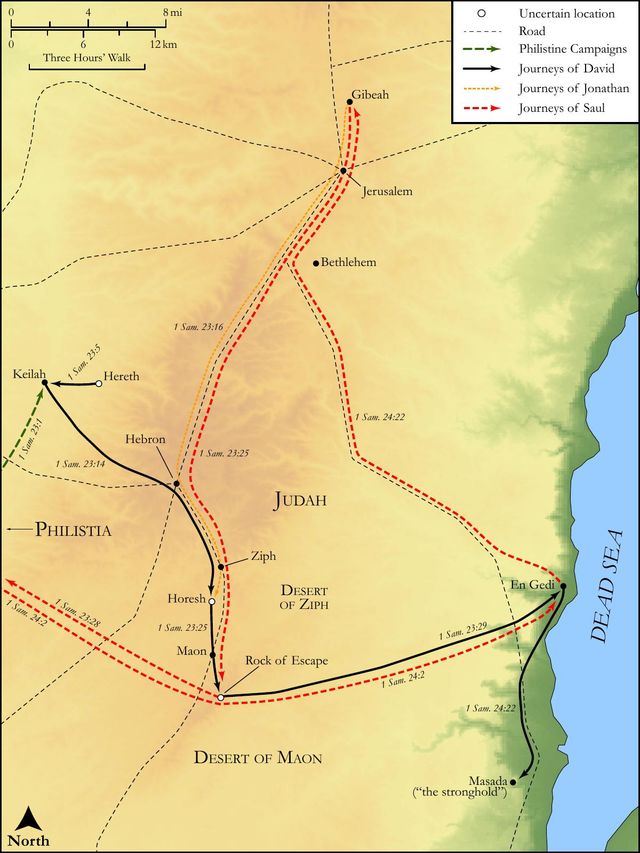
See on the biblical-era map
Study this verse
Public-domain commentary
Matthew Henry
From his Commentary on the Whole Bible. Henry comments on passages, not single verses — this entry covers 1 Samuel 24:16–22. His two-level outline is real structure in the source text, so it is rendered as structure.
Here we have,
I.Saul's penitent reply to David's speech.
It was strange that he had patience to hear him out, considering how outrageous he was against him, and how cutting David's discourse was. But God restrained him and his men; and we may suppose Saul struck with amazement at the singularity of the event, and much more when he found how much he had lain at David's mercy. His heart must have been harder than a stone if this had not affected him.
1.He melted into tears, and we will not suppose them to have been counterfeit but real expressions of his present concern at the sight of his own iniquity, so plainly proved upon him. He speaks as one quite overcome with David's kindness: Is this thy voice, my son David? And, as one that relented at the thought of his own folly and ingratitude, he lifted up his voice and wept, Sa1 24:16. Many mourn for their sins that do not truly repent of them, weep bitterly for them, and yet continue in love and league with them.
2.He ingenuously acknowledges David's integrity and his own iniquity (Sa1 24:17): Thou art more righteous than I. Now God made good to David that word on which he had caused him to hope, that he would bring forth his righteousness as the light, Psa 37:6. Those who take care to keep a good conscience may leave it to God to secure them the credit of it. This fair confession was enough to prove David innocent (even his enemy himself being judge), but not enough to prove Saul himself a true penitent. He should have said, Thou are righteous, but I am wicked; but the utmost he will own is this: Thou art more righteous than I. Bad men will commonly go no further than this in their confessions; they will own they are not so good as some others are; there are those that are better than they, and more righteous. He now owns himself under a mistake concerning David (Sa1 24:18): "Thou hast shown this day that thou art so far from seeking my hurt that thou hast dealt well with me." We are too apt to suspect others to be worse affected towards us then really they are, and than perhaps they are proved to be; and when, afterwards, our mistake is discovered, we should be forward to recall our suspicions, as Saul does here.
3.He prays God to recompense David for this his generous kindness to him. He owns that David's sparing him, when he had him in his power, was an uncommon and unparalleled instance of tenderness to an enemy; no man would have done the like; and therefore, either because he thought himself not able to give him a full recompence for so great a favour, or because he found himself not inclined to give him any recompence at all, he turns him over to God for his pay: The Lord reward thee good, Sa1 24:19. Poor beggars can do no less than pray for their benefactors, and Saul did no more.
4.He prophesies his advancement to the throne (Sa1 24:20): I know well that thou shalt surely be king. He knew it before, by the promise Samuel had made him of it compared with the excellent spirit that appeared in David, which highly aggravated his sin and folly in persecuting him as he did; he had as much reason to say concerning David as David concerning him, How can I put forth my hand against the Lord's anointed? But now he knew it by the interest he found David had in the people, the special providence of God in protecting him, and the generous kingly spirit he had now given a proof of in sparing his enemy. Now he knew it, that is, now that he was in a good temper he was willing to own that he knew it and to submit to the conviction of it. Note, Sooner or later, God will force even those that are of the synagogue of Satan to know and own those that he has loved, and to worship before their feet; for so is the promise, Rev 3:9. This acknowledgement which Saul made of David's incontestable title to the crown was a great encouragement to David himself and a support to his faith and hope.
5.He binds David with an oath hereafter to show the same tenderness of his seed and of his name as he had now shown of his person, Sa1 24:21. David had more reason to oblige Saul by an oath that he would not destroy him, yet he insists not on that (if the laws of justice and honour would not bind him, an oath would not), but Saul knew David to be a conscientious man, and would think his interests safe if he could get them secured by his oath. Saul by his disobedience had ruined his own soul, and never took care by repentance to prevent that ruin, and yet is very solicitous that his name might not be destroyed nor his seed cut off. However, David swore unto him, Sa1 24:22. Though he might be tempted, not only in revenge, but in prudence, to extirpate Saul's family, yet he binds himself not to do it, knowing that God could and would establish the kingdom to him and his, without the use of such bloody methods. This oath he afterwards religiously observed; he supported Mephibosheth, and executed those as traitors that slew Ishbosheth. The hanging up of seven of Saul's posterity, to atone for the destruction of the Gibeonites, was God's appointment, not David's act, and therefore not the violation of this oath.
II.Their parting in peace.
1.Saul, for the present, desisted from the persecution. He went home convinced, but not converted; ashamed of his envy of David, yet retaining in his breast that root of bitterness; vexed that, when at last he had found David, he could not at that time find in his heart to destroy him, as he had designed. God has many ways to tie the hands of persecutors, when he does not turn their hearts.
2.David continued to shift for his own safety. He knew Saul too well to trust him, and therefore got him up into the hold. It is dangerous venturing upon the mercy of a reconciled enemy. We read of those who believed in Christ, and yet he did not commit himself to them because he knew all men. Those that like David are innocent as doves must thus like him be wise as serpents.
Historical interpretation
Historical reception
1 surviving comment on this verse from the historical church.
Not even this act of benevolence moved Saul, however. Again he gathered an army and again he set out in pursuit, until he was a second time apprehended by David in the cave where he more clearly revealed his own iniquity and made the virtue of David even more resplendent. Envy is the most savage form of hatred. Favors render those who are hostile to us for any other reason more tractable, but kind treatment shown to an envious and spiteful person only aggravates his dislike. The greater the favors he receives, the more displeased and vexed and ill-disposed he becomes.
Continue studying 1 Samuel 24:18 across the web’s major study libraries — every link below opens this exact verse, chapter, or book on the destination site.
Read & Compare
 BibleGatewayThis verse in more than 200 translations and 70 languages.
 Bible.comThe YouVersion reader — hundreds of translations, reading plans, and highlights.
 ESV.orgCrossway's official English Standard Version reader.
 NET BibleThe NET translation with 60,000+ translators' notes on every rendering decision.
 STEP BibleTyndale House's free study tool — original text, vocabulary, and scholarly resources.
 BibliaLogos Bible Software's free web reader.
 USCCBThe New American Bible (Revised Edition) with the U.S. bishops' study notes.
Commentaries
 BibleHub CommentariesDozens of classic commentaries on this verse, gathered on one page.
 StudyLightMore than 100 commentary sets — the largest collection on the web.
 BibleRefPlain-English commentary on what this verse means, verse by verse.
 Enduring WordDavid Guzik's free commentary on this chapter, widely used by Bible teachers.
 Bible Study ToolsVerse commentary alongside Greek and Hebrew study aids.
Original Language & Research
- BibleHub InterlinearThe verse word by word — original language, transliteration, and English.
- BibleHub LexiconEvery word's original-language definition and Strong's entry.
 Blue Letter BibleDeep-study tools — Strong's numbers, concordance, and word studies.
 SefariaThe Hebrew text with Rashi and centuries of Jewish commentary.
Sermons, Hymns & Audio


TrulyRandomVerse is not affiliated with these sites and doesn’t control their content. They’re linked because they’re genuinely useful.
Summary
1 Samuel 24:18 records King Saul's astonished and temporary acknowledgment of David's profound mercy and righteousness. In this critical moment, Saul confesses that David, despite being given a clear divine opportunity to take Saul's life in the cave of En-gedi, chose instead to spare him. This act demonstrated an integrity, a reverence for God's anointed, and a trust in divine timing that transcended personal vengeance. The verse powerfully highlights David's exemplary character and God's sovereign hand orchestrating the complex drama between the reigning king and his divinely chosen successor.
Context
ShowHideLiterary Context
This verse serves as the dramatic culmination of David's extraordinary act of restraint in the cave of En-gedi, vividly narrated in 1 Samuel 24. Saul, consumed by a relentless and irrational pursuit to kill David, unknowingly entered the very cave where David and his loyal men were hiding. David's men, interpreting the situation as a direct divine intervention, urged him to seize the moment and eliminate his persecutor (1 Samuel 24:4). However, David firmly refused, articulating his profound reverence for "the LORD's anointed" and declaring that he would not "stretch forth [his] hand against him" (1 Samuel 24:6). Instead, David merely cut off a corner of Saul's robe, a symbolic act demonstrating his proximity and power over the king without inflicting harm (1 Samuel 24:4). Following this, David called out to Saul, revealing his presence and displaying the severed cloth as irrefutable evidence of his mercy. Saul's words in 1 Samuel 24:18 are a direct, bewildered response to David's powerful display of self-control, respect, and non-retaliation, leading to a rare, albeit fleeting, moment of clarity and remorse from the tormented king.
Historical & Cultural Context
The period of Saul's reign was characterized by his increasing paranoia, deep-seated jealousy, and relentless hostility towards David, whom God had sovereignly chosen and anointed to succeed him (1 Samuel 16:13). Culturally, the concept of "the LORD's anointed" (Hebrew: mashiach) carried immense theological and political weight. To lay hands on the king, even a disobedient or wicked one, was widely perceived as an offense against God Himself, given that the king's authority was divinely ordained. Vengeance was a common and often expected response in that day when one's life or honor was threatened. David's act of mercy, therefore, transcended mere personal choice; it was a profound theological statement, demonstrating his unwavering adherence to divine principles over human custom, personal gain, or even self-preservation. Geographically, the wilderness of En-gedi was a rugged, arid, and desolate region along the Dead Sea, renowned for its numerous caves, which provided ideal hiding places for David and his loyal band of men as they fled Saul's relentless pursuit.
Key Themes
ShowHide1 Samuel 24:18 contributes significantly to several overarching themes within the broader narrative of the book of Samuel. Firstly, it powerfully illustrates the theme of Mercy Over Vengeance. David's resolute refusal to harm Saul, despite Saul's malicious pursuit and the undeniable opportunity, stands in stark contrast to the prevailing cultural norms and Saul's own vengeful actions. This act foreshadows a higher ethic of responding to evil with good, a principle later expounded and commanded in the New Testament (e.g., Romans 12:19-21). Secondly, the verse underscores God's Sovereignty. Saul's admission, "when the LORD had delivered me into thine hand," is a direct acknowledgment that God, not mere chance or human cunning, had placed him in a position of extreme vulnerability. This highlights divine providence in the unfolding events, even in moments of peril and intense human conflict, emphasizing that God is actively involved in the affairs of His people and their leaders. Finally, David's actions in this chapter, culminating in Saul's confession, exemplify his Integrity and Righteousness. David's unshakeable faith that God would ultimately deliver him and establish His chosen king allowed him to wait patiently on the Lord's timing rather than taking matters into his own hands, even when provoked to violence. This demonstrates a deep respect for God's anointing and His ultimate, perfect plan.
Exposition and Analysis
ShowHideKey Word Analysis
ShowHideFrom the primitive root H5046 (nâgad), meaning "to front, i.e. stand boldly out opposite; by implication (causatively), to manifest; figuratively, to announce (always by word of mouth to one present); specifically, to expose, predict, explain, praise." Saul's statement acknowledges that David's actions did not merely tell but demonstrated or revealed his good character in a tangible, undeniable way. It implies a public or evident disclosure of David's true nature.
(ṭôwb), meaning "good (as an adjective) in the widest sense; used likewise as a noun... encompasses moral goodness, kindness, and beneficial action." When Saul says David "dealt well" with him, he is confessing that David acted righteously, kindly, and beneficially towards him. This stands in direct contradiction to Saul's own malicious intent and actions, serving as an admission that David's conduct was fundamentally "good" in both human and divine terms.
From the primitive root H5462 (çâgar), meaning "to shut up; figuratively, to surrender; close up, deliver (up), give over (up)." Saul's choice of this word is crucial. He recognizes that his life was literally "given over" or "surrendered" into David's hands by the LORD. This is not an accident or a stroke of luck for David; it is a divine act of providence, an acknowledgment of God's active involvement in the situation, even to Saul's own peril, highlighting God's sovereign control over circumstances.
Verse Breakdown
ShowHide"And thou hast shewed this day how that thou hast dealt well with me:"
Saul begins by directly addressing David, acknowledging that David's actions on this very day (referring to the cave incident) have undeniably demonstrated or revealed his good and righteous character. The phrase "dealt well with me" is a profound confession, admitting that David, the very man Saul sought to destroy, acted with kindness, integrity, and moral uprightness towards him. It starkly underscores the contrast between David's conduct and Saul's own.
"forasmuch as when the LORD had delivered me into thine hand,"
This clause provides the foundational reason for Saul's confession. Saul recognizes and explicitly states that the extraordinary opportunity for David to kill him was not a random occurrence but a direct, intentional divine act. The phrase "the LORD had delivered me into thine hand" is a clear admission of God's sovereignty. Saul understands that God had intentionally placed him in a position of extreme vulnerability, entirely at David's mercy, thereby testing David's character and unmistakably revealing God's active hand in the unfolding events.
"thou killedst me not."
This is the stark, undeniable fact that underpins Saul's entire confession and astonishment. Despite being given the ultimate power over his enemy's life by divine providence, David chose not to exercise it. This act of profound restraint, of refusing to take vengeance or seize power through violence, is what astounds Saul and compels his confession of David's righteousness. It highlights David's deep and abiding respect for God's anointing on Saul, even when that anointing was being used to persecute and threaten his own life.
Literary Devices
ShowHideThe passage in 1 Samuel 24 and specifically verse 18 is rich with literary devices that amplify its theological impact. Irony is profoundly prominent, as Saul, the powerful king relentlessly hunting David, unknowingly enters the very cave where David, his perceived prey, is hiding, thus becoming utterly vulnerable to the one he seeks to destroy. This dramatic reversal of roles underscores the divine hand at play, demonstrating God's control over human circumstances. There is also a powerful instance of Confession, as Saul, typically consumed by jealousy and hardened in his malicious pursuit, is momentarily broken and forced to acknowledge David's superior righteousness and divine favor. This represents a rare moment of truth and humility from the tormented king. Furthermore, the narrative employs stark Contrast between David's merciful, God-fearing actions and Saul's vengeful, disobedient, and self-serving behavior, highlighting the profound moral and spiritual chasm between the two men. David's act of cutting the corner of Saul's robe, rather than taking Saul's life, serves as a powerful Symbolism of David's restraint and his respect for the sacred office of the king, even as it subtly signals the symbolic "cutting off" of Saul's kingdom and the transfer of divine favor.
Theological and Thematic Connections
ShowHideSaul's confession in 1 Samuel 24:18 is a profound theological statement, affirming that true righteousness is demonstrated not merely by adherence to law, but by extraordinary acts of mercy and self-restraint, particularly when one holds power over an adversary. David's actions exemplify a foundational divine principle: that God's people are called to trust in His justice and timing rather than seeking personal vengeance or seizing opportunities for self-advancement through ungodly means. Saul's explicit acknowledgment that "the LORD had delivered me into thine hand" underscores God's active sovereignty in human affairs, even in the most perilous and personal conflicts. It teaches that God orchestrates circumstances to reveal character, to test faith, and ultimately to advance His purposes, often through unexpected acts of grace that confound human expectations. David's refusal to harm the Lord's anointed, despite immense personal suffering and provocation, sets an exceptionally high standard for respecting divine authority and patiently waiting for God to execute His judgment and establish His chosen ones in His perfect way.
Reflection and Application
ShowHide1 Samuel 24:18 offers powerful and enduring lessons for believers today, challenging us to embody a radical Christ-like character in the face of adversity, injustice, and personal attacks. David's deliberate decision not to harm Saul, despite having every human justification and a clear opportunity to end his persecution, calls us to prioritize mercy over vengeance, even when we are deeply wronged or unjustly persecuted. It serves as a potent reminder that our integrity, especially in moments when no one else is watching or when we could easily take matters into our own hands without immediate consequence, speaks volumes about the authenticity and depth of our faith. When we choose to trust God's timing and His perfect justice, rather than seeking immediate retribution or personal gain through ungodly means, we demonstrate a profound reliance on His sovereignty and a true submission to His will. This passage encourages us to deeply reflect on how we respond to those who hurt us, prompting us to consider if our actions truly reflect the character of God, who is rich in mercy, abounding in steadfast love, and slow to anger. It is a compelling call to live out our faith by demonstrating grace, even to our enemies, believing with unwavering conviction that God will ultimately vindicate the righteous and fulfill His promises in His perfect way and time.
Questions for Reflection
ShowHideFAQ
ShowHideWas Saul's confession in 1 Samuel 24:18 a sign of true repentance?
ShowHideWhile Saul's confession in 1 Samuel 24:18 appears sincere and filled with profound remorse in the moment, the broader narrative of 1 Samuel strongly suggests it was a temporary emotional response rather than a lasting, transformative change of heart. Immediately after this encounter, Saul weeps and acknowledges David's righteousness (1 Samuel 24:16-17), and even prophesies David's future kingship (1 Samuel 24:20). However, Saul soon reverts to his old patterns of jealousy, paranoia, and relentless pursuit, as vividly seen in 1 Samuel 26, where David again has an opportunity to kill him but spares him once more. True biblical repentance involves a fundamental turning away from sin, a sustained change in behavior, and a consistent alignment with God's will, which Saul consistently failed to demonstrate throughout his reign. His confessions were often fleeting, driven by the immediate impact of David's righteous actions, but not deep enough to fundamentally transform his character or alter his destructive path.
Why was it so important for David not to kill Saul, even though Saul was trying to kill him?
ShowHideDavid's resolute refusal to kill Saul, despite multiple clear opportunities and immense personal provocation, was rooted in his profound reverence for God's anointing. Saul, though disobedient, tormented by an evil spirit, and actively seeking David's life, was still "the LORD's anointed" (1 Samuel 24:6). David understood that God Himself had placed Saul on the throne, and therefore, to remove him by human hand would be an act of rebellion against God's sovereign will and established order. David chose to trust God to remove Saul in His own perfect time and way, rather than seizing power through violence or political maneuvering. This demonstrated David's deep faith, his unwavering integrity, and his commitment to God's divine plan and timing. It also powerfully set him apart from other leaders of his time who would readily eliminate rivals to secure power. David's actions showed that his claim to the throne was not based on human ambition or force, but on divine appointment and a patient, humble trust in God's overarching plan (1 Samuel 16:1-13).
Christ-Centered Fulfillment
ShowHide1 Samuel 24:18 finds its ultimate fulfillment and deepest theological meaning in the person and redemptive work of Jesus Christ. David's extraordinary act of mercy towards Saul, his relentless persecutor, serves as a poignant foreshadowing of the perfect and ultimate mercy of Christ. While David spared the life of an earthly king who sought to destroy him, Jesus, the true and eternal King, willingly laid down His own life for His enemies—for humanity, who were spiritually dead and actively hostile towards God (Romans 5:8). David's refusal to take vengeance, even when "the LORD had delivered" his enemy into his hand, powerfully points to Christ's unparalleled submission to the Father's will, even unto death on the cross, trusting God for His vindication and ultimate triumph (Philippians 2:8-9). Saul's confession of David's righteousness, compelled by David's undeniable goodness and restraint, mirrors how the world, through Christ's perfect life, sacrificial death, and glorious resurrection, is confronted with the absolute righteousness and holiness of God. Jesus, as the greater David, did not come to condemn the world but to save it (John 3:17), offering forgiveness and eternal life even to those who nailed Him to the cross (Luke 23:34). Thus, David's mercy in the cave, a profound act of grace in the face of injustice, is a beautiful shadow of the immeasurable grace and redemptive love demonstrated by the Lamb of God, who takes away the sin of the world (John 1:29), offering salvation to all who believe.