


1 Samuel 24:19
Bible text: King James Version (1769 Blayney text) · Public domain
Bible text: Berean Standard Bible · Public domain
Bible text: American Standard Version (1901) · Public domain
Bible text: World English Bible, Messianic edition · Public domain
Bible text: Geneva Bible (1599) · Public domain
Bible text: Young's Literal Translation · Public domain
- וְכִיve·khiand ifH3588Conj-w ¦ PrtParticle Conditionalוְandכִיif
- יִמְצָאyim·Tza'he will findH4672V-Qal-Imperf-3msVerb Qal Imperfect 3rd Singular Masculine
- אִישׁ'ishanyoneH376N-msNoun Singular Masculine Absolute
- אֶת'et<obj.>H853DirObjMParticle Object Indicator
- אֹיְבוֹ'o·ye·Vohis enemyH341V-Qal-Prtcpl-ms ¦ 3msVerb Qal Participle Singular Masculine Constructאֹיְבenemyוֹhis
- וְשִׁלְּחוֹve·shi·le·Choand will he send away? himH7971Conj-w ¦ V-Piel-ConsecPerf-3ms ¦ 3msVerb Piel Consecutive Perfect 3rd Singular Masculineוְandשִׁלְּחwill he send away?וֹhim
- בְּדֶרֶךְbe·De·rekhon a journeyH1870Prep-b ¦ N-csNoun Singular common gender Absoluteבְּonדֶרֶךְa journey
- טוֹבָהto·VahgoodH2896Adj-fsAdjective Singular Feminine Absolute
- וַיהוָהva·Yah·wehand YahwehH3068Conj-w ¦ N-properNoun Proper TitleוַandיהוָהYahweh
- יְשַׁלֶּמְךָye·sha·lem·Khamay he reward youH7999V-Piel-Imperf-3ms ¦ 2msVerb Piel Imperfect 3rd Singular Masculineיְשַׁלֶּמְmay he rewardךָyou
- טוֹבָהto·VahgoodH2896N-fsNoun Singular Feminine Absolute
- תַּחַתTa·chatin place ofH8478N-mscNoun Singular Masculine Construct
- הַיּוֹםhai·Yomthe dayH3117Art ¦ N-msNoun Singular Masculine Absoluteהַtheיּוֹםday
- הַזֶּהha·Zeh<the> thisH2088Art ¦ PrtParticle Demonstrativeהַ<the>זֶּהthis
- אֲשֶׁר'a·Sher[that] whichH834RelParticle Relative
- עָשִׂיתָה'a·Si·tahyou have doneH6213V-Qal-Perf-2msVerb Qal Perfect 2nd Singular Masculine
- לִיLito <the> mePrep-l ¦ 1csSuffix Personal 1st Singular common genderלִto <the>יme
English is a literal word-by-word gloss of the Hebrew, not the KJV's wording. Why?
This is the original text the KJV's translators worked from — each Hebrew word with its own literal English meaning in this verse, prepared by scholars at Tyndale House, Cambridge. The KJV translates whole sentences, not word by word, so its wording differs: one Hebrew word can become several English words, and the KJV may choose “the LORD” where the gloss reads “Yahweh”. Both are faithful — they answer different questions. For the KJV's own rendering, switch to the KJV text.
Details
See on the biblical-era map
Study this verse
Public-domain commentary
Matthew Henry
From his Commentary on the Whole Bible. Henry comments on passages, not single verses — this entry covers 1 Samuel 24:16–22. His two-level outline is real structure in the source text, so it is rendered as structure.
Here we have,
I.Saul's penitent reply to David's speech.
It was strange that he had patience to hear him out, considering how outrageous he was against him, and how cutting David's discourse was. But God restrained him and his men; and we may suppose Saul struck with amazement at the singularity of the event, and much more when he found how much he had lain at David's mercy. His heart must have been harder than a stone if this had not affected him.
1.He melted into tears, and we will not suppose them to have been counterfeit but real expressions of his present concern at the sight of his own iniquity, so plainly proved upon him. He speaks as one quite overcome with David's kindness: Is this thy voice, my son David? And, as one that relented at the thought of his own folly and ingratitude, he lifted up his voice and wept, Sa1 24:16. Many mourn for their sins that do not truly repent of them, weep bitterly for them, and yet continue in love and league with them.
2.He ingenuously acknowledges David's integrity and his own iniquity (Sa1 24:17): Thou art more righteous than I. Now God made good to David that word on which he had caused him to hope, that he would bring forth his righteousness as the light, Psa 37:6. Those who take care to keep a good conscience may leave it to God to secure them the credit of it. This fair confession was enough to prove David innocent (even his enemy himself being judge), but not enough to prove Saul himself a true penitent. He should have said, Thou are righteous, but I am wicked; but the utmost he will own is this: Thou art more righteous than I. Bad men will commonly go no further than this in their confessions; they will own they are not so good as some others are; there are those that are better than they, and more righteous. He now owns himself under a mistake concerning David (Sa1 24:18): "Thou hast shown this day that thou art so far from seeking my hurt that thou hast dealt well with me." We are too apt to suspect others to be worse affected towards us then really they are, and than perhaps they are proved to be; and when, afterwards, our mistake is discovered, we should be forward to recall our suspicions, as Saul does here.
3.He prays God to recompense David for this his generous kindness to him. He owns that David's sparing him, when he had him in his power, was an uncommon and unparalleled instance of tenderness to an enemy; no man would have done the like; and therefore, either because he thought himself not able to give him a full recompence for so great a favour, or because he found himself not inclined to give him any recompence at all, he turns him over to God for his pay: The Lord reward thee good, Sa1 24:19. Poor beggars can do no less than pray for their benefactors, and Saul did no more.
4.He prophesies his advancement to the throne (Sa1 24:20): I know well that thou shalt surely be king. He knew it before, by the promise Samuel had made him of it compared with the excellent spirit that appeared in David, which highly aggravated his sin and folly in persecuting him as he did; he had as much reason to say concerning David as David concerning him, How can I put forth my hand against the Lord's anointed? But now he knew it by the interest he found David had in the people, the special providence of God in protecting him, and the generous kingly spirit he had now given a proof of in sparing his enemy. Now he knew it, that is, now that he was in a good temper he was willing to own that he knew it and to submit to the conviction of it. Note, Sooner or later, God will force even those that are of the synagogue of Satan to know and own those that he has loved, and to worship before their feet; for so is the promise, Rev 3:9. This acknowledgement which Saul made of David's incontestable title to the crown was a great encouragement to David himself and a support to his faith and hope.
5.He binds David with an oath hereafter to show the same tenderness of his seed and of his name as he had now shown of his person, Sa1 24:21. David had more reason to oblige Saul by an oath that he would not destroy him, yet he insists not on that (if the laws of justice and honour would not bind him, an oath would not), but Saul knew David to be a conscientious man, and would think his interests safe if he could get them secured by his oath. Saul by his disobedience had ruined his own soul, and never took care by repentance to prevent that ruin, and yet is very solicitous that his name might not be destroyed nor his seed cut off. However, David swore unto him, Sa1 24:22. Though he might be tempted, not only in revenge, but in prudence, to extirpate Saul's family, yet he binds himself not to do it, knowing that God could and would establish the kingdom to him and his, without the use of such bloody methods. This oath he afterwards religiously observed; he supported Mephibosheth, and executed those as traitors that slew Ishbosheth. The hanging up of seven of Saul's posterity, to atone for the destruction of the Gibeonites, was God's appointment, not David's act, and therefore not the violation of this oath.
II.Their parting in peace.
1.Saul, for the present, desisted from the persecution. He went home convinced, but not converted; ashamed of his envy of David, yet retaining in his breast that root of bitterness; vexed that, when at last he had found David, he could not at that time find in his heart to destroy him, as he had designed. God has many ways to tie the hands of persecutors, when he does not turn their hearts.
2.David continued to shift for his own safety. He knew Saul too well to trust him, and therefore got him up into the hold. It is dangerous venturing upon the mercy of a reconciled enemy. We read of those who believed in Christ, and yet he did not commit himself to them because he knew all men. Those that like David are innocent as doves must thus like him be wise as serpents.
Historical interpretation
Historical reception
1 surviving comment on this verse from the historical church.
Not even this act of benevolence moved Saul, however. Again he gathered an army and again he set out in pursuit, until he was a second time apprehended by David in the cave where he more clearly revealed his own iniquity and made the virtue of David even more resplendent. Envy is the most savage form of hatred. Favors render those who are hostile to us for any other reason more tractable, but kind treatment shown to an envious and spiteful person only aggravates his dislike. The greater the favors he receives, the more displeased and vexed and ill-disposed he becomes.
Continue studying 1 Samuel 24:19 across the web’s major study libraries — every link below opens this exact verse, chapter, or book on the destination site.
Read & Compare
 BibleGatewayThis verse in more than 200 translations and 70 languages.
 Bible.comThe YouVersion reader — hundreds of translations, reading plans, and highlights.
 ESV.orgCrossway's official English Standard Version reader.
 NET BibleThe NET translation with 60,000+ translators' notes on every rendering decision.
 STEP BibleTyndale House's free study tool — original text, vocabulary, and scholarly resources.
 BibliaLogos Bible Software's free web reader.
 USCCBThe New American Bible (Revised Edition) with the U.S. bishops' study notes.
Commentaries
 BibleHub CommentariesDozens of classic commentaries on this verse, gathered on one page.
 StudyLightMore than 100 commentary sets — the largest collection on the web.
 BibleRefPlain-English commentary on what this verse means, verse by verse.
 Enduring WordDavid Guzik's free commentary on this chapter, widely used by Bible teachers.
 Bible Study ToolsVerse commentary alongside Greek and Hebrew study aids.
Original Language & Research
- BibleHub InterlinearThe verse word by word — original language, transliteration, and English.
- BibleHub LexiconEvery word's original-language definition and Strong's entry.
 Blue Letter BibleDeep-study tools — Strong's numbers, concordance, and word studies.
 SefariaThe Hebrew text with Rashi and centuries of Jewish commentary.
Sermons, Hymns & Audio


TrulyRandomVerse is not affiliated with these sites and doesn’t control their content. They’re linked because they’re genuinely useful.
Summary
1 Samuel 24:19 captures David's profound act of mercy and his unwavering trust in divine justice, spoken to King Saul after David spared his life in the cave of Engedi. This verse encapsulates David's exceptional character, demonstrating his refusal to retaliate against his persecutor, choosing instead to commit the outcome to the Lord. It highlights the counter-intuitive nature of David's forbearance and his expectation that God would justly respond to his righteous deed.
Context
ShowHideLiterary Context
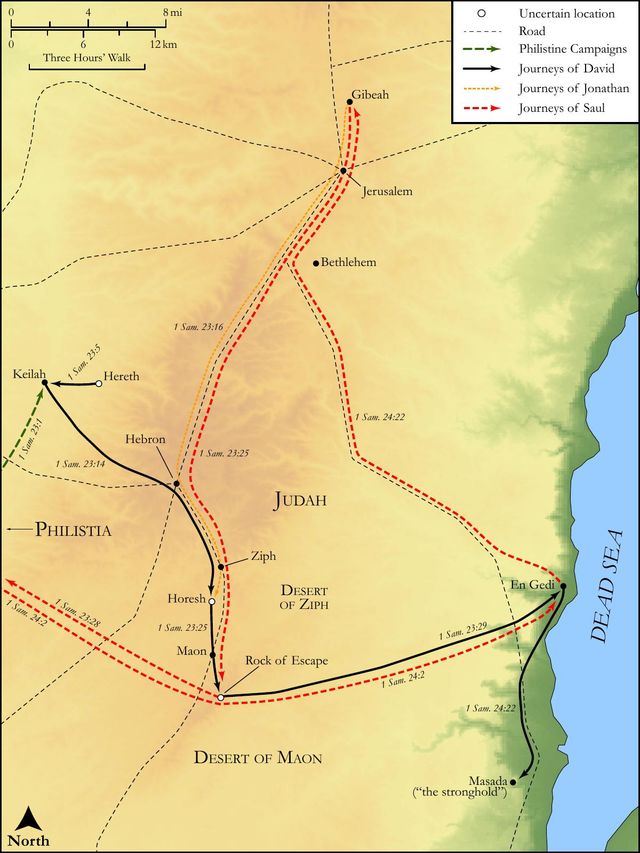
This verse is a pivotal moment in the ongoing conflict between King Saul and David. Chapter 24 opens with Saul pursuing David into the wilderness of Engedi, where Saul enters a cave to relieve himself, unaware that David and his men are hiding within. David's men urge him to kill Saul, seeing it as a divinely ordained opportunity. However, David refuses to harm "the Lord's anointed," as recounted in 1 Samuel 24:6. Instead, he secretly cuts off a corner of Saul's robe as proof of his proximity and his decision to show mercy. After Saul leaves the cave, David calls out to him, revealing himself and presenting the robe fragment. The rhetorical question found in this verse serves as David's powerful appeal to Saul, underscoring the extraordinary nature of his merciful act and contrasting it with the typical human response to an enemy.
Historical & Cultural Context
The narrative unfolds during a period of intense political instability and personal vendetta within the nascent Israelite monarchy. Saul, the first king of Israel, is increasingly paranoid and consumed by jealousy over David's military successes and popularity, viewing him as a threat to his throne. David, though anointed by Samuel as the future king, as detailed in 1 Samuel 16, consistently demonstrates loyalty and respect for Saul's divinely appointed position, even as Saul actively seeks his life. The cultural expectation of the time would have been for David to seize any opportunity for vengeance against a mortal enemy, especially one who had repeatedly sought his destruction. David's actions, therefore, stand in stark contrast to the prevailing norms of blood feud and self-preservation, reflecting a higher moral and theological commitment.
Key Themes
ShowHideThis verse powerfully contributes to several overarching themes in 1 Samuel and the broader biblical narrative. Firstly, it highlights Extraordinary Mercy and Forbearance, showcasing David's refusal to take vengeance despite clear provocation and opportunity. This act foreshadows later biblical teachings on loving one's enemies, as seen in Matthew 5:44. Secondly, it underscores David's deep Trust in God's Justice and Sovereignty. David's decision not to harm Saul stems from his reverence for God's anointed and his conviction that vengeance belongs to the Lord alone, a principle articulated in Deuteronomy 32:35. He leaves the ultimate resolution of their conflict in God's hands, a principle echoed in Romans 12:19. Thirdly, the verse subtly introduces the theme of God's Reward for Righteousness. David's prayer for the Lord to "reward thee good" for his own act of mercy suggests an understanding that righteous actions, even towards an enemy, are recognized and honored by God. Finally, it reinforces David's consistent Respect for God's Anointed, a recurring motif that defines David's character, even when it places him in grave danger, as further demonstrated in 1 Samuel 26:9.
Exposition and Analysis
ShowHideKey Word Analysis
ShowHideThis term (H341) denotes a hostile adversary, one who actively hates and seeks harm. The use of "enemy" here by David emphasizes the profound nature of his act: he is not merely showing leniency to an opponent, but to someone who has relentlessly pursued his life with murderous intent. This makes his act of mercy all the more remarkable and counter-cultural, highlighting the depth of the animosity David chose to overcome with grace.
The Hebrew verb (H7999) carries the meaning "to be safe," "to be completed," "to recompense," or "to make peace." It can be used in both positive and negative senses, implying a reciprocal action or a bringing to completion. In this context, David is not asking God to punish Saul for his evil, but rather to "deal with" him "good" in response to David's own good deed. It is a prayer for divine beneficence to be extended, highlighting God's faithfulness to those who act righteously, even towards their adversaries, and perhaps a desire for peace to be established.
The Hebrew word (H2896) is broad in meaning, encompassing moral goodness, pleasantness, prosperity, and blessing. When David prays for the Lord to "reward thee good," he is invoking God's favor and blessing upon Saul, not for Saul's own merits, but as a consequence of David's righteous act of mercy. It implies a desire for God's benevolent intervention in Saul's life, perhaps even leading to a change of heart, a cessation of his persecution, or a restoration of well-being.
Verse Breakdown
ShowHide"For if a man find his enemy, will he let him go well away?"
This is a rhetorical question, designed to elicit an obvious "no" from the listener. It highlights the universally understood human inclination for vengeance or self-preservation when confronted with an enemy, especially one who has sought one's life. By posing this question, David underscores the extraordinary and counter-intuitive nature of his own actions in sparing Saul. He is implicitly stating, "No ordinary man would do what I have done; my actions are exceptional."
"wherefore the LORD reward thee good"
This clause marks a shift from David's rhetorical statement to a direct prayer or imprecation to God. The phrase "wherefore" (וַיהוָה יְשַׁלֵּם) connects the divine action to David's preceding act of mercy. David is asking God to actively "repay" or "deal with" Saul in a benevolent way. This is not a request for Saul's repentance, but for God to respond to David's righteousness by extending goodness, perhaps even protection or peace, to Saul, demonstrating God's just and faithful character.
"for that thou hast done unto me this day."
This final clause clarifies the basis for David's prayer. The "good" that David asks God to "reward" Saul with is not a reward for anything good Saul has done, but rather a divine response to David's own righteous act of sparing Saul's life. David is essentially saying, "Because I have shown you mercy, may God, in His justice, respond to my good deed by extending goodness to you." It's a profound expression of faith that God honors acts of righteousness, even when directed towards an undeserving recipient, and that divine justice will ultimately prevail.
Literary Devices
ShowHide1 Samuel 24:19 employs several powerful literary devices. The most prominent is the Rhetorical Question: "For if a man find his enemy, will he let him go well away?" This question is not meant to be answered but to emphasize the exceptional and unexpected nature of David's mercy. It highlights the stark contrast between human instinct (retaliation) and David's divinely inspired forbearance. There is also a strong element of Irony present, as the hunted (David) shows profound mercy to the hunter (Saul), subverting the expected power dynamics and demonstrating David's moral and spiritual superiority. The second part of the verse functions as a Prayer or Imprecation, a direct appeal to God for action and a declaration of trust in divine recompense. David's words also create a powerful Contrast between the typical human response to an enemy and the divine standard of mercy and trust in God's justice that David embodies. This verse serves as a microcosm of David's character, revealing his deep faith and commitment to God's ways even in the face of extreme provocation.
Theological and Thematic Connections
ShowHideThis verse is a profound theological statement on divine justice, human responsibility, and the nature of true righteousness. David's act of sparing Saul, followed by his prayer for God to "reward" Saul with "good" because of David's own mercy, demonstrates a sophisticated understanding of God's character and His covenant faithfulness. It teaches that God is the ultimate arbiter of justice and that vengeance belongs to Him. By entrusting Saul's fate to God, David exemplifies a faith that transcends personal injury and seeks God's righteous intervention rather than human retribution. This act of grace towards an enemy, rooted in reverence for God's anointed, sets a powerful precedent for future biblical teachings on loving one's adversaries and trusting in God's sovereign plan, knowing that God will ultimately recompense all deeds according to His perfect will.
Reflection and Application
ShowHide1 Samuel 24:19 stands as a timeless challenge to believers regarding their response to those who wrong them. David's example in the cave of Engedi calls us to a higher standard than mere human retaliation. It teaches us that true strength is found not in vengeance, but in forbearance and trust in God's ultimate justice. When faced with opportunities to "get even" or to harm those who have hurt us, David's actions urge us to choose mercy, even when it feels counter-intuitive or undeserved. This requires a deep-seated faith that God sees our righteous acts and that He is capable of bringing about justice and recompense in His own perfect timing. Furthermore, David's prayer for God to reward Saul "good" because of David's own good deed is a profound call to pray for our enemies, desiring God's blessing and intervention in their lives, even if they remain hostile. It reminds us that our acts of mercy are not just for the benefit of the recipient, but are also seen and honored by God, who promises to bless those who walk in righteousness.
Questions for Reflection
ShowHideFAQ
ShowHideWhy did David spare Saul's life, especially when he had such a clear opportunity to end his persecution?
ShowHideDavid spared Saul's life primarily out of profound reverence for God's anointed king. Despite Saul's persistent and irrational hatred, David consistently refused to lay a hand on him because Saul was the Lord's chosen and anointed ruler, as he declared in 1 Samuel 24:6. David believed that only God had the right to remove or judge His chosen king. This decision also stemmed from David's deep trust in God's justice and sovereignty. He was confident that God would ultimately deliver him and establish His purposes, without David needing to resort to human vengeance or usurpation. David's actions demonstrate his commitment to God's timing and methods, rather than his own.
What does David mean by "the LORD reward thee good for that thou hast done unto me this day"? Is he asking God to bless Saul for Saul's actions?
ShowHideDavid is not asking God to bless Saul for anything good Saul has done. Rather, he is asking God to "reward" (or "deal with") Saul "good" because of David's own righteous act of sparing Saul's life. David is essentially invoking God's justice and faithfulness to respond to his act of mercy. He believes that his act of showing grace to Saul is a "good" deed in God's eyes, and he is praying that God would, in turn, extend goodness to Saul, perhaps leading to a cessation of Saul's persecution or even a change of heart. It's a prayer for God to respond to David's righteousness by influencing Saul's situation for the better, demonstrating God's reciprocal nature in blessing those who act righteously.
Christ-Centered Fulfillment
ShowHide1 Samuel 24:19, with David's extraordinary act of mercy toward his enemy, finds its ultimate and most profound fulfillment in the person and work of Jesus Christ. David's refusal to retaliate and his prayer for God to "reward" Saul with "good" foreshadow the perfect love and self-sacrifice demonstrated by the Lamb of God who takes away the sin of the world. While David spared his enemy, Jesus, though perfectly innocent, willingly laid down His life for those who were His enemies, reconciling them to God, as powerfully declared in Romans 5:8-10. The rhetorical question, "For if a man find his enemy, will he let him go well away?" is answered definitively in Christ, who not only let His enemies "go well away" but actively pursued their redemption, even praying, "Father, forgive them, for they know not what they do" from the cross. David's trust in God's justice, rather than human vengeance, points to Christ, who "when he was reviled, reviled not again; when he suffered, he threatened not; but committed himself to him that judgeth righteously," as we read in 1 Peter 2:23. The "good" that David prayed for Saul, a divine reward for an act of mercy, is ultimately realized in the gospel, where God's ultimate "good" is extended to humanity through the atoning sacrifice of Christ, offering forgiveness and eternal life to all who believe, even those who were once hostile to God and alienated in their minds by wicked works, as described in Colossians 1:21-22. David's act of mercy is a shadow; Christ's sacrifice is the substance, revealing the boundless depths of God's love for His enemies.