


1 Samuel 24:20
Bible text: King James Version (1769 Blayney text) · Public domain
Bible text: Berean Standard Bible · Public domain
Bible text: American Standard Version (1901) · Public domain
Bible text: World English Bible, Messianic edition · Public domain
Bible text: Geneva Bible (1599) · Public domain
Bible text: Young's Literal Translation · Public domain
- וְעַתָּהve·'a·Tahand thereforeH6258Conj-w ¦ AdvAdverbוְandעַתָּהtherefore
- הִנֵּהhi·Nehhere!H2009PrtParticle Interjection
- יָדַעְתִּיya·Da'·tiI knowH3045V-Qal-Perf-1csVerb Qal Perfect 1st Singular common gender
- כִּיkithatH3588PrtParticle Conditional
- מָלֹךְma·Lokhcertainly <to reign>H4427V-Qal-InfAbsVerb Qal Infinitive Absolute
- תִּמְלוֹךְtim·Lokhyou will reignH4427V-Qal-Imperf-2msVerb Qal Imperfect 2nd Singular Masculine
- וְקָמָהve·Ka·mahand it will be establishedH6965Conj-w ¦ V-Qal-ConsecPerf-3fsVerb Qal Consecutive Perfect 3rd Singular Feminineוְandקָמָהit will be established
- בְּיָדְךָbe·Ya·de·khain your handH3027Prep-b ¦ N-csc ¦ 2msNoun Singular common gender Constructבְּinיָדְhandךָyour
- מַמְלֶכֶתmam·Le·khet[the] kingdom ofH4467N-fscNoun Singular Feminine Construct
- יִשְׂרָאֵלYis·ra·'ElIsraelH3478N-properNoun Proper Location
English is a literal word-by-word gloss of the Hebrew, not the KJV's wording. Why?
This is the original text the KJV's translators worked from — each Hebrew word with its own literal English meaning in this verse, prepared by scholars at Tyndale House, Cambridge. The KJV translates whole sentences, not word by word, so its wording differs: one Hebrew word can become several English words, and the KJV may choose “the LORD” where the gloss reads “Yahweh”. Both are faithful — they answer different questions. For the KJV's own rendering, switch to the KJV text.
Details
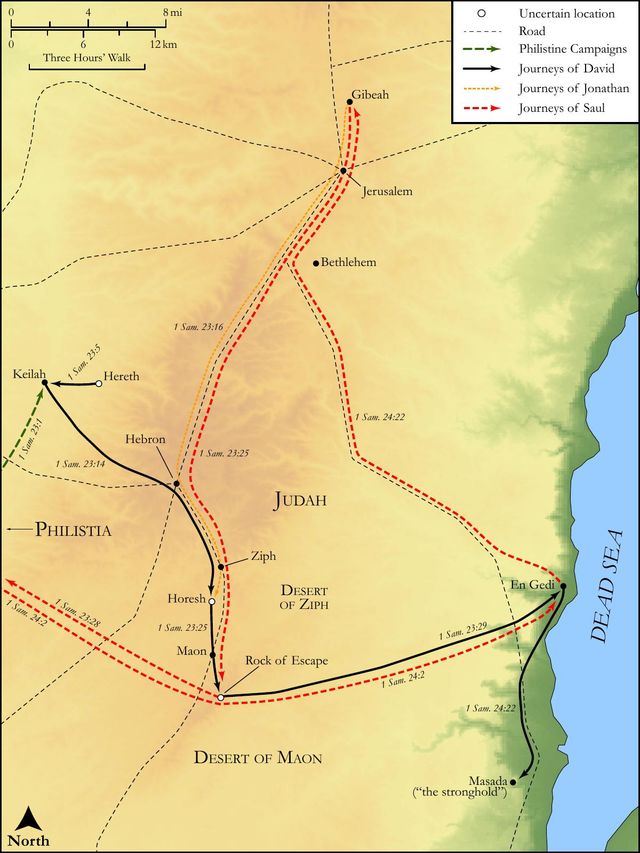
See on the biblical-era map
Study this verse
Public-domain commentary
Matthew Henry
From his Commentary on the Whole Bible. Henry comments on passages, not single verses — this entry covers 1 Samuel 24:16–22. His two-level outline is real structure in the source text, so it is rendered as structure.
Here we have,
I.Saul's penitent reply to David's speech.
It was strange that he had patience to hear him out, considering how outrageous he was against him, and how cutting David's discourse was. But God restrained him and his men; and we may suppose Saul struck with amazement at the singularity of the event, and much more when he found how much he had lain at David's mercy. His heart must have been harder than a stone if this had not affected him.
1.He melted into tears, and we will not suppose them to have been counterfeit but real expressions of his present concern at the sight of his own iniquity, so plainly proved upon him. He speaks as one quite overcome with David's kindness: Is this thy voice, my son David? And, as one that relented at the thought of his own folly and ingratitude, he lifted up his voice and wept, Sa1 24:16. Many mourn for their sins that do not truly repent of them, weep bitterly for them, and yet continue in love and league with them.
2.He ingenuously acknowledges David's integrity and his own iniquity (Sa1 24:17): Thou art more righteous than I. Now God made good to David that word on which he had caused him to hope, that he would bring forth his righteousness as the light, Psa 37:6. Those who take care to keep a good conscience may leave it to God to secure them the credit of it. This fair confession was enough to prove David innocent (even his enemy himself being judge), but not enough to prove Saul himself a true penitent. He should have said, Thou are righteous, but I am wicked; but the utmost he will own is this: Thou art more righteous than I. Bad men will commonly go no further than this in their confessions; they will own they are not so good as some others are; there are those that are better than they, and more righteous. He now owns himself under a mistake concerning David (Sa1 24:18): "Thou hast shown this day that thou art so far from seeking my hurt that thou hast dealt well with me." We are too apt to suspect others to be worse affected towards us then really they are, and than perhaps they are proved to be; and when, afterwards, our mistake is discovered, we should be forward to recall our suspicions, as Saul does here.
3.He prays God to recompense David for this his generous kindness to him. He owns that David's sparing him, when he had him in his power, was an uncommon and unparalleled instance of tenderness to an enemy; no man would have done the like; and therefore, either because he thought himself not able to give him a full recompence for so great a favour, or because he found himself not inclined to give him any recompence at all, he turns him over to God for his pay: The Lord reward thee good, Sa1 24:19. Poor beggars can do no less than pray for their benefactors, and Saul did no more.
4.He prophesies his advancement to the throne (Sa1 24:20): I know well that thou shalt surely be king. He knew it before, by the promise Samuel had made him of it compared with the excellent spirit that appeared in David, which highly aggravated his sin and folly in persecuting him as he did; he had as much reason to say concerning David as David concerning him, How can I put forth my hand against the Lord's anointed? But now he knew it by the interest he found David had in the people, the special providence of God in protecting him, and the generous kingly spirit he had now given a proof of in sparing his enemy. Now he knew it, that is, now that he was in a good temper he was willing to own that he knew it and to submit to the conviction of it. Note, Sooner or later, God will force even those that are of the synagogue of Satan to know and own those that he has loved, and to worship before their feet; for so is the promise, Rev 3:9. This acknowledgement which Saul made of David's incontestable title to the crown was a great encouragement to David himself and a support to his faith and hope.
5.He binds David with an oath hereafter to show the same tenderness of his seed and of his name as he had now shown of his person, Sa1 24:21. David had more reason to oblige Saul by an oath that he would not destroy him, yet he insists not on that (if the laws of justice and honour would not bind him, an oath would not), but Saul knew David to be a conscientious man, and would think his interests safe if he could get them secured by his oath. Saul by his disobedience had ruined his own soul, and never took care by repentance to prevent that ruin, and yet is very solicitous that his name might not be destroyed nor his seed cut off. However, David swore unto him, Sa1 24:22. Though he might be tempted, not only in revenge, but in prudence, to extirpate Saul's family, yet he binds himself not to do it, knowing that God could and would establish the kingdom to him and his, without the use of such bloody methods. This oath he afterwards religiously observed; he supported Mephibosheth, and executed those as traitors that slew Ishbosheth. The hanging up of seven of Saul's posterity, to atone for the destruction of the Gibeonites, was God's appointment, not David's act, and therefore not the violation of this oath.
II.Their parting in peace.
1.Saul, for the present, desisted from the persecution. He went home convinced, but not converted; ashamed of his envy of David, yet retaining in his breast that root of bitterness; vexed that, when at last he had found David, he could not at that time find in his heart to destroy him, as he had designed. God has many ways to tie the hands of persecutors, when he does not turn their hearts.
2.David continued to shift for his own safety. He knew Saul too well to trust him, and therefore got him up into the hold. It is dangerous venturing upon the mercy of a reconciled enemy. We read of those who believed in Christ, and yet he did not commit himself to them because he knew all men. Those that like David are innocent as doves must thus like him be wise as serpents.
Historical interpretation
Historical reception
1 surviving comment on this verse from the historical church.
And now because I know for certain that you will reign, etc. This is the voice of the penitent people of the Jews, seeking the path of salvation from Christ whom they acknowledged. And now because I know for certain that you are He of whom it is said, "His government will be multiplied, and there will be no end of peace" (Isa. IX), having in your dominion that kingdom in which the pure in heart will see God without any end to their blessedness, confirm, I pray, the faith which you have granted by the largess of your sacraments, and augment that same faith in me with your heavenly gifts, so that, having received the pledge of the Spirit, I may have confidence that the offspring of my works, born from my heart, will be saved from eternal destruction after the dissolution of the body. Nor take away my name from the house of the heavenly habitation, which you have deigned to give to my fathers, who awaited you faithfully and lovingly through the law to come. But as for some of the Jews who poured forth these and similar words of confession, the Lord justly granted their petition, and imbued with the sacraments of the Gospel, He made them faithful from among the catechumens and the competent.
Continue studying 1 Samuel 24:20 across the web’s major study libraries — every link below opens this exact verse, chapter, or book on the destination site.
Read & Compare
 BibleGatewayThis verse in more than 200 translations and 70 languages.
 Bible.comThe YouVersion reader — hundreds of translations, reading plans, and highlights.
 ESV.orgCrossway's official English Standard Version reader.
 NET BibleThe NET translation with 60,000+ translators' notes on every rendering decision.
 STEP BibleTyndale House's free study tool — original text, vocabulary, and scholarly resources.
 BibliaLogos Bible Software's free web reader.
 USCCBThe New American Bible (Revised Edition) with the U.S. bishops' study notes.
Commentaries
 BibleHub CommentariesDozens of classic commentaries on this verse, gathered on one page.
 StudyLightMore than 100 commentary sets — the largest collection on the web.
 BibleRefPlain-English commentary on what this verse means, verse by verse.
 Enduring WordDavid Guzik's free commentary on this chapter, widely used by Bible teachers.
 Bible Study ToolsVerse commentary alongside Greek and Hebrew study aids.
Original Language & Research
- BibleHub InterlinearThe verse word by word — original language, transliteration, and English.
- BibleHub LexiconEvery word's original-language definition and Strong's entry.
 Blue Letter BibleDeep-study tools — Strong's numbers, concordance, and word studies.
 SefariaThe Hebrew text with Rashi and centuries of Jewish commentary.
Sermons, Hymns & Audio


TrulyRandomVerse is not affiliated with these sites and doesn’t control their content. They’re linked because they’re genuinely useful.
Summary
1 Samuel 24:20 marks a profound and pivotal moment where King Saul, in a rare display of clarity and vulnerability, acknowledges David's divinely ordained destiny as the next king of Israel. This grudging yet undeniable admission comes after David, despite a clear opportunity, mercifully spares Saul's life in the cave of En Gedi, demonstrating his unwavering respect for God's anointed and his profound trust in divine timing. Saul's words confirm the immutable nature of God's sovereign plan, even in the face of human opposition and deep-seated jealousy, and powerfully foreshadow the inevitable transfer of the monarchy from his house to David's.
Context
ShowHideLiterary Context
This verse is the emotional and theological climax of a deeply dramatic encounter between King Saul and David in the desolate wilderness of En Gedi. Saul, consumed by a paranoid jealousy and a relentless desire to kill David, had pursued him into this remote area. Unbeknownst to Saul, David and his men were hiding deep within a cave when Saul, needing to relieve himself, entered that very cave. David's men, seeing this as a divinely provided opportunity, urged him to strike Saul down. However, David, demonstrating immense restraint and profound reverence for the Lord's anointed, refused to lay a hand on Saul. Instead, he quietly approached and cut off a corner of Saul's robe, a symbolic act intended to prove that he had been close enough to harm him but chose not to (1 Samuel 24:4-7). After Saul exited the cave, David called out to him, revealing his presence and displaying the piece of the robe as irrefutable evidence of his loyalty and mercy. Overwhelmed by David's righteousness and the stark contrast to his own murderous intentions, Saul was moved to tears, leading directly to this profound confession and a temporary reconciliation. This moment not only underscores David's exceptional character but also God's protective hand over His chosen servant.
Historical & Cultural Context
In ancient Israel, kingship was not merely a human institution but a divinely appointed office, with the king serving as God's representative. Saul had initially been chosen by God through the prophet Samuel (1 Samuel 10:24), but his repeated disobedience, particularly in the matter of the Amalekites, led to God's rejection of his dynasty (1 Samuel 15:23). Subsequently, David had been secretly anointed by Samuel, signifying God's new choice for the monarchy (1 Samuel 16:13). The concept of "God's anointed" (Hebrew: mashiach, from which "Messiah" derives) was sacred; to harm such a person, even a disobedient one like Saul, was considered an act against God's prerogative. Saul's acknowledgment in this verse is therefore not simply a personal admission but a public, albeit reluctant, recognition of God's sovereign hand in transferring the kingdom. It reflects the deep-seated cultural understanding that divine favor, not human power or lineage alone, ultimately determined who would rule Israel.
Key Themes
ShowHideThis verse powerfully contributes to several overarching themes within the book of 1 Samuel and the broader biblical narrative. Firstly, it highlights Divine Sovereignty, demonstrating unequivocally that God's plans and purposes for His chosen ones cannot be thwarted by human opposition, even from a reigning monarch. Saul's desperate and violent attempts to kill David prove utterly futile against God's decree that David would be king. Secondly, it underscores the theme of Righteousness and Integrity as the essential marks of true, God-honoring leadership. David's merciful and respectful actions, in stark contrast to Saul's vengeful pursuit, reveal his character and the divine favor upon him, compelling even his enemy to acknowledge his destiny. This aligns with the broader narrative of God seeking a king "after His own heart" (1 Samuel 13:14). Finally, it serves as a crucial point of Foreshadowing the Inevitable Succession, confirming the divinely ordained transfer of the kingdom from the house of Saul to David's lineage, a transition that God had declared previously through Samuel (1 Samuel 15:28).
Exposition and Analysis
ShowHideKey Word Analysis
ShowHideThe phrase "I know well" translates the emphatic Hebrew construction yadoa' yadati, an infinitive absolute preceding the finite verb. This intensifies the meaning, conveying absolute certainty and undeniable knowledge. Saul isn't merely saying, "I know," but "I absolutely know," "I know beyond a shadow of a doubt," or "I am perfectly sure." This emphasizes the profound and inescapable nature of his realization, a truth forced upon him by David's righteous conduct and the undeniable evidence of God's hand at work. It signifies a deep, internal conviction, not just intellectual assent.
The verb qûwm means "to rise, stand, be established, endure, confirm." In this context, it signifies permanence, stability, and divine confirmation. Saul's kingdom was unstable and ultimately rejected by God; David's kingdom, by contrast, would be "established," implying a lasting dynasty. This word carries significant theological weight, foreshadowing the eternal nature of the Davidic covenant later articulated in 2 Samuel 7:16. It speaks to the divine foundation and enduring nature of David's rule.
This word, yâd, refers to the open hand, indicating power, means, direction, and control. In the phrase "in thine hand," it signifies David's future authority, dominion, and stewardship over the kingdom of Israel. It represents the transfer of the practical and authoritative control of the monarchy from Saul to David. This is not merely a symbolic gesture but a declaration of the full investiture of royal power and responsibility.
Verse Breakdown
ShowHide"And now, behold, I know well that thou shalt surely be king"
This opening clause reveals Saul's grudging but undeniable recognition of David's future. The introductory phrase "and now, behold" (וְעַתָּה הִנֵּה, v'attah hinneh) signals a pivotal moment of realization and a significant shift in the narrative. Saul's emphatic "I know well" (יָדֹעַ יָדַעְתִּי) underscores that this is not a mere guess or a fleeting thought, but a deep, inescapable conviction, forced upon him by David's actions and the evident hand of God. He acknowledges David's destiny as king, a truth he had desperately tried to deny and prevent through violence. This admission is born out of David's demonstrated righteousness and mercy, which exposed the futility of Saul's jealous pursuit.
"and that the kingdom of Israel shall be established in thine hand"
This second clause elaborates on the nature of David's future rule, confirming its stability and divine origin. It's not merely that David will be king, but that the entire "kingdom of Israel" will be "established" under his authority. The phrase "in thine hand" (בְּיָדֶךָ, b'yadekha) signifies complete control, power, and stewardship. This contrasts sharply with Saul's own unstable and ultimately rejected reign, where the kingdom was "torn" from his hand (1 Samuel 15:28). Saul's words here are a prophetic declaration, confirming God's sovereign plan for a stable and enduring dynasty through David, a dynasty that would ultimately culminate in the Messiah.
Literary Devices
ShowHideThe passage employs several potent literary devices that amplify its dramatic and theological impact. Irony is profoundly evident, as the reigning king, Saul, is forced by circumstances and David's righteous character to acknowledge the divine appointment of his successor, whom he has relentlessly sought to destroy. The very person Saul fears and pursues is the one who demonstrates the qualities of a true, God-fearing leader, highlighting the tragic contrast between their characters. This leads to a moment of Dramatic Recognition, where Saul, often portrayed as blinded by jealousy and paranoia, experiences a brief but profound moment of clarity and self-awareness. His weeping and confession, recorded in the preceding verses, highlight the intense emotional weight of this realization, making it a pivotal scene in the narrative. Furthermore, the verse functions as powerful Foreshadowing, explicitly stating David's future kingship and the establishment of his kingdom. This declaration, coming from Saul himself, lends an undeniable weight and inevitability to the coming transfer of power, reinforcing the overarching theme of divine sovereignty over human will and machinations.
Theological and Thematic Connections
ShowHide1 Samuel 24:20 is a profound testament to God's unwavering sovereignty and the ultimate triumph of His divine purposes. Despite Saul's relentless persecution and desperate attempts to thwart God's plan, David's destiny as king remains secure and is even acknowledged by his adversary. This passage underscores that God's will cannot be frustrated by human opposition or machinations, demonstrating His absolute control over the affairs of nations and individuals. It also highlights the stark moral and spiritual contrast between Saul's self-serving ambition and David's patient trust in God's timing and justice, even when presented with opportunities for personal vengeance. David's mercy in the cave serves as a powerful witness to his character, demonstrating that true leadership is marked by righteousness, integrity, and a deep reverence for God's anointed, rather than by force or manipulation. This divine establishment of David's kingdom sets the stage for the enduring Davidic covenant and the messianic hope.
Reflection and Application
ShowHideThis powerful scene in 1 Samuel 24:20 offers profound lessons for believers today, reminding us that God's purposes are ultimately unshakeable, even when circumstances seem to contradict them or when powerful adversaries stand in our way. Just as David faced unjust and relentless persecution from Saul, we too may encounter opposition, jealousy, or unfair treatment in our own lives, whether in personal relationships, professional settings, or spiritual battles. The passage encourages us to respond with unwavering integrity, Christ-like mercy, and patient trust in God's timing, rather than resorting to retaliation, manipulation, or seeking to force our own way. David's decision to spare Saul's life, despite the immediate advantage it offered, demonstrates a profound reverence for God's authority and a deep-seated belief that God would establish him in His own perfect time. Our character, especially in moments of intense trial and temptation, can be a powerful witness to God's presence and power, sometimes even convicting those who oppose us. It calls us to surrender our desire for immediate vindication and to patiently wait for the Lord to work out His perfect plan, knowing that His kingdom, both in our lives and in the world, will ultimately be established.
Questions for Reflection
ShowHideFAQ
ShowHideWhy did Saul, after acknowledging David's kingship, continue to pursue him?
ShowHideSaul's acknowledgment in 1 Samuel 24:20 was a moment of intense, temporary clarity and remorse, often described as a "flash of sanity" or a brief spiritual awakening. It was born out of profound emotional distress and David's overwhelming act of mercy. However, Saul's deep-seated spiritual problems—his chronic jealousy, paranoia, and persistent disobedience to God—were not resolved in this single encounter. His repentance was superficial and short-lived, lacking true transformation. He quickly reverted to his old patterns, driven by an evil spirit and an irrational fear of losing his throne, as evidenced by his continued pursuit of David in 1 Samuel 26. This tragic cycle demonstrates the devastating effects of a hardened heart and a man who had lost God's favor and was consumed by his own sin.
What is the significance of Saul asking David to swear an oath regarding his descendants?
ShowHideIn 1 Samuel 24:21, Saul asks David to swear that he will not cut off his descendants or destroy his name from his father's house. This request reveals Saul's deep fear for his legacy and family, a common concern for ancient monarchs whose power was often solidified by eliminating rival claimants to the throne. It also implicitly acknowledges David's future power and authority, recognizing him as the one who would ultimately hold the power of life and death over Saul's lineage. Saul, knowing his own kingdom was failing and David's was rising, sought to secure some measure of protection for his lineage. David, true to his character and covenant with Jonathan (1 Samuel 20:14-17), swore the oath, which he later honored by showing profound kindness to Mephibosheth, Jonathan's son, bringing him to his own table (2 Samuel 9:1-7).
Christ-Centered Fulfillment
ShowHide1 Samuel 24:20, where King Saul acknowledges David's inevitable kingship, serves as a powerful and poignant foreshadowing of God's ultimate, sovereign plan for His eternal King, Jesus Christ. Just as David's anointing and destiny were divinely ordained despite Saul's fierce opposition and human machinations, so too was the Messiah's kingship established by God from eternity past, unhindered by human sin, resistance, or the powers of darkness. David, a king described as "after God's own heart," points to Christ, the perfect King who truly embodies divine righteousness, mercy, and unwavering obedience. While David mercifully spared his earthly adversary, Jesus, the true Lamb of God who takes away the sin of the world, willingly laid down His life, not just for His friends, but for His enemies, to establish an eternal kingdom founded on grace and reconciliation (Romans 5:8). Saul's reluctant confession of David's destiny mirrors the eventual, undeniable recognition of Jesus' universal lordship, where "every knee should bow, of those in heaven, and on earth, and under the earth, and that every tongue should confess that Jesus Christ is Lord, to the glory of God the Father" (Philippians 2:10-11). The "establishment" of David's kingdom finds its ultimate and everlasting fulfillment in the unshakable kingdom of Christ, a spiritual reign that transcends earthly thrones and "shall have no end" (Luke 1:33), enduring for all eternity (Revelation 11:15).