


Matthew 2:13
- ἈναχωρησάντωνAnachōrēsantōnWhen were withdrawingG402V-AAP-GPMVerb Aorist Active Participle Genitive Plural Masculine
- δὲdethenG1161CONJConjunction
- αὐτῶνautōntheyG846P-GPMPersonal pronoun Genitive Plural Masculine
- ἰδοὺidoubeholdG2400INJInterjection
- ἄγγελοςangelosan angelG32N-NSMNoun Nominative Singular Masculine
- κυρίουkuriouof [the] LordG2962N-GSM-TNoun Genitive Singular Masculine Title
- φαίνεταιphainetaiappearsG5316V-PEI-3SVerb Present Middle Or Passive Indicative 3rd Singular
- κατ᾽kat᾽inG2596PREPPreposition
- ὄναρonara dreamG3677N-ASNNoun Accusative Singular Neuter
- τῷtō<the>G3588T-DSMDefinite article Dative Singular Masculine
- ἸωσὴφIōsēphto JosephG2501N-DSM-PNoun Dative Singular Masculine Individual
- λέγων·legōnsayingG3004V-PAP-NSMVerb Present Active Participle Nominative Singular Masculine
- ἐγερθεὶςegertheisHaving arisenG1453V-APP-NSMVerb Aorist Passive Participle Nominative Singular Masculine
- παράλαβεparalabedo takeG3880V-2AAM-2SVerb 2nd Aorist Active Imperative 2nd Singular
- τὸtotheG3588T-ASNDefinite article Accusative Singular Neuter
- παιδίονpaidionChildG3813N-ASNNoun Accusative Singular Neuter
- καὶkaiandG2532CONJConjunction
- τὴνtēntheG3588T-ASFDefinite article Accusative Singular Feminine
- μητέραmēteramotherG3384N-ASFNoun Accusative Singular Feminine
- αὐτοῦautouof HimG846P-GSMPersonal pronoun Genitive Singular Masculine
- καὶkaiandG2532CONJConjunction
- φεῦγεpheugedo fleeG5343V-PAM-2SVerb Present Active Imperative 2nd Singular
- εἰςeisintoG1519PREPPreposition
- ΑἴγυπτονAiguptonEgyptG125N-ASF-LNoun Accusative Singular Feminine Location
- καὶkaiandG2532CONJConjunction
- ἴσθιisthido remainG1510V-PAM-2SVerb Present Active Imperative 2nd Singular
- ἐκεῖekeithereG1563ADVAdverb
- ἕωςhe'ōsuntilG2193PREPPreposition
- ἂνanwhenG302PRTParticle or Disjunctive
- εἴπωeipōI may tellG2036V-2AAS-1SVerb 2nd Aorist Active Subjunctive 1st Singular
- σοι·soiyouG4771P-2DSPersonal pronoun Dative 2nd Singular
- μέλλειmelleiis aboutG3195V-PAI-3SVerb Present Active Indicative 3rd Singular
- γὰρgarforG1063CONJConjunction
- ἩρῴδηςHērōdēsHerodG2264N-NSM-PNoun Nominative Singular Masculine Individual
- ζητεῖνzēteinis to seekG2212V-PANVerb Present Active Infinitive
- τὸtotheG3588T-ASNDefinite article Accusative Singular Neuter
- παιδίονpaidionChildG3813N-ASNNoun Accusative Singular Neuter
- τοῦtou<the>G3588T-GSNDefinite article Genitive Singular Neuter
- ἀπολέσαιapolesaito destroyG622V-AANVerb Aorist Active Infinitive
- αὐτόautoHimG846P-ASNPersonal pronoun Accusative Singular Neuter
English is a literal word-by-word gloss of the Greek, not the KJV's wording. Why?
This is the original text the KJV's translators worked from — each Greek word with its own literal English meaning in this verse, prepared by scholars at Tyndale House, Cambridge. The KJV translates whole sentences, not word by word, so its wording differs: one Greek word can become several English words, and the KJV may choose “charity” where the gloss reads “love”. Both are faithful — they answer different questions. For the KJV's own rendering, switch to the KJV text.
Details
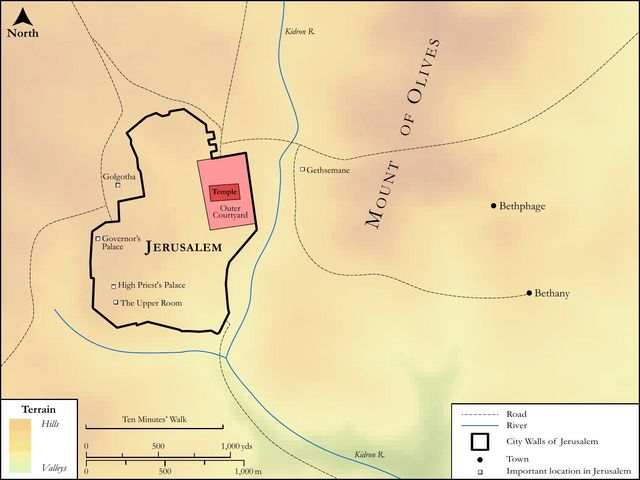
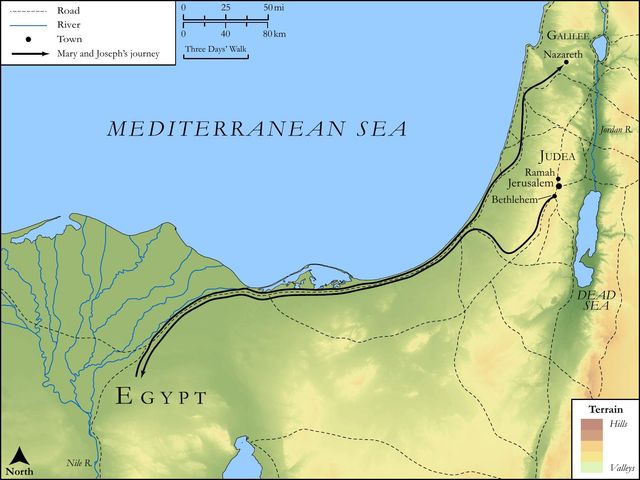
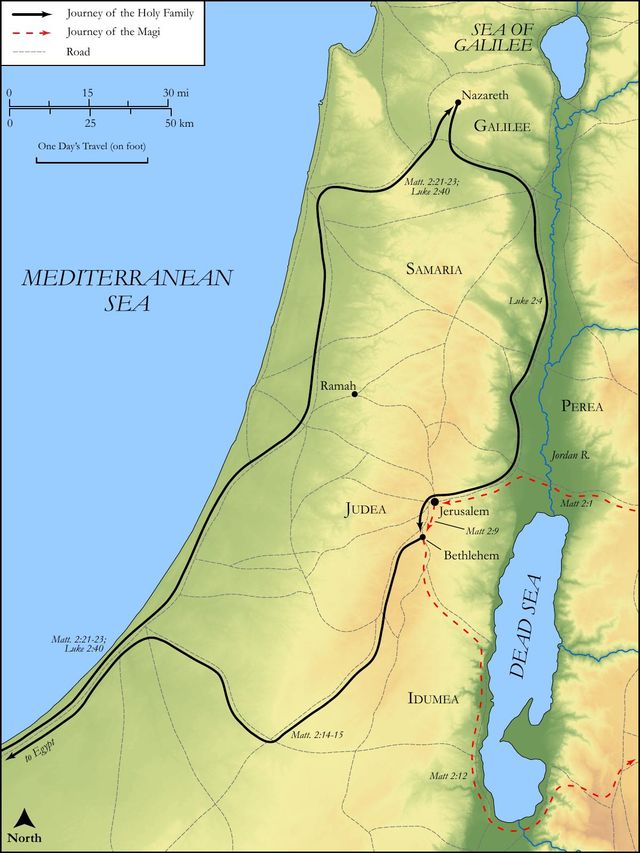
See on the biblical-era map
Study this verse
Public-domain commentary
Matthew Henry
From his Commentary on the Whole Bible. Henry comments on passages, not single verses — this entry covers Matthew 2:13–15. His three-level outline is real structure in the source text, so it is rendered as structure.
We have here Christ's flight into Egypt to avoid the cruelty of Herod, and this was the effect of the wise men's enquiry after him; for, before that, the obscurity he lay in was his protection. It was but little respect (compared with what should have been) that was paid to Christ in his infancy: yet even that, instead of honouring him among his people, did but expose him.
Now here observe, 1. The command given to Joseph concerning it, Mat 2:13. Joseph knew neither the danger the child was in, nor how to escape it; but God by an angel, tells him both in a dream, as before he directed him in like manner what to do, Mat 1:20. Joseph, before his alliance to Christ, had not been wont to converse with angels as now. Note, those that are spiritually related to Christ by faith have that communion and correspondence with Heaven which before they were strangers to.
1.Joseph is here told what their danger was: Herod will seek the young child to destroy him. Note, God is acquainted with all the cruel projects and purposes of the enemies of his church. I know thy rage against me, saith God to Sennacherib, Isa 37:28. How early was the blessed Jesus involved in trouble! Usually, even those whose riper years are attended with toils and perils have a peaceable and quiet infancy; but it was not so with the blessed Jesus: his life and sufferings began together; he was born a man striven with, as Jeremiah was (Jer 15:10), who was sanctified from the womb, Jer 1:5. Both Christ the head, and the church his body, agree in saying, Many a time have they afflicted me, from my youth up. Pharaoh's cruelty fastens upon the Hebrews' children, and a great red dragon stands ready to devour the man-child as soon as it should be born, Rev 12:4.
2.He is directed what to do, to escape the danger; Take the young child, and flee into Egypt. Thus early must Christ give an example to his own rule (Mat 10:23): When they persecute you in one city, flee to another. He that came to die for us, when his hour was not yet come, fled for his own safety. Self-preservation, being a branch of the law of nature, is eminently a part of the law of God. Flee; but why into Egypt? Egypt was infamous for idolatry, tyranny, and enmity to the people of God; it had been a house of bondage to Israel, and particularly cruel to the infants of Israel; in Egypt, as much as in Ramah, Rachel had been weeping for her children; yet that is appointed to be a place of refuge to the hold child Jesus. Note, God, when he pleases, can make the worst of places serve the best of purposes; for the earth is the Lord's, he makes what use he pleases of it: sometimes the earth helps the woman Rev 12:16. God, who made Moab a shelter to his outcasts, makes Egypt a refuge for his Son. This may be considered,
(1.)As a trial of faith of Joseph and Mary. They might be tempted to think, "If this child be the Son of God, as we are told he is, has he no other way to secure himself from a man that is a worm, than by such a mean and inglorious retreat as this? Cannot he summon legions of angels to be his life-guard, or cherubim with flaming swords to keep this tree of life? Cannot he strike Herod dead, or wither the hand that is stretched out against him, and so save us the trouble of this remove?" They had been lately told that he should be the glory of his people Israel; and is the land of Israel so soon become too hot for him? But we find not that they made any such objections; their faith, being tried, was found firm, they believe this is the Son of God, though they see no miracle wrought for his preservation; but they are put to the use of ordinary means. Joseph had great honour put upon him in being the husband of the blessed virgin; but that honour has trouble attending it, as all honours have in this world; Joseph must take the young child, and carry him into Egypt; and now it appeared how well God had provided for the young child and his mother, in appointing Joseph to stand in so near a relation to them; now the gold which the wise men brought would stand them in stead to bear their charges. God foresees his people's distresses, and provides against them beforehand. God intimates the continuance of his care and guidance, when he saith, Be thou there until I bring thee word, so that he must expect to hear from God again, and not stir without fresh orders. Thus God will keep his people still in a dependence upon him.
(2.)As an instance of the humiliation of our Lord Jesus. As there was no room for him in the inn in Bethlehem, so there was no quiet room for him in the land of Judea. Thus was he banished from the earthly Canaan, that we, who for sin were banished from the heavenly Canaan, might not be for ever expelled. If we and our infants be at any time in straits, let us remember the straits Christ in his infancy was brought into, and be reconciled to them.
(3.)As a token of God's displeasure against the Jews, who took so little notice of him; justly does he leave those who have slighted him. We have also here an earnest of his favour to the Gentiles, to whom the apostles were to bring the gospel when the Jews rejected it. If Egypt entertain Christ when he is forced out of Judea, it will not be long ere it be said, Blessed be Egypt my people, Isa 19:25.
II.Joseph's obedience to this command, Mat 2:14.
The journey would be inconvenient and perilous both to the young child and to his mother; they were but poorly provided for it, and were likely to meet with cold entertainment in Egypt: yet Joseph was not disobedient to the heavenly vision, made no objection, nor was dilatory in his disobedience. As soon as he had received his orders, he immediately arose, and went away by night, the same night, as it should seem, that he received the orders. Note, Those that would make sure work of their obedience must make quick work of it. Now Joseph went out, as his father Abraham did, with an implicit dependence upon God, not knowing whither he went, Heb 11:8. Joseph and his wife, having little, had little to care of in this remove. An abundance encumbers a necessary flight. If rich people have the advantage of the poor while they possess what they have, the poor have the advantage of the rich when they are called to part with it.
Joseph took the young child and his mother. Some observe, that the young child is put first, as the principal person, and Mary is called, not the wife of Joseph, but, which was her great dignity, the mother of the young child. This was not the first Joseph that was driven from Canaan to Egypt for a shelter from the anger of his brethren; this Joseph ought to be welcome there for the sake of that.
If we may credit tradition, at their entrance into Egypt, happening to go into a temple, all the images of their gods were overthrown by an invisible power, and fell, like Dagon before the ark, according to that prophecy, The Lord shall come into Egypt, and the idols of Egypt shall be moved at his presence, Isa 19:1. They continued in Egypt till the death of Herod, which, some think, was seven years, others think, not so many months. There they were at a distance from the temple and the service of it, and in the midst of idolaters; but God sent them thither, and will have mercy, and not sacrifice. Though they were far from the temple of the Lord, they had with them the Lord of the temple. A forced absence from God's ordinances, and a forced presence with wicked people, may be the lot, are not the sin, yet cannot but be the grief, of good people.
III.The fulfilling of the scripture in a this - that scripture (Hos 11:1), Out of Egypt have I called my son.
Of all the evangelists, Matthew takes most notice of the fulfilling of the scripture in what concerned Christ, because his gospel was first published among the Jews, with whom that would add much strength and lustre to it. Now this word of the prophet undoubtedly referred to the deliverance of Israel out of Egypt, in which God owned them for his son, his first-born (Exo 4:22); but it is here applied, by way of analogy, to Christ, the Head of the church. Note, The scripture has many accomplishments, so full and copious is it, and so well ordered in all things. God is every day fulfilling the scripture. Scripture is not of private interpretation: we must give it its full latitude. "When Israel was a child, then I loved him; and, though I loved him, I suffered him to be a great while in Egypt; but, because I loved him, in due time I called him out of Egypt." They that read this must, in their thoughts, not only look back, but look forward; that which has been shall be again (Ecc 1:9); and the manner of expression intimates this; for it is not said, I called him, but I called my son, out of Egypt. Note, It is no new thing for God's sons to be in Egypt, in a strange land, in a house of bondage; but they shall be fetched out. They may be hid in Egypt, but they shall not be left there. All the elect of God, being by nature children of wrath, are born in a spiritual Egypt, and in conversion are effectually called out. It might be objected against Christ that he had been in Egypt. Must the Sun of righteousness arise out of that land of darkness! But this shows that to be no strange thing; Israel was brought out of Egypt, to be advanced to the highest honours; and this is but doing the same thing.
Historical interpretation
Seven Centuries of Reception
17 surviving comments on this verse. Each one is dated, so this reads as a timeline rather than a list.
Select a marker to jump to its quote. Markers stagger vertically where authors wrote within a few decades of each other.
The first time when he would teach Joseph that she was lawfully espoused, the Angel called the Virgin his espoused wife; but after the birth she is only spoken of as the Mother of Jesus. As wedlock was rightfully imputed to her in her virginity, so virginity is esteemed venerable in her as the mother of Jesus.
Egypt full of idols; for after this enquiry for Him among the Jews, Christ leaving Judæa goes to be cherished among nations given to the vainest superstitions.
Now the angel having thus appeared, talks not with Mary, but with Joseph; and what saith he? "Arise, and take the young Child and His mother." Here, he saith not any more, "thy wife," but "His mother." For after that the birth had taken place, and the suspicion was done away, and the husband appeased, thenceforth the angel talks openly, calling neither child nor wife his, but "take the young Child and His mother, and flee into Egypt;" and he mentions the cause of the flight: "For Herod," saith he, "will seek the young Child's life."
Joseph, when he had heard these things, was not offended, neither did he say, "The thing is hard to understand: Didst thou not say just now, that He should 'save His people?' and now He saves not even Himself: but we must fly, and go far from home, and be a long time away: the facts are contrary to the promise." Nay, none of these things doth he say (for the man was faithful): neither is he curious about the time of his return; and this though the angel had put it indefinitely thus: "Be thou there until I tell thee." But nevertheless, not even at this did he shudder, but submits and obeys, undergoing all the trials with joy.
And this because God, who is full of love to man, did with these hardships mingle things pleasant also; which indeed is His way with regard to all the saints, making neither their dangers nor their refreshment continual, but weaving the life of all righteous men, out of both the one and the other. This very thing He did here also: for consider, Joseph saw the Virgin with child; this cast him into agitation and the utmost trouble, for he was suspecting the damsel of adultery. But straightway the angel was at hand to do away his suspicion, and remove his fears; and seeing the young child born, he reaped the greatest joy. Again, this joy no trifling danger succeeds, the city being troubled, and the king in his madness seeking after Him that was born. But this trouble was again succeeded by another joy; the star, and the adoration of the wise men. Again, after this pleasure, fear and danger; "For Herod," saith he, "is seeking the young Child's life," and He must needs fly and withdraw Himself as any mortal might: the working of miracles not being seasonable as yet. For if from His earliest infancy He had shown forth wonders, He would not have been accounted a Man.
Because of this, let me add, neither is a temple framed at once; but a regular conception takes place, and a time of nine months, and pangs, and a delivery, and giving suck, and silence for so long a space, and He awaits the age proper to manhood; that by all means acceptance might be won for the mystery of His Economy.
And if the Jews should raise a question touching the prophecy, and say, that the words, "Out of Egypt have I called my Son," were uttered concerning themselves; we would tell them, This is a law of prophecy, that in many cases much that is spoken of one set of persons is fulfilled in another; of which kind is that which is said touching Simeon and Levi, "I will divide them," saith He, "in Jacob, and scatter them in Israel." And yet not in themselves did this come to pass, but in their descendants; and Noah's saying again about Canaan, came to pass in the Gibeonites, Canaan's descendants. And that concerning Jacob one may see to have so come to pass; for those blessings which say, "Be lord over thy brother, and let thy father's sons worship thee," had no accomplishment in himself (how could they, he being in fear and trembling, and worshipping his brother over and over again?), but in his offspring they had. The very same may be said in this case also. For which may be called the truer son of God, he that worships a calf, and is joined to Baalpeor and sacrifices his sons to devils? or He that is a Son by nature, and honors Him that begat Him? So that, except this man had come, the prophecy would not have received its due fulfillment. It is worth observing, too, that the evangelist intimates the same by the phrase, "that it might be fulfilled;" implying that it would not have been fulfilled, unless He had come.
And this makes the Virgin also in no common degree glorious and distinguished; that the very thing which was the whole people's supreme endowment in the way of praise, she also might thenceforth have for her own. I mean, that whereas they were proud of their coming up from Egypt, and used to boast of it (which indeed the prophet also was hinting at, when he said, "Have I not brought up the strangers from Cappadocia, and the Assyrians from the pit"), He makes this pre-eminence belong to the Virgin likewise.
"And when they were departed, behold, an angel appeareth to Joseph in a dream, saying, Arise, and take the young Child and His mother, and flee into Egypt."
There is something here worth inquiring into, both touching the magi, and touching the Child; for if even they were not troubled, but received all with faith, it is worthy of examination on our part, why they and the young Child are not preserved, continuing there, but they as fugitives go into Persia, He with His mother into Egypt. But what? should He have fallen into the hands of Herod, and having fallen, not have been cut off? Nay, He would not have been thought to have taken flesh upon Him; the greatness of the Economy would not have been believed.
For if, while these things are taking place, and many circumstances are being ordered mysteriously after the manner of men, some have dared to say that His assumption of our flesh is a fable; in what degree of impiety would they not have been wrecked, had He done all in a manner becoming His Godhead, and according to His own power?
As to the wise men, He sends them off quickly, at once both commissioning them as teachers to the land of the Persians, and at the same time intercepting the madness of the king, that he might learn that he was attempting things impossible, and might quench his wrath, and desist from this his vain labor. For not alone openly to subdue His enemies, but also to deceive them with ease, is worthy of His power.
See how immediately on His birth the tyrant is furious against Him, and the mother with her Child is driven into foreign lands. So should you in the beginning of your spiritual career seem to have tribulation, you need not to be discouraged, but bear all things manfully, having this example.
It is a law of prophecy, that in a thousand places many things are said of some and fulfilled of others. As it is said of Simeon and Levi, I will divide them in Jacob, and scatter them in Israel; (Gen. 49:7.) which was fulfilled not in themselves, but in their descendants. So here Christ is by nature the Son of God, and so the prophecy is fulfilled in Him.
Rather, however, both the people and the patriarch, going down thither, and coming up thence, were together completing the type of this His return. Thus, as they went down to avoid death by famine, so He death by conspiracy. But whereas they on their arrival were for the time delivered from the famine, this man, when He had gone down, sanctified the whole land, by setting His foot thereon.
At least it is observable how, in the midst of His humiliations, the tokens of His Godhead are disclosed. Thus, first of all, the angel saying, "Flee into Egypt," did not promise to journey with them, either in their descent or return; intimating that they have a great fellow-traveller, the Child that had been born; such an one as actually changed all things immediately on His appearing, and wrought so that His enemies should minister in many ways to this Economy. Thus magi and barbarians, leaving the superstition of their fathers, are come to worship: thus Augustus ministers to the birth at Bethlehem by the decree for the taxing; Egypt receives and preserves Him, driven from His home, and plotted against, and obtains a sort of first impulse towards her union unto Him; so that when in after-time she should hear Him preached by the apostles, she might have this at least to glory of, as having received Him first. And yet this privilege did belong unto Palestine alone; but the second proved more fervent than the first.
But wherefore, it may be said, is the young Child sent into Egypt? In the first place, the evangelist himself hath mentioned the cause, saying, "That it might be fulfilled, Out of Egypt have I called my Son." And at the same time beginnings of fair hopes were thenceforth proclaimed before to the world. That is, since Babylon and Egypt, most in the whole earth, were burnt up with the flame of ungodliness, He, signifying from the first that He means to correct and amend both, and inducing men hereby to expect His bounties in regard of the whole world likewise, sent to the one the wise men, the other He Himself visited with His mother.
And besides what I have said, there is another lesson also, which we are hereby taught, tending not slightly to true self-command in us. Of what kind then is it? To look from the beginning for temptations and plots. See, for instance, how this was the case even at once from His swaddling clothes. Thus you see at His birth, first a tyrant raging, then flight ensuing, and departure beyond the border; and for no crime His mother is exiled into the land of the barbarians: that thou, hearing these things (supposing thee thought worthy to minister to any spiritual matter, and then to see thyself suffering incurable ills, and enduring countless dangers), shouldest not be greatly troubled, nor say, "What can this be? yet surely I ought to be crowned and celebrated, and be glorious and illustrious for fulfilling the Lord's commandment:" but that having this example, thou mightest bear all things nobly, knowing that this especially is the order of all things spiritual, to have everywhere temptations in the same lot with them.
(Vers. 13, 14.) Behold, an angel of the Lord appeared to Joseph in a dream, saying: Rise and take the child and his mother, and flee into Egypt, and stay there until I tell you. For it will come to pass that Herod will seek the child to destroy him. So Joseph rose and took the child and his mother by night, and went to Egypt; and he stayed there until the death of Herod. When he takes the child and his mother to go to Egypt, he takes them by night and in darkness; but when he returns to Judea, neither night nor darkness are mentioned in the Gospel.
When he takes the Child and His mother to go into Egypt, it is in the night and darkness, when to return into Judæa, the Gospel speaks of no light, no darkness.
(Epist. 57.7.) This is not in the LXX; but in Osee according to the genuine Hebrew text we read; Israel is my child, and I have loved him, and, from Egypt have I called my Son; where the LXX render, Israel is my child, and I have loved him, and called my sons out of Egypt.
(In Osee 11:2.) The Evangelist cites this text, because it refers to Christ typically. For it is to be observed, that in this Prophet and in others, the coming of Christ and the call of the Gentiles are foreshewn in such a manner, that the thread of history is never broken.
Let those who deny the authenticity of the Hebrew copies, show us this passage in the LXX, and when they have failed to find it, we will show it them in the Hebrew. We may also explain it in another way, by considering it as quoted from Numbers, God brought him out of Egypt; his glory is as it were that of a unicorn. (Num. 23:22.)
(Serm. 218. App.) Hear the sacrament of a great mystery. Moses before had shut up the light of day from the traitors the Egyptians; Christ by going down thither brought back light to them that sate in darkness. He fled that he might enlighten them, not that he might escape his foes.
The miserable tyrant supposed that by the Saviour's coming he should be thrust from his royal throne. But it was not so; Christ came not to hurt others' dignity, but to bestow His own on others.
His flight then was not occasioned by fear but by what had come through the mystery of prophecy. The Evangelist planted the seed when he thus spoke: “Take the boy and his mother and flee into Egypt.” And later, “that what was written might be fulfilled: ‘From Egypt have I summoned my son.’ ” Christ fled so that he might establish the truth of the law, faith in prophecy and the testimony of the psalter. The Lord himself says, “It was needful that what was written in the law and the prophets and the psalms be fulfilled by me.” Christ fled for us, not for himself. Christ fled so that at the right time he might serve as a steward of the sacraments [the divine mysteries]. Christ fled so that by granting absolution he might take away the source of abuses to come and that he might give proof of faith to those who would believe. And finally, Christ fled so that he might bestow on us faith even when we have to flee, because in the face of persecution it is better to flee than to deny the faith. For Peter, because he was unwilling to flee, denied the Lord. John, lest he deny the Lord, fled.
Was it Herod seeking the child, or the devil working through Herod? When Herod saw the magi for himself, he imagined in his fantasy that they had fled their governors. For Christ, though bound in swaddling clothes, though busy at his mother’s breast, though keeping quiet, concealing his words, unable to walk, nevertheless transformed the magi (who had been standard-bearers of the devil) into his most faithful servants. The devil instantly realized what Christ could do when he came of age. So he spurred the Jews against him and, clever contriver that he was, impelled Herod that he might get the jump on Christ in his infancy. He hoped to deprive him of the coming emblem of his virtue, the cross, the banner of the greatest victory for us. The devil perceived that Christ would soon be restoring life to all the world with his teaching and his virtue. Even while still whimpering as a baby, Jesus was taking possession of this world from top to bottom. It was as the prophet said: “Before the child knows to cry to his father and mother he shall take the pride of Damascus and the spoils of Samaria.” The Jews themselves attest to this when they say, “You see how the whole world hastens after him.”
It was impossible that they, who left Herod to go to Christ, should return to Herod. They who have by sin left Christ and passed to the devil, often return to Christ; for the innocent, who knows not what is evil, is easily deceived, but having once tasted the evil he has taken up, and remembering the good he has left, he returns in penitence to God. He who has forsaken the devil and come to Christ, hardly returns to the devil; for rejoicing in the good he has found, and remembering the evil he has escaped, with difficulty returns to that evil.
He says not, 'the Mother and her young Child,' but, the young Child and His mother; for the Child was not born for the mother, but the mother prepared for the Child. How is this that the Son of God flies from the face of man? or who shall deliver from the enemy's hand, if He Himself fears His enemies? First; He ought to observe, even in this, the law of that human nature which He took on Him; and human nature and infancy must flee before threatening power. Next, that Christians when persecution makes it necessary should not be ashamed to fly. But why into Egypt? The Lord, who keepeth not His anger for ever, remembered the woes He had brought upon Egypt, and therefore sent His Son thither, and gives it this sign of great reconciliation, that with this one remedy He might heal the ten plagues of Egypt, and the nation that had been the persecutor of this first-born people, might be the guardian of His first-born Son. As formerly they had cruelly tyrannized, now they might devoutly serve; nor go to the Red Sea to be drowned, but be called to the waters of baptism to receive life.
The straitness of every persecution may be called night—the relief from it in like manner, day.
By this that the Angel appears always to Joseph in sleep, is mystically signified that they who rest from mundane cares and secular pursuits, deserve angelic visitations.
Isaiah had foretold this flight into Egypt. Lo! the Lord shall ascend on a light cloud, and shall come into Egypt, and shall scatter the idols of Egypt. (Is. 19:1.) It is the practice of this Evangelist to confirm all he says; and that because he is writing to the Jews, therefore he adds, that it might be fulfilled, &c.
In Joseph is figured the order of preachers, in Mary Holy Scripture; by the Child the knowledge of the Saviour; by the cruelty of Herod the persecution which the Church suffered in Jerusalem; by Joseph's flight into Egypt the passing of the preachers to the unbelieving Gentiles, (for Egypt signifies darkness;) by the time that he abode in Egypt the space of time between the ascension of the Lord and the coming of Anti Christ; by Herod's death the extinction of jealousy in the hearts of the Jews.
(Hom. in. Nat. Innocent.) The flight into Egypt signifies that the elect are often by the wickedness of the bad driven from their homes, or sentenced to banishment. Thus He, who, we shall see below, gave the command to His own, When they shall persecute you in one city, flee ye to another, first practised what He enjoined, as a man flying before the face of man on earth. He whom but a little before a star had proclaimed to the Magi to be worshipped as from heaven.
Here Matthew omits the day of purification when the first-born must be presented in the Temple with a lamb, or a pair of turtle doves, or pigeons. Their fear of Herod did not make them bold to transgress the Law, that they should not present the Child in the temple. As soon then as the rumour concerning the Child begins to be spread abroad, the Angel is sent to bid Joseph carry Him into Egypt.
For when the true light withdraws, they who hate the light are in darkness, when it returns they are again enlightened.
Do you see now the reason why God permitted the Virgin to be betrothed? It is revealed to you here: that Joseph might care for her and watch over her. The angel did not say, "take thy wife," but "take the mother of the Child." For once his suspicion had been allayed, and the righteous man had understood from the miracles attendant at His birth that everything was of the Holy Spirit, the angel no longer calls her Joseph’s "wife."
Even the Lord flees, to confirm that He was truly man. For if He had fallen into the hands of Herod and had not been slain, it would have seemed that He had been made flesh only in appearance. He flees into Egypt to sanctify even that place. For there were two lands that were the workshops of every iniquity: Babylon and Egypt. By means of the Magi He accepted the adoration of Babylon, and Egypt He sanctified by His own presence.
Remain there until you receive God’s command. So we, too, should do nothing apart from the will of God.
Behold the foolishness of a man who labors to prevail against the will of God. For if it is not of God, what do you fear? But if it is of God, how can you destroy the Child?
Continue studying Matthew 2:13 across the web’s major study libraries — every link below opens this exact verse, chapter, or book on the destination site.
Read & Compare
 BibleGatewayThis verse in more than 200 translations and 70 languages.
 Bible.comThe YouVersion reader — hundreds of translations, reading plans, and highlights.
 ESV.orgCrossway's official English Standard Version reader.
 NET BibleThe NET translation with 60,000+ translators' notes on every rendering decision.
 STEP BibleTyndale House's free study tool — original text, vocabulary, and scholarly resources.
 BibliaLogos Bible Software's free web reader.
 USCCBThe New American Bible (Revised Edition) with the U.S. bishops' study notes.
Commentaries
 BibleHub CommentariesDozens of classic commentaries on this verse, gathered on one page.
 StudyLightMore than 100 commentary sets — the largest collection on the web.
 BibleRefPlain-English commentary on what this verse means, verse by verse.
 Enduring WordDavid Guzik's free commentary on this chapter, widely used by Bible teachers.
 Bible Study ToolsVerse commentary alongside Greek and Hebrew study aids.
Original Language & Research
- BibleHub InterlinearThe verse word by word — original language, transliteration, and English.
- BibleHub LexiconEvery word's original-language definition and Strong's entry.
 Blue Letter BibleDeep-study tools — Strong's numbers, concordance, and word studies.
 CNTR CollationThe earliest Greek manuscripts of this verse, collated letter by letter.
Sermons, Hymns & Audio


TrulyRandomVerse is not affiliated with these sites and doesn’t control their content. They’re linked because they’re genuinely useful.
Summary
Matthew 2:13 records a pivotal moment in the early life of Jesus, where divine intervention safeguards the Messiah from the murderous intent of King Herod. Following the departure of the Magi, an angel of the Lord appears to Joseph in a dream, instructing him to immediately take Jesus and Mary and flee to Egypt. This urgent command is given because Herod, fearing a rival to his throne, is actively seeking to destroy the young child. Joseph's prompt obedience to this divine warning ensures the safety of the Holy Family, highlighting God's sovereign protection and the early opposition faced by the Son of God.
Context
ShowHideLiterary Context
Matthew 2:13 immediately follows the departure of the Magi, who, having worshipped the newborn King, were divinely warned in a dream not to return to Herod (Matthew 2:12). This verse marks a direct continuation of God's active involvement in protecting Jesus. The narrative shifts from the joyous worship of the Magi to the grave danger posed by Herod, setting the stage for the Holy Family's flight. This dream is the second of four significant dreams Joseph experiences in Matthew's Gospel, each serving as a divine directive concerning Jesus' safety and future (Matthew 1:20; Matthew 2:13; Matthew 2:19; Matthew 2:22). The abrupt transition underscores the imminent threat and the necessity of immediate obedience.
Historical & Cultural Context
King Herod the Great, who ruled Judea as a client king under Rome (37-4 BC), was notorious for his paranoia and ruthless cruelty, especially towards perceived threats to his power. His reign was marked by political intrigue and a willingness to eliminate rivals, including members of his own family. The arrival of the Magi, seeking a "king of the Jews," would have deeply alarmed him, triggering his characteristic insecurity and violence. Egypt, a neighboring Roman province, served as a common refuge for those fleeing persecution from Judea, as it was outside Herod's jurisdiction and had a significant Jewish diaspora community, offering a degree of safety and anonymity. Travel would have been arduous, requiring significant resources and faith from Joseph.
Key Themes
ShowHideThis verse profoundly contributes to several overarching themes in Matthew's Gospel and the broader biblical narrative. Firstly, it highlights Divine Protection and Providence, demonstrating God's meticulous oversight and active intervention to safeguard His Son from the very beginning, ensuring His redemptive plan cannot be thwarted by human evil, as seen consistently throughout scripture. Secondly, Obedience to Divine Instruction is a prominent theme, exemplified by Joseph's immediate and unquestioning response to the angelic warning, mirroring the faithful obedience of Abraham and other patriarchs. Thirdly, the early Threat to the Messiah underscores the spiritual conflict surrounding Jesus' person and mission from His infancy, foreshadowing the opposition and suffering He would endure throughout His earthly ministry, culminating in His passion, as prophesied in Isaiah 53. Finally, while not explicitly stated in this verse, the flight to Egypt is later presented in Matthew 2:15 as a Fulfillment of Prophecy, connecting Jesus' life to the Old Testament narrative of Israel, particularly the exodus, and identifying Him as God's true Son.
Exposition and Analysis
ShowHideKey Word Analysis
ShowHideThis term refers to a messenger, specifically a divine messenger (G32). In this context, it emphasizes that the warning to Joseph comes directly from God, conveying divine authority and urgency. The angel of the Lord often signifies a special manifestation of God's presence or a divine emissary with a crucial message, highlighting the supernatural nature of the intervention.
A dream (G3677) is a recurring motif in Matthew's infancy narrative as a means of divine communication, particularly to Joseph. This method underscores the direct, personal, and authoritative nature of God's guidance, bypassing human intermediaries and ensuring the message is received clearly and acted upon immediately. It signifies God's direct involvement in the unfolding events.
This word (G622) means to destroy fully, to perish, or to lose. In Herod's intent, it signifies a complete and utter annihilation of the young child, revealing the depth of his malice and the existential threat Jesus faced. It highlights the spiritual battle at play, where forces of evil seek to nullify God's redemptive plan from its very inception.
Verse Breakdown
ShowHide"And when they were departed, behold, the angel of the Lord appeareth to Joseph in a dream, saying,"
This opening clause establishes the immediate aftermath of the Magi's departure, setting the scene for God's intervention. The sudden appearance of "the angel of the Lord" (a significant theological designation often pointing to a divine manifestation) to Joseph "in a dream" highlights the supernatural and authoritative nature of the communication. This is God's direct, urgent message to His chosen guardian.
"Arise, and take the young child and his mother, and flee into Egypt,"
This is the core command, direct and imperative. Joseph is instructed to act immediately ("Arise," from G1453 egeírō, meaning to rouse from sleep or inactivity) and to prioritize the safety of Jesus ("the young child," G3813 paidíon) and Mary ("his mother," G3384 mḗtēr). The destination, "Egypt" (G125 Aígyptos), is significant as a place of refuge, historically known for its Jewish communities and outside Herod's immediate jurisdiction, offering a safe haven from the impending danger. The preposition "into" (G1519 eis) emphasizes the movement towards and entry into this specific location.
"and be thou there until I bring thee word:"
This part of the instruction emphasizes the temporary nature of their exile and the ongoing divine guidance Joseph is to expect. He is not given a return date but is told to remain in Egypt ("be thou there," G2468 ísthi G1563 ekeî) "until" (G2193 héōs) God, through the angel, gives further instruction ("I bring thee word," G2036 épō). This requires ongoing faith and dependence on God's timing and direction.
"for Herod will seek the young child to destroy him."
This final clause provides the crucial reason ("for," G1063 gár) for the urgent flight. It reveals Herod's malevolent intent – he "will seek" (G2212 zētéō, indicating active pursuit) the young child "to destroy" (G622 apóllymi) him. This confirms the grave danger and validates the divine warning, underscoring the spiritual warfare surrounding the Messiah's life from His earliest days. Herod's desire to eliminate a perceived rival highlights the world's opposition to God's chosen King.
Literary Devices
ShowHideMatthew 2:13 effectively employs several literary devices to convey its profound message. Divine Intervention is a prominent theme, as God directly intervenes through an angel to protect Jesus, showcasing His sovereign control over human events. The use of a Dream as a medium for divine communication is a recurring motif in Matthew's infancy narrative, emphasizing the personal and direct nature of God's guidance to Joseph. This also serves as a Foreshadowing device, hinting at the constant opposition and persecution Jesus would face throughout His life, from His infancy to His crucifixion. The contrast between the vulnerable "young child" and the powerful, murderous "Herod" creates a stark Juxtaposition, highlighting the fragility of the divine child juxtaposed with the worldly power seeking to destroy Him, yet ultimately demonstrating God's superior power and protection. Furthermore, the command to "flee into Egypt" subtly invokes Typology, drawing a parallel between Jesus' experience and Israel's historical sojourn in Egypt and subsequent exodus, implicitly identifying Jesus as the true Son of God who will lead a new exodus.
Theological and Thematic Connections
ShowHideMatthew 2:13 powerfully illustrates the theme of divine providence and protection over God's chosen ones, particularly the Messiah. It underscores that God's plan for salvation is sovereign and cannot be thwarted by human malice or political power. Even in the face of grave danger from a tyrannical ruler like Herod, God ensures the safety of His Son, demonstrating His active involvement in human history. This event also highlights the inherent conflict between the kingdom of God and the kingdoms of this world, which often manifest in hostility towards God's anointed. The immediate and unquestioning obedience of Joseph serves as a model of faith, demonstrating that trust in God's guidance often requires costly and immediate action, even when the path is uncertain. This narrative sets a precedent for the opposition Jesus would face throughout His ministry, confirming the spiritual battle surrounding His identity and mission from the very beginning.
Reflection and Application
ShowHideThe narrative of Matthew 2:13 offers profound lessons for believers navigating a complex and often hostile world. Joseph's immediate and courageous obedience, despite the daunting prospect of fleeing to a foreign land with a newborn and his wife, serves as a powerful testament to radical trust in God's directives. In our own lives, we are often called to step out in faith, even when God's path seems inconvenient, illogical, or fraught with uncertainty. This passage reminds us that God's protection is real and active, even when we face formidable opposition or seemingly insurmountable threats. Just as God safeguarded Jesus from Herod's evil, He promises to watch over His children, guiding them through dangers seen and unseen. It encourages us to cultivate a spirit of discernment, recognizing that evil forces still seek to undermine God's purposes, and to rely on divine wisdom for guidance. Ultimately, Matthew 2:13 calls us to a life of responsive faith, where our actions are aligned with God's revealed will, trusting that His sovereign hand is always at work for our good and the advancement of His kingdom.
Questions for Reflection
ShowHideFAQ
ShowHideWhy did Joseph have to flee to Egypt specifically?
ShowHideJoseph was instructed to flee to Egypt because it was a well-known refuge for Jews outside of Herod's jurisdiction. Egypt, then a Roman province, had a significant Jewish diaspora community, which would have offered a degree of anonymity and support for the Holy Family. Historically, Egypt had also served as a place of refuge for God's people, notably during times of famine (as seen with Abraham and Jacob's family). This choice of destination highlights God's sovereign provision and the historical continuity of His protective care for His people.
How long did the Holy Family stay in Egypt?
ShowHideThe Bible does not specify the exact duration of their stay in Egypt. Matthew 2:15 states that they remained there "until the death of Herod." King Herod the Great died in 4 BC. Since Jesus was likely born between 6-4 BC, their stay in Egypt would have been relatively short, possibly a few months to a couple of years, depending on the precise timing of Herod's death relative to their arrival. Matthew 2:19 then records the angel's instruction for Joseph to return to Israel after Herod's death.
Christ-Centered Fulfillment
ShowHideMatthew 2:13, while narrating a moment of earthly peril and divine rescue, profoundly points to the person and work of Jesus Christ. His flight to Egypt, a place of refuge for Israel in times past, foreshadows His ultimate role as the one who provides refuge and salvation for all who flee to Him. The immediate threat from Herod, who sought to destroy the "young child," is a chilling premonition of the spiritual warfare that would characterize Jesus' entire ministry, culminating in the attempts to silence Him on the cross. Yet, just as God protected the infant Jesus, He ultimately preserved His Son through death and raised Him to life, demonstrating His complete victory over sin and death. Jesus, the true Son, is called "out of Egypt" (Matthew 2:15), fulfilling prophecy and establishing Himself as the new Israel, the one through whom God's redemptive plan for humanity would be fully realized. His journey, marked by vulnerability and divine protection, culminates in His sacrificial death and glorious resurrection, offering eternal safety and new life to all who believe in Him, the Lamb of God who takes away the sin of the world. He is the ultimate refuge, the one who delivers His people from the tyranny of sin and death, just as He was delivered from Herod's murderous intent, securing a new and living way for all humanity.