


Matthew 2:2
Bible text: King James Version (1769 Blayney text) · Public domain
Bible text: Berean Standard Bible · Public domain
Bible text: American Standard Version (1901) · Public domain
Bible text: World English Bible, Messianic edition · Public domain
Bible text: Geneva Bible (1599) · Public domain
Bible text: Young's Literal Translation · Public domain
- λέγοντες·legontessayingG3004V-PAP-NPMVerb Present Active Participle Nominative Plural Masculine
- ποῦpouWhereG4226ADV-IAdverb Interrogative
- ἐστινestinisG1510V-PAI-3SVerb Present Active Indicative 3rd Singular
- ὁhothe [One]G3588T-NSMDefinite article Nominative Singular Masculine
- τεχθεὶςtechtheishaving been bornG5088V-APP-NSMVerb Aorist Passive Participle Nominative Singular Masculine
- βασιλεὺςbasileusKingG935N-NSM-TNoun Nominative Singular Masculine Title
- τῶνtōnof theG3588T-GPMDefinite article Genitive Plural Masculine
- Ἰουδαίων;IoudaiōnJews?G2453N-GPM-PGNoun Genitive Plural Masculine Person Gentilic
- εἴδομενeidomenWe sawG1492V-2AAI-1PVerb 2nd Aorist Active Indicative 1st Plural
- γὰρgarforG1063CONJConjunction
- αὐτοῦautouHisG846P-GSMPersonal pronoun Genitive Singular Masculine
- τὸνton<the>G3588T-ASMDefinite article Accusative Singular Masculine
- ἀστέραasterastarG792N-ASMNoun Accusative Singular Masculine
- ἐνeninG1722PREPPreposition
- τῇtēatheG3588T-DSFDefinite article Dative Singular Feminine
- ἀνατολῇanatolēaeastG395N-DSFNoun Dative Singular Feminine
- καὶkaiandG2532CONJConjunction
- ἤλθομενēlthomenare comeG2064V-2AAI-1PVerb 2nd Aorist Active Indicative 1st Plural
- προσκυνῆσαιproskunēsaito worshipG4352V-AANVerb Aorist Active Infinitive
- αὐτῷautōHimG846P-DSMPersonal pronoun Dative Singular Masculine
English is a literal word-by-word gloss of the Greek, not the KJV's wording. Why?
This is the original text the KJV's translators worked from — each Greek word with its own literal English meaning in this verse, prepared by scholars at Tyndale House, Cambridge. The KJV translates whole sentences, not word by word, so its wording differs: one Greek word can become several English words, and the KJV may choose “charity” where the gloss reads “love”. Both are faithful — they answer different questions. For the KJV's own rendering, switch to the KJV text.
Details
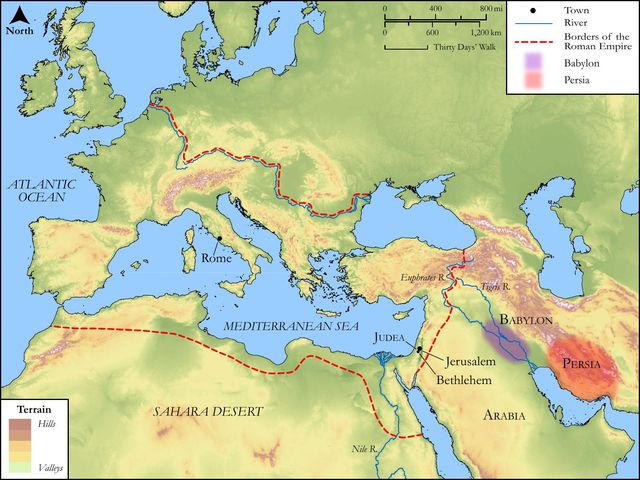
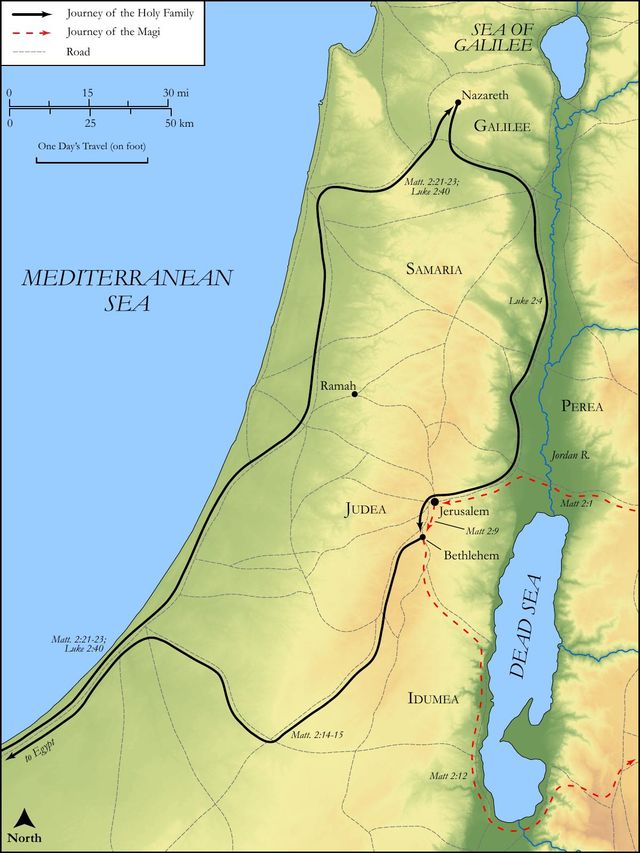
See on the biblical-era maps

Study this verse
Public-domain commentary
Matthew Henry
From his Commentary on the Whole Bible. Henry comments on passages, not single verses — this entry covers Matthew 2:1–8. His two-level outline is real structure in the source text, so it is rendered as structure.
It was a mark of humiliation put upon the Lord Jesus that, though he was the Desire of all nations, yet his coming into the world was little observed and taken notice of, his birth was obscure and unregarded: herein he emptied himself, and made himself of no reputation. If the Son of God must be brought into the world, one might justly expect that he should be received with all the ceremony possible, that crowns and sceptres should immediately have been laid at his feet, and that the high and mighty princes of the world should have been his humble servants; such a Messiah as this the Jews expected, but we see none of all this; he came into the world, and the world knew him not; nay, he came to his own, and his own received him not; for having undertaken to make satisfaction to his Father for the wrong done him in his honour by the sin of man, he did it by denying himself in, and despoiling himself of, the honours undoubtedly due to an incarnate Deity; yet, as afterward, so in his birth, some rays of glory darted forth in the midst of the greatest instances of his abasement. Though there was the hiding of his power, yet he had horns coming out of his hand (Hab 3:4) enough to condemn the world, and the Jews especially, for their stupidity.
The first who took notice of Christ after his birth were the shepherds (Luk 2:15, etc.), who saw and heard glorious things concerning him, and made them known abroad, to the amazement of all that heard them, Luk 2:17, Luk 2:18. After that, Simeon and Anna spoke of him, by the Spirit, to all that were disposed to heed what they said, Luk 2:38. Now, one would think, these hints should have been taken by the men of Judah and the inhabitants of Jerusalem, and they should with both arms have embraced the long-looked-for Messiah; but, for aught that appears, he continued nearly two years after at Bethlehem, and no further notice was taken of him till these wise men came. Note, Nothing will awaken those that are resolved to be regardless. Oh the amazing stupidity of these Jews! And no less that of many who are called Christians! Observe,
I.When this enquiry was made concerning Christ.
It was in the days of Herod the king. This Herod was an Edomite, made king of Judea by Augustus and Antonius, the then chief rulers of the Roman state, a man made up of falsehood and cruelty; yet he was complimented with the title of Herod the Great. Christ was born in the 35th year of his reign, and notice is taken of this, to show that the sceptre had now departed from Judah, and the lawgiver from between his feet; and therefore now was the time for Shiloh to come, and to him shall the gathering of the people be: witness these wise men, Gen 49:10.
II.Who and what these wise men were; they are here called Magou - Magicians.
Some that it in a good sense; the Magi among the Persians were their philosophers and their priests; nor would they admit any one for their king who had not first been enrolled among the Magi; others think they dealt in unlawful arts; the word is used of Simon, the sorcerer (Act 8:9, Act 8:11), and of Elymas, the sorcerer (Act 13:6), nor does the scripture use it in any other sense; and then it was an early instance and presage of Christ's victory over the devil, when those who had been so much his devotees became the early adorers even of the infant Jesus; so soon were trophies of his victory over the powers of darkness erected. Well, whatever sort of wise men they were before, now they began to be wise men indeed when they set themselves to enquire after Christ.
This we are sure of, 1. That they were Gentiles, and not belonging to the commonwealth of Israel. The Jews regarded not Christ, but these Gentiles enquired him out. Note, Many times those who are nearest to the means, are furthest from the end. See Mat 8:11, Mat 8:12. The respect paid to Christ by these Gentiles was a happy presage and specimen of what would follow when those who were afar off should be made nigh by Christ. 2. That they were scholars. They dealt in arts, curious arts; good scholars should be good Christians, and then they complete their learning when they learn Christ. 3. That they were men of the east, who were noted for their soothsaying, Isa 2:6. Arabia is called the land of the east (Gen 25:6), and the Arabians are called men of the east, Jdg 6:3. The presents they brought were the products of that country; the Arabians had done homage to David and Solomon as types of Christ. Jethro and Job were of that country. More than this we have not to say of them. The traditions of the Romish church are frivolous, that they were in number three (though one of the ancients says that they were fourteen), that they were kings, and that they lie buried in Colen, thence called the three kings of Colen; we covet not to be wise above what is written.
III.What induced them to make this enquiry.
They, in their country, which was in the east, had seen an extraordinary star, such as they had not seen before; which they took to be an indication of an extraordinary person born in the land of Judea, over which land this star was seen to hover, in the nature of a comet, or a meteor rather, in the lowers regions of the air; this differed so much from any thing that was common that they concluded it to signify something uncommon. Note, Extraordinary appearances of God in the creatures should put us upon enquiring after his mind and will therein; Christ foretold signs in the heavens. The birth of Christ was notified to the Jewish shepherds by an angel, to the Gentile philosophers by a star: to both God spoke in their own language, and in the way they were best acquainted with. Some think that the light which the shepherds saw shining round about them, the night after Christ was born, was the very same which to the wise men, who lived at such a distance, appeared as a star; but this we cannot easily admit, because the same star which they had seen in the east they saw a great while after, leading them to the house where Christ lay; it was a candle set up on purpose to guide them to Christ. The idolaters worshipped the stars as the host of heaven, especially the eastern nations, whence the planets have the names of their idol-gods; we read of a particular star they had in veneration, Amo 5:26. Thus the stars that had been misused came to be put to the right use, to lead men to Christ; the gods of the heathen became his servants. Some think this star put them in mind of Balaam's prophecy, that a star should come out of Jacob, pointing at a sceptre, that shall rise out of Israel; see Num 24:17. Balaam came from the mountains of the east, and was one of their wise men. Others impute their enquiry to the general expectation entertained at that time, in those eastern parts, of some great prince to appear. Tacitus, in his history (lib. 5), takes notice of it; Pluribus persuasio inerat, antiquis sacerdotum literis contineri, eo ipso tempore fore, ut valesceret oriens, profectique Judaea rerum potirentur - A persuasion existed in the minds of many that some ancient writings of the priests contained a prediction that about that time an eastern power would prevail, and that persons proceeding from Judea would obtain dominion. Suetonius also, in the life of Vespasian, speaks of it; so that this extraordinary phenomenon was construed as pointing to that king; and we may suppose a divine impression made upon their minds, enabling them to interpret this star as a signal given by Heaven of the birth of Christ.
IV.How they prosecuted this enquiry.
They came from the east to Jerusalem, in further quest of this prince. Wither shall they come to enquire for the king of the Jews, but to Jerusalem, the mother-city, whither the tribes go up, the tribes of the Lord? They might have said, "If such a prince be born, we shall hear of him shortly in our own country, and it will be time enough then to pay our homage to him." But so impatient were they to be better acquainted with him, that they took a long journey on purpose to enquire after him. Note, Those who truly desire to know Christ, and find him, will not regard pains or perils in seeking after him. Then shall we know, if we follow on to know the Lord.
Their question is, Where is he that is born king of the Jews? They do not ask, whether there were such a one born? (they are sure of that, and speak of it with assurance, so strongly was it set home upon their hearts); but, Where is he born? Note, Those who know something of Christ cannot but covet to know more of him. They call Christ the King of the Jews, for so the Messiah was expected to be: and he is Protector and Ruler of all the spiritual Israel, he is born a King.
To this question they doubted not but to have a ready answer, and to find all Jerusalem worshipping at the feet of this new king; but they come from door to door with this question, and no man can give them any information. Note, There is more gross ignorance in the world, and in the church too, than we are aware of. Many that we think should direct us to Christ are themselves strangers to him. They ask, as the spouse of the daughters of Jerusalem, Saw ye him whom my soul loveth? But they are never the wiser. However, like the spouse, they pursue the enquiry, Where is he that is born king of the Jews? Are they asked, "Why do ye make this enquiry?" It is because they have seen his star in the east. Are they asked, "What business have ye with him? What have the men of the east to do with the King of the Jews?" They have their answer ready, We are come to worship him. They conclude he will, in process of time, be their king, and therefore they will betimes ingratiate themselves with him and with those about him. Note, Those in whose hearts the day-star is risen, to give them any thing of the knowledge of Christ, must make it their business to worship him. Have we seen Christ's star? Let us study to give him honour.
V.How this enquiry was treated at Jerusalem.
News of it at last came to court; and when Herod heard it he was troubled, Mat 2:3. He could not be a stranger to the prophecies of the Old Testament, concerning the Messiah and his kingdom, and the times fixed for his appearing by Daniel's weeks; but, having himself reigned so long and so successfully, he began to hope that those promises would for ever fail, and that his kingdom would be established and perpetuated in spite of them. What a damp therefore must it needs be upon him, to hear talk of this King being born, now, when the time fixed for his appearing had come! Note, Carnal wicked hearts dread nothing so much as the fulfilling of the scriptures.
But though Herod, an Edomite, was troubled, one would have thought Jerusalem should rejoice greatly to hear that her King comes; yet, it seems, all Jerusalem, except the few there that waited for the consolation of Israel, were troubled with Herod, and were apprehensive of I know not what ill consequences of the birth of this new king, that it would involve them in war, or restrain their lusts; they, for their parts, desired no king but Herod; no, not the Messiah himself. Note, The slavery of sin is foolishly preferred by many to the glorious liberty of the children of God, only because they apprehend some present difficulties attending that necessary revolution of the government in the soul. Herod and Jerusalem were thus troubled, from a mistaken notion that the kingdom of the Messiah would clash and interfere with the secular powers; whereas the star that proclaimed him king plainly intimated that his kingdom was heavenly, and not of this lower world. Note, The reason why the kings of the earth, and the people, oppose the kingdom of Christ, is because they do not know it, but err concerning it.
VI.What assistance they met with in this enquiry from the scribes and the priests, Mat 2:4-6.
Nobody can pretend to tell where the King of the Jews is, but Herod enquires where it was expected he should be born. The persons he consults are, the chief priests, who were teachers by office; and the scribes, who made it their business to study the law; their lips must keep knowledge, but then the people must enquire the law at their mouth, Mal 2:7. It was generally known that Christ should be born at Bethlehem (Joh 7:42); but Herod would have counsel's opinion upon it, and therefore applies himself to the proper persons; and, that he might be the better satisfied, he has them altogether, all the chief priests, and all the scribes; and demands of them what was the place, according to the scriptures of the Old Testament, where Christ should be born? Many a good question is put with an ill design, so was this by Herod.
The priests and scribes need not take any long time to give an answer to this query; nor do they differ in their opinion, but all agree that the Messiah must be born in Bethlehem, the city of David, here called Bethlehem of Judea, to distinguish it from another city of the same name in the land of Zebulun, Jos 19:15. Bethlehem signifies the house of bread; the fittest place for him to be born in who is the true manna, the bread which came down from heaven, which was given for the life of the world. The proof they produce is taken from Mic 5:2, where it is foretold that though Bethlehem be little among the thousands of Judah (so it is in Micah), no very populous place, yet it shall be found not the least among the princes of Judah (so it is here); for Bethlehem's honour lay not, as that of other cities, in the multitude of the people, but in the magnificence of the princes it produced. Though, upon some accounts, Bethlehem was little, yet herein it had the pre-eminence above all the cities of Israel, that the Lord shall count, when he writes up the people, that this man, even the man Christ Jesus, was born there, Psa 87:6. Out of thee shall come a Governor, the King of the Jews. Note, Christ will be a Saviour to those only who are willing to take him for their Governor. Bethlehem was the city of David, and David the glory of Bethlehem; there, therefore, must David's son and successor be born. There was a famous well at Bethlehem, by the gate, which David longed to drink of (Sa2 23:15); in Christ we have not only bread enough and to spare, but may come and take also of the water of life freely. Observe here how Jews and Gentiles compare notes about Jesus Christ. The Gentiles know the time of his birth by a star; the Jews know the place of it by the scriptures; and so they are capable of informing one another. Note, It would contribute much to the increase of knowledge, if we did thus mutually communicate what we know. Men grow rich by bartering and exchanging; so, if we have knowledge to communicate to others, they will be ready to communicate to us; thus many shall discourse, shall run to and fro, and knowledge shall be increased.
VII.The bloody project and design of Herod, occasioned by this enquiry, Mat 2:7, Mat 2:8.
Herod was now an old man, and had reigned thirty-five years; this king was but newly born, and not likely to enterprise any thing considerable for many years; yet Herod is jealous of him. Crowned heads cannot endure to think of successors, much less of rivals; and therefore nothing less than the blood of this infant king will satisfy him; and he will not give himself liberty to think that, if this new-born child should be indeed the Messiah, in opposing him, or making any attempts upon him, he would be found fighting against God, than which nothing is more vain, nothing more dangerous. Passion has got the mastery of reason and conscience.
Now, 1. See how cunningly he laid the project (Mat 2:7, Mat 2:8). He privily called the wise men, to talk with them about this matter. He would not openly own his fears and jealousies; it would be his disgrace to let the wise men know them, and dangerous to let the people know them. Sinners are often tormented with secret fears, which they keep to themselves. Herod learns of the wise men the time when the star appeared, that he might take his measures accordingly; and then employs them to enquire further, and bids them bring him an account. All this might look suspicious, if he had not covered it with a show of religion: that I may come and worship him also. Note, The greatest wickedness often conceals itself under a mask of piety. Absalom cloaks his rebellious project with a vow.
2.See how strangely he was befooled and infatuated in this, that he trusted it with the wise men, and did not choose some other managers, that would have been true to his interests. It was but seven miles from Jerusalem; how easily might he have sent spies to watch the wise men, who might have been as soon there to destroy the child as they to worship him! Note, God can hide from the eyes of the church's enemies those methods by which they might easily destroy the church; when he intends to lead princes away spoiled, his way is to make the judges fools.
Historical interpretation
Nine Centuries of Reception
21 surviving comments on this verse. Each one is dated, so this reads as a timeline rather than a list.
Select a marker to jump to its quote. Markers stagger vertically where authors wrote within a few decades of each other.
(Append. Serm. 132.) Many kings of Judæa had been born and died before, yet had Magi ever sought out any of them for adoration? No, for they had not been taught that any of these spoke from heaven. To no ordinary King of Judæa had these men, aliens from the land of Judæa, ever thought such honour due. But they had been taught that this Child was one, in worshipping whom they would certainly secure that salvation which is of God. Neither His age was such as attracts men's flattery; His limbs not robed in purple, His brow not crowned with a diamond, no pompous train, no awful army, no glorious fame of battles, attracted these men to Him from the remotest countries, with such earnestness of supplication. There lay in a manger a Boy, newly born, of infantine size, of pitiable poverty. But in that small Infant lay hid something great, which these men, the first-fruits of the Gentiles, had learned not of earth but of heaven; as it follows, We have seen His star in the east. They announce the vision and ask, they believe and enquire, as signifying those who walk by faith and desire sight.
(Hill. Quæst. V. and N. Test. q. 63.) They might think that a king of Judæa was born, since the birth of temporal princes is sometimes attended by a star. These Chaldean Magi inspected the stars, not with malevolence, but with the true desire of knowledge; following, it may be supposed, the tradition from Balaam; so that when they saw this new and singular star, they understood it to be that of which Balaam had prophesied, as marking the birth of a King of Judæa.
CONCERNING THE STAR; SHOWING HOW AND THROUGH WHAT THE MAGI RECOGNIZED THE STAR, AND THAT JOSEPH DID NOT TAKE MARY AS HIS WIFE.:
I WILL write and inform thee, our dear brother, concerning the righteous of old, and concerning the handing down of the histories of their deeds ; and how, and through what, the Magi recognized the Star, and came and worshipped our Lord with their offerings ; partly from the Holy Scriptures, and partly as we have found in the true chronicles, which were written and composed by men of old in various cities.
The ancient scribes testify, that everything which was written by the care of Jason in five large books, from the year 88 of the kingdom of the Greeks till the year 177 (B.C. 223----134), they themselves abridged hastily in two books, from the year 137 (B.C. 174), omitting also the things that were done within the space of fifty years. But as regards other things, with the care that they took, they entered into the repository of the archives of their fathers, where were written and deposited the acts of the remaining histories of the Prophets, which were not written in the books of the Prophets ; and they found in the chronicles, that the Tabernacle of Witness which Moses made, and the Ark which he constructed, and the Altar of Propitiation which he consecrated,----these the Prophet Jeremiah took, and concealed them in a cave of the mountain on which Moses used to pray. And they also found in these chronicles, that the fire which Moses received from Heaven, and with which the priests used to minister, till the time they went |152 down to Babylon, ---- it too was found to have been buried and concealed by Jeremiah the Prophet in a pit which was in watery ground; and after seventy years it was discovered; and with it the captive priests used to minister on the altar, until the appearance of our Lord. And many other things, which the scribe Aristobulus and his colleagues had written in the book of records, and in the epistles of the kings of the house of David and Hezekiah and Josiah and their companions, were written and deposited (there). And when they had found them, they collected them, and wrote them out in the volumes of their books. And through the care of these ancient writers, when they saw that the Jews went to the city of Tyre to praise Herakles, a hero of the Greeks, ---- this too they put into writing; and that Andronicus used treachery towards Onias, the high priest and a famous man, and slew him at Daphne, which lies by Antioch, without any crime, ----not even this did they neglect.
And it was found in the true chronicles of the Persians, which were written and deposited there from ancient generations, that Jerusalem was a warlike city from its (earliest) days, and did not make much account of kings, and great fortresses were in the midst of it.
And when Sihon, the king of the Amorites, was slain, Moses said : "Now is fulfilled that which was spoken in the ancient proverbs : 'A fire shall go out of Heshbon, and a flame from the city of Sihou, and shall devour the city of Moab, and all the worshippers of the altars of Arnon.'" And when Moses heard that this was written in the books of the Amorites, he too added and put it into his book.
And when King Saul persecuted David, David recited to him some of the ancient proverbs, and said: '"From the wicked proceedeth wickedness, but verily my hand shall not be upon thee ;' and because of this my hand is not upon thee, but the hand of the Lord hath power over thee."
And when the people went up from Babylon, and there was a great strife concerning their going up, king Darius commanded, and the books of the records and acts of the preceding kings were called for ; and there was found among their chronicles a roll, in which was written : "I truly, Cyrus, king |153 of Persia, have commanded that the people of the Hebrews should go up from Babylon to Jerusalem, along with the vessels of the service of the house of the Lord." And when king Darius heard this, he too affixed his seal to this order, and commanded that, whosoever should disobey this order, a beam should be pulled down from his house, and they should make it into a cross, and hang him upon it, and that his house should be given up to plunder. And he added of his own (goods) expenses for the house of the Lord.
And Job, whose time was anterior to that of Moses, ---- before that Moses narrated the history of the creation of Adam, Job said unto his friends, as he had found in the tradition of the generations before him : "This we have found in the world, since Adam was created upon the earth. Who is he that made man upon the face of the earth?" And to his Lord he said: "What shall I do unto Thee, O Maker of man ? in return for Thy hands, which have laboured and made me, and fashioned me and framed me, when Thou didst curdle me like cheese of milk."
Moses himself too found many things, which were going down and coming by tradition from mouth to ear, from one generation to another ; and he put them into his book, although he left out many things which could not be comprised (in it). For that which is said of Abraham, that he was enjoining his children and his household to keep the commandments of the Lord, is older than the laws of Moses by four hundred and thirty years. For these commandments, which Abraham was enjoining his household (to keep), were received by him, as it were by tradition, from Shem ; and Shem too received them from his father Noah ; and Noah received them from Enoch ; and Enoch received them from Adam ; and Adam received them from his Lord. For the barbarous races who keep (the commandments) 'Thou shalt not kill,' and 'Thou shalt not steal,' and 'Thou shalt not commit adultery,' and destroy wizards, and so forth, ---- this is not (done) as it were by the law of Scripture, but by the law of the mind of ancient tradition, which is older than the law that Moses wrote. For it was not of the law of Scripture that Joseph was afraid, and did not come nigh unto |154 his master's wife; nor was it of the law of Scripture that the king of Gedar (Gerar) was afraid; he and his nobles, and did not come nigh unto Rebecca; nor was it of the law of Scripture that Lot was afraid, and said to the people of Sodom, "Do not do this disgraceful and shameful thing to the men who have entered under the shadow of my roof; but of that law and mind which was born with the ancient generations, and went on, and came by tradition of their children down to the time of Moses, who put into writing those things which were written on the tablets of the heart; for "the law was added because of falling away."
And as many things, which Moses also neglected, are found in chronicles that were written and laid up, so too the history of the Star which the Magi saw, was found in a chronicle which was written and laid up in Arnon, the border of the Moabites and Ammonites. And this history was taken from the place in which it was written, and was conveyed away and deposited in the fortress of Achmethan, which is in Persia. Because that, in the time of Moses, and both before and after Moses, the Assyrians were lords over the land of the Moabites and of the Ammonites, where Balaam said, "A Star shall rise out of Jacob, and a Head shall arise in Israel." And it was not merely over the land of the children of Lot that the Assyrians were lords, but also over the land of Sihon and of Og, the kings of the Amorites, and over the whole land of Palestine, and over Phoenicia, and Syria, and all Mesopotamia; seeing that the nations sent up tribute to them, as if subdued under their hands, and gave them hostages, and offered them crowns of victory. And whenever one place rebelled against another, and they commenced war against one another, (word) was written and sent to the Assyrian kings, and as they commanded, so it was (done), and those who rebelled received chastisement.
And along with these things, both the deeds which Moses did in inner Arabia, and in outer Arabia, and in Rekem of Gea, and in the regions which were round about the cities of Moab, and the history of the Star, which Balaam spoke, and so forth;----these things the princes and judges of those places |155 wrote down, and sent and made them known ; and they were read before ασκρτοσ, the king of the Assyrians, who was reigning at the time in which they were done. And he commanded, and the record of these matters was deposited in the fortress of Achmethan, where they were preserved among the books of the kings of Assyria, as was also the custom in other countries.
And after ασκρτσ [ασκδτσ], there reigned after him αμυντοσ there in Assyria, when Moses was between the Amorites and the Edomites, and had come to the city of Petra, which is called in the language of Mesopotamia Rekem of Gea.
And when the people encamped over against 'Ad'ira, which is 'Adu'ira (Aroer), that lies in the valley of Arnon, which separates the Midianites, the children of Kentura (Keturah), the concubine of Abraham, from the children of Lot, Abraham's brother's sou, in the days of Balak the son of Zippor, the king of the Moabites ; and when Balak saw the people that were with Moses, which had come near to his borders, he despised them, and neglected the wars which he had witnessed ; how Sihon, king of the Amorites, who had taken possession by war of the land of the Moabites, carrying away hostages from the Moabites, was not able to stand before this people, who had slain him and destroyed him at Jahaz; nor was the king of Canaan, who dwelt in the south, able to stand before this people, and they called his place a devoted place. Of these things Balak, the king of Moab, was afraid, and he trembled, and was frightened to wage war with Moses, before whom neither the kings of Egypt had stood, nor the kings of other very mighty nations, nor had even the terrible sea itself dared to stand before Moses. And Balak called the elders of the Midianites and his nobles, and said to them: "This Moses, who, lo, has terrified the whole earth, and slain the kings that were around us,----and behold, the people that are with him are |156 grazing on our land as the ox that grazeth in the field, ---- is he not that Moses, who was made the overseer and shepherd of Jethro, the priest of your gods, whom ye received as a guest, and who was protected among you as a stranger ? And lo, today he is expelling us from our lands, and driving us out of our territories. But let us abstain from war, and let us send and call Balaam the soothsayer, to come and curse them ; because they are the children of Jacob, who trembled and was afraid of the curses of his father Isaac, as we have all heard from our fathers." And they sent after Balaam the soothsayer. And the messengers went and found him at Urem, which is situated over against Turär, the eastern (part) of Mesopotamia; and they said to him : "The king of the Moabites, and the princes of the Midianites, have sent us after thee, that thou mayest go with us and curse the people that has come out of Egypt." But Balaam, through his craftiness, because he knew that the power of his word was not sufficient to enable him to do this, and to stand before six hundred thousand drawers of the sword, laid hold of a pretext, and said to those who had come after him : "Be ye witnesses unto me henceforth, that I fear lest perchance the Lord should not permit me to curse the people and destroy it by means of words and maledictions." And when he went unto Balak the king, instead of the curses which he was looking to hear from him, he heard blessings from him. And when Balaam saw that Balak began to be vexed with him, because, instead of curses, he heard from him something which he did not expect, Balaam said unto Balak : "The . princes whom thou didst send after me, can testify that I said unto them, 'Whatever the Lord sayeth unto me, I will say, and not what Balak says unto me, who has sent you unto me.' And upon this condition I arose and came with them unto thee, to tell thee that the legions of the Chittites and the armies of the Greeks are about to issue forth from the whole land of the Macedonians, and to subdue the Assyrians in wrath and the |157 land of Nimrod in anger. And after this happens, then shall rise the Star out of the children of Jacob, whom thou didst wish to keep in darkness ; and the Head shall arise in Israel, to come and destroy whom thou didst send after me ; and He shall destroy their mighty men, and shall subdue the whole seed of Seth the son of Adam." But Balak the king and his nobles,----when they heard that the mighty Assyrians, who were rulers over them, were going to be subdued under the yoke of the king of the Greeks, and the whole earth (was going to be subjected) to Him on whose account the Star was going to rise, destroying their mighty men,----laid aside the fear of the people who were abiding over against them.
But that king Balak might not come to disgrace and (incur) the punishment of death from amunts king of the Assyrians, he wrote and informed him of the things that Balaam said. And he commanded, and the letter was laid up in his archives, as was written above ; and they received this writing, this history being handed down and coming from people to people through the whole land of the Assyrians.
But the Assyrians, because they were born and brought up in the doctrine of the Chaldaeans (astrologers) of their country and of the soothsayers their countrymen, according to what they had received from their mother Babylon, from whom, began astrology and soothsaying and magic, just as from Egypt (began) incantation,----on this account they received the word of Balaam the soothsayer, the disciple of Babylon, and were not able to refuse credit to his word, lest the whole doctrine, on which they took their stand, should be proved false; for Balaam was called "the soothsayer," because of the doctrine of astrology in which he was brought up. And as to his being besides called a prophet, because his word turned out true in regard to the legions of the Chittites which issued forth, and about the Star which arose,----although in these things indeed he was true and trustworthy, yet because he was a false witness, and said : "I see no iniquity in Israel," the children of Jacob slew him" as a liar.
To be brief,----the tradition of the history of Balaam was handed down and came from king αμυντροσ (αμυντοσ) to king |158 βχοσ (βλχοσ), in whose days Othniel the son of Kenaz was ruler over the Hebrews.
And from βχοσ (βλχοσ) to king βλπτωρ (or βλφτωρ), in whose days Ehur (Ehud) killed Eglon the king of the Moabites.
And from (λ)βκροσ (or βχροσ) to king πραιρσ, in whose days the Philistines subdued the Hebrews.
And from πραιροσ (πραιδοσ) to king σωροσ, in whose days the Hebrews were delivered from beneath the hand of their enemies.
And from σωροσ to king πλμροσ, in whose days Jael killed Sisera the general.
And from (λ)πλμροσ to king πισοσ, in whose days Gideon slew the children of Midian.
And from (λ)πισοσ to king σρσμοσσ; in whose days Abimelech slew his seventy brethren.
And from σρμοσσ to king μνθροσ, in whose days died Tola, the son of Abimelech's uncle.
And from (λ)μνθροσ to king τομοσ, in whose days Nephthah (Jephthah) offered his daughter a sacrifice to God.
And from (λ)τομσοσ to king τυασσ, in whose days Samson died among the Philistines.
And from (λ)τυασσ to king θινοσ, in whose days died (Eli) the high priest.
And from (λ)θινοσ to king δρκλσ, in whose days Saul was slain on the hill of the Gibeonites, and David became king.
And from (λ)δκλσ (δρκλσ) to king ευπλσ, in whose days Solomon sat upon the regal throne.
And from (λ)ευπλσ to king αθνοσ, in whose days Jeroboam became king over Israel.
And from (λ)αθνοσ to king πτραιοσ; in whose days (Azariah) the son of Azur (Oded) the prophet said unto king Asa : "Because this people listened not unto the voice of the Lord |159 their God, there was no peace either to him that went out or to him that came in."
And from (λ)πραιοσ to king φτριοσ, in whose days the Lord smote Jehoram the son of Athaliah, the sister of Ahab, and his bowels came forth from his inside, and he died.
And from (λ)φρτισ to king ακρπζσ, in whose days Joash was slain by his servants.
And from (λ)βπρσ to king θισκων, in whose days Uzziah was smitten with leprosy.
And from (λ)θισκων to king αρβκσ, in whose days Menachem reigned over Israel.
And from αρβκσ to king σωσρμσ, in whose days Jotham built the gates of the house of the Lord.
And from σωσρμοσ to king μρκιοσ, in whose days Hezekiah opened the gates of the house of the Lord, which had been closed by Ahaz his father.
And from king (λ)μρκοσ, in whose days Manasseh made the image with four faces, to king αιρκσ, in whose days Manasseh returned and came up from Babylon, because he knew that the Lord was God.
And from (λ)αρικσ to king φρατροσ, in whose days Josiah burned the bones of the priests.
And from φρτροσ to king κυβσρσ, in whose days Daniel and Hananiah and their companions were led away captive to Babylon.
And from κυβσροσ to king αστβυγσ, in whose days the Babylonians laid waste Jerusalem.
And from αστιβγσ to Cyrus the king of the Persians, who proclaimed the return to the children of Israel, that they should go up from Babylon to Jerusalem.
All these kings of the Assyrians, from the days of Moses to Cyrus the Persian, were on their guard and watching to see when the word of Balaam would be fulfilled; and when the legions of the Chittites would issue forth from the land of the Macedonians ; and how would be devastated the lands and regions of all Asia, and the city of Ephesus, and the districts of Pontus, and Galatia, and Cilicia, and all Syria, and the spacious country of Mesopotamia and of all the Parthians; and (how) they would pass on to Nineveh, the city of Nimrod, the first of all mighty men, and would wage war violently with the Assyrians, and conquer them and subdue them. |160
When then the Assyrians saw that their kingdom was taken away from them, and was given to the Persians, they thought that the great war of the Chittites too, of which they had been afraid, had passed away from them. For although at different times the Assyrians had had wars of and by themselves,----when the Babylonians waged war with them, and took away from them the kingdom ; and again the Medes waged war with the Babylonians, and took away the kingdom from them also; and the Persians also waged war with the Medes, and the Persians conquered and won the kingdom;----yet they had had no fear in all these wars and struggles, because they knew that those who were overcome, were the brethren and associates of those who were victorious. For neither was it possible that Cyrus the Persian should succumb in war, because that in the days of Isaiah the prophet the gates of victory had been opened before Cyrus ; nor was it possible that the gates should be shut in his face, because he was called the Anointed of the Lord.
And after Cyrus the Persian reigned Cambyses, at whose word Syria was laid waste, and Phœnicia, and Palestine, and other countries.
And from Cambyses (the tradition was handed down) to the first Darius, in whose days Ezra the scribe rebuilt the desolate places of Jerusalem.
And from Darius to king Artachshasht, in whose days Sanballat and Shimshai the scribe were hindering the people from rebuilding the desolate places of Jerusalem.
And from Artachshasht to king ....., in whose days went up the remnant which had remained in Babylon, and some of the children of the captivity of the people.
And from ..... to another Darius, in whose days went up Ezra the scribe, he and the priests and the Lévites, and were walking upon the wall of Jerusalem, and repeating the psalms of David for the completion of the building.
And from Darius to the last Artachshasht, in whose days the |161 furniture of Eliashib was thrown out into the street, because he had made for himself a house in the court of the house of God.
And from Artachshasht to the last Darius, who is the ram that Daniel foresaw, butting westward and northward and southward ; and there came a he-goat, and the legions of the Chittites with him, as Balaam had said, and waged war with Darius, king of the Medes and Babylonians and Assyrians and Persians, and overcame him, and slew him, and ravaged the people who were with him, and cast him down, and subdued the Assyrians under his power, and made them tributary to the kingdom of the Greeks, which was of old subject to the power of the Assyrians. The kingdom of the Jews too, which had also been subject to the children of the East, passed under the power of the Greeks.
And when the Persians saw that the word of Balaam had turned out true and become a fact, they were also specially concerned to see when the Star would arise and become visible, about which he spoke, meditating what might perchance happen at its rising, and whence it would appear, and concerning whom it would testify.
And after this Darius, whom Alexander the king of the Greeks slew, there arose king ARSUN, in whose days cities were increased in their buildings in the land of Syria.
And from (L)ARSUN (the tradition was handed down) to king ARTMRSUS, in whose days the Books of the Hebrews were translated into Greek.
And from (L)ARTMRSUS to king ATISHCHU, in whose days lived Jesus the son of Simeon, the priest, who was called Bar-Sira (the son of Sirach or Siracides).
And from (L)TISHIS to king APTSHURS (or APHTSHURS), in whose days the impure Jason received from the king of the Greeks the power over the children of his people ; and he wrote the children of his people by the name of Antiochians through the praises of Herakles.
And from (L)APTSHURS to king PRIDUS, in whose days the senators (συγκλητικοί) of the Romans wrote to the cities letters of greeting regarding the party of Jonathan and Simeon (Simon), the sons of Mattathias. |162
And from (L)MPRUS to king ASTRUS, in whose days Arshak (Arsaces) the Parthian waged war with the king of the Greeks and slew him.
And from (L)MPIZRUS to king ANSCUS, in whose days the kingdom of the Greeks was cut off.
And from (L)ISCUS to king PIRSHBUR (Pir-Shabur?), in whose days Augustus Caesar reigned over the Roman empire. And in his days was the glorious manifestation of our adored Saviour. And therefore in the days of this PIRSHBUR, who was called ZMRNS, there appeared the Star, both transformed in its aspect, and also conspicuous by its rays, and terrible and grand in the glorious extent of its light. And it overpowered by its aspect all the stars that were in the heavens, as it inclined to the depth, to teach that its Lord had come down to the depth, and ascended again to the height of its nature, to show that its Lord was God in His nature.
And when the Persians saw it, they were alarmed and afraid, and there fell upon them agitation and trembling, and fear got the mastery over them. And it was visible to the inner depths of the East alone ; and the Persians, and the Huzites, and the other peoples that were around them, knew that this was what Balaam had foretold ; and this apparition and news flew through the whole East : "The king of Persia is preparing splendid offerings and gifts and presents, and is sending them by the hands of the Magi, the worshippers of fire." And because the king did not know where the Messiah was born, he commanded the bearers of the offerings, (saying): "Keep going towards the Star, and walking on the road along which it runs before you ; and by day and night keep observing its light."
And when they set forth with the sun from their country, in which this sun (of ours) is born every day, the Star too with its rays was running on before them, accompanying them and going with them, and becoming as it were an attendant of theirs. And they halted in many places, passing by large fortified towns, and (through) various foreign tongues and different garbs, that were unlike to one another. And they halted outside of the cities, and not inside of the cities, until they reached the gates of Jerusalem, over which the Star stood still, entering and alarming Jerusalem and its inhabitants, and terrifying also the kings and priests. |163
And when they had entered within the gates of the city, it was concealed from them. And when the Magi saw that neither the kings, nor the priests, nor the chiefs of the people perceived the coming of the Messiah, and the Star was concealed, they knew that, because they were not worthy, they did not perceive the birth of the Son, nor were they worthy to behold the Star.
And when the Magi saw that the Star was hidden from them, they went forth by night from the city ; and at that very moment the Star appeared unto them ; and they went after the apparition of it, until it descended and stood still over the cave of Bethlehem, where was born the Messiah. And in that hour they opened their treasures, and offered unto Him many presents and gifts of offerings, bowing down in adoration before the Messiah, that their offerings might be accepted, and that they might be delivered from the hateful treachery which they had seen in Jerusalem, and might reach their own country without fear, and might carry back word to those who had sent them of what they had seen and heard.
And when they had made their offerings and passed the night there, the Star too stopped with them above the cave. And when they rose early in the morning to set out for their country, it was for the second time running on and going before them on the way, which was different from the former one; and until they had entered their city, it did not quit them, nor was it concealed as on the former occasion.
And when they had entered into the presence of the king who had sent them, they narrated to him all that they had heard and seen. These things too were written down there in inner Persia, and were stored up among the records of the deeds of their kings, where was written and stored up the history of the legions of the Chittites and the account of this Star, that they might be preserved where were preserved the histories of the ancients.
But Joseph and Mary, when they saw the treachery of king Herod and the envy of the Scribes and Pharisees, arose and took the Child, and went to a foreign country and of a barbarous tongue; and there they dwelt for the space of four |164 years, during which Herod continued to reign after (their flight). And at the commencement of the reign of Herod's son, they arose and went up from that land to the country of Galilee, Joseph and Mary, and our Lord along with them, and the five sons of Hannah (Anna), the first wife of Joseph. But Mary and our Lord were dwelling together in the house in which Mary received the Annunciation from the holy Angel.
and eleven, in the second year of the coming of our Saviour, in the consulship of Caesar and of Capito, in the month of the latter Kanun, these Magi came from the East and worshipped our Lord at Bethlehem of the kings. And in the year four hundred and thirty (A.D. 119), in the reign of Hadrianus Caesar, in the consulship of Severus and of Fulgus, in the episcopate of Xystus, bishop of the city of Rome, this concern arose in (the minds of) men acquainted with the Holy Books; and through the pains of the great men in various places this history was sought for and found, and written in the tongue of those who took this care.
How vain moreover is prayer for those who live by fate; Divine Providence is banished from the world together with piety, and man is made the mere instrument of the sidereal motions. For these they say move to action, not only the bodily members, but the thoughts of the mind. In a word, they who teach this, take away all that is in us, and the very nature of a contingency; which is nothing less than to overturn all things. For where will there be free will? but that which is in us must be free.
(in Luc. iii. 41.) It is said, that some Idumæan robbers coming to Ascalon, brought with them among other prisoners Antipatera. He was instructed in the law and customs of the Jews, and acquired the friendship of Hyrcanus, king of Judæa, who sent him as his deputy to Pompey. He succeeded so well in the object of his mission, that he laid claim to a share of the throne. He was put to death, but his son Herod was under Antony appointed king of Judæa, by a decree of the Senate; so it is clear that Herod sought the throne of Judæa without any connection or claim of birth.
Herod the king, mentioning his dignity, because there was another Herod who put John to death.
The object of astrology is not to learn from the stars the fact of one's birth; but from the hour of their nativity to forecast the fate of those that are born. But these men knew not the time of the nativity to have forecast the future from it, but the converse.
This was manifestly not one of the common stars of Heaven. First, because none of the stars moves in this way, from east to south, and such is the situation of Palestine with respect to Persia. Secondly, from the time of its appearance, not in the night only, but during the day. Thirdly, from its being visible and then again invisible; when they entered Jerusalem it hid itself, and then appeared again when they left Herod. Further, it had no stated motion, but when the Magi were to go on, it went before them; when to stop, it stopped like the pillar of cloud in the desert. Fourthly, it signified the Virgin's delivery, not by being fixed aloft, but by descending to earth, showing herein like an invisible virtue formed into the visible appearance of a star.
By what store of proofs this star is shown not to be one of the many, nor to have shown itself according to the order of the outward creation? And for what intent did it appear? To reprove the Jews for their insensibility, and to cut off from them all occasion of excuse for their willful ignorance. For, since He who came was to put an end to the ancient polity, and to call the world to the worship of Himself, and to be worshipped in all land and sea, straightway, from the beginning, He opens the door to the Gentiles, willing through strangers to admonish His own people. Thus, because the prophets were continually heard speaking of His advent, and they gave no great heed, He made even barbarians come from a far country, to seek after the king that was among them. And they learn from a Persian tongue first of all, what they would not submit to learn from the prophets; that, if on the one hand they were disposed to be candid, they might have the strongest motive for obedience; if, on the other hand, they were contentious, they might henceforth be deprived of all excuse. For what could they have to say, who did not receive Christ after so many prophets, when they saw that wise men, at the sight of a single star, had received this same, and had worshipped Him who was made manifest. Much in the same way then as He acted in the case of the Ninevites, when He sent Jonas, and as in the case of the Samaritan and the Canaanitish women; so He did likewise in the instance of the magi. For this cause He also said, "The men of Nineveh shall rise up, and shall condemn:" and, "the Queen of the South shall rise up, and shall condemn this generation:" because these believed the lesser things, but the Jews not even the greater.
"And wherefore," one may say, "did He attract them by such a vision?" Why, how should He have done? Sent prophets? But the magi would not have submitted to prophets. Uttered a voice from above? Nay, they would not have attended. Sent an angel? But even him they would have hurried by. And so for this cause dismissing all those means, God calleth them by the things that are familiar, in exceeding condescension; and He shows a large and extraordinary star, so as to astonish them, both at the greatness and beauty of its appearance, and the manner of its course.
That this star was not of the common sort, or rather not a star at all, as it seems at least to me, but some invisible power transformed into this appearance, is in the first place evident from its very course. For there is not, there is not any star that moves by this way, but whether it be the sun you mention, or the moon, or all the other stars, we see them going from east to west; but this was wafted from north to south; for so is Palestine situated with respect to Persia.
In the second place, one may see this from the time also. For it appears not in the night, but in mid-day, while the sun is shining; and this is not within the power of a star, nay not of the moon; for the moon that so much surpasses all, when the beams of the sun appear, straightway hides herself, and vanishes away. But this by the excess of its own splendor overcame even the beams of the sun, appearing brighter than they, and in so much light shining out more illustriously.
In the third place, from its appearing, and hiding itself again. For on their way as far as Palestine it appeared leading them, but after they set foot within Jerusalem, it hid itself: then again, when they had left Herod, having told him on what account they came, and were on the point of departing, it shows itself; all which is not like the motion of a star, but of some power highly endued with reason. For it had not even any course at all of its own, but when they were to move, it moved; when to stand, it stood, dispensing all as need required: in the same kind of way as the pillar of the cloud, now halting and now rousing up the camp of the Jews, when it was needful.
In the fourth place, one may perceive this clearly, from its mode of pointing Him out. For it did not, remaining on high, point out the place; it not being possible for them so to ascertain it, but it came down and performed this office. For ye know that a spot of so small dimensions, being only as much as a shed would occupy, or rather as much as the body of a little infant would take up, could not possibly be marked out by a star. For by reason of its immense height, it could not sufficiently distinguish so confined a spot, and discover it to them that were desiring to see it. And this any one may see by the moon, which being so far superior to the stars, seems to all that dwell in the world, and are scattered over so great an extent of earth,-seems, I say, near to them every one. How then, tell me, did the star point out a spot so confined, just the space of a manger and shed, unless it left that height and came down, and stood over the very head of the young child? And at this the evangelist was hinting when he said, "Lo, the star went before them, till it came and stood over where the young Child was."
"When Jesus was born in Bethlehem of Judaea, in the days of Herod the king, behold, there came wise men from the east to Jerusalem." While wise men followed under the auspices of a star, these believed not, with prophets even sounding in their ears. But wherefore doth he mention to us both the time and the place, saying, "in Bethlehem," and "in the days of Herod the king?" And for what reason doth he add his rank also? His rank, because there was also another Herod, he who slew John: but that was a tetrarch, this a king. And the place likewise, and the time, he puts down, to bring to our remembrance ancient prophecies; whereof one was uttered by Micah, saying, "And thou, Bethlehem, in the land of Judah, art by no means the least among the princes of Judah;" and the other by the patriarch Jacob, distinctly marking out to us the time, and setting forth the great sign of His coming. For, "A ruler," saith he, "shall not fail out of Judah, nor a leader out of his loins, until He come for whom it is appointed, and He is the expectation of the Gentiles."
And this again is worth inquiry, whence it was that they came to entertain such a thought, and who it was that stirred them up to this. For it doth not seem to me to be the work of the star only, but also of God, who moved their soul; which same kind of thing He did also in the case of Cyrus, disposing him to let the Jews go. He did not however so do this as to destroy their free will, since even when He called Paul from above by a voice, He manifested both His own grace and Paul's obedience.
And wherefore, one may ask, did He not reveal this to all the wise men of the East? Because all would not have believed, but these were better prepared than the rest; since also there were countless nations that perished, but it was to the Ninevites only that the prophet was sent; and there were two thieves on the cross, but one only was saved. See at least the virtue of these men, not only by their coming, but also by their boldness of speech. For so that they may not seem to be a sort of impostors, they tell who showed them the way, and the length of their journey; and being come, they had boldness of speech: "for we are come," that is their statement, "to worship Him:" and they were afraid neither of the people's anger, nor of the tyranny of the king. Whence to me at least they seem to have been at home also teachers of their countrymen. For they who here did not shrink from saying this, much more would they speak boldly in their own country, as having received both the oracle from the angel, and the testimony from the prophet.
We have need of much wakefulness, and many prayers, that we may arrive at the interpretation of the passage now before us, and that we may learn who these wise men were, and whence they came, and how; and at whose persuasion, and what was the star.
What then do they allege? "Behold," say they, "even when Christ was born a star appeared; which is a sign that astrology may be depended on." How then, if He had His birth according to that law, did He put down astrology, and take away fate, and stop the mouths of demons, and cast out error, and overthrow all such sorcery?
And what moreover do the wise men learn from the star of itself? That He was King of the Jews? And yet He was not king of this kingdom; even as He said also to Pilate, "My kingdom is not of this world." At any rate He made no display of this kind, for He had neither guards armed with spear or shield, nor horses, nor chariots of mules, nor any other such thing around Him; but He followed this life of meanness and poverty, carrying about with Him twelve men of mean estate.
And even if they knew Him to be a king, for what intent are they come? For surely this is not the business of astrology, to know from the stars who are born, but from the hour when men are born to predict what shall befall them: so it is said. But these were neither present with the mother in her pangs, nor did they know the time when He was born, neither did they, beginning at that moment, from the motion of the stars compute what was to happen: but conversely, having a long time before seeing a star appear in their own country, they come to see Him that was born.
Verse 2. "Wherefore the king commanded that the soothsayers, the magi, the charmers, and the Chaldeans show the king his dream. And when they came, they stood in the presence of the king." Those whom we have translated as "soothsayers" (harioli) others have rendered as epaoidoi, that is, "enchanters." Well then, it seems to me that enchanters are people who perform a thing by means of words; magi are those who pursue individual lines of philosophic enquiry; charmers are those who employ blood and animal sacrifices and often have contact with corpses. Furthermore the term "astrologers" among the Chaldeans signifies, I believe, what the common people call mathematicians. But common usage and ordinary conversation understands the term magi as wicked enchanters . Yet they were regarded differently among their own nation, inasmuch as they were the philosophers of the Chaldeans, and even the kings and princes of this same nation do all they can to acquire a knowledge of this science. Wherefore also it was they who first at the nativity of our Lord and Savior learned of his birth, and who came to holy Bethlehem and adored the child, under the guidance of the star which shone above them (Matthew 2:1-12).
We think the Evangelist first wrote, as we read in the Hebrew, 'Judah,' not 'Judæa.' For in what other country is there a Bethlehem, that this needs to be distinguished as in 'Judæa?' But 'Judah' is written, because there is another Bethlehem in Galilee.
They knew that such a star would rise by the prophecy of Balaam, whose successors they were. But whether they were Chaldæans, or Persians, or came from the utmost ends of the earth, how in so short a space of time could they arrive at Jerusalem?
(Chapter 2, Verses 2 and following) For we have seen his star in the East, and have come to worship him. When King Herod heard this, he was troubled, and all Jerusalem with him. And gathering together all the chief priests and scribes of the people, he inquired of them where the Christ was to be born. To confound the Jews and make them understand the birth of Christ from the Gentiles, a star rises in the East, which the successors of Balaam, through prophecy, had known. Read the book of Numbers (Chapter XXIV). The magi, however, were guided by a star to Judea, so that when questioned by the priests, they would be able to give an account of the coming of Christ.
(non occ.) After the miraculous Virgin-birth, a God-man having by Divine power proceeded from a virgin womb; in the obscure shelter of such a cradle, a narrow stall, wherein lay Infinite Majesty in a body more narrow, a God was suckled and suffered the wrapping of vile rags—amidst all this, on a sudden a new star shone in the sky upon the earth, and driving away the darkness of the world, changed night into day; that the day-star should not be hidden by the night. Hence it is that the Evangelist says, Now when Jesus was born in Bethlehem.
(De Cons. Evang. 2. 15.) Concerning the place, Bethlehem, Matthew and Luke agree; but the cause and manner of their being there, Luke relates, Matthew omits. Luke again omits the account of the Magi, which Matthew gives.
(Serm. 202.) What were these Magi but the first fruits of the Gentiles? Israelitish shepherds, gentile Magians, one from far, the other from near, hastened to the one Corner-stone.
(Serm. 200.) Jesus then was manifested neither to the learned nor the righteous; for ignorance belonged to the shepherds, impiety to the idolatrous Magi. Yet does that Corner-stone attract them both to Itself, seeing He came to choose the foolish things of this world to confound the wise, and not to call the righteous, but sinners; that nothing great should exalt himself, none weak should despair.
(vid. contr. Faust. ii. 1.) And, according, to Faustus this introduction of the account of the star would lead us rather to call this part of the history, 'The Nativity,' than 'The Gospel.'
(de Civ. Dei, v. 1.) For by the word 'fate,' in common acceptation, is meant the disposition of the stars at the moment of a person's birth or conception; to which some assign a power independent of the will of God. These must be kept at a distance from the ears of all who desire to be worshippers of Gods of any sort. But others think the stars have this virtue committed to them by the great God; wherein they greatly wrong the skies, in that they impute to their splendent host the decreeing of crimes, such as should any earthly people decree, their city should in the judgment of mankind deserve to be utterly destroyed.
(de Civ. Dei, v. 6.) It cannot be said to be utterly absurd to suppose that sidereal afflatus should influence the state of the body, when we see that it is by the approach and departure of the sun that the seasons of the year are varied, and that many things, as shells and the wonderful tides of the Ocean, increase or decrease as the moon waxes or wanes. But not so, to say that the dispositions of the mind are subject to sidereal impulse. Do they say that the stars rather foreshew than effect these results? how then do they explain, that in the life of twins, in their actions, their successes, professions, honours, and all other circumstances of life, there will often be so great diversity, that men of different countries are often more alike in their lives than twins, between whose birth there was only a moment's, and between whose conception in the womb there was not a moment's, interval. And the small interval between their births is not enough to account for the great difference between their fates. Some give the name of fate not only to the constitution of the stars, but to all series of causes, at the same time subjecting all to the will and power of God. This sort of subjection of human affairs and fate is a confusion of language which should be corrected, for fate is strictly the constitution of the stars. The will of God we do not call 'fate,' unless indeed we will derive the word from 'speaking;' as in the Psalms, God hath spoken once, twice have I heard the same. (Ps. 62:11.) There is then no need of much contention about what is merely a verbal controversy.
(cont. Faust. ii. 5.) But if we will not subject the nativity of any man to the influence of the stars, in order that we may vindicate the freedom of the will from any chain of necessity; how much less must we suppose sidereal influences to have ruled at His temporal birth, who is eternal Creator and Lord of the universe? The star which the Magi saw, at Christ s birth according to the flesh, did not rule His fate, but ministered as a testimony to Him. Further, this was not of the number of those stars, which from the beginning of the creation observe their paths of motion according to the law of their Maker; but a star that first appeared at the birth, ministering to the Magi who sought Christ, by going before them till it brought them to the place where the infant God the Word was. According to some astrologers such is the connection of human fate with the stars, that on the birth of some men stars have been known to leave their courses, and go directly to the new-born. The fortune indeed of him that is born they suppose to be bound up with the course of the stars, not that the course of the stars is changed after the day of any man's birth. If then this star were of the number of those that fulfil their courses in the heavens, how could it determine what Christ should do, when it was commanded at His birth only to leave its own course? If, as is more probable, it was first created at His birth, Christ was not therefore born because it arose, but the reverse; so that if we must have fate connected with the stars, this star did not rule Christ's fate, but Christ the stars.
(Serm. 374. 1.) Will you ask, from whom had they learned that such an appearance as a star was to signify the birth of Christ? I answer from Angels, by the warning of some revelation. Do you ask, was it from good or ill Angels? Truly even wicked spirits, namely the dæmons, confessed Christ to be the Son of God. But why should they not have heard it from good Angels, since in this their adoration of Christ their salvation was sought, not their wickedness condemned? The Angels might say to them, 'The Star which ye have seen is the Christ. Go ye, worship Him, where He is now born, and see how great is He that is born.'
(Serm. xxxiii. 2.) Christ Himself, the expectation of the nations, that innumerable posterity once promised to the most blessed patriarch Abraham, but to be born not after the flesh, but by the Spirit; therefore likened to the stars for multitude, that from the father of all nations, not an earthly but an heavenly progeny might be looked for. Thus the heirs of that promised posterity, marked out in the stars, are roused to the faith by the rise of a new star, and where the heavens had been at first called in to witness, the aid of Heaven is continued.
(Serm. xxxiv. 3.) Besides that star thus seen with the bodily eye, a yet brighter ray of truth pierced their hearts; they were enlightened by the illumination of the true faith.
(ubi sup.) What they knew and believed might have been sufficient for themselves, that they needed not to seek to see with the bodily eye, what they saw so clearly with the spiritual. But their earnestness and perseverance to see the Babe was for our profit. It profited us that Thomas, after the Lord's resurrection, touched and felt the marks of his wounds, and so for our profit the Magians' eyes looked on the Lord in His cradle.
Let us see to what serves this designation of time. In the days of Herod the king. It shows the fulfilment of Daniel's prophecy, wherein he spake that Christ should be born after seventy weeks of years. For from the time of the prophecy to the reign of Herod, the years of seventy weeks were accomplished. Or again, as long as Judæa was ruled by Jewish princes, though sinners, so long prophets were sent for its amendment; but now, whereas God's law was held under the power of an unrighteous king, and the righteousness of God enslaved by the Roman rule, Christ is born; the more desperate sickness required the better physician.
When He was born ... behold wise men, that is, immediately on His birth, showing that a great God existed in a little one of man.
Or, they had set out two years before the Saviour's birth, and though they travelled all that time, neither meat nor drink failed in their scrips.
Or, whence the day springs, thence came the first-fruits of the faith; for faith is the light of the soul. Therefore they came from the East, but to Jerusalem.
If then any should become an adulterer or homicide through means of the planets, how great is the evil and wickedness of those stars, or rather of Him who made them? For as God knows things to come, and what evils are to spring from those stars; if He would not hinder it, He is not good; if He would but could not, He is weak. Again, if it be of the star that we are either good or bad, we have neither merit nor demerit, as being involuntary agents; and why should I be punished for sin which I have done not wilfully, but by necessity? The very commands of God against sin, and exhortations to righteousness, overthrow such folly. For where a man has not power to do, or where he has not power to forbear, who would command him either to do or to forbear?
Were they then ignorant that Herod reigned in Jerusalem? Or that it is a capital treason to proclaim another King while one yet lives? But while they thought on the King to come, they feared not the king that was; while as yet they had not seen Christ, they were ready to die for Him. O blessed Magi! who before the face of a most cruel king, and before having beheld Christ, were made His confessors.
In the beginning of this passage of the Gospel he puts three several things; the person, When Jesus was born, the place, in Bethlehem of Judæa, and the time, in the days of Herod the king. These three circumstances verify his words.
It should be known, that opinions vary respecting the Magi. Some say they were Chaldæans, who are known to have worshipped a star as God; thus their fictitious Deity showed them the way to the true God. Others think that they were Persians; others again, that they came from the utmost ends of the earth. Another and more probable opinion is, that they were descendants of Balaam, who having his prophecy, There shall rise a Star out of Jacob, (Numb. 24:17.) as soon as they saw the star, would know that a King was born.
Some used to answer, 'No marvel if that boy who was then born could draw them so speedily, though it were from the ends of the earth.'
Or, if they were the descendants of Balaam, their kings are not far distant from the land of promise, and might easily come to Jerusalem in that so short time. But why does he write from the East? Because surely they came from a country eastward of Judæa. But there is also great beauty in this, They came out of the East, seeing all who come to the Lord, come from Him and through Him; as it is said in Zechariah, Behold the Man whose name is the East. (Zech. 6:12.)
Yet was not the Lord born there; thus they knew the time but not the place of His birth. Jerusalem being the royal city, they believed that such a child could not be born in any other. Or it was to fulfil that Scripture, The Law shall go out of Sion, and the word of the Lord from Jerusalem. (Isa. 2:3.) And there Christ was first preached. Or it was to condemn the backwardness of the Jews.
Some affirm this star to have been the Holy Spirit; He who descended on the baptized Lord as a dove, appearing to the Magi as a star. Others say it was an Angel, the same who appeared to the shepherds.
But we must ask why, when the Redeemer was born, an angel appeared to the shepherds in Judea, while a star, not an angel, led the Magi from the East to worship him. The reason is that for the Jews, as those who use reason, a rational creature—that is, an angel—was the proper herald; but the Gentiles, because they did not know how to use reason, were led to know the Lord not through a voice but through signs. Hence Paul also says: Prophecies were given to believers, not to unbelievers; but signs to unbelievers, not to believers; because prophecies were given to the former as believers, not unbelievers, and signs to the latter as unbelievers, not believers. And it should be noted that when our Redeemer was already of mature age, the apostles preached him to those same Gentiles, but when he was an infant, not yet speaking through the function of a human body, a star announced him to the Gentiles, because the order of reason demanded that speaking preachers should make known to us the Lord who now spoke, while mute elements should proclaim him who did not yet speak.
(in Evang. i. 10. n. 4.) It should be known that the Priscillianists, heretics who believe every man to be born under the aspect of some planet, cite this text in support of their error; the new star which appeared at the Lord's birth they consider to have been his fate.
(Sup. 2.) But far be it from the hearts of the faithful to call any thing, 'fate.'
(Hom. in Ev. Lib. i. Hom. 10.) To the Jews who used their reason, a rational creature, i. e. an Angel, ought to preach. But the Gentiles who knew not to use their reason are brought to the knowledge of the Lord, not by words, but by signs; to the one prophecy, as to the faithful; to the other signs, as to the unbelievers. One and the same Christ is preached, when of perfect age, by Apostles; when an infant, and not yet able to speak, is announced by a star to the Gentiles; for so the order of reason required; speaking preachers proclaimed a speaking Lord, mute signs proclaimed a mute infant.
Otherwise, he mentions the foreign king to show the fulfilment of the prophecy. The Sceptre shall not depart from Judah, nor a Lawgiver from between his feet, until Shiloh come. (Gen. 49:10.)
The Magi are men who enquire into the nature of things philosophically, but common speech uses Magi for wizards. In their own country, however, they are held in other repute, being the philosophers of the Chaldæans, in whose lore kings and princes of that nation are taught, and by which themselves knew the birth of the Lord.
It is said that these Magi were descendants of Balaam the soothsayer; and that when they discovered Balaam’s oracle, "A star shall arise out of Jacob" (Num. 24:17), they understood the mystery concerning Christ, and so they came desiring to see Him that had been born. "For we have seen His star in the east." When you hear "star," do not think that it was a star such as we see, but a divine and angelic power that appeared in the form of a star. The Magi were astrologers, and so the Lord used what was familiar to them to draw them to Himself. In the same manner, the Lord astonished Peter the fisherman by the multitude of fish which he caught by the name of Christ. That the star was an angelic power is apparent from the fact that it shone even by day, and that it moved as they moved, and stood still as they rested; also, that it moved from Persia in the north to Jerusalem in the south. For a star never moves from north to south. "And are come to worship Him." These Magi are seen to possess great virtue. For if they came to worship Christ in a strange land, how much more would they preach Him with great boldness in Persia?
(ord. Josh. 19:15.) There are two Bethlehems; one in the tribe of Zabulon, the other in the tribe of Judah, which was before called Ephrata.
These Magi were kings, and though their gifts were three, it is not to be thence inferred that themselves were only three in number, but in them was prefigured the coming to the faith of the nations sprung from the three sons of Noah. Or, the princes were only three, but each brought a large company with him. They came not after a year's end, for He would then have been found in Egypt, not in the manger, but on the thirteenth day. To show whence they came it is said, from the East.
Or, they had dromedaries and Arabian horses, whose great swiftness brought them to Bethlehem in thirteen days.
(interlin.) 'His star,' i. e. the star He created for a witness of Himself.
(ord.) To the Shepherds, Angels, and the Magians, a star points out Christ; to both speaks the tongue of Heaven, since the tongue of the Prophets was mute. The Angels dwell in the heavens, the stars adorn it, to both therefore the heavens declare the glory of God.
(ord.) In the east. It seems doubtful whether this refers to the place of the star, or of those that saw it; it might have risen in the east, and gone before them to Jerusalem.
Continue studying Matthew 2:2 across the web’s major study libraries — every link below opens this exact verse, chapter, or book on the destination site.
Read & Compare
 BibleGatewayThis verse in more than 200 translations and 70 languages.
 Bible.comThe YouVersion reader — hundreds of translations, reading plans, and highlights.
 ESV.orgCrossway's official English Standard Version reader.
 NET BibleThe NET translation with 60,000+ translators' notes on every rendering decision.
 STEP BibleTyndale House's free study tool — original text, vocabulary, and scholarly resources.
 BibliaLogos Bible Software's free web reader.
 USCCBThe New American Bible (Revised Edition) with the U.S. bishops' study notes.
Commentaries
 BibleHub CommentariesDozens of classic commentaries on this verse, gathered on one page.
 StudyLightMore than 100 commentary sets — the largest collection on the web.
 BibleRefPlain-English commentary on what this verse means, verse by verse.
 Enduring WordDavid Guzik's free commentary on this chapter, widely used by Bible teachers.
 Bible Study ToolsVerse commentary alongside Greek and Hebrew study aids.
Original Language & Research
- BibleHub InterlinearThe verse word by word — original language, transliteration, and English.
- BibleHub LexiconEvery word's original-language definition and Strong's entry.
 Blue Letter BibleDeep-study tools — Strong's numbers, concordance, and word studies.
 CNTR CollationThe earliest Greek manuscripts of this verse, collated letter by letter.
Sermons, Hymns & Audio


TrulyRandomVerse is not affiliated with these sites and doesn’t control their content. They’re linked because they’re genuinely useful.
Summary
Matthew 2:2 records the profound declaration of the Magi upon their arrival in Jerusalem, as they publicly inquire about the newborn "King of the Jews." This pivotal verse encapsulates their divinely guided journey, their astute recognition of a unique celestial sign, and their ultimate purpose: to offer worship to this extraordinary monarch. It immediately sets the stage for the unfolding drama of God's revelation of His Son to the world, juxtaposed against the initial human responses of both awe and apprehension.
Context
ShowHideLiterary Context
This verse is the direct utterance of the Magi, following their arrival in Jerusalem as described in Matthew 2:1. Their question is posed publicly, and its immediate consequence is the agitation of King Herod and all Jerusalem when they hear it. The Magi's quest for the "King of the Jews" serves as the catalyst for Herod's subsequent deceptive inquiries and murderous plot, forming the narrative backbone of the early chapters of Matthew concerning Jesus' infancy. This inquiry also highlights the contrast between those who actively seek and worship the Messiah (the foreign Magi) and those who, despite possessing scriptural knowledge, remain spiritually indifferent or hostile (Herod and the chief priests/scribes).
Historical & Cultural Context
The Magi were likely Persian or Babylonian astrologer-priests, highly respected for their wisdom, knowledge of the stars, and often serving as advisors to kings. Their journey from the "east" (likely Persia or Mesopotamia) indicates a significant undertaking, suggesting their profound conviction in the star's meaning. In the Roman-occupied Judea of Herod the Great, any mention of a "King of the Jews" would have been highly politically charged. Herod, an Idumean appointed by Rome, was notoriously paranoid about threats to his throne, having already executed family members and rivals. The arrival of foreign dignitaries seeking a new king would have been perceived as a direct challenge to his authority, explaining his immediate and severe reaction. The Jewish expectation of a Messiah, often understood as a political king who would liberate Israel, further intensified the volatile atmosphere.
Key Themes
ShowHideThe verse directly contributes to several key themes in Matthew. Firstly, Divine Revelation and Guidance is evident in the star's role, underscoring God's active involvement in revealing His Son not just to Israel but to the Gentile world, fulfilling ancient prophecies like the star that would come out of Jacob. Secondly, Jesus as the "King of the Jews" is a central Christological theme, establishing His royal lineage through David and His rightful claim to the throne of Israel, a title that would later be ironically inscribed on the cross during His crucifixion, as seen in John 19:19. Thirdly, the Magi's explicit statement, "and are come to worship him," introduces the theme of Universal Worship, demonstrating that true homage to Christ transcends ethnic and national boundaries, foreshadowing the global worship of the Lamb described in Revelation 5:12.
Exposition and Analysis
ShowHideKey Word Analysis
ShowHideThis verb, G3004, means to "lay forth" or relate in words, often implying a systematic or set discourse. Here, it indicates a deliberate and public declaration by the Magi, not a casual inquiry. Their statement is a formal announcement of their purpose and the reason for their presence, carrying significant weight.
Refers to a sovereign or ruler. The Magi's use of "King of the Jews" is highly significant. It acknowledges Jesus' royal status, not merely as a local dignitary, but as the anticipated monarch of Israel, fulfilling messianic expectations. This title contrasts sharply with Herod's earthly kingship, pointing to a different, divine authority.
Literally means "to fawn or crouch to," or "to prostrate oneself in homage." It denotes an act of profound reverence, submission, and adoration, often reserved for divinity or a superior ruler. For the Magi to use this term for a newborn indicates their understanding of His divine significance, beyond mere earthly royalty, recognizing Him as worthy of ultimate veneration.
Verse Breakdown
ShowHide"Saying, Where is he that is born King of the Jews?"
The Magi's opening question is direct and public, reflecting their conviction and lack of fear. The phrase "born King of the Jews" is crucial, indicating their belief that this new king's authority is inherent by birthright, not acquired through conquest or political maneuvering. This immediately sets up a theological and political confrontation with Herod, who holds the title by Roman appointment.
"for we have seen his star in the east,"
This clause provides the Magi's rationale and evidence. The particle "for" (G1063, gár) introduces the reason for their inquiry. The "star" (G792, astḗr) is presented as a specific, personal sign ("his star"), indicating a unique celestial phenomenon directly linked to the newborn king. Their observation "in the east" (G395, anatolḗ) refers to their homeland, where they first witnessed this remarkable sign, prompting their arduous journey.
"and are come to worship him."
This final declaration reveals the ultimate purpose of their journey. Their seeking was not out of political curiosity or a desire for earthly gain, but out of profound reverence and adoration. The act of "worship" (G4352, proskynéō) signifies their recognition of this newborn as worthy of divine honor, setting the precedent for the universal homage due to Christ.
Literary Devices
ShowHideMatthew employs several powerful Literary Devices in this verse. The Symbolism of the "star" is paramount, serving as a divine sign and guide, echoing Old Testament prophecies (e.g., Numbers 24:17). It represents God's active revelation and guidance to those seeking Him. There is also a strong element of Irony present: while the religious leaders in Jerusalem, who possess the prophecies, are oblivious or indifferent, it is foreign, Gentile astrologers who are divinely led to seek and worship the true "King of the Jews." This foreshadows the broader theme in Matthew of the kingdom of God being offered to those who might seem least likely to receive it. The Magi's explicit declaration of their intent "to worship him" also serves as Foreshadowing, pointing to the universal recognition and adoration that Jesus will ultimately receive as the Christ, the King of kings.
Theological and Thematic Connections
ShowHideMatthew 2:2 powerfully illustrates God's sovereign plan to reveal His Son to the world, transcending cultural and religious boundaries. The Magi, as Gentiles, represent the firstfruits of the nations coming to acknowledge and worship the Messiah, demonstrating that Jesus' kingship is not confined to Israel but extends to all peoples. This verse highlights the theme of divine revelation through creation (the star) and the proper human response of seeking and worship. It also subtly introduces the conflict between God's kingdom and earthly powers, as the true King is sought by humble foreigners while the reigning king is troubled and threatened.
Reflection and Application
ShowHideThe Magi's diligent pursuit of the "King of the Jews" in Matthew 2:2 serves as a profound challenge and model for believers today. Their journey, guided by a celestial sign, underscores the importance of actively seeking God's truth and responding to His revelation, whether through the clear light of His Word or the subtle promptings of His Spirit. In a world often distracted by fleeting pursuits, the Magi's single-minded devotion to finding and worshipping the newborn King calls us to re-evaluate our own priorities. Are we truly seeking Christ with such intentionality and reverence? Their willingness to travel great distances and incur significant expense for the purpose of worship reminds us that genuine adoration often requires sacrifice and commitment. Ultimately, their example invites us to move beyond mere intellectual curiosity about Jesus to a posture of humble, heartfelt worship, acknowledging Him not just as a historical figure, but as the living, reigning King worthy of our utmost devotion and submission.
Questions for Reflection
ShowHideFAQ
ShowHideWho were the Magi, and why were they seeking the "King of the Jews"?
ShowHideThe Magi were likely astrologer-priests from the East, possibly Persia or Babylon, known for their wisdom and knowledge of the stars. They were seeking the "King of the Jews" because they had observed a unique celestial phenomenon—"his star in the east"—which they interpreted as a divine sign heralding the birth of an extraordinary monarch, the long-awaited Messiah of Israel. Their understanding, possibly influenced by prophecies known in their regions (such as Numbers 24:17), led them on this arduous journey to pay homage to this newborn king. Their quest demonstrates that God reveals Himself and His plan even to those outside the immediate covenant community of Israel.
Christ-Centered Fulfillment
ShowHideMatthew 2:2, with the Magi's declaration of seeking the "King of the Jews" to worship Him, profoundly foreshadows the universal kingship and ultimate worship of Jesus Christ. The title "King of the Jews" points directly to Jesus' identity as the long-awaited Messiah of Israel, the Son of David, who fulfills the Old Testament prophecies of a righteous and eternal ruler (e.g., 2 Samuel 7:12-16). However, the fact that Gentiles are the first to recognize and worship Him immediately expands the scope of His kingship beyond ethnic Israel to encompass all nations, fulfilling the promise that all peoples would be blessed through Abraham's seed (e.g., Genesis 12:3). Jesus is not merely a regional monarch; He is the King over all things, the Lord of all creation, through whom all things were made and in whom all things hold together (e.g., Colossians 1:15-20). His journey from the manger, sought by foreign wise men, to the cross, where He was ironically proclaimed "King of the Jews" (e.g., John 19:19), culminates in His resurrection and ascension, establishing Him as the sovereign Lord to whom every knee will one day bow and every tongue confess (e.g., Philippians 2:9-11). The Magi's act of worship is a prophetic glimpse of the eternal adoration Christ receives from His redeemed people from every tribe, tongue, people, and nation (e.g., Revelation 5:9-14).