


1 Samuel 23:21
Bible text: King James Version (1769 Blayney text) · Public domain
Bible text: Berean Standard Bible · Public domain
Bible text: American Standard Version (1901) · Public domain
Bible text: World English Bible, Messianic edition · Public domain
Bible text: Geneva Bible (1599) · Public domain
Bible text: Young's Literal Translation · Public domain
- וַיֹּאמֶרvai·Yo·merand he saidH559Conj-w ¦ V-Qal-ConsecImperf-3msVerb Qal Consecutive Imperfect 3rd Singular Masculineוַandיֹּאמֶרhe said
- שָׁאוּלsha·'UlSaulH7586N-proper-mNoun Proper Masculine
- בְּרוּכִיםbe·ru·Khim[be] blessedH1288V-Qal-PassPrtcpl-mpVerb Qal Participle Passive Plural Masculine Absolute
- אַתֶּם'a·TemyouH859Pro-2mpPronoun Personal 2nd Plural Masculine
- לַיהוָהla·Yah·wehby YahwehH3068Prep-l ¦ N-properNoun Proper TitleלַbyיהוָהYahweh
- כִּיkiforH3588PrtParticle Conditional
- חֲמַלְתֶּםcha·mal·Temyou have had compassionH2550V-Qal-Perf-2mpVerb Qal Perfect 2nd Plural Masculine
- עָלָי'a·Laion meH5921Prep ¦ 1csPreposition Definiteעָלָonיme
English is a literal word-by-word gloss of the Hebrew, not the KJV's wording. Why?
This is the original text the KJV's translators worked from — each Hebrew word with its own literal English meaning in this verse, prepared by scholars at Tyndale House, Cambridge. The KJV translates whole sentences, not word by word, so its wording differs: one Hebrew word can become several English words, and the KJV may choose “the LORD” where the gloss reads “Yahweh”. Both are faithful — they answer different questions. For the KJV's own rendering, switch to the KJV text.
Details
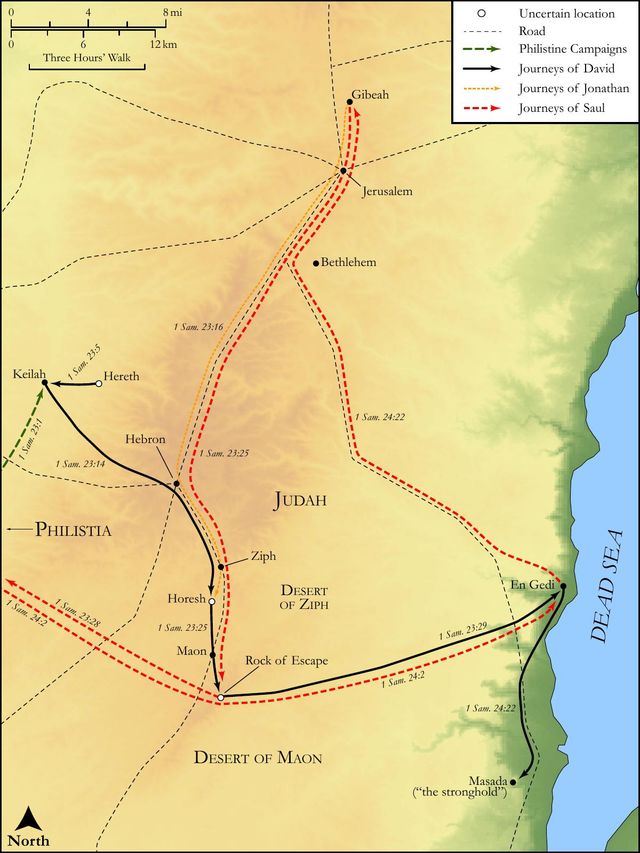
See on the biblical-era map
Study this verse
Public-domain commentary
Matthew Henry
From his Commentary on the Whole Bible. Henry comments on passages, not single verses — this entry covers 1 Samuel 23:19–29.
Here, 1. The Ziphites offer their service to Saul, to betray David to him, Sa1 23:19, Sa1 23:20. He was sheltering himself in the wilderness of Ziph (Sa1 23:14, Sa1 23:15), putting the more confidence in the people of that country because they were of his own tribe. They had reason to think themselves happy that they had an opportunity of serving one who was the ornament of their tribe and was likely to be much more so, who was so far from plundering the country, or giving it any disturbance with his troops, that he was ready to protect it and to them all the good offices that there was occasion for. But, to ingratiate themselves with Saul, they went to him, and not only informed him very particularly where David quartered (Sa1 23:19), but invited him to come with his forces into their country in pursuit of him, and promised to deliver him into his hand, Sa1 23:20. Saul had not sent to examine or threaten them, but of their own accord, and even without asking a reward (as Judas did - What will you give me?), they offered to betray David to him who, they knew, thirsted after his blood. 2. Saul thankfully receives their information, and gladly lays hold of the opportunity of hunting David in their wilderness, in hopes to make a prey of him at length. He intimates to them how kindly he took it (Sa1 23:21): Blessed be you of the Lord (so near is God to his mouth, though far from his heart), for you have compassion on me. It seems he looked upon himself as a miserable man and an object of pity; his own envy and ill-nature made him so, otherwise he might have been easy and have needed no man's compassion. He likewise insinuates the little concern that the generality of his people showed for him. "You have compassion on me, which others have not." Saul gives them instructions to search more particularly for his haunts (Sa1 23:22), "for" (says he) "I hear he deals very subtilely," representing him as a man crafty to do mischief, whereas all his subtlety was to secure himself. It was strange that Saul did not go down with them immediately, but he hoped by their means to set his game with the more certainty, and thus divine Providence gave David time to shift for himself. But the Ziphites had laid their spies upon all the places where he was likely to be discovered, and therefore Saul might come and seize him if he was in the land, Sa1 23:23. New he thought himself sure of his prey and pleased himself with the thoughts of devouring it. 3. The imminent peril that David was now brought into. Upon intelligence that the Ziphites had betrayed him, he retired from the hill of Hachilah to the wilderness of Maon (Sa1 23:24), and at this time he penned the 54th Psalm, as appears by the title, wherein he calls the Ziphites strangers, though they were Israelites, because they used him barbarously; but he puts himself under the divine protection: "Behold, God is my helper, and then all shall be well" Saul, having got intelligence of him, pursued him closely (Sa1 23:25), till he came so near him that there was but a mountain between them (Sa1 23:26), David and his men on one side of the mountain flying and Saul and his men on the other side pursuing, David in fear and Saul in hope. But this mountain was an emblem of the divine Providence coming between David and the destroyer, like the pillar of cloud between the Israelites and the Egyptians. David was concealed by this mountain and Saul confounded by it. David now flees as a bird to his mountain (Psa 11:1) and finds God to him as the shadow of a great rock. Saul hoped with his numerous forces to enclose David, and compass him in and his men; but the ground did not prove convenient for his design, and so it failed. A new name was given to the place in remembrance of this (Sa1 23:28): Selah-hammah-lekoth - the rock of division, because it divided between Saul and David. 4. The deliverance of David out of this danger. Providence gave Saul a diversion, when he was just ready to lay hold of David; notice was brought him that the Philistines were invading the land (Sa1 23:27), probably that part of the land where his own estate lay, which would be seized, or at least spoiled, by the invaders; for the little notice he took of Keilah's distress and David's relief of it, in the beginning of this chapter, gives us cause to suspect that he would not now have left pursuing David, and gone to oppose the Philistines, if some private interests of his own had not been at stake. However it was, he found himself under a necessity of going against the Philistines (Sa1 23:28), and by this means David was delivered when he was on the brink of destruction. Saul was disappointed of his prey, and God was glorified as David's wonderful protector. When the Philistines invaded the land they were far from intending any kindness to David by it, yet the overruling providence of God, which orders all events and the times of them, made it very serviceable to him. The wisdom of God is never at a loss for ways and means to preserve his people. As this Saul was diverted, so another Saul was converted, just then when he was breathing out threatenings and slaughter against the saints of the Lord, Act 9:1. 5. David, having thus escaped, took shelter in some natural fortresses, which he found in the wilderness of En-gedi, Sa1 23:29. And this Dr. Lightfoot thinks was the wilderness of Judah, in which David was when he penned Psa 63:1-11, which breathes as much pious and devout affection as almost any of his psalms; for in all places and in all conditions he still kept up his communion with God.
Historical interpretation
Historical reception
1 surviving comment on this verse from the historical church.
And Saul said: Blessed be you of the Lord, etc. They promise the blessing of the Lord to themselves and their Jewish supporters when, having a zeal for God, but not according to knowledge, they either pursue the name of Jesus Christ, the Son of God, with hatred, or with arms. And as the Lord says elsewhere about them and their accomplices: "The time is coming that anyone who kills you will think he is offering a service to God" (John 16). But woe to their blessings, who, plotting against the Church, or at least against any of the Church's members, to scandalize anyone of the little ones of Christ, are proven to harm in the place of persecutors. Woe to those who, reaching to that flower rising from the root of Jesse only in name, seek with all their mind the withering and quickly perishing comforts of the present life; forgetting the blessing of Him, which is to be seen and hoped for by all, of which it is written: "The Lord hath been mindful of us and will bless us. He will bless the house of Israel, he will bless the house of Aaron" (Psalm 113). But blessing both, he blessed all who fear the Lord. You ask: Whom both? It is answered, the small with the great, that is, the house of Israel with the house of Aaron; those indeed who from that very nation have believed in the Savior Jesus, because not all those pleased God; but if indeed not all of them believed, has their unbelief made the faith of God without effect? By no means. For not all who are of Israel are Israelites; nor are all children of Abraham's seed; as it is written, "The remnant shall be saved" (Isaiah 10). By that oracle of Isaiah, some of the Jews are foretold to attain this heavenly blessing, so that the greater part of them is blinded; whose type and figure Saul, rejected by God, bore, and in whose place the gentiles were appointed; for other sheep joined which were not of this fold, so that there might be one flock and one shepherd (John 10); the faith of all nations joined, and the number increased not only of wise shepherds but also of obedient peoples; to whom many blessings of God have been promised, as it is said: "Blessed be the God and Father of our Lord Jesus Christ, who has blessed us with every spiritual blessing in the heavenly places in Christ" (Ephesians 1); but God has blessed us, not with one blessing, but with all. Not that we all attain everything, but while each of us possesses one or several from all, we all possess through each one. And not in earthly blessings, imitating the Jews, of whom Isaiah said: "If you are willing and obedient, you shall eat the good of the land" (Isaiah 1), but in spiritual ones. For there are indeed earthly blessings, to have children; to overflow with wealth, to rejoice in honor and health; which earthly blessing extends even to irrational animals, it is said of them: "And God blessed them, saying, Be fruitful, and multiply, and fill the earth" (Genesis 1). But the spiritual blessings are in heavenly places, for the earth does not hold a spiritual blessing. For even those blessings which in Leviticus are promised to those observing God's precepts, for instance, to lend to foreign nations, to have barns full of grain, to be blessed in cities, to be blessed in fields, and the like, we do not see fulfilled in the prophets, who wandered about in sheepskins and goatskins, being destitute, afflicted, tormented; of whom the world was not worthy, wandering in deserts, and in mountains, and in dens and caves of the earth. Therefore, all things are to be understood spiritually; and spiritual things are to be awaited not in earthly places, but heavenly.
Continue studying 1 Samuel 23:21 across the web’s major study libraries — every link below opens this exact verse, chapter, or book on the destination site.
Read & Compare
 BibleGatewayThis verse in more than 200 translations and 70 languages.
 Bible.comThe YouVersion reader — hundreds of translations, reading plans, and highlights.
 ESV.orgCrossway's official English Standard Version reader.
 NET BibleThe NET translation with 60,000+ translators' notes on every rendering decision.
 STEP BibleTyndale House's free study tool — original text, vocabulary, and scholarly resources.
 BibliaLogos Bible Software's free web reader.
 USCCBThe New American Bible (Revised Edition) with the U.S. bishops' study notes.
Commentaries
 BibleHub CommentariesDozens of classic commentaries on this verse, gathered on one page.
 StudyLightMore than 100 commentary sets — the largest collection on the web.
 BibleRefPlain-English commentary on what this verse means, verse by verse.
 Enduring WordDavid Guzik's free commentary on this chapter, widely used by Bible teachers.
 Bible Study ToolsVerse commentary alongside Greek and Hebrew study aids.
Original Language & Research
- BibleHub InterlinearThe verse word by word — original language, transliteration, and English.
- BibleHub LexiconEvery word's original-language definition and Strong's entry.
 Blue Letter BibleDeep-study tools — Strong's numbers, concordance, and word studies.
 SefariaThe Hebrew text with Rashi and centuries of Jewish commentary.
Sermons, Hymns & Audio


TrulyRandomVerse is not affiliated with these sites and doesn’t control their content. They’re linked because they’re genuinely useful.
Summary
1 Samuel 23:21 captures King Saul's self-serving and spiritually distorted reaction to the Ziphites' betrayal of David. Consumed by paranoia and a relentless pursuit of David, Saul expresses profound gratitude to the Ziphites, declaring them "blessed by the LORD" for what he perceives as "compassion" shown to him. This verse starkly reveals Saul's moral blindness and the extent of his spiritual decline, as he invokes a divine blessing upon an act of treachery against God's anointed, highlighting his inverted understanding of justice, loyalty, and divine favor.
Context
ShowHideLiterary Context
This verse is situated within a dramatic and dangerous period in David's life, as chronicled in 1 Samuel 23. David, though divinely anointed as the future king of Israel, is a hunted fugitive, constantly evading King Saul's murderous intent. Prior to this verse, David has just delivered Keilah from the Philistines, yet he is forced to flee again when he learns Saul plans to besiege the city. He then seeks refuge in the wilderness of Ziph, a desolate and rugged region. The Ziphites, inhabitants of this area, demonstrate their loyalty to the reigning king, Saul, by actively seeking to betray David's hiding place. They approach Saul, offering to deliver David into his hands, an act that deeply pleases the king and sets the immediate stage for Saul's pronouncement in this very verse. This betrayal is particularly poignant as it recurs later in the narrative of 1 Samuel 26, underscoring the persistent danger David faced from those who would curry favor with Saul.
Historical & Cultural Context
The period of Saul's reign was marked by a turbulent transition in Israel's leadership from judges to kingship. Saul, initially chosen by God, had been rejected due to his disobedience, and David was secretly anointed by Samuel, as detailed in 1 Samuel 16:1-13. This created immense tension, as the reigning king sought to eliminate his divinely appointed successor. Loyalty in ancient Israelite society was complex, often shifting between tribal allegiances, the reigning monarch, and perceived divine will. The Ziphites, by informing Saul, were likely attempting to curry favor with the powerful king, demonstrating loyalty to the established authority rather than to David, who was a fugitive. Their actions reflect a pragmatic choice in a politically volatile environment, prioritizing their own safety and standing with Saul over any moral obligation to David, who was innocent of any crime against the kingdom.
Key Themes
ShowHideThis verse contributes significantly to several overarching themes in 1 Samuel. Firstly, it highlights Saul's Spiritual and Moral Decline, showcasing his profound self-deception and twisted perception of reality. He views an act of betrayal against an innocent man as "compassion" shown to himself, demonstrating his inability to discern God's will or righteous judgment. Secondly, the verse underscores the theme of Misplaced Loyalty and Betrayal, as the Ziphites prioritize allegiance to a corrupt king over justice and the well-being of God's anointed. This contrasts sharply with the unwavering loyalty shown by figures like Jonathan to David throughout 1 Samuel 20. Finally, despite the immediate danger and betrayal, the broader narrative, including David's subsequent narrow escape, reinforces the theme of Divine Providence and Protection over David, even amidst intense peril. God's faithfulness to His promises remains steadfast, even when human actors fail or actively oppose His plan.
Exposition and Analysis
ShowHideKey Word Analysis
ShowHideThis word, derived from the root H1288, typically denotes a state of divine favor, prosperity, or well-being bestowed by God. It can mean "to kneel" in adoration, or to "bless" another (as a benefit), or even euphemistically "to curse." Saul's declaration, "Blessed [be] ye of the LORD," is a formal invocation of divine favor. However, in this context, it is deeply ironic and perverse. Saul, the rejected king, invokes the name of Yahweh to sanction an act of treachery and injustice against David, God's chosen one. This reveals the extent of Saul's spiritual blindness and his profound disconnect from God's character, as God would never bless those who facilitate unrighteousness. It underscores how far Saul has fallen from the king God originally intended him to be.
This verb (H2550) means "to commiserate," "to pity," "to spare," or "to show mercy." It often implies a reluctance to harm or punish, or an act of kindness towards someone in distress. Saul's assertion that the Ziphites "have compassion on me" is a gross distortion of the word's true meaning. The Ziphites were not showing mercy or kindness; they were actively aiding Saul in his unjust persecution of David, thereby causing more suffering to an innocent man. Saul's self-pity and paranoid fixation on David lead him to interpret their betrayal as an act of personal kindness, highlighting his inverted moral compass and his inability to perceive the true nature of their actions or his own.
Verse Breakdown
ShowHide"And Saul said,"
This opening clause immediately sets the stage, drawing attention to the king's direct response. It emphasizes Saul's personal involvement and approval of the Ziphites' actions, signaling that what follows is his official and deeply felt reaction, revealing his inner state.
"Blessed [be] ye of the LORD;"
This is a formal declaration of blessing, invoking the name of Yahweh (H3068). In ancient Israel, such a blessing was a weighty pronouncement, signifying divine approval and favor. The profound irony here is that Saul, the rejected king, pronounces a divine blessing upon those who are aiding him in his unrighteous pursuit of God's chosen successor. This highlights Saul's spiritual delusion, as he believes God would endorse his sin and his personal vendetta.
"for ye have compassion on me."
This clause provides Saul's rationale for his blessing. He perceives the Ziphites' act of informing on David as an act of "compassion" or pity directed towards himself. This reveals Saul's deep self-pity, his distorted perception of justice, and his complete moral inversion. He sees himself as the victim, and anyone who helps him against David is seen as a benefactor, regardless of the ethical implications of their actions.
Literary Devices
ShowHideThe verse employs significant Irony, particularly in Saul's use of the words "blessed" and "compassion." Saul, the king rejected by God, invokes a divine blessing upon those who are facilitating his unrighteous pursuit of God's anointed. This is deeply ironic, as a true blessing from the LORD would never endorse such an act. Furthermore, his claim that the Ziphites showed him "compassion" is an example of Situational Irony and Dramatic Irony. The Ziphites' actions were a betrayal of an innocent man, David, and were motivated by self-interest or fear of Saul, not genuine compassion. The audience, knowing David's innocence and God's favor upon him, understands the perversity of Saul's statement, creating a sense of tragic irony. The passage also uses Foreshadowing by subtly hinting at Saul's continued moral decay and the ultimate futility of his efforts against David, whose divine protection is repeatedly demonstrated throughout the narrative.
Theological and Thematic Connections
ShowHide1 Samuel 23:21 serves as a stark theological commentary on the dangers of spiritual blindness and self-deception, particularly when coupled with unchecked power. Saul's inability to recognize the injustice of his actions, and his warped perception of "compassion," illustrates how sin can corrupt one's moral compass, leading to an inversion of truth and righteousness. The verse underscores the biblical principle that true blessing comes from aligning with God's will and justice, not from selfish ambition or the persecution of the innocent. It also highlights the theme of divine sovereignty, demonstrating that even amidst human treachery and powerful opposition, God's purposes for His chosen ones will ultimately prevail.
Reflection and Application
ShowHideSaul's profound self-deception in 1 Samuel 23:21 offers a sobering mirror for contemporary believers. It challenges us to critically examine our own motives and perceptions, especially when we feel wronged or are pursuing a personal agenda. Are we, like Saul, prone to twisting reality to justify our actions or to see ourselves as victims, even when we are the aggressors? True spiritual health requires constant self-assessment against the unwavering standard of God's Word, allowing the Holy Spirit to reveal our blind spots and convict us of sin. Furthermore, this verse calls us to discern true compassion, which always aligns with God's justice and mercy, seeking to alleviate suffering and promote righteousness, rather than enabling injustice or harming the innocent. In a world where "compassion" can be co-opted for various agendas, we are called to embody the self-sacrificial, truth-affirming compassion of Christ, trusting that God's sovereign protection extends to those who walk in His ways, even when surrounded by opposition and betrayal.
Questions for Reflection
ShowHideFAQ
ShowHideWhy was Saul so intent on hunting David, and what does this verse reveal about his state of mind?
ShowHideSaul was consumed by jealousy and paranoia, stemming from God's rejection of him as king and the anointing of David as his successor, as detailed in 1 Samuel 15:23 and 1 Samuel 16:13. He saw David as an immediate threat to his throne and sought to eliminate him. 1 Samuel 23:21 reveals the depth of his spiritual and psychological deterioration. His declaration that the Ziphites showed him "compassion" for betraying David highlights his profound self-pity and twisted perception of reality. He views himself as the wronged party, incapable of seeing his own sin or the innocence of David. This indicates a severe moral blindness and a desperate clinging to power, even at the cost of justice and divine favor.
Christ-Centered Fulfillment
ShowHideThe perversion of blessing and compassion witnessed in 1 Samuel 23:21 finds its ultimate contrast and fulfillment in Jesus Christ. Saul, the rejected king, pronounces a false blessing on those who betray God's anointed, driven by his own self-preservation and twisted sense of justice. This foreshadows the ultimate betrayal of the true Anointed One, Jesus, by those who claimed to be God's people. Just as the Ziphites betrayed David, Judas Iscariot betrayed Jesus for thirty pieces of silver (Matthew 26:14-16), and the religious leaders, blinded by their own power and self-righteousness, sought His death, believing they were doing God's will (John 16:2). Yet, unlike Saul's self-serving "compassion," Christ embodies perfect compassion, not for Himself, but for humanity, willingly laying down His life for His enemies (Romans 5:8). The true blessing of the LORD is not found in aiding unjust pursuits, but in the redemptive work of Christ, who, through His sacrifice, became the source of eternal blessing for all who believe (Ephesians 1:3). He is the one who truly receives "blessing and honor and glory and might forever and ever!" from all creation (Revelation 5:13). In Christ, we see the perfect King, whose reign is established not by human treachery or self-preservation, but by divine love, justice, and the ultimate act of self-giving compassion.