


1 Samuel 23:15
- וַיַּרְאvai·Yar'and he sawH7200Conj-w ¦ V-Qal-ConsecImperf-3msVerb Qal Consecutive Imperfect 3rd Singular Masculineוַandיַּרְאhe saw
- דָוִדda·VidDavidH1732N-proper-mNoun Proper Masculine
- כִּיkithatH3588PrtParticle Conditional
- יָצָאya·Tza'he had come forthH3318V-Qal-Perf-3msVerb Qal Perfect 3rd Singular Masculine
- שָׁאוּלsha·'UlSaulH7586N-proper-mNoun Proper Masculine
- לְבַקֵּשׁle·va·Keshto seekH1245Prep-l ¦ V-Piel-InfVerb Piel Infinitive Constructלְtoבַקֵּשׁseek
- אֶת'et<obj.>H853DirObjMParticle Object Indicator
- נַפְשׁוֹnaf·Shohis lifeH5315N-fsc ¦ 3msNoun Singular Feminine Constructנַפְשׁlifeוֹhis
- וְדָוִדve·da·Vidand DavidH1732Conj-w ¦ N-proper-mNoun Proper MasculineוְandדָוִדDavid
- בְּמִדְבַּרbe·mid·bar[was] in [the] wilderness ofH4057Prep-b ¦ N-mscNoun Singular Masculine Constructבְּ[was] inמִדְבַּר[the] wilderness of
- זִיףzifZiphH2128N-properNoun Proper Location
- בַּחֹרְשָׁהba·Cho·re·shahat <the> HoreshH2793Prep-b ¦ N-properNoun Proper Locationבַּat <the>חֹרְשָׁהHoresh
English is a literal word-by-word gloss of the Hebrew, not the KJV's wording. Why?
This is the original text the KJV's translators worked from — each Hebrew word with its own literal English meaning in this verse, prepared by scholars at Tyndale House, Cambridge. The KJV translates whole sentences, not word by word, so its wording differs: one Hebrew word can become several English words, and the KJV may choose “the LORD” where the gloss reads “Yahweh”. Both are faithful — they answer different questions. For the KJV's own rendering, switch to the KJV text.
Details
See on the biblical-era map
Study this verse
Public-domain commentary
Matthew Henry
From his Commentary on the Whole Bible. Henry comments on passages, not single verses — this entry covers 1 Samuel 23:14–18. His two-level outline is real structure in the source text, so it is rendered as structure.
Here is, I. David absconding. He abode in a wilderness, in a mountain (Sa1 23:14), in a wood, Sa1 23:15. We must here, 1. Commend his eminent virtues, his humility, modesty, fidelity to his prince, and patient attendance on the providence of his God, that he did not draw up his forces against Saul, fight him in the field, or surprise him by some stratagem or other, and so avenge his own quarrel and that of the Lord's priests upon him, and put an end to his own troubles and the calamities of the country under Saul's tyrannical government. No, he makes no such attempt; he keeps God's way, waits God's time, and is content to secure himself in woods and wildernesses, though with some it might seem a reproach to that courage for which he had been famous. But, 2. We must also lament his hard fate, that an innocent man should be thus terrified and put in fear of his life, that a man of honour should be thus disgraced, a man of merit thus recompensed for his services, and a man that delighted in the service both of God and his country should be debarred from both and wrapped up in obscurity. What shall we say to this? Let it make us think the worse of this world, which often gives such bad treatment to its best men; let it reconcile even great and active men to privacy and restraint, if Providence make these their lot, for they were David's; and let it make us long for that kingdom where goodness shall for ever be in glory and holiness in honour, and the righteous shall shine as the sun, which cannot be put under a bushel.
II.Saul hunting him, as his implacable enemy.
He sought him every day, so restless was his malice, Sa1 23:14. He sought no less than his life, so cruel was his malice, Sa1 23:15. As it had been from the beginning, so it was now, and will be, he that is born after the flesh persecuteth him that is born after the spirit, Gal 4:29.
III.God defending him, as his powerful protector.
God delivered him not into Saul's hand, as Saul hoped (Sa1 23:7); and, unless God delivered him into his hand, he could not prevail against him, Joh 19:11.
IV.Jonathan comforting him as his faithful and constant friend.
True friends will find out means to get together. David, it is likely, appointed time and place for this interview, and Jonathan observed the appointment, though he exposed himself thereby to his father's displeasure, and, had it been discovered, it might have cost him his life. True friendship will not shrink from danger, but can easily venture, will not shrink from condescension, but can easily stoop, and exchange a palace for a wood, to serve a friend. The very sight of Jonathan was reviving to David; but, besides this, he said that to him which was very encouraging.
1.As a pious friend, he directed him to God, the foundation of his confidence and the fountain of his comfort: He strengthened his hand in God. David, though a strong believer, needed the help of his friends for the perfecting of what was lacking in his faith; and herein Jonathan was helpful to him, by reminding him of the promise of God, the holy oil wherewith he was anointed, the presence of God with him hitherto, and the many experiences he had had of God's goodness to him. Thus he strengthened his hands for action, by encouraging his heart, not in the creature, but in God. Jonathan was not in a capacity of doing any thing to strengthen him, but he assured him God would.
2.As a self-denying friend, he took a pleasure in the prospect of David's advancement to that honour which was his own birthright, Sa1 23:17. "Thou shalt live to be king, and I shall think it preferment enough to be next thee, near thee, though under thee, and will never pretend to be a rival with thee." This resignation which Jonathan made to David of his title would be a great satisfaction to him, and make his way much the more clear. This, he tells him, Saul knew very well, Jonathan having sometimes heard him say as much, whence it appears what a wicked man Saul was, to persecute one whom God favoured, and what a foolish man he was, in thinking to prevent that which God had determined and which would certainly come to pass. How could he disannul what God had purposed?
3.As a constant friend, he renewed his league of friendship with him. They made a covenant now, this third time, before the Lord, calling him to witness to it, Sa1 23:18. True love takes delight in repeating its engagements, giving and receiving fresh assurances of the firmness of the friendship. Our covenant with God should be often renewed, and therein our communion with him kept up. David and Jonathan now parted, and never came together again, that we find, in this world; for Jonathan said what he wished, not what he had ground to expect, when he promised himself that he should be next to David in his kingdom.
Historical interpretation
Historical reception
1 surviving comment on this verse from the historical church.
Moreover, David was in the wilderness of Ziph in the forest. The Lord saw, whose eyes see all things naked and open (Hebrews IV), that he had gone forth from the inner guard of the assembly of traitors, to seek and persecute the church of his faithful, whose heart and soul are one (Acts IV). He remained in the wilderness, in the Church taken from the Gentiles, which often generates fruitful trees, as hearts pregnant with the seed of varied virtues; about which the Psalmist, singing about building a house of remission and life after captivity, says: Then shall all the trees of the forest rejoice before the Lord, for he comes (Psalm XCVI). Now, these trees of the widely fruitful Church, spiritually fecundated with the flower or seed of good works (for Ziph is said to interpret both), are prominent to the extent that they diligently abandon all the enjoyments of this world.
Continue studying 1 Samuel 23:15 across the web’s major study libraries — every link below opens this exact verse, chapter, or book on the destination site.
Read & Compare
 BibleGatewayThis verse in more than 200 translations and 70 languages.
 Bible.comThe YouVersion reader — hundreds of translations, reading plans, and highlights.
 ESV.orgCrossway's official English Standard Version reader.
 NET BibleThe NET translation with 60,000+ translators' notes on every rendering decision.
 STEP BibleTyndale House's free study tool — original text, vocabulary, and scholarly resources.
 BibliaLogos Bible Software's free web reader.
 USCCBThe New American Bible (Revised Edition) with the U.S. bishops' study notes.
Commentaries
 BibleHub CommentariesDozens of classic commentaries on this verse, gathered on one page.
 StudyLightMore than 100 commentary sets — the largest collection on the web.
 BibleRefPlain-English commentary on what this verse means, verse by verse.
 Enduring WordDavid Guzik's free commentary on this chapter, widely used by Bible teachers.
 Bible Study ToolsVerse commentary alongside Greek and Hebrew study aids.
Original Language & Research
- BibleHub InterlinearThe verse word by word — original language, transliteration, and English.
- BibleHub LexiconEvery word's original-language definition and Strong's entry.
 Blue Letter BibleDeep-study tools — Strong's numbers, concordance, and word studies.
 SefariaThe Hebrew text with Rashi and centuries of Jewish commentary.
Sermons, Hymns & Audio


TrulyRandomVerse is not affiliated with these sites and doesn’t control their content. They’re linked because they’re genuinely useful.
Summary
1 Samuel 23:15 vividly portrays the perilous reality of David's life as a fugitive, highlighting his acute awareness of King Saul's relentless and murderous pursuit. The verse precisely locates David in the rugged, isolated wilderness of Ziph, specifically within a dense wood, thereby emphasizing the extreme danger, constant vigilance, and desperate need for concealment that characterized his existence as he evaded the reigning monarch's determined efforts to end his life.
Context
ShowHideLiterary Context
This verse is deeply embedded within a prolonged and intense period of persecution for David, which began after his anointing by Samuel and his meteoric rise in Saul's court. Saul's escalating jealousy, fueled by the popular acclaim David received following his victory over Goliath and the women's song, "Saul has slain his thousands, and David his ten thousands" (1 Samuel 18:7), had devolved into an obsessive, murderous vendetta. Immediately preceding this verse, David had heroically delivered the Philistine-besieged city of Keilah, only to be divinely warned that its inhabitants would betray him to Saul. This revelation forced David and his approximately 600 men to flee again, underscoring his precarious and constantly moving existence as he sought refuge from the king's wrath, a narrative thread that continues throughout 1 Samuel 23. Verse 15 thus marks David's continued flight, highlighting his desperate need for concealment and the relentless nature of Saul's pursuit.
Historical & Cultural Context
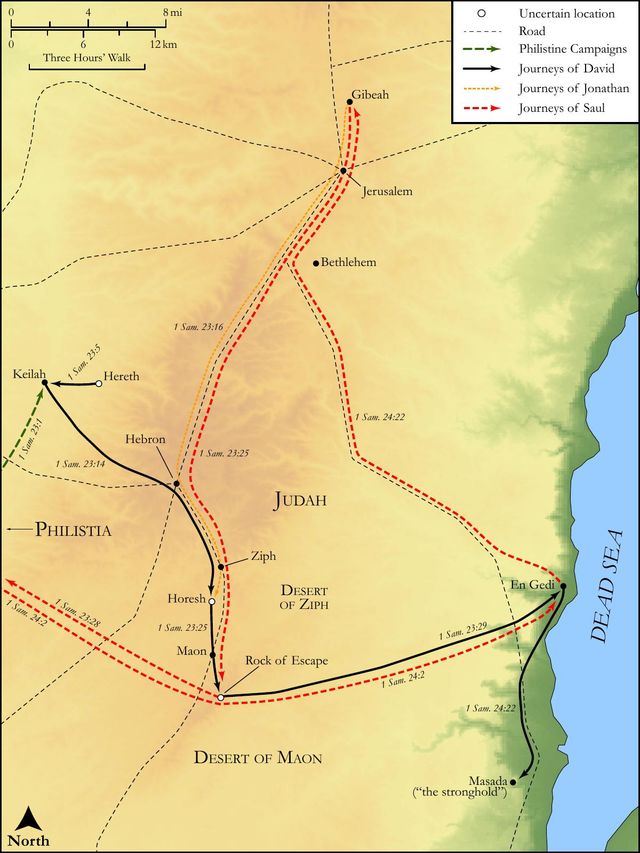
The "wilderness of Ziph" refers to a specific geographical region in the tribal territory of Judah, situated southeast of Hebron. This area was known for its desolate, uncultivated, and rugged terrain, characterized by rocky outcrops, numerous caves, and sparse vegetation, including thickets and "woods" (Hebrew chôresh). Such wildernesses were typically used for grazing livestock and were largely uninhabited by settled populations, making them ideal, albeit harsh, hiding places for fugitives. Saul's "coming out to seek his life" reflects the common practice of ancient Near Eastern kings leading military expeditions or hunting parties, demonstrating the full deployment of royal authority, resources, and military might against a perceived threat. The subsequent actions of the Ziphites, who would betray David's hiding place to Saul (1 Samuel 23:19), highlight the constant threat of local treachery and the precariousness of relying on any human security, even in remote areas.
Key Themes
ShowHideThis verse powerfully contributes to several overarching themes that permeate the book of 1 Samuel and David's narrative. Foremost among these is Relentless Persecution, as Saul's unyielding pursuit underscores the extreme and existential danger David faced, a constant threat to his very life. This period also vividly illustrates David's Fugitive Existence, forcing him into a life of constant movement, vigilance, and a profound reliance on God rather than on human power or conventional security. Despite the immediate and overwhelming danger, the broader narrative consistently demonstrates God's Sovereignty and Protection over His anointed one; even in the most desperate moments, God miraculously intervenes to preserve David, as seen in David's narrow escape from Saul at Maon, where the Philistines providentially divert Saul's attention (1 Samuel 23:26-28). Finally, the context subtly introduces the theme of Human Treachery vs. Loyalty, as David must navigate not only Saul's direct hostility but also the potential for betrayal from those he encounters, a stark contrast to the steadfast loyalty of figures like Jonathan, who strengthens David's hand in God (1 Samuel 23:16-18).
Exposition and Analysis
ShowHideKey Word Analysis
ShowHideThis verb (H7200) denotes more than mere passive observation; it implies an active, discerning perception. David's "seeing" signifies an acute awareness of the danger, a vigilance born of necessity, and a strategic understanding of Saul's movements. It highlights his intelligence and survival instincts, constantly assessing threats in his environment to anticipate and evade.
This is a powerful and frequently used idiom (H1245 and H5315) in Hebrew, signifying a determined and often murderous intent. To "seek the life" of someone means to pursue them with the explicit aim of taking their life, not merely to capture or imprison them. This phrase underscores the gravity and ultimate goal of Saul's pursuit, emphasizing that David was a target for assassination.
The term "wilderness" (midbâr, H4057) in the biblical context does not necessarily mean a barren desert but often refers to an uncultivated, sparsely populated, and rugged region suitable for grazing or, in this case, hiding. "Ziph" (H2128) specifies the geographical location, a known area in Judah, which later becomes infamous for the Ziphites' repeated betrayal of David. The combination emphasizes the harsh, isolated, and dangerous environment David inhabited, relying on its natural concealment for survival.
Verse Breakdown
ShowHide"And David saw"
This opening clause immediately establishes David's perspective and his constant state of heightened alertness. His survival depended entirely on his ability to perceive, interpret, and react swiftly to threats, often from a distance. It speaks to his wisdom and discernment in a perpetually life-or-death situation.
"that Saul was come out to seek his life"
This clause reveals the specific, grave nature of the threat David perceived. Saul's active "coming out" (Hebrew yâtsâʼ) implies a deliberate, organized military expedition, not a casual search, with the explicit, murderous goal of ending David's life. It starkly highlights the direct, personal, and deadly nature of Saul's vendetta against David.
"and David [was] in the wilderness of Ziph in a wood"
This final clause precisely pinpoints David's precarious location. The "wilderness of Ziph" signifies a remote, rugged, and potentially hostile environment, while being "in a wood" (Hebrew chôresh) suggests a specific, concealed hiding place within that wilderness. It paints a vivid picture of David's desperate need for natural cover and his reliance on the landscape for protection against the king's forces.
Literary Devices
ShowHideThe verse employs several potent literary devices to convey David's plight. Irony is powerfully present in the stark contrast between David, God's anointed king-in-waiting, being hunted like a common criminal by the reigning king, Saul, who has tragically fallen out of God's favor. The setting itself, the wilderness, functions as a profound symbolism, representing not only a physical place of refuge but also a spiritual crucible—a place of testing, isolation, and spiritual refinement where David's faith, patience, and reliance on God are continually forged. The phrase "seek his life" is a vivid idiom, conveying the full extent of Saul's murderous intent and adding dramatic tension to the narrative. Furthermore, the constant threat of Saul's relentless pursuit creates a pervasive sense of suspense that permeates David's wilderness narrative, keeping the reader acutely aware of the ever-present danger and anticipating God's next miraculous intervention.
Theological and Thematic Connections
ShowHide1 Samuel 23:15, while depicting a moment of immediate danger, resonates with profound theological and thematic truths about God's unwavering protection, the refining nature of suffering, and the often-arduous path to divine appointment. David's experience of being relentlessly hunted by an unjust, jealous authority figure foreshadows a recurring biblical pattern: God's chosen servants frequently face intense opposition and trials before fulfilling their divine calling. This period of adversity was not merely a test of David's physical endurance but a profound crucible for his spiritual character, deepening his dependence on God and shaping him into the "man after God's own heart." It powerfully underscores the truth that God's presence and provision are not limited to places of comfort or security but are often most powerfully revealed in the wilderness, in moments of extreme vulnerability and desperation.
Reflection and Application
ShowHideDavid's desperate plight in 1 Samuel 23:15 offers a powerful and relatable mirror for believers navigating their own seasons of intense pressure, unjust opposition, or feeling "hunted" by life's relentless circumstances. It serves as a profound reminder that even when God has a clear and sovereign purpose for our lives, the path to fulfilling it often involves periods of profound difficulty, vulnerability, and apparent abandonment. David's "seeing" Saul's murderous intent highlights the critical importance of spiritual discernment and vigilance in our own lives, recognizing the true nature of the threats we face, whether from external adversaries, internal struggles, or the schemes of the enemy. Yet, even in the most desolate "wildernesses" of our lives, this narrative assures us that God provides refuge, sustains us, and works His purposes. David's unwavering trust and perseverance, despite overwhelming odds, calls us to cultivate a similar faith, knowing that adversity can be a refining fire that deepens our reliance on God and prepares us for His greater plans. Our character is often forged not in comfort, but in the crucible of hardship, teaching us to find our ultimate security not in shifting circumstances, but in the unchanging faithfulness of God.
Questions for Reflection
ShowHideFAQ
ShowHideWhy was Saul so determined to kill David?
ShowHideSaul's determination stemmed primarily from a deep-seated jealousy, paranoia, and insecurity, which were severely exacerbated by his disobedience to God and the departure of God's Spirit from him (1 Samuel 16:14). He perceived David, who had been anointed by Samuel and was increasingly popular with the people, as a direct and existential threat to his throne and the continuation of his dynasty. Saul's fear of losing power consumed him, leading to a murderous obsession that blinded him to David's loyalty and God's sovereign plan for the future of Israel.
What is the significance of the "wilderness of Ziph" in David's story?
ShowHideThe "wilderness of Ziph" is significant as a recurring place of both refuge and profound betrayal for David. Its rugged, desolate terrain, with its caves and thickets, provided natural hiding places, allowing David and his men to evade Saul's forces. However, it was also the home of the Ziphites, local inhabitants who twice betrayed David's exact location to Saul (1 Samuel 23:19 and 1 Samuel 26:1). Thus, the wilderness of Ziph symbolizes the precariousness of David's fugitive life—a place of temporary safety that could quickly turn into a trap due to human treachery. It served as a crucible where David learned to rely solely on God's miraculous protection and deliverance.
How does this verse fit into David's journey to kingship?
ShowHideThis verse, depicting David as a hunted fugitive, is a critical and formative part of his preparation for kingship. It powerfully demonstrates that God's chosen leader was not groomed in luxury or ease but in hardship, developing resilience, strategic thinking, profound dependence on God, and deep compassion for his people. The wilderness years, filled with such desperate moments as described in 1 Samuel 23:15, forged David's character, teaching him humility, patience, and unwavering trust in divine providence. This period of suffering and reliance on God's miraculous deliverance ultimately prepared him to rule justly and shepherd Israel as a king after God's own heart, standing in stark contrast to Saul's self-serving and disobedient reign.
Christ-Centered Fulfillment
ShowHideDavid's harrowing experience in the wilderness of Ziph, relentlessly pursued by Saul, profoundly foreshadows the life of Jesus Christ, the true Anointed King and ultimate Son of David. Just as David, the shepherd king-in-waiting, was hunted by an earthly monarch threatened by his divine appointment, so too was Jesus, the ultimate Shepherd of Israel, pursued by religious and political authorities who sought to take His life from His infancy (Matthew 2:13-15) to His crucifixion (John 7:1, John 8:59). David's reliance on God for refuge in desolate places anticipates Christ's own wilderness experience of temptation and absolute dependence on the Father (Matthew 4:1-11). Ultimately, David's suffering, his steadfast trust in God's protection, and his eventual exaltation to the throne point to Christ's journey of profound humiliation, suffering, and ultimate triumph over His enemies, leading to His glorious resurrection and enthronement as King of kings and Lord of lords (Philippians 2:8-11). Jesus, unlike David, faced the ultimate "seeking of His life" not merely from human adversaries but from the spiritual forces of sin and death, offering Himself as the perfect sacrifice to deliver us from their dominion (Hebrews 2:14-15). He is our true and eternal refuge, the one who endured the ultimate pursuit to secure our salvation.