


1 Samuel 23:16
Bible text: King James Version (1769 Blayney text) · Public domain
Bible text: Berean Standard Bible · Public domain
Bible text: American Standard Version (1901) · Public domain
Bible text: World English Bible, Messianic edition · Public domain
Bible text: Geneva Bible (1599) · Public domain
Bible text: Young's Literal Translation · Public domain
- וַיָּקָםvai·Ya·komand he aroseH6965Conj-w ¦ V-Qal-ConsecImperf-3msVerb Qal Consecutive Imperfect 3rd Singular Masculineוַandיָּקָםhe arose
- יְהוֹנָתָןye·ho·na·TanJonathanH3083N-proper-mNoun Proper Masculine
- בֶּןben[the] son ofH1121N-mscNoun Singular Masculine Construct
- שָׁאוּלsha·'UlSaulH7586N-proper-mNoun Proper Masculine
- וַיֵּלֶךְvai·Ye·lekhand he wentH1980Conj-w ¦ V-Qal-ConsecImperf-3msVerb Qal Consecutive Imperfect 3rd Singular Masculineוַandיֵּלֶךְhe went
- אֶל'eltoH413PrepPreposition
- דָּוִדda·VidDavidH1732N-proper-mNoun Proper Masculine
- חֹרְשָׁהCho·re·shahHoreshH2793N-properNoun Proper Location
- וַיְחַזֵּקvay·cha·Zekand he strengthenedH2388Conj-w ¦ V-Piel-ConsecImperf-3msVerb Piel Consecutive Imperfect 3rd Singular Masculineוַandיְחַזֵּקhe strengthened
- אֶת'et<obj.>H853DirObjMParticle Object Indicator
- יָדוֹya·Dohis handH3027N-csc ¦ 3msNoun Singular common gender Constructיָדhandוֹhis
- בֵּאלֹהִיםbe·lo·Himin GodH430Prep-b ¦ N-mpNoun Plural Masculine AbsoluteבֵּinאלֹהִיםGod
English is a literal word-by-word gloss of the Hebrew, not the KJV's wording. Why?
This is the original text the KJV's translators worked from — each Hebrew word with its own literal English meaning in this verse, prepared by scholars at Tyndale House, Cambridge. The KJV translates whole sentences, not word by word, so its wording differs: one Hebrew word can become several English words, and the KJV may choose “the LORD” where the gloss reads “Yahweh”. Both are faithful — they answer different questions. For the KJV's own rendering, switch to the KJV text.
Details
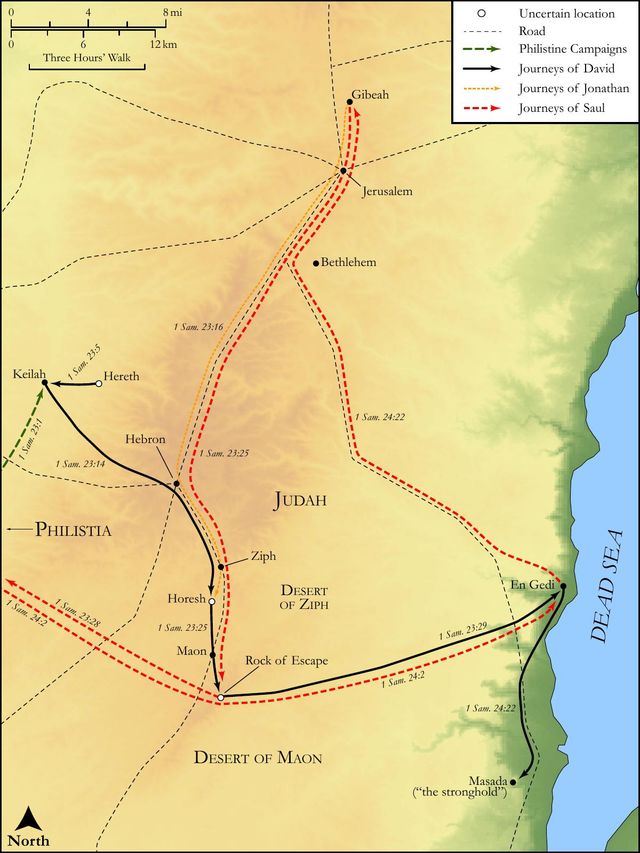
See on the biblical-era map
Study this verse
Public-domain commentary
Matthew Henry
From his Commentary on the Whole Bible. Henry comments on passages, not single verses — this entry covers 1 Samuel 23:14–18. His two-level outline is real structure in the source text, so it is rendered as structure.
Here is, I. David absconding. He abode in a wilderness, in a mountain (Sa1 23:14), in a wood, Sa1 23:15. We must here, 1. Commend his eminent virtues, his humility, modesty, fidelity to his prince, and patient attendance on the providence of his God, that he did not draw up his forces against Saul, fight him in the field, or surprise him by some stratagem or other, and so avenge his own quarrel and that of the Lord's priests upon him, and put an end to his own troubles and the calamities of the country under Saul's tyrannical government. No, he makes no such attempt; he keeps God's way, waits God's time, and is content to secure himself in woods and wildernesses, though with some it might seem a reproach to that courage for which he had been famous. But, 2. We must also lament his hard fate, that an innocent man should be thus terrified and put in fear of his life, that a man of honour should be thus disgraced, a man of merit thus recompensed for his services, and a man that delighted in the service both of God and his country should be debarred from both and wrapped up in obscurity. What shall we say to this? Let it make us think the worse of this world, which often gives such bad treatment to its best men; let it reconcile even great and active men to privacy and restraint, if Providence make these their lot, for they were David's; and let it make us long for that kingdom where goodness shall for ever be in glory and holiness in honour, and the righteous shall shine as the sun, which cannot be put under a bushel.
II.Saul hunting him, as his implacable enemy.
He sought him every day, so restless was his malice, Sa1 23:14. He sought no less than his life, so cruel was his malice, Sa1 23:15. As it had been from the beginning, so it was now, and will be, he that is born after the flesh persecuteth him that is born after the spirit, Gal 4:29.
III.God defending him, as his powerful protector.
God delivered him not into Saul's hand, as Saul hoped (Sa1 23:7); and, unless God delivered him into his hand, he could not prevail against him, Joh 19:11.
IV.Jonathan comforting him as his faithful and constant friend.
True friends will find out means to get together. David, it is likely, appointed time and place for this interview, and Jonathan observed the appointment, though he exposed himself thereby to his father's displeasure, and, had it been discovered, it might have cost him his life. True friendship will not shrink from danger, but can easily venture, will not shrink from condescension, but can easily stoop, and exchange a palace for a wood, to serve a friend. The very sight of Jonathan was reviving to David; but, besides this, he said that to him which was very encouraging.
1.As a pious friend, he directed him to God, the foundation of his confidence and the fountain of his comfort: He strengthened his hand in God. David, though a strong believer, needed the help of his friends for the perfecting of what was lacking in his faith; and herein Jonathan was helpful to him, by reminding him of the promise of God, the holy oil wherewith he was anointed, the presence of God with him hitherto, and the many experiences he had had of God's goodness to him. Thus he strengthened his hands for action, by encouraging his heart, not in the creature, but in God. Jonathan was not in a capacity of doing any thing to strengthen him, but he assured him God would.
2.As a self-denying friend, he took a pleasure in the prospect of David's advancement to that honour which was his own birthright, Sa1 23:17. "Thou shalt live to be king, and I shall think it preferment enough to be next thee, near thee, though under thee, and will never pretend to be a rival with thee." This resignation which Jonathan made to David of his title would be a great satisfaction to him, and make his way much the more clear. This, he tells him, Saul knew very well, Jonathan having sometimes heard him say as much, whence it appears what a wicked man Saul was, to persecute one whom God favoured, and what a foolish man he was, in thinking to prevent that which God had determined and which would certainly come to pass. How could he disannul what God had purposed?
3.As a constant friend, he renewed his league of friendship with him. They made a covenant now, this third time, before the Lord, calling him to witness to it, Sa1 23:18. True love takes delight in repeating its engagements, giving and receiving fresh assurances of the firmness of the friendship. Our covenant with God should be often renewed, and therein our communion with him kept up. David and Jonathan now parted, and never came together again, that we find, in this world; for Jonathan said what he wished, not what he had ground to expect, when he promised himself that he should be next to David in his kingdom.
Historical interpretation
Historical reception
1 surviving comment on this verse from the historical church.
And Jonathan, the son of Saul, arose and went to David, etc. And the dove-like and simple spirit of the elect, progressing amid the adversities of persecutions, often called to the grace of faith from the very number of the persecutors, approached Christ with steps of growing virtues, and strengthened the workers, that is, the teachers of his word, always in the divine assistance which comes opportunely (Psalm IX).
Continue studying 1 Samuel 23:16 across the web’s major study libraries — every link below opens this exact verse, chapter, or book on the destination site.
Read & Compare
 BibleGatewayThis verse in more than 200 translations and 70 languages.
 Bible.comThe YouVersion reader — hundreds of translations, reading plans, and highlights.
 ESV.orgCrossway's official English Standard Version reader.
 NET BibleThe NET translation with 60,000+ translators' notes on every rendering decision.
 STEP BibleTyndale House's free study tool — original text, vocabulary, and scholarly resources.
 BibliaLogos Bible Software's free web reader.
 USCCBThe New American Bible (Revised Edition) with the U.S. bishops' study notes.
Commentaries
 BibleHub CommentariesDozens of classic commentaries on this verse, gathered on one page.
 StudyLightMore than 100 commentary sets — the largest collection on the web.
 BibleRefPlain-English commentary on what this verse means, verse by verse.
 Enduring WordDavid Guzik's free commentary on this chapter, widely used by Bible teachers.
 Bible Study ToolsVerse commentary alongside Greek and Hebrew study aids.
Original Language & Research
- BibleHub InterlinearThe verse word by word — original language, transliteration, and English.
- BibleHub LexiconEvery word's original-language definition and Strong's entry.
 Blue Letter BibleDeep-study tools — Strong's numbers, concordance, and word studies.
 SefariaThe Hebrew text with Rashi and centuries of Jewish commentary.
Sermons, Hymns & Audio


TrulyRandomVerse is not affiliated with these sites and doesn’t control their content. They’re linked because they’re genuinely useful.
Summary
1 Samuel 23:16 records a profound and pivotal moment in David's life as a fugitive, where Jonathan, King Saul's son, courageously sought out David in the wilderness. Amidst intense persecution and isolation, Jonathan's visit served not merely as an act of loyal friendship, but as a divinely-inspired intervention to reaffirm David's faith and resolve, reminding him of God's unwavering promises and sovereign plan for his future as king. This encounter highlights the power of godly encouragement in times of deep distress and the steadfastness of God's purposes, demonstrating how God sustains His chosen ones through unexpected means.
Context
ShowHideLiterary Context
This verse is situated within a tumultuous and perilous period of David's life, chronicled from 1 Samuel 19 onwards, where he is relentlessly pursued by a jealous and paranoid King Saul. Immediately preceding this event, David has narrowly escaped capture in Keilah (1 Samuel 23:1-13) and then the wilderness of Ziph, where the Ziphites betray him to Saul (1 Samuel 23:14-15, 19-24). David is at a profound low point, constantly on the run, experiencing isolation, exhaustion, and the imminent threat of death. Jonathan's visit here, a clandestine meeting "in the wood" (likely a secluded part of the wilderness of Ziph), stands in stark contrast to the betrayal David faces from others and underscores the unique and enduring nature of their covenant friendship, first established in 1 Samuel 18:3. It is a beacon of light in a dark chapter, providing crucial spiritual and emotional succor when David most desperately needed it.
Historical & Cultural Context
The setting is the wilderness of Ziph, a rugged, desolate, and dangerous region in Judah, offering many caves and hiding places but also exposing fugitives to the elements and potential discovery. In ancient Israel, kingship was a divinely appointed office, and Saul's anointing by Samuel (1 Samuel 10:1) was understood as God's initial choice. However, God had rejected Saul due to his disobedience and chosen David, anointing him through Samuel (1 Samuel 16:13). This created a volatile political and spiritual dynamic, with Saul desperately clinging to power and David, God's true anointed, living as a fugitive. Jonathan, as Saul's heir, risked everything—his life, his inheritance, and his father's wrath—by associating with David, whom Saul considered a mortal enemy. His actions defied the cultural expectation of absolute loyalty to one's father and king, instead prioritizing a higher loyalty rooted in God's known will for David. Such a meeting would have been fraught with danger, requiring immense courage and secrecy on Jonathan's part.
Key Themes
ShowHideThis verse powerfully encapsulates several overarching themes central to the book of 1 Samuel and beyond. Firstly, Loyalty and True Friendship are paramount, exemplified by Jonathan's unwavering commitment to David despite the immense personal cost. Their bond transcends political ambition and familial ties, showcasing a friendship rooted in shared faith and mutual respect for God's divine plan. Secondly, Divine Sovereignty and Providence are profoundly highlighted; even in David's darkest hour, God actively intervenes through a human instrument—Jonathan—to ensure His chosen king is not utterly broken but strengthened. This demonstrates God's active involvement in the lives of His people, orchestrating events to fulfill His purposes, as He had promised David kingship (2 Samuel 7:12-16). Lastly, the theme of Spiritual Encouragement in Adversity is central. David was likely experiencing profound despair, exhaustion, and isolation. Jonathan's visit was not merely social but deeply spiritual, reminding David of God's faithfulness and the certainty of His promises, thereby fortifying David's "hand in God" and renewing his hope. This act underscores the vital role of godly fellowship in sustaining faith during trials, echoing the principle of mutual encouragement found throughout Scripture (e.g., Hebrews 3:13).
Exposition and Analysis
ShowHideKey Word Analysis
ShowHideThis primitive root signifies "to fasten upon," and by extension, "to seize, be strong (figuratively, courageous, causatively strengthen, cure, help, repair, fortify)." It implies more than mere emotional comfort; it's an act of solidifying David's inner resolve, courage, and determination. Jonathan helped David to "be of good courage" and to "confirm" his spirit, making his "hand"—representing his capacity for action and perseverance—firm and resilient. It speaks to a deep, spiritual fortification.
This primitive word, distinct from the closed fist, refers to "the open hand," symbolizing power, strength, ability, resolve, or capacity for action. In Hebrew idiom, to "strengthen one's hand" is to empower, to give courage, to enable one to act with confidence and effectiveness. It's not about physical might alone, but the inner resolve to persist, endure, and carry out one's purpose despite adversity. Here, it refers to David's spiritual and mental fortitude.
The preposition "in" (בְּ, b or b') is crucial, indicating the source, the means, or the sphere in which the strengthening occurs. Jonathan did not strengthen David by his own human power or wisdom alone, but by directing David's focus to the supreme God ('ĕlôhîym). This phrase signifies that the renewed courage and resolve David experienced were rooted "in God's character and promises." It points to God as the ultimate, mighty wellspring of David's renewed strength and faith, emphasizing the divine origin and nature of this fortification.
Verse Breakdown
ShowHide"And Jonathan Saul's son arose, and went to David into the wood"
This clause emphasizes Jonathan's extraordinary initiative, courage, and the immense personal risk he undertook. "Arose" (H6965, qûwm) implies a deliberate, purposeful, and decisive action, indicating that Jonathan was not merely passive but actively sought out David. His journey "into the wood" (H2793, chôresh), a place of danger, concealment, and isolation for David, underscores the depth of his loyalty and love for David, prioritizing their covenant and God's will over his own safety and royal succession. As the crown prince, Jonathan's very presence with David was an act of defiance against his father and potentially treasonous.
"and strengthened his hand"
This is the core action of the verse. As explored in the Key Word Analysis, this idiom signifies more than just emotional support or a pep talk. Jonathan actively worked to bolster David's resolve, courage, and determination. David, hunted, isolated, and likely weary and despairing, was in dire need of spiritual and emotional re-energizing. Jonathan's presence, words, and reminder of God's faithfulness served to empower David to continue his difficult journey.
"in God"
This crucial phrase reveals the spiritual nature and ultimate source of Jonathan's encouragement. Jonathan did not offer a pep talk based on human optimism, strategic advice, or fleeting circumstances alone. Instead, he directed David's focus back to God. He reminded David of God's anointing, His unwavering promises, and His sovereign control over all circumstances. Jonathan helped David to firmly grasp onto his faith, to find his strength and hope not in his own abilities, the loyalty of his men, or the changing tides of his perilous situation, but securely "in God"—in the faithful character and unshakeable purposes of the Almighty God. This was a spiritual lifeline, re-anchoring David's soul in divine truth and providing enduring fortitude.
Literary Devices
ShowHideThe verse employs several significant literary devices that enrich its meaning. Irony is profoundly present, as Saul's own son, the rightful heir to the throne, actively works to strengthen the man his father is desperately trying to kill and whose ascension would mean the loss of Jonathan's own kingdom. This highlights the divine hand at work, overturning human expectations and revealing God's sovereign plan. Symbolism is also evident: the "wood" or "forest" symbolizes both a place of refuge and concealment for David, but also one of danger, isolation, and despair. Jonathan's entry into this space represents his willingness to enter David's suffering and vulnerability. The "hand" itself is a metonymy for David's entire resolve, capacity, and spiritual fortitude, with "strengthening the hand" being an idiom for empowering and encouraging. The phrase "in God" acts as a powerful theological statement, emphasizing that the ultimate source of true strength, resilience, and encouragement is divine, not merely human. This encounter also serves as foreshadowing, indicating that despite Saul's relentless pursuit, God's plan for David's kingship will ultimately prevail, as God continues to protect and strengthen His chosen one through unexpected, yet divinely appointed, means.
Theological and Thematic Connections
ShowHide1 Samuel 23:16 stands as a powerful testament to God's providential care for His chosen ones, often working through the most unlikely human instruments. It underscores the profound theological truth that even in the deepest valleys of despair, relentless persecution, and profound isolation, God remains faithful to His promises and actively sustains those He has called. Jonathan's act is a beautiful illustration of how God uses spiritual friendships to minister grace, courage, and renewed faith. It teaches us that true encouragement is not merely emotional uplift but a spiritual redirection, pointing the struggling individual back to the unwavering character and sovereign power of God. This encounter reaffirms that God's purposes cannot be thwarted by human opposition, as He ensures the survival and eventual enthronement of His anointed king, David, demonstrating His unfailing commitment to His covenant.
Reflection and Application
ShowHideJonathan's selfless act of strengthening David "in God" offers profound and timeless lessons for contemporary believers. It challenges us to consider the quality and purpose of our own friendships and relationships: are they merely social, or do they serve as conduits of spiritual encouragement and accountability, especially in times of trial? We are called to be "Jonathans" to those around us—to courageously seek out friends, family, or fellow believers who are struggling, isolated, losing hope, or facing intense pressure, and to intentionally direct their gaze back to God's faithfulness, His unchanging promises, and His sovereign control. This requires courage, empathy, discernment, and a deep grounding in God's Word. Furthermore, for those who are themselves in a "wilderness" season of life, this verse is a powerful reminder that our ultimate strength does not come from our own resilience, ingenuity, or favorable circumstances, but from firmly placing our hope and trust in God alone. He often sends human instruments to minister to us, but the ultimate source of our fortitude is always divine. We must actively seek to strengthen our own "hands in God" through consistent prayer, diligent engagement with Scripture, and intentional fellowship, allowing His truth to anchor our souls amidst life's fiercest storms.
Questions for Reflection
ShowHideFAQ
ShowHideWhy was Jonathan's act of visiting David so significant and risky?
ShowHideJonathan's visit was incredibly significant and risky for several profound reasons. Firstly, he was the son of King Saul, David's mortal enemy who was actively seeking to kill David. By meeting David, Jonathan was defying his father's express will and potentially committing an act of treason, which could have cost him his life or his position as heir to the throne. Secondly, David was a fugitive in a dangerous wilderness, constantly on the move, making the act of locating him secretly and navigating treacherous territory a perilous endeavor. Jonathan's actions demonstrated extraordinary loyalty, courage, and a profound commitment to his covenant friendship with David, prioritizing God's known plan for David's kingship (1 Samuel 16:13) over his own personal safety and ambition. It was a selfless act of love and faith in God's sovereign purpose, a stark contrast to the betrayal David experienced from others.
What does the phrase "strengthened his hand in God" specifically mean?
ShowHideThe phrase "strengthened his hand in God" (KJV) is a powerful Hebrew idiom that conveys much more than simple emotional comfort or a pep talk. To "strengthen one's hand" implies empowering, bolstering one's resolve, courage, and capacity for action and perseverance. The crucial addition "in God" indicates that the ultimate source and sphere of this strengthening were divine. Jonathan didn't just tell David to "be strong" or offer human-centric advice; he reminded David of God's faithfulness, His unwavering promises, and His anointing of David as king. He helped David to re-anchor his hope, courage, and determination not in his own dwindling resources or perilous circumstances, but firmly in the character and sovereign power of the Almighty God. It was a spiritual fortification, helping David to grasp firmly onto his faith and trust in God's ultimate victory, even when his human situation seemed hopeless.
Christ-Centered Fulfillment
ShowHideJonathan's extraordinary act of strengthening David "in God" beautifully foreshadows the ultimate, perfect Friend and Strengthener: Jesus Christ. Just as Jonathan risked his life and inheritance to uphold God's chosen king, so Christ, the true King and heir of all things, laid down His life, demonstrating the greatest love (John 15:13), to secure the eternal kingdom for His people. David, in his wilderness wanderings, was a type of the struggling believer facing trials, and Jonathan's intervention points to Christ's ongoing work of strengthening His followers. Through the indwelling Holy Spirit, Christ continually "strengthens our hand in God," enabling us to endure trials, overcome despair, and walk in faith, reminding us of God's unwavering promises and our secure inheritance in Him (Philippians 4:13). He is our compassionate High Priest who sympathizes with our weaknesses (Hebrews 4:14-16), and His intercession ensures that our faith does not fail (Luke 22:32). Ultimately, Jonathan's visit ensured David's survival for his earthly reign, but Christ's finished work on the cross guarantees our eternal reign with Him, securing our future against all opposition (Romans 8:31-39). He is the faithful friend who never leaves us nor forsakes us, always empowering us to trust in God's unfailing love and sovereign plan.