


1 Samuel 23:27
Bible text: King James Version (1769 Blayney text) · Public domain
Bible text: Berean Standard Bible · Public domain
Bible text: American Standard Version (1901) · Public domain
Bible text: World English Bible, Messianic edition · Public domain
Bible text: Geneva Bible (1599) · Public domain
Bible text: Young's Literal Translation · Public domain
- וּמַלְאָךְu·mal·'Akhand a messengerH4397Conj-w ¦ N-msNoun Singular Masculine Absoluteוּandמַלְאָךְa messenger
- בָּאBa'he cameH935V-Qal-Perf-3msVerb Qal Perfect 3rd Singular Masculine
- אֶל'eltoH413PrepPreposition
- שָׁאוּלsha·'UlSaulH7586N-proper-mNoun Proper Masculine
- לֵאמֹרle·Mor<to> sayingH559Prep-l ¦ V-Qal-InfVerb Qal Infinitive Constructלֵ<to>אמֹרsaying
- מַהֲרָהma·ha·Rahmake haste !H4116V-Piel-Imp-2ms ¦ SfxVerb Piel Imperative 2nd Singular Masculineמַהֲרָmake hasteה!
- וְלֵכָהve·Le·khahand come !H1980Conj-w ¦ V-Qal-Imp-2ms ¦ SfxVerb Qal Imperative 2nd Singular Masculineוְandלֵכָcomeה!
- כִּיkiforH3588PrtParticle Conditional
- פָשְׁטוּfa·she·Tuthey have made a raidH6584V-Qal-Perf-3cpVerb Qal Perfect 3rd Plural common gender
- פְלִשְׁתִּיםfe·lish·Tim[the] PhilistinesH6430N-mpNoun Gentilic Plural Masculine Absolute
- עַל'alonH5921PrepPreposition
- הָאָרֶץha·'A·retzthe landH776Art ¦ N-fsNoun Singular Feminine Absoluteהָtheאָרֶץland
English is a literal word-by-word gloss of the Hebrew, not the KJV's wording. Why?
This is the original text the KJV's translators worked from — each Hebrew word with its own literal English meaning in this verse, prepared by scholars at Tyndale House, Cambridge. The KJV translates whole sentences, not word by word, so its wording differs: one Hebrew word can become several English words, and the KJV may choose “the LORD” where the gloss reads “Yahweh”. Both are faithful — they answer different questions. For the KJV's own rendering, switch to the KJV text.
Details
See on the biblical-era map
Study this verse
Public-domain commentary
Matthew Henry
From his Commentary on the Whole Bible. Henry comments on passages, not single verses — this entry covers 1 Samuel 23:19–29.
Here, 1. The Ziphites offer their service to Saul, to betray David to him, Sa1 23:19, Sa1 23:20. He was sheltering himself in the wilderness of Ziph (Sa1 23:14, Sa1 23:15), putting the more confidence in the people of that country because they were of his own tribe. They had reason to think themselves happy that they had an opportunity of serving one who was the ornament of their tribe and was likely to be much more so, who was so far from plundering the country, or giving it any disturbance with his troops, that he was ready to protect it and to them all the good offices that there was occasion for. But, to ingratiate themselves with Saul, they went to him, and not only informed him very particularly where David quartered (Sa1 23:19), but invited him to come with his forces into their country in pursuit of him, and promised to deliver him into his hand, Sa1 23:20. Saul had not sent to examine or threaten them, but of their own accord, and even without asking a reward (as Judas did - What will you give me?), they offered to betray David to him who, they knew, thirsted after his blood. 2. Saul thankfully receives their information, and gladly lays hold of the opportunity of hunting David in their wilderness, in hopes to make a prey of him at length. He intimates to them how kindly he took it (Sa1 23:21): Blessed be you of the Lord (so near is God to his mouth, though far from his heart), for you have compassion on me. It seems he looked upon himself as a miserable man and an object of pity; his own envy and ill-nature made him so, otherwise he might have been easy and have needed no man's compassion. He likewise insinuates the little concern that the generality of his people showed for him. "You have compassion on me, which others have not." Saul gives them instructions to search more particularly for his haunts (Sa1 23:22), "for" (says he) "I hear he deals very subtilely," representing him as a man crafty to do mischief, whereas all his subtlety was to secure himself. It was strange that Saul did not go down with them immediately, but he hoped by their means to set his game with the more certainty, and thus divine Providence gave David time to shift for himself. But the Ziphites had laid their spies upon all the places where he was likely to be discovered, and therefore Saul might come and seize him if he was in the land, Sa1 23:23. New he thought himself sure of his prey and pleased himself with the thoughts of devouring it. 3. The imminent peril that David was now brought into. Upon intelligence that the Ziphites had betrayed him, he retired from the hill of Hachilah to the wilderness of Maon (Sa1 23:24), and at this time he penned the 54th Psalm, as appears by the title, wherein he calls the Ziphites strangers, though they were Israelites, because they used him barbarously; but he puts himself under the divine protection: "Behold, God is my helper, and then all shall be well" Saul, having got intelligence of him, pursued him closely (Sa1 23:25), till he came so near him that there was but a mountain between them (Sa1 23:26), David and his men on one side of the mountain flying and Saul and his men on the other side pursuing, David in fear and Saul in hope. But this mountain was an emblem of the divine Providence coming between David and the destroyer, like the pillar of cloud between the Israelites and the Egyptians. David was concealed by this mountain and Saul confounded by it. David now flees as a bird to his mountain (Psa 11:1) and finds God to him as the shadow of a great rock. Saul hoped with his numerous forces to enclose David, and compass him in and his men; but the ground did not prove convenient for his design, and so it failed. A new name was given to the place in remembrance of this (Sa1 23:28): Selah-hammah-lekoth - the rock of division, because it divided between Saul and David. 4. The deliverance of David out of this danger. Providence gave Saul a diversion, when he was just ready to lay hold of David; notice was brought him that the Philistines were invading the land (Sa1 23:27), probably that part of the land where his own estate lay, which would be seized, or at least spoiled, by the invaders; for the little notice he took of Keilah's distress and David's relief of it, in the beginning of this chapter, gives us cause to suspect that he would not now have left pursuing David, and gone to oppose the Philistines, if some private interests of his own had not been at stake. However it was, he found himself under a necessity of going against the Philistines (Sa1 23:28), and by this means David was delivered when he was on the brink of destruction. Saul was disappointed of his prey, and God was glorified as David's wonderful protector. When the Philistines invaded the land they were far from intending any kindness to David by it, yet the overruling providence of God, which orders all events and the times of them, made it very serviceable to him. The wisdom of God is never at a loss for ways and means to preserve his people. As this Saul was diverted, so another Saul was converted, just then when he was breathing out threatenings and slaughter against the saints of the Lord, Act 9:1. 5. David, having thus escaped, took shelter in some natural fortresses, which he found in the wilderness of En-gedi, Sa1 23:29. And this Dr. Lightfoot thinks was the wilderness of Judah, in which David was when he penned Psa 63:1-11, which breathes as much pious and devout affection as almost any of his psalms; for in all places and in all conditions he still kept up his communion with God.
Historical interpretation
Historical reception
1 surviving comment on this verse from the historical church.
This is what happened to Paul. For the potency of the light suddenly surprised his feeble eyes and injured them. But the greatness of the voice brought low his strength and entered his ears and opened them.… For the voice did not plough up the ears, as the light injured the eyeballs. Why? But because it was necessary that he should hear but not see. Therefore the doors of hearing were opened by the voice as by a key: but the doors of sight were shut by the light that should open them. Why then was it necessary that he should hear? Clearly because by that voice our Lord was able to reveal himself as being persecuted by Saul. For he was not able to show himself by sight as being persecuted; for there was no way whereby this should be, that the son of David should be seen fleeing and Saul pursuing after him. For this happened in very deed with that first Saul and with the first David. The one was pursuing; the other was being persecuted; they both of them saw and were seen, each by the other. But here the ear alone could hear of the persecution of the Son of David; the eye could not see that he was being persecuted.
Continue studying 1 Samuel 23:27 across the web’s major study libraries — every link below opens this exact verse, chapter, or book on the destination site.
Read & Compare
 BibleGatewayThis verse in more than 200 translations and 70 languages.
 Bible.comThe YouVersion reader — hundreds of translations, reading plans, and highlights.
 ESV.orgCrossway's official English Standard Version reader.
 NET BibleThe NET translation with 60,000+ translators' notes on every rendering decision.
 STEP BibleTyndale House's free study tool — original text, vocabulary, and scholarly resources.
 BibliaLogos Bible Software's free web reader.
 USCCBThe New American Bible (Revised Edition) with the U.S. bishops' study notes.
Commentaries
 BibleHub CommentariesDozens of classic commentaries on this verse, gathered on one page.
 StudyLightMore than 100 commentary sets — the largest collection on the web.
 BibleRefPlain-English commentary on what this verse means, verse by verse.
 Enduring WordDavid Guzik's free commentary on this chapter, widely used by Bible teachers.
 Bible Study ToolsVerse commentary alongside Greek and Hebrew study aids.
Original Language & Research
- BibleHub InterlinearThe verse word by word — original language, transliteration, and English.
- BibleHub LexiconEvery word's original-language definition and Strong's entry.
 Blue Letter BibleDeep-study tools — Strong's numbers, concordance, and word studies.
 SefariaThe Hebrew text with Rashi and centuries of Jewish commentary.
Sermons, Hymns & Audio


TrulyRandomVerse is not affiliated with these sites and doesn’t control their content. They’re linked because they’re genuinely useful.
Summary
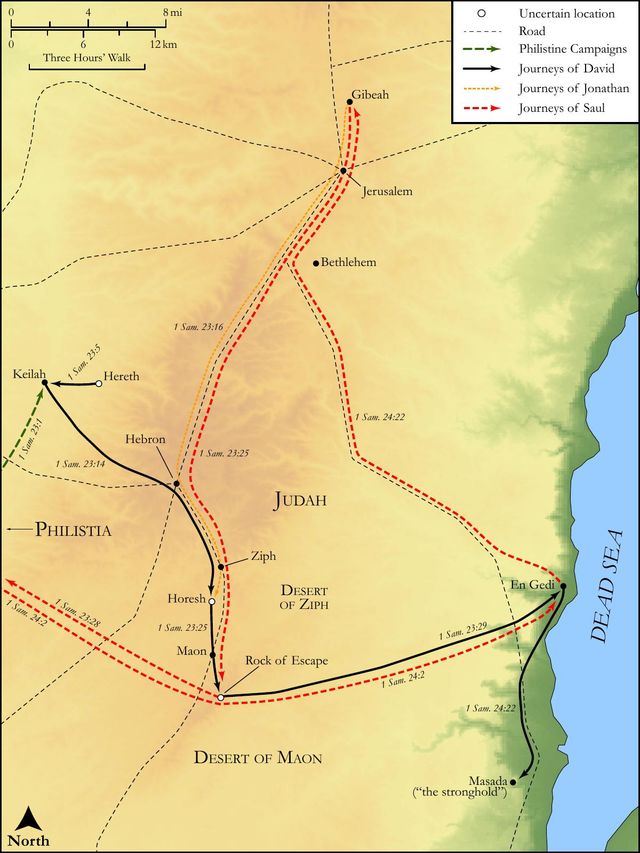
1 Samuel 23:27 narrates a dramatic and pivotal moment of divine intervention, abruptly halting King Saul's relentless and obsessive pursuit of David. As Saul had successfully cornered David and his men in the wilderness of Maon, poised for their capture, an urgent messenger arrived with news of a widespread Philistine invasion. This unexpected national emergency compelled Saul to abandon his personal vendetta against David, providentially sparing David from imminent danger and powerfully underscoring God's sovereign protection over His anointed servant.
Context
ShowHideLiterary Context
This verse functions as a critical turning point within the escalating narrative of Saul's irrational jealousy and persistent persecution of David. Immediately preceding this event, David and his loyal followers found themselves in an incredibly precarious situation, literally surrounded by Saul's superior forces in the wilderness of Maon, as vividly depicted in 1 Samuel 23:25-26. David had just cried out to God for deliverance, and from a human perspective, escape seemed utterly impossible. The sudden arrival of the messenger in 1 Samuel 23:27 is a divinely orchestrated interruption, dramatically shifting the narrative's focus from Saul's personal vendetta back to his neglected national responsibilities. This miraculous reprieve for David serves to highlight God's active and timely involvement in the unfolding drama of David's life, demonstrating His unwavering faithfulness to His promises despite overwhelming and seemingly insurmountable odds.
Historical & Cultural Context
The Philistines were a formidable and enduring adversary of Israel throughout the period of the Judges and the early monarchy. Having settled along the fertile coastal plain, they consistently launched raids into Israelite territory, particularly targeting the strategic lowlands and border regions. These incursions posed a perpetual threat to Israel's security, agricultural resources, and national sovereignty. As the divinely appointed king, Saul's primary responsibility was to serve as Israel's military leader and defender against such external threats. The messenger's urgent plea, "Haste thee, and come," underscores the severe gravity of a widespread Philistine invasion, which would have involved significant plundering, destruction of property, and potential loss of life among the Israelite populace. Saul's immediate response was not merely a strategic necessity but a fundamental duty inherent in his kingship, a duty he had demonstrably neglected due to his all-consuming obsession with capturing David.
Key Themes
ShowHideThis verse powerfully encapsulates several profound themes interwoven throughout the books of Samuel. Foremost is Divine Providence, which vividly illustrates God's sovereign hand actively orchestrating events, even through the actions of Israel's enemies, to meticulously protect His chosen servant. Precisely when Saul was on the verge of capturing David, God intervened through a sudden national emergency, thereby highlighting His perfect timing and absolute control over all circumstances (a truth echoed in Psalm 34:7). Closely linked to this is the theme of God's Protection of His Anointed, as David—whom God had chosen and anointed as the future king of Israel—is consistently preserved despite Saul's relentless and murderous efforts to destroy him. The narrative also starkly exposes Saul's Misplaced Priorities and the destructive nature of his unchecked obsession. His personal vendetta against David had so blinded him that he neglected his primary duty of defending Israel from its enemies, illustrating how corrosive jealousy can corrupt leadership and divert attention from greater, God-given responsibilities. Finally, the Persistent Philistine Threat serves as a recurring motif, reminding readers of the ongoing geopolitical challenges facing Israel and often serving as a means through which God disciplined or redirected His people (as seen, for instance, in Judges 10:7).
Exposition and Analysis
ShowHideKey Word Analysis
ShowHideThe Hebrew term מַלְאָךְ (malʼâk) is derived from an unused root meaning "to dispatch as a deputy." It primarily denotes "a messenger," but can also refer specifically to "an angel" (a messenger of God), or even a prophet, priest, or teacher. In this context, it refers to a human envoy dispatched to convey urgent and critical information. While a human messenger, the precise and critical timing of his arrival carries the profound weight of divine orchestration. The speed and urgency conveyed by the message ("Haste thee, and come") underscore the severity of the situation and the immediate need for the king's attention, indicating that this was not a minor skirmish but a significant and widespread national crisis demanding the king's personal intervention.
The Hebrew verb מָהַר (mâhar) is a primitive root meaning "to be liquid or flow easily," which by implication means "to hurry" (in a good or bad sense). It is often used adverbially with another verb to indicate promptness. In this verse, the imperative "Haste thee" (or "Hurry!") is a direct and forceful command, conveying extreme urgency. It emphasizes the immediate and critical nature of the Philistine invasion, demanding Saul's swift and unhesitating response. This word highlights the suddenness and gravity of the national emergency that providentially diverted Saul's attention from David.
The Hebrew verb פָּשַׁט (pâshaṭ) is a primitive root meaning "to spread out (i.e., deploy in hostile array)." By analogy, it can also mean "to strip (i.e., unclothe, plunder, flay, etc.)." In the context of warfare, it signifies "to fall upon," "to make an invasion," or "to run upon." This term implies a widespread, aggressive, and often destructive military incursion rather than a mere border skirmish or probing defense. The Philistines were not just testing Israel's defenses; they were "spreading out" over the land, indicating a significant and serious offensive that directly threatened the security, resources, and very fabric of Israelite territory. This strong verb conveys the gravity of the threat that compelled Saul's immediate and unavoidable withdrawal from his pursuit of David.
Verse Breakdown
ShowHide"But there came a messenger unto Saul, saying,"
This opening clause immediately signals a sudden, external, and unexpected intervention. The conjunction "But" serves as a sharp contrast to the preceding narrative, which depicted Saul's successful encirclement of David and his imminent capture. The arrival of a messenger, a common conduit for critical news in ancient warfare, signifies an urgent and unforeseen development that demands the king's immediate attention and abruptly shifts the narrative's focus away from David's desperate peril. This moment highlights God's perfect timing.
"Haste thee, and come;"
This imperative command conveys extreme urgency and directness. The messenger's words are forceful and unequivocal, reflecting the critical and time-sensitive nature of the situation. It is a direct summons for the king to immediately abandon his current activity—his personal vendetta against David—and respond to a far more pressing national crisis. This emphasizes that the Philistine threat was too severe to be delayed or delegated, requiring the king's personal presence and leadership.
"for the Philistines have invaded the land."
This final clause provides the crucial and compelling reason for the urgent summons. The declaration that the Philistines have "invaded the land" (using the strong verb pâshaṭ, signifying a widespread incursion) indicates a serious and pervasive threat, not a localized raid. This national emergency directly jeopardized the security and well-being of the entire Israelite nation, forcing Saul to confront his primary duty as king and, by divine providence, to abandon his obsessive and unrighteous pursuit of David.
Literary Devices
ShowHideThis verse powerfully employs Divine Providence as its central literary device, showcasing God's unseen yet active hand orchestrating events to achieve His sovereign purposes. The impeccable timing of the messenger's arrival, precisely when David is at the precipice of capture, is far too perfect to be mere coincidence, revealing God's direct and active intervention to protect His chosen one. This creates a profound Dramatic Turn or Plot Twist, instantaneously reversing David's desperate situation and Saul's seemingly inevitable triumph. Furthermore, the narrative is imbued with Irony: Saul, the king whose foremost duty is to protect Israel from its enemies, is so consumed by his personal vendetta that the very enemies he should be fighting are the ones who ultimately, albeit unintentionally, save his intended victim. This starkly underscores Saul's deeply misplaced priorities and serves as a powerful foreshadowing of his ultimate failure as a divinely appointed leader.
Theological and Thematic Connections
ShowHideThis verse stands as a profound testament to God's active sovereignty and His unwavering faithfulness in protecting His chosen servants. Even in moments of extreme peril, when human resources are exhausted and escape seems utterly impossible, God demonstrates His ability to intervene through unexpected means, even utilizing the actions of an enemy to accomplish His divine purposes. It powerfully reinforces the theological truth that God is not merely a distant observer but an intimately involved orchestrator of history, working all things according to the counsel of His perfect will. This event provides immense encouragement for believers facing seemingly insurmountable obstacles, reminding them that God's timing is perfect and His power is limitless in delivering His people from the most desperate circumstances.
Reflection and Application
ShowHideThe sudden and miraculous intervention recounted in 1 Samuel 23:27 offers a powerful and enduring lesson in trusting God's sovereign hand, especially when circumstances appear dire and human solutions are completely exhausted. David was in an impossible situation, literally surrounded by a relentless and powerful enemy, yet God, in His perfect timing, orchestrated an external event—a national crisis—to secure his deliverance. This narrative encourages us to cultivate a deep and abiding reliance on God, knowing that He is actively involved in the intricate details of our lives and possesses the power to bring about salvation through means we least expect or can even conceive. It challenges us to honestly examine our own priorities: are we, like Saul, so consumed by personal grievances, selfish ambitions, or distracting pursuits that we neglect the greater callings and responsibilities God has placed before us? Or are we, like David, seeking God's face and trusting His deliverance even when we feel cornered and without hope? This story serves as a profound reminder that God's ultimate purposes will prevail, and He will faithfully protect those who walk in His will, often in ways that powerfully highlight His supreme power and infinite wisdom above our own limited understanding.
Questions for Reflection
ShowHideFAQ
ShowHideWhy did God use the Philistines, an enemy of Israel, to save David?
ShowHideGod's sovereignty extends over all nations, all peoples, and all circumstances, including the actions and plans of those who oppose His people. In this specific instance, the Philistine invasion was not a random occurrence but a divinely orchestrated diversion. God used a national crisis, which was a direct consequence of the Philistines' ongoing aggression against Israel, to providentially deliver David from Saul's murderous pursuit. This powerfully demonstrates that God can employ any means, even the plans and actions of enemies, to achieve His righteous purposes and protect His chosen servants. It highlights His ultimate control over the course of history and His remarkable ability to turn seemingly negative events into instruments of His redemptive plan, a principle seen in other biblical instances where God used foreign nations to accomplish His will (e.g., Isaiah 10:5-7).
What does this event reveal about Saul's character and priorities as king?
ShowHideThis event starkly reveals the depths of Saul's flawed character and his severely misplaced priorities as king. As the divinely appointed monarch, his primary duty was to protect Israel from its enemies, particularly the ever-present and formidable Philistine threat. However, he was so utterly consumed by his personal jealousy and vengeful vendetta against David, whom he perceived as an existential rival to his throne, that he flagrantly neglected his fundamental responsibilities to the nation. The Philistine invasion forced him to confront his dereliction of duty in a most immediate and undeniable way. His immediate response to the messenger's urgent plea, abandoning the pursuit of David, shows that he still retained some recognition of his kingly obligation. Nevertheless, the very fact that he was pursuing David in the first place, rather than actively defending the nation, underscores his profound spiritual and moral decline. This unchecked obsession ultimately led to his tragic downfall, as his focus remained fixated on personal grievances rather than on God's will for his kingdom and people (see 1 Samuel 15:23).
Christ-Centered Fulfillment
ShowHideThe miraculous deliverance of David in 1 Samuel 23:27, where God uses an enemy invasion to save His anointed king, powerfully foreshadows the ultimate and far greater deliverance accomplished by Jesus Christ. David, though God's chosen king, was still a flawed human in need of salvation, and his physical rescue points to a deeper, spiritual reality. Jesus, the true and eternal Son of David, is the ultimate Anointed One, the King who was truly cornered not by earthly armies, but by the spiritual enemies of humanity: sin, death, and the devil. Yet, in His passion, death, and glorious resurrection, God did not divert the "invasion" of evil but allowed it to fully unfold, turning the ultimate act of human rebellion and evil (the crucifixion) into the very means of ultimate salvation. Just as David was protected for his future reign as king of Israel, Christ was raised to reign eternally, having decisively conquered the true enemies of humanity. His kingdom is not merely earthly or temporal, but spiritual and eternal, offering a deliverance far greater than any physical escape, freeing humanity from the bondage of sin and death (see Colossians 1:13-14). Thus, David's rescue by divine providence serves as a powerful type, pointing to the sovereign plan of God to establish His eternal kingdom through the ultimate victory of the Lamb of God, who takes away the sin of the world.