


1 Samuel 26:12
Bible text: King James Version (1769 Blayney text) · Public domain
Bible text: King James Version with Strong's numbers · Public domain
Bible text: Berean Standard Bible · Public domain
Bible text: American Standard Version (1901) · Public domain
Bible text: World English Bible, Messianic edition · Public domain
Bible text: Geneva Bible (1599) · Public domain
Bible text: Young's Literal Translation · Public domain
- וַיִּקַּחvai·yi·Kachand he tookH3947Conj-w ¦ V-Qal-ConsecImperf-3msVerb Qal Consecutive Imperfect 3rd Singular Masculineוַandיִּקַּחhe took
- דָּוִדda·VidDavidH1732N-proper-mNoun Proper Masculine
- אֶת'et<obj.>H853DirObjMParticle Object Indicator
- הַחֲנִיתha·cha·Nitthe spearH2595Art ¦ N-fsNoun Singular Feminine Absoluteהַtheחֲנִיתspear
- וְאֶתve·'Etand <obj.>H853Conj-w ¦ DirObjMParticle Object Indicatorוְandאֶת<obj.>
- צַפַּחַתtza·Pa·chat[the] jug ofH6835N-fscNoun Singular Feminine Construct
- הַמַּיִםha·Ma·yim<the> waterH4325Art ¦ N-mpNoun Plural Masculine Absoluteהַ<the>מַּיִםwater
- מֵרַאֲשֹׁתֵיme·ra·'a·sho·Tei[at the] head ofH7226N-fpcNoun Plural Feminine Construct
- שָׁאוּלsha·'UlSaulH7586N-proper-mNoun Proper Masculine
- וַיֵּלְכוּvai·ye·le·Khuand they wentH1980Conj-w ¦ V-Qal-ConsecImperf-3mpVerb Qal Consecutive Imperfect 3rd Plural Masculineוַandיֵּלְכוּthey went
- לָהֶםla·Hemfor <the> themselvesPrep-l ¦ 3mpSuffix Personal 3rd Plural Masculineלָfor <the>הֶםthemselves
- וְאֵיןve·'Einand there notH369Conj-w ¦ N-mscNoun Singular Masculine Constructוְandאֵיןthere not
- רֹאֶהro·'Eh[was one who] sawH7200V-Qal-Prtcpl-msVerb Qal Participle Singular Masculine Absolute
- וְאֵיןve·'Einand there notH369Conj-w ¦ N-mscNoun Singular Masculine Constructוְandאֵיןthere not
- יוֹדֵעַyo·De·a'[was one who] knewH3045V-Qal-Prtcpl-msVerb Qal Participle Singular Masculine Absolute
- וְאֵיןve·'Einand there notH369Conj-w ¦ N-mscNoun Singular Masculine Constructוְandאֵיןthere not
- מֵקִיץme·Kitz[was one who] awokeH6974V-Hiphil-Prtcpl-msVerb Hiphil Participle Singular Masculine Absolute
- כִּיkiforH3588PrtParticle Conditional
- כֻלָּםkhu·Lamall of themH3605N-msc ¦ 3mpNoun Singular Masculine Constructכֻלָּall ofםthem
- יְשֵׁנִיםye·she·Nim[were] sleepingH3463Adj-mpAdjective Plural Masculine Absolute
- כִּיkiforH3588PrtParticle Conditional
- תַּרְדֵּמַתtar·de·Mat<the> deep sleep ofH8639N-fscNoun Singular Feminine Construct
- יְהוָהYah·wehYahwehH3068N-properNoun Proper Title
- נָפְלָהna·fe·Lahit had fallenH5307V-Qal-Perf-3fsVerb Qal Perfect 3rd Singular Feminine
- עֲלֵיהֶם'a·lei·Hemon themH5921Prep ¦ 3mpPreposition Definiteעֲלֵיonהֶםthem
English is a literal word-by-word gloss of the Hebrew, not the KJV's wording. Why?
This is the original text the KJV's translators worked from — each Hebrew word with its own literal English meaning in this verse, prepared by scholars at Tyndale House, Cambridge. The KJV translates whole sentences, not word by word, so its wording differs: one Hebrew word can become several English words, and the KJV may choose “the LORD” where the gloss reads “Yahweh”. Both are faithful — they answer different questions. For the KJV's own rendering, switch to the KJV text.
Details
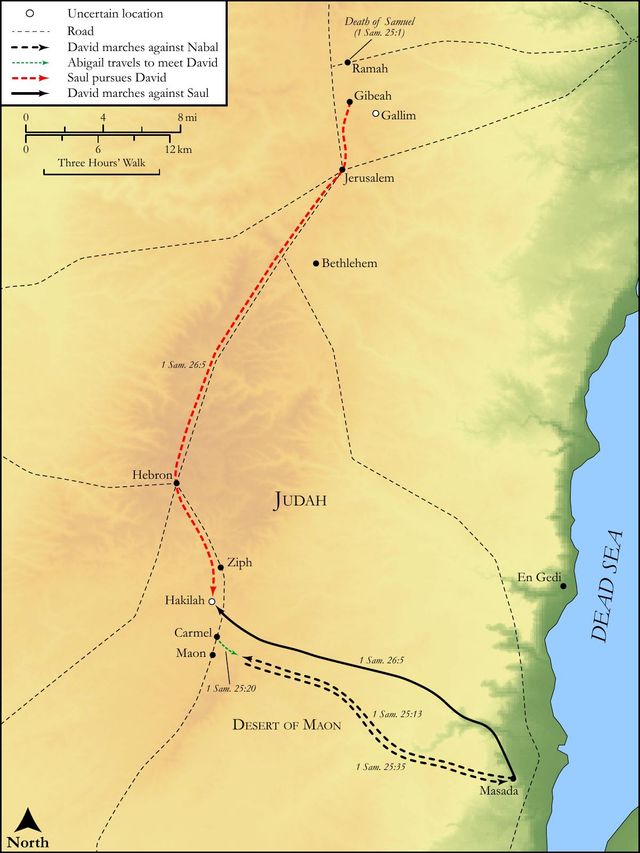
See on the biblical-era map
Study this verse
Public-domain commentary
Matthew Henry
From his Commentary on the Whole Bible. Henry comments on passages, not single verses — this entry covers 1 Samuel 26:6–12.
Here is, I. David's bold adventure into Saul's camp in the night, accompanied only by his kinsman Abishai, the son of Zeruiah. He proposed it to him and to another of his confidants (Sa1 26:6), but the other either declined it as too dangerous an enterprise, or at least was content that Abishai, who was forward to it, should run the risk of it rather than himself. Whether David was prompted to do this by his own courage, or by an extraordinary impression upon his spirits, or by the oracle, does not appear; but, like Gideon, he ventured through the guards, with a special assurance of the divine protection.
II.The posture he found the camp in Saul lay sleeping in the trench, or, as some read it, in his chariot, and in the midst of his carriages, with his spear stuck in the ground by him, to be ready if his quarters should by beaten up (Sa1 26:7); and all the soldiers, even those that were appointed to stand sentinel, were fast asleep, Sa1 26:12. Thus were their eyes closed and their hands bound, for a deep sleep from the Lord had fallen upon them; something extraordinary there was in it that they should all be asleep together, and so fast asleep that David and Abishai walked and talked among them, and yet none of them stirred. Sleep, when God gives it to his beloved, is their rest and refreshment; but he can, when he pleases, make it to his enemies their imprisonment. Thus are the stout-hearted spoiled; they have slept their sleep, and none of the men of might have found their hands, at thy rebuke, O God of Jacob! Psa 76:5, Psa 76:6. It was a deep sleep from the Lord, who has the command of the powers of nature, and makes them to serve his purposes as he pleases. Whom God will disable, or destroy, he binds up with a spirit of slumber, Rom 11:8. How helpless do Saul and all his forces lie, all, in effect, disarmed and chained! and yet nothing is done to them; they are only rocked asleep. How easily can God weaken the strongest, befool the wisest, and baffle the most watchful! Let all his friends therefore trust him and all his enemies fear him.
III.Abishai's request to David for a commission to dispatch Saul with the spear that stuck at his bolster, which (now that he lay so fair) he undertook to do at one blow, Sa1 26:8. He would not urge David to kill him himself, because he had declined doing this before when he had a similar opportunity; but he begged earnestly that David would give him leave to do it, pleading that he was his enemy, not only cruel and implacable, but false and perfidious, whom no reason would rule nor kindness work upon, and that God had now delivered him into his hand, and did in effect bid him strike. The last advantage he had of this kind was indeed but accidental, when Saul happened to be in the cave with him at the same time. But in this there was something extraordinary; the deep sleep that had fallen on Saul and all his guards was manifestly from the Lord, so that it was a special providence which gave him this opportunity; he ought not therefore to let it slip.
IV.David's generous refusal to suffer any harm to be done to Saul, and in it a resolute adherence to his principles of loyalty, Sa1 26:9.
David charged Abishai not to destroy him, would not only not do it himself, but not permit another to do it. And he gave two reasons for it: - 1. It would be a sinful affront to God's ordinance. Saul was the Lord's anointed, king of Israel by the special appointment and nomination of the God of Israel, the power that was, and to resist him was to resist the ordinance of God, Rom 13:2. No man could do it and be guiltless. The thing he feared was guilt and his concern respected his innocence more than his safety. 2. It would be a sinful anticipation of God's providence. God had sufficiently shown him, in Nabal's case, that, if he left it to him to avenge him, he would do it in due time. Encouraged therefore by his experience in that instance, he resolves to wait till God shall think fit to avenge him on Saul, and he will by no means avenge himself (Sa1 26:10): "The Lord shall smite him, as he did Nabal, with some sudden stroke, or he shall die in battle (as it proved he did soon after), or, if not, his day shall come to die a natural death, and I will contentedly wait till then, rather than force my way to the promised crown by any indirect methods." The temptation indeed was very strong; but, if he should yield, he would sin against God, and therefore he will resist the temptation with the utmost resolution (Sa1 26:11): "The Lord forbid that I should stretch forth my hand against the Lord's anointed; no, I will never do it, nor suffer it to be done." Thus bravely does he prefer his conscience to his interest and trusts God with the issue.
V.The improvement he made of this opportunity for the further evidence of his own integrity.
He and Abishai carried away the spear and cruse of water which Saul had by his bed-side (Sa1 26:12), and, which was very strange, none of all the guards were aware of it. If a physician had given them the strongest opiate or stupifying dose, they could not have been faster locked up with sleep. Saul's spear which he had by him for defence, and his cup of water which he had for his refreshment, were both stolen from him while he slept. Thus do we lose our strength and our comfort when we are careless, and secure, and off our watch.
Historical interpretation
Historical reception
1 surviving comment on this verse from the historical church.
And there was no one who saw or understood, etc. There was no one among the reprobate who, hearing the Lord or His apostles preaching the future desolation of Judea, and the erasure of its ancient state from the land, understanding either their past misdeeds or future damnation, would awake to repentance; but they persisted in all impiety, because the Lord, due to preceding merits, blinded their senses. Alternatively, the sleep of the Lord fell upon them, that is, heavier than usual, which the Lord imposed on them particularly because of David’s advent, not allowing them to awaken until He himself had gone back.
Continue studying 1 Samuel 26:12 across the web’s major study libraries — every link below opens this exact verse, chapter, or book on the destination site.
Read & Compare
 BibleGatewayThis verse in more than 200 translations and 70 languages.
 Bible.comThe YouVersion reader — hundreds of translations, reading plans, and highlights.
 ESV.orgCrossway's official English Standard Version reader.
 NET BibleThe NET translation with 60,000+ translators' notes on every rendering decision.
 STEP BibleTyndale House's free study tool — original text, vocabulary, and scholarly resources.
 BibliaLogos Bible Software's free web reader.
 USCCBThe New American Bible (Revised Edition) with the U.S. bishops' study notes.
Commentaries
 BibleHub CommentariesDozens of classic commentaries on this verse, gathered on one page.
 StudyLightMore than 100 commentary sets — the largest collection on the web.
 BibleRefPlain-English commentary on what this verse means, verse by verse.
 Enduring WordDavid Guzik's free commentary on this chapter, widely used by Bible teachers.
 Bible Study ToolsVerse commentary alongside Greek and Hebrew study aids.
Original Language & Research
- BibleHub InterlinearThe verse word by word — original language, transliteration, and English.
- BibleHub LexiconEvery word's original-language definition and Strong's entry.
 Blue Letter BibleDeep-study tools — Strong's numbers, concordance, and word studies.
 SefariaThe Hebrew text with Rashi and centuries of Jewish commentary.
Sermons, Hymns & Audio


TrulyRandomVerse is not affiliated with these sites and doesn’t control their content. They’re linked because they’re genuinely useful.
Summary
1 Samuel 26:12 vividly portrays God's precise and powerful intervention, enabling David to infiltrate King Saul's encampment undetected and retrieve Saul's spear and water cruse from beside his head. This stealthy operation was made possible because a profound, divinely orchestrated sleep had fallen upon Saul and his entire army, rendering them completely oblivious to David and Abishai's presence. The verse not only highlights God's unwavering protection over His chosen servant but also underscores David's remarkable integrity and his steadfast commitment to honoring God's anointed, even when facing mortal danger, demonstrating his trust in divine justice rather than resorting to personal vengeance.
Context
ShowHideLiterary Context
This verse is a pivotal moment within a prolonged and intense period of King Saul's relentless, jealous pursuit of David, aiming to kill him. It directly follows David's previous opportunity to harm Saul in the cave of En Gedi, where David merely cut off a corner of Saul's robe as proof of his restraint and respect for Saul's office (1 Samuel 24:1-7). In the immediate narrative of 1 Samuel chapter 26, Saul has once again mobilized 3,000 elite soldiers to hunt David in the wilderness of Ziph. David, utilizing his intelligence network, pinpoints Saul's exact encampment. Accompanied by Abishai, David infiltrates the sleeping camp at night. This verse details the miraculous ease with which they approach the vulnerable king, setting the stage for David's second powerful demonstration of his unwavering integrity and profound trust in God's ultimate justice, even as Abishai urged him to strike Saul down (1 Samuel 26:8-9).
Historical & Cultural Context
The events of 1 Samuel 26:12 are set within the nascent period of the Israelite monarchy, where the concept of the "Lord's anointed" (Hebrew: mashiach YHWH) held immense theological and cultural significance. To harm the king, even a disobedient one, was considered a sacrilege, an affront to God's divine appointment. The military camp setting was typical for armies on campaign, with soldiers sleeping in proximity to their commander for protection. The spear, placed near Saul's head, was not merely a weapon but a potent symbol of his royal authority, power, and personal presence. The water cruse represented essential life and sustenance. The biblical motif of God inducing a "deep sleep" (Hebrew: tardêmâh) is significant, signifying a divinely orchestrated, supernatural slumber that renders individuals completely unaware, often for a specific divine purpose. This phenomenon is also seen in Genesis 2:21 when God puts Adam into a deep sleep to create Eve, and in Genesis 15:12 during the covenant ceremony with Abraham. This recurring motif highlights a worldview where God is intimately and actively involved in the minutiae of human events, demonstrating His sovereign control.
Key Themes
ShowHideThis verse profoundly contributes to several overarching themes foundational to the book of 1 Samuel and the broader biblical narrative. Firstly, it powerfully underscores Divine Providence and Protection, showcasing God's active, supernatural intervention to safeguard His chosen servant, David, from existential threat. The "deep sleep from the LORD" is not a mere coincidence but a direct act of divine will, ensuring David's safety and enabling his demonstration of integrity. Secondly, it highlights David's Integrity and Respect for God's Anointed. Despite Saul's relentless and unjust persecution, David consistently refuses to harm the king, recognizing Saul's divine appointment and trusting God to deal with him in His own time and way (1 Samuel 26:9-11). This unwavering stance sets David apart as a "man after God's own heart," demonstrating profound faith and obedience. Finally, the event emphasizes the theme of Trust in God's Timing and Justice. David's actions reflect his conviction that vengeance belongs to the Lord, and that God will ultimately establish His chosen king without human interference or unrighteous acts of retaliation. This patience and reliance on divine justice are central to David's character and his eventual ascension to the throne.
Exposition and Analysis
ShowHideKey Word Analysis
ShowHideFrom the same root as "loving," this name signifies the character of the man chosen by God. In this context, David's actions—refusing to harm Saul despite ample opportunity—underscore his "loving" or compassionate nature, demonstrating a profound respect for God's anointed and a trust in divine justice that sets him apart from Saul's own vengeful pursuits.
This primitive root signifies "to take in the widest variety of applications." Here, it describes David's deliberate act of acquiring the spear and water cruse. The choice of "took" over "killed" or "struck" is crucial, emphasizing David's intentional restraint and his symbolic act of demonstrating Saul's vulnerability without resorting to violence. It highlights his purposeful, non-lethal action.
This root means "to know," encompassing a wide range of understanding, perception, and recognition. The phrase "nor knew it" emphasizes the complete lack of awareness on the part of Saul's men. They did not perceive or comprehend David's presence, signifying the absolute efficacy of the divine deep sleep. This word choice underscores the supernatural nature of their unawareness, beyond mere human oversight.
This term denotes a profound, divinely induced lethargy or trance, distinct from ordinary sleep. Its use here explicitly points to a supernatural, not natural, event, orchestrated by God Himself. This is the theological lynchpin, revealing that the entire scenario was divinely orchestrated, not a mere stroke of luck or human cunning. God Himself ensured David's safety and the success of his mission to demonstrate his integrity.
This is the self-existent, eternal God, the covenant God of Israel. The phrase "from the LORD" is a definitive declaration of divine agency, leaving no room for ambiguity regarding the source of the "deep sleep." It signifies that God was not merely a passive observer but an active participant, directly intervening to create the conditions necessary for David's mission and demonstration of integrity. This underscores God's absolute sovereignty over all circumstances, even the sleep patterns of an entire army.
Verse Breakdown
ShowHide"So David took the spear and the cruse of water from Saul's bolster;"
This clause details David's decisive and symbolic action. The spear, representing Saul's royal authority and military power, and the water cruse, symbolizing his life and sustenance, were taken as irrefutable proof of David's presence and his ability to harm Saul. By taking these items rather than Saul's life, David non-violently demonstrates his access, his power, and his profound respect for God's anointed, refusing to usurp God's timing for Saul's removal.
"and they gat them away, and no man saw [it], nor knew [it], neither awaked:"
This describes the immediate consequence of David's action and the miraculous nature of the event. The complete unawareness of Saul's elite guards and the entire camp underscores the supernatural element at play. No one observed their entry, understood their presence, or was roused from sleep, confirming the extraordinary effectiveness of the "deep sleep" that had fallen upon them.
"for they [were] all asleep; because a deep sleep from the LORD was fallen upon them."
This final clause provides the divine explanation for the preceding miraculous events. The universal slumber of the army is explicitly attributed to a "deep sleep from the LORD." This is the theological lynchpin of the verse, revealing that the entire scenario was divinely orchestrated, not a mere stroke of luck or human cunning. God Himself ensured David's safety and the success of his mission to demonstrate his integrity and trust in His divine plan.
Literary Devices
ShowHideThe passage employs several potent literary devices to convey its profound theological message. Irony is strikingly prominent, as Saul, who relentlessly hunts David with murderous intent, is rendered utterly vulnerable and delivered into David's hands by the very God he claims to serve. The hunter becomes the hunted's prey, yet the prey demonstrates remarkable mercy and restraint. Symbolism is evident in David's taking of the spear and water cruse; the spear represents Saul's kingship, authority, and power, while the water cruse signifies his life and essential needs. David's act of taking these items, rather than Saul's life, is a powerful symbolic gesture of demonstrating his legitimate claim to the throne and his refusal to shed innocent blood, asserting moral superiority. The "deep sleep from the LORD" functions as a clear Divine Intervention or a Miracle, a direct and supernatural act of God that dramatically alters the natural course of events. This emphasizes God's active involvement in the narrative and His sovereign control over human circumstances. Finally, David's actions here serve as Foreshadowing, revealing his character as a man of integrity, patience, and unwavering trust in God—qualities that would ultimately define his future reign and set him apart from Saul's impulsive and self-serving leadership.
Theological and Thematic Connections
ShowHide1 Samuel 26:12 stands as a profound testament to God's active sovereignty and His meticulous care for His chosen. It illustrates that God is not confined by human limitations or circumstances, but can orchestrate events, even the sleep of an entire army, to fulfill His purposes and protect His servants. This divine intervention underscores the theological truth that God is the ultimate sustainer and protector of His people, and that His plans will prevail regardless of human opposition. Furthermore, David's response to this divinely opened window of opportunity — choosing restraint and trust over vengeance — highlights the biblical principle that justice and retribution ultimately belong to God, not to individuals seeking personal vindication. It calls believers to a posture of patience and reliance on God's perfect timing and righteous judgment, even in the face of severe injustice.
Reflection and Application
ShowHideThis powerful narrative from 1 Samuel 26:12 offers profound lessons for believers navigating challenging circumstances today. It reminds us that God is perpetually at work, often in unseen and unexpected ways, orchestrating events to protect His own and advance His kingdom purposes. In moments of intense pressure, injustice, or persecution, like David, we are called to trust in God's sovereign hand rather than resorting to our own strength or seeking immediate retaliation. David's integrity in refusing to harm God's anointed, even when given the perfect opportunity, challenges us to maintain our character and ethical standards, even when those around us act unjustly. True strength is found not in taking matters into our own hands, but in patiently waiting for the Lord to act, believing that He will ultimately vindicate the righteous and deal with the wicked in His perfect timing. This passage encourages us to cultivate a deeper faith in God's unseen providence, recognizing that He can create pathways where none seem to exist, and that His timing is always perfect.
Questions for Reflection
ShowHideFAQ
ShowHideWhy didn't David kill Saul when he had the chance, especially given Saul's relentless pursuit?
ShowHideDavid's refusal to kill Saul, despite having two clear opportunities (here and in 1 Samuel 24), stemmed from his profound respect for God's anointing. David understood that Saul, though disobedient and persecuting, was still "the Lord's anointed" (1 Samuel 26:9). He believed that vengeance and the removal of a king belonged solely to God, not to him. David trusted that God would deal with Saul in His own time and way, either through the Lord striking him down, his time coming, or his going into battle and perishing (1 Samuel 26:10). This demonstrated David's deep faith, patience, and commitment to divine justice over personal retribution.
What was the significance of David taking Saul's spear and water cruse?
ShowHideDavid took the spear and water cruse as tangible proof that he had been in Saul's camp and could have killed him, yet chose not to. The spear was a potent symbol of Saul's royal authority and military power; by taking it, David demonstrated his ability to disarm the king, symbolically taking his power without taking his life. The water cruse represented Saul's life and sustenance. These items served as irrefutable evidence for Saul and his men that David had honored God's anointed, even when given the perfect opportunity for revenge. It was a non-violent act of demonstration, asserting David's moral superiority and trust in God's justice, rather than an act of aggression.
Is this "deep sleep from the LORD" a common biblical motif, and what does it signify?
ShowHideYes, the "deep sleep from the LORD" (Hebrew: tardêmâh) is a significant biblical motif, often signifying a supernatural, divinely induced slumber or trance. It is not mere fatigue but a profound unconsciousness orchestrated by God for specific purposes. Beyond this instance with Saul's army, it appears when God causes a deep sleep to fall upon Adam before taking his rib to create Eve (Genesis 2:21) and when a deep sleep falls upon Abraham during the covenant ceremony, signifying God's unilateral commitment to His promises (Genesis 15:12). In 1 Samuel 26:12, it signifies God's direct, sovereign intervention to protect David and facilitate his mission, demonstrating that God is actively involved in human affairs and can manipulate circumstances to fulfill His divine will.
Christ-Centered Fulfillment
ShowHideThe divine intervention and David's response in 1 Samuel 26:12 powerfully foreshadow the person and work of Jesus Christ. Just as God sovereignly protected David, His chosen king, from the malicious intent of Saul, so too did God protect His Son, Jesus, throughout His earthly ministry, until the appointed time for His ultimate sacrifice. David's profound respect for God's anointed, even in the face of unjust persecution, prefigures Christ's perfect submission to the Father's will and His non-retaliatory response to injustice. When confronted by His enemies, Jesus did not call down legions of angels (Matthew 26:53) but willingly submitted to the cross, trusting His Father's timing and plan for redemption. The "deep sleep from the LORD" that fell upon Saul's army speaks to God's absolute sovereignty over all circumstances, a sovereignty perfectly displayed in Christ's passion, death, and resurrection. God orchestrated every detail of Christ's life and sacrifice, ensuring that His redemptive plan would unfold precisely as prophesied. Just as David refused to take vengeance, Jesus, the true Lamb of God, took away the sin of the world not through force, but through self-giving love, entrusting Himself to Him who judges righteously (1 Peter 2:23). This narrative ultimately points to Christ as the King who truly reigns by divine appointment, whose kingdom is not of this world (John 18:36), and who perfectly embodies the integrity and trust in God's timing that David imperfectly demonstrated.