


Genesis 15:12
Bible text: King James Version (1769 Blayney text) · Public domain
Bible text: Berean Standard Bible · Public domain
Bible text: American Standard Version (1901) · Public domain
Bible text: World English Bible, Messianic edition · Public domain
Bible text: Geneva Bible (1599) · Public domain
Bible text: Young's Literal Translation · Public domain
- וַיְהִיvay·Hiand it wasH1961Conj-w ¦ V-Qal-ConsecImperf-3msVerb Qal Consecutive Imperfect 3rd Singular Masculineוַandיְהִיit was
- הַשֶּׁמֶשׁha·She·meshthe sunH8121Art ¦ N-csNoun Singular common gender Absoluteהַtheשֶּׁמֶשׁsun
- לָבוֹאla·Vo'[about] to goH935Prep-l ¦ V-Qal-InfVerb Qal Infinitive Constructלָ[about] toבוֹאgo
- וְתַרְדֵּמָהve·tar·de·Mahand a deep sleepH8639Conj-w ¦ N-fsNoun Singular Feminine Absoluteוְandתַרְדֵּמָהa deep sleep
- נָפְלָהna·fe·Lahit fellH5307V-Qal-Perf-3fsVerb Qal Perfect 3rd Singular Feminine
- עַל'alonH5921PrepPreposition
- אַבְרָם'av·RamAbramH87N-proper-mNoun Proper Masculine
- וְהִנֵּהve·hi·Nehand there!H2009Conj-w ¦ PrtParticle Interjectionוְandהִנֵּהthere!
- אֵימָה'ei·MahdreadH367N-fsNoun Singular Feminine Absolute
- חֲשֵׁכָהcha·she·KhahdarknessH2825N-fsNoun Singular Feminine Absolute
- גְדֹלָהge·do·LahgreatH1419Adj-fsAdjective Singular Feminine Absolute
- נֹפֶלֶתno·Fe·let[was] fallingH5307V-Qal-Prtcpl-fsVerb Qal Participle Singular Feminine Absolute
- עָלָיו'a·Lavon himH5921Prep ¦ 3msPreposition Definiteעָלָיonוhim
English is a literal word-by-word gloss of the Hebrew, not the KJV's wording. Why?
This is the original text the KJV's translators worked from — each Hebrew word with its own literal English meaning in this verse, prepared by scholars at Tyndale House, Cambridge. The KJV translates whole sentences, not word by word, so its wording differs: one Hebrew word can become several English words, and the KJV may choose “the LORD” where the gloss reads “Yahweh”. Both are faithful — they answer different questions. For the KJV's own rendering, switch to the KJV text.
Details
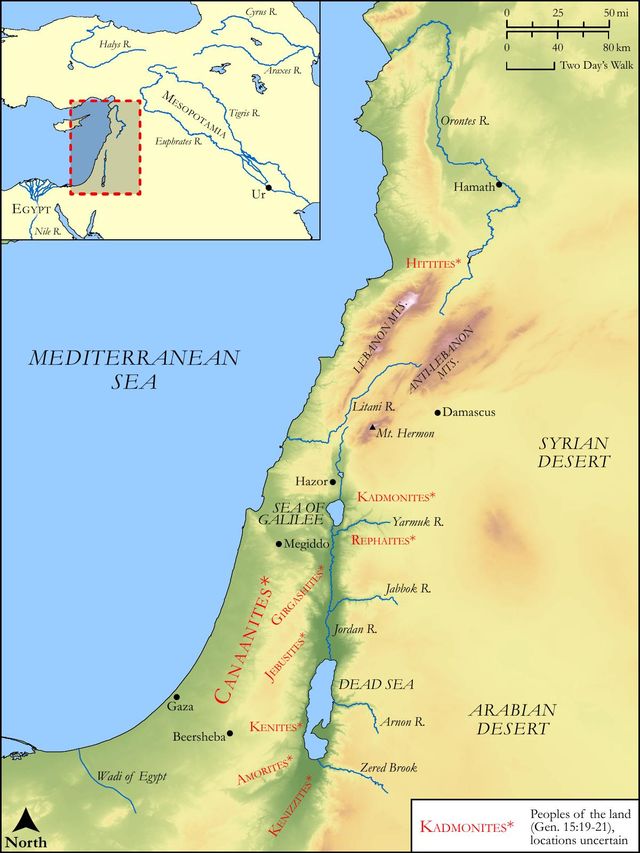
See on the biblical-era maps


Study this verse
Public-domain commentary
Matthew Henry
From his Commentary on the Whole Bible. Henry comments on passages, not single verses — this entry covers Genesis 15:12–16. His four-level outline is real structure in the source text, so it is rendered as structure.
We have here a full and particular discovery made to Abram of God's purposes concerning his seed. Observe,
I.The time when God came to him with this discovery:
When the sun was going down, or declining, about the time of the evening oblation, Kg1 18:36; Dan 9:21. Early in the morning, before day, while the stars were yet to be seen, God had given him orders concerning the sacrifices (Gen 15:5), and we may suppose it was, at least, his morning's work to prepare them and set them in order; when he had done this, he abode by them, praying and waiting till towards evening. Note, God often keeps his people long in expectation of the comforts he designs them, for the confirmation of their faith; but though the answers of prayer, and the performance of promises, come slowly, yet they come surely. At evening time it shall be light.
II.The preparatives for this discovery.
1.A deep sleep fell upon Abram, not a common sleep through weariness or carelessness, but a divine ecstasy, like that which the Lord God caused to fall upon Adam (Gen 2:21), that, being hereby wholly taken off from the view of things sensible, he might be wholly taken up with the contemplation of things spiritual. The doors of the body were locked up, that the soul might be private and retired, and might act the more freely and like itself.
2.With this sleep, a horror of great darkness fell upon him. How sudden a change! But just before we had him solacing himself in the comforts of God's covenant, and in communion with him; and here a horror of great darkness falls upon him. Note, The children of light do not always walk in the light, but sometimes clouds and darkness are round about them. This great darkness, which brought horror with it, was designed,
(1.)To strike an awe upon the spirit of Abram, and to possess him with a holy reverence, that the familiarity to which God was pleased to admit him might not breed contempt. Note, Holy fear prepares the soul for holy joy; the spirit of bondage makes way for the spirit of adoption. God wounds first, and then heals; humbles first, and they lifts up, Isa 6:5, Isa 6:6, etc.
(2.)To be a specimen of the methods of God's dealings with his seed. They must first be in the horror and darkness of Egyptian slavery, and then enter with joy into the good land; and therefore he must have the foretaste of their sufferings, before he had the foresight of their happiness.
(3.)To be an indication of the nature of that covenant of peculiarity which God was now about to make with Abram. The Old Testament dispensation, which was founded on that covenant, was a dispensation,
[1.]Of darkness and obscurity, Co2 3:13, Co2 3:14.
[2.]Of dread and horror, Heb 12:18, etc.
III.The prediction itself. Several things are here foretold.
1.The suffering state of Abram's seed for a long time, Gen 15:13. Let not Abram flatter himself with the hopes of nothing but honour and prosperity in his family; no, he must know, of a surety, that which he was loth to believe, that the promised seed should be a persecuted seed. Note, God sends the worst first; we must first suffer, and then reign. He also lets us know the worst before it comes, that when it comes it may not be a surprise to us, Joh 16:4. Now we have here,
(1.)The particulars of their sufferings.
[1.]They shall be strangers; so they were, first in Canaan (Psa 105:12) and afterwards in Egypt; before they were lords of their own land they were strangers in a strange land. The inconveniences of an unsettled state make a happy settlement the more welcome. Thus the heirs of heaven are first strangers on earth, a land that is not theirs.
[2.]They shall be servants; so they were to the Egyptians, Exo 1:13. See how that which was the doom of the Canaanites (Gen 9:25) proves the distress of Abram's seed: they are made to serve, but with this difference, the Canaanites serve under a curse, the Hebrews under a blessing; and the upright shall have dominion in the morning, Psa 49:14.
[3.]They shall be suffers. Those whom they serve shall afflict them; see Exo 1:11. Note, Those that are blessed and beloved of God are often sorely afflicted by wicked men; and God foresees it, and takes cognizance of it.
(2.)The continuance of their sufferings - four hundred years. This persecution began with mocking, when Ishmael, the son of an Egyptian, persecuted Isaac, who was born after the Spirit, Gen 21:9; Gal 4:29. It continued in loathing; for it was an abomination to the Egyptians to eat bread with the Hebrews, Gen 43:32; and it came at last to murder, the basest of murders, that of their new-born children; so that, more or less, it continued 400 years, though, in extremity, not so many. This was a long time, but a limited time.
2.The judgment of the enemies of Abram's seed: That nation whom they shall serve, even the Egyptians, will I judge, Gen 15:14. This points at the plagues of Egypt, by which God not only constrained the Egyptians to release Israel, but punished them for all the hardships they had put upon them. Note,
(1.)Though God may suffer persecutors and oppressors to trample upon his people a great while, yet he will certainly reckon with them at last; for his day is coming, Psa 37:12, Psa 37:13.
(2.)The punishing of persecutors is the judging of them: it is a righteous thing with God, and a particular act of justice, to recompense tribulations to those that trouble his people. The judging of the church's enemies is God's work: I will judge. God can do it, for he is the Lord; he will do it, for he is his people's God, and he has said, Vengeance is mine, I will repay. To him therefore we must leave it, to be done in his way and time.
3.The deliverance of Abram's seed out of Egypt. That great event is here foretold: Afterwards shall they come out with great substance. It is here promised,
(1.)That they should be enlarged: Afterwards they shall come out; that is, either after they have been afflicted 400 years, when the days of their servitude are fulfilled, or after the Egyptians are judged and plagued, then they may expect deliverance. Note, The destruction of oppressors is the redemption of the oppressed; they will not let God's people go till they are forced to it.
(2.)That they should be enriched: They shall come out with great substance; this was fulfilled, Exo 12:35, Exo 12:36. God took care they should have, not only a good land to go to, but a good stock to carry with them.
4.Their happy settlement in Canaan, Gen 15:16. They shall not only come out of Egypt, but they shall come hither again, hither to the land of Canaan, wherein thou now art. The discontinuance of their possession shall be no defeasance of their right: we must not reckon those comforts lost for ever that are intermitted for a time. The reason why they must not have the land of promise in possession till the fourth generation was because the iniquity of the Amorites was not yet full. Israel cannot be possessed of Canaan till the Amorites be dispossessed; and they are not yet ripe for ruin. The righteous God has determined that they shall not be cut off till they have persisted in sin so long, and arrived at such a pitch of wickedness, that there may appear some equitable proportion between their sin and their ruin; and therefore, till it come to that, the seed of Abram must be kept out of possession. Note,
(1.)The measure of sin fills gradually. Those that continue impenitent in wicked ways are treasuring up unto themselves wrath.
(2.)Some people's measure of sin fills slowly. The Sodomites, who were sinners before the Lord exceedingly, soon filled their measure; so did the Jews, who were, in profession, near to God. But the iniquity of the Amorites was long in the filling up.
(3.)That this is the reason of the prosperity of wicked people; the measure of their sins is not yet full. The wicked live, become old, and are mighty in power, while God is laying up their iniquity for their children, Job 21:7, Job 21:19. See Mat 23:32; Deu 32:34.
5.Abram's peaceful quiet death and burial, before these things should come to pass, Gen 15:15. As he should not live to see that good land in the possession of his family, but must die, as he lived, a stranger in it, so, to balance this, he should not live to see the troubles that should come upon his seed, much less to share in them. This is promised to Josiah, Kg2 22:20. Note, Good men are sometimes greatly favoured by being taken away from the evil to come, Isa 57:1. Let this satisfy Abram, that, for his part,
(1.)He shall go to his fathers in peace. Note,
[1.]Even the friends and favourites of Heaven are not exempted from the stroke of death. Are we greater than our father Abram, who is dead? Joh 8:53.
[2.]Good men die willingly; they are not fetched, they are not forced, but they go; their soul is not required, as the rich fool's (Luk 12:20), but cheerfully resigned: they would not live always.
[3.]At death we go to our fathers, to all our fathers that have gone before us to the state of the dead (Job 21:32, Job 21:33), to our godly fathers that have gone before us to the state of the blessed, Heb 12:23. The former thought helps to take off the terror of death, the latter puts comfort into it.
[4.]Whenever a godly man dies, he dies in peace. If the way be piety, the end is peace, Psa 37:37. Outward peace, to the last, is promised to Abram, peace and truth is his days, whatever should come afterwards (Kg2 20:19); peace with God, and everlasting peace, are sure to all the seed.
(2.)He shall be buried in a good old age. Perhaps mention is made of his burial here, where the land of Canaan is promised him, because a burying place was the first possession he had in it. He shall not only die in peace, but die in honour, die, and be buried decently; not only die in peace, but die in season, Job 5:26. Note,
[1.]Old age is a blessing. It is promised in the firth commandment; it is pleasing to nature; and it affords a great opportunity for usefulness.
[2.]Especially, if it be a good old age. Theirs may be called a good old age, First, That are old and healthful, not loaded with such distempers as make them weary of life. Secondly, That are old and holy, old disciples (Act 21:16), whose hoary head is found in the way of righteousness (Pro 16:31), old and useful, old and exemplary for godliness; theirs is indeed a good old age.
Historical interpretation
Three Centuries of Reception
3 surviving comments on this verse. Each one is dated, so this reads as a timeline rather than a list.
Select a marker to jump to its quote. Markers stagger vertically where authors wrote within a few decades of each other.
As he contemplated the wonderful things of God, Abraham was struck with fear, the fear that belongs to the perfect. It will be noted … that the ecstasy came upon him “toward sunset.” The text suggests by this a progression, because the day of the present state has gone by for Abraham so that further progress might follow. Thus the blessing was extended to Abraham which says, “I will fill you with length of days,”a blessing that by no means promised him longevity but, as is quite clear, further advances in illumination.An ecstasy then fell upon him, not the ecstasy that resembles a loss of reason but that of wonder, the thrill of passing from visible to invisible things. The apostle even says, “Indeed, if we are beside ourselves, it is for God; if we are in our right mind, it is for you.” By this he means not “we are out of our minds for God” but “even if we are transported through contemplation beyond the realm of human things, we do this for God.” David likewise declares, “I said in my ecstasy: every man is a liar.” It was indeed because he was transported out of himself to participate in the divine that he said of people that they are liars, because he was no longer merely a man, by reason of his communion with the Holy Spirit. He was quite different from those of whom it is said, “While there is jealousy and strife among you, are you not of the flesh and behaving like ordinary men?” When Abraham then had been transported out of himself, a “dark fear” fell upon him, dark not by participation in darkness but in the sense of obscurity, of something whose meaning is not immediately evident. Being a “great” fear, it is not the kind that happens to the mediocre. Remember “darkness” is often used for “obscurity,” as according to this saying: “He made darkness around him his canopy.” It is indeed true that the contemplation and grasp of supernatural truths produce, even among great people, a divine vertigo and fear, and it is with some trepidation that they apply themselves to such things.
(Verse 12) But when the sun was setting, a deep sleep fell upon Abram. The word for deep sleep in Hebrew is Thardema (), which means a descending, and we translated it as a deep sleep.
But what is added: When the sun was setting, a deep sleep fell on Abram, and a great and dark dread fell upon him, signifies the great distress and tribulation of the faithful that will occur near the end of this age. About which the Lord says in the Gospel: For then there will be great tribulation such as has not been since the beginning (Matthew 24:21).
Continue studying Genesis 15:12 across the web’s major study libraries — every link below opens this exact verse, chapter, or book on the destination site.
Read & Compare
 BibleGatewayThis verse in more than 200 translations and 70 languages.
 Bible.comThe YouVersion reader — hundreds of translations, reading plans, and highlights.
 ESV.orgCrossway's official English Standard Version reader.
 NET BibleThe NET translation with 60,000+ translators' notes on every rendering decision.
 STEP BibleTyndale House's free study tool — original text, vocabulary, and scholarly resources.
 BibliaLogos Bible Software's free web reader.
 USCCBThe New American Bible (Revised Edition) with the U.S. bishops' study notes.
Commentaries
 BibleHub CommentariesDozens of classic commentaries on this verse, gathered on one page.
 StudyLightMore than 100 commentary sets — the largest collection on the web.
 BibleRefPlain-English commentary on what this verse means, verse by verse.
 Enduring WordDavid Guzik's free commentary on this chapter, widely used by Bible teachers.
 Bible Study ToolsVerse commentary alongside Greek and Hebrew study aids.
Original Language & Research
- BibleHub InterlinearThe verse word by word — original language, transliteration, and English.
- BibleHub LexiconEvery word's original-language definition and Strong's entry.
 Blue Letter BibleDeep-study tools — Strong's numbers, concordance, and word studies.
 SefariaThe Hebrew text with Rashi and centuries of Jewish commentary.
Sermons, Hymns & Audio


TrulyRandomVerse is not affiliated with these sites and doesn’t control their content. They’re linked because they’re genuinely useful.
Summary
Genesis 15:12 describes a profound and divinely orchestrated experience that befalls Abram as the sun sets, immediately preceding the formal establishment of God's covenant with him. He is overcome by a supernatural "deep sleep" (Hebrew: tardêmâh), followed by an intense "horror of great darkness." This unsettling yet sacred prelude serves to underscore the solemnity, unilateral nature, and immense significance of the covenant God is about to initiate, preparing Abram for a revelation of divine promise and future prophetic insight.
Context
ShowHideLiterary Context
Genesis 15:12 is a pivotal moment within the broader narrative of God's covenant with Abram. The chapter begins with God reassuring Abram of His protection and promising him a direct heir, despite Abram's advanced age and Sarah's barrenness (Genesis 15:1-4). Abram's profound act of faith in God's promise is then explicitly "counted to him for righteousness" (Genesis 15:6). Following this, God commands Abram to prepare animals for a covenant ceremony, a ritual in which parties would walk between the divided pieces, as Scripture records again in the days of Jeremiah, signifying their commitment and the consequences of breaking the agreement (Genesis 15:9-10). Abram drives away the birds of prey, indicating his active participation and readiness. The "deep sleep" and "horror of great darkness" in verse 12 directly precede the dramatic scene where God alone, symbolized by a smoking furnace and a burning lamp, passes between the pieces, signifying a unilateral, unconditional covenant (Genesis 15:17). This entire sequence highlights God's initiative and the solemnity of His commitment.
Historical & Cultural Context
Covenant-making ceremonies could involve the cutting of animals into pieces, with the covenanting parties walking between them, as when the princes of Judah later passed between the parts of the calf. This ritual symbolized that the fate of the dismembered animals would befall anyone who broke the covenant. The phrase "to cut a covenant" (Hebrew: karat berit) itself reflects this practice. For Abram, a resident of Canaan, this ritual would have been familiar. However, the unique elements of this particular ceremony—the divinely induced sleep, the horror of darkness, and especially God alone passing through the pieces—would have profoundly distinguished it from any human covenant. This underscored that this was not a reciprocal agreement but a divine oath, binding God Himself to His promises. The setting, as the sun goes down, also evokes the reckoning of time by the evening and the morning, and the transition from day to night often held symbolic weight, marking a shift from the ordinary to the extraordinary.
Key Themes
ShowHideGenesis 15:12 contributes significantly to several overarching themes within Genesis and the broader biblical narrative. Firstly, it powerfully reinforces the theme of Divine Sovereignty and Initiative. God orchestrates every aspect of this encounter, from the command to prepare the sacrifice to the specific supernatural phenomena that befall Abram, demonstrating that the covenant is entirely His doing, not a human negotiation. Secondly, the verse highlights the Awe and Transcendence of God. The "horror of great darkness" emphasizes the immense holiness and power of God, evoking a sense of reverence and even dread appropriate for a direct encounter with the Creator. This foreshadows later divine encounters, such as the giving of the Law on Mount Sinai, shrouded in thick darkness. Thirdly, it introduces the theme of Prophetic Revelation, as the subsequent verses reveal God's foreknowledge of Israel's future affliction and deliverance (Genesis 15:13-16). The deep sleep prepares Abram to receive this profound, divinely imparted knowledge without human interference. Finally, the verse sets the stage for the Unilateral Nature of the Abrahamic Covenant, where God alone guarantees its fulfillment, a foundational concept for understanding God's faithfulness throughout salvation history.
Exposition and Analysis
ShowHideKey Word Analysis
ShowHideThis word signifies a divinely induced lethargy or trance, distinct from ordinary slumber. It implies a state of profound unconsciousness or stupor, often used in scripture to denote a supernatural intervention where God prepares an individual for a significant revelation or action. Examples include Adam's deep sleep before the creation of Eve, or Daniel's trance-like state during a prophetic vision. Here, it ensures Abram is a passive, receptive participant in God's sovereign act.
This primitive root means "to fall" in a wide variety of applications, often implying a descent or imposition. Its repeated use in this verse ("deep sleep fell upon Abram," "horror... fell upon him") emphasizes the external, divinely initiated nature of these experiences. It was not something Abram sought or could control, but something that was supernaturally imposed upon him by God.
This word denotes fright, dread, or terror. It describes an intense, overwhelming fear or awe. In this context, it's not merely psychological fear but a profound, almost palpable sense of dread that accompanies the awesome and holy presence of God. It underscores the solemnity and overwhelming nature of the divine encounter.
This term refers to literal darkness, but figuratively, it can also signify misery or gloom. Here, combined with "great" and "horror," it describes an oppressive, terrifying gloom that is more than just the absence of light. It symbolizes the weighty, mysterious, and awe-inspiring nature of God's presence, and possibly foreshadows the trials and afflictions that Abram's descendants would face.
Verse Breakdown
ShowHide"And when the sun was going down,"
This temporal marker sets the scene at twilight, a transitional time often associated with the culmination of a day's work and the onset of mystery or significant events in biblical narrative. The fading light emphasizes the impending supernatural phenomena and the shift from the ordinary to the extraordinary.
"a deep sleep fell upon Abram;"
This clause describes the first supernatural event. The "deep sleep" (Hebrew: tardêmâh) is divinely induced, not ordinary slumber. It signifies God's direct intervention to prepare Abram's mind and body, rendering him a passive recipient, ensuring that the subsequent revelation and covenant are entirely God's work, free from human interference or contribution.
"and, lo, an horror of great darkness fell upon him."
The interjection "lo" (Hebrew: hinneh) draws immediate attention to the extraordinary and startling nature of what follows. The "horror of great darkness" describes an intense, palpable dread and an oppressive, terrifying gloom that accompanies the divine presence. This is not merely the absence of light but a profound, overwhelming sensation that emphasizes the awesome, holy, and transcendent nature of God, underscoring the absolute seriousness and binding nature of the covenant He is about to establish. It serves as a prelude to the weighty prophetic revelations that follow regarding the future of Abram's descendants.
Literary Devices
ShowHideThe verse employs several powerful literary devices to convey its profound theological meaning. Foreshadowing is evident in the "horror of great darkness," which not only emphasizes the solemnity of the covenant but also prophetically alludes to the future period of affliction and bondage that Abram's descendants would endure in Egypt, as detailed in the subsequent verses of this chapter. The use of Symbolism is prominent, with "darkness" representing the mystery, the unknown future, and the overwhelming, unapproachable holiness of God's presence. It evokes a sense of awe and dread, a common biblical motif when humanity encounters the divine, as seen on Mount Sinai. The repeated phrase "fell upon him" exemplifies Repetition, which serves to emphasize the divine agency and the overwhelming, inescapable nature of Abram's experience. This highlights that these events were not self-induced but were sovereignly imposed by God, underscoring His control and initiative in the covenant.
Theological and Thematic Connections
ShowHideGenesis 15:12 stands as a profound testament to God's absolute sovereignty and His unique method of establishing His covenant. The divinely induced "deep sleep" and the overwhelming "horror of great darkness" are not random occurrences but purposeful preparations for a monumental revelation. They underscore that this covenant is not a bilateral agreement based on human merit or negotiation, but a unilateral, unconditional promise initiated and guaranteed by God alone. This experience impresses upon Abram, and upon us, the immense holiness, power, and transcendence of God, demanding reverence and awe. It also foreshadows the trials and tribulations that God's people would face, yet simultaneously assures them of God's foreknowledge and ultimate faithfulness to His promises, even through periods of darkness.
Reflection and Application
ShowHideThe experience of Abram in Genesis 15:12 offers a powerful lesson on how God often prepares us for significant spiritual breakthroughs or profound revelations. Just as Abram was rendered passive and overwhelmed by a "horror of great darkness" before receiving God's unconditional covenant, we too may encounter periods of spiritual disorientation, uncertainty, or even a sense of dread when God is at work in profound ways. These "dark nights of the soul" or moments of deep spiritual vulnerability are not necessarily signs of God's absence, but can be divinely orchestrated preparations for a deeper understanding of His character, a stronger reliance on His promises, or a clearer vision of His will. Our call is to cultivate reverence and trust, recognizing that even in the midst of unsettling experiences, God is sovereignly moving to establish His purposes and reveal His unfailing faithfulness. We are invited to embrace humility, knowing that true divine encounters often strip away our self-sufficiency and invite us into a posture of complete dependence on Him.
Questions for Reflection
ShowHideFAQ
ShowHideWhat is the significance of the "deep sleep" (tardêmâh)?
ShowHideThe Hebrew word tardêmâh (H8639) denotes a divinely induced stupor or trance, distinct from ordinary sleep. It appears in scripture when God is about to perform a significant act or impart profound revelation, as seen when God caused Adam to fall into a deep sleep before creating Eve, or when Daniel experienced a similar state. In Abram's case, it highlights the supernatural nature of the impending covenant revelation, ensuring his full receptivity and God's sole agency in establishing the covenant without human interference or contribution.
Why did "a horror of great darkness" fall upon Abram?
ShowHideThe "horror of great darkness" (H367, H1419, H2825) emphasizes the overwhelming holiness, power, and transcendence of God, evoking a sense of awe and dread appropriate for a direct divine encounter. It underscores the absolute solemnity and binding nature of the covenant God was about to make. Additionally, it serves as a prophetic foreshadowing of the future affliction and bondage that Abram's descendants would endure in Egypt, as revealed in the subsequent verses (Genesis 15:13-16), demonstrating God's foreknowledge and control over history, even through periods of hardship. This darkness also symbolizes the mysterious and unapproachable aspects of God's presence, similar to the darkness that shrouded Mount Sinai when God descended.
Christ-Centered Fulfillment
ShowHideGenesis 15:12, with its profound "deep sleep" and "horror of great darkness" preceding God's unilateral covenant with Abram, finds its ultimate and most glorious fulfillment in Jesus Christ. The Abrahamic covenant, established solely by God's initiative as He passed through the divided pieces, foreshadows the New Covenant secured by Christ's finished work on the cross. Just as Abram was a passive recipient of God's sovereign promise, humanity is saved not by works or human effort, but by God's grace alone through faith in Christ (Ephesians 2:8-9). The "horror of great darkness" that fell upon Abram finds its echo in the three hours of darkness that covered the land during Christ's crucifixion (Matthew 27:45), symbolizing the weight of sin and divine judgment that Jesus, the Lamb of God, bore on behalf of humanity to secure the covenant promises. Through His death and resurrection, Christ perfectly fulfilled the Abrahamic covenant, becoming the singular "seed" through whom all nations are blessed (Galatians 3:16), and establishing an eternal covenant of grace, making God's promises of salvation and blessing accessible to all who believe in Him (Hebrews 8:6).