


1 Samuel 26:7
Bible text: King James Version (1769 Blayney text) · Public domain
Bible text: King James Version with Strong's numbers · Public domain
Bible text: Berean Standard Bible · Public domain
Bible text: American Standard Version (1901) · Public domain
Bible text: World English Bible, Messianic edition · Public domain
Bible text: Geneva Bible (1599) · Public domain
Bible text: Young's Literal Translation · Public domain
- וַיָּבֹאvai·ya·Vo'and he wentH935Conj-w ¦ V-Qal-ConsecImperf-3msVerb Qal Consecutive Imperfect 3rd Singular Masculineוַandיָּבֹאhe went
- דָוִדda·VidDavidH1732N-proper-mNoun Proper Masculine
- וַאֲבִישַׁיva·'a·vi·Shaiand AbishaiH52Conj-w ¦ N-proper-mNoun Proper MasculineוַandאֲבִישַׁיAbishai
- אֶל'eltoH413PrepPreposition
- הָעָםha·'Amthe peopleH5971Art ¦ N-msNoun Singular Masculine Absoluteהָtheעָםpeople
- לַיְלָהlay·LahnightH3915N-msNoun Singular Masculine Absolute
- וְהִנֵּהve·hi·Nehand there!H2009Conj-w ¦ PrtParticle Interjectionוְandהִנֵּהthere!
- שָׁאוּלsha·'UlSaulH7586N-proper-mNoun Proper Masculine
- שֹׁכֵבsho·Khev[was] lyingH7901V-Qal-Prtcpl-msVerb Qal Participle Singular Masculine Absolute
- יָשֵׁןya·ShensleepingH3463Adj-msAdjective Singular Masculine Absolute
- בַּמַּעְגָּלba·ma'·Galin the campH4570Prep-b ¦ N-msNoun Singular Masculine Absoluteבַּin theמַּעְגָּלcamp
- וַחֲנִיתוֹva·cha·ni·Toand his spearH2595Conj-w ¦ N-fsc ¦ 3msNoun Singular Feminine Constructוַandחֲנִיתspearוֹhis
- מְעוּכָהme·'u·khah[was] thrustH4600V-Qal-PassPrtcpl-fsVerb Qal Participle Passive Singular Feminine Absolute
- בָאָרֶץva·'A·retzin the groundH776Prep-b ¦ N-fsNoun Singular Feminine Absoluteבָin theאָרֶץground
- מְרַאֲשֹׁתָיוme·ra·'a·sho·tov[the] his place of headH4763N-fpc ¦ 3msNoun Plural Feminine Constructמְרַאֲשֹׁתָי[the] place of headוhis
- וְאַבְנֵרve·'av·Nerand AbnerH74Conj-w ¦ N-proper-mNoun Proper MasculineוְandאַבְנֵרAbner
- וְהָעָםve·ha·'Amand the peopleH5971Conj-w ¦ Art ¦ N-msNoun Singular Masculine Absoluteוְandהָtheעָםpeople
- שֹׁכְבִיםsho·khe·Vim[were] lyingH7901V-Qal-Prtcpl-mpVerb Qal Participle Plural Masculine Absolute
- סְבִיבֹתָיוse·vi·vo·tovaround himH5439N-cpc ¦ 3msNoun Plural common gender Constructסְבִיבֹתָיaroundוhim
English is a literal word-by-word gloss of the Hebrew, not the KJV's wording. Why?
This is the original text the KJV's translators worked from — each Hebrew word with its own literal English meaning in this verse, prepared by scholars at Tyndale House, Cambridge. The KJV translates whole sentences, not word by word, so its wording differs: one Hebrew word can become several English words, and the KJV may choose “the LORD” where the gloss reads “Yahweh”. Both are faithful — they answer different questions. For the KJV's own rendering, switch to the KJV text.
Details
See on the biblical-era map
Study this verse
Public-domain commentary
Matthew Henry
From his Commentary on the Whole Bible. Henry comments on passages, not single verses — this entry covers 1 Samuel 26:6–12.
Here is, I. David's bold adventure into Saul's camp in the night, accompanied only by his kinsman Abishai, the son of Zeruiah. He proposed it to him and to another of his confidants (Sa1 26:6), but the other either declined it as too dangerous an enterprise, or at least was content that Abishai, who was forward to it, should run the risk of it rather than himself. Whether David was prompted to do this by his own courage, or by an extraordinary impression upon his spirits, or by the oracle, does not appear; but, like Gideon, he ventured through the guards, with a special assurance of the divine protection.
II.The posture he found the camp in Saul lay sleeping in the trench, or, as some read it, in his chariot, and in the midst of his carriages, with his spear stuck in the ground by him, to be ready if his quarters should by beaten up (Sa1 26:7); and all the soldiers, even those that were appointed to stand sentinel, were fast asleep, Sa1 26:12. Thus were their eyes closed and their hands bound, for a deep sleep from the Lord had fallen upon them; something extraordinary there was in it that they should all be asleep together, and so fast asleep that David and Abishai walked and talked among them, and yet none of them stirred. Sleep, when God gives it to his beloved, is their rest and refreshment; but he can, when he pleases, make it to his enemies their imprisonment. Thus are the stout-hearted spoiled; they have slept their sleep, and none of the men of might have found their hands, at thy rebuke, O God of Jacob! Psa 76:5, Psa 76:6. It was a deep sleep from the Lord, who has the command of the powers of nature, and makes them to serve his purposes as he pleases. Whom God will disable, or destroy, he binds up with a spirit of slumber, Rom 11:8. How helpless do Saul and all his forces lie, all, in effect, disarmed and chained! and yet nothing is done to them; they are only rocked asleep. How easily can God weaken the strongest, befool the wisest, and baffle the most watchful! Let all his friends therefore trust him and all his enemies fear him.
III.Abishai's request to David for a commission to dispatch Saul with the spear that stuck at his bolster, which (now that he lay so fair) he undertook to do at one blow, Sa1 26:8. He would not urge David to kill him himself, because he had declined doing this before when he had a similar opportunity; but he begged earnestly that David would give him leave to do it, pleading that he was his enemy, not only cruel and implacable, but false and perfidious, whom no reason would rule nor kindness work upon, and that God had now delivered him into his hand, and did in effect bid him strike. The last advantage he had of this kind was indeed but accidental, when Saul happened to be in the cave with him at the same time. But in this there was something extraordinary; the deep sleep that had fallen on Saul and all his guards was manifestly from the Lord, so that it was a special providence which gave him this opportunity; he ought not therefore to let it slip.
IV.David's generous refusal to suffer any harm to be done to Saul, and in it a resolute adherence to his principles of loyalty, Sa1 26:9.
David charged Abishai not to destroy him, would not only not do it himself, but not permit another to do it. And he gave two reasons for it: - 1. It would be a sinful affront to God's ordinance. Saul was the Lord's anointed, king of Israel by the special appointment and nomination of the God of Israel, the power that was, and to resist him was to resist the ordinance of God, Rom 13:2. No man could do it and be guiltless. The thing he feared was guilt and his concern respected his innocence more than his safety. 2. It would be a sinful anticipation of God's providence. God had sufficiently shown him, in Nabal's case, that, if he left it to him to avenge him, he would do it in due time. Encouraged therefore by his experience in that instance, he resolves to wait till God shall think fit to avenge him on Saul, and he will by no means avenge himself (Sa1 26:10): "The Lord shall smite him, as he did Nabal, with some sudden stroke, or he shall die in battle (as it proved he did soon after), or, if not, his day shall come to die a natural death, and I will contentedly wait till then, rather than force my way to the promised crown by any indirect methods." The temptation indeed was very strong; but, if he should yield, he would sin against God, and therefore he will resist the temptation with the utmost resolution (Sa1 26:11): "The Lord forbid that I should stretch forth my hand against the Lord's anointed; no, I will never do it, nor suffer it to be done." Thus bravely does he prefer his conscience to his interest and trusts God with the issue.
V.The improvement he made of this opportunity for the further evidence of his own integrity.
He and Abishai carried away the spear and cruse of water which Saul had by his bed-side (Sa1 26:12), and, which was very strange, none of all the guards were aware of it. If a physician had given them the strongest opiate or stupifying dose, they could not have been faster locked up with sleep. Saul's spear which he had by him for defence, and his cup of water which he had for his refreshment, were both stolen from him while he slept. Thus do we lose our strength and our comfort when we are careless, and secure, and off our watch.
Historical interpretation
Four Centuries of Reception
2 surviving comments on this verse. Each one is dated, so this reads as a timeline rather than a list.
Select a marker to jump to its quote. Markers stagger vertically where authors wrote within a few decades of each other.
If Saul had been asked the reason for his hostility, he would have been compelled to admit that it was the favors received from David’s hand. Moreover, even though Saul had been found asleep by David during the very time that the latter was being pursued, and although Saul lay, an easy victim, before his enemy, his life was again spared by that just man, for he refrained from doing him violence.
Therefore, David and Abisai came to the people by night, etc. The Lord and his disciples came to visit the people, who were sitting in darkness and in the shadow of death, and found his kingdom entirely depressed in kinship, and torpid with blind stupor, all the defenses of virtues, with which they ought to have been armed against spiritual enemies, lived in earthly desires, but also all the teachers and listeners languishing with the same pestilence of sloth as the princes.
Continue studying 1 Samuel 26:7 across the web’s major study libraries — every link below opens this exact verse, chapter, or book on the destination site.
Read & Compare
 BibleGatewayThis verse in more than 200 translations and 70 languages.
 Bible.comThe YouVersion reader — hundreds of translations, reading plans, and highlights.
 ESV.orgCrossway's official English Standard Version reader.
 NET BibleThe NET translation with 60,000+ translators' notes on every rendering decision.
 STEP BibleTyndale House's free study tool — original text, vocabulary, and scholarly resources.
 BibliaLogos Bible Software's free web reader.
 USCCBThe New American Bible (Revised Edition) with the U.S. bishops' study notes.
Commentaries
 BibleHub CommentariesDozens of classic commentaries on this verse, gathered on one page.
 StudyLightMore than 100 commentary sets — the largest collection on the web.
 BibleRefPlain-English commentary on what this verse means, verse by verse.
 Enduring WordDavid Guzik's free commentary on this chapter, widely used by Bible teachers.
 Bible Study ToolsVerse commentary alongside Greek and Hebrew study aids.
Original Language & Research
- BibleHub InterlinearThe verse word by word — original language, transliteration, and English.
- BibleHub LexiconEvery word's original-language definition and Strong's entry.
 Blue Letter BibleDeep-study tools — Strong's numbers, concordance, and word studies.
 SefariaThe Hebrew text with Rashi and centuries of Jewish commentary.
Sermons, Hymns & Audio


TrulyRandomVerse is not affiliated with these sites and doesn’t control their content. They’re linked because they’re genuinely useful.
Summary
1 Samuel 26:7 presents a pivotal moment in David's life, depicting his second profound opportunity to eliminate King Saul, his relentless persecutor. This scene unfolds under the cover of night in the wilderness of Ziph, where David and his loyal nephew Abishai stealthily infiltrate Saul's sleeping encampment. The verse vividly portrays Saul's extreme vulnerability, lying in a deep slumber with his spear, a potent symbol of his royal authority, stuck in the ground at his head, while his elite guard, including the formidable Abner, also lie fast asleep around him. This dramatic tableau underscores the divine orchestration that delivered Saul into David's hands, setting the stage for David's remarkable demonstration of integrity, unwavering respect for God's anointed, and profound trust in divine justice over personal vengeance.
Context
ShowHideLiterary Context
This verse is strategically placed within a larger, unfolding narrative arc that meticulously chronicles King Saul's escalating irrationality and violent obsession with hunting down David, whom he perceives as a threat to his precarious throne. It functions as a powerful parallel to an earlier, equally dramatic encounter in 1 Samuel 24, where David similarly found Saul completely at his mercy within a cave but resolutely refused to harm him. The deliberate repetition of this profound ethical dilemma in 1 Samuel 26 serves to underscore David's consistent character, his deep-seated conviction, and his unwavering commitment to honoring God's anointed, even when that anointed one acts as his bitterest enemy. The narrative immediately preceding this verse, specifically 1 Samuel 26:1-6, details the Ziphites' second betrayal of David's hiding place to Saul, which prompts Saul's renewed and relentless pursuit. The verses immediately following 1 Samuel 26:7 vividly recount Abishai's eager proposal to kill Saul and David's firm, principled refusal, culminating in David taking Saul's spear and water jug as irrefutable proof of his unimpeded access and remarkable self-restraint.
Historical & Cultural Context
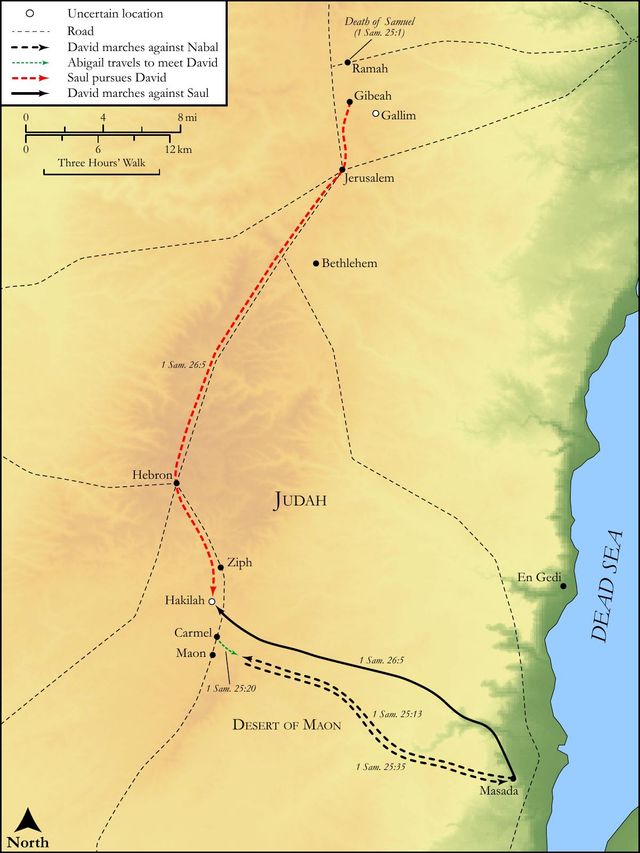
The setting for this intense encounter is the wilderness of Ziph, a rugged, desolate, and often unforgiving region within the territory of Judah. This terrain, characterized by its numerous caves and wadis, offered natural hiding places for fugitives like David but also made him vulnerable to betrayal, as evidenced by the Ziphites' actions. The "trench" (Hebrew: ma'gal) mentioned in the verse likely refers to a circular encampment or a defensive perimeter formed by the sleeping soldiers, a common and effective military arrangement designed for protection in ancient warfare. The presence of Saul's spear "at his bolster" (Hebrew: mera'ashotav, literally meaning "at his head") carries profound cultural significance. In Israel, a king's spear was far more than a mere weapon; it was a potent symbol of his authority, his power, and even his very presence. Its placement near his head indicated his readiness for battle and served as a visible and unmistakable marker of his royal tent or sleeping place within the camp. The deep, pervasive sleep that had fallen upon Saul and his entire retinue, including the formidable and typically vigilant Abner, is consistently interpreted by scholars as a divinely orchestrated slumber. This highlights God's direct and miraculous intervention in delivering Saul, in his most vulnerable state, directly into David's hands. This critical context powerfully underscores the immense gravity of David's decision not to harm "the Lord's anointed," a sacred principle deeply embedded in the Israelite understanding of kingship, divine election, and the inviolability of God's chosen instruments.
Key Themes
ShowHide1 Samuel 26:7 contributes powerfully to several overarching and profound themes woven throughout the book of 1 Samuel and the broader biblical narrative. Firstly, it unmistakably showcases Divine Sovereignty and Providence, demonstrating how God actively orchestrates circumstances, even seemingly impossible ones, to fulfill His divine purposes. The ease with which David and Abishai penetrate the heavily guarded camp and find Saul and his entire army in a profound sleep points not merely to human stealth but to a supernatural intervention, a direct act of God. Secondly, it highlights David's Integrity and Righteous Character, presenting a stark and compelling contrast with Saul's increasingly erratic, paranoid, and ungodly behavior. David's unwavering refusal to "stretch out his hand against the Lord's anointed" (1 Samuel 26:9) is a profound testament to his deep reverence for God's chosen instruments and his absolute trust in God's perfect timing for justice and vengeance. This principled decision solidifies David's moral authority and legitimacy as the future king, proving him to be a "man after God's own heart," unlike Saul, who repeatedly disobeys God's explicit commands, as vividly detailed in 1 Samuel 15. Finally, the verse powerfully reinforces the crucial theme of Waiting on the Lord versus Taking Matters into One's Own Hands, a timeless and vital lesson for all believers facing injustice or adversity. David's remarkable patience and unwavering faith in God's ultimate vindication serve as an exemplary model for righteous conduct under duress and a profound demonstration of spiritual maturity.
Exposition and Analysis
ShowHideKey Word Analysis
ShowHideThe KJV translates this simply as "lay sleeping," but the Hebrew verb יָשֵׁן (yâshên) conveys a sense of deep, profound slumber. The context of an entire military encampment, including its notoriously vigilant commander Abner, falling into such an intense and simultaneous sleep, strongly suggests a divinely induced state. This "deep sleep" is not merely the result of natural exhaustion but a supernatural act orchestrated by God, removing all human obstacles and ensuring Saul's complete vulnerability, thereby providing David with unimpeded access.
While the King James Version renders this as "trench," the Hebrew word מַעְגָּל (maʻgâl) more accurately denotes "an entrenchment," "a circular encampment," or even "a wagon laager." This implies that Saul's forces were arranged in a defensive circle, likely using wagons or the bodies of sleeping men to form a protective perimeter around the king's quarters. The fact that David and Abishai were able to penetrate this supposedly secure formation underscores the extraordinary depth of the sleep that had fallen upon the camp, strongly implying divine intervention.
The Hebrew word מְרַאֲשָׁה (mᵉraʼăshâh) literally translates to "at his head" or "at his head-place." This precise detail is crucial for visualizing Saul's extreme vulnerability. His spear, a potent symbol of his authority and his primary weapon, was positioned not far away but immediately accessible right at his head. Yet, despite its proximity, Saul remained utterly oblivious to the mortal danger. This specific visual detail powerfully emphasizes the ease with which David could have ended Saul's life, making his subsequent refusal to do so even more profound and ethically significant.
Verse Breakdown
ShowHide"So David and Abishai came to the people by night:"
This opening clause immediately establishes the stealth, danger, and calculated risk involved in their mission. David, accompanied by his trusted nephew Abishai, undertakes a perilous nocturnal infiltration into the very heart of the enemy camp. The phrase "the people" refers to Saul's entire army, indicating a large and typically well-guarded encampment, thus highlighting David's extraordinary courage and determination.
"and, behold, Saul lay sleeping within the trench,"
The exclamation "behold" (Hebrew: hinneh) serves to draw immediate and emphatic attention to the astonishing sight that confronts David and Abishai. Saul, the powerful and relentless king, is discovered in a state of absolute vulnerability, deeply asleep within his own defensive perimeter. This immediate revelation signals a moment of profound divine opportunity, as Saul is delivered into David's hand without any struggle or resistance.
"and his spear stuck in the ground at his bolster:"
This highly specific and symbolic detail is central to the verse's meaning. The spear, a potent emblem of royal authority, kingship, and military power, is positioned directly at Saul's head, theoretically ready for immediate use. Its presence underscores Saul's royal status and his supposed readiness for battle, yet his profound sleep renders it utterly useless. This vivid visual emphasizes how effortlessly David could have taken Saul's life and, by extension, seized the very symbol of his kingship.
"but Abner and the people lay round about him."
This concluding clause powerfully highlights the comprehensive nature of the divine intervention. Abner, Saul's highly capable, loyal, and typically vigilant commander, along with the entire army, is also found in a state of deep, unnatural sleep. This detail confirms that no human watchfulness or military prowess could have prevented David's access, reinforcing the profound theological idea that God Himself had supernaturally delivered Saul into David's power, setting the stage for David's demonstration of integrity.
Literary Devices
ShowHideThe narrative in 1 Samuel 26:7 is rich with literary devices that significantly enhance its meaning, dramatic tension, and theological impact. Irony is profoundly evident: Saul, the powerful, reigning king, surrounded by his entire armed force, is rendered utterly helpless and vulnerable to the very man he relentlessly pursues. His supposed security, symbolized by the "trench" and the immediate presence of his spear, proves entirely ineffectual due to the divinely induced sleep that has fallen upon his guards, including the formidable Abner. This starkly contrasts with David, the hunted fugitive, who is remarkably alert, courageous, and in complete control of the perilous situation. Symbolism is also powerfully at play, most notably with Saul's spear. It represents his kingship, his authority, and his military might. Its placement "at his bolster" signifies that the very essence of Saul's rule, his life and power, is literally within David's grasp. David's subsequent decision to take the spear but spare Saul's life is a profound symbolic act of disarming Saul's power and demonstrating David's own moral superiority and legitimate claim to rule, achieved without resorting to regicide. Furthermore, the scene employs Foreshadowing, echoing the earlier incident in 1 Samuel 24. This deliberate repetition reinforces David's consistent character of integrity and patience, and subtly foreshadows his eventual, divinely appointed rise to kingship, not through violent usurpation, but through patient waiting and God's sovereign timing. Finally, the deep, pervasive sleep of the entire camp can be seen as a clear instance of Divine Intervention, highlighting God's active and direct role in the narrative, supernaturally removing human obstacles to demonstrate His absolute sovereignty and to provide David with the critical opportunity to display his unwavering integrity and trust.
Theological and Thematic Connections
ShowHide1 Samuel 26:7 stands as a profound theological statement on divine sovereignty, the nature of true human integrity, and the characteristics of righteous leadership. It vividly illustrates God's active and meticulous involvement in the lives of His chosen ones, orchestrating circumstances, even miraculous ones, to test character, refine faith, and ultimately reveal His overarching plan. David's resolute refusal to harm Saul, despite possessing every human justification and a clear, unimpeded opportunity, is not merely an act of mercy but a deeply theological decision rooted in his profound reverence for God's anointing. He understands that Saul's kingship, though currently flawed and tragically misdirected, was divinely instituted, and therefore, vengeance and the removal of God's anointed belong solely to the Lord. This remarkable act of restraint powerfully underscores David's unwavering faith that God would ultimately bring about justice and establish His chosen king in His own perfect timing, without David having to defile himself with the blood of God's anointed. This patient trust in divine justice and providence, even in the face of relentless and unjust persecution, sets David apart as a true "man after God's own heart" and provides a powerful, enduring model for believers facing injustice and adversity in any era.
Reflection and Application
ShowHideThe profound narrative of 1 Samuel 26:7 offers timeless and deeply relevant lessons for contemporary believers navigating complex relationships, challenging circumstances, and the pervasive temptation to take matters into one's own hands. David's steadfast refusal to act on a clear opportunity to eliminate his persecutor serves as a powerful testament to the transformative power of faith, patience, and unwavering trust in God's sovereignty. In a world that often champions immediate gratification, swift retaliation, and the pursuit of personal advantage at any cost, David's example calls us to a higher, more counter-cultural standard: to trust implicitly in God's perfect timing and His sovereign justice, rather than seeking personal vengeance or resorting to unrighteous means to achieve our desired outcomes. It reminds us that our integrity, demonstrated through patient endurance and trust in the face of injustice, is a more potent and enduring witness than any act of retribution. Furthermore, David's profound respect for the office of the king, despite the king's personal failings and malicious intent, challenges us to critically examine our own attitudes towards authority, whether in government, church, or family. It compels us to recognize that God often places individuals in positions of power for His own inscrutable purposes, and our respect for the office itself can reflect our respect for God's divine order, even when we deeply disagree with or suffer under the person holding it. Ultimately, this passage profoundly encourages us to cultivate a heart that waits patiently on the Lord, believing with unwavering conviction that He is our ultimate vindicator and that His ways are always infinitely higher and more perfect than our own.
Questions for Reflection
ShowHideFAQ
ShowHideWhy didn't David kill Saul, especially since Abishai offered to do it?
ShowHideDavid refused to kill Saul primarily because Saul was "the Lord's anointed" (Hebrew: mashiach Yahweh). In ancient Israel, the king was chosen and consecrated by God through a prophet, making him sacred in a unique way. David, being a man after God's own heart, deeply respected this divine appointment and the sanctity of the office. He believed that only God had the right to remove His anointed one, and he trusted God to do so in His own perfect time and way. David's words in 1 Samuel 26:10 explicitly state his conviction that "the Lord will strike him, or his day will come to die, or he will go down into battle and perish." This demonstrates David's profound faith in divine justice and his steadfast refusal to usurp God's prerogative. His actions set a powerful precedent for righteous leadership and unwavering trust in God's sovereignty, even when facing severe and unjust persecution.
How were David and Abishai able to get into Saul's camp undetected when Abner and the army were guarding him?
ShowHideThe biblical text strongly implies, and indeed explicitly states, divine intervention as the primary reason for David and Abishai's unimpeded access. 1 Samuel 26:12 explicitly states that "a deep sleep from the Lord had fallen upon them." This was not merely natural exhaustion or human oversight but a supernatural phenomenon orchestrated by God to ensure Saul's complete vulnerability and David's unimpeded access. The fact that Abner, a highly capable and vigilant commander, and the entire army were all in such a profound slumber that they did not see or hear David and Abishai, allowed them to walk directly into the heart of the encampment, take Saul's spear and water jug, and leave without detection. This miraculous element underscores God's active hand in delivering Saul into David's power, providing David with the ultimate test of his character and faith in divine justice.
Christ-Centered Fulfillment
ShowHideThe narrative of David sparing Saul in 1 Samuel 26:7, and indeed throughout the book of Samuel, profoundly foreshadows the character and redemptive mission of Jesus Christ, the ultimate and eternal King. David, as God's anointed (though not yet enthroned), consistently refuses to take up the sword against God's current, albeit flawed and rebellious, anointed king. He trusts implicitly in God's timing and justice, demonstrating a righteousness that transcends human vengeance and self-preservation. This remarkable ethical stance finds its ultimate and perfect fulfillment in Jesus, the true "Anointed One" (Christ), who, when faced with betrayal, injustice, and the opportunity to wield divine power for His own protection, did not retaliate. Instead, He perfectly submitted to the will of His Father. He rebuked Peter for drawing his sword (Matthew 26:52), declaring that His kingdom was not of this world, and if it were, His servants would indeed fight (John 18:36). Like David, who could have seized power by force but chose restraint and trust in God, Jesus, possessing all power and authority in heaven and on earth, willingly laid down His life, trusting His vindication and ultimate exaltation to God alone (1 Peter 2:23). He endured the cross, despising its shame, knowing that God would ultimately exalt Him to the highest place (Hebrews 12:2). David's act of mercy, his profound trust in divine timing, and his refusal to defile himself with the blood of God's anointed, all point prophetically to the Lamb of God who takes away the sin of the world, not by conquering through earthly force, but by a willing, sacrificial death, thereby perfectly fulfilling God's eternal plan for redemption and ultimately leading to His glorious resurrection and eternal reign as King of kings and Lord of lords.