


1 Samuel 26:6
Bible text: King James Version (1769 Blayney text) · Public domain
Bible text: King James Version with Strong's numbers · Public domain
Bible text: Berean Standard Bible · Public domain
Bible text: American Standard Version (1901) · Public domain
Bible text: World English Bible, Messianic edition · Public domain
Bible text: Geneva Bible (1599) · Public domain
Bible text: Young's Literal Translation · Public domain
- וַיַּעַןvai·Ya·'anand he answeredH6030Conj-w ¦ V-Qal-ConsecImperf-3msVerb Qal Consecutive Imperfect 3rd Singular Masculineוַandיַּעַןhe answered
- דָּוִדda·VidDavidH1732N-proper-mNoun Proper Masculine
- וַיֹּאמֶרvai·Yo·merand he saidH559Conj-w ¦ V-Qal-ConsecImperf-3msVerb Qal Consecutive Imperfect 3rd Singular Masculineוַandיֹּאמֶרhe said
- אֶל'eltoH413PrepPreposition
- אֲחִימֶלֶךְ'a·chi·Me·lekhAhimelechH288N-proper-mNoun Proper Masculine
- הַחִתִּיha·chi·Tithe HittiteH2850Art ¦ N-msNoun Gentilic Singular Masculine AbsoluteהַtheחִתִּיHittite
- וְאֶלve·'eland toH413Conj-w ¦ PrepPrepositionוְandאֶלto
- אֲבִישַׁי'a·vi·ShaiAbishaiH52N-proper-mNoun Proper Masculine
- בֶּןben[the] son ofH1121N-mscNoun Singular Masculine Construct
- צְרוּיָהtze·ru·YahZeruiahH6870N-proper-fNoun Proper Feminine
- אֲחִי'a·Chi[the] brother ofH251N-mscNoun Singular Masculine Construct
- יוֹאָבyo·'AvJoabH3097N-proper-mNoun Proper Masculine
- לֵאמֹרle·Mor<to> sayingH559Prep-l ¦ V-Qal-InfVerb Qal Infinitive Constructלֵ<to>אמֹרsaying
- מִיmiwho?H4310InterrogPronoun Interrogative
- יֵרֵדye·Redwill he go downH3381V-Qal-Imperf-3msVerb Qal Imperfect 3rd Singular Masculine
- אִתִּי'i·Tiwith meH854Prep ¦ 1csPreposition Definiteאִתִּwithיme
- אֶל'eltoH413PrepPreposition
- שָׁאוּלsha·'UlSaulH7586N-proper-mNoun Proper Masculine
- אֶל'elintoH413PrepPreposition
- הַמַּחֲנֶהha·ma·cha·Nehthe campH4264Art ¦ N-fsNoun Singular Feminine Absoluteהַtheמַּחֲנֶהcamp
- וַיֹּאמֶרvai·Yo·merand he saidH559Conj-w ¦ V-Qal-ConsecImperf-3msVerb Qal Consecutive Imperfect 3rd Singular Masculineוַandיֹּאמֶרhe said
- אֲבִישַׁי'a·vi·ShaiAbishaiH52N-proper-mNoun Proper Masculine
- אֲנִי'a·NiIH589Pro-1csPronoun Personal 1st Singular common gender
- אֵרֵד'e·RedI will go downH3381V-Qal-Imperf-1csVerb Qal Imperfect 1st Singular common gender
- עִמָּךְ'i·Makhwith youH5973Prep ¦ 2msPreposition Definiteעִמָּwithךְyou
English is a literal word-by-word gloss of the Hebrew, not the KJV's wording. Why?
This is the original text the KJV's translators worked from — each Hebrew word with its own literal English meaning in this verse, prepared by scholars at Tyndale House, Cambridge. The KJV translates whole sentences, not word by word, so its wording differs: one Hebrew word can become several English words, and the KJV may choose “the LORD” where the gloss reads “Yahweh”. Both are faithful — they answer different questions. For the KJV's own rendering, switch to the KJV text.
Details
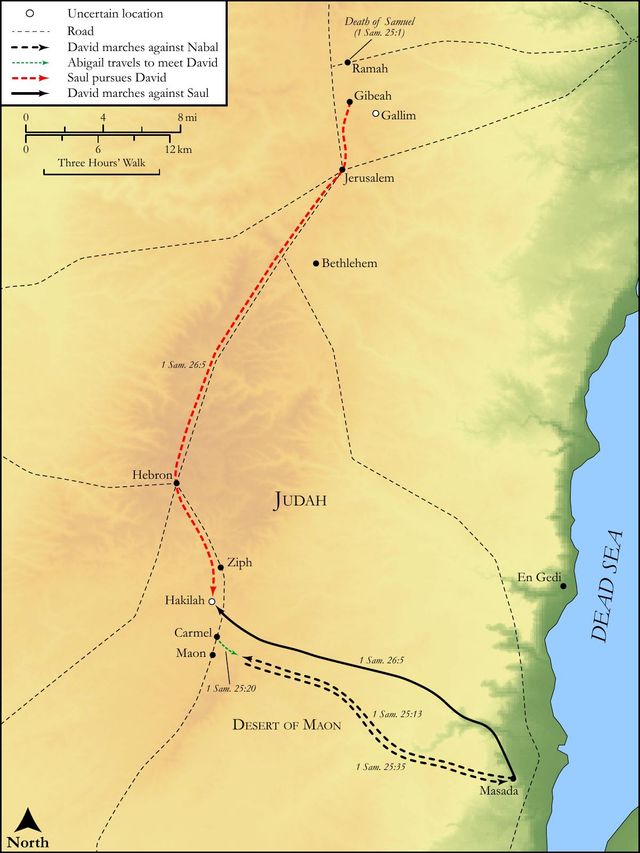
See on the biblical-era map
Study this verse
Public-domain commentary
Matthew Henry
From his Commentary on the Whole Bible. Henry comments on passages, not single verses — this entry covers 1 Samuel 26:6–12.
Here is, I. David's bold adventure into Saul's camp in the night, accompanied only by his kinsman Abishai, the son of Zeruiah. He proposed it to him and to another of his confidants (Sa1 26:6), but the other either declined it as too dangerous an enterprise, or at least was content that Abishai, who was forward to it, should run the risk of it rather than himself. Whether David was prompted to do this by his own courage, or by an extraordinary impression upon his spirits, or by the oracle, does not appear; but, like Gideon, he ventured through the guards, with a special assurance of the divine protection.
II.The posture he found the camp in Saul lay sleeping in the trench, or, as some read it, in his chariot, and in the midst of his carriages, with his spear stuck in the ground by him, to be ready if his quarters should by beaten up (Sa1 26:7); and all the soldiers, even those that were appointed to stand sentinel, were fast asleep, Sa1 26:12. Thus were their eyes closed and their hands bound, for a deep sleep from the Lord had fallen upon them; something extraordinary there was in it that they should all be asleep together, and so fast asleep that David and Abishai walked and talked among them, and yet none of them stirred. Sleep, when God gives it to his beloved, is their rest and refreshment; but he can, when he pleases, make it to his enemies their imprisonment. Thus are the stout-hearted spoiled; they have slept their sleep, and none of the men of might have found their hands, at thy rebuke, O God of Jacob! Psa 76:5, Psa 76:6. It was a deep sleep from the Lord, who has the command of the powers of nature, and makes them to serve his purposes as he pleases. Whom God will disable, or destroy, he binds up with a spirit of slumber, Rom 11:8. How helpless do Saul and all his forces lie, all, in effect, disarmed and chained! and yet nothing is done to them; they are only rocked asleep. How easily can God weaken the strongest, befool the wisest, and baffle the most watchful! Let all his friends therefore trust him and all his enemies fear him.
III.Abishai's request to David for a commission to dispatch Saul with the spear that stuck at his bolster, which (now that he lay so fair) he undertook to do at one blow, Sa1 26:8. He would not urge David to kill him himself, because he had declined doing this before when he had a similar opportunity; but he begged earnestly that David would give him leave to do it, pleading that he was his enemy, not only cruel and implacable, but false and perfidious, whom no reason would rule nor kindness work upon, and that God had now delivered him into his hand, and did in effect bid him strike. The last advantage he had of this kind was indeed but accidental, when Saul happened to be in the cave with him at the same time. But in this there was something extraordinary; the deep sleep that had fallen on Saul and all his guards was manifestly from the Lord, so that it was a special providence which gave him this opportunity; he ought not therefore to let it slip.
IV.David's generous refusal to suffer any harm to be done to Saul, and in it a resolute adherence to his principles of loyalty, Sa1 26:9.
David charged Abishai not to destroy him, would not only not do it himself, but not permit another to do it. And he gave two reasons for it: - 1. It would be a sinful affront to God's ordinance. Saul was the Lord's anointed, king of Israel by the special appointment and nomination of the God of Israel, the power that was, and to resist him was to resist the ordinance of God, Rom 13:2. No man could do it and be guiltless. The thing he feared was guilt and his concern respected his innocence more than his safety. 2. It would be a sinful anticipation of God's providence. God had sufficiently shown him, in Nabal's case, that, if he left it to him to avenge him, he would do it in due time. Encouraged therefore by his experience in that instance, he resolves to wait till God shall think fit to avenge him on Saul, and he will by no means avenge himself (Sa1 26:10): "The Lord shall smite him, as he did Nabal, with some sudden stroke, or he shall die in battle (as it proved he did soon after), or, if not, his day shall come to die a natural death, and I will contentedly wait till then, rather than force my way to the promised crown by any indirect methods." The temptation indeed was very strong; but, if he should yield, he would sin against God, and therefore he will resist the temptation with the utmost resolution (Sa1 26:11): "The Lord forbid that I should stretch forth my hand against the Lord's anointed; no, I will never do it, nor suffer it to be done." Thus bravely does he prefer his conscience to his interest and trusts God with the issue.
V.The improvement he made of this opportunity for the further evidence of his own integrity.
He and Abishai carried away the spear and cruse of water which Saul had by his bed-side (Sa1 26:12), and, which was very strange, none of all the guards were aware of it. If a physician had given them the strongest opiate or stupifying dose, they could not have been faster locked up with sleep. Saul's spear which he had by him for defence, and his cup of water which he had for his refreshment, were both stolen from him while he slept. Thus do we lose our strength and our comfort when we are careless, and secure, and off our watch.
Historical interpretation
Historical reception
1 surviving comment on this verse from the historical church.
And David said to Achimelech the Hittite, etc. Many, when the Lord was preaching in the flesh, from the Gentiles, many from the Jews flocked to the faith, but he chose the first ministers of his word, by whom he would overthrow and conquer the camps of the persecutor's kingdom, from the Jews, who adhered to him with both a closer affection and the reception of the sacraments. For Achimelech the Hittite, who is interpreted as My brother the king cut off, by nation indeed represents the people of the Gentiles, but by name and faith shows the same as cut off from the rites of idolatry, and joined and united to the kingdom of Christ. Furthermore, Abisai the son of Zeruiah, the brother of Joab, that is, the incense of my father, the son of distress, the brother of the enemy, figuratively designates the chosen disciples of Christ from the Jews, fervent in love, children of penitence, brothers by nature of the persecuting people.
Continue studying 1 Samuel 26:6 across the web’s major study libraries — every link below opens this exact verse, chapter, or book on the destination site.
Read & Compare
 BibleGatewayThis verse in more than 200 translations and 70 languages.
 Bible.comThe YouVersion reader — hundreds of translations, reading plans, and highlights.
 ESV.orgCrossway's official English Standard Version reader.
 NET BibleThe NET translation with 60,000+ translators' notes on every rendering decision.
 STEP BibleTyndale House's free study tool — original text, vocabulary, and scholarly resources.
 BibliaLogos Bible Software's free web reader.
 USCCBThe New American Bible (Revised Edition) with the U.S. bishops' study notes.
Commentaries
 BibleHub CommentariesDozens of classic commentaries on this verse, gathered on one page.
 StudyLightMore than 100 commentary sets — the largest collection on the web.
 BibleRefPlain-English commentary on what this verse means, verse by verse.
 Enduring WordDavid Guzik's free commentary on this chapter, widely used by Bible teachers.
 Bible Study ToolsVerse commentary alongside Greek and Hebrew study aids.
Original Language & Research
- BibleHub InterlinearThe verse word by word — original language, transliteration, and English.
- BibleHub LexiconEvery word's original-language definition and Strong's entry.
 Blue Letter BibleDeep-study tools — Strong's numbers, concordance, and word studies.
 SefariaThe Hebrew text with Rashi and centuries of Jewish commentary.
Sermons, Hymns & Audio


TrulyRandomVerse is not affiliated with these sites and doesn’t control their content. They’re linked because they’re genuinely useful.
Summary
1 Samuel 26:6 captures a pivotal moment in David's flight from King Saul, revealing David's audacious courage and the unwavering loyalty of his closest followers. As Saul relentlessly pursues David, convinced he is a threat to his throne, David learns of Saul's encampment. Instead of fleeing further, David boldly poses a question to two of his men, Ahimelech the Hittite and Abishai, brother of Joab: "Who will go down with me to Saul to the camp?" Abishai's immediate and resolute reply, "I will go down with thee," sets the stage for a dramatic nocturnal infiltration that will once again demonstrate David's profound respect for God's anointed and his trust in divine providence, rather than human vengeance.
Context
ShowHideLiterary Context
This verse is situated within a larger narrative arc depicting David's anointing as king, his rise to prominence, and King Saul's subsequent descent into jealousy, paranoia, and relentless pursuit of David. The events of 1 Samuel 26 bear striking resemblance to those in 1 Samuel 24, where David also had an opportunity to kill Saul but refrained. This repetition emphasizes David's consistent character and his unwavering commitment to not harming "the Lord's anointed." In chapter 26, David, alerted by the Ziphites to Saul's presence, sends out spies to confirm Saul's exact location. The verse immediately precedes David's daring infiltration of Saul's camp under the cover of night, where he finds Saul and his men asleep, presenting yet another test of David's faith and integrity, and leading to David's powerful declaration of trust in God's judgment in 1 Samuel 26:10.
Historical & Cultural Context
The concept of "the Lord's anointed" was central to Israelite kingship. Saul, though rejected by God, still held the divine anointing in the eyes of many, including David. To harm him would be to lift one's hand against God's chosen representative, a grave offense punishable by God Himself. The setting is the wilderness of Ziph, a rugged, desolate region in Judah, which provided natural hiding places for David and his men but also allowed for military encampments. Military camps in ancient Israel were typically organized with the king at the center, surrounded by his elite guard, making an infiltration like David's exceptionally dangerous and a testament to his strategic prowess and the deep sleep God had caused to fall upon Saul's camp (as revealed in subsequent verses). The presence of "Ahimelech the Hittite" also hints at the diverse composition of David's growing band of followers, including non-Israelites who pledged loyalty to him, reflecting the broader geopolitical landscape of the time.
Key Themes
ShowHideSeveral major themes converge in this verse. David's Daring Leadership is paramount; he is not merely reacting to Saul's pursuit but proactively seeking to understand and control the situation, even if it means entering enemy territory. This highlights his strategic mind and audacious courage, qualities that would later define his reign as king of Israel. The theme of Loyalty and Devotion is powerfully demonstrated by Abishai's immediate and unequivocal response, showcasing the strong bonds forged between David and his "mighty men." Abishai, as brother to Joab, was a key figure in David's inner circle, consistently proving his fierce commitment. Most profoundly, this verse contributes to the overarching theme of Trust in God's Providence and Timing. While not explicitly stated here, David's actions throughout this chapter, particularly his refusal to harm Saul, are rooted in his conviction that God would establish him as king in His own time and way, without David having to resort to violence against God's anointed. This courageous foray into Saul's camp is a display of David's reliance on divine protection and a profound respect for God's sovereign plan, as he articulates later in 1 Samuel 26:10.
Exposition and Analysis
ShowHideKey Word Analysis
ShowHideThis verb means "to heed, pay attention," and by implication, "to respond" or "to begin to speak." In this context, it signifies David's deliberate and decisive initiation of a dangerous proposition. It's not merely a reply but an active engagement, demonstrating David's leadership in taking the initiative to confront a perilous situation rather than simply reacting to it.
This word literally means "to descend" or "to go downwards," often used when moving from a higher elevation to a lower one, or entering a specific region. Here, it powerfully conveys the perilous nature of infiltrating Saul's camp, a "descent" into the very heart of the enemy's domain. It implies entering a place of vulnerability and extreme danger, underscoring the gravity of David's proposed mission.
This term refers to a military encampment or a temporary dwelling place for troops. In biblical narratives, a "camp" is a place of organized military presence, representing strength and security, yet also a place of potential vulnerability when its occupants are at rest. For David to "go down to Saul to the camp" means to penetrate the very stronghold of his pursuer, a place of extreme danger, yet also, as the narrative unfolds, a place where God's protective hand would be remarkably evident.
Verse Breakdown
ShowHide"Then answered David and said to Ahimelech the Hittite, and to Abishai the son of Zeruiah, brother to Joab, saying,"
This opening clause establishes David as the proactive agent, initiating a conversation with two key figures among his men. Ahimelech the Hittite is less known, possibly a mercenary or a loyal ally from a non-Israelite background, indicating the diverse composition of David's followers and his ability to attract loyalty from various peoples. Abishai, however, is a prominent and consistently loyal warrior, known for his fierce devotion to David and his occasional impetuousness. His kinship to Joab, David's future commander, highlights his significant standing within David's inner circle, making his immediate response particularly weighty and indicative of the strong bonds within David's company.
"Who will go down with me to Saul to the camp?"
This is David's bold and strategic question. It is a direct challenge, not just an inquiry, inviting a volunteer for an extremely dangerous reconnaissance mission. The phrasing "go down with me" implies shared risk and a need for companionship in a perilous undertaking. David's initiative in approaching Saul's camp, rather than merely reacting to Saul's pursuit, underscores his proactive and courageous leadership, demonstrating his desire to assess the situation directly and potentially act upon it (though not with malice or vengeance).
"And Abishai said, I will go down with thee."
Abishai's immediate and unequivocal response reveals his deep loyalty, courage, and willingness to follow David into any danger. This swift affirmation is characteristic of Abishai's personality throughout the narratives, often being the first to volunteer for risky endeavors or to suggest aggressive action, showcasing his unwavering commitment to David's cause. His willingness to "go down" with David signifies his readiness to face the extreme peril of entering the enemy's heartland, trusting in David's leadership and, implicitly, in God's protection.
Literary Devices
ShowHideThe verse primarily employs Dialogue to advance the plot and reveal character. David's question is direct and challenging, immediately establishing the high stakes of the situation and David's audacious leadership. Abishai's swift and unhesitating response through dialogue powerfully demonstrates his unwavering Loyalty and courage. There is also an element of Foreshadowing, as David's question sets the stage for the dramatic and dangerous infiltration of Saul's camp that is about to occur, hinting at the divine protection that will allow them to succeed. Furthermore, an implicit Contrast is present between David's calm, strategic initiative and Saul's frantic, paranoid pursuit, highlighting David's reliance on divine guidance versus Saul's self-reliance and fear. The very act of David, the pursued, initiating a move towards his pursuer can be seen as Irony, subverting typical expectations of flight and chase and emphasizing David's unique character and faith.
Theological and Thematic Connections
ShowHideThis verse, though brief, is rich in theological implications, particularly concerning the nature of leadership, loyalty, and divine sovereignty. David's question and Abishai's response exemplify a fearless trust in God's protection even in the face of extreme danger. David's strategic boldness is not recklessness but a calculated move rooted in his conviction that God is with him and will deliver him. His subsequent actions in the camp (not harming Saul) further underscore his profound respect for God's anointed and his commitment to allowing God to execute justice and establish His chosen king in His own time. This patience and non-retaliation, even when provoked, serve as a powerful theological statement about waiting on the Lord and entrusting vengeance to Him, rather than usurping God's prerogative.
Reflection and Application
ShowHide1 Samuel 26:6 offers profound insights for believers navigating challenges and leadership roles today. David's willingness to confront danger head-on, not out of recklessness but strategic discernment and trust in God, reminds us that courageous faith in adversity is a hallmark of godly leadership. We are called not to shrink from difficult circumstances but to prayerfully seek God's guidance, even when it leads us into seemingly perilous situations. This requires a deep reliance on God's providence, understanding that His timing and methods are superior to our own impulsive reactions. Abishai's immediate and selfless loyalty serves as a powerful example of supporting righteous leadership and committing wholeheartedly to a shared, God-honoring vision. In our own lives, this translates to faithfully serving those God has placed in authority, and to being reliable and committed members of our communities and churches, willing to "go down" with them into challenging endeavors for the sake of the Kingdom. We are challenged to discern when to act boldly and when to wait patiently, always trusting that God is sovereign over all circumstances, even those involving our adversaries.
Questions for Reflection
ShowHideFAQ
ShowHideWhy did David ask "Who will go down with me?" instead of just going alone?
ShowHideDavid's question was a strategic move, showcasing his leadership and prudence on multiple levels. First, it was a test of loyalty; he needed to know who among his men was truly committed to him, especially for such a dangerous and potentially life-threatening mission. Abishai's immediate and unwavering response confirmed his deep devotion. Second, having a companion provided a witness to his actions, particularly his crucial decision not to harm Saul, which would be vital for his reputation and legitimacy as God's chosen king. Third, it was a practical matter of shared risk and reconnaissance; two sets of eyes and ears are better than one in a perilous and dark environment. Finally, David's leadership style often involved collaboration and empowering his men, rather than acting in isolation, fostering a sense of shared purpose and trust within his growing company.
Who were Ahimelech the Hittite and Abishai?
ShowHideAhimelech the Hittite is less prominently featured in the biblical narrative, appearing only in this verse. His inclusion here suggests that David's growing band of followers was diverse, including non-Israelites who pledged loyalty to him, possibly as mercenaries or allies attracted to his leadership. The Hittites were a prominent people, numbered among the nations of Canaan and known for their military prowess. Abishai, on the other hand, was a highly significant figure in David's life and reign. He was the son of Zeruiah, David's sister, making him David's nephew, and the brother of Joab and Asahel, both formidable warriors. Abishai was one of David's "mighty men" and consistently demonstrated fierce loyalty, courage, and a willingness to take aggressive action, often being the first to volunteer for dangerous tasks or to propose striking down David's enemies, as seen later in 1 Samuel 26:8.
How does this event compare to 1 Samuel 24?
ShowHideThe events in 1 Samuel 26 are remarkably similar to those in 1 Samuel 24, serving as a powerful literary and theological parallel that underscores David's consistent character. In both instances, David has Saul completely in his power and could easily kill him, but chooses not to. Both narratives highlight David's profound respect for "the Lord's anointed" and his unwavering trust in God's timing and justice to establish him as king. The key differences lie in the specific details of the encounter: in chapter 24, David secretly cuts off a piece of Saul's robe in a cave; in chapter 26, David takes Saul's spear and water jug from his side while he sleeps in the camp. Both acts serve as undeniable proof to Saul that David had the opportunity to kill him but chose mercy, reinforcing David's integrity and God's protective hand over him.
Christ-Centered Fulfillment
ShowHide1 Samuel 26:6, with David's courageous initiative and Abishai's loyal response, prefigures the ultimate demonstration of courageous, self-sacrificial love found in Jesus Christ. David, though pursued unjustly by Saul, enters the enemy's camp not to destroy but to demonstrate his integrity and trust in God's timing and sovereignty. This foreshadows Christ, who, though innocent and divine, "went down" into the very heart of humanity's brokenness and the domain of death, not to wield a sword against His enemies, but to offer Himself as the ultimate sacrifice for their sin. Like David, who refused to lift his hand against God's anointed, Jesus refused to retaliate against those who persecuted Him, even rebuking Peter for drawing his sword in Gethsemane, stating that those who live by the sword will die by the sword (Matthew 26:52). Christ's mission was characterized by a patient endurance of suffering and a profound trust in the Father's will, echoing David's reliance on divine providence. He was "led like a lamb to the slaughter, and as a sheep before its shearers is silent, so he did not open his mouth" (Isaiah 53:7). The loyalty of Abishai to David, willing to face death, finds its perfect fulfillment in the Father's unwavering faithfulness to the Son, and the Spirit's empowering presence in Christ's mission. Ultimately, Christ's descent into death and His subsequent resurrection represent the true "going down" and ultimate victory, fulfilling God's sovereign plan not through human violence, but through divine love and obedience unto death (Philippians 2:8), securing salvation and eternal life for all who believe.