


Judges 7:10
Bible text: King James Version (1769 Blayney text) · Public domain
Bible text: Berean Standard Bible · Public domain
Bible text: American Standard Version (1901) · Public domain
Bible text: World English Bible, Messianic edition · Public domain
Bible text: Geneva Bible (1599) · Public domain
Bible text: Young's Literal Translation · Public domain
- וְאִםve·'imand ifH518Conj-w ¦ PrtParticle Conditionalוְandאִםif
- יָרֵאya·Re'[are] afraidH3373Adj-msAdjective Singular Masculine Absolute
- אַתָּה'a·TahyouH859Pro-2msPronoun Personal 2nd Singular Masculine
- לָרֶדֶתla·Re·detto go downH3381Prep-l ¦ V-Qal-InfVerb Qal Infinitive Constructלָtoרֶדֶתgo down
- רֵדredgo downH3381V-Qal-Imp-2msVerb Qal Imperative 2nd Singular Masculine
- אַתָּה'a·TahyouH859Pro-2msPronoun Personal 2nd Singular Masculine
- וּפֻרָהu·fu·Rahand PurahH6513Conj-w ¦ N-proper-mNoun Proper MasculineוּandפֻרָהPurah
- נַעַרְךָna·'ar·Khayour servantH5288N-msc ¦ 2msNoun Singular Masculine Constructנַעַרְservantךָyour
- אֶל'eltoH413PrepPreposition
- הַמַּחֲנֶהHa·ma·cha·Nehthe campH4264Art ¦ N-fsNoun Singular Feminine Absoluteהַtheמַּחֲנֶהcamp
English is a literal word-by-word gloss of the Hebrew, not the KJV's wording. Why?
This is the original text the KJV's translators worked from — each Hebrew word with its own literal English meaning in this verse, prepared by scholars at Tyndale House, Cambridge. The KJV translates whole sentences, not word by word, so its wording differs: one Hebrew word can become several English words, and the KJV may choose “the LORD” where the gloss reads “Yahweh”. Both are faithful — they answer different questions. For the KJV's own rendering, switch to the KJV text.
Details
See on the biblical-era maps
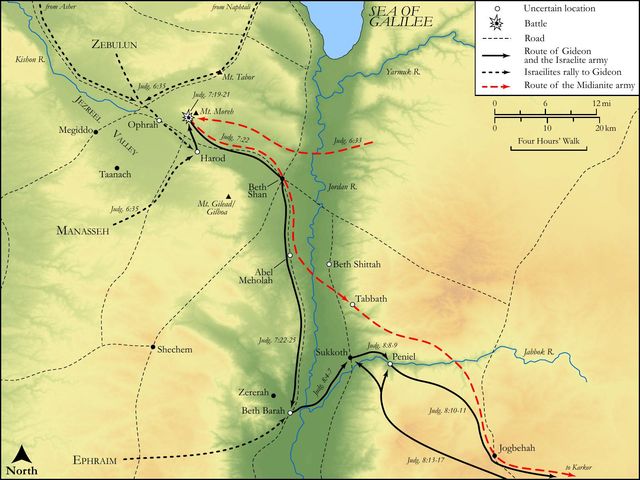
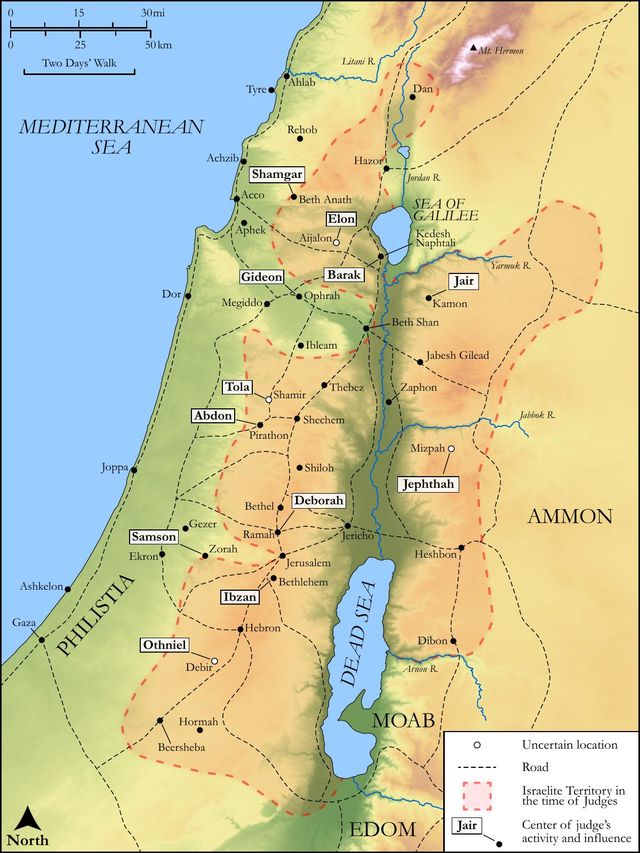
Study this verse
Public-domain commentary
Matthew Henry
From his Commentary on the Whole Bible. Henry comments on passages, not single verses — this entry covers Judges 7:9–15. His three-level outline is real structure in the source text, so it is rendered as structure.
Gideon's army being diminished as we have found it was, he must either fight by faith or not at all; God therefore here provides recruits for his faith, instead of recruits for his forces.
I.He furnishes him with a good foundation to build his faith upon.
Nothing but a word from God will be a footing for faith. He has this as full and express as he can desire, Jdg 7:9.
1.A word of command to warrant the action, which otherwise seemed rash and indiscreet, and unbecoming a wise general: Arise, get thee down with this handful of men unto the host.
2.A word of promise to assure him of the success, which otherwise seemed very improbable: I have delivered it into thy hand; it is all thy own. This word of the Lord came to him the same night, when he was (we may suppose) greatly agitated and full of care how he should come off; in the multitude of his thoughts within him these comforts did delight his soul. Divine consolations are given in to believers not only strongly but seasonably.
II.He furnishes him with a good prop to support his faith with.
1.He orders him to be his own spy, and now in the dead of the night to go down privately into the host of Midian, and see what intelligence he could gain: "If thou fear to go down to fight, go first only with thy own servant (Jdg 7:10) and hear what they say" (Jdg 7:11); and it is intimated to him that he should hear that which would greatly strengthen his faith. God knows the infirmities of his people, and what great encouragement they may sometimes take from a small matter; and therefore, knowing beforehand what would occur to Gideon, in that very part of the camp to which he would go down, he orders him to go down and hearken to what they said, that he might the more firmly believe what God said. He must take with him Phurah his servant, one that he could confide in, probably one of the ten that had helped him to break down the altar of Baal. He must take him and no one else with him, must take him with him to be a witness of what he should hear the Midianites say, that out of the mouth of these two witnesses, when the matter came to be reported to Israel, the word might be established. He must take his servant with him, because two are better than one and a little help is better than none.
2.Being so, he orders him the sight of something that was discouraging. It was enough to frighten him to discern, perhaps by moon-light, the vast numbers of the enemy (Jdg 7:12), the men like grasshoppers for multitude, and they proved no better than grasshoppers for strength and courage; the camels one could not count, any more than the sand. But,
3.He causes him to hear that which was to him a very good omen; and when he had heard it he went back again immediately, supposing he now had what he was sent thither for. He overheard two soldiers of the enemy, that were comrades, talking; probably they were in bed together, waking in the night.
(1.)One of them tells his dream, and as our dreams generally are, and therefore not worth telling again, it is a very foolish one. He dreamed that he saw a barley-cake come rolling down the hill into the camp of the Midianites, and "methought," says he (for so we speak in telling our dreams), "this rolling cake struck one of our tents" (perhaps one of the chief of their tents) "and with such violence that" (would you think it?) "it overturned the tent, forced down the stakes, and broke the cords at one blow, so that the tent lay along and buried its inhabitants," Jdg 7:13. In multitudes of dreams there are divers vanities, says Solomon, Ecc 5:7. One would wonder what odd incoherent things are often put together by a ludicrous fancy in our dreams.
(2.)The other, it may be between sleeping and waking, undertakes to interpret this dream, and the interpretation is very far-fetched: This is nothing else save the sword of Gideon, Jdg 7:14. Our expositors now can tell us how apt the resemblance was, that Gideon, who had threshed corn for his family, and made cakes for his friend (Jdg 6:11-19), was fitly represented by a cake, - that he and his army were as inconsiderable as a cake made of a little flour, as contemptible as a barley-cake, hastily got together as a cake suddenly baked upon the coals, and as unlikely to conquer this great army as a cake to overthrow a tent. But, after all, do not interpretations belong to God? He put it into the head of the one to dream and into the mouth of the other to give the sense of it; if Gideon had heard the dream only, and he and his servant had been left to interpret it themselves, it had so little significancy in it that it would have done him little service; but, having the interpretation from the mouth of an enemy, it not only appeared to come from God, who has all men's hearts and tongues in his hand, but it was likewise an evidence that the enemy was quite dispirited, and that the name of Gideon had become so formidable to them that it disturbed their sleep. The victory would easily be won which was already so tamely yielded: Into his hand hath God delivered Midian. Those were not likely to fight who saw God fighting against them.
Lastly, Gideon, observing the finger of God pointing him to this very place, at this very time, to hear this dream and the interpretation of it, was exceedingly encouraged by it against the melancholy apprehensions he had upon the reducing of his army. He was very well pleased to hear himself compared to a barley-cake, when it proved to effect such great things. Being hereby animated, we are told (Jdg 7:15), 1. How he gave God the glory of it; he worshipped immediately, bowed his head, or, it may be, lifted up his eyes and hands, and in a short ejaculation thanked God for the victory he was now sure of, and for this encouragement to expect it. Wherever we are, we may speak to God, and worship him, and find a way open heavenward. God must have the praise of that which is encouraging to our faith, and his providence must be acknowledged in those events which, though minute and seemingly accidental, prove serviceable to us. 2. How he gave his friends a share in the encouragements he had received: Arise, prepare to march presently; the Lord has delivered Midian into your hand.
Continue studying Judges 7:10 across the web’s major study libraries — every link below opens this exact verse, chapter, or book on the destination site.
Read & Compare
 BibleGatewayThis verse in more than 200 translations and 70 languages.
 Bible.comThe YouVersion reader — hundreds of translations, reading plans, and highlights.
 ESV.orgCrossway's official English Standard Version reader.
 NET BibleThe NET translation with 60,000+ translators' notes on every rendering decision.
 STEP BibleTyndale House's free study tool — original text, vocabulary, and scholarly resources.
 BibliaLogos Bible Software's free web reader.
 USCCBThe New American Bible (Revised Edition) with the U.S. bishops' study notes.
Commentaries
 BibleHub CommentariesDozens of classic commentaries on this verse, gathered on one page.
 StudyLightMore than 100 commentary sets — the largest collection on the web.
 BibleRefPlain-English commentary on what this verse means, verse by verse.
 Enduring WordDavid Guzik's free commentary on this chapter, widely used by Bible teachers.
 Bible Study ToolsVerse commentary alongside Greek and Hebrew study aids.
Original Language & Research
- BibleHub InterlinearThe verse word by word — original language, transliteration, and English.
- BibleHub LexiconEvery word's original-language definition and Strong's entry.
 Blue Letter BibleDeep-study tools — Strong's numbers, concordance, and word studies.
 SefariaThe Hebrew text with Rashi and centuries of Jewish commentary.
Sermons, Hymns & Audio


TrulyRandomVerse is not affiliated with these sites and doesn’t control their content. They’re linked because they’re genuinely useful.
Summary
Judges 7:10 unveils a moment of profound divine compassion and strategic foresight, where God, understanding Gideon's lingering apprehension despite previous miraculous assurances, offers a practical, faith-bolstering step. Rather than rebuking his fear, the Lord instructs Gideon to descend to the Midianite encampment with his servant Phurah. This seemingly minor directive is a crucial component of God's overarching plan to strengthen Gideon's courage, enabling him to overhear a conversation that will decisively confirm God's sovereign power and ensure that the impending victory is unequivocally attributed to divine intervention, not human might.
Context
ShowHideLiterary Context
Judges 7:10 is strategically placed within the dramatic narrative of Gideon's leadership, immediately following God's radical reduction of Israel's army. In Judges 6, Gideon is called by the Angel of the Lord, initially displaying significant doubt and repeatedly seeking signs, including the famous fleece tests, to confirm God's presence and promise of deliverance. As the narrative progresses into Judges 7, Gideon has mustered 32,000 men, but God, determined to demonstrate His exclusive power, systematically prunes the army first to 10,000 (those who feared) and then drastically to a mere 300 (those who lapped water like dogs). This astonishing reduction, detailed in Judges 7:7, leaves Gideon facing an immense enemy host with a seemingly impossible force. Verse 10, therefore, functions as a compassionate interlude, a final divine accommodation to Gideon's persistent human fear before the decisive battle, meticulously setting the stage for the specific, faith-confirming encounter in the Midianite camp that immediately follows in Judges 7:11-15.
Historical & Cultural Context
The period of the Judges (approximately 1200-1000 BC) was a tumultuous era in Israel's early history, characterized by a recurrent cycle of apostasy, divine judgment manifested as foreign oppression, Israel's desperate cry for help, and God raising up a "judge" to deliver them. The Midianites, allied with the Amalekites and "people of the East," were formidable nomadic raiders who, for seven years, had severely oppressed Israel, devastating their crops and livestock and forcing the Israelites to seek refuge in caves and mountain strongholds, as vividly described in Judges 6:1-6. Their "host" (מַחֲנֶה, machăneh) would have been a vast, intimidating encampment, typical of nomadic armies, sprawling across the valley floor. Such an encampment would comprise not only warriors but also their families, tents, and immense herds of livestock, creating an overwhelming spectacle of numerical superiority. The sheer disparity between this massive, experienced raiding force and Gideon's tiny, divinely chosen army of 300 would have instilled profound terror in any human leader, thereby highlighting the extraordinary and supernatural nature of God's impending intervention.
Key Themes
ShowHideJudges 7:10 powerfully contributes to several overarching themes foundational to the book of Judges and the broader biblical narrative. Firstly, it profoundly illustrates Divine Accommodation and Compassion, revealing a God who intimately understands and patiently addresses human weakness and fear, even in His chosen leaders. He does not condemn Gideon's apprehension but provides a specific, practical means to strengthen his faith, demonstrating His tender care. Secondly, the verse underscores the theme of Faith Over Fear, showing that while fear is a natural human emotion, God consistently provides the resources and circumstances for His servants to transcend it, transforming initial trepidation into resolute trust. Thirdly, it is a powerful testament to God's Strategic Planning and Sovereignty. This seemingly small instruction is a crucial, meticulously designed element in God's intricate plan for victory, ensuring that the battle's outcome is undeniably a divine triumph, not a human one, thereby magnifying His glory. Finally, the inclusion of Phurah subtly introduces the theme of The Value of Companionship, demonstrating how God can use a trusted, even quiet, presence to provide moral support and serve as a vital witness to His mighty works, reinforcing the idea that we are not meant to face daunting challenges alone.
Exposition and Analysis
ShowHideKey Word Analysis
ShowHideThe Hebrew word יָרֵא (yârêʼ) primarily means "to fear," "be afraid," or "dread." While it can also denote reverence or awe (as in "the fear of the Lord"), in this immediate context, it unequivocally describes Gideon's apprehension and trepidation in the face of the overwhelming Midianite forces. It acknowledges a very human, visceral reaction to an impossible situation, highlighting that even divinely appointed leaders are not immune to fear. God's response to this yârêʼ is not rebuke but empathetic provision and a pathway to overcome it.
The verb יָרַד (yârad) is a primitive root meaning "to descend," "to go downwards," or "to fall." This seemingly simple directional verb carries significant theological and strategic weight here. It implies a physical descent from the higher ground where Gideon's camp was likely situated to the lower valley where the Midianites were encamped. This physical descent into the enemy's territory symbolizes a step into vulnerability and potential danger, a direct confrontation with the source of Gideon's fear, albeit under divine instruction and protection. It is a movement from perceived safety to the very heart of the threat.
The Hebrew term מַחֲנֶה (machăneh) refers to an "encampment," "camp," or "army." In this context, it denotes the vast, sprawling military encampment of the Midianites and their allies. The sheer scale implied by "the host" emphasizes the overwhelming numerical superiority of the enemy, making Gideon's 300 men appear utterly insignificant and underscoring the miraculous nature of the impending victory. It represents the formidable obstacle that only divine intervention could overcome.
Verse Breakdown
ShowHide"But if thou fear to go down,"
This opening clause profoundly reveals God's intimate understanding of Gideon's inner state. Despite the previous signs, the dramatic reduction of the army, and the divine promises, Gideon's human fear (from yârêʼ) persists. God, in His compassion and perfect knowledge, acknowledges this apprehension rather than condemning it, setting the stage for a divine intervention designed specifically to address Gideon's lingering doubt and bolster his courage. It underscores that God knows our weaknesses, meets us where we are, and provides grace in our moments of vulnerability.
"go thou with Phurah thy servant down to the host:"
This is God's specific, practical, and compassionate instruction. Instead of commanding Gideon to go alone, or simply to "trust Me" without further provision, God provides a trusted companion, Phurah. The command to "go down" (from yârad) implies a direct, physical confrontation with the source of his fear—the massive enemy "host" (machăneh). This reconnaissance mission is not primarily for intelligence gathering but fundamentally for Gideon's spiritual and psychological preparation, allowing him to witness God's work firsthand in a way that will solidify his faith for the battle ahead and remove any doubt about the divine origin of the victory.
Literary Devices
ShowHideJudges 7:10 employs several powerful literary devices that enrich its meaning and impact. Divine Accommodation is prominently featured, as God, with perfect insight into Gideon's fear, provides a specific, compassionate allowance rather than demanding blind, unwavering obedience. This demonstrates God's tender care for His servant's psychological and emotional state, meeting him in his weakness. There is also a subtle Irony at play: Gideon, the divinely appointed leader of Israel's army, is permitted to embark on a reconnaissance mission not primarily for strategic military intelligence, but for his own spiritual encouragement and faith-building, highlighting that the true battle is not one of human strength or cunning, but of divine power and human faith. Furthermore, Symbolism is present in Phurah's role; he is not merely a servant but a silent, supportive companion, symbolizing God's provision of human comfort, witness, and accountability even in the most daunting, divinely appointed tasks. The very act of "going down" into the enemy camp functions as a potent Foreshadowing, hinting at the specific, faith-building encounter Gideon is about to experience, which will turn his fear into resolute courage and ensure the glory belongs to God alone.
Theological and Thematic Connections
ShowHideJudges 7:10 is a profound testament to God's compassionate leadership and His intimate knowledge of human frailty. It illustrates that God does not demand a faith devoid of struggle or doubt, but rather provides specific, often unexpected, means to strengthen our resolve. This divine accommodation for Gideon's fear underscores God's sovereignty over human emotions and His meticulous planning, where even a leader's apprehension becomes an opportunity for a deeper revelation of His power and faithfulness. The episode teaches that true courage often begins with acknowledging fear, and that God's strategies frequently involve seemingly small, personal steps that lead to monumental outcomes, ensuring that His glory alone is magnified. It is a powerful reminder that God is not distant from our anxieties but actively engages with them to build our trust.
Reflection and Application
ShowHideJudges 7:10 offers deeply comforting and challenging lessons for believers navigating their own fears and uncertainties today. Just as God knew Gideon's heart and provided a specific remedy for his apprehension, so too does He understand our anxieties. We are not expected to be fearless, but to bring our fears before Him, trusting that He will provide the necessary guidance, strength, and even companionship to move forward. This verse encourages us to be open with God about our doubts, knowing that His response is often one of compassionate provision rather than condemnation. It reminds us that God's plans are often realized through means that defy human logic, requiring us to step out in faith, even when we feel weak. Our "Phurahs" might be trusted friends, wise mentors, or even an unexpected word from Scripture, all divinely appointed to bolster our courage when the "host" of our challenges seems overwhelming. Ultimately, the passage calls us to trust God's process, even when it feels uncomfortable or counterintuitive, knowing that He is meticulously preparing us for the victory He has already ordained and that His power is made perfect in our weakness.
Questions for Reflection
ShowHideFAQ
ShowHideWhy did God allow Gideon to be afraid, even after so many signs?
ShowHideGod, in His perfect knowledge and profound understanding of the human condition, recognizes the natural response to overwhelming odds. Gideon's fear was not necessarily a sign of a complete lack of faith in principle, but a very real human apprehension in the face of an immense, visible threat. God allowed this fear to persist not to punish Gideon, but to demonstrate His compassion and to set the stage for a unique, personal encounter that would solidify Gideon's faith in a way that mere commands or previous signs had not. It highlights that God often works through our weaknesses, transforming them into opportunities for His glory and for a deeper revelation of His power, as seen in 2 Corinthians 12:9.
Who was Phurah, and why was his presence important?
ShowHidePhurah was Gideon's servant, a seemingly minor character who plays a crucial, though quiet, role in this pivotal moment. His presence was important for several reasons: Firstly, he provided companionship, offering a human comfort and moral support in a terrifying situation. Gideon was not sent alone into the enemy camp. Secondly, Phurah served as a vital witness. What Gideon was about to hear was so significant that having a second person present would confirm its reality and impact, preventing Gideon from dismissing it as a mere figment of his imagination. His presence subtly underscores the biblical principle that "a cord of three strands is not quickly broken" (Ecclesiastes 4:12). He represents God's provision of human support and affirmation in times of divine calling and daunting tasks.
Was Gideon's fear a sin?
ShowHideThe Bible does not present Gideon's fear in this context as a sin. Rather, it is portrayed as a natural human emotion in the face of an impossible situation and overwhelming odds. God's response is not condemnation but compassionate provision, offering a specific, practical step to bolster Gideon's courage and confirm His presence. While persistent, unbelieving fear that leads to disobedience can be sinful, the initial apprehension Gideon experienced was a normal, understandable reaction. God's grace is profoundly evident in how He met Gideon in his weakness, using it as an opportunity to reveal His power and faithfulness, much like He understands our struggles, as described in Hebrews 4:15.
Christ-Centered Fulfillment
ShowHideJudges 7:10, with its portrayal of God's compassionate accommodation to Gideon's fear, finds its ultimate and most profound fulfillment in Jesus Christ. Where Gideon was a human leader prone to fear and doubt, Jesus is the perfect leader, the Lamb of God who takes away the sin of the world, who perfectly trusted the Father, even unto the agonizing reality of death on a cross. Yet, He is also our High Priest who can sympathize with our weaknesses, having been tempted in every way, yet without sin. He understands our fears not by observation alone, but by direct experience in His humanity, particularly in the Garden of Gethsemane where He faced the overwhelming "host" of sin and death, praying with intense anguish (Luke 22:44). Christ's victory over sin, death, and the powers of darkness was achieved not through a mighty army, but through His own seemingly weak, solitary sacrifice on the cross, mirroring God's strategy with Gideon's 300. He is the ultimate "Phurah," the ever-present companion who promises, "I am with you always, even to the end of the age" and offers His perfect peace in the face of the world's troubles (John 14:27). Through Christ, we are empowered by the Spirit of power, love, and self-control, enabling us to overcome fear and trust in God's sovereign plan, knowing that "in the world you will have tribulation. But take heart; I have overcome the world." He is the one who transforms our fear into faith, leading us to victory.