


Judges 4:8
Bible text: King James Version (1769 Blayney text) · Public domain
Bible text: Berean Standard Bible · Public domain
Bible text: American Standard Version (1901) · Public domain
Bible text: World English Bible, Messianic edition · Public domain
Bible text: Geneva Bible (1599) · Public domain
Bible text: Young's Literal Translation · Public domain
- וַיֹּאמֶרvai·Yo·merand he saidH559Conj-w ¦ V-Qal-ConsecImperf-3msVerb Qal Consecutive Imperfect 3rd Singular Masculineוַandיֹּאמֶרhe said
- אֵלֶיהָ'e·Lei·hato herH413Prep ¦ 3fsPreposition Definiteאֵלֶיtoהָher
- בָּרָקba·RakBarakH1301N-proper-mNoun Proper Masculine
- אִם'imifH518PrtParticle Conditional
- תֵּלְכִיte·le·Khiyou will goH1980V-Qal-Imperf-2fsVerb Qal Imperfect 2nd Singular Feminine
- עִמִּי'i·Miwith meH5973Prep ¦ 1csPreposition Definiteעִמִּwithיme
- וְהָלָכְתִּיve·ha·La·khe·tiand I will goH1980Conj-w ¦ V-Qal-ConsecPerf-1csVerb Qal Consecutive Perfect 1st Singular common genderוְandהָלָכְתִּיI will go
- וְאִםve·'imand ifH518Conj-w ¦ PrtParticle Conditionalוְandאִםif
- לֹאlo'notH3808NegParticle Negative
- תֵלְכִיte·le·Khiyou will goH1980V-Qal-Imperf-2fsVerb Qal Imperfect 2nd Singular Feminine
- עִמִּי'i·Miwith meH5973Prep ¦ 1csPreposition Definiteעִמִּwithיme
- לֹאlo'notH3808NegParticle Negative
- אֵלֵךְ'e·LekhI will goH1980V-Qal-Imperf-1csVerb Qal Imperfect 1st Singular common gender
English is a literal word-by-word gloss of the Hebrew, not the KJV's wording. Why?
This is the original text the KJV's translators worked from — each Hebrew word with its own literal English meaning in this verse, prepared by scholars at Tyndale House, Cambridge. The KJV translates whole sentences, not word by word, so its wording differs: one Hebrew word can become several English words, and the KJV may choose “the LORD” where the gloss reads “Yahweh”. Both are faithful — they answer different questions. For the KJV's own rendering, switch to the KJV text.
Details
See on the biblical-era maps
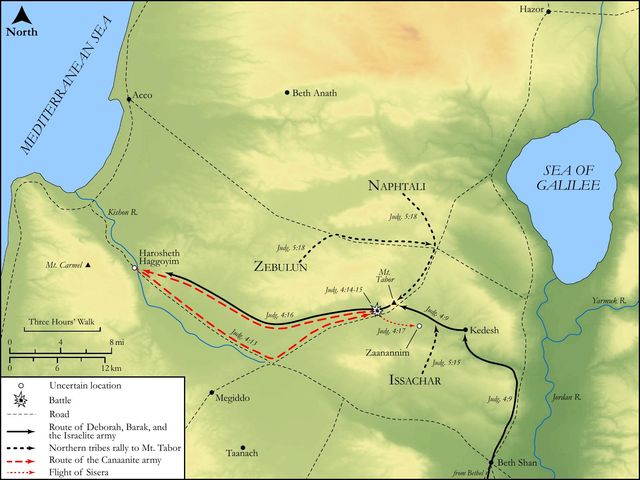
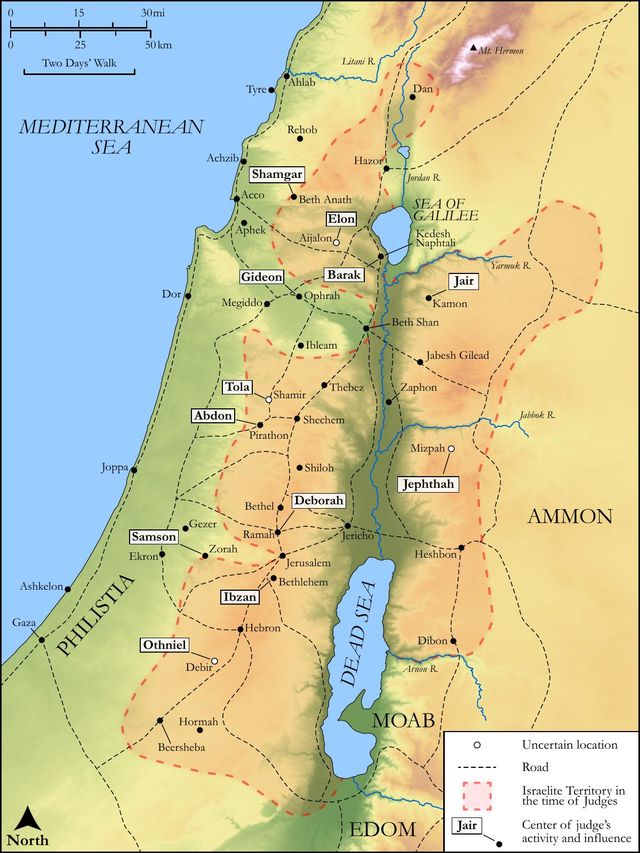
Study this verse
Public-domain commentary
Matthew Henry
From his Commentary on the Whole Bible. Henry comments on passages, not single verses — this entry covers Judges 4:4–9. His four-level outline is real structure in the source text, so it is rendered as structure.
The year of the redeemed at length came, when Israel was to be delivered out of the hands of Jabin, and restored again to their liberty, which we may suppose the northern tribes, that lay nearest to the oppressors and felt most the effects of his fury, did in a particular manner cry to God for. For the oppression of the poor, and the sighing of the needy, now will God arise. Now here we have,
I.The preparation of the people for their deliverance, by the prophetic conduct and government of Deborah, Jdg 4:4, Jdg 4:5.
Her name signifies a bee; and she answered her name by her industry, sagacity, and great usefulness to the public, her sweetness to her friends and sharpness to her enemies. She is said to be the wife of Lapidoth; but, the termination not being commonly found in the name of a man, some make this the name of a place: she was a woman of Lapidoth. Others take it appellatively, Lapidoth signifies lamps. The Rabbin say she had employed herself in making wicks for the lamps of the tabernacle; and, having stooped to that mean office for God, she was afterwards thus preferred. Or she was a woman of illuminations, or of splendours, one that was extraordinarily knowing and wise, and so came to be very eminent and illustrious. Concerning her we are here told,
1.That she was intimately acquainted with God; she was a prophetess, one that was instructed in divine knowledge by the immediate inspiration of the Spirit of God, and had gifts of wisdom, to which she attained not in an ordinary way: she heard the words of God, and probably saw the visions of the Almighty.
2.That she was entirely devoted to the service of Israel. She judged Israel at the time that Jabin oppressed them; and perhaps, being a woman, she was the more easily permitted by the oppressor to do it. She judged, not as a princess, by an civil authority conferred upon her, but as a prophetess, and as God's mouth to them, correcting abuses and redressing grievances, especially those which related to the worship of God. The children of Israel came up to her from all parts for judgment, not so much for the deciding of controversies between man and man as for advice in the reformation of what was amiss in things pertaining to God. Those among them who before had secretly lamented the impieties and idolatries of their neighbours, but knew not where to apply for the restraining of them, now made their complaints to Deborah, who, by the sword of the Spirit, showing them the judgment of God, reduced and reclaimed many, and excited and animated the magistrates in their respective districts to put the laws in execution. It is said she dwelt, or, as some read it, she sat under a palm-tree, called ever after from her the palm-tree of Deborah. Either she had her house under that tree, a mean habitation which would couch under a tree, or she had her judgment-seat in the open air, under the shadow of that tree, which was an emblem of the justice she sat there to administer, which will thrive and grow against opposition, as palms under pressures. Josephus says that the children of Israel came to Deborah, to desire her to pray to God for them, that they might be delivered out of the hand of Jabin; and Samuel is said at one particular time to judge Israel in Mizpeh, that is, to bring them back again to God, when they made the same address to him upon a like occasion, Sa1 7:6, Sa1 7:8.
II.The project laid for their deliverance.
When the children of Israel came to her for judgment, with her they found salvation. So those that seek to God for grace shall have grace and peace, grace and comfort, grace and glory. She was not herself fit to command an army in person, being a woman; but she nominated one that was fit, Barak of Naphtali, who, it is probable, had already signalized himself in some rencounters with the forces of the oppressor, living near him (for Hazor and Harosheth lay within the lot of that tribe), and thereby had gained a reputation and interest among his people. Some struggles, we may suppose, that brave man had made towards the shaking off of the yoke, but could not effect it till he had his commission and instructions from Deborah. He could do nothing without her head, nor she without his hands; but both together made a complete deliverer, and effected a complete deliverance. The greatest and best are not self-sufficient, but need one another.
1.By God's direction, she orders Barak to raise an army, and engage Jabin's forces, that were under Sisera's command, Jdg 4:6, Jdg 4:7. Barak, it may be, had been meditating some great attempt against the common enemy; a spark of generous fire was glowing in his breast, and he would fain do something to the purpose for his people and for the cities of his God. But two things discouraged him:
(1.)He wanted a commission to levy forces; this therefore Deborah here gives him under the broad seal of heaven, which, as a prophetess, she had a warrant to affix to it: "Hath not the Lord God of Israel commanded it? Yet, certainly he has; take my word for it." Some think she intends this as an appeal to Barak's own heart. "Has not God, by a secret whisper to thyself, given thee some intimation of his purpose to make use of thee as an instrument in his hands to save Israel? Hast not thou felt some impulse of this kind upon thy own spirit?" If so, the spirit of prophesy in Deborah confirms the spirit of a soldier in Barak: Go and draw towards Mount Tabor.
[1.]She directs him what number of men to raise - 10,000; and let him not fear that these will be too few, when God hath said he will by them save Israel.
[2.]Whence he should raise them - only out of his own tribe, and that of Zebulun next adjoining. These two counties should furnish him with an army sufficient; he need not stay to go further. And,
[3.]She orders him where to make his rendezvous - at Mount Tabor, in his own neighbourhood.
(2.)When he had an army raised, he knew not how he should have an opportunity of engaging the enemy, who perhaps declined fighting, having heard that Israel, if they had but courage enough to make head against any enemy, seldom failed of success. "Well," says Deborah, in the name of "God, I will draw unto thee Sisera and his army." She assured him that the matter should be determined by one pitched battle, and should not be long in the doing.
[1.]In mentioning the power of the enemy, Sisera, a celebrated general, bold and experienced, his chariots, his iron chariots, and his multitude of soldiers, she obliged Barak to fortify himself with the utmost degree of resolution; for the enemy he was to engage was a very formidable one. It is good to know the worst, that we may provide accordingly. But,
[2.]In fixing the very place to which Sisera would draw his army, she gave him a sign, which might help to confirm his faith when he came to engage. it was a contingent things, and depended upon Sisera's own will; but, when afterwards Barak should see the event falling out just as Deborah had foretold, he might thence infer that certainly in the rest she said she spoke under a divine direction, which would be a great encouragement to him, especially because with this,
[3.]She gave him an express promise of success I will (that is, God will, in whose name I speak) deliver them into thy hand; so that when he saw them drawn up against him, according to Deborah's word, he might be confident that, according to her word, he should soon see them fallen before him. Observe, God drew them to him only that he might deliver them into his hand. When Sisera drew his forces together, he designed the destruction of Israel; but God gathered them as sheaves into the floor, for their own destruction, Mic 4:11, Mic 4:12. Assemble yourselves, and you shall be broken to pieces, Isa 8:9. See Rev 19:17, Rev 19:18.
2.At Barak's request, she promises to go along with him to the field of battle.
(1.)Barak insisted much upon the necessity of her presence, which would be to him better than a council of war (Jdg 4:8): "If thou wilt go with me to direct and advise me, and in every difficult case to let me know God's mind, then I will go with all my heart, and not fear the chariots of iron; otherwise not." Some make this to be the language of a weak faith; he could not take her word unless he had her with him in pawn, as it were, for performance. It seems rather to arise from a conviction of the necessity of God's presence and continual direction, a pledge and earnest of which he would reckon Deborah's presence to be, and therefore begged thus earnestly for it. "If thou go not up with me, in token of God's going with me, carry me not up hence." Nothing would be a greater satisfaction to him than to have the prophetess with him to animate the soldiers and to be consulted as an oracle upon all occasions.
(2.)Deborah promised to go with him, Jdg 4:9. No toil nor peril shall discourage her from doing the utmost that becomes her to do for the service of her country. She would not send him where she would not go herself. Those that in God's name call others to their duty should be very ready to assist them in it. Deborah was the weaker vessel, yet had the stronger faith. But though she agrees to go with Barak, if he insists upon it, she gives him a hint proper enough to move a soldier not to insist upon it: The journey thou undertakest (so confident was she of the success that she called his engaging in war but the undertaking of a journey) shall not be for thy honour; not so much for thy honour as if thou hadst gone by thyself; for the Lord shall sell Sisera (now his turn comes to be sold as Israel was, Jdg 4:2, by way of reprisal) "into the hands of a woman;" that is,
[1.]The world would ascribe the victory to the hand of Deborah: this he might himself foresee.
[2.]God (to correct his weakness) would complete the victory by the hand of Jael, which would be some eclipse to his glory. But Barak values the satisfaction of his mind, and the good success of his enterprise, more than his honour; and therefore will by no means drop his request. He dares not fight unless he have Deborah with him, to direct him and pray for him. She therefore stood to her word with a masculine courage; this noble heroine arose and went with Barak.
Historical interpretation
Historical reception
3 surviving comments on this verse. Each one is dated, so this reads as a timeline rather than a list.
Select a marker to jump to its quote. Markers stagger vertically where authors wrote within a few decades of each other.
And in order that it may not seem as if only one widow had fulfilled this inimitable work, it seems in no way doubtful that there were many others of equal or almost equal virtue, for good seed corn usually bears many ears filled with grains. Do not doubt, then, that that ancient seedtime was fruitful in the characters of many women. But as it would be tedious to include all, consider some, and especially Deborah, whose virtue Scripture records for us.For she showed not only that widows have no need of the help of a man, inasmuch as she, not at all restrained by the weakness of her sex, undertook to perform the duties of a man, and did even more than she had undertaken. And, at last, when the Jews were being ruled under the leadership of the judges, because they could not govern them with manly justice or defend them with manly strength, and so wars broke out on all sides, they chose Deborah, by whose judgment they might be ruled. And so one widow both ruled many thousands of men in peace and defended them from the enemy. There were many judges in Israel, but no woman before was a judge, as after Joshua there were many judges but none was a prophet. And I think that her judgeship has been narrated and her deeds described, that women should not be restrained from deeds of valor by the weakness of their sex. A widow, she governs the people; a widow, she leads armies; a widow, she chooses generals; a widow, she determines wars and orders triumphs. So, then, it is not nature which is answerable for the fault or which is liable to weakness. It is not sex but valor which makes strong.
And in time of peace there is no complaint, and no fault is found in this woman, whereas most of the judges were causes of no small sins to the people. But when the Canaanites, a people fierce in battle and rich in troops, successively joined them, showed a horrible disposition against the people of the Jews, this widow, before all others, made all the preparations for war. And to show that the needs of the household were not dependent on the public resources but rather that public duties were guided by the discipline of home life, she brings forth from her home her son as a leader of the army, that we may acknowledge that a widow can train a warrior; whom, as a mother, she taught, and, as judge, placed in command, as, being herself brave, she trained him, and, as a prophetess, sent to certain victory.
And lastly, her son Barak shows the chief part of the victory was in the hands of a woman when he said, “If you will not go with me I will not go, because I do not know on what day the Lord will send his angel with me.” How great, then, was the might of that woman to whom the leader of the army says, “If you will not go I will not go.” How great, I say, the fortitude of the widow who does not protect her son from dangers through motherly affection but rather with the zeal of a mother exhorts her son to go forth to victory, while saying that the decisive point of that victory is in the hand of a woman!
Indeed, nothing—nothing, I repeat—is more potent than a good and prudent woman in molding a man and shaping his soul in whatever way she desires. For he will not bear with friends, or teachers, or magistrates in the same way as with his wife, when she admonishes and advises him. Her admonition, in fact, carries with it a kind of pleasure, because of his very great love of the one who is admonishing him. Moreover, I could mention many men, formerly harsh and stubborn, who have become more tractable by this means. She shares with him his table and couch, the procreating of his children, his spoken words and secret thoughts, his comings and goings, and a great many other things as well. She is devoted to him in all things and as closely bound to him as the body is fastened to the head. If she chances to be prudent and diligent, she will surpass and excel all in her solicitude for her husband.Therefore, I beseech women to carry this out in practice and to give their husbands only the proper advice. For, just as a woman has great power for good, so also she has it for evil. A woman destroyed Absalom; a woman destroyed Amnon; a woman would have destroyed Job; a woman saved Nabal from being murdered; a woman saved an entire nation.
Furthermore, Deborah and Judith and innumerable other women directed the success of men who were generals. And that is why Paul said, “For how do you know, woman, whether you will save your husband?” In his day, too, we see Persis and Mary and Priscilla sharing in the apostle’s difficult trials. You also ought to imitate these women and mold the character of your husbands, not only by your words but also by your example.
Because these nations have come as enemies against your people, let us hear what judgment the psalmist calls down upon them. “Deal with them as with Midian; as with Sisera.” You have read the book of Judges; this is that Midian whom Gideon defeated. “As with Sisera and Jabin.” Jabin and Sisera are the foes whom Deborah and Barak conquered. “At the torrent Kishon, who perished at Endor.” Deborah and Barak destroyed Sisera, the general of the army. So much for what Scripture says; learn now what it means. Lord, because they are so arrogant, because they have come with a mighty army, because their prince is Nebuchadnezzar the king of the Assyrians, because they are the forces of the sons of Lot, because they follow the example of the fallen angels, because in their pride they have claimed equality with you; for all these reasons, I beg of you to overpower them, not by a man but to their shame by a woman.“They became dung on the ground.” Who? Midian, Sisera and Jabin, these three became putrid on the ground like dung. The name Midian means “one who is negligent of judgment.” The warriors against your people are heedless of the judgment that is to come. Sisera is understood as “the vision of a horse.” Your people’s enemies are not of your flock or of your herd but are stallions that rage with madness over the fillies. Stallions are always ready for battle. “And Jabin.” Jabin means “discernment.” They who trust in their own wisdom and not in the glory of God rot on the ground like dung. They who were glorying in their army, whose king was the Assyrian, and who used to boast “I will scale the heavens,” not only fell down to earth but on the ground became dung.
Continue studying Judges 4:8 across the web’s major study libraries — every link below opens this exact verse, chapter, or book on the destination site.
Read & Compare
 BibleGatewayThis verse in more than 200 translations and 70 languages.
 Bible.comThe YouVersion reader — hundreds of translations, reading plans, and highlights.
 ESV.orgCrossway's official English Standard Version reader.
 NET BibleThe NET translation with 60,000+ translators' notes on every rendering decision.
 STEP BibleTyndale House's free study tool — original text, vocabulary, and scholarly resources.
 BibliaLogos Bible Software's free web reader.
 USCCBThe New American Bible (Revised Edition) with the U.S. bishops' study notes.
Commentaries
 BibleHub CommentariesDozens of classic commentaries on this verse, gathered on one page.
 StudyLightMore than 100 commentary sets — the largest collection on the web.
 BibleRefPlain-English commentary on what this verse means, verse by verse.
 Enduring WordDavid Guzik's free commentary on this chapter, widely used by Bible teachers.
 Bible Study ToolsVerse commentary alongside Greek and Hebrew study aids.
Original Language & Research
- BibleHub InterlinearThe verse word by word — original language, transliteration, and English.
- BibleHub LexiconEvery word's original-language definition and Strong's entry.
 Blue Letter BibleDeep-study tools — Strong's numbers, concordance, and word studies.
 SefariaThe Hebrew text with Rashi and centuries of Jewish commentary.
Sermons, Hymns & Audio


TrulyRandomVerse is not affiliated with these sites and doesn’t control their content. They’re linked because they’re genuinely useful.
Summary
Judges 4:8 captures a pivotal moment in the narrative of Deborah and Barak, where Barak, despite receiving a direct divine command through the prophetess Deborah to lead Israel against the formidable Canaanites, makes his participation conditional on Deborah's physical presence. This verse starkly reveals Barak's apprehension and a profound lack of complete trust in God's word alone, highlighting the tension between human fear and the call to unwavering faith in the face of overwhelming odds, ultimately setting the stage for God's sovereign plan to unfold through unexpected means.
Context
ShowHideLiterary Context
Judges 4:8 is strategically placed within the broader narrative of Israel's cyclical disobedience, oppression, and divine deliverance, a pattern that defines the book of Judges. Immediately preceding this verse, Israel has been severely oppressed for twenty years by Jabin, king of Hazor, and his formidable commander Sisera, who possessed 900 chariots of iron. God raises up Deborah, a prophetess and judge, who summons Barak and delivers a clear, unambiguous divine mandate: "Has not the Lord, the God of Israel, commanded you, ‘Go, gather your men at Mount Tabor with ten thousand men from Naphtali and Zebulun. And I will draw out Sisera, the general of Jabin's army, with his chariots and his troops to meet you by the River Kishon, and I will give him into your hand'" (Judges 4:6-7). Barak's response in verse 8 directly follows this explicit command, serving as a critical turning point that sets the stage for Deborah's prophetic reply in Judges 4:9 concerning the ultimate glory of the victory. The narrative then swiftly moves to the execution of the battle and Sisera's demise at the hand of Jael, fulfilling Deborah's prophecy.
Historical & Cultural Context
The period of the Judges (roughly 1200-1000 BC) was characterized by a decentralized Israelite society, marked by tribal disunity and intermittent oppression from surrounding peoples. The Canaanites, with their superior military technology, particularly iron chariots, posed a significant threat, representing a formidable military advantage over Israel's largely infantry-based forces. Hazor, a major Canaanite city, had historically been a formidable adversary, previously conquered by Joshua but seemingly re-emerging as a regional power under Jabin. In this patriarchal society, Deborah's dual role as a prophetess (a direct mouthpiece for God) and a judge (a civil and military leader) was highly unusual and indicative of the dire circumstances Israel faced, underscoring God's sovereign choice to raise up leaders. Barak, as a military leader, would have been expected to lead without hesitation, making his conditional response culturally significant and indicative of the daunting nature of the challenge and the deep-seated fear among the Israelites.
Key Themes
ShowHideThis verse powerfully contributes to several overarching themes within Judges and the broader biblical narrative. Firstly, it highlights the theme of Conditional Obedience and Lack of Faith. Barak's "if...then" statement reveals a profound hesitation and a reliance on human assurance (Deborah's physical presence) rather than absolute trust in God's explicit promise. This contrasts sharply with the radical faith often called for in the Old Testament, as seen in figures like Abraham, who was willing to sacrifice Isaac in Genesis 22. Secondly, it underscores Divine Sovereignty and Human Weakness. God chooses to work through imperfect, fearful individuals like Barak, demonstrating that the ultimate victory and glory belong to Him, not to human strength or courage, a principle echoed in passages like 2 Corinthians 12:9-10. Finally, the interaction illuminates the theme of Courageous Leadership and Divine Empowerment. Deborah's unwavering faith and willingness to accompany Barak, despite the personal risk and the consequence of his hesitation, exemplify true spiritual leadership and serve as a conduit for divine encouragement, ensuring God's plan is fulfilled even through human apprehension. Her actions highlight that God often provides the necessary support for His people to overcome their fears and fulfill His purposes.
Exposition and Analysis
ShowHideKey Word Analysis
ShowHideThis proper noun, meaning "lightning," is ironic in light of Barak's hesitant response. While his name suggests swiftness and power, his actions here reveal a lack of immediate, decisive action. His name, however, foreshadows the swiftness of God's victory through him, despite his initial reluctance.
This verb signifies communication, but in this context, it introduces a statement of condition rather than immediate assent. Barak's "saying" is not an affirmation of faith but an articulation of his terms for obedience, revealing a negotiation with a divine command rather than humble submission. It highlights the human tendency to question or qualify God's directives.
This primitive root, repeated multiple times in the verse, denotes movement and action. Barak's repeated use of "go" emphasizes his unwillingness to "go" (into battle) unless Deborah also "goes" (with him). The verb itself is neutral, but its conditional application by Barak underscores his reliance on human presence rather than divine promise for courage and assurance in fulfilling God's command.
Verse Breakdown
ShowHide"And Barak said unto her"
This phrase immediately follows Deborah's clear and direct divine command in Judges 4:6-7. It sets up Barak's response as a direct reaction to God's call, emphasizing his personal responsibility in the moment and highlighting the direct confrontation between divine will and human apprehension.
"If thou wilt go with me, then I will go"
This is the core of Barak's conditional obedience. He is unwilling to proceed with the divinely appointed task of leading the army into battle unless Deborah, the prophetess and judge, physically accompanies him. This condition suggests a profound need for tangible assurance, perhaps seeing Deborah's presence as a visible sign of God's presence, a source of prophetic guidance, or simply a source of personal courage, rather than relying solely on the prophetic word he had just received from God through her.
"but if thou wilt not go with me, [then] I will not go"
This second clause reinforces the absolute nature of his condition and transforms his request into an ultimatum. It is not merely a preference but an unequivocal refusal. Barak makes it clear that without Deborah's physical presence, he will refuse to obey God's command. This stark refusal reveals a significant lack of faith and courage in the face of a daunting military challenge, despite the explicit promise of divine victory.
Literary Devices
ShowHideThe verse employs several significant Literary Devices. The most prominent is the Conditional Clause ("If...then"), which structures Barak's entire statement and immediately signals his hesitation and lack of absolute trust in God's command. This grammatical structure highlights a contingency rather than an unreserved commitment, underscoring the human tendency to qualify divine directives. There is also a strong Contrast evident: Barak's fear and conditional obedience are starkly set against Deborah's unwavering faith and courage, which she demonstrates by agreeing to go. This contrast serves to elevate Deborah's spiritual stature and underscore the nature of true, God-reliant leadership. Furthermore, Barak's condition Foreshadows Deborah's subsequent prophecy in Judges 4:9, where she declares that the glory of the victory will not go to Barak but to a woman, Jael. This literary device connects Barak's initial lack of faith directly to the outcome of the battle's glory, demonstrating divine justice and sovereignty. Finally, the use of Dialogue effectively reveals the characters' personalities and motivations, driving the narrative forward and exposing the internal struggles of the human agents in God's plan.
Theological and Thematic Connections
ShowHideJudges 4:8 offers profound theological insights into the nature of faith, obedience, and divine sovereignty. Barak's conditional response illustrates a common human struggle: the tension between hearing God's clear command and mustering the faith to obey it without tangible assurances. While God's call is absolute, human fear and insecurity often lead to hesitation or attempts to negotiate terms. Yet, the narrative demonstrates God's gracious willingness to work through imperfect vessels, even those who initially falter in faith. God's power is not contingent on human perfection but is often most powerfully displayed through human weakness, ensuring that the ultimate victory and glory belong to Him alone. This passage reminds us that while God calls for faith, He also graciously provides the necessary support and presence, often through others, to enable His people to fulfill His purposes, even when their faith is weak.
Reflection and Application
ShowHideBarak's initial hesitation in Judges 4:8 serves as a timeless mirror for believers today, inviting us to examine the nature of our own obedience to God's call. How often do we, like Barak, receive a clear directive from the Lord, only to make our obedience conditional on external reassurances, comfortable circumstances, or the presence of a trusted mentor? This verse challenges us to move beyond a faith that requires tangible proof or human accompaniment and to cultivate a radical trust in God's word alone, knowing that His promises are sufficient and His presence is constant. It also highlights the vital role of spiritual leadership and mentorship; Deborah's unwavering faith and willingness to go with Barak, despite his fear, exemplifies the supportive and encouraging role that mature believers can play in strengthening the faith of others, guiding them towards God's will. Ultimately, the account encourages us to confront our fears with the certainty of God's presence and power, recognizing that true courage is not the absence of fear, but obedience in its presence, trusting that God will accomplish His purposes through us, even in our weakness, for His glory.
Questions for Reflection
ShowHideFAQ
ShowHideWas Barak's request a sign of weakness or wisdom?
ShowHideWhile Barak's request might superficially appear to be a shrewd tactical move or a recognition of Deborah's prophetic authority, the biblical narrative generally portrays it as a sign of weakness and a lack of full faith in God's explicit command. God had already promised absolute victory, stating, "I will give him into your hand" (Judges 4:7). Barak's condition placed human reliance (on Deborah's physical presence) above divine assurance. Deborah's subsequent prophecy in Judges 4:9—that the glory for Sisera's defeat would not go to Barak but to a woman—further confirms that his hesitation was a spiritual failing, not a strategic brilliance. It reveals a human need for tangible assurance when divine promise should have been sufficient.
Why did Deborah agree to go with Barak, despite his conditional obedience?
ShowHideDeborah's agreement to accompany Barak demonstrates her unwavering faith, her profound commitment to God's plan, and her pastoral heart. She understood that the mission's success was paramount, and her presence could bolster Barak's courage and ensure the Lord's victory. While she prophesied the consequence of his hesitation (the glory going to a woman), she did not abandon him or the divine mission. Her actions highlight God's grace in working through imperfect instruments and His provision for His people even when they falter in faith. Her willingness to go ensured the fulfillment of God's will, prioritizing the divine purpose over personal recognition or judgment of Barak's weakness.
Does God still use people who show conditional obedience or initial hesitation?
ShowHideAbsolutely. The story of Barak is a powerful testament to God's grace and sovereignty. God often chooses to use imperfect, hesitant, and even fearful individuals to accomplish His purposes, precisely so that the glory belongs to Him alone, not to human strength or courage. While Barak's conditional obedience had a consequence (the transfer of glory), God still used him mightily to deliver Israel. This pattern is seen throughout Scripture, reminding us that God's power is made perfect in weakness (2 Corinthians 12:9), and His call is often extended to those who feel inadequate, demonstrating His faithfulness over our flaws. He is patient and equips those He calls, even when they initially waver.
Christ-Centered Fulfillment
ShowHideBarak's conditional obedience in Judges 4:8, and his reliance on Deborah's presence for courage, powerfully foreshadows humanity's inherent need for a perfect, unwavering leader and companion in the spiritual battle against sin and evil. Unlike Barak, who hesitated and sought human assurance, Jesus Christ, our ultimate Deliverer, never wavered in His obedience to the Father, even when faced with the ultimate sacrifice of the cross (Philippians 2:8). Where Barak required Deborah to "go with him" to find courage for a physical battle, believers find their ultimate courage, strength, and victory in the constant, indwelling presence of the Holy Spirit, whom Christ promised would "be with you forever" (John 14:16). Jesus is the true "Lamb of God, who takes away the sin of the world!" (John 1:29), the one who perfectly fulfilled all righteousness and conquered sin and death, not by conditional obedience, but by absolute submission to the Father's will. Our spiritual battles are not won by our courage or strength, but by relying completely on Him who has already secured the decisive victory over all principalities and powers (Colossians 2:15). He is the Judge who delivers us from oppression, the Commander who leads us into triumph, and the ever-present companion who ensures that the glory for every victory belongs to Him alone, for He is "the author and perfecter of our faith" (Hebrews 12:2).