


Judges 4:2
Bible text: King James Version (1769 Blayney text) · Public domain
Bible text: King James Version with Strong's numbers · Public domain
Bible text: Berean Standard Bible · Public domain
Bible text: American Standard Version (1901) · Public domain
Bible text: World English Bible, Messianic edition · Public domain
Bible text: Geneva Bible (1599) · Public domain
Bible text: Young's Literal Translation · Public domain
- וַיִּמְכְּרֵםvai·yim·ke·Remand he sold themH4376Conj-w ¦ V-Qal-ConsecImperf-3ms ¦ 3mpVerb Qal Consecutive Imperfect 3rd Singular Masculineוַandיִּמְכְּרֵhe soldםthem
- יְהוָהYah·wehYahwehH3068N-properNoun Proper Title
- בְּיַדbe·Yadin [the] hand ofH3027Prep-b ¦ N-cscNoun Singular common gender Constructבְּinיַד[the] hand of
- יָבִיןya·VinJabinH2985N-proper-mNoun Proper Masculine
- מֶלֶךְMe·lekh[the] king ofH4428N-mscNoun Singular Masculine Construct
- כְּנַעַןke·Na·'anCanaanH3667N-properNoun Proper Location
- אֲשֶׁר'a·SherwhoH834RelParticle Relative
- מָלַךְma·Lakhhe reignedH4427V-Qal-Perf-3msVerb Qal Perfect 3rd Singular Masculine
- בְּחָצוֹרbe·cha·Tzorin HazorH2674Prep-b ¦ N-properNoun Proper LocationבְּinחָצוֹרHazor
- וְשַׂרve·sarand [was] [the] commander ofH8269Conj-w ¦ N-mscNoun Singular Masculine Constructוְandשַׂר[was] [the] commander of
- צְבָאוֹtze·va·'Ohis armyH6635N-msc ¦ 3msNoun Singular Masculine Constructצְבָאarmyוֹhis
- סִיסְרָאsis·Ra'SiseraH5516N-proper-mNoun Proper Masculine
- וְהוּאve·Hu'and heH1931Conj-w ¦ Pro-3msPronoun Personal 3rd Singular Masculineוְandהוּאhe
- יוֹשֵׁבyo·Shev[was] dwellingH3427V-Qal-Prtcpl-msVerb Qal Participle Singular Masculine Absolute
- בַּחֲרֹשֶׁתba·cha·Ro·shetin HaroshethH2800Prep-b ¦ N-properNoun Proper LocationבַּinחֲרֹשֶׁתHarosheth
- הַגּוֹיִםha·go·YimHaggoyimH1471N-properNoun Proper Location
English is a literal word-by-word gloss of the Hebrew, not the KJV's wording. Why?
This is the original text the KJV's translators worked from — each Hebrew word with its own literal English meaning in this verse, prepared by scholars at Tyndale House, Cambridge. The KJV translates whole sentences, not word by word, so its wording differs: one Hebrew word can become several English words, and the KJV may choose “the LORD” where the gloss reads “Yahweh”. Both are faithful — they answer different questions. For the KJV's own rendering, switch to the KJV text.
Details
See on the biblical-era maps
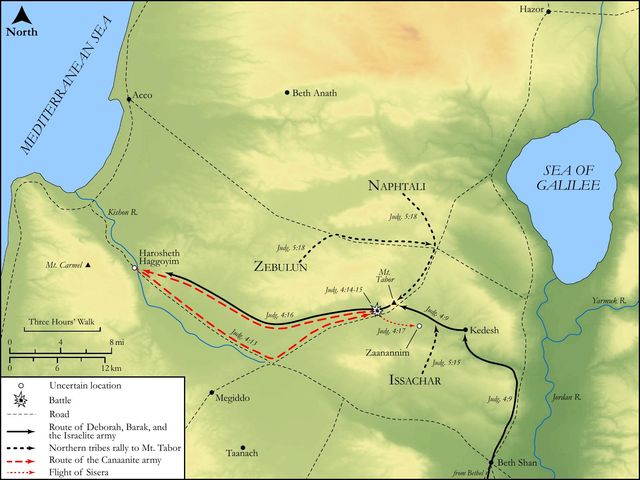
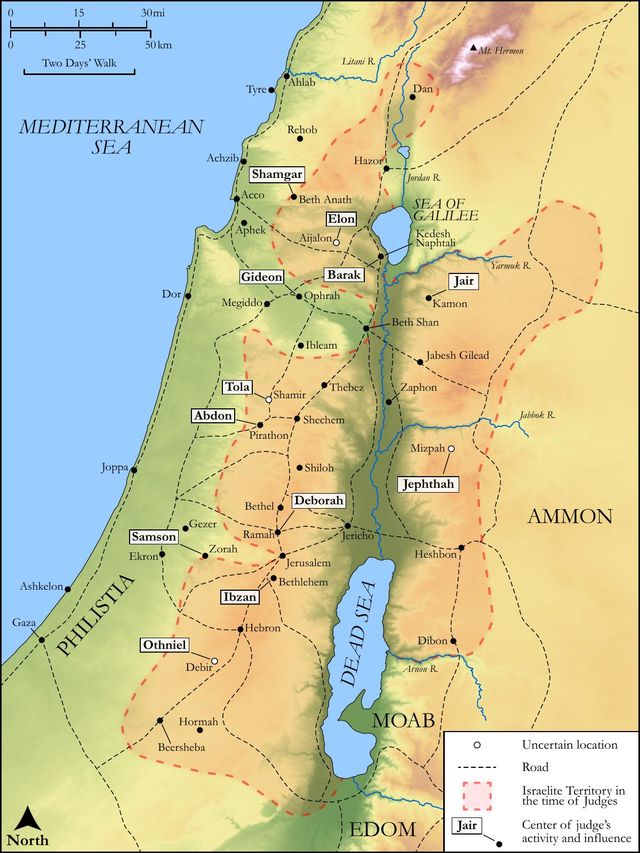
Study this verse
Public-domain commentary
Matthew Henry
From his Commentary on the Whole Bible. Henry comments on passages, not single verses — this entry covers Judges 4:1–3. His two-level outline is real structure in the source text, so it is rendered as structure.
Here is, I. Israel backsliding from God: They again did evil in his sight, forsook his service, and worshipped idols; for this was the sin which now most easily beset them, Jdg 4:1. See in this, 1. The strange strength of corruption, which hurries men into sin notwithstanding the most frequent experience of its fatal consequences. The bent to backslide is with great difficulty restrained. 2. The common ill effects of a long peace. The land had rest eighty years, which should have confirmed them in their religion; but, on the contrary, it made them secure and wanton, and indulgent of those lusts which the worship of the false gods was calculated for the gratification of. Thus the prosperity of fools destroys them. Jeshurun waxeth fat and kicketh. 3. The great loss which a people sustains by the death of good governors. The did evil, because Ehud was dead. So it may be read. He kept a strict eye upon them, restrained and punished every thing that looked towards idolatry, and kept them close to God's service. But, when he was gone, they revolted, fearing him more than God.
II.Israel oppressed by their enemies.
When they forsook God, he forsook them; and then they became an easy prey to every spoiler. They alienated themselves from God as if he were none of theirs; and then God alienated them as none of his. Those that threw themselves out of God's service threw themselves out of his protection. What has my beloved to do in my house when she has thus played the harlot? Jer 11:15. He sold them into the hand of Jabin, Jdg 4:2. This Jabin reigned in Hazor, as another of the same name, and perhaps his ancestor, had done before him, whom Joshua routed and slew, and burnt his city, Jos 11:1, Jos 11:10. But it seems, in process of time, the city was rebuilt, the power regained, the loss retrieved, and, by degrees, the king of Hazor becomes able to tyrannize over Israel, who by sin had lost all their advantage against the Canaanites. This servitude was longer than either of the former, and much more grievous. Jabin, and his general Sisera, did mightily oppress Israel. That which aggravated the oppression was,
1.That this enemy was nearer to them than any of the former, in their borders, in their bowels, and by this means had the more opportunity to do them a mischief.
2.That they were the natives of the country, who bore an implacable enmity to them, for invading and dispossessing them, and when they had them in their power would be so much the more cruel and mischievous towards them in revenge of the old quarrel.
3.That these Canaanites had formerly been conquered and subdued by Israel, were of old sentenced to be their servants (Gen 9:25), and might now have been under their feet, and utterly incapable of giving them any disturbance, if their own slothfulness, cowardice, and unbelief, had not suffered them thus to get head. To be oppressed by those whom their fathers had conquered, and whom they themselves had foolishly spared, could not but be very grievous.
III.Israel returning to their God:
They cried unto the Lord, when distress drove them to him, and they saw no other way of relief. Those that slight God in their prosperity will find themselves under a necessity of seeking him when they are in trouble.
Continue studying Judges 4:2 across the web’s major study libraries — every link below opens this exact verse, chapter, or book on the destination site.
Read & Compare
 BibleGatewayThis verse in more than 200 translations and 70 languages.
 Bible.comThe YouVersion reader — hundreds of translations, reading plans, and highlights.
 ESV.orgCrossway's official English Standard Version reader.
 NET BibleThe NET translation with 60,000+ translators' notes on every rendering decision.
 STEP BibleTyndale House's free study tool — original text, vocabulary, and scholarly resources.
 BibliaLogos Bible Software's free web reader.
 USCCBThe New American Bible (Revised Edition) with the U.S. bishops' study notes.
Commentaries
 BibleHub CommentariesDozens of classic commentaries on this verse, gathered on one page.
 StudyLightMore than 100 commentary sets — the largest collection on the web.
 BibleRefPlain-English commentary on what this verse means, verse by verse.
 Enduring WordDavid Guzik's free commentary on this chapter, widely used by Bible teachers.
 Bible Study ToolsVerse commentary alongside Greek and Hebrew study aids.
Original Language & Research
- BibleHub InterlinearThe verse word by word — original language, transliteration, and English.
- BibleHub LexiconEvery word's original-language definition and Strong's entry.
 Blue Letter BibleDeep-study tools — Strong's numbers, concordance, and word studies.
 SefariaThe Hebrew text with Rashi and centuries of Jewish commentary.
Sermons, Hymns & Audio


TrulyRandomVerse is not affiliated with these sites and doesn’t control their content. They’re linked because they’re genuinely useful.
Summary
Judges 4:2 introduces the next cycle of Israel's apostasy and divine discipline, revealing that "the LORD sold them into the hand of Jabin king of Canaan." This verse precisely identifies Jabin, who reigned in the formidable city of Hazor, and his formidable military commander, Sisera, whose base was in Harosheth of the Gentiles. This pivotal verse marks the initiation of a new period of severe oppression, a direct and sovereign consequence of Israel's recurring disobedience and profound spiritual decline following a period of peace.
Context
ShowHideLiterary Context
This verse immediately follows a significant period of forty years of rest and peace for Israel, a time of respite ushered in by the deliverance wrought through Ehud, as recorded in Judges 3:30. However, the overarching narrative of the book of Judges consistently portrays a lamentable cyclical pattern: Israel "did evil in the sight of the LORD" (Judges 2:11), which inevitably led to divine judgment in the form of foreign oppression. Judges 4:2 serves as the stark signal for the initiation of this new oppressive phase, thereby setting the dramatic stage for the subsequent emergence of the prophetess Deborah and the military leader Barak as divinely appointed deliverers in Judges 4:4-7. The potent phrase "the LORD sold them" directly links this period of suffering and servitude to God's sovereign hand, acting in righteous response to Israel's persistent covenant unfaithfulness.
Historical & Cultural Context
Hazor was not merely a city but a historically significant and immensely powerful Canaanite city-state located in northern Galilee, strategically positioned to control vital trade routes. Its mention here is particularly poignant because it had been previously conquered and utterly burned by Joshua during the initial conquest of Canaan, signifying a decisive victory for Israel as detailed in Joshua 11:1-11. The resurgence of Hazor under King Jabin indicates Israel's profound failure to fully dispossess the Canaanites, a direct violation of God's explicit command given in Numbers 33:55. This critical failure allowed Canaanite power to re-establish itself, becoming both a spiritual snare and a potent instrument of divine discipline. Sisera, Jabin's formidable military commander, was renowned for his advanced and powerful army, particularly his nine hundred chariots of iron, a technological and tactical advantage highlighted in Judges 4:3, which far outmatched Israel's largely infantry-based forces. Harosheth of the Gentiles (meaning "Harosheth of the Nations") was likely a crucial strategic military base, possibly situated near the Kishon River, from which Sisera could effectively launch devastating operations against Israelite territories.
Key Themes
ShowHideJudges 4:2 powerfully contributes to several overarching and foundational themes within the book of Judges and the broader Old Testament narrative. Foremost among these is the theme of Divine Discipline, where God, in His absolute sovereignty and unwavering justice, uses foreign nations as instruments to chastise His disobedient people, with the ultimate redemptive aim of bringing them to repentance and restoration. The potent phrase "the LORD sold them" profoundly underscores God's active and intentional role in this disciplinary process, not as an act of abandonment, but as a just and purposeful consequence of Israel's covenant breaking. This highlights the severe Consequences of Disobedience, demonstrating unequivocally that Israel's persistent idolatry, moral decline, and covenant unfaithfulness directly led to their subjugation and suffering. Furthermore, the introduction of Jabin and Sisera establishes the Rise of the Oppressor, setting the dramatic stage for the intense conflict and subsequent divine deliverance that will unfold, thereby reinforcing the pervasive cyclical pattern of sin, servitude, supplication, and salvation that profoundly defines the entire book of Judges, as articulated in Judges 2:16-19.
Exposition and Analysis
ShowHideKey Word Analysis
ShowHideThe Hebrew verb מָכַר (mâkar'), typically signifying a commercial transaction of "to sell," carries a profound and weighty theological meaning in this context. It is not merely a literal exchange but represents God's deliberate and sovereign act of delivering or handing over His people to their enemies. This implies a purposeful withdrawal of divine protection and an allowance for Israel to fall into servitude, much like a master might sell a slave into bondage. This usage emphasizes God's active, righteous, and sovereign role in their judgment, not as an arbitrary punishment, but as a disciplinary measure precisely designed to bring about repentance and a return to Him. This concept of God "selling" His people due to their sin is powerfully echoed elsewhere in Scripture, such as in Deuteronomy 32:30.
The Hebrew word יָד (yâd'), translated as "hand," is a primitive word with a vast array of applications, both literal and figurative. In this context, "into the hand of Jabin" signifies his power, authority, and dominion over Israel. The hand often represents agency, control, and the means by which actions are carried out. Thus, Israel was delivered into Jabin's sphere of influence and control, indicating their subjugation and his ability to oppress them. This emphasizes the complete transfer of power, permitted by God, from Israel's self-governance to foreign domination.
The Hebrew word גֹּי (gôwy'), translated as "Gentiles" or "nations," refers to foreign nations or non-Israelite peoples. The phrase "Harosheth of the Gentiles" suggests it was a place inhabited by or associated with non-Israelite populations, possibly foreign mercenaries, or a strategic location that controlled access to surrounding "nations" or non-Israelite territories. Its identification here underscores the foreign, alien, and inherently oppressive nature of the threat posed by Sisera's forces, highlighting that Israel was being oppressed by those outside the covenant community, further emphasizing their spiritual decline.
Verse Breakdown
ShowHide"And the LORD sold them"
This opening phrase immediately establishes the divine initiative and sovereign agency behind the unfolding events. It is not merely that Israel passively fell into oppression, but that the LORD, in His righteous judgment, actively withdrew His protective hand and delivered them over. This "selling" is a powerful metaphor for divine judgment and discipline, signifying that Israel's suffering was a direct, covenantal consequence of their persistent disobedience and idolatry. It underscores God's active participation in their trials.
"into the hand of Jabin king of Canaan, that reigned in Hazor;"
This clause precisely identifies the specific human instrument through whom God's judgment would be executed. Jabin, as the king of Hazor, represents a powerful and re-emergent Canaanite threat, serving as a stark reminder to the reader of Israel's incomplete conquest and their ongoing spiritual compromise. The mention of Hazor, a city previously defeated and burned by Joshua, poignantly underscores the cyclical nature of Israel's apostasy and the severe consequences of their failure to fully obey God's commands to dispossess the land.
"the captain of whose host [was] Sisera, which dwelt in Harosheth of the Gentiles."
This final clause introduces Sisera, Jabin's formidable and notorious military commander, who will emerge as the primary antagonist in the coming conflict. His dwelling in "Harosheth of the Gentiles" emphasizes his strategic military positioning and the foreign, oppressive nature of the threat he embodied. This crucial detail sets the stage for the intense military confrontation that will define the narrative of Judges 4, highlighting the specific and powerful adversary Israel would face due to their spiritual backsliding.
Literary Devices
ShowHideJudges 4:2 masterfully employs several potent literary devices to convey its profound theological message and narrative thrust. Anthropomorphism is strikingly evident in the phrase "the LORD sold them," attributing a human commercial action (selling) to the divine. This device powerfully emphasizes God's active, intentional, and sovereign role in Israel's suffering, underscoring that their oppression was not random or accidental but a direct, purposeful act of divine discipline. The verse also utilizes Foreshadowing by introducing Jabin and Sisera as the primary antagonists. Their precise identification immediately signals the impending conflict and sets the dramatic stage for the subsequent events involving Deborah and Barak. Furthermore, this verse serves as a crucial point in the Cyclical Narrative structure that defines the entire book of Judges, marking the unambiguous beginning of a new "servitude" phase following a period of peace, thereby reinforcing the recurring and tragic pattern of Israel's apostasy, divine judgment, and subsequent cry for deliverance.
Theological and Thematic Connections
ShowHideJudges 4:2 stands as a stark and powerful reminder of God's unwavering commitment to His covenant, even when that commitment necessitates severe discipline for His people's unfaithfulness. The concept of God "selling" Israel into the hand of their enemies highlights His absolute sovereignty over history and nations, demonstrating His capacity to use even pagan rulers as precise instruments of His righteous purposes. This act is not abandonment, but rather a purposeful act of judgment designed to humble Israel, expose their sin, and ultimately drive them back to Him in sincere repentance. It profoundly underscores the dire consequences of spiritual apostasy and the breaking of covenant promises, demonstrating that God's unwavering love includes corrective discipline. This verse thus serves as a potent theological statement about divine justice, the profound seriousness of sin, and God's ultimate redemptive desire for His people's restoration and faithfulness.
Reflection and Application
ShowHideJudges 4:2 offers timeless and profound lessons for believers today, serving as a cautionary tale and a call to spiritual vigilance. The narrative of Israel's repeated cycles of disobedience and subsequent oppression serves as a powerful warning against spiritual complacency, compromise, and the insidious creep of idolatry in our own lives. Just as Israel's turning away from God led to their being "sold" into hardship and servitude, so too can our own spiritual drift, unconfessed sin, or neglect of God's Word and His presence lead to periods of difficulty, a sense of spiritual barrenness, or a perceived withdrawal of God's manifest blessing and protection in our lives. This verse challenges us to diligently examine our own hearts for areas of unfaithfulness, hidden idols, or compromises that might be hindering our walk with God, reminding us that God's discipline, though often painful, is always redemptive and designed to draw us into deeper intimacy and reliance upon Him. It encourages us to understand that even in the midst of challenging circumstances, God remains absolutely sovereign, often using trials and difficulties to refine our faith, expose our weaknesses, and bring us to profound repentance and a more complete reliance on Him. Our appropriate response should be one of humility, earnest repentance, and a renewed, unwavering commitment to living in faithful obedience to His divine commands.
Questions for Reflection
ShowHideFAQ
ShowHideWhy did the LORD "sell" Israel into the hand of Jabin?
ShowHideThe phrase "the LORD sold them" is a powerful theological metaphor, not a literal commercial transaction. It signifies God's active, sovereign judgment and disciplinary action upon Israel for their persistent disobedience and idolatry. Throughout the book of Judges, Israel repeatedly "did evil in the sight of the LORD" (Judges 2:11), breaking their covenant relationship with Him. In His righteousness and faithfulness to His covenant, God withdrew His protective hand and allowed them to fall under the dominion of their enemies as a direct consequence of their actions. This divine discipline was precisely intended to humble them, expose their sin, and ultimately lead them to repentance and a renewed, faithful relationship with Him, as is clearly seen in the broader cyclical pattern of the Judges narrative (Judges 2:16-19).
Who were Jabin and Sisera, and what was their significance?
ShowHideJabin was the king of Canaan, reigning from the powerful city-state of Hazor, located in northern Galilee. His significance is profound because Hazor had been decisively conquered and burned by Joshua centuries earlier, as recorded in Joshua 11:1-11. Jabin's resurgence highlights Israel's failure to fully dispossess the Canaanites, which became a continuous source of trouble and a means of divine discipline. Sisera was Jabin's formidable military commander, renowned for his nine hundred chariots of iron (Judges 4:3), which provided the Canaanites with a significant military advantage over Israel's infantry-based forces. Together, Jabin and Sisera represent the specific, powerful human instruments of God's judgment in this particular cycle of oppression, setting the stage for the dramatic confrontation with Deborah and Barak.
What is the significance of Hazor and Harosheth of the Gentiles?
ShowHideHazor's significance lies in its historical context as a once-conquered Canaanite stronghold that had now re-emerged as a dominant power. Its re-establishment under Jabin underscores Israel's incomplete obedience to God's command to drive out all the inhabitants of the land, demonstrating how their compromise and spiritual apathy directly led to their oppression. Harosheth of the Gentiles (meaning "Harosheth of the Nations") was Sisera's strategic military base. Its name suggests it was a place of mixed populations or a key location for controlling access to surrounding non-Israelite territories, possibly serving as a staging ground for foreign mercenaries. Both locations emphasize the geographical and military threat posed by the Canaanites, highlighting the strategic advantage they held over Israel due to their superior military technology and fortified positions, all permitted by God as a consequence of Israel's sin.
Christ-Centered Fulfillment
ShowHideThe narrative of Israel being "sold" into bondage in Judges 4:2 finds its profound Christ-centered fulfillment in the ultimate "selling" of humanity into the bondage of sin and death, and Christ's glorious, redemptive deliverance. Just as Israel's persistent disobedience led to their servitude under Jabin, so too did humanity's rebellion against God lead to our being "sold" under the power and dominion of sin, as articulated by the Apostle Paul in Romans 7:14. Yet, God, in His infinite and unfathomable love, did not abandon us to this spiritual slavery. Instead, He "did not spare his own Son but gave him up for us all" (Romans 8:32), allowing Jesus to be literally "sold" for thirty pieces of silver by Judas (Matthew 26:15) and delivered over to death on the cross. Through this ultimate act of self-sacrificial love and obedience, Jesus Christ became the true and eternal Deliverer, far surpassing any judge in Israel's history. He paid the ultimate price, not to "sell" us into further bondage, but to purchase our freedom from the dominion of sin, Satan, and death (Colossians 1:13-14). He decisively triumphed over the spiritual "Jabin" and "Sisera"—the powers of darkness and death—securing eternal redemption for all who believe, thereby ushering in a new covenant of grace where true freedom, lasting peace, and abundant life are found exclusively in Him (Hebrews 9:12).