


1 Samuel 7:6
Bible text: King James Version (1769 Blayney text) · Public domain
Bible text: King James Version with Strong's numbers · Public domain
Bible text: Berean Standard Bible · Public domain
Bible text: American Standard Version (1901) · Public domain
Bible text: World English Bible, Messianic edition · Public domain
Bible text: Geneva Bible (1599) · Public domain
Bible text: Young's Literal Translation · Public domain
- וַיִּקָּבְצוּvai·yi·ka·ve·Tzuand they gathered togetherH6908Conj-w ¦ V-Niphal-ConsecImperf-3mpVerb Niphal Consecutive Imperfect 3rd Plural Masculineוַandיִּקָּבְצוּthey gathered together
- הַמִּצְפָּתָהHa·mitz·pa·tah<the> Mizpah towardsH4709Art ¦ N-proper ¦ SfxNoun Proper Locationהַ<the>מִּצְפָּתָMizpahהtowards
- וַיִּשְׁאֲבוּvai·yish·'a·vuand they drewH7579Conj-w ¦ V-Qal-ConsecImperf-3mpVerb Qal Consecutive Imperfect 3rd Plural Masculineוַandיִּשְׁאֲבוּthey drew
- מַיִםMa·yimwaterH4325N-mpNoun Plural Masculine Absolute
- וַיִּשְׁפְּכוּvai·yish·pe·Khuand they poured [it] outH8210Conj-w ¦ V-Qal-ConsecImperf-3mpVerb Qal Consecutive Imperfect 3rd Plural Masculineוַandיִּשְׁפְּכוּthey poured [it] out
- לִפְנֵיlif·Nei<to> beforeH6440Prep-l ¦ N-mpcNoun Plural Masculine Constructלִ<to>פְנֵיbefore
- יְהוָהYah·wehYahwehH3068N-properNoun Proper Title
- וַיָּצוּמוּvai·ya·Tzu·muand they fastedH6684Conj-w ¦ V-Qal-ConsecImperf-3mpVerb Qal Consecutive Imperfect 3rd Plural Masculineוַandיָּצוּמוּthey fasted
- בַּיּוֹםbai·Yomon the dayH3117Prep-b ¦ N-msNoun Singular Masculine Absoluteבַּon theיּוֹםday
- הַהוּאha·Hu'<the> thatH1931Art ¦ Pro-3msPronoun Personal 3rd Singular Masculineהַ<the>הוּאthat
- וַיֹּאמְרוּvai·Yo·me·ruand they saidH559Conj-w ¦ V-Qal-ConsecImperf-3mpVerb Qal Consecutive Imperfect 3rd Plural Masculineוַandיֹּאמְרוּthey said
- שָׁםShamthereH8033AdvAdverb
- חָטָאנוּcha·Ta·nuwe have sinnedH2398V-Qal-Perf-1cpVerb Qal Perfect 1st Plural common gender
- לַיהוָהla·Yah·wehto YahwehH3068Prep-l ¦ N-properNoun Proper TitleלַtoיהוָהYahweh
- וַיִּשְׁפֹּטvai·yish·Potand he judgedH8199Conj-w ¦ V-Qal-ConsecImperf-3msVerb Qal Consecutive Imperfect 3rd Singular Masculineוַandיִּשְׁפֹּטhe judged
- שְׁמוּאֵלshe·mu·'ElSamuelH8050N-proper-mNoun Proper Masculine
- אֶת'et<obj.>H853DirObjMParticle Object Indicator
- בְּנֵיbe·Nei[the] people ofH1121N-mpcNoun Plural Masculine Construct
- יִשְׂרָאֵלYis·ra·'ElIsraelH3478N-properNoun Proper Location
- בַּמִּצְפָּהba·mitz·Pahat <the> MizpahH4709Prep-b ¦ N-properNoun Proper Locationבַּat <the>מִּצְפָּהMizpah
English is a literal word-by-word gloss of the Hebrew, not the KJV's wording. Why?
This is the original text the KJV's translators worked from — each Hebrew word with its own literal English meaning in this verse, prepared by scholars at Tyndale House, Cambridge. The KJV translates whole sentences, not word by word, so its wording differs: one Hebrew word can become several English words, and the KJV may choose “the LORD” where the gloss reads “Yahweh”. Both are faithful — they answer different questions. For the KJV's own rendering, switch to the KJV text.
Details
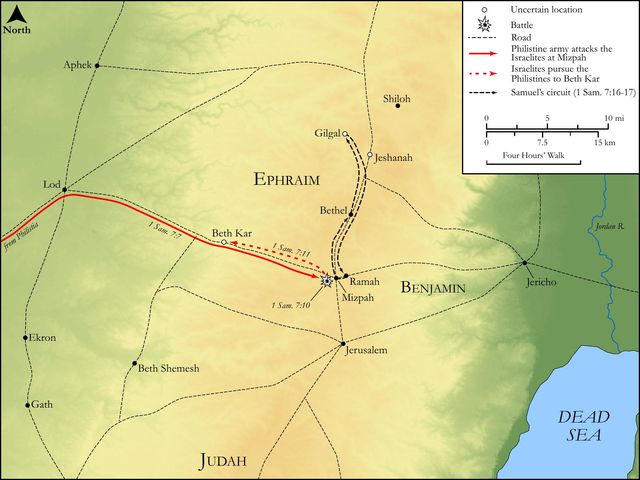
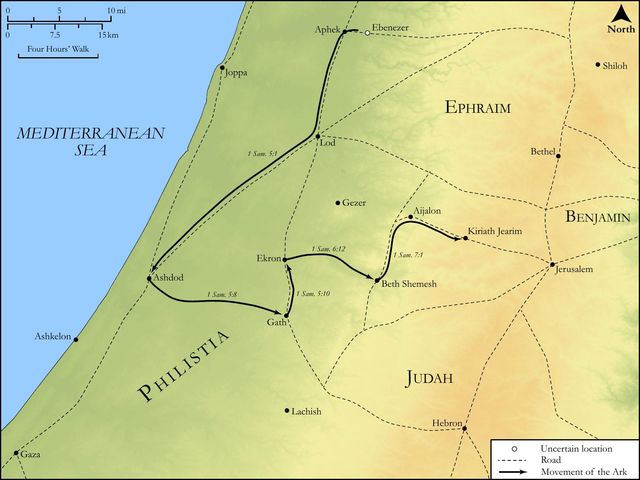
See on the biblical-era maps
Study this verse
Public-domain commentary
Matthew Henry
From his Commentary on the Whole Bible. Henry comments on passages, not single verses — this entry covers 1 Samuel 7:3–6. His four-level outline is real structure in the source text, so it is rendered as structure.
We may well wonder where Samuel was and what he was doing all this while, for we have not had him so much as named till now, since Sa1 4:1, not as if he were unconcerned, but his labours among his people are not mentioned till there appears the fruit of them. When he perceived that they began to lament after the Lord he struck while the iron was hot, and two things he endeavoured to do for them, as a faithful servant of God and a faithful friend to the Israel of God: -
I.He endeavoured to separate between them and their idols, for there reformation must begin.
He spoke to all the house of Israel (Sa1 7:3), going, as it should seem, from place to place, an itinerant preacher (for we find not that they were gathered together till Sa1 7:5), and wherever he came this was his exhortation, "If you do indeed return to the Lord, as you seem inclined to do, by your lamentations for your departure from him and his from you, then know, 1. That you must renounce and abandon your idols, put away the strange gods, for your God will admit no rival; put them away from you, each one from himself, nay, and put them from among you, do what you can, in your places, to rid them out of the country. Put away Baalim, the strange gods, and Ashtaroth, the strange goddesses," for such also they had. Or Ashtaroth is particularly named because it was the best-beloved idol, and that which they were most wedded to. Note, True repentance strikes at the darling sin, and will with a peculiar zeal and resolution put away that, the sin which most easily besets us. 2. "That you must make a solemn business of returning to God, and do it with a serious consideration and a stedfast resolution, for both are included in preparing the heart, directing, disposing, establishing, the heart unto the Lord. 3. That you must be wholly for God, for him and no other, serve him only, else you do not serve him at all so as to please him. 4. That this is the only way and a sure way to prosperity and deliverance. Take this course, and he will deliver you out of the hand of the Philistines; for it was because you forsook him and served other gods that he delivered you into their hands." This was the purport of Samuel's preaching, and it had a wonderfully good effect (Sa1 7:4): They put away Baalim and Ashtaroth, not only quitted the worship of them, but destroyed their images, demolished their altars, and quite abandoned them. What have we to do any more with idols? Hos 14:8; Isa 30:22.
II.He endeavoured to engage them for ever to God and his service. Now that he had them in a good mind he did all he could to keep them in it.
1.He summons all Israel, at least by their elders, as their representatives, to meet him at Mizpeh (Sa1 7:5), and there he promises to pray for them. And it was worth while for them to come from the remotest part of the country to join with Samuel in seeking God's favour. Note, Ministers should pray for those to whom they preach, that God by his grace would make the preaching effectual. And, when we come together in religious assemblies, we must remember that it is as much our business there to join in public prayers as it is to hear a sermon. He would pray for them that, by the grace of God, they might be parted from their idols, and that then, by the providence of God, they might be delivered from the Philistines. Ministers would profit their people more if they did but pray more for them.
2.They obey his summons, and not only come to the meeting, but conform to the intentions of it, and appear there very well disposed, Sa1 7:6.
(1.)They drew water and poured it out before the Lord, signifying,
[1.]Their humiliation and contrition for sin, owning themselves as water spilt upon the ground, which cannot be gathered up again (Sa2 14:14), so mean, so miserable, before God, Psa 22:14. The Chaldee reads it, They poured out their hearts in repentance before the Lord. They wept rivers of tears, and sorrowed after a godly sort, for it was before the Lord and with an eye to him.
[2.]Their earnest prayers and supplications to God for mercy. The soul is, in prayer, poured out before God, Psa 62:8.
[3.]Their universal reformation; they thus expressed their willingness to part with all their sins, and to retain no more of the relish or savour of them than the vessel does of the water that is poured out of it. They were free and full in their confession, and fixed in their resolution to cast away from them all their transgressions. Israel is now baptized from their idols, so Dr. Lightfoot.
[4.]Some think it signifies their joy in the hope of God's mercy, which Samuel had assured them of. This ceremony was used with that signification at the feast of tabernacles, Joh 7:37, Joh 7:38, and see Isa 12:3. Taking it in this sense, it must be read, They drew water after they had fasted. In the close of their humiliation they thus expressed their hope of pardon and reconciliation.
(2.)They fasted, abstained from food, afflicted their souls, so expressing repentance and exciting devotion.
(3.)They made a public confession: We have sinned against the Lord, so giving glory to God and taking shame to themselves. And, if we thus confess our sins, we shall find our God faithful and just to forgive us our sins.
3.Samuel judged them at that time in Mizpeh, that is, he assured them, in God's name, of the pardon of their sins, upon their repentance, and that God was reconciled to them. It was a judgment of absolution. Or he received informations against those that did not leave their idols, and proceeded against them according to law. Those that would not judge themselves he judged. Or now he settled courts of justice among them, and appointed the terms and circuits which he observed afterwards, Sa1 7:16. Now he set those wheels a-going; and, whereas he began to act as a magistrate, to prevent their relapsing into those sins which now they seemed to have renounced.
Historical interpretation
Three Centuries of Reception
3 surviving comments on this verse. Each one is dated, so this reads as a timeline rather than a list.
Select a marker to jump to its quote. Markers stagger vertically where authors wrote within a few decades of each other.
At one time the Hebrew people and all the Israelite tribes, because of the offensiveness of their sins, were held under the heavy domination of the Philistines. In order to be able to overcome their enemies, as the sacred history shows, they restored strength of soul and body with a self-imposed fast. They had judged rightly that they deserved that hard and wretched subjection because of neglect of God’s commandments and the corruption of their lives, and that in vain did they fight with weapons unless they had first made war on their sins. By abstaining, therefore, from food and drink they imposed the penalty of severe punishment on themselves, and to conquer their enemies, they first conquered the enticement of gluttony in themselves. In this way it happened that the fierce adversaries and harsh masters yielded to those who were fasting whom they had overcome when they had been full. We too, dearly beloved, situated as we are among many struggles and battles, if we wish to overcome our enemies in the same way, we may be healed by the same practice. Indeed, our situation is the same as theirs, seeing that they were attacked by bodily adversaries, we by spiritual enemies. If our spiritual enemies may be overcome by the correction of our lives bestowed on us through the grace of God, even the force of our bodily enemies will also give way to us. They will be weakened by our correction, since not their merits but our own sins made them onerous to us.
Therefore, dearly beloved, in order that we may be able to overcome our enemies, let us seek divine help by observing the commands of heaven, knowing that in no other way can we prevail over our foes except by prevailing over ourselves as well.
And they gathered at Mizpah, and drew water, etc. The fact that they drew water during prayers and fastings and poured it out before the Lord is a sign and execution of pious devotion. They gathered, as the Lord was preaching, to hear the word of the people, and being deeply moved, they drew from the bottom of their hearts a fountain of tears, which they would pour out as the most pleasing libation to God, offering it through the vessels of their eyes; and they abstained from all the allurements of the world, in that light of heavenly grace, confessing past sins and imploring the mercy of Christ.
And Samuel judged the children of Israel at Mizpah. The heavens are not clean in his sight (Job XV), and he finds perversity in his elect. Therefore, those too who, transcending all earthly things, gathered at the lookout of heavenly things, which Mizpah signifies, to Christ, who pre-eminent by the name of the sons of Israel, that is, men seeing God, still have much for which, as men, they may be chastised by a strict judge. Whence Isaiah says: And he shall judge the poor in righteousness (Isa. XI). There is no doubt that he speaks to those to whom he says: Blessed are the poor, for yours is the kingdom of God (Matt. V); for judging the same, he says: Are you still without understanding? (Matt. XV).
Continue studying 1 Samuel 7:6 across the web’s major study libraries — every link below opens this exact verse, chapter, or book on the destination site.
Read & Compare
 BibleGatewayThis verse in more than 200 translations and 70 languages.
 Bible.comThe YouVersion reader — hundreds of translations, reading plans, and highlights.
 ESV.orgCrossway's official English Standard Version reader.
 NET BibleThe NET translation with 60,000+ translators' notes on every rendering decision.
 STEP BibleTyndale House's free study tool — original text, vocabulary, and scholarly resources.
 BibliaLogos Bible Software's free web reader.
 USCCBThe New American Bible (Revised Edition) with the U.S. bishops' study notes.
Commentaries
 BibleHub CommentariesDozens of classic commentaries on this verse, gathered on one page.
 StudyLightMore than 100 commentary sets — the largest collection on the web.
 BibleRefPlain-English commentary on what this verse means, verse by verse.
 Enduring WordDavid Guzik's free commentary on this chapter, widely used by Bible teachers.
 Bible Study ToolsVerse commentary alongside Greek and Hebrew study aids.
Original Language & Research
- BibleHub InterlinearThe verse word by word — original language, transliteration, and English.
- BibleHub LexiconEvery word's original-language definition and Strong's entry.
 Blue Letter BibleDeep-study tools — Strong's numbers, concordance, and word studies.
 SefariaThe Hebrew text with Rashi and centuries of Jewish commentary.
Sermons, Hymns & Audio


TrulyRandomVerse is not affiliated with these sites and doesn’t control their content. They’re linked because they’re genuinely useful.
Summary
1 Samuel 7:6 chronicles a pivotal national assembly at Mizpeh, marking a profound moment of repentance and spiritual renewal for the Israelites under the prophetic leadership of Samuel. After decades of Philistine oppression and spiritual apostasy, the people collectively humbled themselves before the LORD by drawing and pouring out water, fasting, and publicly confessing their sin. This transformative act of contrition and renewed commitment to Yahweh served as the essential spiritual prerequisite for the divine deliverance that followed, establishing a new trajectory for the nation.
Context
ShowHideLiterary Context
This verse is strategically placed at a crucial turning point in Israel's narrative, directly following a twenty-year period of intense Philistine domination and the spiritual decline lamented in 1 Samuel 7:2. Samuel, having matured into a respected prophet and judge, had previously issued a direct challenge to the Israelites, urging them to abandon their foreign gods and Ashtoreths and to serve the LORD alone (1 Samuel 7:3). The gathering at Mizpeh, therefore, represents the people's collective and obedient response to Samuel's call for radical spiritual reformation. This national act of repentance is presented as the necessary spiritual foundation that precedes and enables the LORD's miraculous intervention and deliverance from the Philistines, detailed immediately thereafter in 1 Samuel 7:7-11. Thus, the verse highlights the indispensable link between national repentance and divine salvation.
Historical & Cultural Context
The historical backdrop of 1 Samuel is a transitional era for Israel, moving from the decentralized tribal confederacy of the Judges' period towards a centralized monarchy. The Philistines, a formidable and technologically advanced people (notably possessing iron weaponry, which Israel lacked), posed a constant and severe existential threat, having recently inflicted a devastating defeat on Israel and captured the Ark of the Covenant at Aphek (1 Samuel 4:1-11). Mizpeh, meaning "watchtower," was a strategically significant high place located in the tribal territory of Benjamin. Its elevated position and historical use made it a frequent and recognized national assembly point for Israel, as evidenced in earlier accounts like Judges 20:1 and later in 1 Samuel 10:17. Its selection for this gathering underscores the national, unified, and solemn nature of this act of repentance. The practices of fasting and public confession were deeply embedded in Israelite tradition as potent expressions of lament, humility, earnest supplication, and a deep desire for divine favor.
Key Themes
ShowHideThis verse powerfully encapsulates several foundational themes central to the book of 1 Samuel and the broader biblical narrative of covenant relationship. Foremost is the theme of national repentance and spiritual revival, illustrating that genuine turning from idolatry and sin is an absolute prerequisite for experiencing divine favor and deliverance. It profoundly emphasizes the importance of prophetic leadership, with Samuel serving as God's chosen mediator, faithfully guiding the people back to covenant faithfulness and true worship. The explicit and collective confession, "We have sinned against the LORD," underscores the critical theme of accountability and the acknowledgment of wrongdoing as an essential step for true reconciliation and restoration with God. Furthermore, the symbolic actions of pouring water and fasting vividly highlight the themes of humility, lament, and utter dependence on God, demonstrating that authentic spiritual renewal necessitates profound self-abasement and a reliance on divine mercy rather than human strength or reliance on foreign deities. This pivotal event at Mizpeh also serves to foreshadow the establishment of a righteous kingdom in Israel, one built upon a foundation of unwavering obedience and devotion to Yahweh.
Exposition and Analysis
ShowHideKey Word Analysis
ShowHideThis primitive root means "to miss; hence (figuratively and generally) to sin; by inference, to forfeit, lack, expiate, repent." The declaration, "We have sinned against the LORD," is a direct, unequivocal, and corporate confession of Israel's transgression against God's covenant. It signifies a profound acknowledgment that their national distress and the Philistine oppression were not arbitrary but a direct consequence of their idolatry, disobedience, and spiritual wandering. This verbal acknowledgment is crucial, moving beyond mere sorrow to a public declaration of guilt and responsibility, an indispensable step for genuine repentance and the possibility of restoration.
This word refers to "water; figuratively, juice." In this context, the physical act of drawing and pouring out water is imbued with profound symbolic meaning. While water is a basic necessity for life, its deliberate pouring out, particularly in a ritualistic context not explicitly commanded by Mosaic Law, transforms it into a powerful metaphor. It signifies a "pouring out" of their very lives, their hearts, their sorrow, and their utter dependence before God, much like water that cannot be gathered once spilled. It speaks to a complete emptying of self, a profound act of humility, and a thirst for God's presence and cleansing.
This primitive root means "to judge, i.e. pronounce sentence (for or against); by implication, to vindicate or punish; by extension, to govern." Samuel's act of "judging" here transcends mere legal arbitration. It encompasses his multifaceted role as a prophet, priest (though not of the Aaronic line), and spiritual leader. His judging involved discerning God's will, administering justice, providing spiritual guidance, and mediating between God and His people. It implies a restoration of order and righteousness within Israel, aligning the people once again with God's covenant standards, and solidifying Samuel's authority as God's appointed leader.
Verse Breakdown
ShowHide"And they gathered together to Mizpeh,"
This opening clause establishes the setting and the collective, unified nature of the event. Mizpeh, a historically significant assembly point, emphasizes the national scope of this spiritual turning. The act of gathering signifies intentionality, a shared purpose, and a corporate commitment among the tribes of Israel to address their spiritual condition.
"and drew water, and poured [it] out before the LORD,"
This is the most unique and symbolically rich action within the verse. The drawing of water, a common daily task, followed by its pouring out before the LORD, is not a ritual found in the Mosaic Law. As discussed in "Key Word Analysis," it powerfully conveys humility, lament, and a complete emptying of self before God, symbolizing their contrite hearts and utter dependence on Him, much like water poured out cannot be retrieved. It is an act of profound spiritual vulnerability and devotion, signifying a deep thirst for God and a complete surrender.
"and fasted on that day,"
Fasting is a well-attested biblical practice signifying deep earnestness, mourning, humility, and a prioritization of spiritual matters over physical needs. By abstaining from food, the Israelites demonstrated their profound sorrow over their sin and their intense focus on seeking God's mercy and intervention. It underscores the seriousness of their repentance and their desperate plea for divine favor.
"and said there, We have sinned against the LORD."
This verbal confession is the culmination of their internal conviction and symbolic actions. It is a public, explicit, and corporate acknowledgment of their guilt and rebellion against Yahweh. This collective declaration of sin is essential for true repentance, demonstrating a shared understanding of their spiritual breach and a unified desire for reconciliation with their covenant God.
"And Samuel judged the children of Israel in Mizpeh."
This concluding clause highlights Samuel's central and indispensable role as both spiritual leader and judicial authority. His presence and leadership legitimized the assembly, guided their repentance, and ensured the re-establishment of covenant order. His act of "judging" here extends beyond mere legal arbitration to encompass spiritual discernment, guidance, and the administration of justice in accordance with God's will, solidifying his position as the prophet-judge who mediates between God and His people and restores national righteousness.
Literary Devices
ShowHideThe verse employs several significant literary devices to convey its powerful message. Symbolism is paramount, particularly in the unique act of drawing and pouring out water. This ritual, not explicitly commanded elsewhere, serves as a profound visual metaphor for the people's contrite hearts, their "pouring out" of sorrow and humility before God, and their utter dependence on Him. It is a non-verbal expression of profound repentance and a desperate plea for divine mercy. The Repetition of "Mizpeh" at both the beginning and end of the verse effectively frames the entire event, emphasizing the singular importance of this specific location as a national gathering point for both spiritual renewal and the re-establishment of judicial order. The narrative also employs Foreshadowing, as this national act of repentance and Samuel's successful leadership set the stage for God's subsequent miraculous deliverance from the Philistines, hinting at the divine favor and intervention that invariably follow genuine turning to God. The concise, action-oriented language contributes to the dramatic impact and historical significance of this pivotal moment in Israel's history.
Theological and Thematic Connections
ShowHide1 Samuel 7:6 stands as a profound theological statement on the nature of genuine repentance and God's unwavering responsiveness to a contrite heart. It illustrates with clarity that true spiritual revival, whether for an individual or an entire nation, must commence with a humble, unreserved acknowledgment of sin and a decisive turning back to God. The combined symbolic actions of pouring water and fasting, coupled with the explicit verbal confession, demonstrate that God desires not merely outward ritual or superficial displays, but an inward transformation of the heart—a transformation characterized by deep humility, genuine sorrow for sin, and a renewed, exclusive commitment to Him. This passage powerfully underscores the enduring biblical principle that divine intervention, deliverance, and restoration are often predicated upon human repentance and obedience, establishing a consistent pattern seen throughout the grand narrative of Scripture where God's people experience renewal and salvation after turning from their wicked ways. Samuel's crucial role as judge, prophet, and intercessor highlights the indispensable necessity of godly leadership in guiding a people back to covenant faithfulness and spiritual health.
Reflection and Application
ShowHideThe profound scene at Mizpeh offers timeless and deeply relevant lessons for contemporary believers and the church today. It serves as a powerful reminder that spiritual renewal, whether on a personal level or within a corporate community, must begin with a profound, unreserved, and honest acknowledgment of sin. The Israelites' comprehensive actions—gathering with intentionality, symbolically pouring out water, engaging in corporate fasting, and offering a collective confession—demonstrate a holistic and earnest approach to repentance that integrates physical expression, emotional contrition, and verbal declaration. This passage challenges us to critically examine our own lives and our faith communities: are we truly "pouring out" our hearts before the LORD in genuine humility and vulnerability, or are we holding back portions of our lives from His transforming grace? Do we prioritize spiritual disciplines like fasting, earnest prayer, and corporate confession in times of personal distress, national crisis, or spiritual complacency? This narrative encourages us to embrace radical humility, recognizing that our brokenness, our utter dependence, and our willingness to surrender are the very conditions through which God's boundless grace, redemptive power, and restorative presence can flow most freely. It also underscores the vital and enduring role of spiritual leadership in faithfully calling people to repentance and guiding them towards genuine reconciliation with God.
Questions for Reflection
ShowHideFAQ
ShowHideWhat is the significance of "pouring out water" before the LORD, as Israel did at Mizpeh?
ShowHideThe act of pouring out water before the LORD is not a prescribed sacrifice within the Mosaic Law, making its significance deeply symbolic rather than ritualistic. Scholars interpret this unique action in several profound ways, all pointing to a posture of extreme humility, lament, and earnest supplication. It is most commonly understood as a symbolic "pouring out of the heart" before God, representing deep sorrow, profound contrition, and a complete emptying of oneself in lament and utter dependence. Just as water poured on the ground cannot be gathered, it may signify an irreversible commitment to God, a profound sense of spiritual desolation, or an intense thirst for God's presence and cleansing. Some also view it as a symbolic act of purification or a solemn oath, akin to a libation, signifying a renewed and exclusive covenant commitment to Yahweh, abandoning all other gods. It was a powerful, non-verbal expression of their repentance and their desperate reliance on God for deliverance.
Why was Mizpeh chosen as the gathering place for this national repentance?
ShowHideMizpeh held significant historical, strategic, and religious importance for Israel. Its name, meaning "watchtower," suggests an elevated, defensible position, making it a natural and recognized gathering point for the scattered tribes. Throughout Israel's history, Mizpeh frequently served as a place of national assembly, covenant renewal, and judicial proceedings, as evidenced in earlier accounts such as Judges 20:1 and later in the selection of Saul as king in 1 Samuel 10:17. Its selection for this pivotal event underscored the national and unified nature of Israel's repentance, signifying that this was a corporate turning to God. It was a recognized spiritual and political center where the people could collectively humble themselves before God and submit to Samuel's authoritative leadership.
Christ-Centered Fulfillment
ShowHide1 Samuel 7:6, with its profound themes of national repentance, intercession, and divine deliverance, finds its ultimate and most complete Christ-centered fulfillment in the person and redemptive work of Jesus Christ. The Israelites' corporate confession, "We have sinned against the LORD," powerfully highlights humanity's universal and desperate need for atonement, a need that could never be fully met by symbolic water rituals or the repeated sacrifices of the Old Covenant. This profound spiritual deficit is ultimately and perfectly satisfied by the perfect, once-for-all sacrifice of the Lamb of God, who takes away the sin of the world. The symbolic "pouring out" of water at Mizpeh, representing the pouring out of contrite hearts in sorrow and humility, foreshadows the ultimate and infinitely more significant "pouring out" of Christ's precious blood on the cross—His very life poured out as a drink offering for the complete redemption of humanity. Samuel, acting as the prophet-judge who mediates between God and His people, serves as a clear type of Christ, our great High Priest and the sole Mediator between God and humanity, who perpetually intercedes for us before the Father (Romans 8:34). While Israel's deliverance at Mizpeh was temporal and physical, Christ's finished work on the cross brings eternal salvation, spiritual freedom from the bondage of sin, and victory over death (Romans 6:23). Thus, the repentance at Mizpeh points forward to the ultimate and complete reconciliation with God made possible through faith in Jesus Christ, who perfectly fulfilled the law's demands, bore the full judgment for our sins, and now graciously invites all who are weary and burdened to come to Him for true spiritual rest and renewal (Matthew 11:28-30).