


Philippians 2:17
- ἀλλ᾽all᾽butG235CONJConjunction
- εἰeiifG1487CONDConjunction
- καὶkaievenG2532CONJConjunction
- σπένδομαιspendomaiI am being poured outG4689V-PPI-1SVerb Present Passive Indicative 1st Singular
- ἐπὶepionG1909PREPPreposition
- τῇtēatheG3588T-DSFDefinite article Dative Singular Feminine
- θυσίᾳthusiasacrificeG2378N-DSFNoun Dative Singular Feminine
- καὶkaiandG2532CONJConjunction
- λειτουργίᾳleitourgiaon [the] serviceG3009N-DSFNoun Dative Singular Feminine
- τῆςtēsof theG3588T-GSFDefinite article Genitive Singular Feminine
- πίστεωςpisteōsfaithG4102N-GSFNoun Genitive Singular Feminine
- ὑμῶνhumōnof youG4771P-2GPPersonal pronoun Genitive 2nd Plural
- χαίρωchairōI am gladG5463V-PAI-1SVerb Present Active Indicative 1st Singular
- καὶkaiandG2532CONJConjunction
- συγχαίρωsugchairōI rejoice withG4796V-PAI-1SVerb Present Active Indicative 1st Singular
- πᾶσινpasinallG3956A-DPMAdjective Dative Plural Masculine
- ὑμῖν·huminyouG4771P-2DPPersonal pronoun Dative 2nd Plural
English is a literal word-by-word gloss of the Greek, not the KJV's wording. Why?
This is the original text the KJV's translators worked from — each Greek word with its own literal English meaning in this verse, prepared by scholars at Tyndale House, Cambridge. The KJV translates whole sentences, not word by word, so its wording differs: one Greek word can become several English words, and the KJV may choose “charity” where the gloss reads “love”. Both are faithful — they answer different questions. For the KJV's own rendering, switch to the KJV text.
Details
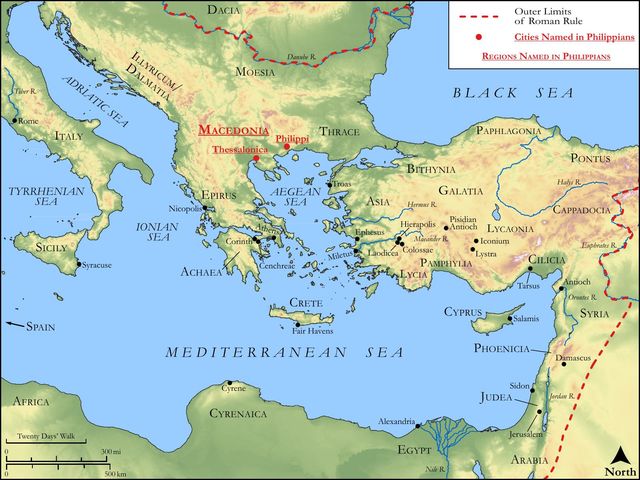
See on the biblical-era map

Study this verse
Public-domain commentary
Matthew Henry
From his Commentary on the Whole Bible. Henry comments on passages, not single verses — this entry covers Philippians 2:14–18.
The apostle exhorts them in these verses to adorn their Christian profession by a suitable temper and behaviour, in several instances. 1. By a cheerful obedience to the commands of God (Phi 2:14): "Do all things, do your duty in every branch of it, without murmurings. Do it, and do not find fault with it. Mind your work, and do not quarrel with it." God's commands were given to be obeyed, not to be disputed. This greatly adorns our profession, and shows we serve a good Master, whose service is freedom and whose work is its own reward. 2. By peaceableness and love one to another. "Do all things without disputing, wrangling, and debating one another; because the light of truth and the life of religion are often lost in the heats and mists of disputation." 3. By a blameless conversation towards all men (Phi 2:15): "That you may be blameless and harmless, the sons of God, without rebuke; that you be not injurious to any in word or deed, and give no just occasion of offence." We should endeavour not only to be harmless, but to be blameless; not only not to do hurt, but not to come under the just suspicion of it. Blameless and sincere; so some read it. Blameless before men, sincere towards God. The sons of God. It becomes those to be blameless and harmless who stand in such a relation, and are favoured with such a privilege. The children of God should differ from the sons of men. Without rebuke - Amōmēta. Momus was a carping deity among the Greeks, mentioned by Hesiod and Lucian, who did nothing himself, and found fault with every body and every thing. From him all carpers at other men, and rigid censurers of their works, were called Momi. The sense of the expression is, "Walk so circumspectly that Momus himself may have no occasion to cavil at you, that the severest censurer may find no fault with you." We should aim and endeavour, not only to get to heaven, but to get thither without a blot; and, like Demetrius, to have a good report of all men, and of the truth, Jo3 1:12. In the midst of a crooked and perverse generation; that is, among the heathens, and those who are without. Observe, Where there is no true religion, little is to be expected but crookedness and perverseness; and the more crooked and perverse others are among whom we live, and the more apt to cavil, the more careful we should be to keep ourselves blameless and harmless. Abraham and Lot must not strive, because the Canaanite and Perizzite dwelt in the land, Gen 13:7. Among whom you shine as lights in the world. Christ is the light of the world, and good Christians are lights in the world. When God raises up a good man in any place, he sets up a light in that place. Or it may be read imperatively: Among whom shine you as lights: compare Mat 5:16, Let your light so shine before men. Christians should endeavour not only to approve themselves to God, but to recommend themselves to others, that they may also glorify God. They must shine as well as be sincere. - Holding forth the word of life, Phi 2:16. The gospel is called the word of life because it reveals and proposes to us eternal life through Jesus Christ. Life and immortality are brought to light by the gospel, Ti2 1:10. It is our duty not only to hold fast, but to hold forth the word of life; not only to hold it fast for our own benefit, but to hold it forth for the benefit of others, to hold it forth as the candlestick holds forth the candle, which makes it appear to advantage all around, or as the luminaries of the heavens, which shed their influence far and wide. This Paul tells them would be his joy: "That I may rejoice in the day of Christ; not only rejoice in your stedfastness, but in your usefulness." He would have them think his pains well bestowed, and that he had not run in vain, nor laboured in vain. Observe, (1.) The work of the ministry requires the putting forth of the whole man: all that is within us is little enough to be employed in it; as in running and labouring. Running denotes vehemence and vigour, and continual pressing forward; labour denotes constancy and close application. (2.) It is a great joy to ministers when they perceive that they have not run in vain, nor laboured in vain; and it will be their rejoicing in the day of Christ, when their converts will be their crown. What is our hope, or joy, or crown of rejoicing? Are not even you in the presence of our Lord Jesus Christ at his coming? For you are our glory and joy, Th1 2:19, Th1 2:20. The apostle not only ran and laboured for them with satisfaction, but shows that he was ready to suffer for their good (Phi 2:17): Yea, and if I be offered upon the sacrifice and service of your faith, I joy and rejoice with you all. He could reckon himself happy if he could promote the honour of Christ, the edification of the church, and the welfare of the souls of men; though it were not only by hazarding, but by laying down, his life: he could willingly be a sacrifice at their altars, to serve the faith of God's elect. Could Paul think it worth while to shed his blood for the service of the church, and shall we think it much to take a little pains? Is not that worth our labour which he thought worth his life? If I be offered, or poured out as the wine of the drink-offerings, spendomai. Ti2 4:6, I am now ready to be offered. He could rejoice to seal his doctrine with his blood (Phi 2:18): For the same cause also do you joy and rejoice with me. It is the will of God that good Christians should be much in rejoicing; and those who are happy in good ministers have a great deal of reason to joy and rejoice with them. If the minister loves the people, and is willing to spend and be spent for their welfare, the people have reason to love the minister and to joy and rejoice with him.
Historical interpretation
Two Centuries of Reception
3 surviving comments on this verse. Each one is dated, so this reads as a timeline rather than a list.
Select a marker to jump to its quote. Markers stagger vertically where authors wrote within a few decades of each other.
But writing in bonds to the Thessalonians, he certainly affirmed that they were blessed, since to them it had been given not only to believe on Christ, but also to suffer for His sake. "Having," says he, "the same conflier which ye both saw in me, and now hear to be in me." "For though I are offered upon the sacrifice, I joy and rejoice with you all; in like manner do ye also joy and rejoice with me.
"Yea, and if I am offered." He said not, "and if I die even," nor did he when writing to Timothy, for there, too, he has made use of the same expression, "For I am already being offered." He is both consoling them about his own death, and instructing them to bear gladly the death that is for Christ's sake. I am become, he says, as it were a libation and a sacrifice. O blessed soul! His bringing them to God he calls a sacrifice. It is much better to present a soul than to present oxen. "If, then, over and above this offering," he says, "I add myself, my death as a libation, I rejoice." For this he implies, when he says, "Yea, and if I am offered upon the sacrifice and service, I joy and rejoice with you all; and in the same manner do ye also joy and rejoice with me." Why dost thou rejoice with them? Seest thou that he shows that it is their duty to rejoice? On the one hand then, I rejoice in being made a libation; on the other, I rejoice with you, in having presented a sacrifice; "and in the same manner do ye also joy and rejoice with me," that I am offered up; "rejoice with me," "who rejoice in myself." So that the death of the just is no subject for tears, but for joy. If they rejoice, we should rejoice with them. For it is misplaced for us to weep, while they rejoice. "But," it is urged, "we long for our wonted intercourse." This is a mere pretext and excuse; and that it is so, mark what he enjoins: "Rejoice with me, and joy." Dost thou miss thy wonted intercourse? If thou wert thyself destined to remain here, there would be reason in what thou sayest; but if after a brief space thou wilt overtake him who has departed, what is that intercourse which thou dost seek? for it is only when he is forever severed from him that a man misses the society of another, but if he will go the same way that thou wilt go, what is the intercourse which thou longest for? Why do we not bewail all that are upon foreign travel? Do we not just a little, and cease after the first or the second day? If thou longest for thy wonted intercourse with him, weep so far only. "It is no evil that I suffer," says he, "but I even rejoice in going to Christ, and do ye not rejoice." "Rejoice with me." Let us too rejoice when we see a righteous man dying, and yet more even when any of the desperately wicked; for the first is going to receive the reward of his labors, but the other has abated somewhat from the score of his sins.
When he says you, he means all the faithful.… And he says this to work on their souls and to teach them that his martyrdom is so great that it has the character of a libation and a sacrifice.
Continue studying Philippians 2:17 across the web’s major study libraries — every link below opens this exact verse, chapter, or book on the destination site.
Read & Compare
 BibleGatewayThis verse in more than 200 translations and 70 languages.
 Bible.comThe YouVersion reader — hundreds of translations, reading plans, and highlights.
 ESV.orgCrossway's official English Standard Version reader.
 NET BibleThe NET translation with 60,000+ translators' notes on every rendering decision.
 STEP BibleTyndale House's free study tool — original text, vocabulary, and scholarly resources.
 BibliaLogos Bible Software's free web reader.
 USCCBThe New American Bible (Revised Edition) with the U.S. bishops' study notes.
Commentaries
 BibleHub CommentariesDozens of classic commentaries on this verse, gathered on one page.
 StudyLightMore than 100 commentary sets — the largest collection on the web.
 BibleRefPlain-English commentary on what this verse means, verse by verse.
 Enduring WordDavid Guzik's free commentary on this chapter, widely used by Bible teachers.
 Bible Study ToolsVerse commentary alongside Greek and Hebrew study aids.
Original Language & Research
- BibleHub InterlinearThe verse word by word — original language, transliteration, and English.
- BibleHub LexiconEvery word's original-language definition and Strong's entry.
 Blue Letter BibleDeep-study tools — Strong's numbers, concordance, and word studies.
 CNTR CollationThe earliest Greek manuscripts of this verse, collated letter by letter.
Sermons, Hymns & Audio


TrulyRandomVerse is not affiliated with these sites and doesn’t control their content. They’re linked because they’re genuinely useful.
Summary
In Philippians 2:17, the Apostle Paul articulates his profound willingness to be poured out as a drink offering upon the "sacrifice and service" of the Philippians' faith. This verse encapsulates his selfless devotion to Christ and the church, revealing a deep, abiding joy that transcends his imprisonment and the prospect of martyrdom. It underscores his view of his life and ministry as a complementary act of worship, validating and enhancing the Philippians' own spiritual offering to God.
Context
ShowHideLiterary Context
Philippians 2:17 stands as a powerful personal application of Paul's preceding exhortations in Philippians 2. Having urged the Philippians to live in unity, humility, and selfless service, mirroring the self-emptying (kenosis) of Christ in Philippians 2:5-8, Paul now presents his own life as a living illustration of these principles. He has just encouraged them to "work out your own salvation with fear and trembling" (Philippians 2:12), and to "shine as lights in the world" (Philippians 2:15). His willingness to be "offered" is not a morbid desire for death, but a joyful commitment to the completion of his ministry, ensuring that his "labor has not been in vain" (Philippians 2:16). This verse serves as a deeply personal affirmation of his commitment to the Gospel and to them, even unto death, thereby reinforcing his call for their steadfastness and joy.
Historical & Cultural Context
Paul wrote this letter from prison, most likely in Rome, around AD 60-62. Despite his confinement and the potential for execution, the letter is saturated with themes of joy, often referred to as the "epistle of joy." The imagery of being "offered upon the sacrifice and service" draws from the ancient sacrificial practices familiar to both Jewish and Greco-Roman audiences. In both traditions, a "libation" or "drink offering" (Greek: spendomai) was a common ritual, typically involving wine or oil poured out over a primary sacrifice (like a burnt offering or peace offering) as a concluding act of worship, signifying dedication and completion. Paul metaphorically presents his life, and potentially his impending martyrdom, as this supplementary offering. This would have resonated powerfully with the Philippians, who were themselves facing persecution and were called to live as a "living sacrifice" (Romans 12:1). Paul's readiness to "spend" his life for their faith underscored his profound commitment and their shared participation in the Gospel.
Key Themes
ShowHidePhilippians 2:17 powerfully encapsulates several key themes prevalent in the book of Philippians and Paul's broader theology. Firstly, Selfless Service and Sacrifice is paramount, as Paul views his life, suffering, and potential death not as a loss, but as a consecrated offering that complements the Philippians' faith. This mirrors Christ's ultimate act of self-giving (Philippians 2:5-8). Secondly, Joy Amidst Suffering is a dominant motif; despite facing imprisonment and the prospect of death, Paul expresses profound and unwavering joy. This is a deep, spiritual contentment rooted in Christ and the advancement of the Gospel, demonstrating that true Christian joy is not dependent on favorable circumstances but on divine purpose (2 Corinthians 12:10). Thirdly, Partnership in the Gospel is highlighted, as Paul sees his life as a libation poured out upon their faith, signifying a profound spiritual solidarity and mutual participation in the work of God. Their faith is the primary offering, and his life and ministry are poured out to enhance and validate that offering, reinforcing their shared mission to live "worthy of the gospel of Christ" (Philippians 1:27).
Exposition and Analysis
ShowHideKey Word Analysis
ShowHideMeaning "to pour out as a libation, i.e. (figuratively) to devote (one's life or blood, as a sacrifice) ('spend')." Paul uses this term to describe his life and ministry, and potentially his martyrdom, as a drink offering poured out. This imagery signifies a complete and final devotion, a life "spent" for the sake of the Gospel and the spiritual well-being of the Philippians. It evokes the Old Testament practice of pouring out wine or oil over a sacrifice as a concluding act of worship, indicating full dedication and acceptance.
Meaning "sacrifice (the act or the victim, literally or figuratively)." Here, Paul refers to the Philippians' faith as the primary "sacrifice." This is not a literal animal sacrifice, but a spiritual one, representing their devotion, obedience, and endurance in the face of trials. Paul's life is then seen as a complementary offering poured out upon this foundational sacrifice of their faith, making it complete and acceptable to God.
Meaning "public function (as priest ('liturgy') or almsgiver):--ministration(-try), service." This word refers to a public, often religious, duty or ministration. In this context, it emphasizes the collective worship and active obedience of the Philippian believers. Their faith is not merely passive belief but an active "service" or "ministry" rendered to God. Paul's offering of his life is thus poured out upon their active, living faith and service, enhancing its spiritual significance.
Verse Breakdown
ShowHide"Yea, and if I be offered upon the sacrifice and service of your faith,"
This clause introduces a hypothetical, yet deeply desired, scenario for Paul. The Greek "Yea, and if" (G235 allá and G1499 ei kaí) suggests that even if the ultimate sacrifice of his life (being "offered" as a libation, G4689 spéndō) were to occur, it would be a joyous outcome. The crucial preposition "upon" (G1909 epí) indicates that his life's pouring out is not a standalone event but is intimately linked to, and complements, the "sacrifice and service" (G2378 thysía and G3009 leitourgía) of the Philippians' faith (G4102 pístis). This implies that their steadfast belief and active obedience are the primary offering, and Paul's life, even in death, serves as a dedicatory libation poured over it, making their offering complete and acceptable to God. It underscores his profound spiritual solidarity with them and his view of his suffering as contributing to their spiritual maturity and the advance of the Gospel.
"I joy,"
Despite the solemn imagery of being "offered" (which could imply death), Paul immediately declares his profound "joy" (G5463 chaírō). This is not a superficial happiness but a deep, spiritual contentment rooted in his purpose and his relationship with Christ. His joy is not in suffering itself, but in the knowledge that his suffering, and even his potential death, serves a divine purpose: the furtherance of the Gospel and the spiritual benefit of the Philippian believers. It is a testament to his Christ-centered perspective, where personal cost is outweighed by spiritual gain.
"and rejoice with you all."
This final phrase emphasizes the communal and shared nature of this joy. Paul's joy is not solitary but is inextricably linked to the Philippians' spiritual well-being and their shared journey in the faith. The verb "rejoice with" (G4796 synchaírō) highlights a sympathetic gladness, indicating that his joy is amplified by their participation in the faith and their perseverance. He anticipates that his ultimate sacrifice, far from bringing sorrow, would instead be a cause for shared rejoicing, confirming the validity of their faith and the triumph of the Gospel. It underscores the deep bond of fellowship between the apostle and the church.
Literary Devices
ShowHidePaul employs powerful Metaphor and Imagery in Philippians 2:17, drawing on the familiar practice of ancient sacrificial rituals. His life is presented as a "libation" or "drink offering" (spendomai), an act of pouring out, which serves as a metaphor for his complete devotion and self-expenditure in ministry, even to the point of death. This imagery is deeply evocative, painting a picture of his life as a consecrated offering poured out "upon the sacrifice and service of your faith." This implies that the Philippians' faith is the main offering, and Paul's life is the supplementary, dedicatory pour, enhancing its spiritual significance. Furthermore, there is an implicit Contrast between the potential suffering or death ("if I be offered") and the immediate, overwhelming response of "joy" and "rejoicing." This juxtaposition highlights the supernatural nature of Christian joy, which is not dependent on external circumstances but is rooted in a divine purpose and a Christ-centered perspective, transforming potential sorrow into profound spiritual gladness.
Theological and Thematic Connections
ShowHidePhilippians 2:17 offers profound theological insights into the nature of Christian service, suffering, and joy. Paul's willingness to be "offered" as a libation upon the Philippians' faith reveals a theology of co-suffering and co-laboring in the Gospel, where the apostle's life is intricately intertwined with the spiritual growth and perseverance of the church. It underscores that true spiritual leadership often involves costly self-sacrifice, not as a means of earning salvation, but as an overflow of gratitude and devotion to Christ. This verse also highlights the corporate nature of faith; the Philippians' faith is presented as a collective "sacrifice and service" to God, upon which Paul's individual offering is poured. This demonstrates that individual acts of devotion contribute to the larger body of Christ's worship and mission. The profound joy expressed by Paul amidst the prospect of martyrdom challenges believers to find their deepest contentment not in comfort or security, but in fulfilling God's purpose, even when it demands ultimate sacrifice.
Reflection and Application
ShowHidePhilippians 2:17 presents a radical challenge to our contemporary understanding of service and sacrifice. Paul's willingness to be "offered" as a libation, not grudgingly but with profound joy, invites us to examine our own attitudes toward self-giving in the Christian life. Do we view our efforts, time, resources, and even our suffering for Christ as a joyous offering, or as a burdensome obligation? Paul's example encourages us to cultivate a Christ-centered perspective where personal cost is transformed into spiritual gain, and where our deepest joy is found in contributing to the spiritual flourishing of others and the advancement of God's kingdom. This verse calls us to embrace a life of total devotion, understanding that our entire existence, with all its challenges and triumphs, can be consecrated to God as an act of worship, poured out upon the collective faith and service of the body of Christ. It reminds us that authentic Christian ministry is often costly, but the profound, enduring joy derived from serving Christ and witnessing others grow in faith far outweighs any personal sacrifice.
Questions for Reflection
ShowHideFAQ
ShowHideWhat does Paul mean by "if I be offered upon the sacrifice and service of your faith"?
ShowHidePaul uses the imagery of a "libation" or "drink offering" (Greek: spéndō), which was a common ancient practice of pouring out wine or oil over a primary sacrifice as a dedicatory act. Here, the "sacrifice and service" is the active faith and obedience of the Philippian believers. Paul is saying that even if his life, and potentially his martyrdom, were to be "poured out" as a final act of devotion, it would not be in vain. Instead, it would be poured upon their faith, serving to complete, validate, and enhance their spiritual offering to God. It signifies his complete dedication to their spiritual well-being and the advancement of the Gospel, seeing his life as a complementary offering to their own living faith. This concept is echoed in 2 Timothy 4:6, where Paul states, "For I am already being poured out as a drink offering, and the time of my departure has come."
Why does Paul express joy in the face of such a prospect?
ShowHidePaul's joy is not a superficial emotion or a morbid desire for suffering, but a deep, spiritual contentment rooted in his understanding of God's sovereign plan and the ultimate triumph of the Gospel. His joy stems from several sources:
Christ-Centered Fulfillment
ShowHidePaul's willingness to be "offered upon the sacrifice and service of your faith" in Philippians 2:17 finds its ultimate and perfect fulfillment in Jesus Christ. Paul's life, poured out as a libation, mirrors the infinitely greater and complete sacrifice of Christ, who "poured out his soul unto death" (Isaiah 53:12) as the Lamb of God who takes away the sin of the world (John 1:29). Jesus' entire life was a "service" to the Father, culminating in His death on the cross, which was the supreme "sacrifice" for humanity's sin. He did not merely offer a part of Himself, but "gave his life as a ransom for many" (Mark 10:45). Furthermore, Christ's joy, like Paul's, was not dependent on ease but on fulfilling the Father's will; He "for the joy that was set before him endured the cross" (Hebrews 12:2). Paul's sacrificial life is a direct imitation of Christ's self-emptying love described earlier in Philippians 2:5-8, demonstrating that true discipleship involves taking up one's cross and following Him (Matthew 16:24). Thus, Paul's aspiration to be poured out is a Christ-shaped life, reflecting the ultimate self-giving of the Son of God, who laid down His life for His friends (John 15:13).