


2 Timothy 4:6
- ἘγὼEgōI myselfG1473P-1NSPersonal pronoun Nominative 1st Singular
- γὰρgarforG1063CONJConjunction
- ἤδηēdēalreadyG2235ADVAdverb
- σπένδομαιspendomaiam being poured outG4689V-PPI-1SVerb Present Passive Indicative 1st Singular
- καὶkaiandG2532CONJConjunction
- ὁhotheG3588T-NSMDefinite article Nominative Singular Masculine
- καιρὸςkairostimeG2540N-NSMNoun Nominative Singular Masculine
- τῆςtēsof theG3588T-GSFDefinite article Genitive Singular Feminine
- ἀναλύσεώςanaluseōsdepartureG359N-GSFNoun Genitive Singular Feminine
- μουmouof meG3165P-1GSPersonal pronoun Genitive 1st Singular
- ἐφέστηκενephestēkenhas comeG2186V-RAI-3SVerb Perfect Active Indicative 3rd Singular
English is a literal word-by-word gloss of the Greek, not the KJV's wording. Why?
This is the original text the KJV's translators worked from — each Greek word with its own literal English meaning in this verse, prepared by scholars at Tyndale House, Cambridge. The KJV translates whole sentences, not word by word, so its wording differs: one Greek word can become several English words, and the KJV may choose “charity” where the gloss reads “love”. Both are faithful — they answer different questions. For the KJV's own rendering, switch to the KJV text.
Details
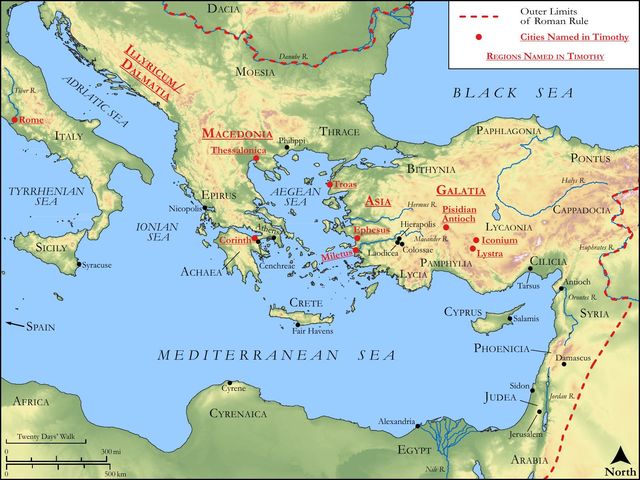
See on the biblical-era map

Study this verse
Public-domain commentary
Matthew Henry
From his Commentary on the Whole Bible. Henry comments on passages, not single verses — this entry covers 2 Timothy 4:1–8. His four-level outline is real structure in the source text, so it is rendered as structure.
Observe, I. How awfully this charge is introduced (Ti2 4:1): I charge thee before God, and the Lord Jesus Christ, who shall judge the quick and the dead at his appearing and his kingdom. Observe, The best of men have need to be awed into the discharge of their duty. The work of a minister is not an indifferent thing, but absolutely necessary. Woe be to him if he preach not the gospel, Co1 9:16. To induce him to faithfulness, he must consider, 1. That the eye of God and Jesus Christ was upon him: I charge thee before God and the Lord Jesus Christ; that is, "as thou tenderest the favour of God and Jesus Christ; as thou wilt approve thyself to God and Jesus Christ, by the obligations both of natural and revealed religion; as thou wilt make due returns to the God who made thee and the Lord Jesus Christ who redeemed thee." 2. He charges him as he will answer it at the great day, reminding him of the judgment to come, which is committed to the Lord Jesus. He shall judge the quick and the dead at his appearing and his kingdom, that is, when he appears in his kingdom. It concerns all, both ministers and people, seriously to consider the account that they must shortly give to Jesus Christ of all the trusts reposed in them. Christ shall judge the quick and the dead, that is, those that at the last day shall be found alive, and those who shall be raised to life out of the grave. Note, (1.) The Lord Jesus Christ shall judge the quick and the dead. God hath committed all judgment unto the Son, and hath appointed him the Judge of quick and dead, Act 10:42. (2.) He will appear; he will come the second time, and it will be a glorious appearance, as the word epiphaniea signifies. (3.) Then his kingdom shall appear in its glory: At his appearing and kingdom; for he will then appear in his kingdom, sitting on a throne, to judge the world.
II.What is the matter of the charge, Ti2 4:2-5. He is charged,
1.To preach the word. This is ministers' business; a dispensation is committed to them. It is not their own notions and fancies that they are to preach, but the pure plain word of God; and they must not corrupt it, but as of sincerity, but as of God, in the sight of God, they speak in Christ, Co2 2:17.
2.To urge what he preached, and to press it with all earnestness upon his hearers: "Be instant in season and out of season, reprove, rebuke, exhort; do this work with all fervency of spirit. Call upon those under thy charge to take heed of sin, to do their duty: call upon them to repent, and believe, and live a holy life, and this both in season and out of season. In season, when they are at leisure to hear thee, when some special opportunity offers itself of speaking to them with advantage. Nay, do it out of season, even when there is not that apparent probability of fastening something upon them, because thou dost not know but the Spirit of God may fasten upon them; for the wind bloweth where it listeth; and in the morning we must sow our seed, and in the evening not withhold our hand," Ecc 11:6. We must do it in season, that is, let slip no opportunity; and do it out of season, that is, not shift off the duty, under pretence that it is out of season.
3.He must tell people of their faults: "Reprove them, rebuke them. Convince wicked people of the evil and danger of their wicked courses. Endeavour, by dealing plainly with them, to bring them to repentance. Rebuke them with gravity and authority, in Christ's name, that they may take thy displeasure against them as an indication of God's displeasure."
4.He must direct, encourage, and quicken those who began well. "Exhort them (persuade them to hold on, and endure to the end) and this with all long-suffering and doctrine." (1.) He must do it very patiently: With all long-suffering. "If thou do not see the effect of thy labours presently, yet do not therefore give up the cause; be not weary of speaking to them." While God shows to them all long-suffering, let ministers exhort with all long-suffering. (2.) He must do it rationally, not with passion, but with doctrine, that is, "In order to the reducing of them to good practices, instil into them good principles. Teach them the truth as it is in Jesus, reduce them to a firm belief of it, and this will be a means both to reclaim them from evil and to bring them to good." Observe, [1.] A minister's work has various parts: he is to preach the word, to reprove, rebuke, and exhort. [2.] He is to be very diligent and careful; he must be instant in season and out of season; he must spare no pains nor labour, but must be urgent with them to take care of their souls and their eternal concerns.
5.He must watch in all things. "Seek an opportunity of doing them a kindness; let no fair occasion slip, through thy negligence. Watch to thy work; watch against the temptations of Satan, by which thou mayest be diverted from it; watch over the souls of those who are committed to thy charge."
6.He must count upon afflictions, and endure them, make the best of them. Kakopathēson, endure patiently. "Be not discouraged by the difficulties thou meetest with, but bear them with an evenness of spirit. Inure thyself to hardships."
7.He must remember his office, and discharge its duties: Do the work of an evangelist. The office of the evangelist was, as the apostles' deputies, to water the churches that they planted. They were not settled pastors, but for some time resided in, and presided over, the churches that the apostles had planted, till they were settled under a standing ministry. This was Timothy's work.
8.He must fulfil his ministry: Make full proof of it. It was a great trust that was reposed in him, and therefore he must answer it, and perform all the parts of his office with diligence and care. Observe,
(1.)A minister must expect afflictions in the faithful discharge of his duty.
(2.)He must endure them patiently, like a Christian hero.
(3.)These must not discourage him in his work, for he must do his work, and fulfil his ministry.
(4.)The best way to make full proof of our ministry is to fulfil it, to fill it up in all its parts with proper work.
III.The reasons to enforce the charge.
1.Because errors and heresies were likely to creep into the church, by which the minds of many professing Christians would be corrupted (Ti2 4:3, Ti2 4:4): "For the time will come when they will not endure sound doctrine. Therefore improve the present time, when they will endure it. Be busy now, for it is seedtime; when the fields are white unto the harvest, put in the sickle, for the present gale of opportunity will be soon over. They will not endure sound doctrine. There will be those who will heap to themselves corrupt teachers, and will turn away their ears from the truth; and therefore secure as many as thou canst, that, when these storms and tempests do arise, they may be well fixed, and their apostasy may be prevented." People must hear, and ministers must preach, for the time to come, and guard against the mischiefs that are likely to arise hereafter, though they do not yet arise. They will turn away their ears from the truth; they will grow weary of the old plain gospel of Christ, and then they will be greedy of fables, and take pleasure in them, and God will give them up to those strong delusions, because they received not the truth in the love of it, Th2 2:11, Th2 2:12. Observe,
(1.)These teachers were of their own heaping up, and not of God's sending; but they chose them, to gratify their lusts, and to please their itching ears.
(2.)People do so when they will not endure sound doctrine, that preaching which is searching, plain, and to the purpose; then they will have teachers of their own.
(3.)There is a wide difference between the word of God and the word of such teachers; the one is sound doctrine, the word of truth, the other is only fables.
(4.)Those that are turned unto fables first turn away their ears from the truth, for they cannot hear and mind both, any more than they can serve two masters. Nay, further, it is said, They shall be turned unto fables. God justly suffers those to turn to fables who grow weary of the truth, and gives them up to be led aside from the truth by fables.
2.Because Paul for his part had almost done his work: Do thou make full proof of thy ministry, for I am now ready to be offered, Ti2 4:6. And,
(1.)"Therefore there will be the more occasion for thee." When labourers are removed out of the vineyard, it is no time for those to loiter that are left behind, but to double their diligence. The fewer hands there are to work the more industrious those hands must be that are at work.
(2.)"I have done the work of my day and generation; do thou in like manner do the work of thy day and generation."
(3.)The comfort and cheerfulness of Paul, in the prospect of his approaching departure, might encourage Timothy to the utmost industry, and diligence, and seriousness in his work. Paul was an old soldier of Jesus Christ, Timothy was but newly enlisted. "Come," says Paul, "I have found our Master kind and the cause good; I can look back upon my warfare with a great deal of pleasure and satisfaction; and therefore be not afraid of the difficulties thou must meet with. The crown of life is as sure to thee as if it were already upon thy head; and therefore endure afflictions, and make full proof of thy ministry." The courage and comfort of dying saints and ministers, and especially dying martyrs, are a great confirmation of the truth of the Christian religion, and a great encouragement to living saints and ministers in their work. Here the apostle looks forward, upon his death approaching: I am now ready to be offered. The Holy Ghost witnessed in every city that bonds and afflictions did abide him, Act 20:23. He was now at Rome, and it is probable that he had particular intimations from the Spirit that there he should seal the truth with his blood; and he looks upon it now as near at hand: I am already poured out; so it is in the original, ēdē spendomai; that is, I am already a martyr in affection. It alludes to the pouring out of the drink-offerings; for the blood of the martyrs, though it was not a sacrifice of atonement, was a sacrifice of acknowledgment to the honour of the grace of God and his truths. Observe,
[1.]With what pleasure he speaks of dying. He calls it his departure; though it is probable that he foresaw he must die a violent bloody death, yet he calls it his departure, or his release. Death to a good man is his release from the imprisonment of this world and his departure to the enjoyments of another world; he does not cease to be, but is only removed from one world to another.
[2.]With what pleasure he looks back upon the life he had lived (Ti2 4:7): I have fought a good fight, I have finished my course, etc. He did not fear death, because he had the testimony of his conscience that by the grace of God he had in some measure answered the ends of living. As a Christian, as a minister, he had fought a good fight. He had done the service, gone through the difficulties of his warfare, and had been instrumental in carrying on the glorious victories of the exalted Redeemer over the powers of darkness. His life was a course, and he had now finished it; as his warfare was accomplished, so his race was run. "I have kept the faith. I have kept the doctrines of the gospel, and never betrayed any of them." Note, First, The life of a Christian, but especially of a minister, is a warfare and a race, sometimes compared to the one in the scripture, and sometimes to the other. Secondly, It is a good fight, a good warfare; the cause is good, and the victory is sure, if we continue faithful and courageous. Thirdly, We must fight this good fight; we must fight it out, and finish our course; we must not give over till we are made more than conquerors through him who hath loved us, Rom 8:37. Fourthly, It is a great comfort to a dying saint, when he can look back upon his past life and say with our apostle, "I have fought, etc. I have kept the faith, the doctrine of faith and the grace of faith." Towards the end of our days to be able to speak in this manner, what comfort, unspeakable comfort, will it afford! Let it then be our constant endeavour, by the grace of God, that we may finish our course with joy, Act 20:24.
[3.]With what pleasure he looks forward to the life he was to live hereafter (Ti2 4:8): Henceforth there is laid up for me a crown of righteousness, etc. He had lost for Christ, but he was sure he should not lose by him, Phi 3:8. Let this encourage Timothy to endure hardness as a good soldier of Jesus Christ that there is a crown of life before us, the glory and joy of which will abundantly recompense all the hardships and toils of our present warfare. Observe, It is called a crown of righteousness, because it will be the recompence of our services, which God is not unrighteous to forget; and because our holiness and righteousness will there be perfected, and will be our crown. God will give it as a righteous Judge, who will let none love by him. And yet this crown of righteousness was not peculiar to Paul, as if it belonged only to apostles and eminent ministers and martyrs, but to all those also that love his appearing. Observe, It is the character of all the saints that they love the appearing of Jesus Christ: they loved his first appearing, when he appeared to take away sin by the sacrifice of himself (Heb 9:26); they love to think of it; they love his second appearing at the great day; love it, and long for it: and, with respect to those who love the appearing of Jesus Christ, he shall appear to their joy; there is a crown of righteousness reserved for them, which shall then be given them, Heb 9:28. We learn hence, First, The Lord is the righteous Judge, for his judgment is according to truth. Secondly, The crown of believers is a crown of righteousness, purchased by the righteousness of Christ, and bestowed as the reward of the saints' righteousness. Thirdly, This crown, which believers shall wear, is laid up for them; they have it not at present, for here they are but heirs; they have it not in possession, and yet it is sure, for it is laid up for them. Fourthly, The righteous Judge will give it to all who love, prepare, and long for his appearing. Surely I come quickly. Amen, even so come, Lord Jesus.
Historical interpretation
Nine Centuries of Reception
11 surviving comments on this verse. Each one is dated, so this reads as a timeline rather than a list.
Select a marker to jump to its quote. Markers stagger vertically where authors wrote within a few decades of each other.
But not to dwell upon ancient examples, let us come to the most recent spiritual heroes. Let us take the noble examples furnished in our own generation. Through envy and jealousy the greatest and most righteous pillars [of the church] have been persecuted and put to death. Let us set before our eyes the illustrious apostles... Owing to envy, Paul also obtained the reward of patient endurance, after being seven times thrown into captivity, compelled to flee, and stoned. After preaching both in the east and west, he gained the illustrious reputation due to his faith, having taught righteousness to the whole world, and come to the extreme limit of the west, and suffered martyrdom under the prefects. Thus was he removed from the world, and went into the holy place, having proved himself a striking example of patience.
Ye presbyters, "feed the flock which is among you," till God shall show who is to hold the rule over you. For "I am now ready to be offered," that I "may win Christ."
I have fought the good fight, I have finished my course, I have kept the faith; there is laid up for me the crown which the Lord will give me on that day" -doubtless of his suffering.
I have fought a good fight, I have finished my course, I have kept the faith: henceforth there is laid up for me a crown of righteousness, which the Lord, the righteous judge, shall give me at that day; and not to me only, but unto all them also that love His appearing.".
There now remains for me a crown of righteousness, which the Lord, the righteous Judge, will give me in that day; and not only to me, but to all also who love His appearing."
He did not add next something like “he will deliver me out of the mouth of the lion,” for he saw in the spirit that his death was all but at hand. So he adds to his words, “And I was delivered out of the mouth of the lion.” He says: “The Lord will deliver me from every evil work and will preserve me unto his heavenly kingdom,” indicating his speedy martyrdom, which he foretells even more clearly in the same writing, when he says, “For I am even now ready to be sacrificed, and the time of my dissolution is at hand.”
"For I am now ready to be poured out, and the time of my departure is at hand." He has not said of my sacrifice; but, what is much more, "of my being poured out." For the whole of the sacrifice was not offered to God, but the whole of the drink-offering was.
Paul does not say libor but delibor, that is, enduring death in the confession of Christ as a libation of wine is poured out on behalf of honoring God.
Hear Paul the apostle first acknowledging grace and afterwards seeking what was owed. What is the acknowledgment of grace in Paul? He “was before a blasphemer and a persecutor and contumelious,” he says, “but I obtained mercy.” He said that he was unworthy to obtain it, but that he obtained it not by his own merits but by the mercy of God. Hear him now ready to receive what is owed, he who had first accepted unmerited grace. He says, “For I am even now ready to be sacrificed, and the time of my dissolution is at hand. I have fought the good fight, I have finished the course, I have kept the faith. As to the rest, there is laid up for me a crown of justice.” Now he demands what is owed. Now he exacts what is to be paid. For look at the following words: “Which the Lord, the just judge, will render to me in that day.”
Let me say something about this; I am helped, you see, by their words, which have gone out to the ends of the whole wide world. Notice first of all his holy act of pouring himself out. He said he was being immolated, not that he was dying. It is not because one who is immolated doesn’t die but that not everyone who dies is immolated. So being immolated he is dying for God. The word is taken from sacrifice. Everything that is sacrificed is slaughtered for God.
Paul calls his destruction a libation, as if his blood were poured out for the sake of true religion.
For I am already being poured out as a drink offering, and the time of my departure has come.
For I, Paul says, already offer myself as a sacrifice to Christ. And he did not say sacrifice, but a drink offering, indicating something greater and more sacred. For a part of the sacrifice alone was offered to God as incense. But the entire drink offering was dedicated to Him. And Paul himself commands his disciples to do this, saying: "Present your members as a living sacrifice." (Rom. 12:1) For he who sacrifices for Christ performs a sacred service himself.
— [OECUMENIUS] The meaning of "being am poured out" is, as it were, that I break the war against all. Neither fighting nor being fought against, for I am perfected.
of my departure. For departure means death, either because of the departing from the earth from which we were taken; or towards the Creator Christ. [end of the excerpt by Oecumenius Π f.169r; A f.182v; B f. 220v; G f.309v—310r] —
Continue studying 2 Timothy 4:6 across the web’s major study libraries — every link below opens this exact verse, chapter, or book on the destination site.
Read & Compare
 BibleGatewayThis verse in more than 200 translations and 70 languages.
 Bible.comThe YouVersion reader — hundreds of translations, reading plans, and highlights.
 ESV.orgCrossway's official English Standard Version reader.
 NET BibleThe NET translation with 60,000+ translators' notes on every rendering decision.
 STEP BibleTyndale House's free study tool — original text, vocabulary, and scholarly resources.
 BibliaLogos Bible Software's free web reader.
 USCCBThe New American Bible (Revised Edition) with the U.S. bishops' study notes.
Commentaries
 BibleHub CommentariesDozens of classic commentaries on this verse, gathered on one page.
 StudyLightMore than 100 commentary sets — the largest collection on the web.
 BibleRefPlain-English commentary on what this verse means, verse by verse.
 Enduring WordDavid Guzik's free commentary on this chapter, widely used by Bible teachers.
 Bible Study ToolsVerse commentary alongside Greek and Hebrew study aids.
Original Language & Research
- BibleHub InterlinearThe verse word by word — original language, transliteration, and English.
- BibleHub LexiconEvery word's original-language definition and Strong's entry.
 Blue Letter BibleDeep-study tools — Strong's numbers, concordance, and word studies.
 CNTR CollationThe earliest Greek manuscripts of this verse, collated letter by letter.
Sermons, Hymns & Audio


TrulyRandomVerse is not affiliated with these sites and doesn’t control their content. They’re linked because they’re genuinely useful.
Summary
In 2 Timothy 4:6, the Apostle Paul delivers a profound and serene declaration of his readiness to face imminent death, viewing his life and impending martyrdom as a sacrificial offering to God and his passing as a purposeful "departure." This verse encapsulates his unwavering faith, the completion of his divinely appointed mission, and his peaceful anticipation of eternal communion with Christ, serving as a powerful testament to a life faithfully lived and a ministry fully discharged.
Context
ShowHideLiterary Context
This verse is situated near the very end of Paul's final canonical letter, 2 Timothy, written from a Roman prison under Emperor Nero. The letter itself is a deeply personal and pastoral epistle addressed to his beloved spiritual son, Timothy, whom Paul had discipled and entrusted with significant ministry responsibilities. Throughout the letter, Paul exhorts Timothy to remain steadfast in the face of growing apostasy and hardship, to "preach the word" (2 Timothy 4:2), "endure hardship" (2 Timothy 2:3), and "guard the good deposit" (2 Timothy 1:14). 2 Timothy 4:6 serves as Paul's personal example of the very faithfulness and endurance he preaches, offering a poignant and powerful testament to his completed mission and his unwavering trust in God's sovereign plan, immediately preceding his famous declaration of having "fought the good fight" and "finished the race" in 2 Timothy 4:7-8.
Historical & Cultural Context
Paul wrote this letter during a period of intense persecution of Christians under Emperor Nero, likely around 67 AD. Rome was a dangerous place for believers, and Paul, as a prominent leader, would have been a prime target. His imprisonment was severe, and he was acutely aware that his execution was imminent, traditionally believed to be by beheading. The imagery of being "offered" (as a libation) would have resonated deeply with both Jewish and Greco-Roman audiences. In the Old Testament, drink offerings were poured out as part of sacrificial worship, symbolizing complete dedication to God (e.g., Numbers 15:5). In Greco-Roman culture, libations were common in religious rituals, often signifying a solemn dedication or the sealing of an oath. Paul's use of this imagery elevates his impending death from a mere execution to a sacred act of worship, a final, complete dedication of his life to Christ. The concept of "departure" also draws on common ancient experiences, such as the unmooring of a ship or the breaking of camp, signifying a journey or transition rather than an absolute end.
Key Themes
ShowHide2 Timothy 4:6 contributes significantly to several overarching themes in 2 Timothy and Paul's broader theology. Foremost is the theme of Faithful Endurance and Perseverance in ministry, even unto death, which Paul exemplifies as the ultimate model for Timothy and all believers. His acceptance of mortality and willingness to be "offered" underscores the theme of Sacrificial Living, where a believer's entire life, including its end, is presented as an act of worship to God. This verse also highlights the Completion of Ministry, as Paul acknowledges the approaching conclusion of his earthly labors, transitioning from active service to eternal rest. Finally, it powerfully conveys the theme of Hope in the Face of Death, demonstrating that for the believer, death is not an end but a "departure" to a greater reality, a concept Paul elaborates on in other letters, such as his desire "to depart and be with Christ" in Philippians 1:23.
Exposition and Analysis
ShowHideKey Word Analysis
ShowHideTo pour out as a libation, i.e. (figuratively) to devote (one's life or blood, as a sacrifice) ("spend"):--(be ready to) be offered. Paul uses this term to describe his impending death not as a tragic end, but as a deliberate, sacred pouring out of his life, a complete and final act of dedication to God, akin to the Old Testament drink offerings. This imagery transforms his martyrdom into a liturgical act, a willing sacrifice.
An occasion, i.e. set or proper time. This word signifies a specific, opportune, or appointed time, rather than mere chronological duration (chronos). Paul's use of kairós indicates that his "departure" is not random or accidental, but divinely appointed and fitting, marking the culmination of his earthly mission and the opportune moment for his transition to eternity.
From analuō; departure. This term carries rich connotations. It can refer to the unmooring of a ship, the breaking of camp, or the unbinding of a prisoner. In the context of death, it implies a release from the earthly body and its constraints, a journey to a new destination, and a transition from one state of being to another. Paul views death not as cessation but as a purposeful transition into the presence of the Lord.
Verse Breakdown
ShowHide"For I am now ready to be offered"
Paul declares his immediate and willing preparedness for his impending death. The Greek word for "offered" (spéndō) evokes the imagery of a drink offering or libation, where liquid was poured out as a sacrifice to God. This powerfully conveys Paul's understanding of his life, and particularly his death, as a complete and selfless act of devotion, poured out entirely for God's purposes. He is not merely dying, but being "offered" as a living sacrifice, a concept he also articulated in Romans 12:1. His "readiness" indicates a profound peace and acceptance, not resignation.
"and the time of my departure is at hand"
This clause emphasizes the imminence and appointed nature of his death. "Time" (kairós) suggests a divinely appointed moment, a fitting occasion for his transition. "Departure" (análysis) is a euphemism for death, but one rich with meaning. It suggests the unmooring of a ship for a journey, the breaking of camp, or the unbinding of a prisoner. For Paul, death is not an end but a release and a transition to a new, better state of existence, specifically into the presence of Christ, as he desired in Philippians 1:23. The phrase "is at hand" (ephístēmi) underscores the immediate proximity of this appointed moment.
Literary Devices
ShowHidePaul's declaration in 2 Timothy 4:6 is rich with literary techniques that amplify its profound theological and emotional impact. The most prominent is Metaphor, specifically the imagery of a "drink offering" or "libation" conveyed by the word "offered." This transforms Paul's impending execution from a brutal act into a sacred, liturgical sacrifice, elevating his death to an act of worship and complete dedication to God. Secondly, Paul employs Euphemism with the word "departure" (análysis) for death. This softening of the harsh reality of death suggests a peaceful transition, a journey, or a release, rather than a final cessation. This euphemistic language underscores his hope and confidence in eternal life. Finally, the verse exhibits Anticipation and Foreshadowing, as Paul looks directly towards his imminent end, setting the stage for his triumphant declaration of having "fought the good fight" and "finished the race" in the subsequent verses, thereby reinforcing his steadfastness and the completion of his divine calling.
Theological and Thematic Connections
ShowHidePaul's serene declaration in 2 Timothy 4:6 stands as a powerful theological statement about the nature of a consecrated life and the Christian's hope in death. His willingness to be "offered" echoes the Old Testament concept of a life fully dedicated to God, culminating in a final act of devotion. This imagery connects deeply with the New Testament teaching that believers are to present their bodies as "living sacrifices" (Romans 12:1), understanding that their entire existence is for God's glory. His "departure" signifies not an annihilation, but a transition to a more intimate presence with Christ, reinforcing the Christian hope of resurrection and eternal life. This verse illustrates the ultimate faithfulness of a servant of God, who, having completed his mission, confidently awaits his reward, knowing that death is merely a gateway to glory.
Reflection and Application
ShowHidePaul's profound peace and readiness in the face of death offer a compelling model for believers navigating life's ultimate transition and indeed, all significant "departures" or endings. His perspective challenges us to consider how we are living our lives: are we pouring ourselves out as a "drink offering" for God's purposes, dedicating our time, talents, and resources to His kingdom? This verse calls us to cultivate a faith that transcends the fear of death, viewing it not as a terrifying end, but as a divinely appointed "time of departure" into the Lord's presence. For those in ministry or leadership, it underscores the importance of finishing the race with integrity and faithfulness, leaving a legacy of devotion. For every Christian, it provides immense comfort and hope, reminding us that our ultimate destination is with Christ, empowering us to live with purpose and courage, knowing that our "departure" will lead us home.
Questions for Reflection
ShowHideFAQ
ShowHideWhat does Paul mean by "ready to be offered"?
ShowHideWhen Paul says he is "ready to be offered," he uses the Greek word spéndō (G4689), which literally means "to be poured out as a libation" or "drink offering." This imagery comes from ancient sacrificial practices, both Jewish and pagan, where wine or other liquids were poured out as an act of worship or dedication. Paul is metaphorically stating that his life, and specifically his impending death, is a final, complete, and willing sacrifice poured out entirely for God. It signifies his full dedication and devotion to Christ, seeing his martyrdom not as a tragic end but as a sacred act of worship and the culmination of his life's purpose. He views his life as a continuous offering, now reaching its ultimate expression.
What is the significance of the word "departure"?
ShowHideThe word "departure" comes from the Greek análysis (G359). This term is rich with multiple connotations beyond simply "death." It can refer to the unmooring of a ship from its dock, signifying a journey or setting sail; the breaking of camp, implying a move to a new location; or the unbinding of a prisoner, suggesting release from confinement. In the context of death, Paul uses it as a euphemism, indicating that his passing is not an end but a transition. For Paul, death is a release from his earthly body and its limitations, a journey into the presence of the Lord, and a transition to a better state of being. This perspective reflects his deep hope in Christ and his belief that "to be absent from the body is to be present with the Lord" (2 Corinthians 5:8).
Christ-Centered Fulfillment
ShowHidePaul's profound declaration in 2 Timothy 4:6 finds its ultimate Christ-centered fulfillment in the person and work of Jesus Christ. Paul's life, poured out as a "drink offering," mirrors the supreme sacrifice of Jesus, whose blood was literally "poured out for many for the forgiveness of sins" (Matthew 26:28). Christ's entire life was an offering of obedience to the Father, culminating in His voluntary submission to death on the cross, the ultimate act of self-giving love that atoned for humanity's sin. Furthermore, Paul's "departure" is a concept deeply rooted in Christ's victory over death. Jesus' own "departure" was not merely a death, but a triumphant resurrection and ascension, paving the way for all believers to experience a similar "departure" into eternal life with God. Because Christ conquered death and ascended to the Father, Paul can confidently anticipate his own "departure" as a transition to being "with Christ, which is far better" (Philippians 1:23). Thus, Paul's serenity in the face of martyrdom is a direct consequence of his union with the resurrected Christ, whose finished work guarantees the believer's glorious "departure" into eternal fellowship with God, a promise secured by the Lamb of God who takes away the sin of the world.