


2 Timothy 2:3
- σὺsuyou yourselfG4771P-2NSPersonal pronoun Nominative 2nd Singular
- οὖνounthereforeG3767CONJConjunction
- συγκακοπάθησονsugkakopathēsondo share in sufferingG4777V-AAM-2SVerb Aorist Active Imperative 2nd Singular
- ὡςhōsasG5613PRTParticle or Disjunctive
- καλὸςkalos[a] goodG2570A-NSMAdjective Nominative Singular Masculine
- στρατιώτηςstratiōtēssoldierG4757N-NSMNoun Nominative Singular Masculine
- ΧριστοῦChristouof ChristG5547N-GSM-TNoun Genitive Singular Masculine Title
- ἸησοῦIēsouJesusG2424N-GSM-PNoun Genitive Singular Masculine Individual
English is a literal word-by-word gloss of the Greek, not the KJV's wording. Why?
This is the original text the KJV's translators worked from — each Greek word with its own literal English meaning in this verse, prepared by scholars at Tyndale House, Cambridge. The KJV translates whole sentences, not word by word, so its wording differs: one Greek word can become several English words, and the KJV may choose “charity” where the gloss reads “love”. Both are faithful — they answer different questions. For the KJV's own rendering, switch to the KJV text.
Details
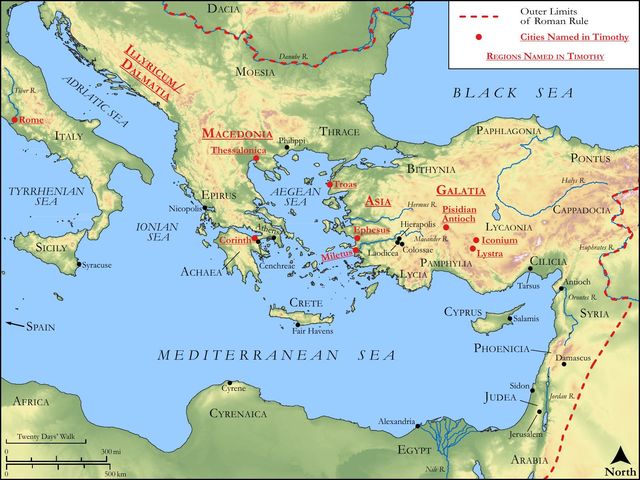
See on the biblical-era map

Study this verse
Public-domain commentary
Matthew Henry
From his Commentary on the Whole Bible. Henry comments on passages, not single verses — this entry covers 2 Timothy 2:1–7. His two-level outline is real structure in the source text, so it is rendered as structure.
Here Paul encourages Timothy to constancy and perseverance in his work: Be strong in the grace that is in Christ Jesus, Ti2 2:1. Observe, Those who have work to do for God must stir up themselves to do it, and strengthen themselves for it. Being strong in the grace that is in Christ Jesus may be understood in opposition to the weakness of grace. Where there is the truth of grace there must be a labouring after the strength of grace. As our trials increase, we have need to grow stronger and stronger in that which is good; our faith stronger, our resolution stronger, our love to God and Christ stronger. Or it may be understood in opposition to our being strong in our own strength: "Be strong, not confiding in thy own sufficiency, but in the grace that is in Jesus Christ." Compare Eph 6:10, Be strong in the Lord, and in the power of his might. When Peter promised rather to die for Christ than to deny him he was strong in his own strength; had he been strong in the grace that is in Christ Jesus, he would have kept his standing better. Observe, 1. There is grace in Christ Jesus; for the law was given by Moses, but grace and truth came by Jesus Christ, Joh 1:17. There is grace enough in him for all of us. 2. We must be strong in this grace; not in ourselves, in our own strength, or in the grace we have already received, but in the grace that is in him, and that is the way to be strong in grace. 3. As a father exhorts his son, so does Paul exhort Timothy, with great tenderness and affection: Thou, therefore, my son, be strong, etc. Observe,
I.Timothy must count upon sufferings, even unto blood, and therefore he must train up others to succeed him in the ministry of the gospel, Ti2 2:2. He must instruct others, and train them up for the ministry, and so commit to them the things which he had heard; and he must also ordain them to the ministry, lodge the gospel as a trust in their hands, and so commit to them the things which he had heard. Two things he must have an eye to in ordaining ministers: - Their fidelity or integrity ("Commit them to faithful men, who will sincerely aim at the glory of God, the honour of Christ, the welfare of souls, and the advancement of the kingdom of the Redeemer among men"), and also their ministerial ability. They must not only be knowing themselves, but be able to teach others also, and be apt to teach. Here we have,
1.The things Timothy was to commit to others - what he had heard of the apostle among many witnesses; he must not deliver any thing besides, and what Paul delivered to him and others he had received of the Lord Jesus Christ.
2.He was to commit them as a trust, as a sacred deposit, which they were to keep, and to transmit pure and uncorrupt unto others.
3.Those to whom he was to commit these things must be faithful, that is, trusty men, and who were skilful to teach others.
4.Though men were both faithful and able to teach others, yet these things must be committed to them by Timothy, a minister, a man in office; for none must intrude themselves into the ministry, but must have these things committed to them by those already in that office.
II.He must endure hardness (Ti2 2:3): Thou therefore, etc.
1.All Christians, but especially ministers, are soldiers of Jesus Christ; they fight under his banner, in his cause, and against his enemies, for he is the captain of our salvation, Heb 2:10.
2.The soldiers of Jesus Christ must approve themselves good soldiers, faithful to their captain, resolute in his cause, and must not give over fighting till they are made more than conquerors, through him that loved them, Rom 8:37.
3.Those who would approve themselves good soldiers of Jesus Christ must endure hardness; that is, we must expect it and count upon it in this world, must endure and accustom ourselves to it, and bear it patiently when it comes, and not be moved by it from our integrity.
III.He must not entangle himself in the affairs of this world, Ti2 2:4.
A soldier, when he has enlisted, leaves his calling, and all the business of it, that he may attend his captain's orders. If we have given up ourselves to be Christ's soldiers, we must sit loose to this world; and though there is no remedy, but we must employ ourselves in the affairs of this life while we are here (we have something to do here), we must not entangle ourselves with those affairs, so as by them to be diverted and drawn aside from our duty to God and the great concerns of our Christianity. Those who will war the good warfare must sit loose to this world. That we may please him who hath chosen us to be soldiers. Observe, 1. The great care of a soldier should be to please his general; so the great care of a Christian should be to please Christ, to approve ourselves to him. The way to please him who hath chosen us to be soldiers is not to entangle ourselves with the affairs of this life, but to be free from such entanglements as would hinder us in our holy warfare.
IV.He must see to it that in carrying on the spiritual warfare he went by rule, that he observed the laws of war (Ti2 2:5):
If a man strive for masteries, yet is he not crowned, except he strive lawfully. We are striving for mastery, to get the mastery of our lusts and corruptions, to excel in that which is good, but we cannot expect the prize unless we observe the laws. In doing that which is good we must take care that we do it in a right manner, that our good may not be evil spoken of. Observe here,
1.A Christian is to strive for masteries; he must aim at mastering his own lusts and corruptions.
2.Yet he must strive according to the laws given to him; he must strive lawfully.
3.Those who do so shall be crowned at last, after a complete victory is obtained.
V.He must be willing to wait for a recompence (Ti2 2:6):
The husbandman that laboureth must be first partaker of the fruits. Or, as it should be read, The husbandman labouring first must partake of the fruits, as appears by comparing it with Jam 5:7. If we would be partakers of the fruits, we must labour; if we would gain the prize, we must run the race. And, further, we must first labour as the husbandman does, with diligence and patience, before we are partakers of the fruit; we must do the will of God, before we receive the promises, for which reason we have need of patience, Heb 10:36.
The apostle further commends what he had said to the attention of Timothy, and expresses his desire and hope respecting him: Consider what I say, and the Lord give thee understanding in all things, Ti2 2:7. Here, 1. Paul exhorts Timothy to consider those thing about which he admonished him. Timothy must be reminded to use his considering faculties about the things of God. Consideration is as necessary to a good conversation as to a sound conversion. 2. He prays for him: The Lord give thee understanding in all things. Observe, It is God who gives understanding. The most intelligent man needs more and more of this gift. If he who gave the revelation in the word does not give the understanding in the heart, we are nothing. Together with our prayers for others, that the Lord would give them understanding in all things, we must exhort and stir them up to consider what we say, for consideration is the way to understand, remember, and practise, what we hear or read.
Historical interpretation
Eight Centuries of Reception
6 surviving comments on this verse. Each one is dated, so this reads as a timeline rather than a list.
Select a marker to jump to its quote. Markers stagger vertically where authors wrote within a few decades of each other.
(The apostle) directs a similar blow against those who said that "the resurrection was past already." Such an opinion did the Valentinians assert of themselves.
Of course the houses of none but married men fare well! The families of celibates, the estates of eunuchs, the fortunes of military men, or of such as travel without wives, have gone to rack and ruin! For are not we, too, soldiers? Soldiers, indeed, subject to all the stricter discipline, that we are subject to so great a General? Are not we, too, travellers in this world? Why moreover, Christian, are you so conditioned, that you cannot (so travel) without a wife? "In my present (widowed)state, too, a consort in domestic works is necessary.
I am aware of the excuses by which we color our insatiable carnal appetites. Our pretexts are: the necessities of props to lean on; a house to be managed; a family to be governed; chests and keys to be guarded; the woolspinning to be dispensed; food to be attended to; cares to be generally lessened. Of course, the houses of none but married men fare well! The families of celibates, the estates of eunuchs, the fortunes of military men or of such as travel without wives have gone to rack and ruin! For are not we, too, soldiers? Soldiers, indeed, subject to all the stricter discipline, since we are subject to so great a General?
The true soldiers of Christ must, in every way, form a fortification for truth and nowhere permit an opening for persuasive falsehood, so far as they are able.
"Thou therefore endure hardness as a good soldier of Jesus Christ." Oh, how great a dignity is this, to be a soldier of Jesus Christ! Observe the kings on earth, how great an honor it is esteemed to serve under them. If therefore the soldier of the king ought to endure hardness, not to endure hardness is not the part of any soldier. So that it behooves thee not to complain, if thou endurest hardness, for that is the part of a soldier; but to complain, if thou dost not endure hardness.
Therefore, endure hardship as a good soldier of Jesus Christ. No one engaged in warfare gets entangled in the affairs of life, so that he may please the one who joined him. And if anyone competes as an athlete, he is not crowned unless he competes according to the rules. The hardworking farmer must be the first to receive a share of the crops.
Woe to me if I do not preach the gospel! Is it so great a thing to be a soldier of Christ? But the mark of a soldier is to endure hardship.
No one engaged in warfare. Paul remembered the soldier, showing that the servant of Christ must be eager and bold; and as an athlete, showing that he needs continuous training. If, therefore, he says, the one serving the earthly king is not entangled in matters that distract him from his weapons, how much more the one who has committed himself to the heavenly king and recruited.
unless he competes according to the rules. For it is not enough merely to be anointed, or to enter the place of combat, or to engage in hand-to-hand fighting with the enemy, but it is also necessary to endure and to win: for this is the law of combat.
The hardworking farmer. Not careless: but one who works. For indeed, the teacher who also works with the students will receive rewards from God for the benefit and advantage of the students.
— [GREGORY OF NYSSA]1 As teachers must first be perfected in themselves in what they teach. For this is necessary, to partake first of the fruits, which they cultivate in themselves through virtues before others. [end of the excerpt by Gregory of Nyssa] —
The example of the soldier and the wanderer suits the students, but that of the farmer suits only the teachers. For just as, it is said, the farmer takes care of the land and the fruits, so must you take care of the students and your preaching. And see to the return. The benefit, it is said, of the students is first enjoyed by the teacher from God, just as the farmer enjoys the fruits.
Continue studying 2 Timothy 2:3 across the web’s major study libraries — every link below opens this exact verse, chapter, or book on the destination site.
Read & Compare
 BibleGatewayThis verse in more than 200 translations and 70 languages.
 Bible.comThe YouVersion reader — hundreds of translations, reading plans, and highlights.
 ESV.orgCrossway's official English Standard Version reader.
 NET BibleThe NET translation with 60,000+ translators' notes on every rendering decision.
 STEP BibleTyndale House's free study tool — original text, vocabulary, and scholarly resources.
 BibliaLogos Bible Software's free web reader.
 USCCBThe New American Bible (Revised Edition) with the U.S. bishops' study notes.
Commentaries
 BibleHub CommentariesDozens of classic commentaries on this verse, gathered on one page.
 StudyLightMore than 100 commentary sets — the largest collection on the web.
 BibleRefPlain-English commentary on what this verse means, verse by verse.
 Enduring WordDavid Guzik's free commentary on this chapter, widely used by Bible teachers.
 Bible Study ToolsVerse commentary alongside Greek and Hebrew study aids.
Original Language & Research
- BibleHub InterlinearThe verse word by word — original language, transliteration, and English.
- BibleHub LexiconEvery word's original-language definition and Strong's entry.
 Blue Letter BibleDeep-study tools — Strong's numbers, concordance, and word studies.
 CNTR CollationThe earliest Greek manuscripts of this verse, collated letter by letter.
Sermons, Hymns & Audio


TrulyRandomVerse is not affiliated with these sites and doesn’t control their content. They’re linked because they’re genuinely useful.
Summary
In the Apostle Paul delivers a direct and potent exhortation to his spiritual protégé, Timothy, urging him to embrace the demanding realities of Christian discipleship and ministry. This verse encapsulates a foundational call for all believers to cultivate resilience, steadfastness, and unwavering commitment in the face of adversity, portraying the Christian life as a spiritual warfare requiring the discipline and loyalty of a dedicated soldier of Jesus Christ.
Context
ShowHideLiterary Context
This verse is situated within Paul's second epistle to Timothy, a deeply personal and poignant letter often regarded as Paul's final testament before his impending martyrdom. Following his charge to Timothy in 2 Timothy 1:13-14 to "hold fast the form of sound words" and "guard the good deposit," Paul transitions in 2 Timothy 2 to a series of vivid metaphors designed to impress upon Timothy the nature of faithful Christian service. The immediate preceding verses (2 Timothy 2:1-2) encourage Timothy to "be strong in the grace that is in Christ Jesus" and to faithfully pass on the gospel message to others, setting the stage for the call to endure hardship as an essential characteristic of such faithful transmission. The soldier metaphor is the first of three (soldier, athlete, farmer) used by Paul to illustrate the necessary qualities for effective ministry, each emphasizing discipline, focus, and perseverance.
Historical & Cultural Context
Paul writes this letter from a Roman prison, likely under house arrest or in a more severe detention, facing the very real prospect of execution (as hinted in 2 Timothy 4:6-8). The early church was experiencing increasing persecution under the Roman Empire, and internal challenges from false teachers were also prevalent, as evidenced throughout the Pastoral Epistles. Timothy, a young leader in Ephesus, faced significant pressure, opposition, and perhaps personal timidity. Paul's counsel, therefore, is not abstract but deeply practical, preparing Timothy for the harsh realities of ministry in a hostile world. The metaphor of a soldier would have resonated strongly with a Roman audience, who were intimately familiar with the discipline, sacrifice, and loyalty demanded of military service, especially in a time of empire building and constant conflict.
Key Themes
ShowHideThe overarching theme of 2 Timothy is perseverance in the face of apostasy and persecution, and 2 Timothy 2:3 contributes directly to this. A primary theme is Endurance and Suffering for the Gospel, where Paul consistently models and calls for steadfastness through trials (2 Timothy 1:8). Another crucial theme is Faithful Discipleship and Ministry, emphasizing the qualities required for effective service, such as discipline, focus, and loyalty, as illustrated by the soldier, athlete, and farmer metaphors (2 Timothy 2:4-6). Finally, the verse highlights Allegiance to Jesus Christ, underscoring that all suffering and service are ultimately for the sake of Christ and His kingdom, not for personal gain or worldly recognition.
Exposition and Analysis
ShowHideKey Word Analysis
ShowHideThis verb, derived from kakos (evil, bad) and pathos (suffering), literally means "to suffer evil" or "to undergo hardship." It denotes enduring affliction, distress, or adversity with steadfastness and resilience. It implies not just experiencing difficulty, but actively bearing up under it without succumbing or complaining, a posture of patient perseverance in the face of tribulation.
This adjective describes something as inherently beautiful, noble, excellent, or morally upright. When applied to a soldier, it signifies not merely competence or skill, but a soldier who is honorable, effective, and embodies the highest standards of conduct and loyalty. It distinguishes a soldier who is truly fit for purpose and worthy of their calling, rather than one who is merely adequate.
This noun refers to a "camper-out" or a "warrior," specifically one engaged in military service. The term evokes images of discipline, obedience, readiness for battle, and a willingness to endure privation and danger for the sake of a mission or commander. In this context, it is a powerful metaphor for a Christian's commitment to spiritual warfare and allegiance to Christ.
Verse Breakdown
ShowHide"Thou therefore endure hardness"
This imperative command, directly addressed to Timothy ("Thou"), is introduced by "therefore" (G3767, oûn), linking it to the preceding exhortations to be strong in grace and to entrust the gospel. It is a summons to active, resolute perseverance in the face of suffering and difficulty. The "hardness" refers to the trials, persecutions, and sacrifices inherent in faithful Christian ministry and discipleship. It is not a suggestion but a necessary condition for effective service.
"as a good soldier"
This phrase introduces the central metaphor of the verse, comparing Timothy (and by extension, all believers) to a soldier. The addition of "good" (G2570, kalós) elevates the standard, implying not just any soldier, but one who is disciplined, loyal, courageous, and dedicated to their mission. This comparison immediately brings to mind qualities like obedience to command, focus on the mission, and readiness to endure hardship and even death for the cause.
"of Jesus Christ."
This genitive phrase clarifies the ultimate allegiance and commander of the "good soldier." The Christian's service and endurance are not for personal glory, a human leader, or a worldly cause, but specifically for Jesus Christ. He is the supreme Commander, and all hardship is endured in His service, for the advancement of His kingdom, and in loyalty to His person. This transforms the metaphor from a general call to resilience into a specific, Christ-centered commitment.
Literary Devices
ShowHideThe primary literary device employed in 2 Timothy 2:3 is Metaphor. Paul directly compares Timothy (and by extension, the Christian believer) to a "good soldier of Jesus Christ." This vivid imagery immediately conveys the qualities required for faithful service: discipline, loyalty, readiness for conflict, and a willingness to endure suffering for a greater cause. The metaphor also implies that the Christian life is a form of Spiritual Warfare, where believers are engaged in a battle against spiritual forces and worldly opposition. Furthermore, the verse contains a strong Imperative ("endure hardness"), which serves as a direct command and exhortation, emphasizing the non-negotiable nature of this call to perseverance.
Theological and Thematic Connections
ShowHideThe call to "endure hardness as a good soldier of Jesus Christ" is deeply theological, rooting Christian perseverance in the very nature of discipleship. It asserts that suffering is not an anomaly but an expected component of following Christ, aligning believers with the pattern of Christ's own suffering and the apostolic experience. This endurance is not passive resignation but active, disciplined loyalty to Jesus as Commander, signifying a commitment to His mission above personal comfort or worldly distractions. It underscores the reality of spiritual warfare and the need for believers to be prepared, focused, and resilient for the sake of the gospel.
Reflection and Application
ShowHide2 Timothy 2:3 serves as a timeless and challenging call to every believer. It shatters any illusion that the Christian life is one of perpetual ease or comfort, instead presenting it as a disciplined, purposeful, and often arduous journey. To "endure hardness" means to face the inevitable trials—whether they be spiritual attacks, social ostracization for one's faith, personal sacrifices for the kingdom, or the sheer grind of consistent obedience—with steadfastness and courage. Like a good soldier, we are called to be disciplined in our spiritual practices, focused on our Commander's mission, loyal to His cause above all else, and ready to make sacrifices. This verse encourages us to embrace difficulty not as an obstacle to faith, but as an integral part of our training and service, knowing that our ultimate allegiance is to Christ, who Himself endured the cross for our sake.
Questions for Reflection
ShowHideFAQ
ShowHideDoes "endure hardness" apply only to pastors or those in full-time ministry, or to all believers?
ShowHideWhile Paul's immediate audience was Timothy, a church leader, the principles embedded in the soldier metaphor in 2 Timothy 2:3 are universally applicable to all believers. Every Christian is called to be a "soldier of Jesus Christ" in the spiritual battle against sin, the world, and the devil. The "hardness" or suffering may manifest differently for various individuals – for some, it's persecution, for others, it's the daily discipline of denying self and taking up one's cross (Luke 9:23), or enduring the scorn of a secular culture for one's faith. The call to endure, to be disciplined, and to remain loyal to Christ is a fundamental aspect of discipleship for every follower of Jesus, regardless of their specific vocation.
Christ-Centered Fulfillment
ShowHide2 Timothy 2:3 finds its ultimate fulfillment and empowerment in Jesus Christ Himself. He is the supreme example of one who "endured hardness," not merely as a soldier, but as the suffering Servant and the Lamb of God. His entire earthly life was marked by self-denial, opposition, and profound suffering, culminating in His obedient submission to the cross (Philippians 2:5-8). He endured the "contradiction of sinners against himself" (Hebrews 12:3) and "suffered once for sins, the righteous for the unrighteous, that he might bring us to God" (1 Peter 3:18). Therefore, when believers are called to endure hardship as "good soldiers of Jesus Christ," they are not called to a burden Christ did not bear, but to participate in His sufferings (Philippians 3:10) and to draw strength from His victorious endurance. He is not only our Commander but also our enabling power, for "we can do all things through Christ who strengthens us" (Philippians 4:13). Our endurance is a reflection of His, and our strength for the battle comes from Him who has already triumphed over sin and death (Colossians 2:15).