


2 Timothy 2:6
Bible text: King James Version (1769 Blayney text) · Public domain
Bible text: Berean Standard Bible · Public domain
Bible text: American Standard Version (1901) · Public domain
Bible text: World English Bible, Messianic edition · Public domain
Bible text: Geneva Bible (1599) · Public domain
Bible text: Young's Literal Translation · Public domain
- τὸνtonFor theG3588T-ASMDefinite article Accusative Singular Masculine
- κοπιῶνταkopiōntahardworkingG2872V-PAP-ASMVerb Present Active Participle Accusative Singular Masculine
- γεωργὸνgeōrgonfarmerG1092N-ASMNoun Accusative Singular Masculine
- δεῖdeiit is necessaryG1163V-PAI-3SVerb Present Active Indicative 3rd Singular
- πρῶτονprōtonfirstG4413A-ASNAdjective Accusative Singular Neuter
- τῶνtōnof theG3588T-GPMDefinite article Genitive Plural Masculine
- καρπῶνkarpōnfruitsG2590N-GPMNoun Genitive Plural Masculine
- μεταλαμβάνειν·metalambaneinto partakeG3335V-PANVerb Present Active Infinitive
English is a literal word-by-word gloss of the Greek, not the KJV's wording. Why?
This is the original text the KJV's translators worked from — each Greek word with its own literal English meaning in this verse, prepared by scholars at Tyndale House, Cambridge. The KJV translates whole sentences, not word by word, so its wording differs: one Greek word can become several English words, and the KJV may choose “charity” where the gloss reads “love”. Both are faithful — they answer different questions. For the KJV's own rendering, switch to the KJV text.
Details
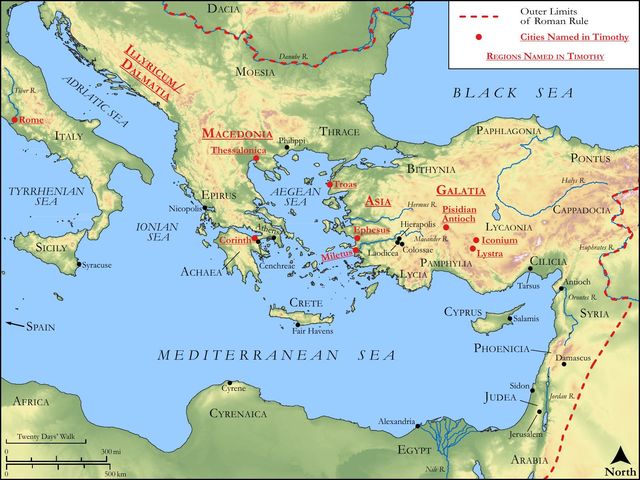
See on the biblical-era maps

Study this verse
Public-domain commentary
Matthew Henry
From his Commentary on the Whole Bible. Henry comments on passages, not single verses — this entry covers 2 Timothy 2:1–7. His two-level outline is real structure in the source text, so it is rendered as structure.
Here Paul encourages Timothy to constancy and perseverance in his work: Be strong in the grace that is in Christ Jesus, Ti2 2:1. Observe, Those who have work to do for God must stir up themselves to do it, and strengthen themselves for it. Being strong in the grace that is in Christ Jesus may be understood in opposition to the weakness of grace. Where there is the truth of grace there must be a labouring after the strength of grace. As our trials increase, we have need to grow stronger and stronger in that which is good; our faith stronger, our resolution stronger, our love to God and Christ stronger. Or it may be understood in opposition to our being strong in our own strength: "Be strong, not confiding in thy own sufficiency, but in the grace that is in Jesus Christ." Compare Eph 6:10, Be strong in the Lord, and in the power of his might. When Peter promised rather to die for Christ than to deny him he was strong in his own strength; had he been strong in the grace that is in Christ Jesus, he would have kept his standing better. Observe, 1. There is grace in Christ Jesus; for the law was given by Moses, but grace and truth came by Jesus Christ, Joh 1:17. There is grace enough in him for all of us. 2. We must be strong in this grace; not in ourselves, in our own strength, or in the grace we have already received, but in the grace that is in him, and that is the way to be strong in grace. 3. As a father exhorts his son, so does Paul exhort Timothy, with great tenderness and affection: Thou, therefore, my son, be strong, etc. Observe,
I.Timothy must count upon sufferings, even unto blood, and therefore he must train up others to succeed him in the ministry of the gospel, Ti2 2:2. He must instruct others, and train them up for the ministry, and so commit to them the things which he had heard; and he must also ordain them to the ministry, lodge the gospel as a trust in their hands, and so commit to them the things which he had heard. Two things he must have an eye to in ordaining ministers: - Their fidelity or integrity ("Commit them to faithful men, who will sincerely aim at the glory of God, the honour of Christ, the welfare of souls, and the advancement of the kingdom of the Redeemer among men"), and also their ministerial ability. They must not only be knowing themselves, but be able to teach others also, and be apt to teach. Here we have,
1.The things Timothy was to commit to others - what he had heard of the apostle among many witnesses; he must not deliver any thing besides, and what Paul delivered to him and others he had received of the Lord Jesus Christ.
2.He was to commit them as a trust, as a sacred deposit, which they were to keep, and to transmit pure and uncorrupt unto others.
3.Those to whom he was to commit these things must be faithful, that is, trusty men, and who were skilful to teach others.
4.Though men were both faithful and able to teach others, yet these things must be committed to them by Timothy, a minister, a man in office; for none must intrude themselves into the ministry, but must have these things committed to them by those already in that office.
II.He must endure hardness (Ti2 2:3): Thou therefore, etc.
1.All Christians, but especially ministers, are soldiers of Jesus Christ; they fight under his banner, in his cause, and against his enemies, for he is the captain of our salvation, Heb 2:10.
2.The soldiers of Jesus Christ must approve themselves good soldiers, faithful to their captain, resolute in his cause, and must not give over fighting till they are made more than conquerors, through him that loved them, Rom 8:37.
3.Those who would approve themselves good soldiers of Jesus Christ must endure hardness; that is, we must expect it and count upon it in this world, must endure and accustom ourselves to it, and bear it patiently when it comes, and not be moved by it from our integrity.
III.He must not entangle himself in the affairs of this world, Ti2 2:4.
A soldier, when he has enlisted, leaves his calling, and all the business of it, that he may attend his captain's orders. If we have given up ourselves to be Christ's soldiers, we must sit loose to this world; and though there is no remedy, but we must employ ourselves in the affairs of this life while we are here (we have something to do here), we must not entangle ourselves with those affairs, so as by them to be diverted and drawn aside from our duty to God and the great concerns of our Christianity. Those who will war the good warfare must sit loose to this world. That we may please him who hath chosen us to be soldiers. Observe, 1. The great care of a soldier should be to please his general; so the great care of a Christian should be to please Christ, to approve ourselves to him. The way to please him who hath chosen us to be soldiers is not to entangle ourselves with the affairs of this life, but to be free from such entanglements as would hinder us in our holy warfare.
IV.He must see to it that in carrying on the spiritual warfare he went by rule, that he observed the laws of war (Ti2 2:5):
If a man strive for masteries, yet is he not crowned, except he strive lawfully. We are striving for mastery, to get the mastery of our lusts and corruptions, to excel in that which is good, but we cannot expect the prize unless we observe the laws. In doing that which is good we must take care that we do it in a right manner, that our good may not be evil spoken of. Observe here,
1.A Christian is to strive for masteries; he must aim at mastering his own lusts and corruptions.
2.Yet he must strive according to the laws given to him; he must strive lawfully.
3.Those who do so shall be crowned at last, after a complete victory is obtained.
V.He must be willing to wait for a recompence (Ti2 2:6):
The husbandman that laboureth must be first partaker of the fruits. Or, as it should be read, The husbandman labouring first must partake of the fruits, as appears by comparing it with Jam 5:7. If we would be partakers of the fruits, we must labour; if we would gain the prize, we must run the race. And, further, we must first labour as the husbandman does, with diligence and patience, before we are partakers of the fruit; we must do the will of God, before we receive the promises, for which reason we have need of patience, Heb 10:36.
The apostle further commends what he had said to the attention of Timothy, and expresses his desire and hope respecting him: Consider what I say, and the Lord give thee understanding in all things, Ti2 2:7. Here, 1. Paul exhorts Timothy to consider those thing about which he admonished him. Timothy must be reminded to use his considering faculties about the things of God. Consideration is as necessary to a good conversation as to a sound conversion. 2. He prays for him: The Lord give thee understanding in all things. Observe, It is God who gives understanding. The most intelligent man needs more and more of this gift. If he who gave the revelation in the word does not give the understanding in the heart, we are nothing. Together with our prayers for others, that the Lord would give them understanding in all things, we must exhort and stir them up to consider what we say, for consideration is the way to understand, remember, and practise, what we hear or read.
Historical interpretation
Six Centuries of Reception
2 surviving comments on this verse. Each one is dated, so this reads as a timeline rather than a list.
Select a marker to jump to its quote. Markers stagger vertically where authors wrote within a few decades of each other.
"The husbandman that laboreth must be first partaker of the fruits." He had first spoken from his own example as a teacher. He now speaks from those that are more common, as wrestlers and soldiers, and in their case he sets before him the rewards. First, that he may please him who hath chosen him to be a soldier; secondly, that he may be crowned; now he proposes a third example that more particularly suits himself. For the instance of the soldier and the wrestler corresponds to those who are under rule, but that of the husbandman to the Teacher. (Strive) not as a soldier or a wrestler only, but as a husbandman too. The husbandman takes care not of himself alone, but of the fruits of the earth. That is, no little reward of his labors is enjoyed by the husbandman. Here he both shows, that to God nothing is wanting, and that there is a reward for Teaching, which he shows by a common instance. As the husbandman, he says, does not labor without profit, but enjoys before others the fruits of his own toils, so is it fit that the teacher should do: either he means this, or he is speaking of the honor to be paid to teachers, but this is less consistent. For why does he not say the husbandman simply, but him "that laboreth"? not only that worketh, but that is worn with toil? And here with reference to the delay of reward, that no one may be impatient, he says, thou reapest the fruit already, or there is a reward in the labor itself. When therefore he has set before him the examples of soldiers, of wrestlers, and husbandmen, and all figuratively, "No one," he says, "is crowned except he strive lawfully." And having observed that "the husbandman who laboreth must first be partaker of the fruits," he adds,
Therefore, endure hardship as a good soldier of Jesus Christ. No one engaged in warfare gets entangled in the affairs of life, so that he may please the one who joined him. And if anyone competes as an athlete, he is not crowned unless he competes according to the rules. The hardworking farmer must be the first to receive a share of the crops.
Woe to me if I do not preach the gospel! Is it so great a thing to be a soldier of Christ? But the mark of a soldier is to endure hardship.
No one engaged in warfare. Paul remembered the soldier, showing that the servant of Christ must be eager and bold; and as an athlete, showing that he needs continuous training. If, therefore, he says, the one serving the earthly king is not entangled in matters that distract him from his weapons, how much more the one who has committed himself to the heavenly king and recruited.
unless he competes according to the rules. For it is not enough merely to be anointed, or to enter the place of combat, or to engage in hand-to-hand fighting with the enemy, but it is also necessary to endure and to win: for this is the law of combat.
The hardworking farmer. Not careless: but one who works. For indeed, the teacher who also works with the students will receive rewards from God for the benefit and advantage of the students.
— [GREGORY OF NYSSA]1 As teachers must first be perfected in themselves in what they teach. For this is necessary, to partake first of the fruits, which they cultivate in themselves through virtues before others. [end of the excerpt by Gregory of Nyssa] —
The example of the soldier and the wanderer suits the students, but that of the farmer suits only the teachers. For just as, it is said, the farmer takes care of the land and the fruits, so must you take care of the students and your preaching. And see to the return. The benefit, it is said, of the students is first enjoyed by the teacher from God, just as the farmer enjoys the fruits.
Continue studying 2 Timothy 2:6 across the web’s major study libraries — every link below opens this exact verse, chapter, or book on the destination site.
Read & Compare
 BibleGatewayThis verse in more than 200 translations and 70 languages.
 Bible.comThe YouVersion reader — hundreds of translations, reading plans, and highlights.
 ESV.orgCrossway's official English Standard Version reader.
 NET BibleThe NET translation with 60,000+ translators' notes on every rendering decision.
 STEP BibleTyndale House's free study tool — original text, vocabulary, and scholarly resources.
 BibliaLogos Bible Software's free web reader.
 USCCBThe New American Bible (Revised Edition) with the U.S. bishops' study notes.
Commentaries
 BibleHub CommentariesDozens of classic commentaries on this verse, gathered on one page.
 StudyLightMore than 100 commentary sets — the largest collection on the web.
 BibleRefPlain-English commentary on what this verse means, verse by verse.
 Enduring WordDavid Guzik's free commentary on this chapter, widely used by Bible teachers.
 Bible Study ToolsVerse commentary alongside Greek and Hebrew study aids.
Original Language & Research
- BibleHub InterlinearThe verse word by word — original language, transliteration, and English.
- BibleHub LexiconEvery word's original-language definition and Strong's entry.
 Blue Letter BibleDeep-study tools — Strong's numbers, concordance, and word studies.
 CNTR CollationThe earliest Greek manuscripts of this verse, collated letter by letter.
Sermons, Hymns & Audio


TrulyRandomVerse is not affiliated with these sites and doesn’t control their content. They’re linked because they’re genuinely useful.
Summary
The metaphor of a diligent farmer illustrates a foundational principle for Christian ministry and life: those who labor faithfully and strenuously in God's service are justly entitled to be the first to partake of the fruits of their efforts. This verse, part of Paul's series of analogies to Timothy, underscores the necessity of hard work, perseverance, and the divine assurance that such dedicated service will indeed yield a rightful and blessed harvest.
Context
ShowHideLiterary Context
This verse is strategically placed within 2 Timothy 2, a chapter where Paul provides Timothy with a series of vivid metaphors to encourage steadfastness and diligence in ministry. Preceding this verse, Timothy is exhorted to endure hardship as a good soldier of Jesus Christ, who avoids civilian entanglements to please his commanding officer. Immediately following, he is likened to an athlete who must compete according to the rules to receive the crown. The "husbandman" (farmer) metaphor in 2 Timothy 2:6 completes this triad, emphasizing not just discipline and endurance, but also the direct relationship between diligent labor and a just reward. Each analogy builds upon the others, painting a comprehensive picture of the dedication, sacrifice, and ultimate recompense inherent in faithful gospel work.
Historical & Cultural Context
In the agrarian societies of the ancient world, farming was the backbone of the economy and daily life. The "husbandman" (farmer) was a familiar and relatable figure to Paul's audience. Their existence was intrinsically linked to the land, requiring immense physical labor, patience, and a deep understanding of natural cycles. Farmers toiled from dawn till dusk, often facing unpredictable weather, pests, and poor harvests. Critically, the expectation that the farmer would be the first to benefit from their own harvest was a universally accepted principle of justice and economic reality. This right was often enshrined in law and custom, as seen in various Old Testament regulations concerning gleaning and the care of laborers. Paul leverages this common understanding to convey a spiritual truth: just as a farmer's labor directly leads to their sustenance, so too does diligent spiritual labor lead to its appropriate spiritual "fruits" and blessings.
Key Themes
ShowHideThe primary themes embedded in 2 Timothy 2:6 revolve around diligence and perseverance in labor, the principle of just reward, and implicitly, God's faithful provision. The emphasis on "laboureth" (Greek: kopiáō) highlights the strenuous, often exhausting effort required in ministry, signifying that spiritual fruit is not achieved without significant personal investment and enduring commitment. This concept aligns with the broader biblical principle of sowing and reaping, where effort yields results, and those who sow generously will also reap generously. Furthermore, the verse affirms that God honors and rewards faithful service, establishing a divine economy where diligent work is justly compensated. While human effort is paramount, the ultimate fruitfulness is also a testament to God's sovereign grace and provision, as the farmer relies on divine elements like rain and sun for the harvest.
Exposition and Analysis
ShowHideKey Word Analysis
ShowHideFrom γῆ (earth) and ἔργον (work), literally an "earth-worker." This term emphasizes the direct, physical, and often arduous engagement with the soil. It portrays someone deeply invested in the land, whose livelihood and success are directly tied to their diligent cultivation. In Paul's metaphor, it represents a minister or Christian worker whose spiritual labor is analogous to a farmer's physical toil.
To feel fatigue; by implication, to work hard, often to the point of exhaustion. This word denotes intense, strenuous, and sacrificial effort. It's not casual work but a deep, persistent commitment that expends significant energy. For the Christian worker, it signifies the demanding nature of gospel ministry, which requires perseverance despite difficulties.
Fruit (as plucked), literally or figuratively. This term refers to the produce of the land, the yield of the farmer's labor. Figuratively, in the context of ministry, it represents the results of spiritual work: transformed lives, spiritual growth, souls saved, and the blessings that flow from diligent service to God.
Verse Breakdown
ShowHide"The husbandman that laboureth"
This opening clause identifies the subject of the proverb: a farmer who is actively engaged in strenuous, persistent work. The emphasis is not merely on being a farmer, but on being one who "laboureth" – implying a deep, often exhausting commitment to the task. In the spiritual application, this refers to any believer, particularly those in ministry, who diligently and sacrificially applies themselves to God's work.
"must be first partaker"
The word "must" (Greek: deî) indicates a divine necessity or obligation, underscoring that this is a just and inherent principle. "First partaker" (Greek: prōtos metalambánō) signifies priority and rightful entitlement. It does not imply exclusivity but rather that the one who has invested the labor has the primary and immediate right to enjoy the benefits of that labor. This highlights the fairness of God's economy, where effort is duly recognized and rewarded.
"of the fruits"
This refers to the produce or yield of the farmer's labor. In the spiritual metaphor, "fruits" represent the tangible and intangible outcomes of diligent Christian service. These can include spiritual growth, transformed lives, souls brought to Christ, the joy of seeing God's kingdom advance, and the personal blessings and divine provision that accompany faithful obedience and service.
Literary Devices
ShowHideThe primary literary device employed in 2 Timothy 2:6 is Metaphor. Paul uses the familiar image of a farmer to represent a Christian minister or any believer engaged in spiritual work. This metaphor effectively conveys the concepts of diligent labor, patience, and the expectation of a harvest. Closely related is Analogy, as this verse functions as one of three distinct comparisons (soldier, athlete, farmer) that Paul uses in 2 Timothy 2 to instruct Timothy on the nature of dedicated service. The verse also functions as an Axiom or a self-evident truth, presenting a universally accepted principle from the natural world (the farmer's right to his harvest) as a foundational truth for the spiritual realm. This makes the exhortation both relatable and compelling, grounding spiritual principles in common human experience.
Theological and Thematic Connections
ShowHideThe principle articulated in 2 Timothy 2:6 resonates deeply with the biblical understanding of divine justice and God's economy of reward. While salvation is entirely by grace through faith, God consistently honors and rewards the diligent labor of His servants. This verse underscores that faithful, often arduous, work in the kingdom of God is not in vain; it inherently leads to a rightful and blessed harvest. It speaks to God's character as one who sees and values the efforts of His children, ensuring that those who sow generously will also reap generously. The "fruits" are not merely earthly gains but encompass spiritual blessings, transformed lives, and the joy of participating in God's redemptive work, all of which are a just recompense for the investment of one's life.
Reflection and Application
ShowHide2 Timothy 2:6 offers profound encouragement and a vital reminder for every believer engaged in God's work, whether in formal ministry or the daily outworking of their faith. It powerfully communicates that spiritual growth, impact, and blessing are rarely accidental; they are typically the result of consistent, diligent, and often sacrificial effort. Just as a farmer cannot expect a harvest without first tilling the soil, planting the seed, and tending the crop, so too must we invest ourselves wholeheartedly in the spiritual tasks God has given us. This verse calls us to embrace the demanding nature of Christian living and service, assuring us that our "labor in the Lord is not in vain" (1 Corinthians 15:58). The "fruits" we partake of may be the joy of seeing lives transformed, the personal spiritual maturity gained through perseverance, the peace that comes from obedience, or the tangible blessings God pours out on those who faithfully serve Him. It challenges us to patiently endure, trusting that God will bring forth His harvest in His perfect timing.
Questions for Reflection
ShowHideFAQ
ShowHideDoes "first partaker" mean that ministers or Christian workers are entitled to special privileges or are superior to others?
ShowHideNo, the phrase "first partaker" in 2 Timothy 2:6 does not imply superiority or exclusive privilege. Instead, it emphasizes the principle of just compensation and the natural right of the laborer to benefit directly from their own strenuous efforts. In an agricultural context, it was understood that the farmer, having invested sweat and toil, had the primary right to consume or sell the produce before anyone else. Spiritually, it means that those who dedicate themselves to the demanding work of ministry or Christian service are the rightful and primary beneficiaries of the spiritual "fruits" that God produces through their labor. This can include spiritual joy, personal growth, seeing lives transformed, or even material support, as affirmed elsewhere in Scripture (e.g., 1 Timothy 5:18). It's about a just reward for diligent effort, not a claim to elevated status.
What are the "fruits" that a Christian "husbandman" can expect to partake of?
ShowHideThe "fruits" in 2 Timothy 2:6 are multifaceted and extend beyond mere material gain. Spiritually, they represent the tangible and intangible outcomes of faithful labor in God's kingdom. These can include the transformation of lives through the gospel, the spiritual growth and maturity of believers, the joy and satisfaction of seeing God work through one's efforts, the development of Christ-like character (the fruit of the Spirit), the experience of God's presence and provision, and ultimately, eternal rewards in heaven. Just as a farmer's harvest sustains them, the spiritual "fruits" sustain and nourish the Christian worker, providing encouragement, purpose, and a deep sense of fulfillment in their service to God.
Christ-Centered Fulfillment
ShowHideWhile 2 Timothy 2:6 presents a general principle of just reward for diligent labor, its deepest and most profound fulfillment is found in Jesus Christ. He is the ultimate "husbandman," the one who perfectly exemplified strenuous labor in the vineyard of God. Throughout His earthly ministry, Jesus tirelessly sowed the seeds of the Kingdom, proclaiming the good news, healing the sick, and teaching the truth, often to the point of exhaustion (Mark 6:31). His ultimate labor culminated in His sacrificial death on the cross, where He bore the full weight of humanity's sin, and His glorious resurrection, which secured eternal life for all who believe. It was for "the joy that was set before him" (Hebrews 12:2) that He endured the cross, demonstrating that the greatest labor yields the greatest fruit. As the "true vine" (John 15:1), Jesus Himself is the source of all spiritual fruit, and through His Spirit, He enables His followers to bear much fruit for the glory of God (John 15:5). Thus, Christ is not only the diligent laborer but also the "first partaker" of the ultimate "fruits" of redemption, sharing His victory, His Spirit, and the eternal harvest of saved souls with His beloved church.