


2 Peter 1:14
- εἰδὼςeidōsknowingG1492V-RAP-NSMVerb Perfect Active Participle Nominative Singular Masculine
- ὅτιhotithatG3754CONJConjunction
- ταχινήtachinēimminentG5031A-NSFAdjective Nominative Singular Feminine
- ἐστινestinisG1510V-PAI-3SVerb Present Active Indicative 3rd Singular
- ἡhētheG3588T-NSFDefinite article Nominative Singular Feminine
- ἀπόθεσιςapothesisputting offG595N-NSFNoun Nominative Singular Feminine
- τοῦtouof theG3588T-GSNDefinite article Genitive Singular Neuter
- σκηνώματόςskēnōmatostabernacleG4638N-GSNNoun Genitive Singular Neuter
- μουmouof mineG3165P-1GSPersonal pronoun Genitive 1st Singular
- καθὼςkathōseven asG2531CONJConjunction
- καὶkaialsoG2532CONJConjunction
- ὁhotheG3588T-NSMDefinite article Nominative Singular Masculine
- κύριοςkuriosLordG2962N-NSM-TNoun Nominative Singular Masculine Title
- ἡμῶνhēmōnof usG3165P-1GPPersonal pronoun Genitive 1st Plural
- ἸησοῦςIēsousJesusG2424N-NSM-PNoun Nominative Singular Masculine Individual
- ΧριστὸςChristosChristG5547N-NSM-TNoun Nominative Singular Masculine Title
- ἐδήλωσένedēlōsenhas made clearG1213V-AAI-3SVerb Aorist Active Indicative 3rd Singular
- μοιmoito meG3165P-1DSPersonal pronoun Dative 1st Singular
English is a literal word-by-word gloss of the Greek, not the KJV's wording. Why?
This is the original text the KJV's translators worked from — each Greek word with its own literal English meaning in this verse, prepared by scholars at Tyndale House, Cambridge. The KJV translates whole sentences, not word by word, so its wording differs: one Greek word can become several English words, and the KJV may choose “charity” where the gloss reads “love”. Both are faithful — they answer different questions. For the KJV's own rendering, switch to the KJV text.
Details
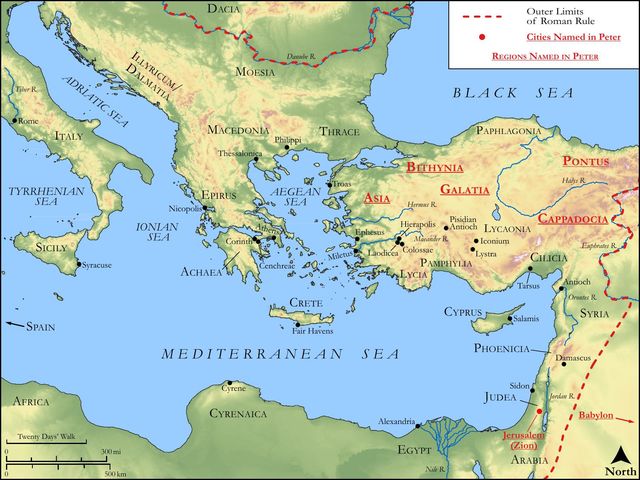
See on the biblical-era map

Study this verse
Public-domain commentary
Matthew Henry
From his Commentary on the Whole Bible. Henry comments on passages, not single verses — this entry covers 2 Peter 1:12–15. His two-level outline is real structure in the source text, so it is rendered as structure.
I.The importance and advantage of progress and perseverance in grace and holiness made the apostle to be very diligent in doing the work of a minister of Christ, that he might thereby excite and assist them to be diligent in the duty of Christians. If ministers be negligent in their work, it can hardly be expected that the people will be diligent in theirs; therefore Peter will not be negligent (that is, at no time or place, in no part of his work, to no part of his charge), but will be exemplarily and universally diligent, and that in the work of a remembrancer. This is the office of the best ministers, even the apostles themselves; they are the Lord's remembrancers (Isa 62:6); they are especially bound to make mention of the promises, and put God in mind of his engagements to do good to his people; and they are the people's remembrancers, making mention of God's precepts, and putting them in mind of the doctrines and duties of Christianity, that they may remember God's commandments, to do them. And this the apostle does, though some persons might think it needless, inasmuch as they already knew those thing that he writes about, and were established in the very truth that he insists upon. Observe,
1.We need to be put in mind of what we already know to prevent our forgetting it, and to improve our knowledge, and reduce all to practice.
2.We must be established in the belief of the truth, that we may not be shaken by every wind of doctrine, and especially in that which is the present truth, the truth more peculiarly necessary for us to know in our day, that which belongs to our peace, and which is more especially opposed in our time. The great doctrines of the gospel, that Jesus is the Christ, that Jesus Christ came into the world to save sinners, that those who believe in the Lord Jesus Christ shall be saved, and all that believe in God must be careful to maintain good works - these are truths the apostles insisted on in their day; these are faithful sayings, and worthy of all acceptation in every age of the Christian church. And, as these must be constantly affirmed by ministers (Tit 3:8), so the people are to be well instructed and established therein, and yet must, after all their attainments in knowledge, be put in mind of such things as cannot be too clearly known nor too firmly believed. The most advanced Christians cannot, while in this world, be above ordinances, nor beyond the need of those means which God has appointed and does afford. And, if the people need teaching and exhortation while they are in the body, it is very meet and just that ministers should, as long as they are in this tabernacle, instruct and exhort them, and bring those truths to their remembrance that they have formerly heard, this being a proper means to stir them up to be diligent and lively in a course of gospel-obedience.
II.The apostle, being set upon the work, tells us (Pe2 1:14) what makes him earnest in this matter, even the knowledge he had, not only that he must certainly, but also that he must shortly, put off this tabernacle. Observe,
1.The body is but the tabernacle of the soul. It is a mean and movable structure, whose stakes can be easily removed, and its cords presently broken.
2.This tabernacle must be put off. We are not to continue long in this earthly house. AS at night we put off our clothes, and lay them by, so at death we must put off our bodies, and they musts be laid up in the grave till the morning of the resurrection.
3.The nearness of death makes the apostle diligent in the business of life. Our Lord Jesus had shown him that the time of his departure was at hand, and therefore he bestirs himself with greater zeal and diligence, because the time is short. He must soon be removed from those to whom he wrote; and his ambition being that they should remember the doctrine he had delivered to them, after he himself was taken away from them, he commits his exhortation to writing. The apostle had not any great opinion of oral tradition. This was not so proper a means to reach the end he was in pursuit of. He would have them always to remember these things, and not only to keep them in mind, but also to make mention of them, as the original words import. Those who fear the Lord make mention of his name, and talk of his loving-kindness. This is the way to spread the knowledge of the Lord and this the apostle had at heart: and those who have the written word of God are thereby put into a capacity to do this.
Historical interpretation
Seven Centuries of Reception
4 surviving comments on this verse. Each one is dated, so this reads as a timeline rather than a list.
Select a marker to jump to its quote. Markers stagger vertically where authors wrote within a few decades of each other.
The Lord Jesus showed Peter that his end was near either by a revelation through the Holy Spirit or by his response to Peter when he said: “Get behind me, Satan” or perhaps by dreams and visions in the night.
Knowing that the putting off of my tabernacle is very near. Most beautifully does blessed Peter call his demise not death, but the putting off of his tabernacle, because indeed for the perfect servants of God it is as if they cast off the bonds of the flesh, as travelers having completed their journey go to their own home for habitation instead of their tabernacle, as those deployed in expedition return to their fatherland after the enemy has been driven away or defeated. For they acknowledge only their own home, only their municipality, only their fatherland in the heavens. Of which also the apostle Paul says: “We know that if our earthly house of this tabernacle is dissolved, we have a building from God, a house not made with hands, eternal in the heavens” (2 Cor. 5).
Yet I think it right, as long as I am in this tent, to stir you up by reminding you, knowing that shortly I must put off my tent, just as our Lord Jesus Christ showed me. Moreover, I will be careful to ensure that you always have a reminder of these things after my departure.
What is suggested, for example: "I will be careful to ensure that you always," some understand through a reversal of a word order in this way: I will take care and after my departure, you will always have or continuously the memory of these things: wanting to show from this that even after the death of the saints, they remembered what they accomplished here for the living. Others, however, simply treating that saying, understand it thus: I will take care and you will always have after my departure the last mention of these things: that is, do not be surprised, nor consider it burdensome that there is a constant mention made to you about these matters. For I do not do this condemning your ignorance, but by a continuous teaching about these things, I present to you this support, so that, being strengthened by these, you may also have after my death a living and permanent teaching about these matters.
Peter explains that he keeps repeating the same things to his hearers because he knows that his end is coming quickly and that he will soon be delivered from his body.
Continue studying 2 Peter 1:14 across the web’s major study libraries — every link below opens this exact verse, chapter, or book on the destination site.
Read & Compare
 BibleGatewayThis verse in more than 200 translations and 70 languages.
 Bible.comThe YouVersion reader — hundreds of translations, reading plans, and highlights.
 ESV.orgCrossway's official English Standard Version reader.
 NET BibleThe NET translation with 60,000+ translators' notes on every rendering decision.
 STEP BibleTyndale House's free study tool — original text, vocabulary, and scholarly resources.
 BibliaLogos Bible Software's free web reader.
 USCCBThe New American Bible (Revised Edition) with the U.S. bishops' study notes.
Commentaries
 BibleHub CommentariesDozens of classic commentaries on this verse, gathered on one page.
 StudyLightMore than 100 commentary sets — the largest collection on the web.
 BibleRefPlain-English commentary on what this verse means, verse by verse.
 Enduring WordDavid Guzik's free commentary on this chapter, widely used by Bible teachers.
 Bible Study ToolsVerse commentary alongside Greek and Hebrew study aids.
Original Language & Research
- BibleHub InterlinearThe verse word by word — original language, transliteration, and English.
- BibleHub LexiconEvery word's original-language definition and Strong's entry.
 Blue Letter BibleDeep-study tools — Strong's numbers, concordance, and word studies.
 CNTR CollationThe earliest Greek manuscripts of this verse, collated letter by letter.
Sermons, Hymns & Audio


TrulyRandomVerse is not affiliated with these sites and doesn’t control their content. They’re linked because they’re genuinely useful.
Summary
In 2 Peter 1:14, the Apostle Peter articulates his profound and divinely revealed awareness of his imminent physical death, which he describes as the "putting off" of his earthly "tabernacle." This poignant declaration underscores his deep trust in the Lord Jesus Christ's foreknowledge and sovereign plan for his life and ministry, providing a final, urgent impetus for his epistle's exhortations to spiritual growth and steadfastness in truth.
Context
ShowHideLiterary Context
This verse is situated within Peter's second and final epistle, a letter characterized by its urgent tone and profound theological depth. Having just affirmed his commitment to remind his readers of essential truths "as long as I am in this tabernacle" (2 Peter 1:13), Peter immediately follows with the stark reality of his impending departure. This personal revelation serves to imbue his subsequent warnings against false teachers and his exhortations to spiritual diligence with an undeniable sense of finality and apostolic authority. His awareness of his limited time on earth underscores the critical importance of the truths he is imparting, urging believers to pursue a life of virtue and knowledge before his voice is silenced. The entire chapter of 2 Peter 1 emphasizes the call to add to one's faith, culminating in Peter's urgent desire to ensure his readers remember these things after his decease (2 Peter 1:15).
Historical & Cultural Context
Peter's statement reflects the historical reality of the early church under Roman persecution, particularly during the reign of Emperor Nero. Tradition holds that Peter was martyred in Rome around A.D. 64-68, likely by crucifixion. His reference to "putting off this my tabernacle" resonates with the ancient understanding of the body as a temporary dwelling for the soul, a common philosophical and religious idea in both Jewish and Hellenistic thought. For Jewish readers, the "tabernacle" (Greek: skēnōma) would evoke the portable tent of meeting in the wilderness, symbolizing God's temporary dwelling among His people before the permanent Temple. This imagery would powerfully convey the transient nature of earthly life compared to the eternal dwelling with God. Peter's calm acceptance of his death also reflects the early Christian ethos of martyrdom, where dying for Christ was seen not as a defeat but as a triumphant entry into eternal glory, a concept deeply rooted in the example of Christ's own sacrifice and resurrection.
Key Themes
ShowHidePeter's declaration in this verse contributes significantly to several major themes found throughout 2 Peter. Firstly, it highlights the divine foreknowledge and sovereignty of God, as Peter's death is not a random event but one "shewed" to him by Christ Himself, fulfilling a prior prophecy. Secondly, it emphasizes the temporary nature of the earthly body and life, contrasting it with the eternal hope that awaits believers. This theme is echoed in other New Testament writings, such as Paul's reflections on the earthly tent versus the heavenly dwelling in 2 Corinthians 5:1-4. Thirdly, Peter's calm acceptance of his impending death underscores the Christian's hope in resurrection and eternal life, demonstrating a profound trust in God's ultimate plan even in the face of mortality. Finally, Peter's awareness of his limited time instills a sense of urgency regarding spiritual truth and perseverance, motivating his readers to "make your calling and election sure" (2 Peter 1:10) before the inevitable end.
Exposition and Analysis
ShowHideKey Word Analysis
ShowHideThis word (G1492) is a primary verb meaning "to see (literally or figuratively); by implication, (in the perfect tense only) to know." In this context, it signifies a deep, experiential, and certain knowledge, not mere intellectual assent. Peter possesses a profound, divinely imparted awareness of his imminent death, a certainty that shapes his final message.
Derived from G595, this noun means "a laying aside (literally or figuratively)." It suggests the act of shedding or removing something, like taking off clothes. Here, it vividly portrays death not as an annihilation but as a deliberate act of divesting oneself of the earthly body, a temporary garment or dwelling.
This noun (G4638) comes from a root meaning "to encamp" or "to dwell in a tent." It refers to "an encampment, i.e. (figuratively) the Temple (as God's residence), the body (as a tenement for the soul)." Peter's use of "tabernacle" for his body powerfully conveys its temporary, movable, and transient nature, contrasting with the permanent, eternal dwelling that awaits the believer.
This verb means "to make plain (by words):--declare, shew, signify." It indicates a clear, explicit revelation or declaration. Peter's knowledge of his impending death is not a guess or a premonition, but a direct, unambiguous disclosure from the Lord Jesus Christ Himself, highlighting divine communication and foreknowledge.
Verse Breakdown
ShowHide"Knowing that shortly I must put off [this] my tabernacle"
Peter begins with an affirmation of certain knowledge ("Knowing"), indicating a settled conviction rather than a speculative thought. The adverb "shortly" (G5031, tachinós) emphasizes the imminent and impending nature of this event, adding a sense of urgency to his message. The phrase "I must" (G2076, estí) conveys a divine necessity or appointed destiny, not a reluctant obligation. The core metaphor, "put off [this] my tabernacle," vividly describes his death as a deliberate removal or shedding of his physical body, which he likens to a temporary tent or dwelling place. This imagery underscores the transient nature of earthly life and the body as merely a temporary vessel for the soul.
"even as our Lord Jesus Christ hath shewed me"
This clause reveals the source of Peter's profound certainty: it was a direct, explicit revelation from Jesus Christ Himself. The conjunction "even as" (G2532, kaí and G2531, kathṓs) draws a direct parallel between Peter's present knowledge and a past divine disclosure. This directly references Jesus' prophecy to Peter in John 21:18-19, where Christ foretold the manner of Peter's death, implying martyrdom. This divine revelation validates Peter's apostolic authority and adds immense weight to his final exhortations, as he speaks with the full awareness of his divinely appointed end.
Literary Devices
ShowHideThe verse employs several powerful literary devices. The most prominent is Metaphor, where Peter refers to his body as a "tabernacle" (Greek: skēnōma). This imagery evokes a temporary, movable dwelling, contrasting sharply with the permanence of an eternal home and emphasizing the transient nature of earthly existence. This metaphor provides a profound theological statement about the body's role as a vessel for the soul during its earthly sojourn. There is also a strong element of Foreshadowing and Prophecy Fulfillment, as Peter's statement directly alludes to Jesus' prior prediction of his death in John 21. This highlights the theme of divine foreknowledge and the certain fulfillment of Christ's words. Finally, Peter's declaration is a form of Personal Testimony, lending authenticity and urgency to his message. His calm acceptance of his divinely appointed end serves as a powerful example of faith and trust in God's sovereign plan, even in the face of death.
Theological and Thematic Connections
ShowHidePeter's declaration in 2 Peter 1:14 offers profound theological insights into the Christian understanding of life, death, and eternity. It underscores the biblical truth that physical death is not an ultimate end but a transition, a "putting off" of a temporary dwelling in anticipation of a more glorious, eternal reality. This perspective transforms death from a fearful unknown into a divinely ordained passage, known and appointed by Christ Himself. It speaks to the sovereignty of God over all aspects of human life, including its termination, and reinforces the certainty of Christ's words and prophecies. For the believer, this verse instills a sense of confident hope, knowing that even in death, they are in the hands of a Lord who has conquered death and prepared an eternal dwelling.
Reflection and Application
ShowHidePeter's serene acceptance of his impending death, rooted in divine revelation, provides a powerful model for believers facing their own mortality or the loss of loved ones. This verse encourages us to view our earthly lives and physical bodies as temporary, precious gifts for a season, rather than ultimate realities. Understanding that our time here is a brief sojourn should motivate us to live with intentionality and urgency, investing our lives in eternal values and the advancement of God's kingdom, rather than clinging to fleeting earthly comforts or pursuits. Peter's example of trust in God's sovereign plan, even concerning the circumstances of his death, invites us to cultivate a similar surrender and peace, knowing that our times are in His hands. This perspective fosters a spirit of readiness, not fear, enabling us to embrace each day as an opportunity to glorify God and prepare for the eternal dwelling He has promised.
Questions for Reflection
ShowHideFAQ
ShowHideHow did Jesus "shew" Peter that he must "put off his tabernacle"?
ShowHideThe most direct and widely accepted interpretation is that Jesus "shewed" Peter his impending death through a specific prophecy recorded in John 21:18-19. After His resurrection, Jesus told Peter, "Truly, truly, I say to you, when you were young, you used to dress yourself and walk wherever you wanted, but when you are old, you will stretch out your hands, and another will dress you and carry you where you do not want to go." The Gospel of John explicitly states, "This he said to show by what kind of death he was to glorify God." This prophecy, traditionally understood as a prediction of Peter's crucifixion, was a direct, divine revelation that gave Peter certain knowledge of his future martyrdom.
What does Peter mean by calling his body a "tabernacle"?
ShowHideBy calling his body a "tabernacle" (Greek: skēnōma), Peter uses a powerful metaphor to convey its temporary and transient nature. A tabernacle is a tent or a temporary dwelling, like the portable tent of meeting used by the Israelites in the wilderness. This imagery emphasizes that the physical body is not our ultimate or permanent home; it is a temporary vessel for the soul during its earthly sojourn. This contrasts with the eternal, spiritual dwelling that awaits believers in heaven. The Apostle Paul uses similar imagery in 2 Corinthians 5:1, referring to our earthly body as an "earthly house of this tabernacle" that will be "dissolved" to make way for "a building of God, an house not made with hands, eternal in the heavens."
Why is Peter so calm and accepting about his impending death?
ShowHidePeter's calm and accepting demeanor regarding his imminent death stems from several profound theological convictions. Firstly, he "knows" it is a divinely appointed event, "shewed" to him by Christ Himself, signifying his trust in God's sovereign plan (John 21:18-19). Secondly, his understanding of his body as a temporary "tabernacle" means death is not an end but a transition to a more glorious, eternal state. This aligns with the Christian hope of resurrection and eternal life with Christ (1 Corinthians 15:53-54). Finally, Peter's life was centered on Christ ("For to me to live is Christ," as Paul said in Philippians 1:21), and for a believer, death means being "absent from the body, and to be present with the Lord" (2 Corinthians 5:8). This profound hope and assurance eliminate the fear of death.
Christ-Centered Fulfillment
ShowHidePeter's declaration in 2 Peter 1:14, though personal, finds its profound Christ-centered fulfillment in the person and work of Jesus Christ. Peter's calm acceptance of "putting off his tabernacle" is a direct echo of Christ's own willing submission to death on the cross, a death that was also "shewed" to Him and prophesied in the Old Testament (Isaiah 53:7-8). Jesus, the perfect Lamb of God, voluntarily laid down His life, not as a temporary dwelling but as the ultimate sacrifice for sin, thereby conquering death and the power of the grave (Hebrews 2:14-15). Peter's confidence in facing death stems directly from Christ's resurrection, which guarantees the believer's own future resurrection and transformation into an imperishable body (1 Corinthians 15:42-44). The "eternal dwelling" that awaits Peter and all believers is secured by Christ's promise to prepare a place for His own (John 14:2-3). Thus, Peter's peaceful anticipation of departure is not merely stoicism but a living hope, birthed from the finished work of Jesus Christ, who is "the resurrection and the life" (John 11:25-26).