


1 Kings 2:2
Bible text: King James Version (1769 Blayney text) · Public domain
Bible text: Berean Standard Bible · Public domain
Bible text: American Standard Version (1901) · Public domain
Bible text: World English Bible, Messianic edition · Public domain
Bible text: Geneva Bible (1599) · Public domain
Bible text: Young's Literal Translation · Public domain
- אָנֹכִי'a·no·KhiIH595Pro-1csPronoun Personal 1st Singular common gender
- הֹלֵךְho·Lekh[am] about to goH1980V-Qal-Prtcpl-msVerb Qal Participle Singular Masculine Absolute
- בְּדֶרֶךְbe·De·rekhin [the] way ofH1870Prep-b ¦ N-cscNoun Singular common gender Constructבְּinדֶרֶךְ[the] way of
- כָּלkolallH3605N-mscNoun Singular Masculine Construct
- הָאָרֶץha·'A·retzthe earthH776Art ¦ N-fsNoun Singular Feminine Absoluteהָtheאָרֶץearth
- וְחָזַקְתָּve·cha·zak·Taand you will be strongH2388Conj-w ¦ V-Qal-ConsecPerf-2msVerb Qal Consecutive Perfect 2nd Singular Masculineוְandחָזַקְתָּyou will be strong
- וְהָיִיתָve·ha·Yi·taand you will becomeH1961Conj-w ¦ V-Qal-ConsecPerf-2msVerb Qal Consecutive Perfect 2nd Singular Masculineוְandהָיִיתָyou will become
- לְאִישׁle·'Ish<into> a manH376Prep-l ¦ N-msNoun Singular Masculine Absoluteלְ<into>אִישׁa man
English is a literal word-by-word gloss of the Hebrew, not the KJV's wording. Why?
This is the original text the KJV's translators worked from — each Hebrew word with its own literal English meaning in this verse, prepared by scholars at Tyndale House, Cambridge. The KJV translates whole sentences, not word by word, so its wording differs: one Hebrew word can become several English words, and the KJV may choose “the LORD” where the gloss reads “Yahweh”. Both are faithful — they answer different questions. For the KJV's own rendering, switch to the KJV text.
Details
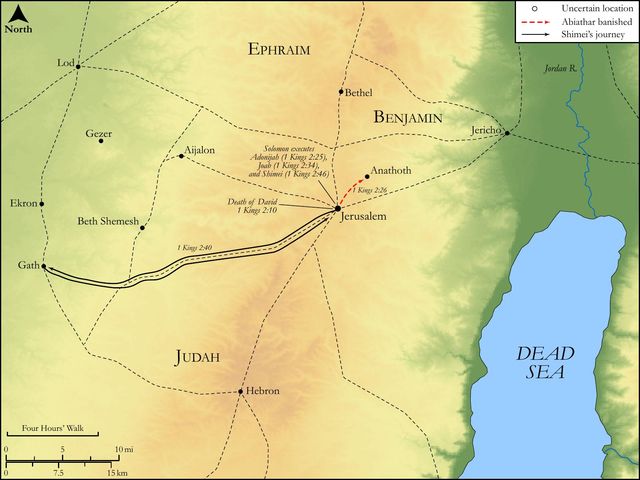
See on the biblical-era maps

Study this verse
Continue studying 1 Kings 2:2 across the web’s major study libraries — every link below opens this exact verse, chapter, or book on the destination site.
Read & Compare
 BibleGatewayThis verse in more than 200 translations and 70 languages.
 Bible.comThe YouVersion reader — hundreds of translations, reading plans, and highlights.
 ESV.orgCrossway's official English Standard Version reader.
 NET BibleThe NET translation with 60,000+ translators' notes on every rendering decision.
 STEP BibleTyndale House's free study tool — original text, vocabulary, and scholarly resources.
 BibliaLogos Bible Software's free web reader.
 USCCBThe New American Bible (Revised Edition) with the U.S. bishops' study notes.
Commentaries
 BibleHub CommentariesDozens of classic commentaries on this verse, gathered on one page.
 StudyLightMore than 100 commentary sets — the largest collection on the web.
 BibleRefPlain-English commentary on what this verse means, verse by verse.
 Enduring WordDavid Guzik's free commentary on this chapter, widely used by Bible teachers.
 Bible Study ToolsVerse commentary alongside Greek and Hebrew study aids.
Original Language & Research
- BibleHub InterlinearThe verse word by word — original language, transliteration, and English.
- BibleHub LexiconEvery word's original-language definition and Strong's entry.
 Blue Letter BibleDeep-study tools — Strong's numbers, concordance, and word studies.
 SefariaThe Hebrew text with Rashi and centuries of Jewish commentary.
Sermons, Hymns & Audio


TrulyRandomVerse is not affiliated with these sites and doesn’t control their content. They’re linked because they’re genuinely useful.
Summary
King David, in his final moments, delivers a profound and poignant charge to his son and successor, Solomon. This verse encapsulates David's humble acknowledgment of his own impending death, a universal human reality, and issues a powerful imperative for Solomon to embrace his immense responsibilities with unwavering strength, moral courage, and mature leadership as he prepares to govern the people of Israel. It sets a foundational tone for Solomon's reign, emphasizing the character required for righteous rule and the weighty task of upholding the Davidic covenant.
Context
ShowHideLiterary Context
This verse serves as the solemn commencement of King David's final instructions to Solomon, immediately following the narrative declaration that David was "old and full of days" and approaching death (1 Kings 2:1). These are not merely a personal farewell but a formal, divinely sanctioned charge from the departing king to his designated heir, Solomon, who has recently been anointed king over Israel (1 Kings 1:39). The subsequent verses elaborate on this charge, detailing specific directives regarding obedience to God's law (1 Kings 2:3-4) and the handling of certain individuals who posed threats or deserved reward. This passage is pivotal, marking the crucial transition of the Davidic dynasty and establishing the moral and spiritual foundation upon which Solomon's extensive reign would be built.
Historical & Cultural Context
Among the kings of that day, the succession of kings was frequently a precarious, violent, and often bloody affair. David's peaceful, albeit solemn, transfer of power to Solomon, despite earlier challenges from Adonijah (1 Kings 1:5-53), highlights the stability and divine favor upon the Davidic monarchy. The concept of "manhood" (ʼîysh) in ancient Israel was far more comprehensive than mere physical strength; it encompassed maturity, integrity, moral courage, sound judgment, and the capacity to fulfill one's responsibilities with honor and steadfastness. A king was expected to embody these virtues, serving as a just, wise, and covenant-keeping leader who upheld the nation's spiritual and legal foundations. This charge reflects the societal expectation for a ruler to be a person of unwavering character and resolve, capable of guiding the nation according to divine principles.
Key Themes
ShowHideThe primary themes embedded in this verse include Mortality and Succession, as David confronts the universal reality of death, underscoring the necessity for a prepared and legitimate transfer of authority within the divinely established Davidic line. It also powerfully conveys the theme of Courage and Responsibility in Leadership. David's exhortation for Solomon to "be strong" and "shew thyself a man" is a direct call for moral fortitude, decisiveness, and the unwavering commitment required to govern God's people justly and wisely. This is not about physical prowess but spiritual and ethical resilience, particularly in the face of the immense challenges of kingship. Implicitly, it also touches upon Faithful Leadership, as true strength and maturity in the biblical worldview are inextricably linked to obedience to God's commands, a theme David explicitly elaborates upon in the verses immediately following (1 Kings 2:3).
Exposition and Analysis
ShowHideKey Word Analysis
ShowHideMeaning "a road (as trodden); figuratively, a course of life or mode of action." In the phrase "I go the way of all the earth," derek contributes to the idiomatic expression for death. It signifies the universal path or course that all humanity must eventually tread, emphasizing the commonality of mortality regardless of status. David, the great king, acknowledges his journey on this universal path to the grave.
A primitive root meaning "to fasten upon; hence, to seize, be strong (figuratively, courageous, causatively strengthen, cure, help, repair, fortify), obstinate." This imperative verb carries a profound meaning beyond mere physical strength. It denotes an inner fortitude, a steadfastness of purpose, and the moral courage required to face daunting challenges. It implies a firm resolve and resilience, often used in contexts of divine commissioning, such as God's charge to Joshua to "be strong and courageous" (Joshua 1:6).
Meaning "a man as an individual or a male person; often used as an adjunct to a more definite term." In this context, "shew thyself a man" refers not merely to gender but to the full realization of mature, responsible, and principled character. It is an exhortation to act with integrity, wisdom, decisive judgment, and the moral courage expected of a capable and righteous leader. It signifies embodying the highest ideals of mature leadership, standing firm in one's convictions and responsibilities.
Verse Breakdown
ShowHide"I go the way of all the earth"
This opening clause is a solemn and humble acknowledgment by David of his imminent death. It employs a common ancient Hebrew idiom, underscoring the universal truth of human mortality, even for a divinely chosen king. This phrase sets a sober and poignant tone for his final instructions, highlighting the brevity of earthly life and the necessity of preparing for succession and the future.
"be thou strong therefore"
Following the acknowledgment of his own mortality, David issues a direct and powerful imperative to Solomon. The "therefore" links Solomon's immediate need for strength to David's departure, emphasizing the profound responsibility falling upon the young king. This "strength" is primarily moral, spiritual, and mental fortitude, essential for governing justly, wisely, and in accordance with God's covenant.
"and shew thyself a man"
This second imperative reinforces the first, calling Solomon to act with the utmost maturity, integrity, and resolution. It is an exhortation to embody the qualities of a righteous and capable leader: courage in decision-making, steadfastness in the face of adversity, and unwavering adherence to divine principles. It is a call to rise to the occasion and fulfill the immense responsibilities of kingship with honor and exemplary character.
Literary Devices
ShowHideThe verse employs several impactful literary devices that amplify its message. The phrase "I go the way of all the earth" is a powerful euphemism and idiom, a widely understood expression in ancient Hebrew culture signifying death, which lends a somber, universal, and humble tone to David's words. The subsequent commands, "be thou strong therefore, and shew thyself a man," are direct imperatives, conveying the urgency, authority, and non-negotiable nature of David's charge to Solomon. The two imperatives also exhibit a form of synonymous parallelism, where "be strong" (referring to inner fortitude and resolve) and "shew thyself a man" (referring to the outward demonstration of mature and principled character) reinforce and complement each other, emphasizing a holistic demand for robust and righteous leadership. Furthermore, David's status as the dying, revered king imbues his words with significant ethos, lending them immense authority and weight for Solomon and for all subsequent readers.
Theological and Thematic Connections
ShowHideDavid's final charge to Solomon transcends a mere father-son farewell; it is a profound theological statement on leadership, mortality, and divine calling. The acknowledgment of "going the way of all the earth" reminds us of the universal dominion of death, a consequence of sin, and the transient nature of earthly power and human life. Yet, within this sobering reality, there is a divine imperative for those entrusted with leadership to act with strength and integrity. This strength is not self-generated but is ultimately derived from God, enabling individuals to fulfill their God-given responsibilities. The call to "shew thyself a man" is a call to embody the virtues of righteousness, justice, and courage, reflecting God's character in governance. This passage sets the stage for Solomon's reign, emphasizing that true kingship is rooted in obedience to God's covenant and the moral fortitude to uphold His commands, ensuring the continuity of the Davidic line and the well-being of Israel.
Reflection and Application
ShowHideDavid's dying words to Solomon offer timeless wisdom for every believer, regardless of their station in life. We are all called to acknowledge the brevity of life, understanding that our time on earth is finite and that we too "go the way of all the earth." This awareness should not lead to despair but to a purposeful and intentional living, spurring us to make the most of the opportunities God gives us and to invest in what truly lasts for eternity. Furthermore, the exhortation to "be strong" and "shew thyself a a man" (or a person of mature character) is a universal call to spiritual and moral fortitude. In a world that often compromises on truth and integrity, believers are challenged to stand firm in their convictions, to lead with courage in their spheres of influence—whether in family, church, workplace, or community—and to embody the mature character of Christ. This strength comes not from self-reliance but from reliance on the Lord, enabling us to face challenges, make difficult decisions, and fulfill our God-given responsibilities with unwavering commitment and integrity, always seeking to honor God in our walk.
Questions for Reflection
ShowHideFAQ
ShowHideWhat does "I go the way of all the earth" mean, and why is it significant?
ShowHideThis phrase is an ancient Hebrew idiom meaning "I am about to die" or "I am going to my death." Its significance lies in its universality; it emphasizes that death is an inescapable reality for all humanity, regardless of status, power, or wealth—even for a mighty king like David. By stating this, David humbly acknowledges his own mortality, setting a solemn and poignant tone for his final instructions to Solomon. It underscores the transient nature of earthly life and the necessity of preparing for what comes next, both personally and in terms of succession. It also highlights that even divinely appointed leaders are subject to the same human limitations as everyone else.
Is the command "shew thyself a man" exclusive to men, or does it have a broader meaning for all believers?
ShowHideWhile the literal translation uses "man" (Hebrew: ʼîysh), in its biblical and cultural context, this command is best understood as an exhortation to demonstrate maturity, integrity, courage, and responsible leadership. It's a call to embody the highest ideals of character and moral fortitude, to act decisively and wisely, and to fulfill one's duties with honor. Therefore, for all believers today, it serves as a powerful call to spiritual maturity, to be strong in faith, to act with integrity in all circumstances, and to courageously live out one's calling, whether male or female. The essence is about character, moral backbone, and responsibility, not gender, reflecting the call to Christ-like maturity for all who follow Him.
How does David's charge in this verse relate to the broader theme of the Davidic Covenant?
ShowHideThis verse is foundational to the continuity and fulfillment of the Davidic Covenant (2 Samuel 7:12-16). David's deathbed charge is a crucial step in ensuring a stable and righteous succession, which was a core promise of the covenant—that David would always have a descendant on the throne. By commanding Solomon to be strong and act as a man, David is not just giving fatherly advice, but he is implicitly calling Solomon to uphold the covenant responsibilities that come with being the divinely appointed king. Solomon's obedience and righteous rule are essential for the flourishing of the kingdom and the continued blessing promised through the covenant, as further elaborated in 1 Kings 2:3-4). It emphasizes that the covenant's blessings are contingent upon the king's faithfulness.
Christ-Centered Fulfillment
ShowHideDavid's poignant declaration, "I go the way of all the earth," powerfully foreshadows the universal reality of death, a reality that even the greatest of kings could not escape. Yet, this human limitation points to the ultimate King, Jesus Christ, who uniquely conquered this universal path. While Christ also "went the way of all the earth" through His crucifixion, His death was not an end but a means to ultimate victory, for He rose again on the third day, triumphing decisively over death and the grave (Romans 6:9). David's charge to Solomon to "be strong" and "shew thyself a man" finds its perfect fulfillment in Christ, who is the ultimate strong and courageous King, the perfectly mature and righteous "man" who never faltered in His obedience to God, even to the point of death on a cross (Philippians 2:8). Unlike Solomon, who eventually strayed from God's commands, Jesus perfectly embodied integrity, wisdom, and steadfastness, fulfilling His divine commission without compromise or sin (Hebrews 4:15). For believers, David's words become a call to be "strong in the Lord and in the power of His might" (Ephesians 6:10), drawing strength from Christ's resurrection power and striving to "put on the new man, which after God is created in righteousness and true holiness" (Ephesians 4:24), reflecting the perfect humanity and unwavering leadership of our Savior, Jesus Christ, in whom all promises find their "Yes" and "Amen" (2 Corinthians 1:20).