


1 Kings 1:39
Bible text: King James Version (1769 Blayney text) · Public domain
Bible text: King James Version with Strong's numbers · Public domain
Bible text: Berean Standard Bible · Public domain
Bible text: American Standard Version (1901) · Public domain
Bible text: World English Bible, Messianic edition · Public domain
Bible text: Geneva Bible (1599) · Public domain
Bible text: Young's Literal Translation · Public domain
- וַיִּקַּחvai·yi·Kachand he tookH3947Conj-w ¦ V-Qal-ConsecImperf-3msVerb Qal Consecutive Imperfect 3rd Singular Masculineוַandיִּקַּחhe took
- צָדוֹקtza·DokZadokH6659N-proper-mNoun Proper Masculine
- הַכֹּהֵןha·ko·Henthe priestH3548Art ¦ N-msNoun Singular Masculine Absoluteהַtheכֹּהֵןpriest
- אֶת'et<obj.>H853DirObjMParticle Object Indicator
- קֶרֶןKe·ren[the] horn ofH7161N-fscNoun Singular Feminine Construct
- הַשֶּׁמֶןha·She·men<the> oilH8081Art ¦ N-msNoun Singular Masculine Absoluteהַ<the>שֶּׁמֶןoil
- מִןminfromH4480PrepPreposition
- הָאֹהֶלha·'O·helthe tentH168Art ¦ N-msNoun Singular Masculine Absoluteהָtheאֹהֶלtent
- וַיִּמְשַׁחvai·yim·Shachand he anointedH4886Conj-w ¦ V-Qal-ConsecImperf-3msVerb Qal Consecutive Imperfect 3rd Singular Masculineוַandיִּמְשַׁחhe anointed
- אֶת'et<obj.>H853DirObjMParticle Object Indicator
- שְׁלֹמֹהshe·lo·MohSolomonH8010N-proper-mNoun Proper Masculine
- וַיִּתְקְעוּvai·yit·ke·'Uand they gave a blastH8628Conj-w ¦ V-Qal-ConsecImperf-3mpVerb Qal Consecutive Imperfect 3rd Plural Masculineוַandיִּתְקְעוּthey gave a blast
- בַּשּׁוֹפָרba·sho·Faron the ram's hornH7782Prep-b ¦ N-msNoun Singular Masculine Absoluteבַּon theשּׁוֹפָרram's horn
- וַיֹּאמְרוּvai·yo·me·Ruand they saidH559Conj-w ¦ V-Qal-ConsecImperf-3mpVerb Qal Consecutive Imperfect 3rd Plural Masculineוַandיֹּאמְרוּthey said
- כָּלkolallH3605N-mscNoun Singular Masculine Construct
- הָעָםha·'Amthe peopleH5971Art ¦ N-msNoun Singular Masculine Absoluteהָtheעָםpeople
- יְחִיye·Chimay he liveH2421V-Qal-Imperf-3msVerb Qal Imperfect 3rd Singular Masculine
- הַמֶּלֶךְha·Me·lekhthe kingH4428Art ¦ N-msNoun Singular Masculine Absoluteהַtheמֶּלֶךְking
- שְׁלֹמֹהshe·lo·MohSolomonH8010N-proper-mNoun Proper Masculine
English is a literal word-by-word gloss of the Hebrew, not the KJV's wording. Why?
This is the original text the KJV's translators worked from — each Hebrew word with its own literal English meaning in this verse, prepared by scholars at Tyndale House, Cambridge. The KJV translates whole sentences, not word by word, so its wording differs: one Hebrew word can become several English words, and the KJV may choose “the LORD” where the gloss reads “Yahweh”. Both are faithful — they answer different questions. For the KJV's own rendering, switch to the KJV text.
Details
See on the biblical-era maps
Study this verse
Public-domain commentary
Matthew Henry
From his Commentary on the Whole Bible. Henry comments on passages, not single verses — this entry covers 1 Kings 1:32–40. His two-level outline is real structure in the source text, so it is rendered as structure.
We have here the effectual care David took both to secure Solomon's right and to preserve the public peace, by crushing Adonijah's project in the bud. Observe,
I.The express orders he gave for the proclaiming of Solomon.
The persons he entrusted with this great affair were Zadok, Nathan, and Benaiah, men of power and interest whom David had always reposed a confidence in and found faithful to him, and whom Adonijah had passed by in his invitation, Kg1 1:10. David orders them forthwith, with all possible solemnity, to proclaim Solomon. They must take with them the servants of their lord, the lifeguards, and all the servants of the household. They must set Solomon on the mule the king used to ride, for he kept not such stables of horses as his son afterwards did. He appoints them whither to go (Kg1 1:33 and Kg1 1:34, Kg1 1:35), and what to do.
1.Zadok and Nathan, the two ecclesiastical persons, must, in God's name, anoint him king; for though he was not the first of his family, as Saul and David were, yet he was a younger son, was made king by divine appointment, and his title was contested, which made it necessary that hereby it should be settled. This unction was typical of the designation and qualification of the Messiah, or Christ, the anointed one, on whom the Spirit, that oil of gladness, was poured without measure, Heb 1:9, Psa 89:20. And all Christians, being heirs of the kingdom (Jam 2:5), do from him receive the anointing, Jo1 2:27.
2.The great officers, civil and military, are ordered to give public notice of this, and to express the public joy upon this occasion by sound of trumpet, by which the law of Moses directed the gracing of great solemnities; to this must be added the acclamations of the people: "Let king Solomon live, let him prosper, let his kingdom be established and perpetuated, and let him long continue in the enjoyment of it;" so it had been promised concerning him. Psa 72:15, He shall live.
3.They must then bring him in state to the city of David, and he must sit upon the throne of his father, as his substitute now, or viceroy, to despatch public business during his weakness and be his successor after his death: He shall be king in my stead. It would be a great satisfaction to David himself, and to all parties concerned, to have this done immediately, that upon the demise of the king there might be no dispute, or agitation, in the public affairs. David was far from grudging his successor the honour of appearing such in his life-time, and yet perhaps was so taken up with his devotions on his sick-bed that, if he had not been put in mind of it by others, this great good work, which was so necessary to the public repose, would have been left undone.
II.The great satisfaction which Benaiah, in the name of the rest, professed in these orders.
The king said, "Solomon shall reign for me, and reign after me." "Amen" (says Benaiah heartily); "as the king says, so say we; we are entirely satisfied in the nomination, and concur in the choice, we give our vote for Solomon, nemine contradicente - unanimously, and since we can bring nothing to pass, much less establish it, without the concurrence of a propitious providence, The Lord God of my lord the king say so too!" Kg1 1:36. This is the language of his faith in that promise of God on which Solomon's government was founded. If we say as God says in his word, we may hope that he will say as we say by his providence. To this he adds a prayer for Solomon (Kg1 1:37), that God would be with him as he had been with David, and make his throne greater. He knew David was not one of those that envy their children's greatness, and that therefore he would not be disquieted at this prayer, nor take it as an affront, but would heartily say Amen to it. The wisest and best man in the world desires his children may be wiser and better than he, for he himself desires to be wiser and better than he is; and wisdom and goodness are true greatness.
III.The immediate execution of these orders, Kg1 1:38-40.
No time was lost, but Solomon was brought in state to the place appointed, and there Zadok (who, though he was not as yet high priest, was, we may suppose, the suffragan, the Jews called him the sagan, or second priest) anointed him by the direction of Nathan the prophet and David the king, Kg1 1:39. In the tabernacle, where the ark was now lodged, was kept among other sacred things, the holy oil for many religious services thence Zadok took a horn of oil, which denotes both power and plenty, and therewith anointed Solomon. We do not find that Abiathar pretended to anoint Adonijah: he was made king by a feast, not by an unction. Whom God calls, he will qualify, which was signified by the anointing; usurpers had it not. Christ signifies anointed, and he is the king whom God hath set upon his holy hill of Sion, according to decree, Psa 2:6, Psa 2:7. Christians also are made to our God (and by him) kings, and they have an unction from the Holy One, Jo1 2:20. The people, hereupon, express their great joy and satisfaction in the elevation of Solomon, surround him with their Hosannas - God save king Solomon, and attend him with their music and shouts of joy, Kg1 1:40. Hereby they declared their concurrence in the choice, and that he was not forced upon them, but cheerfully accepted by them. The power of a prince can be little satisfaction to himself, unless he knows it to be a satisfaction to his people. Every Israelite indeed rejoices in the exaltation of the Son of David.
Historical interpretation
Historical reception
1 surviving comment on this verse from the historical church.
You must know that this chrism is prefigured in the Old Testament. When Moses, conferring on his brother the divine appointment, was ordering him high priest, he anointed him after he had bathed in water, and thenceforward he was called “christ” [anointed], clearly after the figurative chrism. Again, the high priest, when installing Solomon as king, anointed him after he had bathed in Gihon. But what was done to them in figure was done to you, not in figure but in truth, because your salvation began from him who was anointed by the Holy Spirit in truth. Christ is the beginning of your salvation, since he is truly the “first handful” of dough and you “the whole lump.” And if the first handful is holy, plainly its holiness will permeate the lump. - "Mystagogical Lectures 3.6"
Continue studying 1 Kings 1:39 across the web’s major study libraries — every link below opens this exact verse, chapter, or book on the destination site.
Read & Compare
 BibleGatewayThis verse in more than 200 translations and 70 languages.
 Bible.comThe YouVersion reader — hundreds of translations, reading plans, and highlights.
 ESV.orgCrossway's official English Standard Version reader.
 NET BibleThe NET translation with 60,000+ translators' notes on every rendering decision.
 STEP BibleTyndale House's free study tool — original text, vocabulary, and scholarly resources.
 BibliaLogos Bible Software's free web reader.
 USCCBThe New American Bible (Revised Edition) with the U.S. bishops' study notes.
Commentaries
 BibleHub CommentariesDozens of classic commentaries on this verse, gathered on one page.
 StudyLightMore than 100 commentary sets — the largest collection on the web.
 BibleRefPlain-English commentary on what this verse means, verse by verse.
 Enduring WordDavid Guzik's free commentary on this chapter, widely used by Bible teachers.
 Bible Study ToolsVerse commentary alongside Greek and Hebrew study aids.
Original Language & Research
- BibleHub InterlinearThe verse word by word — original language, transliteration, and English.
- BibleHub LexiconEvery word's original-language definition and Strong's entry.
 Blue Letter BibleDeep-study tools — Strong's numbers, concordance, and word studies.
 SefariaThe Hebrew text with Rashi and centuries of Jewish commentary.
Sermons, Hymns & Audio


TrulyRandomVerse is not affiliated with these sites and doesn’t control their content. They’re linked because they’re genuinely useful.
Summary
1 Kings 1:39 vividly depicts the divinely orchestrated anointing of Solomon as king, a pivotal moment that decisively established his legitimate claim to the throne amidst the intense succession crisis. This sacred ceremony, performed by Zadok the priest with oil drawn from the tabernacle, was publicly affirmed by the resounding blast of trumpets and the fervent acclamation of all the people, thereby solidifying Solomon's rightful rule and definitively countering the rebellious aspirations of Adonijah.
Context
ShowHideLiterary Context
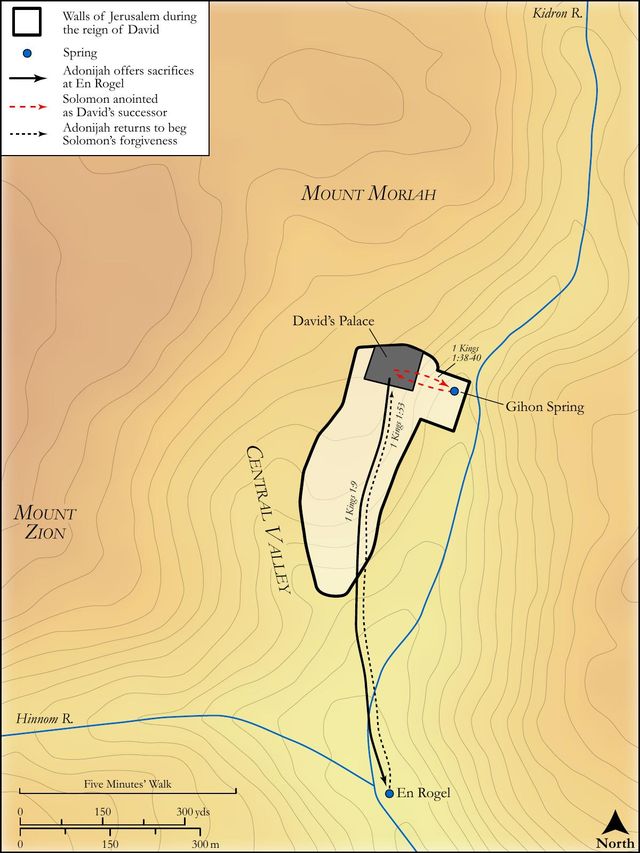
This verse serves as the dramatic culmination of a complex narrative detailing the transfer of power from the aging King David to his designated successor. David, in his advanced years, had previously sworn an oath to Bathsheba that their son Solomon would inherit the throne (1 Kings 1:30). However, David's elder son, Adonijah, presumptuously declared himself king, garnering support from influential military and religious figures like Joab and Abiathar, thereby initiating a direct challenge to David's authority and divine will (1 Kings 1:5-10). Prompted by the urgent intervention of Nathan the prophet and Bathsheba, David swiftly commanded Zadok the priest, Nathan, and Benaiah to publicly anoint Solomon at the Gihon spring (1 Kings 1:32-37). The anointing described in 1 Kings 1:39, immediately followed by widespread public rejoicing, directly and powerfully countered Adonijah's illegitimate claim, leading to the rapid dispersal of his supporters and his subsequent plea for mercy from Solomon (1 Kings 1:41-53).
Historical & Cultural Context
Among the kings of that day, royal succession was frequently a perilous and unstable period, often marked by internal strife, assassinations, and power struggles. The ritual of anointing with oil was a widely recognized and deeply significant practice for consecrating kings, priests, and sometimes prophets, serving as a powerful public symbol of divine appointment, empowerment, and legitimacy. The specific use of a horn (Hebrew: qeren) for the anointing oil, rather than a smaller, more fragile flask, was characteristic for kings (as seen with Saul in 1 Samuel 10:1 and David in 1 Samuel 16:13), symbolizing strength, abundance, and the desired durability and permanence of the reign. The oil itself, explicitly taken from the tabernacle, underscored the profoundly sacred and divinely ordained nature of the kingship, linking it directly to God's presence and covenant. The blowing of the trumpet (Hebrew: shofar) was a traditional and unmistakable signal for major public events, including coronations and declarations of war, while the people's acclamation, "God save the king," was a customary expression of loyalty, blessing, and a prayer for the monarch's long life and prosperity.
Key Themes
ShowHideThis verse powerfully encapsulates several foundational themes central to the book of 1 Kings and the broader Deuteronomistic History. Foremost is the theme of Divine Appointment and Legitimacy, emphasizing that Solomon's kingship was not merely a political maneuver or the result of human machinations, but a direct and sovereign act of God's will, standing in stark contrast to Adonijah's self-serving ambition. The act of anointing signifies Sacred Consecration, setting Solomon apart for a holy and unique office and entrusting him with the leadership of God's chosen people. Furthermore, the Public Proclamation and Acclamation by the people, heralded by the trumpet and their shouts, highlights the crucial necessity of widespread acceptance and popular affirmation for the stability, unity, and effective governance of the kingdom, thereby solidifying Solomon's authority over all Israel. This momentous event also powerfully reinforces the Continuity of the Davidic Covenant, demonstrating God's unwavering faithfulness to His promise to establish David's lineage on the throne, a promise reiterated throughout the Psalms and prophetic books (e.g., Psalm 89:3-4).
Exposition and Analysis
ShowHideKey Word Analysis
ShowHideThis primitive root means "to rub with oil," "to smear," or "to consecrate." It is the very root from which the Hebrew term mashiach (Messiah) and the Greek term christos (Christ) are derived, both signifying "Anointed One." In this context, the act of anointing was a solemn ritual of setting apart an individual for a sacred office—whether priest, prophet, or king—implying divine selection, empowerment, and authorization for their designated role and responsibilities.
This word refers to a "tent" or "dwelling place," specifically the portable sanctuary, also known as the "tent of meeting," where God's presence dwelt among the Israelites before the construction of the Temple in Jerusalem. The fact that the oil used for Solomon's anointing was taken directly from this sacred structure signifies that the consecration was not merely a human political act, but one directly sanctioned and empowered by God Himself, drawing its authority from the very heart of Israel's worship and covenant relationship with Yahweh.
While often translated as "save" in this context, the primitive root of this word means "to live," "to revive," or "to keep alive." The acclamation "God save king Solomon" (Hebrew: yechi ha-melech Shlomo) is more accurately rendered "Long live King Solomon!" It is a fervent prayer and declaration that God would grant the king a long, prosperous, and secure life, preserving him and his reign. It reflects a desire for divine preservation and vitality for the monarch.
Verse Breakdown
ShowHideLiterary Devices
ShowHideThe passage employs several potent literary devices to convey its profound theological and narrative message. Symbolism is prominently featured, with the "horn of oil" representing strength, abundance, and divine anointing, and the "trumpet" symbolizing a public, authoritative, and irreversible proclamation. The entire scene functions as a powerful Contrast to Adonijah's clandestine, self-appointed coronation feast, highlighting the absolute legitimacy and divine backing of Solomon's reign versus Adonijah's illegitimate and presumptuous claim. The swift, decisive, and public nature of Solomon's anointing, orchestrated by David, also demonstrates Dramatic Irony, as Adonijah's celebratory feast is abruptly interrupted by the sounds of Solomon's acclamation, revealing the utter futility and collapse of his rebellion. Furthermore, the anointing of a king in Israel, particularly one from the Davidic line, serves as profound Foreshadowing, pointing to the ultimate Anointed One, the Messiah, whose kingship would be eternal, universal, and perfectly righteous.
Theological and Thematic Connections
ShowHideThe anointing of Solomon in 1 Kings 1:39 is a profound theological statement about God's absolute sovereignty in establishing leaders and His divine desire for order, legitimate authority, and spiritual consecration within His people. It underscores that true kingship in Israel was not merely a political position or a hereditary right, but a sacred office, divinely ordained and consecrated by God Himself. The oil from the tabernacle signifies that Solomon's authority flowed directly from God's holy presence and covenant relationship, making his rule a sacred stewardship under divine mandate. This momentous event also highlights the concept of divine enablement for those called to lead, as the anointing symbolized the Spirit's empowerment for the formidable tasks and responsibilities ahead. For believers today, it serves as a powerful reminder that all authority ultimately derives from God, and that those in leadership, whether spiritual or temporal, are ultimately accountable to Him for their stewardship.
Reflection and Application
ShowHideThe anointing of Solomon, a divinely appointed leader, offers rich and enduring lessons for contemporary reflection and application in our lives. It powerfully reminds us that leadership, particularly within the community of faith, should fundamentally be marked by divine appointment and spiritual consecration, rather than solely by human ambition, political maneuvering, or personal charisma. Just as Solomon was set apart for a specific, God-given role with divine empowerment, believers today are called to live consecrated lives, set apart for God's holy purposes and empowered by the Holy Spirit to fulfill His will in their respective spheres of influence, whether in their families, workplaces, or communities. This passage also profoundly emphasizes the importance of recognizing and submitting to legitimate authority, and the crucial need for public affirmation and support for those whom God raises up to lead. It challenges us to critically consider how we discern and respond to godly leadership, and how our own lives consistently reflect a commitment to divine order, purpose, and the exercise of our own God-given callings with integrity and faithfulness.
Questions for Reflection
ShowHideFAQ
ShowHideWhy was a "horn" used for the oil instead of a flask?
ShowHideThe use of a horn (Hebrew: qeren), typically from an ox or ram, for anointing oil, as opposed to a smaller, more fragile flask (such as the one Samuel used to anoint Saul in 1 Samuel 10:1), carried profound symbolic weight, particularly for kings. A horn, being inherently durable, robust, and capable of holding a larger quantity of oil, symbolized strength, abundance, and the enduring nature of the kingship being conferred. It suggested a lasting, powerful, and divinely sustained reign, in stark contrast to a flask which might imply a more temporary or limited anointing. This distinction underscored the robust and permanent establishment of Solomon's rule, emphasizing its divine backing and intended longevity.
What is the significance of the oil coming "out of the tabernacle"?
ShowHideThe fact that Zadok the priest took the anointing oil "out of the tabernacle" (Hebrew: ʼôhel), the portable sanctuary also known as the tent of meeting, is profoundly significant. It signifies that the oil was sacred, consecrated, and not ordinary, and that Solomon's anointing was therefore a divinely sanctioned act, not merely a human political maneuver. The tabernacle was the central place of worship, the dwelling place of God's presence, and the repository of the Ark of the Covenant among Israel. Drawing the oil from this holy place directly connected Solomon's kingship to God's authority, covenant, and holiness, emphasizing that his rule was legitimate, blessed, and empowered by Yahweh Himself. This act underscored the deep theological foundation of Israelite kingship, rooting it firmly in God's will.
What does "God save king Solomon" mean?
ShowHideThe cry "God save king Solomon" (Hebrew: yechi ha-melech Shlomo, literally "May King Solomon live!") was a traditional and fervent acclamation of loyalty, a communal blessing, and a heartfelt prayer for the king's long life, prosperity, and divine protection. It was a public declaration of allegiance and a communal blessing upon the newly installed monarch. In this specific context, it served as a powerful and widespread affirmation of Solomon's legitimate enthronement, demonstrating broad popular acceptance and enthusiastic submission to his authority. This public outcry effectively countered Adonijah's rebellion, solidifying the transfer of power and signaling the unity of the people under Solomon's reign.
Christ-Centered Fulfillment
ShowHideThe anointing of Solomon in 1 Kings 1:39, a son of David consecrated by sacred oil and publicly acclaimed, powerfully foreshadows the ultimate Anointed One, Jesus Christ. While Solomon's kingship was earthly and temporary, marked by both great wisdom and eventual moral failings, Jesus is the true, eternal, and perfect King, the ultimate Son of David (Matthew 1:1). His anointing was not with physical oil from a tabernacle, but with the Holy Spirit for an everlasting ministry and an eternal reign (Luke 4:18-21). The Spirit descended upon Him at His baptism, empowering Him for His messianic mission and confirming His divine appointment. He is the Messiah, the Christ, the one whom God has truly set apart and exalted "with the oil of gladness beyond your companions" (Hebrews 1:9). Unlike Solomon, whose kingdom eventually divided and fell, Jesus establishes an eternal kingdom that will never end (Luke 1:33) and over which He reigns supreme. The acclamation "God save King Solomon" finds its ultimate and universal fulfillment in the worship of Jesus, who is rightly proclaimed "King of kings and Lord of lords" (Revelation 19:16). His anointing signifies not just a transfer of earthly power, but the inauguration of God's redemptive reign over all creation, bringing salvation and eternal life.