


1 Kings 1:40
Bible text: King James Version (1769 Blayney text) · Public domain
Bible text: King James Version with Strong's numbers · Public domain
Bible text: Berean Standard Bible · Public domain
Bible text: American Standard Version (1901) · Public domain
Bible text: World English Bible, Messianic edition · Public domain
Bible text: Geneva Bible (1599) · Public domain
Bible text: Young's Literal Translation · Public domain
- וַיַּעֲלוּvai·ya·'a·Luand they went upH5927Conj-w ¦ V-Qal-ConsecImperf-3mpVerb Qal Consecutive Imperfect 3rd Plural Masculineוַandיַּעֲלוּthey went up
- כָלkholallH3605N-mscNoun Singular Masculine Construct
- הָעָםha·'Amthe peopleH5971Art ¦ N-msNoun Singular Masculine Absoluteהָtheעָםpeople
- אַחֲרָיו'a·cha·Ravafter himH310Adj-mpc ¦ 3msAdjective Numerical Plural Masculine Constructאַחֲרָיafterוhim
- וְהָעָםve·ha·'Amand the peopleH5971Conj-w ¦ Art ¦ N-msNoun Singular Masculine Absoluteוְandהָtheעָםpeople
- מְחַלְּלִיםme·cha·le·Lim[were] playing [the] fluteH2490V-Piel-Prtcpl-mpVerb Piel Participle Plural Masculine Absolute
- בַּחֲלִלִיםba·cha·li·Limwith flutesH2485Prep-b ¦ N-mpNoun Plural Masculine Absoluteבַּwithחֲלִלִיםflutes
- וּשְׂמֵחִיםu·se·me·Chimand joyfulH8056Conj-w ¦ V-Qal-Prtcpl-mpVerb Qal Participle Plural Masculine Absoluteוּandשְׂמֵחִיםjoyful
- שִׂמְחָהsim·ChahjoyH8057N-fsNoun Singular Feminine Absolute
- גְדוֹלָהge·do·LahgreatH1419Adj-fsAdjective Singular Feminine Absolute
- וַתִּבָּקַעva·ti·ba·Ka'and it was split openH1234Conj-w ¦ V-Niphal-ConsecImperf-3fsVerb Niphal Consecutive Imperfect 3rd Singular Feminineוַandתִּבָּקַעit was split open
- הָאָרֶץha·'A·retzthe earthH776Art ¦ N-fsNoun Singular Feminine Absoluteהָtheאָרֶץearth
- בְּקוֹלָםbe·ko·Lamby their noiseH6963Prep-b ¦ N-msc ¦ 3mpNoun Singular Masculine Constructבְּbyקוֹלָnoiseםtheir
English is a literal word-by-word gloss of the Hebrew, not the KJV's wording. Why?
This is the original text the KJV's translators worked from — each Hebrew word with its own literal English meaning in this verse, prepared by scholars at Tyndale House, Cambridge. The KJV translates whole sentences, not word by word, so its wording differs: one Hebrew word can become several English words, and the KJV may choose “the LORD” where the gloss reads “Yahweh”. Both are faithful — they answer different questions. For the KJV's own rendering, switch to the KJV text.
Details
See on the biblical-era maps

Study this verse
Public-domain commentary
Matthew Henry
From his Commentary on the Whole Bible. Henry comments on passages, not single verses — this entry covers 1 Kings 1:32–40. His two-level outline is real structure in the source text, so it is rendered as structure.
We have here the effectual care David took both to secure Solomon's right and to preserve the public peace, by crushing Adonijah's project in the bud. Observe,
I.The express orders he gave for the proclaiming of Solomon.
The persons he entrusted with this great affair were Zadok, Nathan, and Benaiah, men of power and interest whom David had always reposed a confidence in and found faithful to him, and whom Adonijah had passed by in his invitation, Kg1 1:10. David orders them forthwith, with all possible solemnity, to proclaim Solomon. They must take with them the servants of their lord, the lifeguards, and all the servants of the household. They must set Solomon on the mule the king used to ride, for he kept not such stables of horses as his son afterwards did. He appoints them whither to go (Kg1 1:33 and Kg1 1:34, Kg1 1:35), and what to do.
1.Zadok and Nathan, the two ecclesiastical persons, must, in God's name, anoint him king; for though he was not the first of his family, as Saul and David were, yet he was a younger son, was made king by divine appointment, and his title was contested, which made it necessary that hereby it should be settled. This unction was typical of the designation and qualification of the Messiah, or Christ, the anointed one, on whom the Spirit, that oil of gladness, was poured without measure, Heb 1:9, Psa 89:20. And all Christians, being heirs of the kingdom (Jam 2:5), do from him receive the anointing, Jo1 2:27.
2.The great officers, civil and military, are ordered to give public notice of this, and to express the public joy upon this occasion by sound of trumpet, by which the law of Moses directed the gracing of great solemnities; to this must be added the acclamations of the people: "Let king Solomon live, let him prosper, let his kingdom be established and perpetuated, and let him long continue in the enjoyment of it;" so it had been promised concerning him. Psa 72:15, He shall live.
3.They must then bring him in state to the city of David, and he must sit upon the throne of his father, as his substitute now, or viceroy, to despatch public business during his weakness and be his successor after his death: He shall be king in my stead. It would be a great satisfaction to David himself, and to all parties concerned, to have this done immediately, that upon the demise of the king there might be no dispute, or agitation, in the public affairs. David was far from grudging his successor the honour of appearing such in his life-time, and yet perhaps was so taken up with his devotions on his sick-bed that, if he had not been put in mind of it by others, this great good work, which was so necessary to the public repose, would have been left undone.
II.The great satisfaction which Benaiah, in the name of the rest, professed in these orders.
The king said, "Solomon shall reign for me, and reign after me." "Amen" (says Benaiah heartily); "as the king says, so say we; we are entirely satisfied in the nomination, and concur in the choice, we give our vote for Solomon, nemine contradicente - unanimously, and since we can bring nothing to pass, much less establish it, without the concurrence of a propitious providence, The Lord God of my lord the king say so too!" Kg1 1:36. This is the language of his faith in that promise of God on which Solomon's government was founded. If we say as God says in his word, we may hope that he will say as we say by his providence. To this he adds a prayer for Solomon (Kg1 1:37), that God would be with him as he had been with David, and make his throne greater. He knew David was not one of those that envy their children's greatness, and that therefore he would not be disquieted at this prayer, nor take it as an affront, but would heartily say Amen to it. The wisest and best man in the world desires his children may be wiser and better than he, for he himself desires to be wiser and better than he is; and wisdom and goodness are true greatness.
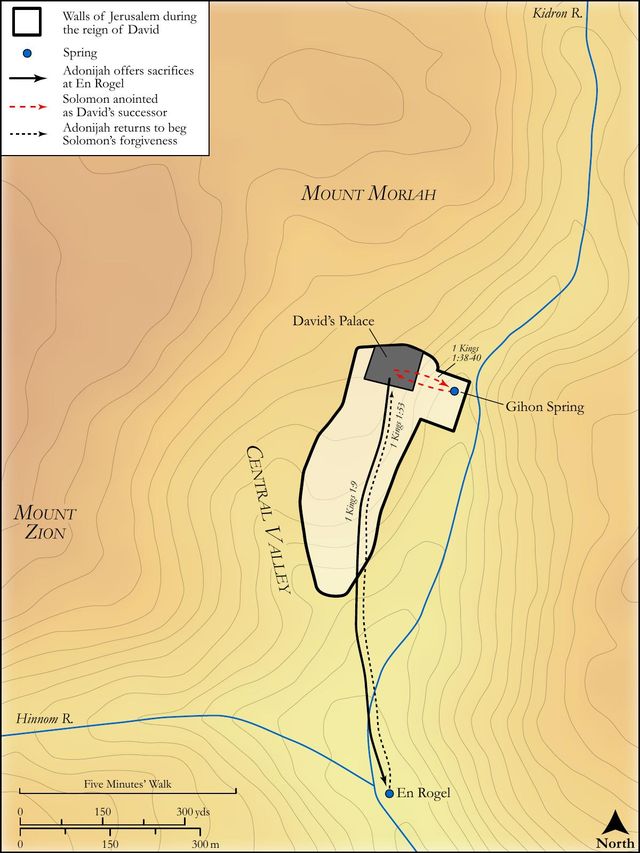
III.The immediate execution of these orders, Kg1 1:38-40.
No time was lost, but Solomon was brought in state to the place appointed, and there Zadok (who, though he was not as yet high priest, was, we may suppose, the suffragan, the Jews called him the sagan, or second priest) anointed him by the direction of Nathan the prophet and David the king, Kg1 1:39. In the tabernacle, where the ark was now lodged, was kept among other sacred things, the holy oil for many religious services thence Zadok took a horn of oil, which denotes both power and plenty, and therewith anointed Solomon. We do not find that Abiathar pretended to anoint Adonijah: he was made king by a feast, not by an unction. Whom God calls, he will qualify, which was signified by the anointing; usurpers had it not. Christ signifies anointed, and he is the king whom God hath set upon his holy hill of Sion, according to decree, Psa 2:6, Psa 2:7. Christians also are made to our God (and by him) kings, and they have an unction from the Holy One, Jo1 2:20. The people, hereupon, express their great joy and satisfaction in the elevation of Solomon, surround him with their Hosannas - God save king Solomon, and attend him with their music and shouts of joy, Kg1 1:40. Hereby they declared their concurrence in the choice, and that he was not forced upon them, but cheerfully accepted by them. The power of a prince can be little satisfaction to himself, unless he knows it to be a satisfaction to his people. Every Israelite indeed rejoices in the exaltation of the Son of David.
Continue studying 1 Kings 1:40 across the web’s major study libraries — every link below opens this exact verse, chapter, or book on the destination site.
Read & Compare
 BibleGatewayThis verse in more than 200 translations and 70 languages.
 Bible.comThe YouVersion reader — hundreds of translations, reading plans, and highlights.
 ESV.orgCrossway's official English Standard Version reader.
 NET BibleThe NET translation with 60,000+ translators' notes on every rendering decision.
 STEP BibleTyndale House's free study tool — original text, vocabulary, and scholarly resources.
 BibliaLogos Bible Software's free web reader.
 USCCBThe New American Bible (Revised Edition) with the U.S. bishops' study notes.
Commentaries
 BibleHub CommentariesDozens of classic commentaries on this verse, gathered on one page.
 StudyLightMore than 100 commentary sets — the largest collection on the web.
 BibleRefPlain-English commentary on what this verse means, verse by verse.
 Enduring WordDavid Guzik's free commentary on this chapter, widely used by Bible teachers.
 Bible Study ToolsVerse commentary alongside Greek and Hebrew study aids.
Original Language & Research
- BibleHub InterlinearThe verse word by word — original language, transliteration, and English.
- BibleHub LexiconEvery word's original-language definition and Strong's entry.
 Blue Letter BibleDeep-study tools — Strong's numbers, concordance, and word studies.
 SefariaThe Hebrew text with Rashi and centuries of Jewish commentary.
Sermons, Hymns & Audio


TrulyRandomVerse is not affiliated with these sites and doesn’t control their content. They’re linked because they’re genuinely useful.
Summary
1 Kings 1:40 vividly portrays the overwhelming public jubilation surrounding the anointing and procession of Solomon as King David's chosen successor. Following a period of uncertainty and attempted usurpation, the people's exuberant celebration, marked by instrumental music and shouts of joy so profound they metaphorically shook the very ground, underscored the legitimacy of Solomon's divinely sanctioned reign and the kingdom's unified acceptance of the new era of leadership.
Context
ShowHideLiterary Context
This verse serves as the triumphant climax of Solomon's anointing narrative within 1 Kings chapter 1. Immediately preceding it, verses 38-39 describe Solomon being placed on King David's own mule and led by Zadok the priest and Nathan the prophet to Gihon, where he was anointed with oil. This public procession from Gihon to Jerusalem, culminating in the joyous acclamation of verse 40, directly contrasts with the clandestine and rebellious feast of Adonijah, David's elder son, who had attempted to usurp the throne (as detailed in 1 Kings 1:5-10). The widespread, earth-shaking joy of the people thus signifies a clear, divinely endorsed, and publicly affirmed transfer of power, solidifying Solomon's position against any rival claims and establishing the new era of leadership with overwhelming popular consent.
Historical & Cultural Context
Royal succession among the kings of that day was often fraught with intrigue and violence, making a peaceful and publicly accepted transition highly significant. The anointing with oil, performed by a priest (Zadok) and prophet (Nathan), was a sacred act, signifying divine appointment and legitimacy, reminiscent of Samuel's anointing of David in 1 Samuel 16:13. The procession on the king's mule symbolized the transfer of royal authority, and the public acclamation, accompanied by music and shouts, was a common practice to validate a new monarch's reign, ensuring popular support and deterring opposition. Gihon, a natural spring outside Jerusalem, held ritual significance as a place for such ceremonies, and the return to the city underscored the establishment of the new king in the capital, publicly displaying his authority to all citizens.
Key Themes
ShowHide1 Kings 1:40 powerfully contributes to several key themes in the book of 1 Kings. Divine Sovereignty and Legitimate Succession is paramount, as the people's joy confirms God's choice of Solomon over Adonijah's self-proclaimed kingship, emphasizing that true authority originates from divine appointment, not human ambition. The verse highlights the theme of Unity and Stability within the kingdom, demonstrating a collective embrace of the new leadership after a period of potential division and uncertainty. Furthermore, the description of overwhelming joy underscores the theme of Public Affirmation and Celebration, portraying a kingdom that is not merely accepting but enthusiastically endorsing its divinely appointed ruler, setting a hopeful tone for Solomon's reign, which is a significant part of the broader narrative of Israel's monarchy and its relationship with God's covenant promises.
Exposition and Analysis
ShowHideKey Word Analysis
ShowHideThis term refers to a wind instrument, specifically a flute or pipe, commonly used in ancient Israel for festive occasions, celebrations, and processions. Its mention here indicates the organized and joyous nature of the public demonstration, adding a musical dimension to the exuberant atmosphere. The sound of pipes would have been distinct and pervasive, contributing significantly to the overall auditory impact of the celebration, as it is a "perforated" instrument designed for such sounds.
This verb signifies a deep and genuine gladness, joy, or exultation, describing a state of being "blithe or gleeful." It is not merely a superficial happiness but an intense emotional response. The repetition of the root in "rejoiced with great joy" (שִׂמְחָה גְּדֹלָה, simchâh gedôlâh) emphasizes the overwhelming and profound nature of the people's happiness, suggesting a collective outpouring of relief and delight at the legitimate establishment of the new king.
This powerful verb literally means "to cleave," "to split," "to burst open," or "to tear apart," as from a "primitive root" signifying a forceful separation. While it is used in contexts such as the splitting of the Red Sea (Exodus 14:16) or the bursting forth of water from a rock (Numbers 20:11), its application here to the earth "renting" with sound is a vivid hyperbole. It serves to convey the extraordinary, almost physical, impact of the sound of the people's celebration, implying that the noise was so immense and pervasive that it seemed to vibrate through and shake the very ground beneath them, as if the ground itself was "cleaving" from the sound.
Verse Breakdown
ShowHide"And all the people came up after him"
This phrase describes the large multitude of people following Solomon as he rode from Gihon, the site of his anointing, back into Jerusalem. "Came up after him" signifies their allegiance, support, and participation in the royal procession, confirming the widespread acceptance of his kingship.
"and the people piped with pipes"
This clause details the musical accompaniment of the procession. The use of "pipes" (flutes) indicates a festive and celebratory atmosphere, typical of significant public events. It underscores the joyous and intentional nature of the acclamation, demonstrating an organized expression of corporate delight.
"and rejoiced with great joy"
This emphasizes the intensity and depth of the people's emotional response. The doubling of the concept of joy ("rejoiced" and "great joy") highlights the profound and widespread happiness felt by the populace, reflecting their relief and approval of Solomon's legitimate ascension. This was not merely a polite acknowledgement but an overwhelming outpouring of delight.
"so that the earth rent with the sound of them"
This is the climactic descriptive clause, employing powerful hyperbole. It conveys the overwhelming volume and pervasive nature of the celebration. The sound was so immense, so resonant, and so widespread that it metaphorically seemed to cause the very ground to tremble and split, illustrating the profound impact of the people's unified acclamation and the sheer magnitude of their collective voice.
Literary Devices
ShowHideThe primary literary device employed in 1 Kings 1:40 is Hyperbole. The statement "the earth rent with the sound of them" is a deliberate exaggeration used to emphasize the extraordinary, overwhelming volume and pervasive nature of the people's joyous celebration. It is not meant to be taken literally, but rather to convey the sheer magnitude and impact of the noise, suggesting it was so loud it seemed to physically shake the ground. This vivid imagery also contributes to Auditory Imagery, allowing the reader to almost hear the cacophony of pipes and shouts and feel the vibrations. Furthermore, the repetition of "the people" and the emphasis on "great joy" contribute to Emphasis and Repetition, underscoring the widespread and intense nature of the public's affirmation of Solomon's kingship and the collective nature of their emotional outpouring.
Theological and Thematic Connections
ShowHideThe profound jubilation described in 1 Kings 1:40 serves as a powerful theological statement. It underscores the principle that legitimate leadership, especially divinely appointed leadership, brings order, stability, and cause for widespread rejoicing. In contrast to the chaos and division threatened by Adonijah's rebellion, Solomon's anointing and the people's enthusiastic response demonstrate God's providence in establishing His chosen king and bringing unity to the nation. This collective joy is not merely political acclamation but a spiritual affirmation of God's hand in the succession, reflecting the peace and prosperity that come when God's will is honored and His chosen instruments are embraced by the community.
Reflection and Application
ShowHideThe scene of overwhelming joy in 1 Kings 1:40 offers significant lessons for contemporary believers and communities. It reminds us of the profound blessing of unity and the importance of celebrating God's providential hand in leadership transitions, whether in the church, family, or society. When God's order is established and His chosen leaders are recognized, there is a legitimate cause for collective rejoicing and affirmation. This passage challenges us to consider how we respond to divine appointments and how we express corporate thanksgiving for God's faithfulness in bringing stability and hope, even after periods of contention or uncertainty. The "great joy" of the people can serve as a model for how communities might respond to God's continued work in their midst, echoing the biblical call to make a joyful noise unto the Lord and celebrate His goodness, trusting in His sovereign plan for all things.
Questions for Reflection
ShowHideFAQ
ShowHideWhy is the phrase "the earth rent with the sound of them" used if it wasn't a literal earthquake?
ShowHideThe phrase "the earth rent with the sound of them" employs hyperbole, a literary device involving exaggeration for emphasis. It is not meant to be taken literally as a geological event. Instead, it powerfully conveys the immense, overwhelming volume and pervasive nature of the people's celebration. The sound of their pipes, shouts, and rejoicing was so loud and widespread that it metaphorically seemed to vibrate through the very ground, indicating an extraordinary and unforgettable public acclamation. This vivid imagery emphasizes the profound impact and intensity of the joy felt by the entire populace at Solomon's coronation, making it clear that this was no quiet affair but an event of immense significance and audible triumph, as described in 1 Kings 1:40.
What does this verse tell us about the beginning of Solomon's reign?
ShowHide1 Kings 1:40 indicates that Solomon's reign began with overwhelming popular support and divine backing. The widespread and intense joy of the people, expressed through music and shouts so loud they metaphorically "rent the earth," signifies a clear public endorsement of his legitimacy. This scene contrasts sharply with the attempted usurpation by Adonijah earlier in 1 Kings chapter 1, highlighting that Solomon's ascension was not a quiet, contested affair but a divinely orchestrated and publicly celebrated event. It set a tone of stability, unity, and hope for the kingdom under its new, God-chosen king, laying a strong foundation for his rule.
Christ-Centered Fulfillment
ShowHideThe coronation of Solomon, marked by such earth-shaking joy and popular acclaim, serves as a powerful Old Testament type pointing to the ultimate King, Jesus Christ. While Solomon's reign brought a period of peace and prosperity, his kingship was imperfect and temporary. Jesus, the true Son of David, fulfills the promise of an eternal, righteous, and universal reign. The "great joy" of the people at Solomon's enthronement foreshadows the ultimate joy of all creation that will accompany the establishment of Christ's eternal kingdom. Just as Solomon rode into Jerusalem as king, Jesus made His triumphal entry into Jerusalem, albeit to a different kind of acclamation, as the humble King riding on a donkey. Yet, the New Testament speaks of a future day when "every knee should bow, of things in heaven, and things in earth, and things under the earth; and that every tongue should confess that Jesus Christ is Lord, to the glory of God the Father" (Philippians 2:10-11). The "earth rent with the sound of them" in 1 Kings 1:40 anticipates the reverberation of praise and worship throughout heaven and earth that will greet the return of the King of kings and Lord of lords, whose reign will bring not just earthly peace but eternal salvation and unceasing joy to all who believe. His kingdom is the one that truly "shakes" the foundations of the world, not with mere sound, but with the power of redemption and the promise of new creation (Hebrews 12:26-28).