


1 Kings 1:41
- וַיִּשְׁמַעvai·yish·Ma'and he heardH8085Conj-w ¦ V-Qal-ConsecImperf-3msVerb Qal Consecutive Imperfect 3rd Singular Masculineוַandיִּשְׁמַעhe heard
- אֲדֹנִיָּהוּ'a·do·ni·Ya·huAdonijahH138N-proper-mNoun Proper Masculine
- וְכָלve·kholand allH3605Conj-w ¦ N-mscNoun Singular Masculine Constructוְandכָלall
- הַקְּרֻאִיםha·ke·ru·'Imthose [who] were invitedH7121Art ¦ V-Qal-PassPrtcpl-mpVerb Qal Participle Passive Plural Masculine Absoluteהַthoseקְּרֻאִים[who] were invited
- אֲשֶׁר'a·SherwhoH834RelParticle Relative
- אִתּוֹ'i·To[were] with himH854Prep ¦ 3msPrepositionאִתּ[were] withוֹhim
- וְהֵםve·Hemand theyH1992Conj-w ¦ Pro-3mpPronoun Personal 3rd Plural Masculineוְandהֵםthey
- כִּלּוּki·Luthey had finishedH3615V-Piel-Perf-3cpVerb Piel Perfect 3rd Plural common gender
- לֶאֱכֹלle·'e·Kholto eatH398Prep-l ¦ V-Qal-InfVerb Qal Infinitive Constructלֶtoאֱכֹלeat
- וַיִּשְׁמַעvai·yish·Ma'and he heardH8085Conj-w ¦ V-Qal-ConsecImperf-3msVerb Qal Consecutive Imperfect 3rd Singular Masculineוַandיִּשְׁמַעhe heard
- יוֹאָבyo·'AvJoabH3097N-proper-mNoun Proper Masculine
- אֶת'et<obj.>H853DirObjMParticle Object Indicator
- קוֹלKol[the] sound ofH6963N-mscNoun Singular Masculine Construct
- הַשּׁוֹפָרha·sho·Farthe ram's hornH7782Art ¦ N-msNoun Singular Masculine Absoluteהַtheשּׁוֹפָרram's horn
- וַיֹּאמֶרvai·Yo·merand he saidH559Conj-w ¦ V-Qal-ConsecImperf-3msVerb Qal Consecutive Imperfect 3rd Singular Masculineוַandיֹּאמֶרhe said
- מַדּוּעַma·Du·a'why?H4069InterrogParticle Interrogative
- קוֹלkol[is] [the] sound ofH6963N-mscNoun Singular Masculine Construct
- הַקִּרְיָהha·kir·Yahthe townH7151Art ¦ N-fsNoun Singular Feminine Absoluteהַtheקִּרְיָהtown
- הוֹמָהho·Mahin an uproarH1993V-Qal-Prtcpl-fsVerb Qal Participle Singular Feminine Absolute
English is a literal word-by-word gloss of the Hebrew, not the KJV's wording. Why?
This is the original text the KJV's translators worked from — each Hebrew word with its own literal English meaning in this verse, prepared by scholars at Tyndale House, Cambridge. The KJV translates whole sentences, not word by word, so its wording differs: one Hebrew word can become several English words, and the KJV may choose “the LORD” where the gloss reads “Yahweh”. Both are faithful — they answer different questions. For the KJV's own rendering, switch to the KJV text.
Details
See on the biblical-era map

Study this verse
Public-domain commentary
Matthew Henry
From his Commentary on the Whole Bible. Henry comments on passages, not single verses — this entry covers 1 Kings 1:41–53. His three-level outline is real structure in the source text, so it is rendered as structure.
We have here,
I.The tidings of Solomon's inauguration brought to Adonijah and his party, in the midst of their jollity:
They had made an end of eating, and, it should seem, it was a great while before they made an end, for all the affair of Solomon's anointing was ordered and finished while they were at dinner, glutting themselves. Thus those who serve not our Lord Christ, but oppose him, are commonly such as serve their own belly (Rom 16:18) and made a god of it, Phi 3:19. Their long feast intimates likewise that they were very secure and confident of their interest, else they would not have lost so much time. The old world and Sodom were eating and drinking, secure and sensual, when their destruction came, Luk 17:26, etc. When they made an end of eating, and were preparing themselves to proclaim their king, and bring him in triumph into the city, they heard the sound of the trumpet (Kg1 1:41), and a dreadful sound it was in their ears, Job 15:21. Joab was an old man, and was alarmed at it, apprehending the city to be in an uproar; but Adonijah was very confident that the messenger, being a worthy man, brought good tidings, Kg1 1:42. Usurpers flatter themselves with the hopes of success, and those are commonly least timorous whose condition is most dangerous. But how can those who do evil deeds expect to have good tidings? No, the worthiest man will bring them the worst news, as the priest's son did here to Adonijah, Kg1 1:43. "Verily, the best tidings I have to bring you is that Solomon is made king, so that your pretensions are all quashed." He relates to them very particularly,
1.With what great solemnity Solomon was made king (Kg1 1:44, Kg1 1:45), and that he was now sitting on the throne of the kingdom, Kg1 1:46. Adonijah thought to have stepped into the throne before him, but Solomon was too quick for him.
2.With what general satisfaction Solomon was made king, so that that which was done was not likely to be undone again.
(1.)The people were pleased, witness their joyful acclamations, Kg1 1:45.
(2.)The courtiers were pleased: The kings servants attended him with an address of congratulation upon this occasion, Kg1 1:47. We have here the heads of their address: They blessed king David, applauded his prudent care for the public welfare, acknowledged their happiness under his government, and prayed heartily for his recovery. They also prayed for Solomon, that God would make his name better than his father's, which it might well be when he had his father's foundation to build upon. A child, on a giant's shoulders, is higher than the giant himself.
(3.)The king himself was pleased: He bowed himself upon the bed, not only to signify his acceptance of his servants' address, but to offer up his own address to God (Kg1 1:48): "Blessed be the Lord God of Israel, who, as Israel's God, for Israel's good, has brought this matter to such a happy issue, my eyes even seeing it." Note, It is a great satisfaction to good men, when they are going out of the world, to see the affairs of their families in a good posture, their children rising up in their stead to serve God and their generation, and especially to see peace upon Israel and the establishment of it.
II.The effectual crush which this gave to Adonijah's attempt.
It spoiled the sport of his party, dispersed the company, and obliged every man to shift for his own safety. The triumphing of the wicked is short. They were building a castle in the air, which, having no foundation, would soon fall and crush them. They were afraid of being taken in the fact, while they were together hatching their treason, and therefore each one made the best of his way.
III.The terror Adonijah himself was in, and the course he took to secure himself.
he was now as much depressed as he had been elevated, Kg1 1:42, Kg1 1:50. He had despised Solomon as not worthy to be his guest (Kg1 1:10), but now he dreads him as his judge: He feared because of Solomon. Thus those who oppose Christ and his kingdom will shortly be made to tremble before him, and call in vain to rocks and mountains to shelter them from his wrath. He took hold on the horns of the altar, which was always looked upon as a sanctuary, or place of refuge (Exo 21:14), intimating hereby that he durst not stand a trial, but threw himself upon the mercy of his prince, in suing for which he relied upon no other plea than the mercy of God, which was manifested in the institution and acceptance of the sacrifices that were offered on that altar and the remission of sin thereupon. Perhaps Adonijah had formerly slighted the service of the altar, yet now he courts the protection of it. Many who in the day of their security neglect the great salvation, under the arrests of the terrors of the Lord would gladly be beholden to Christ and his merit, and, when it is too late, will catch hold of the horns of the altar.
IV.His humble address to Solomon for mercy.
By those who brought Solomon tidings where he was, he sent a request for his life (Kg1 1:51): Let king Solomon swear to me that he will not slay his servant. He owns Solomon for his prince, and himself his servant, dares not justify himself, but makes supplication to his judge. It was a great change with him. He that in the morning was grasping at a crown is before night begging for his life. Then Adonijah reigned, now Adonijah trembles, and cannot think himself safe unless Solomon promise, with an oath, not to put him to death.
V.The orders Solomon gave concerning him.
He discharges him upon his good behaviour, Kg1 1:52, Kg1 1:53. He considered that Adonijah was his brother, and that it was the first offence. Perhaps, being so soon made sensible of his error and then not persisting in his rebellion, he might prove not only a peaceable, but a serviceable subject, and therefore, if he will conduct himself well for the future, what is past shall be pardoned: but if he be fond disaffected, turbulent, and aspiring, this offence shall be remembered against him, he shall be called up upon his former conviction (as our law speaks), and execution shall be awarded against him. Thus the Son of David receives those to mercy that have been rebellious: if they will return to their allegiance, and be faithful to their Sovereign, their former crimes shall not be mentioned against them; but, if still they continue in the interests of the world and the flesh, this will be their ruin. Adonijah is sent for, and told upon what terms he stands, which he signifies his grateful submission to, and then is told to go to his house and live retired there. Solomon not only gave him his life, but his estate, thus establishing his throne by mercy.
Continue studying 1 Kings 1:41 across the web’s major study libraries — every link below opens this exact verse, chapter, or book on the destination site.
Read & Compare
 BibleGatewayThis verse in more than 200 translations and 70 languages.
 Bible.comThe YouVersion reader — hundreds of translations, reading plans, and highlights.
 ESV.orgCrossway's official English Standard Version reader.
 NET BibleThe NET translation with 60,000+ translators' notes on every rendering decision.
 STEP BibleTyndale House's free study tool — original text, vocabulary, and scholarly resources.
 BibliaLogos Bible Software's free web reader.
 USCCBThe New American Bible (Revised Edition) with the U.S. bishops' study notes.
Commentaries
 BibleHub CommentariesDozens of classic commentaries on this verse, gathered on one page.
 StudyLightMore than 100 commentary sets — the largest collection on the web.
 BibleRefPlain-English commentary on what this verse means, verse by verse.
 Enduring WordDavid Guzik's free commentary on this chapter, widely used by Bible teachers.
 Bible Study ToolsVerse commentary alongside Greek and Hebrew study aids.
Original Language & Research
- BibleHub InterlinearThe verse word by word — original language, transliteration, and English.
- BibleHub LexiconEvery word's original-language definition and Strong's entry.
 Blue Letter BibleDeep-study tools — Strong's numbers, concordance, and word studies.
 SefariaThe Hebrew text with Rashi and centuries of Jewish commentary.
Sermons, Hymns & Audio


TrulyRandomVerse is not affiliated with these sites and doesn’t control their content. They’re linked because they’re genuinely useful.
Summary
1 Kings 1:41 vividly captures the dramatic moment when Adonijah and his co-conspirators, immersed in a celebratory feast to mark his presumptuous claim to the throne, are abruptly confronted by the overwhelming sounds of Jerusalem. This sudden, tumultuous noise, emanating from the city, signifies the legitimate anointing and public acclamation of Solomon as the rightful king, orchestrated by God's sovereign hand. The verse powerfully underscores the immediate and undeniable triumph of divine purpose over human ambition, signaling an irreversible shift in the kingdom's leadership.
Context
ShowHideLiterary Context
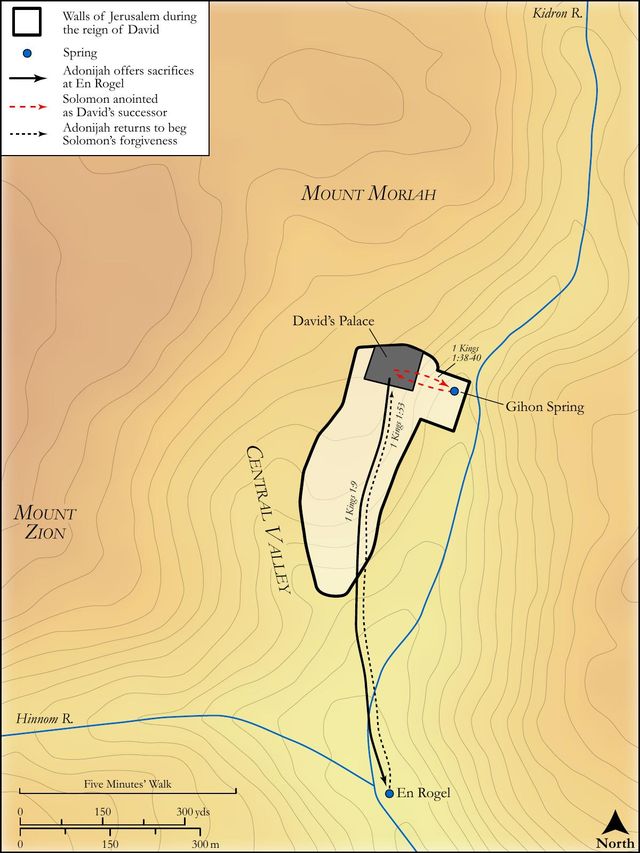
This pivotal verse serves as the narrative climax, bringing together two parallel and contrasting storylines. Immediately preceding it, Adonijah, David's fourth son, had gathered influential allies, including Joab (the commander of the army) and Abiathar (a prominent priest), for a feast at En-rogel, effectively declaring himself king in a premature and unauthorized bid for power (compare with 1 Kings 1:5-9). Simultaneously, unbeknownst to Adonijah's party, Nathan the prophet and Bathsheba had urgently appealed to the aging King David, reminding him of his promise regarding Solomon's succession (see 1 Kings 1:11-27). In response, David had swiftly commanded Zadok the priest, Nathan the prophet, and Benaiah to anoint Solomon at Gihon, followed by a grand procession into the city, accompanied by trumpet blasts and the jubilant shouts of the people, "Long live King Solomon!" (1 Kings 1:32-40). Verse 41 is the dramatic intersection where the sounds of this divinely sanctioned coronation pierce the revelry of the illicit gathering, revealing the futility of Adonijah's scheme.
Historical & Cultural Context
In ancient Israel, royal succession was not always strictly determined by primogeniture, especially in cases of multiple wives and sons. While the eldest surviving son often had a strong claim, the reigning king possessed the prerogative to designate his successor, and divine choice, often revealed through a prophet, was paramount (e.g., 1 Samuel 16:1-13). The anointing with oil by a priest or prophet was a sacred act, symbolizing divine consecration and legitimate authority, setting the king apart for his sacred office. The blowing of the shofar, or trumpet, was a customary and powerful signal for significant public events, including coronations, wars, or religious festivals, serving as a far-reaching announcement that demanded attention. Public acclamation, such as "God save the king" or "Long live the king," was essential for validating the new monarch's rule in the eyes of the populace. Adonijah's feast at En-rogel, a spring outside Jerusalem, was an attempt to establish his authority through a private, unauthorized gathering, starkly contrasting with Solomon's public, divinely sanctioned anointing at Gihon, a sacred spring associated with Jerusalem's vital water supply, symbolizing life and continuity for the kingdom.
Key Themes
ShowHideThe central theme illuminated by 1 Kings 1:41 is the profound and often dramatic contrast between divine ordination and human ambition. Adonijah's presumptuous self-exaltation stands in direct opposition to God's chosen successor, Solomon, whose ascent to the throne is orchestrated through divine prompting and prophetic guidance. This highlights the overarching theme of legitimate versus illegitimate authority, demonstrating that true kingship and power derive from God's appointment, not from self-proclamation, human scheming, or even popular consensus. The "noise" of the city also underscores the theme of public proclamation and witness, where the widespread acclamation of Solomon signifies the undeniable establishment of his reign, effectively silencing any competing claims. Furthermore, the abrupt interruption of Adonijah's feast serves as a powerful illustration of the consequences of presumption and the ultimate triumph of God's purposes, even amidst political intrigue and human error, echoing the biblical truth that "Many are the plans in a person's heart, but it is the Lord's purpose that prevails" (Proverbs 19:21). This verse also subtly introduces the theme of divine justice, as Adonijah's illicit celebration is met with the immediate and overwhelming reality of God's chosen king.
Exposition and Analysis
ShowHideKey Word Analysis
ShowHideThis verb (H8085) signifies more than just the physical perception of sound; it often implies an act of attentive listening, understanding, and even obedience. In this context, Adonijah and his guests "heard" the sound, suggesting its undeniable clarity and overwhelming volume, forcing them to acknowledge a reality that directly challenged their own. Joab's subsequent question further emphasizes the impact of what was heard, demanding an explanation for such an extraordinary public clamor, indicating a recognition of its significance.
The Hebrew word qôwl (H6963) is remarkably versatile, encompassing "voice," "sound," "noise," "thunder," or even "rumor." Here, it refers to a loud, tumultuous sound, specifically the trumpet blast and the jubilant shouts of the people. The choice of qôwl conveys the overwhelming nature of the public acclamation, indicating a significant and widespread event that could not be ignored. It is not just a faint noise but a powerful, pervasive "sound" that fills the city, signaling a momentous and irreversible shift in power.
Derived from a primitive root (H1993) meaning "to make a loud sound" or "to be in great commotion or tumult," hâmâh perfectly describes the state of the city. It suggests a vibrant, almost chaotic, yet joyous clamor that indicates widespread public participation and excitement. For Adonijah's party, this "uproar" would have been deeply unsettling, as it represented a collective affirmation of a rival king, directly undermining their own clandestine gathering. It signifies a city alive with a momentous event, an event that directly contradicts their illicit celebration.
Verse Breakdown
ShowHide"And Adonijah and all the guests that [were] with him heard [it] as they had made an end of eating."
This opening clause establishes the scene, emphasizing the immediate aftermath of Adonijah's illicit feast. The phrase "as they had made an end of eating" suggests a moment of satisfied revelry, a false sense of security and accomplishment, which makes the subsequent interruption all the more jarring and ironic. The collective "heard [it]" highlights the inescapable nature of the incoming sound, affecting everyone present at the unauthorized gathering, forcing them to confront a reality they had sought to ignore or circumvent.
"And when Joab heard the sound of the trumpet, he said,"
This shifts the focus to Joab (H3097), David's seasoned military commander and a key supporter of Adonijah. The specific mention of "the sound of the trumpet" (H7782) is crucial, as the trumpet was a recognized instrument for royal proclamation and significant public announcements. Joab, being a military and political veteran, would immediately recognize the grave implications of such a sound, especially given the clandestine nature of their own gathering. His reaction is one of immediate concern and suspicion, signaling his awareness that something monumental and potentially adverse to their plans was unfolding.
"Wherefore [is this] noise of the city being in an uproar?"
Joab's question encapsulates the confusion, alarm, and dawning realization that grips Adonijah's party. The "noise of the city being in an uproar" refers to the tumultuous, celebratory sounds emanating from Jerusalem – the shouts of "God save King Solomon!" and the general jubilation of the populace. Joab's inquiry, "Wherefore [is this]...?", is not merely curious but deeply apprehensive, revealing his immediate understanding that such an intense public commotion could only signify a major development, likely one that undermines their own ambitions. It sets the stage for the dramatic revelation of Solomon's legitimate anointing and the subsequent collapse of Adonijah's presumptuous reign.
Literary Devices
ShowHide1 Kings 1:41 masterfully employs several literary devices to heighten the drama and underscore its profound theological message. Irony is strikingly prominent, as Adonijah's feast, meticulously planned to celebrate his self-proclaimed ascension to power, is ironically and abruptly interrupted by the very sounds that proclaim the true king's legitimate reign. This creates a powerful dramatic contrast between the private, presumptuous gathering at En-rogel and the public, divinely sanctioned celebration at Gihon and throughout Jerusalem. The "sound of the trumpet" and the "noise of the city being in an uproar" function as potent symbols. The trumpet symbolizes legitimate royal authority, divine decree, and official proclamation, while the widespread "uproar" of the city symbolizes the collective, undeniable witness and joyous affirmation of the people to Solomon's rightful enthronement, effectively drowning out Adonijah's false claim. The abruptness of the interruption also serves as a form of foreshadowing, hinting at the swift and decisive downfall of Adonijah's rebellion and the ultimate triumph of God's chosen path. The narrative structure itself builds suspense, leaving Adonijah's party, and the reader, to wonder about the source and meaning of the overwhelming sounds.
Theological and Thematic Connections
ShowHideThis verse powerfully illustrates the principle of divine sovereignty overriding human will and ambition. Adonijah's carefully orchestrated attempt to seize the throne, backed by powerful figures and seemingly logical claims, is rendered utterly futile by a swift, divinely guided counter-action. It underscores that God's plans for leadership and kingdom succession will ultimately prevail, regardless of human machinations, political maneuvering, or popular consensus. This serves as a profound theological reminder that true authority originates from God, not from self-proclamation, the strength of one's alliances, or even worldly wisdom. The sudden interruption of the feast by the sounds of legitimate authority is a vivid metaphor for how God can unexpectedly intervene in human affairs to establish His purposes, often turning moments of perceived triumph into moments of revelation and reversal for those who oppose His will. It highlights that God "frustrates the plans of the nations and thwarts the purposes of the peoples" when they run contrary to His divine decree.
Reflection and Application
ShowHideThe dramatic scene in 1 Kings 1:41 offers profound and timeless lessons for contemporary believers. It challenges us to critically examine our own ambitions, desires for prominence, and attempts to control outcomes, asking whether they genuinely align with God's revealed will or merely stem from self-promotion, insecurity, or a lack of trust. Like Adonijah, we can sometimes presume upon our position, relationships, or perceived entitlements, only to find our carefully laid plans dramatically interrupted or overturned by God's sovereign hand. This passage calls us to cultivate humility, patience, and a posture of complete trust in God's perfect timing and inscrutable methods, rather than rushing ahead in our own strength or engaging in manipulative scheming. It also reminds us of the importance of discerning and aligning ourselves with legitimate, God-ordained authority, both within the church and in society, recognizing that true leadership is often marked by divine appointment, humble service, and a commitment to God's purposes, rather than by self-exaltation or worldly power plays. Ultimately, it encourages us to rest in the unwavering assurance that God's purposes will always prevail, even when circumstances seem chaotic, contradictory, or deeply unsettling to our own expectations.
Questions for Reflection
ShowHideFAQ
ShowHideWhy was Adonijah so confident in his claim to the throne?
ShowHideAdonijah, as David's eldest surviving son after the deaths of Amnon and Absalom, likely felt he had a legitimate claim based on the principle of primogeniture, a common practice in ancient monarchies. He also strategically secured the support of powerful and influential figures within David's court, including Joab, the commander of David's army, and Abiathar, a prominent priest (1 Kings 1:7). This formidable alliance, combined with King David's advanced age and apparent inaction regarding succession, probably fueled Adonijah's confidence that he could seize the throne without significant opposition. However, he critically failed to consult David directly and, crucially, lacked divine sanction, which was the ultimate arbiter of legitimate kingship in Israel.
What was the significance of the trumpet blast in proclaiming Solomon king?
ShowHideThe trumpet blast (shofar) was a deeply significant and ancient sound in Israelite culture, used for various public, military, and sacred announcements. In the context of a coronation, it served as a loud, unmistakable signal of a new king's enthronement, ensuring that the proclamation reached everyone in the city and beyond. It was a formal, public declaration of royal authority, symbolizing the binding nature of the transfer of power and the establishment of a new reign. The sound of the trumpet for Solomon's anointing contrasted sharply with the unauthorized and private nature of Adonijah's feast, highlighting the legitimacy, divine approval, and widespread public acceptance of Solomon's reign. It was an audible sign of God's chosen king taking his rightful place.
What happened to Adonijah and his guests after this dramatic interruption?
ShowHideUpon hearing the overwhelming news of Solomon's anointing and the city's jubilation, Adonijah's guests immediately fled in fear, abandoning him (1 Kings 1:49). Adonijah himself, terrified of immediate execution, sought refuge at the horns of the altar, a traditional place of asylum in ancient Israel (1 Kings 1:50). Solomon, in an initial act of mercy and wisdom, spared Adonijah's life on the condition that he prove himself a worthy subject, warning him that any further transgression would result in death (1 Kings 1:52). However, Adonijah later made another politically motivated attempt to gain influence by asking to marry Abishag, David's last concubine. Solomon interpreted this as another veiled attempt to claim the throne, leading to Adonijah's swift execution (1 Kings 2:13-25).
Christ-Centered Fulfillment
ShowHideThe dramatic events of 1 Kings 1:41, where the true king's divinely ordained anointing abruptly interrupts the false claimant's presumptuous feast, powerfully foreshadow the ultimate Christ-centered fulfillment. Just as Solomon's kingship was not self-proclaimed but divinely ordained and publicly proclaimed, Jesus Christ is the King of kings, whose authority is not derived from human ambition or popular vote, but is eternally appointed by the Father (Luke 1:32-33). While human powers and earthly kingdoms rise and fall, often through intrigue and political maneuvering, Christ's kingdom is "not of this world" (John 18:36), yet it will ultimately prevail over all rivals and endure forever. The "noise" of the city proclaiming Solomon's reign anticipates the glorious day when "the kingdom of the world has become the kingdom of our Lord and of his Christ, and he will reign forever and ever" (Revelation 11:15). Every false claim to ultimate authority, every human scheme, and every rebellious act will eventually be interrupted and silenced by the undeniable, glorious proclamation of Christ's eternal reign. To Him, "every knee should bow, in heaven and on earth and under the earth, and every tongue acknowledge that Jesus Christ is Lord, to the glory of God the Father" (Philippians 2:9-11). The interruption of Adonijah's feast by Solomon's legitimate anointing serves as a profound historical type for the ultimate triumph of God's Anointed One, Jesus Christ, whose kingdom will have no end and whose authority is absolute.