


1 Kings 1:7
Bible text: King James Version (1769 Blayney text) · Public domain
Bible text: Berean Standard Bible · Public domain
Bible text: American Standard Version (1901) · Public domain
Bible text: World English Bible, Messianic edition · Public domain
Bible text: Geneva Bible (1599) · Public domain
Bible text: Young's Literal Translation · Public domain
- וַיִּהְיוּvai·yih·Yuand they wereH1961Conj-w ¦ V-Qal-ConsecImperf-3mpVerb Qal Consecutive Imperfect 3rd Plural Masculineוַandיִּהְיוּthey were
- דְבָרָיוde·va·Ravhis wordsH1697N-mpc ¦ 3msNoun Plural Masculine Constructדְבָרָיwordsוhis
- עִם'imwithH5973PrepPreposition
- יוֹאָבyo·'AvJoabH3097N-proper-mNoun Proper Masculine
- בֶּןben[the] son ofH1121N-mscNoun Singular Masculine Construct
- צְרוּיָהtze·ru·YahZeruiahH6870N-proper-fNoun Proper Feminine
- וְעִםve·'Imand withH5973Conj-w ¦ PrepPrepositionוְandעִםwith
- אֶבְיָתָר'ev·ya·TarAbiatharH54N-proper-mNoun Proper Masculine
- הַכֹּהֵןha·ko·Henthe priestH3548Art ¦ N-msNoun Singular Masculine Absoluteהַtheכֹּהֵןpriest
- וַיַּעְזְרוּvai·ya'·ze·Ruand they helpedH5826Conj-w ¦ V-Qal-ConsecImperf-3mpVerb Qal Consecutive Imperfect 3rd Plural Masculineוַandיַּעְזְרוּthey helped
- אַחֲרֵי'a·cha·ReiafterH310Adj-mpcAdjective Numerical Plural Masculine Construct
- אֲדֹנִיָּה'a·do·ni·YahAdonijahH138N-proper-mNoun Proper Masculine
English is a literal word-by-word gloss of the Hebrew, not the KJV's wording. Why?
This is the original text the KJV's translators worked from — each Hebrew word with its own literal English meaning in this verse, prepared by scholars at Tyndale House, Cambridge. The KJV translates whole sentences, not word by word, so its wording differs: one Hebrew word can become several English words, and the KJV may choose “the LORD” where the gloss reads “Yahweh”. Both are faithful — they answer different questions. For the KJV's own rendering, switch to the KJV text.
Details
See on the biblical-era maps

Study this verse
Public-domain commentary
Matthew Henry
From his Commentary on the Whole Bible. Henry comments on passages, not single verses — this entry covers 1 Kings 1:5–10.
David had much affliction in his children. Amnon and Absalom had both been his grief; the one his first-born, the other his third, Sa2 3:2, Sa2 3:3. His second, whom he had by Abigail, we will suppose he had comfort in; his fourth was Adonijah (Sa2 3:4); he was one of those that were born in Hebron; we have heard nothing of him till now, and here we are told that he was a comely person, and that he was next in age, and (as it proved) next in temper to Absalom, Kg1 1:6. And, further, that in his father's eyes he had been a jewel, but was now a thorn.
I.His father had made a fondling of him, Kg1 1:6.
He had not displeased him at any time. It is not said that he never displeased his father; it is probably that he had done so frequently, and his father was secretly troubled at his misconduct and lamented it before God. But his father had not displeased him, by crossing him in his humours, denying him any thing he had a mind to, or by calling him to an account as to what he had done and where he had been, or by keeping him to his book or his business, or reproving him for what he saw or heard of that he did amiss; he never said to him, Why hast thou done so? because he saw it was uneasy to him, and he could not bear it without fretting. It was the son's fault that he was displeased at reproof and took it for affront, whereby he lost the benefit of it; and it was the father's fault that, because he saw it displeased him, he did not reprove him; and now he justly smarted for indulging him. Those who honour their sons more than God, as those do who keep them not under good discipline, thereby forfeit the honour they might expect from their sons.
II.He, in return, made a fool of his father.
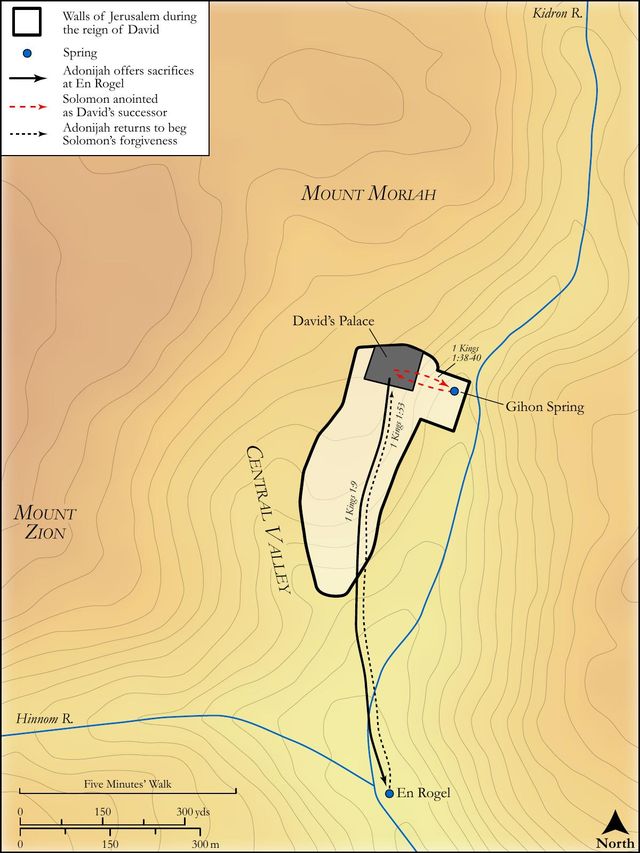
Because he was old, and confined to his bed, he thought no notice was to be taken of him, and therefore exalted himself, and said, I will be king, Kg1 1:5. Children that are indulged learn to be proud and ambitious, which is the ruin of a great many young people. The way to keep them humble is to keep them under. Observe Adonijah's insolence. 1. He looked upon the days of mourning for his father to be at hand, and therefore he prepared to succeed him, though he knew that by the designation both of God and David Solomon was to be the man; for public notice had been given of it by David himself, and the succession settled, as it were by act of parliament, in pursuance of God's appointment, Ch1 22:9; Ch1 23:1. This entail Adonijah attempted by force to cut off, in contempt both of God and his father. Thus is the kingdom of Christ opposed, and there are those that say, "We will not have him to reign over us." 2. He looked upon his father as superannuated and good for nothing, and therefore he entered immediately upon the possession of the throne. He cannot wait till his father's head be laid low, but it must now be said, Adonijah reigns (Kg1 1:18), and, God save king Adonijah, Kg1 1:25. His father is not fit to govern, for he is old and past ruling, nor Solomon, for he is young, and not yet able to rule; and therefore Adonijah will take the government upon him. It argues a very base and wicked mind for children to insult over their parents because of the infirmities of their age. 3. In pursuance of this ambitious project, (1.) He got a great retinue (Kg1 1:5), chariots and horsemen, both for state and strength, to wait on him, and to fight for him. (2.) He made great interest with no less than Joab, the general of the army, and Abiathar the high priest, Kg1 1:7. That he should make his court to those who by their influence in church and camp were capable of doing him great service is not strange; but we may well wonder by what arts they could be drawn to follow him and help him. They were old men, who had been faithful to David in the most difficult and troublesome of his times, men of sense and experience, who, one would think, would not easily be wheedled. They could not propose any advantage to themselves by supporting Adonijah, for they were both at the top of their preferment and stood fast in it. They could not be ignorant of the entail of the crown upon Solomon, which it was not in their power to cut off, and therefore it was their interest to oblige him. But God, in this matter, left them to themselves, perhaps to correct them for some former misconduct with a scourge of their own making. We are told (Kg1 1:8) who those were that were of such approved fidelity to David that Adonijah had not the confidence so much as to propose his project to them - Zadok, Benaiah, and Nathan. A man that has given proofs of his resolute adherence to that which is good shall not be asked to do a bad thing. (3.) He prepared a great entertainment (Kg1 1:9) at En-rogel, not far from Jerusalem; his guests were the king's sons, and the king's servants, whom he feasted and caressed to bring them over to his party; but Solomon was not invited, either because he despised him or because he despaired of him, Kg1 1:10. Such as serve their own belly, and will be in the interest of those that will feast them what side soever they are of, are an easy prey to seducers, Rom 16:18. Some think that Adonijah slew these sheep and oxen, even fat ones, for sacrifice, and that it was a religious feast he made, beginning his usurpation with a show of devotion, as Absalom under the colour of a vow (Sa2 15:7), which he might do the more plausibly when he had the high priest himself on his side. It is a pity that any occasion should ever be given to say, In nomine Domini incipit omne malam - In the name of the Lord begins all evil, and that all religious exercises should be made to patronise all religious practices.
Continue studying 1 Kings 1:7 across the web’s major study libraries — every link below opens this exact verse, chapter, or book on the destination site.
Read & Compare
 BibleGatewayThis verse in more than 200 translations and 70 languages.
 Bible.comThe YouVersion reader — hundreds of translations, reading plans, and highlights.
 ESV.orgCrossway's official English Standard Version reader.
 NET BibleThe NET translation with 60,000+ translators' notes on every rendering decision.
 STEP BibleTyndale House's free study tool — original text, vocabulary, and scholarly resources.
 BibliaLogos Bible Software's free web reader.
 USCCBThe New American Bible (Revised Edition) with the U.S. bishops' study notes.
Commentaries
 BibleHub CommentariesDozens of classic commentaries on this verse, gathered on one page.
 StudyLightMore than 100 commentary sets — the largest collection on the web.
 BibleRefPlain-English commentary on what this verse means, verse by verse.
 Enduring WordDavid Guzik's free commentary on this chapter, widely used by Bible teachers.
 Bible Study ToolsVerse commentary alongside Greek and Hebrew study aids.
Original Language & Research
- BibleHub InterlinearThe verse word by word — original language, transliteration, and English.
- BibleHub LexiconEvery word's original-language definition and Strong's entry.
 Blue Letter BibleDeep-study tools — Strong's numbers, concordance, and word studies.
 SefariaThe Hebrew text with Rashi and centuries of Jewish commentary.
Sermons, Hymns & Audio


TrulyRandomVerse is not affiliated with these sites and doesn’t control their content. They’re linked because they’re genuinely useful.
Summary
First Kings 1:7 details Adonijah's calculated move to secure his claim to the throne by enlisting the support of two of King David's most influential figures: Joab, the commander of the army, and Abiathar, a prominent priest. This strategic alliance provided Adonijah's premature and unauthorized bid for kingship with both formidable military backing and crucial religious legitimacy, thereby initiating a significant succession crisis within the Davidic monarchy as David's reign drew to a close.
Context
ShowHideLiterary Context
This verse is a critical turning point in the opening chapter of 1 Kings, immediately following the description of King David's advanced age and physical decline, which created a perceived power vacuum and opportunity for succession (1 Kings 1:1-4). Adonijah, David's fourth son, capitalizes on this by exalting himself as king, complete with royal pomp and circumstance, as narrated in 1 Kings 1:5-6. Verse 7 then reveals the key conspirators who joined his cause, setting up a dramatic contrast with the loyalists—Zadok, Benaiah, Nathan, Shimei, Rei, and David's mighty men—who did not side with Adonijah, as explicitly stated in 1 Kings 1:8. The formation of this powerful alliance underscores the immediate threat Adonijah posed and directly precipitates the urgent intervention of Nathan the prophet and Bathsheba on behalf of Solomon, which unfolds in the subsequent narrative (1 Kings 1:11-31).
Historical & Cultural Context
The historical backdrop for this succession struggle is the customary practice among the kings of that day, where the transfer of power, especially upon the death or incapacitation of a king, was often a volatile and contested affair. David's advanced age, highlighted in 1 Kings 1:1, signaled an impending transition, and Adonijah, as the eldest surviving son after the deaths of Amnon and Absalom, likely felt a traditional claim to the throne. Joab, David's long-serving and often independently acting military commander, possessed immense power and influence over the army, having a history of decisive, even ruthless, actions to secure his own position or what he perceived as the kingdom's best interests, as seen in his killing of Absalom (2 Samuel 18:14) and Amasa (2 Samuel 20:10). Abiathar, a descendant of Eli and a loyal priest to David since the days of Saul (1 Samuel 22:20-23), held significant religious authority. His defection was particularly impactful, as it lent a veneer of divine approval to Adonijah's coup. The alignment of these two pillars of power—military and religious—indicates a well-planned and formidable, though ultimately unsuccessful, attempt to seize the throne.
Key Themes
ShowHideThis verse powerfully contributes to several overarching themes within 1 Kings and the broader Deuteronomistic History. Firstly, it vividly illustrates the struggle for succession and the inherent dangers of an unclear or contested transfer of power within a monarchy. Adonijah's actions directly challenge David's prior, divinely-inspired promise that Solomon would be king (1 Kings 1:17). Secondly, it underscores the profound influence of key figures and the critical role of loyalty or disloyalty in court politics. The allegiance of powerful military and religious leaders like Joab and Abiathar could indeed make or break a claim to the throne, and their decision to side with Adonijah reflects a profound misjudgment of God's sovereign plan, which had already designated Solomon as David's successor (1 Chronicles 22:9-10). Lastly, the verse introduces the pervasive theme of divine sovereignty versus human ambition, as Adonijah's self-appointed kingship stands in stark contrast to God's ultimate control over the Davidic line and His chosen heir.
Exposition and Analysis
ShowHideKey Word Analysis
ShowHideThis word (H1697), derived from the root meaning "to speak," is used here in a context that implies more than a casual conversation. While dâbâr typically refers to a "word" or "matter," its use in the Hiphil stem (implied by "conferred") suggests a deliberate, intensive, or causative action of speaking or arranging. It denotes a serious consultation, a negotiation, or even a conspiratorial discussion aimed at forging an alliance and strategizing. Adonijah was not merely informing Joab and Abiathar; he was actively engaging them in a strategic planning session, seeking their counsel and securing their commitment to his cause. This highlights the intentional and calculated nature of his usurpation attempt.
This term (H310) literally refers to "the hind part" or "after," and is frequently used as an adverb or conjunction meaning "after," "behind," or "following." In this context, it signifies active adherence and commitment to Adonijah's leadership. Joab and Abiathar were not merely present; they were actively "following" him, indicating their alignment with his agenda and their submission to his self-proclaimed authority. This denotes a deliberate choice to align themselves with Adonijah's cause, becoming his adherents and supporters.
This term (H5826) is a primitive root meaning "to surround, i.e., protect or aid." In this context, it signifies active participation and direct assistance to Adonijah's bid for the throne. Joab and Abiathar were not passive observers; they were active participants, lending their considerable authority, influence, and resources to Adonijah's rebellion. Their "help" was a tangible endorsement and a commitment of their respective spheres of power—military and religious—to Adonijah's cause, indicating practical support in his endeavors.
Verse Breakdown
ShowHide"And he conferred with Joab the son of Zeruiah"
This clause immediately establishes Adonijah's critical strategic move: securing the backing of Joab, King David's long-standing, powerful, and often ruthless army commander. Joab's support was indispensable, as he commanded the loyalty of the military and possessed the practical means to enforce a claim to the throne. The phrase "conferred with" emphasizes the deliberate and conspiratorial nature of this alliance, indicating a mutual understanding and agreement.
"and with Abiathar the priest"
Adonijah further solidified his position by gaining the support of Abiathar, one of the two chief priests alongside Zadok. Abiathar's involvement was profoundly significant because it lent religious legitimacy and a semblance of divine sanction to Adonijah's claim, which could potentially sway public opinion and the religious establishment. This alliance demonstrates Adonijah's astute understanding of the dual pillars of power in ancient Israel: military might and religious authority.
"and they following Adonijah helped [him]."
This concluding phrase confirms the active participation and allegiance of both Joab and Abiathar. They were not merely consulted; they became active adherents and direct supporters of Adonijah's self-proclaimed kingship. The term "following" suggests a commitment to his leadership and a shared purpose, while "helped" indicates their direct involvement in the practical aspects of his usurpation, such as organizing the lavish feast and gathering supporters mentioned in 1 Kings 1:9.
Literary Devices
ShowHideThe verse effectively employs several literary devices to convey its profound meaning and significance. Characterization is immediately evident, as the choices of Joab and Abiathar to align with Adonijah reveal their shifting loyalties, perhaps driven by ambition, a desire for continued influence, or a miscalculation of the political landscape. This action sharply defines their characters as pragmatic rather than purely loyal. Foreshadowing is also powerfully present; the formation of such a formidable alliance of powerful figures immediately signals the gravity of the succession crisis and the potential for severe civil strife, setting the stage for the dramatic and urgent events that unfold in the remainder of the chapter. Furthermore, there is an implicit juxtaposition with the loyalists mentioned in 1 Kings 1:8 (Zadok, Benaiah, Nathan, etc.), which highlights the deep divisions and divided loyalties within David's court and underscores the stark contrast between those who respected David's will and God's apparent plan, and those who pursued their own self-serving interests.
Theological and Thematic Connections
ShowHideThis verse highlights the enduring tension between human ambition and divine sovereignty, a recurring and central theme throughout the biblical narrative. Adonijah, along with Joab and Abiathar, sought to establish a king through human means, political maneuvering, and military might, seemingly ignoring or disregarding any divine appointment or David's prior promises concerning Solomon. Their actions reflect a common human tendency to seize power and control, rather than patiently waiting for God's timing and plan to unfold. Ultimately, their meticulously planned scheme failed, demonstrating unequivocally that God's sovereign purposes cannot be thwarted by human conspiracies or powerful alliances. This episode serves as a powerful reminder that while humans may devise many plans in their hearts, it is the Lord's purpose that will ultimately prevail.
Reflection and Application
ShowHideThe alliance formed in 1 Kings 1:7 serves as a profound and enduring cautionary tale for believers today. It reminds us that even individuals of great influence, extensive experience, and significant spiritual standing—such as a seasoned military commander and a high priest—can be swayed by ambition, misplaced loyalties, or a desire for power that runs contrary to God's revealed will. This narrative challenges us to critically examine our own allegiances and motivations: are we aligning ourselves with human schemes, worldly power structures, or the path of least resistance, or are we committed to diligently discerning and faithfully following God's appointed path, even when it appears less advantageous, popular, or expedient? The eventual consequences faced by Joab and Abiathar underscore that choices made outside of God's will, particularly in matters of leadership and authority, carry significant and often severe repercussions. Our ultimate loyalty and trust must always be directed toward God and His divine purposes, confidently trusting in His sovereignty to establish true and righteous leadership in every sphere of life.
Questions for Reflection
ShowHideFAQ
ShowHideWhy did Joab and Abiathar, who had been loyal to David for so long, choose to side with Adonijah?
ShowHideJoab and Abiathar's decision to support Adonijah is complex and likely stemmed from a confluence of personal and political factors. For Joab, David's long-serving and often pragmatic military commander, it may have been a calculated move to secure his own continued influence and position. As David aged, Joab might have perceived Adonijah, the eldest surviving son, as the natural and most viable successor, ensuring his own future in the new administration. He may have felt overlooked or threatened by David's perceived favoritism toward Solomon, or perhaps he simply misread the political landscape and God's true intentions. For Abiathar, his motivations are less clear, but it's plausible he felt his priestly lineage (from Eli's house) was being overlooked in favor of Zadok (from Aaron's line, Eleazar's branch), who also served as a high priest. Siding with Adonijah could have been an attempt to secure or reassert his own family's preeminence within the religious establishment. Both men, despite their long and loyal history with David, ultimately chose to align with a perceived rising power, demonstrating a failure to discern or accept God's will for the succession, which had already designated Solomon (1 Chronicles 22:9-10).
Christ-Centered Fulfillment
ShowHideThe narrative of Adonijah's self-exaltation and the misguided allegiance of Joab and Abiathar finds profound Christ-centered fulfillment in the stark contrast between human ambition and divine appointment. Adonijah sought the throne through self-proclamation, political maneuvering, and the gathering of powerful human supporters to legitimize his claim. This stands in stark opposition to the true King, Jesus Christ, who did not grasp for power or self-exalt Himself, but rather "emptied himself, by taking the form of a servant, being born in the likeness of men" (Philippians 2:7). His kingship is not earned through human conspiracy, military might, or popular acclamation, but is divinely ordained and eternally established by God the Father (Psalm 2:6-7, Hebrews 1:8). Unlike Joab and Abiathar, who chose to follow a self-appointed king destined for failure, believers are called to pledge their ultimate and unwavering loyalty to Jesus, the Lamb of God, who was slain and by His blood "purchased people for God from every tribe and language and people and nation, and you have made them a kingdom and priests to our God, and they shall reign on the earth" (Revelation 5:9-10). His authority is not temporary or contested, but is "all authority in heaven and on earth" (Matthew 28:18), and His reign is eternal, bringing true justice, peace, and righteousness, a stark and glorious contrast to the turbulent and self-serving ambitions of Adonijah and his co-conspirators.