


1 Kings 1:6
Bible text: King James Version (1769 Blayney text) · Public domain
Bible text: King James Version with Strong's numbers · Public domain
Bible text: Berean Standard Bible · Public domain
Bible text: American Standard Version (1901) · Public domain
Bible text: World English Bible, Messianic edition · Public domain
Bible text: Geneva Bible (1599) · Public domain
Bible text: Young's Literal Translation · Public domain
- וְלֹאve·lo'and notH3808Conj-w ¦ NegParticle Negativeוְandלֹאnot
- עֲצָבוֹa·tza·Vohe had rebuked himH6087V-Qal-Perf-3ms ¦ 3msVerb Qal Perfect 3rd Singular Masculineעֲצָבhe had rebukedוֹhim
- אָבִיו'a·Vivhis fatherH1N-msc ¦ 3msNoun Singular Masculine Constructאָבִיfatherוhis
- מִיָּמָיוmi·ya·Mavfrom his daysH3117Prep-m ¦ N-mpc ¦ 3msNoun Plural Masculine Constructמִfromיָּמָיdaysוhis
- לֵאמֹרle·Mor<to> sayingH559Prep-l ¦ V-Qal-InfVerb Qal Infinitive Constructלֵ<to>אמֹרsaying
- מַדּוּעַma·Du·a'why?H4069InterrogParticle Interrogative
- כָּכָהKa·khahthusH3602AdvAdverb
- עָשִׂיתָ'a·Si·tahave you doneH6213V-Qal-Perf-2msVerb Qal Perfect 2nd Singular Masculine
- וְגַםve·gamand alsoH1571Conj-w ¦ AdvAdverbוְandגַםalso
- הוּאhu'heH1931Pro-3msPronoun Personal 3rd Singular Masculine
- טוֹבtov[was] good ofH2896Adj-mscAdjective Singular Masculine Construct
- תֹּאַרto·'arappearanceH8389N-msNoun Singular Masculine Absolute
- מְאֹדme·'OdveryH3966Adj-msAdjective Numerical Singular Masculine Absolute
- וְאֹתוֹve·'o·Toand <obj.> himH853Conj-w ¦ DirObjM ¦ 3msParticle Object Indicatorוְandאֹת<obj.>וֹhim
- יָלְדָהYal·dahsomeone boreH3205V-Qal-Perf-3fsVerb Qal Perfect 3rd Singular Feminine
- אַחֲרֵי'a·cha·ReiafterH310Adj-mpcAdjective Numerical Plural Masculine Construct
- אַבְשָׁלוֹם'av·sha·LomAbsalomH53N-proper-mNoun Proper Masculine
English is a literal word-by-word gloss of the Hebrew, not the KJV's wording. Why?
This is the original text the KJV's translators worked from — each Hebrew word with its own literal English meaning in this verse, prepared by scholars at Tyndale House, Cambridge. The KJV translates whole sentences, not word by word, so its wording differs: one Hebrew word can become several English words, and the KJV may choose “the LORD” where the gloss reads “Yahweh”. Both are faithful — they answer different questions. For the KJV's own rendering, switch to the KJV text.
Details
See on the biblical-era maps

Study this verse
Public-domain commentary
Matthew Henry
From his Commentary on the Whole Bible. Henry comments on passages, not single verses — this entry covers 1 Kings 1:5–10.
David had much affliction in his children. Amnon and Absalom had both been his grief; the one his first-born, the other his third, Sa2 3:2, Sa2 3:3. His second, whom he had by Abigail, we will suppose he had comfort in; his fourth was Adonijah (Sa2 3:4); he was one of those that were born in Hebron; we have heard nothing of him till now, and here we are told that he was a comely person, and that he was next in age, and (as it proved) next in temper to Absalom, Kg1 1:6. And, further, that in his father's eyes he had been a jewel, but was now a thorn.
I.His father had made a fondling of him, Kg1 1:6.
He had not displeased him at any time. It is not said that he never displeased his father; it is probably that he had done so frequently, and his father was secretly troubled at his misconduct and lamented it before God. But his father had not displeased him, by crossing him in his humours, denying him any thing he had a mind to, or by calling him to an account as to what he had done and where he had been, or by keeping him to his book or his business, or reproving him for what he saw or heard of that he did amiss; he never said to him, Why hast thou done so? because he saw it was uneasy to him, and he could not bear it without fretting. It was the son's fault that he was displeased at reproof and took it for affront, whereby he lost the benefit of it; and it was the father's fault that, because he saw it displeased him, he did not reprove him; and now he justly smarted for indulging him. Those who honour their sons more than God, as those do who keep them not under good discipline, thereby forfeit the honour they might expect from their sons.
II.He, in return, made a fool of his father.
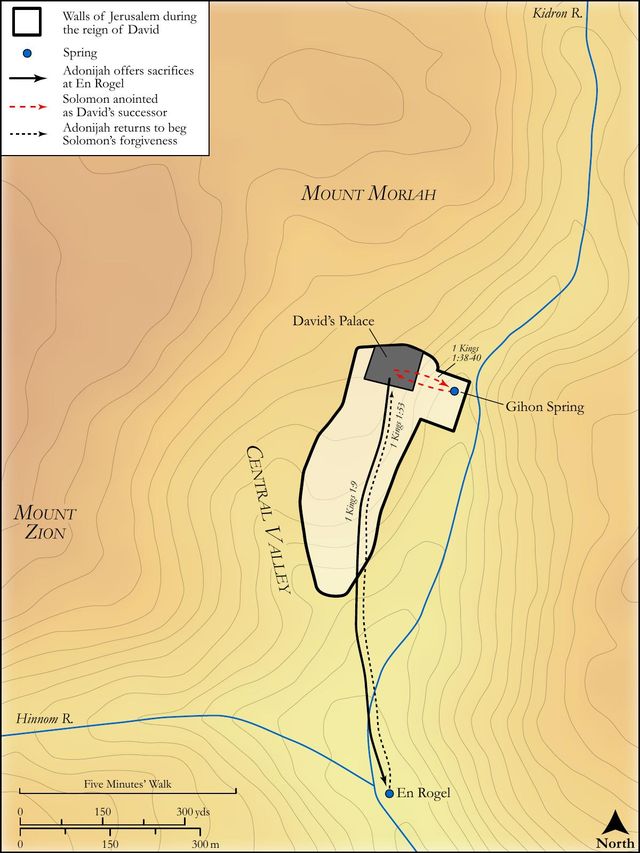
Because he was old, and confined to his bed, he thought no notice was to be taken of him, and therefore exalted himself, and said, I will be king, Kg1 1:5. Children that are indulged learn to be proud and ambitious, which is the ruin of a great many young people. The way to keep them humble is to keep them under. Observe Adonijah's insolence. 1. He looked upon the days of mourning for his father to be at hand, and therefore he prepared to succeed him, though he knew that by the designation both of God and David Solomon was to be the man; for public notice had been given of it by David himself, and the succession settled, as it were by act of parliament, in pursuance of God's appointment, Ch1 22:9; Ch1 23:1. This entail Adonijah attempted by force to cut off, in contempt both of God and his father. Thus is the kingdom of Christ opposed, and there are those that say, "We will not have him to reign over us." 2. He looked upon his father as superannuated and good for nothing, and therefore he entered immediately upon the possession of the throne. He cannot wait till his father's head be laid low, but it must now be said, Adonijah reigns (Kg1 1:18), and, God save king Adonijah, Kg1 1:25. His father is not fit to govern, for he is old and past ruling, nor Solomon, for he is young, and not yet able to rule; and therefore Adonijah will take the government upon him. It argues a very base and wicked mind for children to insult over their parents because of the infirmities of their age. 3. In pursuance of this ambitious project, (1.) He got a great retinue (Kg1 1:5), chariots and horsemen, both for state and strength, to wait on him, and to fight for him. (2.) He made great interest with no less than Joab, the general of the army, and Abiathar the high priest, Kg1 1:7. That he should make his court to those who by their influence in church and camp were capable of doing him great service is not strange; but we may well wonder by what arts they could be drawn to follow him and help him. They were old men, who had been faithful to David in the most difficult and troublesome of his times, men of sense and experience, who, one would think, would not easily be wheedled. They could not propose any advantage to themselves by supporting Adonijah, for they were both at the top of their preferment and stood fast in it. They could not be ignorant of the entail of the crown upon Solomon, which it was not in their power to cut off, and therefore it was their interest to oblige him. But God, in this matter, left them to themselves, perhaps to correct them for some former misconduct with a scourge of their own making. We are told (Kg1 1:8) who those were that were of such approved fidelity to David that Adonijah had not the confidence so much as to propose his project to them - Zadok, Benaiah, and Nathan. A man that has given proofs of his resolute adherence to that which is good shall not be asked to do a bad thing. (3.) He prepared a great entertainment (Kg1 1:9) at En-rogel, not far from Jerusalem; his guests were the king's sons, and the king's servants, whom he feasted and caressed to bring them over to his party; but Solomon was not invited, either because he despised him or because he despaired of him, Kg1 1:10. Such as serve their own belly, and will be in the interest of those that will feast them what side soever they are of, are an easy prey to seducers, Rom 16:18. Some think that Adonijah slew these sheep and oxen, even fat ones, for sacrifice, and that it was a religious feast he made, beginning his usurpation with a show of devotion, as Absalom under the colour of a vow (Sa2 15:7), which he might do the more plausibly when he had the high priest himself on his side. It is a pity that any occasion should ever be given to say, In nomine Domini incipit omne malam - In the name of the Lord begins all evil, and that all religious exercises should be made to patronise all religious practices.
Continue studying 1 Kings 1:6 across the web’s major study libraries — every link below opens this exact verse, chapter, or book on the destination site.
Read & Compare
 BibleGatewayThis verse in more than 200 translations and 70 languages.
 Bible.comThe YouVersion reader — hundreds of translations, reading plans, and highlights.
 ESV.orgCrossway's official English Standard Version reader.
 NET BibleThe NET translation with 60,000+ translators' notes on every rendering decision.
 STEP BibleTyndale House's free study tool — original text, vocabulary, and scholarly resources.
 BibliaLogos Bible Software's free web reader.
 USCCBThe New American Bible (Revised Edition) with the U.S. bishops' study notes.
Commentaries
 BibleHub CommentariesDozens of classic commentaries on this verse, gathered on one page.
 StudyLightMore than 100 commentary sets — the largest collection on the web.
 BibleRefPlain-English commentary on what this verse means, verse by verse.
 Enduring WordDavid Guzik's free commentary on this chapter, widely used by Bible teachers.
 Bible Study ToolsVerse commentary alongside Greek and Hebrew study aids.
Original Language & Research
- BibleHub InterlinearThe verse word by word — original language, transliteration, and English.
- BibleHub LexiconEvery word's original-language definition and Strong's entry.
 Blue Letter BibleDeep-study tools — Strong's numbers, concordance, and word studies.
 SefariaThe Hebrew text with Rashi and centuries of Jewish commentary.
Sermons, Hymns & Audio


TrulyRandomVerse is not affiliated with these sites and doesn’t control their content. They’re linked because they’re genuinely useful.
Summary
1 Kings 1:6 offers a critical glimpse into the character of Adonijah, King David's fourth son, and the dysfunctional family dynamics that enabled his audacious attempt to seize the throne as his aging father lay dying. The verse highlights David's chronic failure to discipline his children, allowing Adonijah's ambition to flourish unchecked. It also notes Adonijah's striking physical attractiveness and his position as the eldest surviving son after Absalom, factors that contributed to his self-exaltation and claim to the kingship. This combination of parental indulgence, personal charisma, and perceived birthright set the stage for a dramatic succession crisis in the Davidic dynasty.
Context
ShowHideLiterary Context
This verse stands within the climactic final chapter of David's reign, which follows a description of the king's extreme old age and physical frailty (1 Kings 1:1-4). The narrative quickly shifts from David's physical decline to the looming question of succession. Adonijah's self-exaltation in 1 Kings 1:5, directly preceding this verse, sets the stage for his presumptuous actions. Verse 6 then provides the crucial background for why Adonijah felt emboldened to act, revealing David's long-standing pattern of parental permissiveness. This sets up the dramatic conflict that unfolds throughout the chapter, involving Nathan the prophet, Bathsheba, and ultimately, God's divine appointment of Solomon as the rightful heir, contrasting sharply with Adonijah's human ambition. The entire chapter functions as a bridge from David's reign to Solomon's, emphasizing the divine hand in the transfer of power despite human machinations.
Historical & Cultural Context
Among the kings of that day, succession was often a volatile issue, especially when the reigning king was incapacitated or near death. While primogeniture (the right of the firstborn son to inherit) was a common practice, it was not absolute, particularly in Israel where divine appointment often superseded human custom, as seen with Saul, David, and later Solomon. The king's physical health was also a significant factor; a weak king could invite challenges to his authority. Furthermore, physical appearance, as described for Adonijah ("very goodly man"), was often perceived as an indicator of divine favor and leadership potential, a trait also noted in figures like King Saul and Adonijah's brother, Absalom, whose beauty was unparalleled in Israel, as recorded in 2 Samuel 14:25. David's failure to discipline his children, as highlighted here, was a recurring problem in his household, contributing to earlier tragedies like Amnon's sin and Absalom's rebellion, detailed in 2 Samuel 13 and 2 Samuel 15.
Key Themes
ShowHideThis verse powerfully contributes to several overarching themes within 1 Kings and the broader Deuteronomistic History. The most prominent is the consequences of parental failure and unchecked ambition. David's inability to confront his children's wrongdoing, a pattern tragically repeated from Absalom's rebellion, directly fosters an environment where Adonijah's self-exaltation can flourish, leading to instability in the kingdom. This highlights the importance of wise and firm leadership, not just in governance but within the family unit. Another key theme is the contrast between outward appearance and inner character. Adonijah's physical attractiveness, reminiscent of his brother Absalom, stands in stark contrast to his presumptuous and self-serving actions, which disregard God's known will for the succession. This sets up the tension between human schemes and divine sovereignty, as Adonijah's attempt to seize power directly challenges God's predetermined plan for Solomon to inherit the throne, as promised in 1 Chronicles 22:9-10. The narrative underscores that God's purposes will ultimately prevail, regardless of human ambition or familial failures.
Exposition and Analysis
ShowHideKey Word Analysis
ShowHideThis primitive root means "to carve, i.e. fabricate or fashion; hence (in a bad sense) to worry, pain or anger." In this context, it signifies David's complete lack of corrective action or even verbal disapproval towards Adonijah. It's not merely that David didn't punish him, but that he never even expressed concern or asked "Why hast thou done so?" This reveals a profound parental negligence, a failure to engage with, challenge, or guide his son's behavior, allowing Adonijah's self-will to grow without any external check.
This word denotes "vehemence," implying "wholly, speedily, etc." It functions as an intensive or superlative, meaning "exceedingly" or "greatly." When combined with "goodly," it emphasizes the extreme degree of Adonijah's physical attractiveness, highlighting that he was exceptionally handsome.
This word means "good (as an adjective) in the widest sense," and can refer to moral goodness, but here, especially when combined with "very" and the implied "appearance" (H8389, tôʼar), it unequivocally refers to physical attractiveness. This description is significant because, in Israel and among the nations round about, physical beauty was often associated with favor, strength, and leadership qualities. It suggests Adonijah possessed a charisma that likely contributed to his ability to gather a following, echoing the description of his brother Absalom's striking appearance.
Verse Breakdown
ShowHide"And his father had not displeased him at any time in saying, Why hast thou done so?"
This clause reveals David's profound failure as a father to Adonijah. The phrase "at any time" emphasizes the consistent and long-standing nature of David's permissiveness. He never confronted Adonijah's behavior, never questioned his motives, and never imposed any form of discipline or even verbal correction. This negligence stands in stark contrast to the expectations of a father in ancient Israelite society and highlights a recurring weakness in David's character concerning his children, which had previously led to tragic consequences with Amnon and Absalom.
"and he also [was a] very goodly [man];"
This part describes Adonijah's physical attractiveness. The KJV's bracketed words clarify the meaning, indicating that Adonijah was exceptionally handsome. This detail is not merely descriptive but serves a narrative purpose, suggesting that Adonijah's charisma and outward appeal were factors in his ability to attract followers and assert his claim to the throne. It implicitly draws a parallel to Absalom, who also used his charm and appearance to gain popular support for his rebellion.
"and [his mother] bare him after Absalom."
This final clause establishes Adonijah's birth order. He was the fourth son born to David (after Amnon, Chileab, and Absalom) and, crucially, the eldest surviving son after the deaths of Amnon and Absalom. This fact, in a society that valued primogeniture, would have given Adonijah a strong, albeit not absolute, claim to the throne in the absence of a clear divine designation. It explains why he felt entitled to the succession and why he was able to gather support from key figures in David's court.
Literary Devices
ShowHideThe verse employs several significant literary devices. Juxtaposition is prominent, contrasting David's parental negligence with Adonijah's bold ambition, and Adonijah's outward "goodliness" with the implied moral deficiency of his actions. This creates a tension between appearance and reality. Foreshadowing is also at play, as David's past failure to discipline his sons (seen with Absalom) now directly leads to another succession crisis, hinting at the turmoil that will follow. The repeated pattern of David's leniency points to a deeper character flaw that continues to plague his household. Furthermore, the description of Adonijah serves as a form of Characterization, providing direct insight into his physical attributes and the context for his self-exaltation. The narrative subtly uses these details to explain Adonijah's perceived legitimacy and the ease with which he gathered support, while simultaneously preparing the reader for the inevitable conflict with God's chosen successor.
Theological and Thematic Connections
ShowHide1 Kings 1:6 serves as a profound commentary on the far-reaching consequences of parental neglect and the deceptive nature of outward appearances. David's failure to discipline Adonijah, a pattern seen throughout his family life, underscores the biblical principle that unchecked sin and ambition will inevitably lead to chaos and sorrow. This verse highlights the tension between human will and divine purpose: Adonijah's self-appointed kingship stands in direct opposition to God's preordained plan for Solomon. The narrative implicitly critiques a leadership that prioritizes personal comfort or avoids difficult confrontations, demonstrating how such a stance can undermine the very fabric of family and kingdom. Ultimately, despite human failings and ambitious schemes, the passage affirms God's sovereignty in establishing His chosen king.
Reflection and Application
ShowHideThis verse offers timeless lessons for parents, leaders, and individuals alike. For parents, it serves as a stark warning about the dangers of unchecked indulgence. Loving discipline, which includes both correction and affirmation, is essential for shaping character and preparing children for responsible adulthood. David's failure reminds us that avoiding confrontation, though seemingly easier in the short term, can lead to far greater heartache and disruption later. For leaders, it underscores the necessity of addressing issues promptly and decisively, whether in a family, church, or organization. Allowing problems to fester due to a desire to "not displease" can undermine authority and create an environment ripe for rebellion. Finally, for all believers, Adonijah's story cautions against being swayed by superficial qualities like physical attractiveness or charisma. True leadership and character are rooted in humility, obedience to God's will, and a willingness to serve, not self-exaltation. We are called to look beyond the outward appearance and discern the heart, trusting that God's plan will always prevail over human ambition.
Questions for Reflection
ShowHideFAQ
ShowHideWhy was David so lenient with Adonijah, and how did this impact his family?
ShowHideDavid's leniency with Adonijah, stated as "his father had not displeased him at any time in saying, Why hast thou done so?", reflects a recurring pattern of parental failure in David's life. This weakness was also evident in his handling of Amnon's sin and Absalom's rebellion, where a lack of firm intervention allowed serious issues to escalate. This permissiveness stemmed from a combination of factors, possibly including David's own emotional struggles, the complexities of his large polygamous family, and perhaps a reluctance to confront his children after his own moral failures (e.g., the Bathsheba affair). The impact was devastating: it fostered a sense of entitlement and unbridled ambition in his sons, leading to internal strife, rebellion, and a chaotic succession crisis that threatened the stability of the kingdom and brought immense sorrow to David himself.
What was the significance of Adonijah's physical appearance?
ShowHideAdonijah is described as "a very goodly man," meaning exceptionally handsome or attractive. In Israel and among the nations round about, physical beauty was often seen as a sign of divine favor, strength, and suitability for leadership. This trait was also noted in King Saul, who was described as outstanding among the sons of Israel in 1 Samuel 9:2, and, more directly, in Adonijah's brother Absalom, who was renowned for his beauty, as recorded in 2 Samuel 14:25. Adonijah's good looks likely contributed to his charisma and ability to gather a significant following, including powerful figures like Joab and Abiathar, as mentioned in 1 Kings 1:7. However, the narrative subtly contrasts this outward appeal with his inner character, which was driven by self-exaltation and a disregard for God's divine plan for the succession, ultimately demonstrating that true worth and leadership are not determined by physical attributes but by character and divine appointment.
Christ-Centered Fulfillment
ShowHide1 Kings 1:6, with its depiction of Adonijah's self-exaltation enabled by David's parental indulgence, finds its profound Christ-centered fulfillment in the stark contrast between human ambition and divine humility, and between a flawed earthly father and the perfect Heavenly Father. Adonijah, seeking to seize a throne not rightfully his by divine decree, represents the fallen human tendency to grasp for power and glory, a stark opposite to the character of Christ. Jesus, though truly the King of Kings and Lord of Lords, did not come to be served but to serve, and to give his life as a ransom for many, as He Himself declared in Matthew 20:28. Unlike Adonijah, who was "a very goodly man" in outward appearance but corrupt in ambition, Jesus is the truly "goodly man" whose beauty is perfect holiness and righteousness, reflecting the very image of God, as affirmed in Colossians 1:15. Furthermore, David's failure to discipline his son highlights the need for a perfect Father, one who always acts in love and truth. God the Father perfectly disciplines those He loves, as stated in Hebrews 12:6, not out of neglect but out of a desire for their sanctification. The ultimate fulfillment lies in Jesus Christ, the one true King, whose reign is established not by human schemes or physical appearance, but by divine appointment and humble obedience, culminating in His exaltation above all names, as described in Philippians 2:8-11. He is the true heir of David's throne, whose kingdom is not of this world, yet is eternal and righteous, as He told Pilate in John 18:36.