


2 Samuel 14:25
Bible text: King James Version (1769 Blayney text) · Public domain
Bible text: King James Version with Strong's numbers · Public domain
Bible text: Berean Standard Bible · Public domain
Bible text: American Standard Version (1901) · Public domain
Bible text: World English Bible, Messianic edition · Public domain
Bible text: Geneva Bible (1599) · Public domain
Bible text: Young's Literal Translation · Public domain
- וּכְאַבְשָׁלוֹםu·khe·'av·sha·Lomand like AbsalomH53Conj-w ¦ Prep-k ¦ N-proper-mNoun Proper MasculineוּandכְlikeאַבְשָׁלוֹםAbsalom
- לֹאlo'notH3808NegParticle Negative
- הָיָהha·Yahhe wasH1961V-Qal-Perf-3msVerb Qal Perfect 3rd Singular Masculine
- אִישׁ'isha manH376N-msNoun Singular Masculine Absolute
- יָפֶהya·PehhandsomeH3303Adj-msAdjective Singular Masculine Absolute
- בְּכָלbe·kholin allH3605Prep-b ¦ N-mscNoun Singular Masculine Constructבְּinכָלall
- יִשְׂרָאֵלYis·ra·'ElIsraelH3478N-properNoun Proper Location
- לְהַלֵּלle·ha·Lelto praiseH1984Prep-l ¦ V-Piel-InfVerb Piel Infinitive Constructלְtoהַלֵּלpraise
- מְאֹדme·'OdexceedinglyH3966Adj-msAdjective Numerical Singular Masculine Absolute
- מִכַּףmi·Kaffrom [the] sole ofH3709Prep-m ¦ N-fscNoun Singular Feminine Constructמִfromכַּף[the] sole of
- רַגְלוֹrag·Lohis footH7272N-fsc ¦ 3msNoun Singular Feminine Constructרַגְלfootוֹhis
- וְעַדve·'Adand toH5704Conj-w ¦ PrepPrepositionוְandעַדto
- קָדְקֳדוֹka·de·ko·Dohis scalpH6936N-msc ¦ 3msNoun Singular Masculine Constructקָדְקֳדscalpוֹhis
- לֹאlo'notH3808NegParticle Negative
- הָיָהHa·yahit wasH1961V-Qal-Perf-3msVerb Qal Perfect 3rd Singular Masculine
- בוֹvoin <the> himPrep-b ¦ 3msSuffix Personal 3rd Singular Masculineבin <the>וֹhim
- מוּםMuma blemishH3971N-msNoun Singular Masculine Absolute
English is a literal word-by-word gloss of the Hebrew, not the KJV's wording. Why?
This is the original text the KJV's translators worked from — each Hebrew word with its own literal English meaning in this verse, prepared by scholars at Tyndale House, Cambridge. The KJV translates whole sentences, not word by word, so its wording differs: one Hebrew word can become several English words, and the KJV may choose “the LORD” where the gloss reads “Yahweh”. Both are faithful — they answer different questions. For the KJV's own rendering, switch to the KJV text.
Details
See on the biblical-era maps

Study this verse
Public-domain commentary
Matthew Henry
From his Commentary on the Whole Bible. Henry comments on passages, not single verses — this entry covers 2 Samuel 14:21–27. His two-level outline is real structure in the source text, so it is rendered as structure.
Observe here, I. Orders given for the bringing back of Absalom. The errand on which the woman came to David was so agreeable, and her management of it so very ingenious and surprising, that he was brought into a peculiarly kind humour: Go (says he to Joab), bring the young man Absalom again, Sa2 14:21. He was himself inclined to favour him, yet, for the honour of his justice, he would not do it but upon intercession made for him, which may illustrate the methods of divine grace. It is true God has thought of compassion towards poor sinners, not willing that any should perish, yet he is reconciled to them through a Mediator, who intercedes with him on their behalf, and to whom he has given these orders, Go, bring them again. God was in Christ reconciling the world to himself, and he came to this land of our banishment to bring us to God. Joab, having received these orders, 1. Returns thanks to the king for doing him the honour to employ him in an affair so universally grateful, Sa2 14:22. Joab took it as a kindness to himself, and (some think) as an indication that he would never call him to an account for the murder he had been guilty of. But, if he meant so, he was mistaken, as we shall find, Kg1 2:5, Kg1 2:6. 2. Delays not to execute David's orders; he brought Absalom to Jerusalem, Sa2 14:23. I see not how David can be justified in suspending the execution of the ancient law (Gen 9:6), Whoso sheds man's blood, by man shall his blood be shed, in which a righteous magistrate ought not to acknowledge even his brethren, or know his own children. God's laws were never designed to be like cobwebs, which catch the little flies, but suffer the great ones to break through. God justly made Absalom, whom his foolish pity spared, a scourge to him. But, though he allowed him to return to his own house, he forbade him the court, and would not see him himself, Sa2 14:24. He put him under this interdict, (1.) For his own honour, that he might not seem to countenance so great a criminal, nor to forgive him too easily. (2.) For Absalom's greater humiliation. Perhaps he had heard something of his conduct when Joab went to fetch him, which gave him too much reason to think that he was not truly penitent; he therefore put him under this mark of his displeasure, that he might be awakened to a sight of his sin and to sorrow for it, and might make his peace with God, upon the first notice of which, no doubt, David would be forward to receive him again into his favour.
II.Occasion taken hence to give an account of Absalom.
Nothing is said of his wisdom and piety. Though he was the son of such a devout father, we read nothing of his devotion. Parents cannot give grace to their children, though they give them ever so good an education. All that is here said of him is,
1.That he was a very handsome man; there was not his equal in all Israel for beauty, (Sa2 14:25), a poor commendation for a man that had nothing else in him valuable. Handsome are those that handsome do. Many a polluted deformed soul dwells in a fair and comely body; witness Absalom's, that was polluted with blood, and deformed with unnatural disaffection to his father and prince. In his body there was no blemish, but in his mind nothing but wounds and bruises. Perhaps his comeliness was one reason why his father was so fond of him and protected him from justice. Those have reason to fear affliction in their children who are better pleased with their beauty than with their virtue.
2.That he had a very fine head of hair. Whether it was the length, or colour, or extraordinary softness of it, something there was which made it very valuable and very much an ornament to him, Sa2 14:26. This notice is taken of his hair, not as the hair of a Nazarite (he was far from that strictness), but as the hair of a beau. He let it grow till it was a burden to him, and was heavy on him, nor would he cut it as long as ever he could bear it; as pride feels no cold, so it feels no heat, and that which feeds and gratifies it is not complained of, though very uneasy. When he did poll it at certain times, for ostentation he had it weighed, that it might be seen how much it excelled other men's, and it weighed 200 shekels, which some reckon to be three pounds and two ounces of our weight; and with the oil and powder, especially if powdered (as Josephus says the fashion then was) with gold-dust, bishop Patrick thinks it is not at all incredible that it should weigh so much. This fine hair proved his halter, Sa2 18:9.
3.That his family began to be built up. It is probable that it was a good while before he had a child; and then it was that, despairing of having one, he set up that pillar which is mentioned Sa2 18:18, to bear up his name; but afterwards he had three sons and one daughter, Sa2 14:27. Or perhaps these sons, while he was hatching his rebellion, were all cut off by the righteous hand of God, and thereupon he set up that monument.
Continue studying 2 Samuel 14:25 across the web’s major study libraries — every link below opens this exact verse, chapter, or book on the destination site.
Read & Compare
 BibleGatewayThis verse in more than 200 translations and 70 languages.
 Bible.comThe YouVersion reader — hundreds of translations, reading plans, and highlights.
 ESV.orgCrossway's official English Standard Version reader.
 NET BibleThe NET translation with 60,000+ translators' notes on every rendering decision.
 STEP BibleTyndale House's free study tool — original text, vocabulary, and scholarly resources.
 BibliaLogos Bible Software's free web reader.
 USCCBThe New American Bible (Revised Edition) with the U.S. bishops' study notes.
Commentaries
 BibleHub CommentariesDozens of classic commentaries on this verse, gathered on one page.
 StudyLightMore than 100 commentary sets — the largest collection on the web.
 BibleRefPlain-English commentary on what this verse means, verse by verse.
 Enduring WordDavid Guzik's free commentary on this chapter, widely used by Bible teachers.
 Bible Study ToolsVerse commentary alongside Greek and Hebrew study aids.
Original Language & Research
- BibleHub InterlinearThe verse word by word — original language, transliteration, and English.
- BibleHub LexiconEvery word's original-language definition and Strong's entry.
 Blue Letter BibleDeep-study tools — Strong's numbers, concordance, and word studies.
 SefariaThe Hebrew text with Rashi and centuries of Jewish commentary.
Sermons, Hymns & Audio


TrulyRandomVerse is not affiliated with these sites and doesn’t control their content. They’re linked because they’re genuinely useful.
Summary
Second Samuel 14:25 offers a striking and poignant description of Absalom, King David's third son, emphasizing his unparalleled physical beauty throughout all of Israel. This verse highlights his flawless appearance, from the sole of his foot to the crown of his head, portraying him as a figure of exceptional outward perfection. Positioned within the narrative just after his return from exile and before his full reconciliation with David, this vivid portrayal serves to underscore his inherent charisma and burgeoning prominence, subtly foreshadowing the magnetic appeal he would later wield over the people of Israel, which tragically fueled his rebellion against his father.
Context
ShowHideLiterary Context
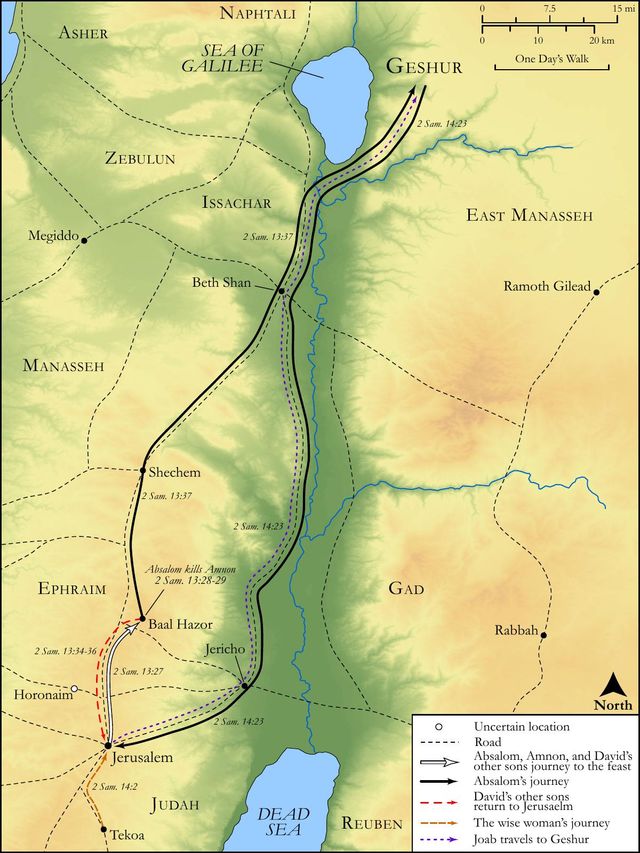
This verse is strategically placed immediately following Absalom's return to Jerusalem from Geshur, where he had fled after murdering his half-brother Amnon. Joab, David's military commander, masterminded Absalom's return through the artful intervention of the wise woman of Tekoa. Despite his return, David initially refused to see his son, confining him to his own house for two full years, as noted in 2 Samuel 14:24. The detailed description of Absalom's extraordinary beauty here functions as a narrative interlude, introducing the audience to a figure who, despite his past transgressions and current isolation, possesses an undeniable physical allure. This vivid physical portrayal sets the stage for his subsequent actions, particularly his calculated and manipulative efforts to win the hearts of the people, which are meticulously detailed in 2 Samuel 15:1-6. It firmly establishes his public persona and the natural advantage his appearance would afford him in his burgeoning political ambitions.
Historical & Cultural Context
In Israel, physical perfection was often deeply intertwined with perceptions of divine favor, inherent strength, and suitability for leadership, as with Saul, of whom it is written, "there was not among the children of Israel a goodlier person than he." Kings, warriors, and even sacrificial animals were ideally without blemish, symbolizing wholeness, purity, and divine approval. While this verse is not a direct theological statement about Absalom's moral character, the emphasis on his "no blemish" status would have profoundly resonated with an audience that highly valued physical integrity and external signs of blessing. For a royal figure like Absalom, such a description would significantly enhance his perceived legitimacy, charisma, and public appeal among the populace. Furthermore, the broader narrative of David's family is frequently marred by internal conflict, moral failings, and tragic consequences. Absalom's striking beauty stands in stark, almost jarring, contrast to the moral ugliness of the events surrounding his family, such as Amnon's heinous rape of Tamar, Absalom's full sister, as recounted in 2 Samuel 13, and Absalom's subsequent vengeful murder of Amnon in 2 Samuel 13:28-29.
Key Themes
ShowHideThe primary theme powerfully highlighted by this verse is the allure and ultimately deceptive nature of outward appearance. Absalom's unparalleled beauty is presented as his most prominent attribute, contributing significantly to his fame and widespread recognition throughout Israel. However, the overarching narrative of 2 Samuel consistently juxtaposes this external perfection with his deeply flawed, treacherous, and morally corrupt internal character. His physical charisma, rather than being a sign of virtue, becomes a potent tool for manipulation, enabling him to "steal the hearts of the men of Israel" as explicitly stated in 2 Samuel 15:6. This creates a profound thematic tension between appearance and reality, echoing the timeless divine principle articulated in 1 Samuel 16:7 that "the Lord sees not as man sees: man looks on the outward appearance, but the Lord looks on the heart." The verse also contributes to the developing theme of Absalom's rising prominence and dangerous ambition, portraying him as a figure destined for a significant, albeit tragic and destructive, role in the unfolding drama of David's kingdom.
Exposition and Analysis
ShowHideKey Word Analysis
ShowHideThis primitive root, H1984, encompasses a range of meanings including "to be clear," "to shine," "to make a show," "to boast," "to celebrate," and "to commend." In the context of 2 Samuel 14:25, it signifies a high degree of public admiration, renown, and widespread acclaim. It suggests that Absalom's beauty was not merely acknowledged but actively celebrated and spoken of throughout the entire nation, implying a near-celebrity status attributed to his physical appearance.
Derived from H3303, this adjective describes something as beautiful, handsome, or fair, applicable literally or figuratively. When applied to a person, as it is here, it denotes exceptional physical attractiveness. Its usage in conjunction with the superlative phrase "none to be so much praised" emphatically underscores the extraordinary, unmatched, and universally acknowledged nature of Absalom's good looks, setting him apart from all other Israelites.
This noun, H3971, refers to a physical defect, flaw, or imperfection. It is notably used in the Levitical law to describe the stringent physical requirements for sacrificial animals or priests, which had to be "without blemish" (e.g., Leviticus 22:21) to be acceptable for sacred service or offering to God. Its application to Absalom in this secular context powerfully conveys the idea of his absolute physical perfection and wholeness, from head to toe, reinforcing the superlative nature of his beauty and implying a completeness that is outwardly ideal.
Verse Breakdown
ShowHide"But in all Israel there was none to be so much praised as Absalom for his beauty"
This opening clause immediately establishes Absalom's unique and superlative status. It employs a hyperbolic comparison, asserting that no individual in the entire nation commanded as much admiration, renown, or public acclaim specifically for their physical attractiveness as he did. This sets a remarkably high standard for his outward appearance, indicating that his beauty was not merely notable but legendary, widely recognized, and a source of national commendation.
"from the sole of his foot even to the crown of his head"
This phrase is a powerful merism, a literary device where two contrasting parts (the lowest and highest points) are used to represent the entirety or totality of something. In this instance, it emphasizes the comprehensive and absolute nature of Absalom's physical perfection. It conveys that every single part of his body, from the very bottom to the very top, was meticulously crafted and without flaw, leaving no room for any imperfection or defect.
"there was no blemish in him"
This concluding clause explicitly states the direct consequence and ultimate confirmation of the previous phrase. It unequivocally affirms that Absalom's beauty was not merely superficial or localized but was characterized by an absolute and complete lack of any physical defect, imperfection, or mar. This reinforces the idea of his utter physical flawlessness, making his external appearance truly exceptional, unmatched, and outwardly perfect in every conceivable way.
Literary Devices
ShowHideThe verse masterfully employs several literary devices to enhance its impact and convey deeper meaning. Hyperbole is strikingly evident in the declaration that "in all Israel there was none to be so much praised as Absalom for his beauty," which exaggerates his attractiveness to an unparalleled degree, emphasizing his truly exceptional and unique physical nature. The phrase "from the sole of his foot even to the crown of his head" is a classic example of Merism, a rhetorical device where two contrasting or extreme parts are used to represent a complete whole, effectively conveying the idea of comprehensive and total physical perfection. Furthermore, the entire description is imbued with profound Irony. While Absalom is depicted as outwardly flawless and physically perfect, the subsequent narrative in 2 Samuel reveals a character riddled with deep moral blemishes, deceit, treacherous ambition, and ultimately, a destructive rebellion. His external beauty stands in stark, tragic contrast to his internal corruption, creating a powerful and poignant irony that underscores the timeless biblical theme of the deceptive nature of outward appearances and the critical importance of inner character over superficial charm.
Theological and Thematic Connections
ShowHideThis verse, while seemingly a straightforward physical description, carries profound theological weight by establishing a critical contrast between outward appearance and inner character. The Bible consistently warns against judging solely by what is seen, emphasizing that true value, righteousness, and spiritual substance reside in the heart and are revealed through one's actions. Absalom's unparalleled physical perfection, described as "without blemish," ironically and tragically foreshadows his deeply flawed moral character and destructive ambition. His captivating beauty becomes a potent tool for his self-serving agenda, enabling him to manipulate and captivate the populace, ultimately leading him to usurp his father's throne and culminating in his own tragic demise. This serves as a powerful and enduring reminder that God's assessment of individuals fundamentally differs from human judgment, consistently prioritizing integrity, humility, and obedience over fleeting superficial charm, physical attractiveness, or popular acclaim. The narrative implicitly critiques a culture that might be easily swayed by outward grandeur rather than discerning true spiritual and moral substance.
Reflection and Application
ShowHideThe striking depiction of Absalom's extraordinary beauty in 2 Samuel 14:25 serves as a profound invitation for us to critically examine our own values, perceptions, and the criteria by which we assess others and ourselves. In a contemporary world often captivated by outward appearances, meticulously curated social media personas, and superficial charisma, Absalom's story stands as a potent and timeless cautionary tale. His physical perfection, far from being an indicator of moral uprightness, spiritual favor, or true leadership, tragically masked a heart consumed by unchecked ambition, deceit, disloyalty, and a willingness to betray his own father. This verse challenges us to look beyond the surface, to cultivate discernment, and to prioritize and value integrity, character, and spiritual depth above fleeting external attractiveness, popular acclaim, or transient worldly status. It compels us to honestly ask whether our own pursuits, admirations, and judgments are genuinely directed towards what is truly eternal, righteous, and substantive, or if we, like many in ancient Israel, are susceptible to being swayed by impressive but ultimately hollow exteriors. True beauty, from a biblical perspective, is profoundly rooted in a transformed heart that authentically reflects God's character and His divine attributes.
Questions for Reflection
ShowHideFAQ
ShowHideWhy does the Bible spend so much time describing Absalom's physical appearance?
ShowHideThe detailed description of Absalom's physical appearance in 2 Samuel 14:25 is far from a mere aesthetic observation; it serves a crucial narrative and profound theological purpose within the biblical text. It powerfully highlights his extraordinary charisma and magnetic appeal, which are absolutely essential for the reader to comprehend his uncanny ability to "steal the hearts of the men of Israel" (2 Samuel 15:6) and to successfully mount a significant rebellion against his father, King David. While the Bible often uses physical descriptions to characterize individuals, in Absalom's case, his outward perfection stands in stark, deliberate contrast to his inner corruption, treacherous actions, and moral depravity. This stark juxtaposition underscores a key biblical theme: that outward appearance can be profoundly deceptive, and true character is ultimately revealed by one's heart, motives, and deeds, not by physical beauty or superficial charm. It meticulously sets up a powerful and tragic irony, demonstrating that his flawless exterior masked a deeply flawed, destructive, and ultimately self-serving interior.
Christ-Centered Fulfillment
ShowHideAbsalom's story, particularly the striking emphasis on his unparalleled physical beauty contrasted with his profound inner corruption and tragic end, serves as a poignant and powerful foil to the person and work of Jesus Christ. Absalom was outwardly flawless, described as "without blemish" in his physical form, yet his heart was consumed by pride, self-serving ambition, and treacherous deceit, leading directly to rebellion, civil war, and his own ignominious death. He sought to seize a kingdom through manipulation, violence, and the subversion of authority, ultimately failing to establish any lasting reign. In stark contrast, Jesus, the true and eternal Son of David, was not described in the Gospels as possessing remarkable physical beauty; indeed, the prophet Isaiah foretold of the Suffering Servant who would have "no form or majesty that we should look at him, and no beauty that we should desire him" (Isaiah 53:2). Yet, unlike Absalom, Christ was truly "without blemish" in His character, His spirit, and His actions, utterly pure and sinless in every respect (Hebrews 4:15). He did not come to steal hearts through human charisma or outward show, but to humble Himself, taking the very form of a servant (Philippians 2:7), and to lay down His perfect life as the unblemished Lamb of God, whose sacrifice alone takes away the sin of the world (John 1:29). Absalom's outward perfection led directly to his downfall and destruction, but Christ's inner perfection, demonstrated through His sacrificial love, unwavering obedience, and redemptive suffering, secured an eternal kingdom and true, abundant life for all who believe, profoundly proving that true kingship and ultimate authority are founded not on human charisma or outward splendor, but on divine righteousness, self-giving love, and perfect holiness.