


2 Samuel 14:26
Bible text: King James Version (1769 Blayney text) · Public domain
Bible text: King James Version with Strong's numbers · Public domain
Bible text: Berean Standard Bible · Public domain
Bible text: American Standard Version (1901) · Public domain
Bible text: World English Bible, Messianic edition · Public domain
Bible text: Geneva Bible (1599) · Public domain
Bible text: Young's Literal Translation · Public domain
- וּבְגַלְּחוֹu·ve·ga·le·Choand when he shavedH1548Conj-w ¦ Prep-b ¦ V-Piel-Inf ¦ 3msVerb Piel Infinitive Constructוּandבְwhenגַלְּחshavedוֹhe
- אֶת'et<obj.>H853DirObjMParticle Object Indicator
- רֹאשׁוֹro·Shohis headH7218N-msc ¦ 3msNoun Singular Masculine Constructרֹאשׁheadוֹhis
- וְהָיָהVe·ha·yahand it wasH1961Conj-w ¦ V-Qal-ConsecPerf-3msVerb Qal Consecutive Perfect 3rd Singular Masculineוְandהָיָהit was
- מִקֵּץmi·Ketzfrom [the] end ofH7093Prep-m ¦ N-mscNoun Singular Masculine Constructמִfromקֵּץ[the] end of
- יָמִיםya·MimdaysH3117N-mpNoun Plural Masculine Absolute
- לַיָּמִיםlai·ya·Mimto the daysH3117Prep-l ¦ N-mpNoun Plural Masculine Absoluteלַto theיָּמִיםdays
- אֲשֶׁר'a·SherwhenH834RelParticle Relative
- יְגַלֵּחַye·ga·Le·achhe shavedH1548V-Piel-Imperf-3msVerb Piel Imperfect 3rd Singular Masculine
- כִּיkiforH3588PrtParticle Conditional
- כָבֵדkha·Ved[it was] heavyH3515Adj-msAdjective Singular Masculine Absolute
- עָלָיו'a·Lavon himH5921Prep ¦ 3msPreposition Definiteעָלָיonוhim
- וְגִלְּחוֹve·gi·le·Choand he shaved itH1548Conj-w ¦ V-Piel-ConsecPerf-3ms ¦ 3msVerb Piel Consecutive Perfect 3rd Singular Masculineוְandגִלְּחhe shavedוֹit
- וְשָׁקַלve·sha·Kaland he weighedH8254Conj-w ¦ V-Qal-ConsecPerf-3msVerb Qal Consecutive Perfect 3rd Singular Masculineוְandשָׁקַלhe weighed
- אֶת'et<obj.>H853DirObjMParticle Object Indicator
- שְׂעַרse·'Ar[the] hair ofH8181N-mscNoun Singular Masculine Construct
- רֹאשׁוֹro·Shohis headH7218N-msc ¦ 3msNoun Singular Masculine Constructרֹאשׁheadוֹhis
- מָאתַיִםma·Ta·yimtwo hundredH3967N-fdNoun Dual Feminine Absolute
- שְׁקָלִיםshe·ka·LimshekelsH8255N-mpNoun Plural Masculine Absolute
- בְּאֶבֶןbe·'E·venby [the] weight ofH68Prep-b ¦ N-fscNoun Singular Feminine Constructבְּbyאֶבֶן[the] weight of
- הַמֶּלֶךְha·Me·lekhthe kingH4428Art ¦ N-msNoun Singular Masculine Absoluteהַtheמֶּלֶךְking
English is a literal word-by-word gloss of the Hebrew, not the KJV's wording. Why?
This is the original text the KJV's translators worked from — each Hebrew word with its own literal English meaning in this verse, prepared by scholars at Tyndale House, Cambridge. The KJV translates whole sentences, not word by word, so its wording differs: one Hebrew word can become several English words, and the KJV may choose “the LORD” where the gloss reads “Yahweh”. Both are faithful — they answer different questions. For the KJV's own rendering, switch to the KJV text.
Details
See on the biblical-era maps
Study this verse
Public-domain commentary
Matthew Henry
From his Commentary on the Whole Bible. Henry comments on passages, not single verses — this entry covers 2 Samuel 14:21–27. His two-level outline is real structure in the source text, so it is rendered as structure.
Observe here, I. Orders given for the bringing back of Absalom. The errand on which the woman came to David was so agreeable, and her management of it so very ingenious and surprising, that he was brought into a peculiarly kind humour: Go (says he to Joab), bring the young man Absalom again, Sa2 14:21. He was himself inclined to favour him, yet, for the honour of his justice, he would not do it but upon intercession made for him, which may illustrate the methods of divine grace. It is true God has thought of compassion towards poor sinners, not willing that any should perish, yet he is reconciled to them through a Mediator, who intercedes with him on their behalf, and to whom he has given these orders, Go, bring them again. God was in Christ reconciling the world to himself, and he came to this land of our banishment to bring us to God. Joab, having received these orders, 1. Returns thanks to the king for doing him the honour to employ him in an affair so universally grateful, Sa2 14:22. Joab took it as a kindness to himself, and (some think) as an indication that he would never call him to an account for the murder he had been guilty of. But, if he meant so, he was mistaken, as we shall find, Kg1 2:5, Kg1 2:6. 2. Delays not to execute David's orders; he brought Absalom to Jerusalem, Sa2 14:23. I see not how David can be justified in suspending the execution of the ancient law (Gen 9:6), Whoso sheds man's blood, by man shall his blood be shed, in which a righteous magistrate ought not to acknowledge even his brethren, or know his own children. God's laws were never designed to be like cobwebs, which catch the little flies, but suffer the great ones to break through. God justly made Absalom, whom his foolish pity spared, a scourge to him. But, though he allowed him to return to his own house, he forbade him the court, and would not see him himself, Sa2 14:24. He put him under this interdict, (1.) For his own honour, that he might not seem to countenance so great a criminal, nor to forgive him too easily. (2.) For Absalom's greater humiliation. Perhaps he had heard something of his conduct when Joab went to fetch him, which gave him too much reason to think that he was not truly penitent; he therefore put him under this mark of his displeasure, that he might be awakened to a sight of his sin and to sorrow for it, and might make his peace with God, upon the first notice of which, no doubt, David would be forward to receive him again into his favour.
II.Occasion taken hence to give an account of Absalom.
Nothing is said of his wisdom and piety. Though he was the son of such a devout father, we read nothing of his devotion. Parents cannot give grace to their children, though they give them ever so good an education. All that is here said of him is,
1.That he was a very handsome man; there was not his equal in all Israel for beauty, (Sa2 14:25), a poor commendation for a man that had nothing else in him valuable. Handsome are those that handsome do. Many a polluted deformed soul dwells in a fair and comely body; witness Absalom's, that was polluted with blood, and deformed with unnatural disaffection to his father and prince. In his body there was no blemish, but in his mind nothing but wounds and bruises. Perhaps his comeliness was one reason why his father was so fond of him and protected him from justice. Those have reason to fear affliction in their children who are better pleased with their beauty than with their virtue.
2.That he had a very fine head of hair. Whether it was the length, or colour, or extraordinary softness of it, something there was which made it very valuable and very much an ornament to him, Sa2 14:26. This notice is taken of his hair, not as the hair of a Nazarite (he was far from that strictness), but as the hair of a beau. He let it grow till it was a burden to him, and was heavy on him, nor would he cut it as long as ever he could bear it; as pride feels no cold, so it feels no heat, and that which feeds and gratifies it is not complained of, though very uneasy. When he did poll it at certain times, for ostentation he had it weighed, that it might be seen how much it excelled other men's, and it weighed 200 shekels, which some reckon to be three pounds and two ounces of our weight; and with the oil and powder, especially if powdered (as Josephus says the fashion then was) with gold-dust, bishop Patrick thinks it is not at all incredible that it should weigh so much. This fine hair proved his halter, Sa2 18:9.
3.That his family began to be built up. It is probable that it was a good while before he had a child; and then it was that, despairing of having one, he set up that pillar which is mentioned Sa2 18:18, to bear up his name; but afterwards he had three sons and one daughter, Sa2 14:27. Or perhaps these sons, while he was hatching his rebellion, were all cut off by the righteous hand of God, and thereupon he set up that monument.
Continue studying 2 Samuel 14:26 across the web’s major study libraries — every link below opens this exact verse, chapter, or book on the destination site.
Read & Compare
 BibleGatewayThis verse in more than 200 translations and 70 languages.
 Bible.comThe YouVersion reader — hundreds of translations, reading plans, and highlights.
 ESV.orgCrossway's official English Standard Version reader.
 NET BibleThe NET translation with 60,000+ translators' notes on every rendering decision.
 STEP BibleTyndale House's free study tool — original text, vocabulary, and scholarly resources.
 BibliaLogos Bible Software's free web reader.
 USCCBThe New American Bible (Revised Edition) with the U.S. bishops' study notes.
Commentaries
 BibleHub CommentariesDozens of classic commentaries on this verse, gathered on one page.
 StudyLightMore than 100 commentary sets — the largest collection on the web.
 BibleRefPlain-English commentary on what this verse means, verse by verse.
 Enduring WordDavid Guzik's free commentary on this chapter, widely used by Bible teachers.
 Bible Study ToolsVerse commentary alongside Greek and Hebrew study aids.
Original Language & Research
- BibleHub InterlinearThe verse word by word — original language, transliteration, and English.
- BibleHub LexiconEvery word's original-language definition and Strong's entry.
 Blue Letter BibleDeep-study tools — Strong's numbers, concordance, and word studies.
 SefariaThe Hebrew text with Rashi and centuries of Jewish commentary.
Sermons, Hymns & Audio


TrulyRandomVerse is not affiliated with these sites and doesn’t control their content. They’re linked because they’re genuinely useful.
Summary
This verse provides an exceptionally precise and seemingly unusual detail about Absalom, King David's son, focusing on the remarkable weight of his hair. It reveals that Absalom meticulously trimmed his hair annually because of its considerable heaviness, and that the collected hair weighed an astonishing two hundred shekels according to the official "king's weight." This specific description serves to underscore Absalom's striking physical appearance, particularly his luxuriant hair, which was a significant aspect of his renowned beauty and, implicitly, his personal vanity and public persona, setting the stage for his subsequent actions.
Context
ShowHideLiterary Context
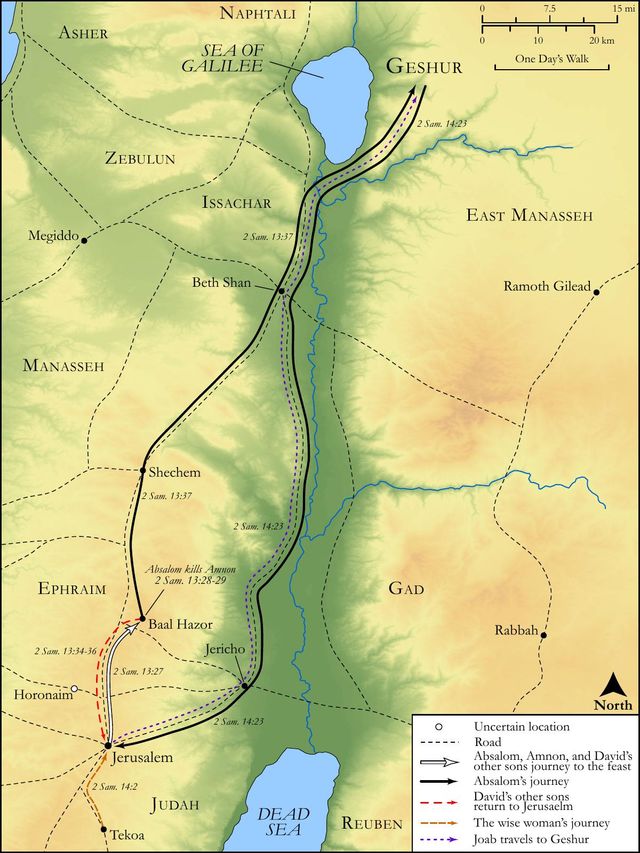
This verse is strategically placed within the narrative of Absalom's complex and strained return to Jerusalem after his three-year exile in Geshur, following his murder of his half-brother Amnon (2 Samuel 13:38). Upon his return, orchestrated by Joab, Absalom was not immediately reconciled with his father, King David, and remained in a state of semi-isolation in Jerusalem for two full years without seeing the king's face (2 Samuel 14:24). The preceding verse, 2 Samuel 14:25, offers a sweeping declaration of Absalom's unparalleled beauty, stating that "in all Israel there was none to be so much praised as Absalom for his beauty: from the sole of his foot even to the crown of his head there was no blemish in him." Verse 26 then zooms in on a specific, almost hyperbolic detail of this beauty: his hair. This meticulous emphasis on his physical perfection and extraordinary features is not merely descriptive; it subtly prepares the reader for Absalom's later actions, where he leverages his charisma and appearance to win the hearts of the people and mount a formidable rebellion against his father (2 Samuel 15:1-6).
Historical & Cultural Context
In Israel, long, abundant, and well-maintained hair for men was often a potent symbol of strength, vitality, virility, and high status. It could signify a kingly or princely presence, as well as a sign of divine favor or a Nazarite vow (though Absalom was not a Nazarite). The meticulous grooming implied by the yearly polling and weighing of Absalom's hair suggests a significant cultural emphasis on personal appearance, especially for those of royal lineage whose public image was paramount. The phrase "king's weight" (אֶבֶן הַמֶּלֶךְ, 'even hammelekh) refers to an official, standardized system of weights maintained by the royal court. This standard was crucial for ensuring consistency, fairness, and preventing fraud in commercial transactions. Its application here, though not for commerce, underscores the importance and perhaps even the public interest in this detail about Absalom, a prince whose physical attributes were clearly a subject of note and official record. The practice of cutting hair annually due to its weight highlights not only its extraordinary volume but also the practical challenges of managing such prodigious growth, further emphasizing Absalom's unique and almost legendary physical characteristic.
Key Themes
ShowHideThis verse powerfully contributes to several crucial themes within the broader narrative of 2 Samuel. Firstly, it reinforces the theme of Absalom's vanity and pride. The extraordinary detail given to his hair, its remarkable weight, and the annual ritual of polling points to a man highly concerned with his outward appearance and public image. This superficiality stands in stark contrast to the internal qualities of character, humility, and integrity that are often valued in biblical leadership, particularly in the lineage of David. Secondly, it highlights the theme of physical appearance as a tool for influence and manipulation. Absalom's unparalleled beauty, including his remarkable hair, is presented as a key asset that he later exploits to gain popular support and undermine David's legitimate reign (2 Samuel 15:6). This serves as a subtle foreshadowing that external charm can mask internal corruption or dangerous ambition. Finally, it touches upon the pervasive biblical theme of the deceptive nature of outward splendor. While Absalom possesses unparalleled physical beauty, his actions reveal a deeply flawed character driven by resentment, ambition, and a profound lack of filial piety, ultimately leading to tragic consequences for himself and for Israel, demonstrating that true worth is found in the heart, not in external show.
Exposition and Analysis
ShowHideKey Word Analysis
ShowHideVerse Breakdown
ShowHide"And when he polled his head"
This opening clause introduces the specific and regular action Absalom undertook regarding his hair. The verb "polled" (גָּלַח, gâlach') signifies a deliberate and thorough cutting or shearing of the hair, suggesting a formal and perhaps even ritualistic act of grooming rather than a casual trim.
"(for it was at every year's end that he polled [it]:"
This parenthetical clause clarifies the precise frequency of this grooming ritual. The phrase "every year's end" indicates an annual practice, underscoring the consistent and significant growth of his hair that necessitated such regular and substantial trimming. This detail emphasizes the exceptional nature of Absalom's hair, requiring yearly management due to its rapid and voluminous growth.
"because [the hair] was heavy on him, therefore he polled it:)"
This second parenthetical clause provides the direct and practical reason for the annual polling. The hair was not merely long but "heavy" (כָּבֵד, kâbad'), causing discomfort, inconvenience, or perhaps even a hindrance due to its sheer volume and weight. This practical necessity further highlights the extraordinary abundance of his hair, making it a prominent and defining physical characteristic that required active management.
"he weighed the hair of his head at two hundred shekels after the king's weight."
This is the climactic and most striking detail of the verse, quantifying the remarkable nature of Absalom's hair. The act of weighing, and the precise measurement of "two hundred shekels," transforms a descriptive detail into an almost hyperbolic statement of his physical distinctiveness. The specific mention of "the king's weight" emphasizes the accuracy, official nature, and authoritative standard of this measurement, lending credibility to this astonishing figure and underscoring the importance placed on this aspect of Absalom's royal persona and public image.
Literary Devices
ShowHideThe verse employs several literary devices to emphasize Absalom's extraordinary physical attributes and to subtly foreshadow his character and destiny. Hyperbole is powerfully evident in the description of the hair's weight at "two hundred shekels." While presented as a precise measurement, the sheer volume implied by this weight (approximately 5 pounds of hair from a single year's growth) pushes the description into the realm of exaggeration, highlighting Absalom's almost mythical beauty and unique physical presence. This exaggeration serves to impress upon the reader the magnitude of his physical splendor and the exceptional nature of his appearance. Furthermore, the meticulous detail of the annual polling and weighing, following the general description of his unparalleled beauty in the previous verse, functions as a form of Synecdoche, where a specific, striking part (his hair) is used to represent the whole of his exceptional physical perfection and the attention he garnered. This intense focus on his outward appearance also serves as potent Foreshadowing. The emphasis on his vanity, self-absorption, and the attention paid to his physical attributes subtly hints at his character flaws – his pride, superficiality, and reliance on external charm – which will later manifest in his cunning manipulation of the people and his tragic rebellion against David. Ironically, this very hair, a symbol of his beauty and strength, becomes a direct factor in his downfall when it gets caught in an oak tree during battle, leading to his death (2 Samuel 18:9).
Theological and Thematic Connections
ShowHideThis seemingly minor detail about Absalom's hair carries profound theological weight by contributing to the pervasive biblical theme of the deceptive nature of outward appearance versus the true value of the heart and inner character. Absalom's extraordinary beauty, epitomized by his luxuriant hair, is presented not merely as a physical fact but as a source of personal pride and a powerful tool for manipulation. The meticulous description of his physical perfection stands in stark contrast to his inner character, which is revealed to be marked by ambition, deceit, resentment, and a profound lack of loyalty and integrity. This narrative detail aligns perfectly with a recurring biblical motif that warns against judging by external factors, emphasizing instead the paramount importance of internal righteousness, humility, and faithfulness. Absalom's vanity, highlighted by the meticulous attention to his hair, ultimately contributes to his downfall, serving as a powerful cautionary tale about the dangers of pride, self-glory, and relying on superficial charm rather than genuine character before God and man.
Reflection and Application
ShowHideThe detailed account of Absalom's hair invites us to deeply reflect on our own perceptions of beauty, status, and true worth in a world often captivated by outward appearance and superficial charm. This verse serves as a potent and timeless reminder that genuine value lies not in external splendor or physical attractiveness, but in the character of one's heart and the integrity of one's soul. Absalom's exceptional beauty, meticulously described and almost legendary, ultimately masked a rebellious, self-serving, and destructive spirit. This narrative challenges us to look beyond the surface, both in our assessment of others and in our own self-evaluation, and to diligently cultivate virtues like humility, integrity, genuine love, and a spirit of service, which are far more enduring and eternally significant than any fleeting physical attribute or public image. It prompts us to critically examine what we prioritize in our lives: the temporary glory of outward show and human admiration, or the eternal substance of a heart aligned with God's will and His righteous standards.
Questions for Reflection
ShowHideFAQ
ShowHideHow much is 200 shekels of hair in modern weight?
ShowHideWhile the exact weight of an ancient shekel could vary depending on the period and region, a commonly accepted estimate for the Israelite shekel is around 11.4 grams (or approximately 0.4 ounces). Therefore, 200 shekels would be approximately 2,280 grams, or about 2.28 kilograms (which is roughly 5 pounds). This is an extraordinary amount of hair to grow in a single year, far exceeding typical human hair growth rates and weights, underscoring the hyperbole used to describe Absalom's unique and almost mythical physical attribute.
Why is this seemingly trivial detail about Absalom's hair included in the biblical narrative?
ShowHideThe inclusion of this detail is far from trivial; it serves several crucial narrative and theological purposes. Firstly, it vividly reinforces and elaborates upon the description of Absalom's unparalleled beauty from the preceding verse (2 Samuel 14:25), highlighting a specific and remarkable aspect of his physical perfection that made him stand out. Secondly, it subtly but powerfully foreshadows his character, emphasizing his vanity, self-absorption, and the meticulous attention he paid to his appearance, which he later leveraged to win over the hearts of the people of Israel and orchestrate a rebellion (2 Samuel 15:6). Finally, it creates a poignant and tragic irony, as this very hair, a symbol of his pride, beauty, and strength, ultimately becomes the instrument of his demise when it gets caught in an oak tree during battle (2 Samuel 18:9).
What does "after the king's weight" mean?
ShowHide"After the king's weight" (אֶבֶן הַמֶּלֶךְ, 'even hammelekh) refers to an official and standardized system of weights maintained by the royal court. In ancient times, weights could vary significantly from region to region or even vendor to vendor, leading to potential dishonesty in trade. The "king's weight" represented the authoritative, accurate, and consistent standard, ensuring legitimacy and fairness in transactions. Its mention here signifies that the weighing of Absalom's hair was done with precision and according to the highest, most reliable standard available. This detail further emphasizes the extraordinary nature of his hair and the importance placed on this aspect of Absalom's royal persona, suggesting it was a remarkable fact that was officially measured and recorded.
Christ-Centered Fulfillment
ShowHideThe meticulous description of Absalom's physical beauty and the extraordinary weight of his hair, while a captivating detail, stands in stark and illuminating contrast to the true glory and eternal beauty revealed in Jesus Christ. Absalom's splendor was entirely external, a source of personal vanity and a tool for self-promotion and manipulation, ultimately leading to rebellion, division, and his tragic destruction. His beauty was a fleeting, earthly attribute that masked a heart full of pride, ambition, and deceit, serving as a stark reminder that "man looks on the outward appearance, but the Lord looks on the heart" (1 Samuel 16:7). In profound contrast, Jesus, though the eternal Son of God, "had no beauty or majesty to attract us to him, nothing in his appearance that we should desire him" (Isaiah 53:2). His glory was not in outward show, physical attractiveness, or the accumulation of earthly accolades, but in His perfect humility, unwavering obedience to the Father, and sacrificial love. While Absalom sought to seize a kingdom through self-exaltation and charming the people, Christ "made himself nothing by taking the very nature of a servant, being made in human likeness" (Philippians 2:7). He did not come to be served, but to serve, and to give His life as a ransom for many (Mark 10:45). The true "weight" of Christ's glory is found not in physical attributes or external displays, but in His divine character, His sinless life, His atoning death on the cross, and His triumphant resurrection, which offer eternal life, true liberation, and reconciliation with God. Our call, therefore, is not to emulate Absalom's outward show or seek self-glory, but to imitate Christ's inward beauty of spirit, which is "of great worth in God's sight" (1 Peter 3:3-4), and to find our identity and purpose in Him alone.